
Updated Checklist of Butterfly Diversity (Lepidoptera: Papilionoidea) of Qatar
Butterflies (Lepidoptera: Papilionoidea) with their vibrant colours and ecological significance serve as crucial environmental indicators. This study documents the butterfly species inhabiting the challenging hot and arid climate of Qatar. Over a threeyear period from 2019 to 2022, a total of 96 specimens representing 15 species from four families were collected using standard entomological methods, including net sweeping and baiting across eight different locales. These families include Nymphalidae (3 species), Lycaenidae (4 species), Pieridae (6 species), and Papilionoidea (2 species). Notably, four species - Papilio demodocus, Belenois aurota, Colotis phisadia, and Colotis amata - are reported from Qatar for the first time, expanding the known butterfly fauna of the country. By amalgamating these novel findings with previously published results, this study presents an updated checklist of Qatar’s butterfly fauna, totalling 24 species spanning five families. This inventory sheds light on the diversity and distribution of butterflies in Qatar, emphasizing their resilience to extreme environmental conditions and underscoring the importance of conservation efforts amidst ongoing urbanization and agricultural expansion.
Introduction
Qatar lies within the vast desert belt on the Arabian Peninsula and is characterized by an arid climate with irregular precipitation [1]. The temperature varies between an extremely hot summer (reaching up to 50°C) and cool, dry winter (around 15-25°C). Consequently, the flora and fauna of the country are limited to a small number of species that can survive these extreme conditions. The scarcity of water and food has a major impact on the faunal composition in Qatar, which includes reptiles such as lizards [2], striped hyenas, various birds, and other animals.
Butterflies (Lepidoptera: Papilionoidea) are distinguished by their scaly wings, diverse wing patterns, and diurnal habits [3]. They are excellent environmental indicators due to their sensitivity to variations in temperature and precipitation and are important pollinators [4, 5, 6]. In the desert environment of Qatar, adults are most often seen feeding on floral nectar. The following plant species are used as adult nectar sources and larval host plants [7]: Ziziphus spina-christi (L.) Willd.; Acacia tortilis (Forssk.) Hayne; Prosopis cineraria (L.) Druce; Bougainvillea glabra Choisy; Heliotropium curassavicum (L.); Tetraena qatarensis (Hadidi) Beier & Thulin; Pulicaria undulata (L.) C.A. Mey.; _Haplophyllum tuberculatum (_Forssk.)
Ad. Juss.; and Capparis spinosa var. mucronifolia Hedge & Lam. ex R.R. Stewart. In addition to resident butterflies, migratory species including Vanessa cardui and Colias croceus are periodic visitors to Qatar [8].
There is limited information available on the insect fauna of Qatar, including butterflies [9, 10, 11]. The latest publications on the butterflies of Qatar are [8, 9, 12]. This study aims to compile an updated checklist of butterfly species (Lepidoptera: Papilionoidea) from various regions in Qatar.
Material and Methods
Study Area
The geographical centre of Qatar is located at 25.3548 N, 51.1839 E, and the country is bordered by water on three sides, with Saudi Arabia to the south. This study surveyed eight Qatari municipalities, namely Doha, Al Wakrah, Al Daayen, Al Shamal, Al Rayyan, Al Khor, Al Shahaniya, and Umm Salal (Figures 1A & 1B). These locations were chosen due to their rich botanical diversity, providing suitable habitats for various insects, including butterflies.
Sample Collection
Sampling spanned three years, conducted monthly from April 2019 to April 2022. Butterfly specimens were captured using standard aerial nets and baiting technique. At each location, the sample process lasted almost three hours on every visit. Five expert researchers conducted the observations and sample collection to guarantee a complete data gathering. then carefully the samples were transported to the entomology laboratory within Qatar University’s Department of Biological and Environmental Sciences for morphological identification. Additionally, unidentified butterflies housed in the biology museum of Qatar University were incorporated into this study.
Direct Pinning
The collected butterflies were carefully placed in a killing jar with ethyl acetate. Before being spread by inserting an insect pin vertically through the thorax with ensuring their wings are properly positioned. They were then left to dry for a period of 1-2 weeks before performing morphological identification.
Identification
The morphology of each adult butterfly underwent examination utilizing a Leica M125C stereomicroscope. Specimens were identified to the species level using the keys provided by Parveen, et al. [13, 14, 15].
Specimen Preservation
The dried butterflies were carefully labelled with collection date, collector name and species name and then stored in wooden Schmidt boxes containing naphthalene for preservation.
Results
Butterfly Diversity in Qatar
Despite three years of monthly sampling in Qatar, we collected only 96 butterfly specimens of 15 species in four families: Nymphalidae (3 species); Lycaenidae (4 species); Pieridae (6 species); and Papilionoidea (2 species) (Table 1). Al-Daayen, Umm Salal, and Doha exhibited the highest family richness as they encompassed species from all four families known from the country (Figure 1A). Four of the species recorded here are newly reported from Qatar, with three of them belonging to the pierids: Belenois aurota, Colotis phisadia, and Colotis amata. Al-Daayen, Umm Salal, and Doha exhibited the highest species richness with 6 species.
| Family | Scientific name | Municipality | Collection year(s) | Refs |
|---|---|---|---|---|
| Papilionidae | Papilio demoleus Linnaeus, 1758 | Al Daayen, Umm Salal | 2019, 2020, 2022 | [1-4] |
| Papilionidae | Papilio demodocus Esper, 1799 * | Al Daayen, Doha | 2019 | [1] |
| Nymphalidae | Argynnis adippe ([Schiffermüller], | [4] | ||
| Nymphalidae | Danaus chrysippus (Linnaeus, 1758) | Doha, Umm Salal, Al Rayyan, Al Wakrah | 2019, 2020, 2022 | [1,3,4] |
| Nymphalidae | Junonia oenone (Linnaeus, 1758) | [4] | ||
| Nymphalidae | Junonia orithya (Linnaeus, 1758) | Al Khor, Al Shahanyia, Doha, Umm Salal, Al Daayen, Al Wakrah | 2019, 2020, 2022 | [1,4] |
| Nymphalidae | Limenitis reducta Staudinger, 1901 | [4] | ||
| Nymphalidae | Vanessa cardui (Linnaeus, 1758) | Doha | 2019, 2020, 2021 | [1-4] |
| Pieridae | Belenois aurota (Fabricius, 1793) * | Umm Salal, Al Shahanyia | 2019, 2020 | [1] |
| Pieridae | Colias croceus (Geoffroy, 1785) | Al Daayen | 2019 | [1-4] |
| Pieridae | Colotis amata (Fabricius, 1775) * | Al Khor | 2019, 2020 | [1] |
| Pieridae | Colotis fausta (Olivier,1804) | Umm Salal, Doha, Al Daayen | 2019, 2020 | [1,2] |
| Pieridae | Colotis phisadia (Godart, 1819) * | Doha | 2019 | [1] |
| Pieridae | Pieris rapae (Linnaeus, 1758) | Doha, Al Rayyan | [3] | |
| Pieridae | Pontia glauconome (Klug, 1829) | Umm Salal, Doha | 2019 | [1-3] |
| Lycaenidae | Azanus ubaldus (Stoll, [1782]) | Doha | 2019 | [1,2,4] |
| Lycaenidae | Chilades parrhasius (Fabricius, 1793) | Al Rayan | [2] | |
| Lycaenidae | Freyeria trochylus (Freyer, 1845) | Doha, Al Shahanyia | [2] | |
| Lycaenidae | Lampides boeticus (Linnaeus), 1767 | Al Shamal | 2019 | [1-4] |
| Lycaenidae | Tarucus balkanica (Freyer, 1844) | Umm Salal, Al Dayyen, Doha | 2019, 2020, 2022 | [1-4] |
| Lycaenidae | Tarucus rosacea (Austaut, 1885) | Al Shahanyia | [3,4] | |
| Lycaenidae | Zizeeria Karsandra (Moore, 1865) | Doha, Al Wakrah, Al Rayan; Al Shahanyia | [2] | |
| Lycaenidae | Zizeeria knysna (Trimen,1862) | Doha, Al Wakrah, Al Shamal | 2019, 2020 | [1,3] |
| Hesperidae | Spialia doris (Walker, 1870) | Umm Salal, Al Dayyen, Doha | [2] |
Table 1: Checklist of Butterfly Species Recorded from Qatar, Including Collection Information of Species Documented in this Study
*Species newly recorded from Qatar
References: 1 – This study; 2 - Pittaway, 1980; 3 - Abdu & Shaumar, 1985;4 - Pinkert et al., 2022. Table 1: Checklist of Butterfly Species Recorded from Qatar, Including Collection Information of Species Documented in this Study.
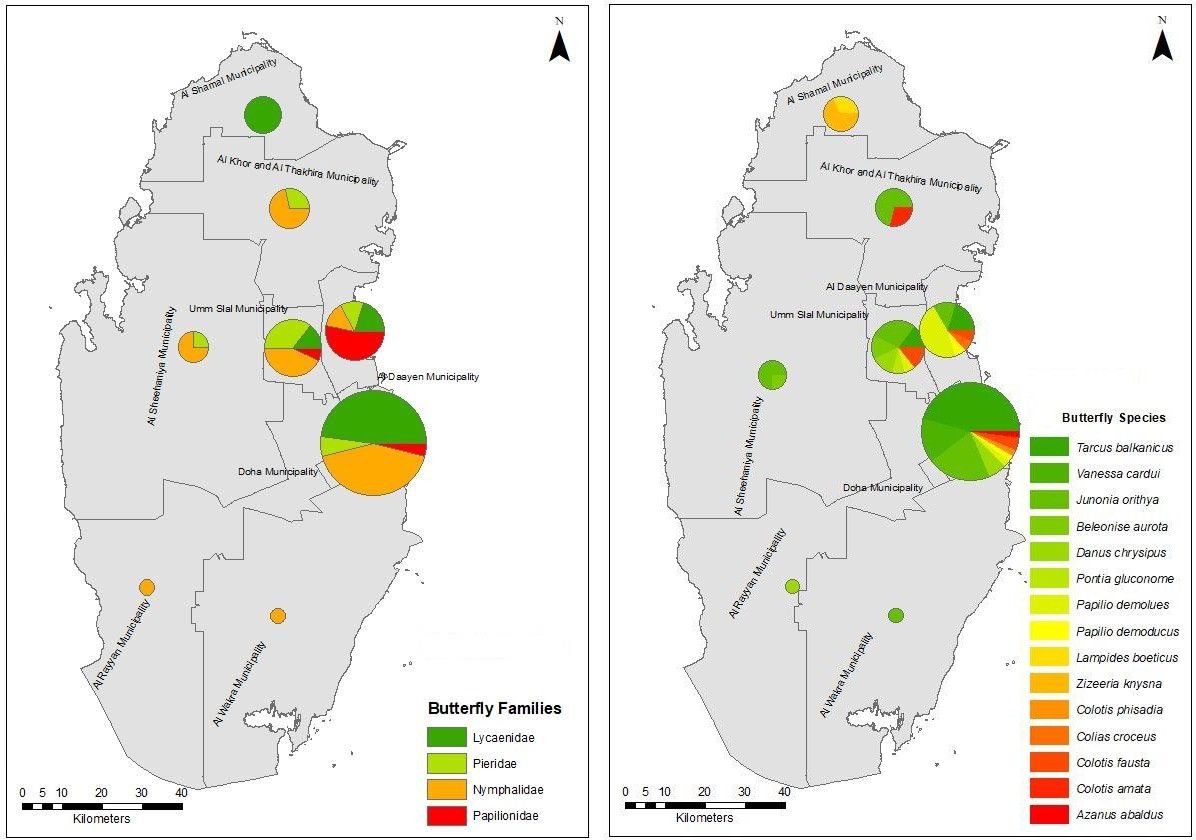
A
Family Papilionidae
Papilio demoleus Linnaeus, 1758 We collected 9 Papilio demoleus specimens from three municipalities in Qatar: Umm Salal, Al Daayen, and Al Wakrah. These specimens were collected during the months of October, November, December, January, and March. Papilio demodocus Esper, 1799 Two Papilio demodocus specimens were collected from Al Daayen and Doha municipalities during the months of June and October.
Family Nymphalidae
Danaus chrysippus (Linnaeus, 1758) Six Danaus chrysippus butterfly specimens were collected from Umm Salal, Al Rayyan, Doha, and Al Wakrah during the months of November, December, February, March, and April. Vanessa cardui (Linnaeus, 1758) Out of a total of 98 specimens, seven butterflies were identified as Vanessa cardui. All these specimens were found within the Doha municipality during the months of December, February, March, April, and July. Junonia orithya (Linnaeus, 1758) Junonia orithya was among the most common species of butterfly in Qatar. 25 specimens collected from Al Daayen, Doha, Al Khor, Al Shahaniya, Umm Salal, and Al Wakrah were identified as Junonia orithya. This species was detected during October, November, January, and June.
Family Pieridae
Pontia glauconome (Klug, 1829) Three specimens of butterfly were collected in November, March and May from Doha and Umm Salal and identified as Pontia glauconome. This species is known as the desert butterfly since it can survive in the hot and dry desert environment. Colias croceus (Geoffroy, 1785) In the Al Daayen municipality, one specimen collected during the month of September was identified as Colias croceus. Belenois aurota (Fabricius, 1793) Three specimens collected during the months of November, February, and April from Umm Salal and Al Shahaniya municipalities were identified as Belenois aurota. Colotis phisadia (Godart, 1819) Only one specimen from Doha municipality collected during December was identified as Colotis phisadia. Colotis fausta (Olivier, 1804) Five specimens collected from Umm Salal, Doha, Al Daayen and Al-Shamal municipalities were identified as Madais (Colotis) fausta. This species was found in the months of June, November, December, January, and February. • Colotis amata (Fabricius, 1775) In the Northern part of Qatar (Al Khor municipality) two specimens collected during the month of January were identified as Colotis amata.
Family Lycaenidae
Tarucus balkanica (Freyer, 1844) The most abundant butterfly species found in Qatar was Tarucus balkanica with 27 specimens. These specimens were collected from Umm Salal, Al Daayen, Al Wakrah, and Doha municipalities during the months of November, January, February, April, and May. Azanus ubaldus (Stoll, [1782]) In this study, only 1 specimen collected from Doha municipality during the month of May was identified as Azanus ubaldus. Zizeeria knysna (Trimen, 1862) Four specimens from Al-Shamal municipality collected in the months of March and October were identified as Zizeeria knysna. Lampides boeticus (Linnaeus, 1767) From the Al Shamal municipality, two specimens collected during March and April were identified as Lampides boeticus (Figure 2).
| Papilio demoleus (lime butterfly) | Danaus chrysippus (plain tiger) |
| Vanessa cardui (painted lady) | Vanessa cardui (painted lady) |
| Junonia orithya male (blue pansy) | Junonia orithya male (blue pansy) |
| Junonia orithya female (blue pansy) | Pontia glauconome (desert white) |
| Colias croceus (male clouded yellow) | Colotis phisadia (blue Spotted Arab) |
| Madais fausta (large salmon arab) | Tarucus balkanica (little tiger blue) |
| Tarucus balkanica (little tiger blue) | Danaus chrysippus (plain tiger) |
| Papilio demodocus (citrus swallowtail) | Belenois aurota (pioneer white) |
Discussion
The hot, arid climate and low precipitation of Qatar significantly influence the distribution of plants and animals in the country, including insects [9]. Previous studies have recorded 24 species of butterflies from various Municipalities in Qatar [8, 9, 12]. In the present study, a total of 15 butterfly species were identified in Qatar, including four species not previously reported from the country: Papilio demodocus, Belenois aurota, Colotis phisadia, and Colotis amata. Pinkert, et al. [12] reported 12 species in Qatar using data from gbif.org, including the North American endemic species Brephidium exilis, which is likely an error. Papilio demodocus is a large species with a dark brown appearance and circular yellow spots on its fore- and hindwings. This butterfly contributes to pollination while bringing some vibrancy to its natural environment [15]. Belenois aurota butterflies, known as the caper white, are small to medium-sized butterflies favouring warm environments, including deserts, steppes, and areas with thorny vegetation, and they feed on the blossoms of Capparis spinosa [16]. Additionally, Colotis phisadia thrives throughout the warmer months of the year, with their larvae feeding on Salvadora persica (Salvadoraceae) [17]. Colotis amata is characterized by salmon-pink-colored outer edges, with thick black borders on its forewings. These butterflies typically fly close to the ground, gather in groups for roosting, and settle in dried-out herbaceous regions to blend in [18].
Due to its hot weather and lack of water year-round [1], Qatar’s butterfly fauna is relatively species-poor in addition to the building constructions around some of the investigated sites. Junonia orithya, Danaus chrysippus, and Vanessa cardui sometimes migrate and can be found in several countries within the Arabian Peninsula, including Saudi Arabia [15], Oman [19], United Arab Emirates [20], and Qatar. Adults of these species rely on the nectar of Asystasia gangetica and Ziziphus spina-christi for nutrition. There are no endemic species or subspecies. Nevertheless, there are three primary kinds of reasons contributing to the decline of butterflies around the world that can be applied on Qatar as well such as, degradation and loss of habitat, chemical pollution, and climate change [21, 22, 23, 24, 25].
The human population of Qatar is rapidly increasing, with a 13.2% increase in 2021, leading to increased urbanization and demands for food resources. Natural and seminatural habitats are disappearing from agricultural landscapes worldwide as a result of these influences [26]. Significant efforts by the government and private sectors to increase crop production and initiate local farms may attract migrant butterfly species. In Europe, the decline of small-scale farms is associated with declines in butterfly abundance and richness [27]. In this study, most butterflies were captured from areas well known for agriculture and flowers, such as Al-Shamal Farm (Al-Shamal municipality), Baladna and Qatar University Farm (Al-Khor municipality), and Khubayb Al Reem and Al Rifaa Farm (Al-Rayan municipality). Some butterflies, such as Pieris rapae and Papilio demoleus, can consume cruciferous and Citrus crops, respectively [28, 29]. In the present study, Pieris rapae was not detected, but Papilio demoleus was found in Qatar. While expanding agriculture has been shown to attract more butterfly species in some countries, its impact on Qatar’s butterfly populations remains uncertain and may vary. On the other hand, the use of synthetic pesticides in industrial agriculture raises serious concerns since these chemicals have the ability to drastically reduce native wildlife, which in turn might negatively harm current butterfly populations. In addition, the extensive use of pesticides may produce an unattractive environment that prevents new migratory species from arriving in the region, negating the possible advantages of further agricultural growth [30, 31]. Long-term monitoring of butterfly populations in Qatar to evaluate the impacts of urbanization, agriculture, and climate change should be the focus of future study. Furthermore, focused research on recently discovered species may shed light on their ecological functions. The difficult environment in Qatar and the lack of historical data, however, might compromise the validity of the conclusions.
Conclusion
In this study, we present an updated checklist of butterfly species found in Qatar, shedding light on their diversity and distribution across the country’s diverse habitats. With a total of 15 species documented, including four newly reported species, our findings contribute to the growing understanding of Qatar’s butterfly fauna. These delicate insects, with their intricate color patterns, serve as vital environmental indicators, reflecting the unique ecological conditions of Qatar’s hot and arid climate. Our comprehensive survey spanning eight municipalities over three years provides valuable insights into the geographic distribution and abundance of butterfly families, highlighting the importance of various habitats in supporting butterfly diversity. Moving forward, the rapid urbanization and increasing demands for food resources in Qatar pose both challenges and opportunities for butterfly conservation. Efforts to expand agriculture and establish local farms may attract more butterfly species to the region, but the use of synthetic pesticides in commercial agriculture threatens existing fauna and may deter new migrants. Therefore, it is imperative to strike a balance between development and conservation to safeguard Qatar’s rich butterfly heritage for future generations.
Declaration of Competing Interest
The authors declare that they have no known competing financial interest or personal relationships that could have appeared to influence the work reported in this paper.
Acknowledgments
We thank the department of Biological and Environmental Sciences, Qatar University, for providing the needed samples found in the Biology Museum. We would like to extend our thanks to Dr. Farzin Shabani for his invaluable assistance in editing and proofreading the English of the manuscript. Also, Special thanks to Dr. Zahoor Ul-Hassan for reviewing the manuscript, Dr. Perumal Balakrishnan for providing GIS maps, our senior student; Muneera Al-Thani and to Muneera Al-Mesaifri, Ahmed Abdul-Aziz (Biology photographer) and Mr.Abdul-Ali M. K. Moghadasi for providing photos for some of butterflies.
References
-
Abdel Bary E (2018) Qatar’s Perception of Climate Change and Meeting the Challenges. Environment and Ecology Research 6(5): 479-486.
-
Cogălniceanu D, Castilla A, Valdeon A, Gosa A, Al Jaidah N, et al. (2014) A preliminary report on the distribution of lizards in Qatar. ZooKeys 373_:_ 67-91.
-
Corbet SA (2000) Butterfly nectaring flowers: Butterfly morphology and flower form. Entomologia Experimentalis et Applicata 96(3): 289-298.
-
Vickery M (2008) Butterflies as Indicators of Climate Change. Science Progress 91(2): 193-201.
-
Al-Houty W (2008) The easy encyclopedia of insects of the State of Kuwait (butterflies and moths). In: 1st (Edn.), Kuwait Foundation for the Advancement of Sciences.
-
Haroon H, Meng YF, Khan Z, Perveen F, Rafi MA, et al. (2020) Biodiversity of Butterflies in Tangi Charsadda, Khyber Pakhtunkhwa, Pakistan. Pakistan Journal of Zoology 52(3): 835-841.
-
Norton J (2009) An Illustrated checklist of the flora of Qatar. Browndown.
-
Pittaway T (1980) Butterflies (Lepidoptera) of Qatar, April-June 1979. Entomologist’s Gazette 31: 102-111.
-
Abdu RM, Shumar NF (1985) Preliminary List of the Insect Fauna of Qatar. Qatar University Science Building 5: 215-232.
-
Kardousha MM (2016) First report of some adult mosquitoes captured by CDC gravid traps from North- Eastern Qatar. Asian Pacific Journal of Tropical Disease 6(2): 100-105.
-
Alkhayat FA, Ahmad AH, Rahim J, Imran M, Sheikh UAA (2021) Distribution and diversity of aquatic insects in different water bodies of Qatar. Brazilian Journal of Biology 84: 1-10.
-
Pinkert S, Barve V, Guralnick R, Jetz W (2022) Global geographical and latitudinal variation in butterfly species richness captured through a comprehensive country‐level occurrence database. Global Ecology and Biogeography 31(5): 830-839.
-
Perveen F, Fazal F (2013) Key for identification of butterflies (Lepidoptera) of Hazara University, Garden Campus, Mansehra, Pakistan. International Journal of Agriculture Innovations and Research 1(5): 2319-1473.
-
Perveen F, Haroon (2016) A contribution key for identification of butterflies (Lepidoptera) of Tehsil Tangi, Khyber Pakhtunkhwa, Pakistan. Arthropods 5(3): 97-108.
-
Larsen TB (1984) Butterflies of Saudi Arabia and its neighbours. Transworld Arabian Library. Stacey International.
-
Ge SX, Hu SJ, Shi HL, Han FY, Li MJ, et al. (2021) The first record of the genus Belenois (Lepidoptera: Pieridae) from China. Biodiversity Data Journal 9: e61332.
-
Nazari V, Larsen TB, Lees DC, Brattström O, Bouyer T, et al. (2011) Phylogenetic systematics of Colotis and associated genera (Lepidoptera: Pieridae): evolutionary and taxonomic implications: Phylogenetic systematics of Colotis. Journal of Zoological Systematics and Evolutionary Research, 49(3): 204-215.
-
Haldhar SM, Bhargava R, Singh RS, Krishna H, Sharma SK (2015) First Report of _Colotis amata_ (Lepidoptera: Pieridae) on _Salvadora_ _persica_ (Capparales: Salvadoraceae) in Rajasthan, India: Incidence and Morphometric Analysis. Florida Entomologist 98(2): 442-445.
-
Schmidt P, Simonyi SJ, Ábrahám L, Sáfián S, Ilniczky S (2020) A faunistic contribution to the butterfly fauna of Oman (Lepidoptera: Diurna). Natura Somogyiensis 34: 153-188.
-
Feulner GR, Roobas B (2014) An unexpected resident butterfly of the United Arab Emirates - the Arabian Grizzled Skipper _Spialia_ _mangana_ (Lepidoptera: Hesperiidae). Tribulus 22: 41-44.
-
Akite P (2008) Effects of anthropogenic disturbances on the diversity and composition of the butterfly fauna of sites in the Sango Bay and Iriiri areas, Uganda: Implications for conservation. African Journal of Ecology 46(s1): 3-13.
-
Harmonis H, Saud OR (2017) Effects of habitat degradation and fragmentation on butterfly biodiversity in West Kotawaringin, Central Kalimantan, Indonesia. Biodiversitas Journal of Biological Diversity 18(2): 500- 506.
-
Hill GM, Kawahara AY, Daniels JC, Bateman CC, Scheffers BR (2021) Climate change effects on animal ecology: Butterflies and moths as a case study. Biological Reviews 96(5): 2113-2126.
-
Mulder C, Aldenberg T, De Zwart D, Van Wijnen HJ, Breure AM (2005) Evaluating the impact of pollution on plant-Lepidoptera relationships. Environmetrics 16(4): 357-373.
-
Richer R (2009) Conservation in Qatar: Impacts of Increasing Industrialization. SSRN Electronic Journal.
-
Robinson RA, Sutherland WJ (2002) Post‐war changes in arable farming and biodiversity in Great Britain. Journal of Applied Ecology 39(1): 157-176.
-
European Environment Agency (2013) The European grassland butterfly indicator: 1990-2011. Publications Office.
-
Sharifi S, Zarea N (1970) Biology of the Citrus Butterfly, Papilio demoleus demoleus (Lepidoptera: Papilionidae). Annals of the Entomological Society of America 63(5): 1211-1213.
-
El-Fakharany S, Hendawy A (2014) Field studies Cabbage White Butterfly, _Pieris rapae_ (Linnaeus) and its associated parasitoid and predatory species in Egypt. Egyptian Journal of Biological Pest Control 24(2): 437- 444.
-
Braak N, Neve R, Jones AK, Gibbs M, Breuker CJ (2018) The effects of insecticides on butterflies – A review. Environmental Pollution 242 507-518.
-
Gremm J, Barth J, Fietkiewicz KJ, Stock WG (2018) Transitioning towards a knowledge society: Qatar as a case study. Springer International Publishing.
- Mitochondrial Bio-Logistics: Steering Co-Enzyme Q10 and Lycopene Synergies within the Science 4.0 Bio-OS Framework
- Hymenoptera Specimens from the Caño Negro Wetland, of the National Museum Collection, Costa Rica
- Science 4.0: Comprehensive Architecture of the Biological Operating System (Bio-OS) A Framework for Systemic Resilience and Industrialized Bio-Governance
- Rabbit on, or Hare Back? Understanding Climate Change
- Clinical Validation of Science 4.0: Flow Steering and Epigenetic Drift Inversion on a 76-Year-Old Hybrid System
- Seeds Planted by another Mind