
Additional Data on the Distribution of Spermophilus xanthophrymnus Bennet, 1835 in the Aegean Region, in the Inner Western Anatolian Part (Afyonkarahisar)
This study reports a new locality for the Anatolian Ground Squirrel (Spermophilus xanthoprymnus Bennet, 1835). The species presence is recorded at Yenibelkavak village of Afyonkarahisar. Direct and indirect observation techniques were used in the region to find species presence and habitat characteristics. The vegetation of the area has been identified to include Astragalus sp., Papaver sp., Verbascum sp., Anthemis sp., Crataegus monogyna, Centaurea benedicta, Elytrigia repens, and Carduus marianus, alongside the agricultural crops Hordeum vulgare and Triticum aestivum located at the boundary. It was determined that the hibernation period of this species begins in October and ends in April. predators of ground squirrels were also observed as Buteo buteo, Falco tinnunculus, Athene noctua, Vulpes vulpes, domestic cats, and dogs in the field. With this research result, it was determined the Anatolian ground squirrel get stuck in these habitats and the presence of the species in habitats may disappear in the future. With this study, the presence information of the species in Yenibelkavak village of Afyonkarahisar has been added to the literature.
Introduction
The distribution of Spermophilus xanthoprymnus (Anatolian ground squirrel) is in Türkiye, Armenia, and northwestern parts of Iran. The Anatolian ground squirrel is one of three species of old-world ground squirrels native to Türkiye [1]. These native species include S. citellus Linnaeus, 1766, known as the European ground squirrel S. taurensis. However, Gündüz, Jaarola, Tez, Yeniyurt, Polly & Searle, 2007, nominated it as the Taurus ground squirrel and S. xanthoprymnus Bennett, 1835, on the other hand, commonly called the Anatolian ground squirrel. According to the ‘red list’ published by The International Union for Conservation of Nature [2], the species is under the category of Near Threatened (NT). Despite being designated for protection under the Bern Convention, this species does not receive the requisite significance in Türkiye [3]. Various academic studies draw attention to the fact that the ground squirrel species in Türkiye is in danger due to the occupation of habitat areas and that it needs to be protected [3, 4, 5].
The distribution of the species extends to the nearby central lowlands and eastern highlands of small areas in Türkiye [6]. They are also found in a few localities in southern Anatolia in both the Teke Peninsula and the Çukurova plain [7] they live in steppe areas and mountain slopes in central, eastern and northwestern Anatolia [8, 9, 10]. Anatolian ground squirrels are group-living, diurnal, hibernating, and pre-dominantly herbivorous, burrowing ground-dwelling squirrels [7, 11]. Squirrels do not nest in grain fields, sometimes preferring to live near them and eat tolerable amounts of grain [7]. There is no agricultural damage [5].
The aim of this study is to describe a new habitat location for S. xanthoprymnus in Türkiye. According to ecological conditions, sensitive habitats can be detected for this species throughout the country. Gene maps and population distribution maps should be generated to understand distribution of species. Scenarios of climate change can be produced to predict the situation of the species over time. To be able to perform all these studies, accurate comparisons should be made in terms of locality, province, region, country and world. Additionally, this should be based on population status at locations close to each other. To form the basis for these studies, the locations detected in Yenibelkavak are of great importance.
Material and Methods
Material
The study was carried out in the Yenibelkavak villages of Afyonkarahisar. Within the borders of Yenibelkavak village, the presence/absence scanning method was applied. Studies were carried out in areas where the species was identified. Two locations were identified, with the first location center coordinates 38°14’29.56”N 30°13’24.71”E, covering an area of 42,000 m² and at an elevation of 1,151 meters. The second location center is found at coordinates 38°14’37.98”N 30°13’44.67”E, covering an area of 14,500 m² and situated at an altitude of 1,156 meters (Figure 1).
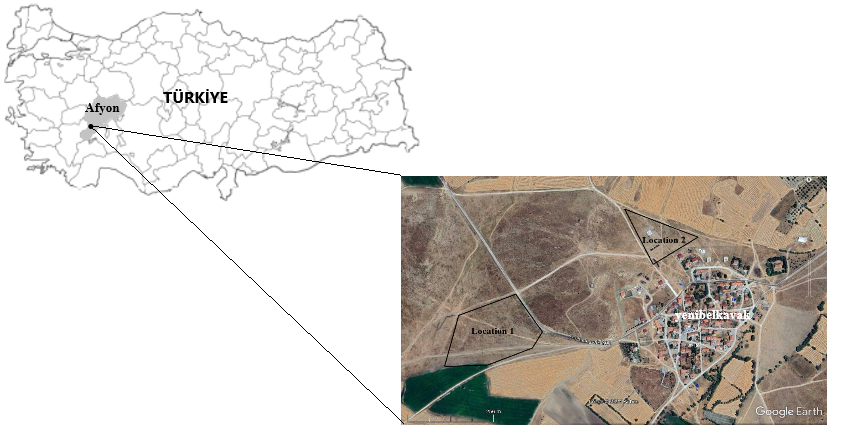
S. xanthoprymnus Location 1. 38°14’29.56”N 30°13’24.71”E, 42.000 m2, 1151 m altitude. S. xanthoprymnus Location 2. 38°14’37.98”N 30°13’44.67”E, 14.500 m2, 1156 m altitude. Figure 1: Country: Türkiye, City: Afyonkarahisar, Village: Yenibelkavak.
This study consists of an analysis of meteorological records (1929-2023) for the Yenibelkavak, which experiences a continental climate. The annual average temperature was measured at 11.3°C, the annual average maximum temperature reached 17.4°C and the annual average minimum temperature was mesured as 5.1°C. The annual average precipitation measured as 444.5mm [12]. The highest monthly temperature average of the year is 39.8°C in August; on the other hand, the monthly average minimum temperature was measured in January as -27°C [12]. The locations have natural short-grass steppe habitats with short vegetation.
Method
Observations were performed in two locations in Yenibelkavak village. S. xanthoprymnus was detected by our research team from 2023 and 2024. Then, the present/ absent inventory method was used in the region to find appropriate habitats and species presence. The direct and indirect observation techniques (Bushnell 8-16x40 binoculars, DSLR Canon EOS 750D, Bushnell brand camera traps), which are among wildlife observation techniques was used from sunrise to sunset during the whole study process.
Results and Discussion
The study represents the first record for S. xanthoprymnus in Yenibelkavak province and the second for Afyonkarahisar. Krystufek, et al. [13] first reported the species from Bolvadin-Hamidiya in Afyonkarahisar. The presence of the species was detected in two close locations in Yenibelkavak village (Figure 1). Location 1. 38°14’29.56”N 30°13’24.71”E, 1151 m altitude. Location 2. 38°14’37.98”N 30°13’44.67”E, 1156 m altitude. Locations far from 400 m as the crow flies (with a walking distance of 2 km) each other. These two locations are separated by a hill with a height difference from locations height of 20 m and a network of roads. Although both locations were found in the village pasture, no nests of the species were found in the area between the two locations. Currently the two locations are isolated from each other.
In this province S. xanthoprymnus is distributed in natural short-grass steppe habitats with short vegetation, as stated by Gür, et al. [9], Kart, et al. [7], Aksan, et al. [9], Kryštufek, et al. [13]. The vegetation of the area has been identified to include Astragalus sp., Papaver sp., Verbascum sp., Anthemis sp., Crataegus monogyna, Centaurea benedicta, Elytrigia repens, and Carduus marianus, alongside the agricultural crops Hordeum vulgare and Triticum aestivum located at the boundary. Our vegetation findings are consistent with the findings of Aksan, et al. [5], Gür, et al. [9], and Kryštufek, et al. [13].
Location 1 is in a pasture area of about 42,000 m2 in the area leading to the fields on the village entrance road. This is an area that villagers use constantly to graze their animals and reach their fields. On the way to their fields, they are accidentally run over by farmers’ vehicles and hunted by shepherds’ dogs. The second habitat is 14,500 m2 and located on the borders of the new residential area. With the construction of houses on the remaining plots, the habitat of the species is in danger of being completely lost. Natural displacement or migration to another habitat seems impossible from this area because it is surrounded by agricultural land, roads and residential areas. The destruction of pasture and meadow ecosystems is recognized by the result in habitat fragmentation, thereby affecting the habitat choices of different species [5].
The research conducted by Kryštufek, et al. [14] revealed that the population of S. xanthoprymnus has been diminishing over the previous decade, attributed to widespread agricultural operations that result in the destruction and fragmentation of its habitat. However, an analysis of the latest distribution maps of S. xanthoprymnus indicates that climatic conditions are also a primary determinant of these habitat preferences [10]. Understanding the nesting site requirements of this endangered species is essential, along with exploring the external influences that threaten its survival in the environment. One of the external factors affecting the survival of a species is predators. It has also been observed that Anatolian ground squirrels were hunted by Buteo buteo, Falco tinnunculus, Athene Noctua, Vulpes vulpes, domestic cats, and dogs in the field. Our findings regarding the predators of the species are consistent with the results of other studies [5, 7]. Except for these indirect negative effects, the local people do not directly harm the species.
The annual life cycle of the target species is divided into active periods; when they are active above ground, and the hibernation period, when they spend the winter in hibernation [1, 5, 10, 15]. As a result of the investigation, we found the life cycles of 2023 and 2024 as shown in Table 1. Observations indicated that temperature has played an affective role in determining the critical periods such as hibernation, mating, birthing, and the emergence of young from their burrows. The year 2024 set new records for both minimal precipitation and maximal temperature levels in comparison compared to the levels of previous years [12]. It was observed that the increase in seasonal temperatures led to earlier awakenings from hibernation, earlier mating, earlier breeding, and delayed hibernation on S. xanthoprymnus. Considering similar results, Aksan, et al. [5] highlighted the effects of temperature on biological rhythms. Our findings, life cycle, hibernation period, mating time, births time, and offspring emerging from burrows are like those given by Karabağ [16] and Yiğit, et al. [15].
| Hibernation period | Mating time | Births time | Offspring emerging from burrows |
|---|---|---|---|
| End of October 2022 to end of April 2023 | May-23 | Jun-23 | June-early July 2023 |
| End of November 2023 to March 2024 | Apr-24 | May-24 | May- early June 2024 |
Table 1: The life cycle of _S. xanthoprymnus_.
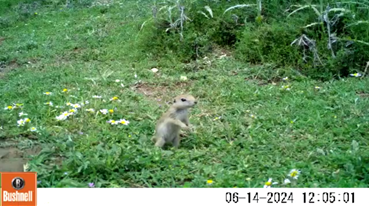
Anatolian ground squirrels were observed to be very active between 09:00 and 18:00 during the day. This finding is consistent with findings of Yiğit, et al. [15] and Aksan, et al. [5]. It is observed that species mate in May 2023 and April 2024 in Yenibelkavak province. S. xanthoprymnus usually mates in March in central lowland Anatolia [9] and in April in northeastern highland Anatolia [17] and adjacent Armenia [13]. The gestation period is nearly 30 days. Regarding gestation periods, our findings are similar to those of other studies [5, 7, 10, 17]. We observed that births occurred underground in May-June 2023 and April-May 2024. Offspring leaves their burrows in June 2023, May 2024 at province. In Figure 2, one of the two offspring was recorded in front of the nest on June 6. The emergence of offspring from natal burrows was observed at about four weeks of age in May in central lowland Anatolia, as in the studies of Gür, et al. [9], Gür [10], Kart Gür, et al. [7], and Aksan, et al. [5]. Sexual maturity is reached after the first hibernation period in Yenibelkavak, as reported by Aksan, et al. [5] and Yiğit, et al. [17].
Our results are significant for the conservation of the species and its habitat as the studies of Özkurt, et al. [3], Irena [4], and Aksan, et al. [5]. To enhance the conservation of species within comparable habitats and to improve their population status, it is essential to reinforce habitat characteristics through the restoration and rehabilitation of the area. In Türkiye, Spermophilus spp. are defined as an agricultural pests, and the pesticides that can be used against the species are given in the web page database of the Department of Plant Protection Products of the Ministry of Agriculture and Forestry [18]. To protect the species, it is recommended to include correction texts in such bulletins and to update web pages to improve the image of the species declared as an agricultural pest and increase the effectiveness of conservation activities. The destruction of the habitat areas of the species can be prevented by taking stricter measures to prevent the unqualified use of the areas qualified as pasture and meadow by the District Directorates of Agriculture. The Regional Directorates of Nature Conservation and National Parks can include this species in wild animal protection training programs and increase the effectiveness of in situ protection measures by raising awareness of citizens. Taking appropriate steps to counteract these influences will not only protect the wildlife diversity at the national level but also contribute to the sustained diversity of species on a global level.
Conclusions
The findings of this study indicated that S. xanthoprymnus was only present in the second location in Yenibelkavak village. The second area is experiencing habitat loss due to increasing construction. Based on our long-term observations in the field, years longer than the 2023–2024 years given in the article, and the results of studies that looked at the species, as human activity increases in the field, the number of individuals in the species may drop, go extinct, or may spread to nearby habitats where humans don’t bother them. Whether the areas to be opened for development have value in terms of wildlife should be investigated by the relevant institutions, and construction should be permitted based on the report. This approach effectively protects both fauna and flora, ensuring their continued survival.
Acknowledgment
The author thanks Dr. Harun ÇİFTÇİ for helpful proofreading for the manuscript.
Conflicts of Interest
The authors declare no conflict of interest and there are no funding or sponsor.
References
-
Gür H (2001) Population biology of _Spermophilus_ _xanthoprymnus_ (Rodentia: Sciuridae). M.S. thesis. Hacettepe University, Ankara, Türkiye.
-
IUCN (2018) The IUCN Redlist of Threatened Species.
-
Özkurt S, Yiğit N, Çolak E, Sözen M, Moradi Gharkheloo M (2005) Observations on the Ecology, Reproduction and Behavior of Spermophilus Bennett, 1835 (Mammalia: Rodentia) in Türkiye. Turkish Journal of Zoology 1: 91- 99.
-
Irena A, Policht R (2011) Acoustic analysis of the alarm call of the Anatolian ground squirrel _Spermophilus_ _xanthoprymnus_ with alarm calls of the Taurus _S._ _taurensis_ and European _S. citellus_ ground squirrels. Naturwissenschaften 99(1): 55-64.
-
Aksan Ş, Çohadar H (2018) New Locality Record of The Anatolian Ground Squirrel, _Spermophilus xanthoprymnus_ Bennett 1835, in Isparta-Gencali Province. Fresenius Environmental Bulletin 27: 9172-9178.
-
Arslan A (2005) Cytogenetic studies on _Spermophilus_ _xanthoprymnus_ (Mammalia: Sciuridae) in central Anatolia. Folia Zool 54(3): 278-284.
-
Kart Gür M, Gür H (2010) _Spermophilus xanthoprymnus_ (Rodentia: Sciuridae). Mammalian Species. 42(1): 183- 194.
-
Özkurt SO, Sözen M, Yiğit N, Kandemir I, Çolak R, et al. (2007) Taxonomic Status of the Genus Spermophilus (Mammalia: Rodentia) in Turkey and Iran with Description of a New Species. Zootaxa 1529: 1-15.
-
Gür H, Kart Gür M (2005) Annual cycle of activity, reproduction, and body mass of Anatolian ground squirrels (_Spermophilus xanthoprymnus_) in Turkey. Journal of Mammalogy 86(1): 7-14.
-
Gür H (2007) Morphometric variation in Anatolian ground squirrel (_Spermophilus xanthoprymnus_) and its relationship to selected environmental variables. Ph.D. dissertation. Hacettepe University, Ankara, Turkey.
-
Kart Gür M, Gür H (2015) Age and sex differences in hibernation patterns in free living Anatolian ground squirrels. Mammalian Biology 80(4): 265-272.
-
(2024) MGM. https://www.mgm.gov.tr/ verideg erl en di rm e/ il - ve- il c el er- ist a t ist ik . aspx?k=A&m=AFYONKARAHISAR.
-
Kryštufek B, Vohralík V (2005) Mammals of Turkey and Cyprus: Rodentia I: Sciuridae, Dipodidae, Gliridae, Arvicolinae. Knjiznica Annales Majora, Koper, Slovenia pp: 299.
-
Kryštufek B, Yiğit N, Hutterer R (2008) _Spermophilus_ _xanthoprymnus_. In: International Union for Conservation of Nature and Natural Resources 2012. International Union for Conservation of Nature and Natural Resources Red list of Threatened Species. Version 2012: 1.
-
Yiğit N, Çolak E, Sözen M, Özkurt S (2000) A Study on the Hibernation of _Spermophilus xanthoprymnus_ (Bennett, 1835) (Mammalia: Rodentia) in Türkiye. Turkish Journal of Zoology 24: 87-93.
-
Karabağ T (1953) Biology and warfare procedure of ground squirrels (Citellus) around Ankara. Publications of Ankara University Faculty of Agriculture pp: 1-68.
-
Yiğit N, Çolak E, Sözen M, Karataş A (2006) Rodents of Türkiye. Meteksan Co. Ankara pp: 1-156. $$ 1 8. (2 0 1 9) \mathrm {B U U}. \mathrm {h t t s}:// a d i y a m a n. t a r i m o r m a n. g o v. t r / S a y f a l a r / D e t a y. a s p x? O g e I d = 2 6 7 \& L i s t e = D u y u r u. $$
- Mitochondrial Bio-Logistics: Steering Co-Enzyme Q10 and Lycopene Synergies within the Science 4.0 Bio-OS Framework
- Hymenoptera Specimens from the Caño Negro Wetland, of the National Museum Collection, Costa Rica
- Science 4.0: Comprehensive Architecture of the Biological Operating System (Bio-OS) A Framework for Systemic Resilience and Industrialized Bio-Governance
- Rabbit on, or Hare Back? Understanding Climate Change
- Clinical Validation of Science 4.0: Flow Steering and Epigenetic Drift Inversion on a 76-Year-Old Hybrid System
- Seeds Planted by another Mind