
Sustainability Assessment of Iguana Management Units in the Oaxaca Coast Region, Mexico
In order to assess the sustainability of management units, a multicriterial analysis can be applied, as an analytical, hierarchical, and technical process. This research was conducted to determine the environmental, socioeconomic, and legal sustainability indexes of wildlife conservation management units in the coastal region of Oaxaca. All wildlife conservation management units in the state of Oaxaca were visited, and those that were no longer in continuous operation or had ceased to operate were eliminated. Three units were evaluated: 1) CECOREI-UMAR, 2) CTENOSAURA PECTINATA, and 3) BARRA DEL POTRERO. Interviews were conducted with owners, workers, and legal and technical representatives. Fifteen criteria, 29 indicators, and 82 verifiers were evaluated, and framed within four headings: environmental, economic, social, and legal. The management units evaluated have the same sustainability (P>0.05): CECOREI-UMAR (1.2), CTENOSAURA PECTINATA (0.68), and BARRA DEL POTRERO (0.72). It is concluded that the management units comply with the operations and legal, social, and environmental indicators; however, the economic indicator must be addressed.
Introduction
Wildlife management units (UMAs) are registered properties and facilities that operate by mutual agreement, with an approved management plan, within which the status of the habitat and the specimens distributed within are monitored [1]. The objective of UMAs is the integration of environmental, economic, social and legal skills to conserve wildlife. This can be achieved through extensive or intensive management, while also taking into account extractive and non-extractive use [2]. UMAs that meet conservation and income generation objectives for the rural population are scarce, especially in regions with low levels of social and economic development [2, 3, 4, 5]. Problems are more significant in units located in more marginalized municipalities [6, 7] because rural communities receive less support and training [7]. In contrast, hunting ranches mainly in northeastern Mexico make an important contribution to the human population at a social and economic level [8, 9, 10, 11, 12, 13]. In the evaluation of management units, technical problems have been revealed due to a lack of personnel training and deficiencies in the management plan [1, 4, 14]. Wildlife-related evaluations focus on the production of environmental goods or services [15, 16], since these are activities of social interest, with scientific, technological, and political value [17]. The increase in the number of official records of UMAs is mentioned as an indicator of success [17, 18]; however, this increase may not have an impact on the success of the units. In success evaluations, few studies consider indicators of socioeconomic development, wildlife conservation, and legal and technical factors [2, 7, 18, 19, 20, 21]. Therefore, headings that describe the general attributes of sustainability, such as environmental, economic, social, and legal, are applied [5, 19, 22]. These attributes can be used for sustainability evaluations through multicriteria analysis [23, 24, 25, 26, 27]. In the state of Oaxaca, UMAs have not been comprehensively evaluated to determine their economic viability and contribution to the social development of their owners. Therefore, a comprehensive evaluation of operating conditions is necessary to determine the socioeconomic development and conservation of iguana breeding sites. It is hypothesized that the evaluation of sustainability principles in Wildlife Management Units will indicate the factors limiting the establishment and maintenance of breeding sites for green iguanas (Iguana iguana) and black iguanas (Ctenosaura pectinata). Therefore, the objective is to use multicriteria analysis to evaluate the sustainability of environmental, economic, social, and legal principles in iguana management units in the Oaxaca Coast Region.
Materials and Methods
Study Area
The location of the UMAs distributed throughout the Oaxaca Coast Region was investigated [28, 29]. After identifying the UMAs, a visit was conducted to learn about the structure and management plan of each one. Those that were not in continuous operation and those that had ceased to operate were eliminated from the list. Three management units were evaluated due to their relevant characteristics, similarity in structure such as a steering committee, and the social actors involved in the implementation, administration, and financing of the UMAs.
- The Iguana Conservation and Reproduction Center of the Universidad del Mar (CECOREI-UMAR), at kilometer 128.1 of the Pinotepa Nacional-Puerto Escondido Federal Highway, located at 97°9’02”W, 15°55’3.4”N, 9 masl [30]. It has eight hectares, with three wild species (Iguana iguana, Ctenosaura pectinata, and Struthio camelus) and four domestic species (Meleagris gallopavo, Oryctolagus cuniculus, Ovis aries, and Bos taurus). The land tenure is communal.
- Management Unit for the Conservation of Ctenosaura Pectinata Wildlife, in the Barra de Navidad area, located at 97°1’20.37”W, 15°49’15.17”N, 29 m a.s.l. [31]. It has 0.54 ha, with 10 wild species (Iguana iguana, Ctenosaura pectinata, Crocodylus acutus, Crocodylus moreletti, Kinosternon herrera, Amazona albifrons, Amazona farinosa, Ara militaris, Odocoileus virginianus and Leopardus wiedii), with private land tenure.
- BARRA DEL POTRERO Iguana Hatchery, at kilometer 179 of the Puerto Escondido-Pochutla highway in the town of Barra del Potrero located at 96°45’30”w, 15°44’05”N, 15 m.a.s.l. [32].
It manages 10 ha, with six wild species (Iguana iguana, Ctenosaura pectinata, Kinosternon herrera, Trachemys scripta, Trachemys scripta elegans, and Rhinoclemmys spp.), also with private land tenure.
A semi-structured interview was designed, incorporating the following headings: environmental, economic, social, and legal [22, 33]. In each management unit, five people were interviewed, including workers, the technical manager, and the legal representative. A hierarchy of four headings (environmental, economic, social, and legal), fifteen criteria, twenty-nine indicators, and eighty-two verifiers was used [34]. All survey questions were formulated according to García- Marmolejo [3, 18]. However, some modifications were made to the qualitative indicators, and others were eliminated.
Statistical Analysis
A multicriterial analysis was implemented, and normalization was performed using the square root transformation and then the angular arcsine transformation[35]. A Kruskal-Wallis test was then performed [36].
Results
Located Management Units
Fourteen management units were identified in the state of Oaxaca that manage green iguanas (Iguana iguana) and black iguanas (Ctenosaura pectinata) for collection, exhibition, breeding, and conservation purposes (Table 1), of which three were found to be the most complete.
Sustainability Index
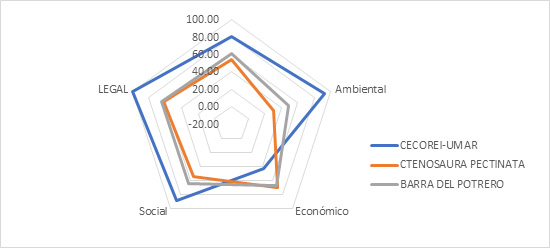
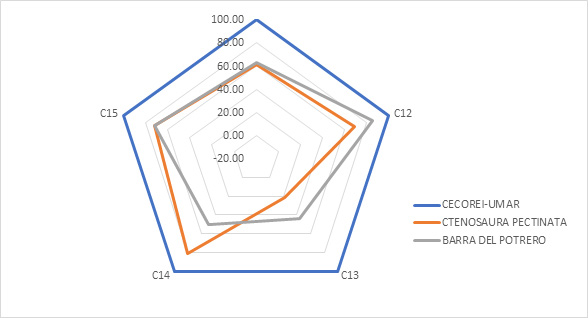
The CECOREI-UMAR, La Barra del Potrero, and Ctenosaura pectinata management units have the same average sustainability index (P>0.05, Table 2). Despite this, in the first management unit, environmental, legal, social, and, to a lesser extent, economic headings are most prominent. In the other units, environmental headings have the lowest degree; however, they receive a higher rating concerning the economic factor (Figure 1).
Environmental Principle
The three management units present a similar environmental sustainability index (P>0.05, Table 2).
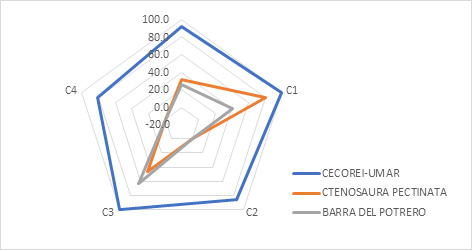
However, the four sustainability criteria used in the CECOREI- UMAR are seen as stronger in that they contribute to reducing several activities with ecological impact: they promote habitat management strategies, allow for the diversified use of wildlife, conduct research, and promote strategies for wildlife management and conservation. Meanwhile, the CTENOSAURA PECTINATA and LA BARRA DEL POTRERO management units do not promote habitat management or wildlife conservation strategies, but do allow for the diversified use of wildlife (Figure 2).
| Name of UMA | Modality | Scientific Name | Objetive |
|---|---|---|---|
| El Garrobo | Intensive | Ctenosaura pectinata | Conservation, recovery, and utilization |
| Iguanario Pinotepa | Intensive | Iguana iguana y Ctenosaura pectinata | Conservation and sustainable utilization |
| Santa María Huazolotitlán | Extensive | Ctenosaura pectinata | Management and conservation |
| Ojo de Agua | Intensive | Iguana iguana y Ctenosaura pectinata | Conservation and ecotourism |
| Guapinol | Intensive | Iguana iguana y Ctenosaura pectinata | Conservation and ecotourism |
| Criadero de iguanas Chacahua | Intensive | Iguana iguana | Management and reproduction |
| Yutu Cuii Sociedad De Solidaridad Social | Intensive | Iguana iguana | Reproduction and commercial utilization |
| Iguanario Roca Blanca | Extensive | Ctenosaura pectinata | Management and conservation |
| Centro de y Conservación y Reproducción de Iguanas UMAR | Intensive | Iguana iguana, Ctenosaura pectinata | Management and reproduction |
| Ctenosaura pectinata | Intensive | Iguana iguana, Ctenosaura pectinata, | Conservation and environmental education |
| Granja Inter-Activa S.A DE C.V. | Intensive | Iguana iguana | Conservation and management |
| Criadero de Iguanas La Barra del Potrero | Intensive | Iguana iguana, Ctenosaura pectinata. | Conservation and ecotourism |
| Iguanario Todos Santos | Intensiva | Ctenosaura pectinata e Iguana iguana | Conservation and sustainable utilization |
| Iguanario Coopalytan | Intensive | Ctenosaura pectinata e Iguana iguana | Conservation and ecotourism |
Table 1: Intensive and extensive iguana units registered until October 2017 in the Oaxaca Coast Region.
Economic Principle
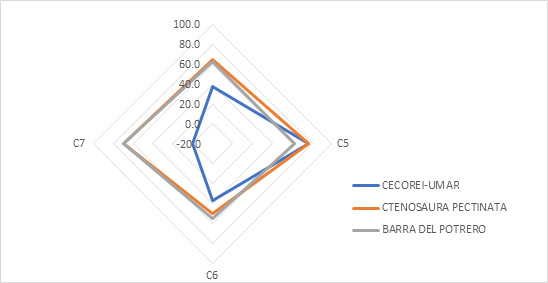
The economic sustainability index is similar (P>0.05, Table 2) in CTENOSAURA PECTINATA, BARRA DEL POTRERO, and CECOREI-UMAR (Figure 3). The first two UMAs secure different sources of income through productive diversification, allow for insertion into a market network, and establish a diversified portfolio of external financing sources; however, they mention that it is difficult to obtain utilization rates. CECOREI-UMAR does not have external financing sources and does not have market networks.
| UMA | Average | Indicator | Average |
|---|---|---|---|
| CECOREI-UMAR | 8.75 | Environmental | 5.33 |
| CTENOSAURA PECTINATA | 5.25 | Economic | 4.33 |
| BARRA DEL POTRERO | 5.5 | Social | 7 |
| Legal | 9.33 | ||
| Ji-Squared | 2.35 | Ji-Squared | 3.31 |
| Probability | 0.31 | Probability | 0.35 |
Table 2: Kruskal-Wallis test for the UMAs.
Social Principle
The social sustainability index is similar (P>0.05) across management units, though greater economic development is observed in the CECOREI-UMAR UMA, followed by the LA BARRA DEL POTRERO iguana farm and the CTENOSAURA PECTINATA UMA (Figure 4). Two management units promote self-management: CECOREI-UMAR and La Barra del Potrero, while CTENOSAURA PECTINATA does not. The greatest contribution of economic development is observed in CECOREI-UMAR, with zero development in the other two management units. All three management units align on the conservation of cultural diversity and biological diversity.
Legal Principle
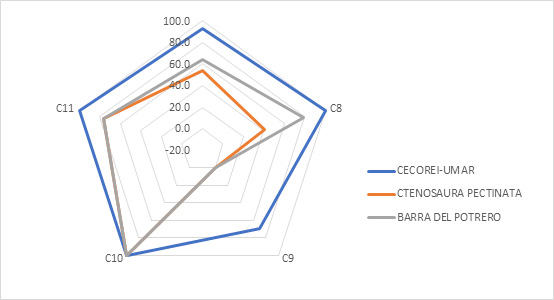
All management units have a similar (P>0.05) legal indicator, although the CECOREI-UMAR contributes 100% of the knowledge of legal regulations for harvesting, generates internal regulation and harvesting mechanisms, promotes the legality of harvesting practices, and generates external legal regulation mechanisms (Figure 5).
Discussion
Sustainability Principle
The CECOREI-UMAR has adequate sustainability indices for several reasons: 1) the operating staff and committee are sufficiently trained in wildlife management. Therefore, compliance with environmental objectives has a higher score; 2) maintenance and personnel costs are covered by a teaching and research institution; 3) they carry out research and community outreach activities. A different situation is observed in the UMAs: CTENOSAURA PECTINATA and LA BARRA DEL POTRERO, where the economic criterion is greater, but their environmental, social, and legal contributions are lower. The sustainability values generated indicate the achievements that the evaluated UMAs have achieved with respect to the general objectives of each of them. No indication is made that the UMAs are performing inadequately in their social, environmental, or legal activities. Although rural communities have been encouraged to conserve biodiversity by providing sources of income and alternative forms of production, optimal conditions are not present due to technical, economic, social and political difficulties, particularly in the units evaluated [37]. It is necessary to consolidate self-management measures, economic development, and the preservation of cultural and biological diversity in order to become a stable and profitable productive activity on the Oaxacan coast in the long term. On the other hand, a government policy could be generated to support the wildlife UMAs in an effective manner.
Environmental Principle
Of the three management units evaluated, the CECOREI- UMAR is the only one that does not monitor habitat or wildlife, as it is a registered UMA. Despite managing a small area within its facilities, it does not allow hunting of wildlife within the eight registered hectares and maintains the state of the vegetation. Another advantage of this management unit is that it conducts research that promotes strategies for habitat management and wildlife conservation [38, 39, 40]. The CECOREI-UMAR and CTENOSAURA PECTINATA UMAs contribute with maintenance activities, which help reduce the impact on natural resources due to their stated objectives. The opposite is the case in LA BARRA DEL POTRERO, where these activities are minor. The absence of habitat management and conservation regulations in the CTENOSAURA PECTINATA and LA BARRA DEL POTRERO UMAs could be related to the area, type of land tenure, and the location of the property. When the size and extension of the unit is small, maintaining habitat integrity is almost impossible [3, 41], due to the concentration of efforts on captive activities. In the Oaxaca Coast Region, during the period 2000-2011, 18,402 ha of jungle, 420 ha of mangroves and 369 ha of forest were lost due to human activities [42].
Even if the evaluated UMAs implemented a habitat restoration program, it would not be enough to address this problem, since other additional measures are needed to regulate land use changes and reduce the deforestation rate in the region, through other national institutions or programs.
The evaluated UMAs promote the diversified use of wildlife activities. Two of them are for commercial purposes, which guarantees the protection and maintenance of a stable population of black (C. pectinata) and green (I. iguana) iguanas by not utilizing the area’s fauna. This situation has led the owners of the UMAs on the Oaxacan coast to establish non-economic protection measures to guarantee the preservation of biodiversity. The opposite occurs in the units in the northern region of the country and the Yucatán Peninsula, where they tend to increase the number of specimens in their facilities through the introduction of individuals captured in their habitat or exceeding the rates authorized by SEMARNAT (National Secretariat of Environmental Protection) to increase their economic profits, accelerating the process of environmental deterioration [4, 14, 18, 19]. Rural communities near management units have a negative impact on their land and wildlife populations due to poaching for personal consumption and commercial purposes [6, 17, 43]. However, with the data available in this study, it is impossible to estimate and specify the actual impact of hunting on wildlife populations.
Economic Principle
The UMAs show financial instability, as they do not generate direct sources of income for the owners or indirect sources for the community. Furthermore, they lack complementary activities that would allow the owners to cover their own maintenance expenses. Interviews with the owners revealed that the UMAs CTENOSAURA PECTINATA and LA BARRA DEL POTRERO lack ongoing support to cover maintenance costs. It was found that there is active participation by family members, which does not generate expenses or income. The exception is the CECOREI-UMAR, where maintenance and personnel costs are directly financed by an educational institution. The spaces in the UMAs are so small that habitat management and conservation strategies tend to be nonexistent, as the UMA owners do not have sufficient financial resources to implement programs [5, 7, 44].
Social Principle
The Wildlife Conservation and Productive Diversification Program in the Rural Sector [45] has become outdated, as it does not show strategies to promote the socioeconomic development of rural communities. Nor does it show that the institutions responsible for authorizing and monitoring the units actively train the owners of authorized properties to provide tools to improve socioeconomic development with the resources available to them, which in turn allow them to consolidate associations in the communities.
It is important to increase training to promote self- management, so that communities can make decisions that favor productive development [5, 44]. However, it is unlikely that the federal government will establish training and monitoring programs to determine the effectiveness of the social development of the UMAS, given the limited financial resources allocated to natural resource management and conservation projects [2, 14, 18]. Self-management is difficult because responsibility falls on the owner, who sometimes fails to create internal policies, as is the case in the CTENOSAURA PECTINATA and LA BARRA DEL POTRERO UMAs, except for CECOREI-UMAR, where an organized group reviews management and makes decisions, and there are internal regulations and management-related executive staff.
The evaluated UMAs are not contributing to social development because they do not encourage active community participation in the management and maintenance activities of iguana breeding farms. The aforementioned deficiencies are a common denominator in the country’s UMAs because, even when community members are involved, participation is generally passive and does not provide real economic benefits that allow those involved to live without financial hardship [3, 5]. In the CECOREI-UMAR management unit, there are no third-party financial contributions. In contrast, in the other two units, voluntary financial contributions from visitors are a source of income.
The greatest social contribution of the evaluated UMAs is that of environmental awareness activities and cultural development of the species, but despite this, there is a lack of training by authorities so that federal programs can be carried out [45]. In the CECORE-UMAR, issues related to the use of local fauna and flora are addressed since it has qualified personnel. It is known that fauna is used for other traditional purposes, as clothing, tools, pets, as well as for medicinal, ritual and religious purposes, among others [37]. Therefore, environmental education activities should be implemented regarding proper use of species and the reduction of hunting.
Legal Principle
The owners and managers of the assessed UMAs identify that iguanas are in a risk category and are listed in NOM- 059-SEMARNAT [46], but they are unaware of the scope. Some interviewees from CECOREI-UMAR and LA BARRA DEL POTRERO commented that the current legal framework is too general and unclear, which generates uncertainty and confusion in its interpretation. Furthermore, some environmental, social, and economic aspects that are considered part of the UMAs and SUMA’s objectives are ignored in relation to the current regulatory works [18, 44, 47]. The owners indicate that the regulatory framework is subject to interpretation by the respective authorities. Therefore, monitoring and evaluation of UMA performance is limited, and management units may be allowed to resort to extracting specimens from natural populations [5, 8, 11, 14]. These factors have a negative impact on biodiversity conservation, making it difficult to assess the actual performance of UMAs and determine their impact on socio-ecological development [3, 4].
Available evaluations of UMAs only analyze the number of official records, the number of species, and the territorial area occupied by the units [18, 20, 21, 48]. The regulatory framework for UMAs is not entirely efficient, presenting gaps in the regulation of wildlife management, since the general objectives of the program were not considered during the design of the legal framework, nor were the socioeconomic and environmental conditions of the different regions of the country taken into account.
Conclusion
The evaluation of environmental factors indicates that the management plans in place for the evaluated iguana habitats do not guarantee the long-term conservation of iguana biodiversity for (C. pectinata and I. iguana). The economic analysis of the studied UMAs reveals financial instability, as they do not generate direct sources of income for the owners or indirect sources of income for the community. The greatest social contribution of the evaluated UMAs is related to environmental awareness activities. The overall sustainability index of the evaluated UMAs indicates that they allow for the conservation of biological and cultural diversity; however, they make only minimal contributions to the socioeconomic development of their communities.
Conflict of Interest Statement
We declare that we have no conflicts of interest.
References
-
Ley General de Vida Silvestre (2021) Ley General de Vida Silvestre. Cámara de Diputados del Honorable Congreso de la Unión. Última reforma Diario Oficial de la Federación.
-
Weber M, García-Marmolejo G, Reyna-Hurtado R (2006) The tragedy of the commons: wildlife management units in southeastern Mexico. Wildl Soc Bull 34(5): 1480- 1488.
-
García-Marmolejo G (2005) Caracterización y sustentabilidad de las Unidades para la Conservación, Manejo y Aprovechamiento Sustentable de la Vida Silvestre en Campeche. Campeche, México: El Colegio de la Frontera Sur.
-
Masés-García CA, Briones-Salas M, Sosa-Escalante J (2016) Análisis del manejo y aprovechamiento legal de los mamíferos silvestres de Oaxaca, México. Rev Mex de Biodiv 87(2): 497-507.
-
Pineda-Vázquez M (2017) Evaluación de la sustentabilidad de las Unidades de Manejo para la Conservación de la Vida Silvestre en Tabasco, México. Villahermosa, Tabasco, México: El Colegio de la Frontera Sur.
-
Avila-Foucat VS, Pérez-Campuzano E (2015) Municipality socioeconomic characteristics and the probability of occurrence of Wildlife Management Units in Mexico. Environ Sci Policy 45: 146-153.
-
Gómez-Aíza L, Martínez-Ballesté A, Álvarez-Balderas L, Lombardero-Goldaracena A, García-Meneses PM, et al. (2017) Can wildlife management units reduce land use/ land cover change and climate change vulnerability? Conditions to encourage this capacity in Mexican municipalities. Land Use Policy 64: 317-326.
-
González-Marín R, Montes-Pérez R, Santos-Flores J (2003) Caracterización de las unidades para la conservación, manejo y aprovechamiento sustentable de fauna silvestre en Yucatán, México. Trop Subtrop Agroecosyst 2: 13-21.
-
ANGANDI (2004) Asociación Nacional de Ganaderos Diversificados Criadores de Fauna. XV Asamblea General Ordinaria y XIV Congreso Nacional de Ganadería Diversificada, Nuevo Laredo, Tamaulipas, México.
-
Zamorano de Haro P (2009) La flora y fauna silvestres en México y su regulación. Procuraduría Agraria, México, pp: 159-169.
-
Ruano-Escalante YR (2011) Viabilidad económica e implicaciones de conservación de las UMA intensivas de venado cola blanca (Odocoileus virginianus) en Yucatán. Mérida, Yucatán, México: Centro de investigación y estudios avanzados del Instituto Politécnico Nacional.
-
Nicolás-Matías F (2012) Análisis de la Situación de las Unidades para Conservación, Manejo y Aprovechamiento Sustentable de la Vida Silvestre en México. Coahuila, México: Universidad Autónoma Agraria Antonio Narro.
-
Escalante T, Martínez-Meyer E (2013) Ecological Niche Modeling And Wildlife Management Units (UMAS): An Application To Deer In Campeche, México. Trop Subtrop Agroecosyst 16: 183-191.
-
Gallina-Tessaro S, Hernández-Huerta A, Delfín-Alfonso CA, González-Gallina A (2009) Unidades para la conservación, manejo y aprovechamiento sustentable de la vida silvestre en México (UMA). Retos para su correcto funcionamiento. Investigación Ambiental 1(2): 143-152.
-
Leopold A (1933) Game management. New York: Charles Scribner’s Sons.
-
Miranda A (1993) Manejo de fauna silvestre. Cienc 7: 103-110.
-
Ojasti J, Dallmeier F (2000) Manejo de Fauna Silvestre Neotropical. Washington DC: SI/MAB Biodiversity Program.
-
Sisk TD, Castellanos AE, Koch GM (2007) Ecological impacts of wildlife conservation units in Mexico. Front Ecol Environ 5(4): 209-212.
-
García-Marmolejo G, Escalona-Segura G, Van Der Wal H (2008) Multicriteria evaluation of wildlife management units in Campeche, Mexico. J Wildl Manag 72(5): 1194- 1202.
-
Ortega SJA, Villarreal GJG, Mandujano S, Gallina S, Weber M, et al. (2014) Retos y estrategias de conservación y aprovechamiento de la fauna en México. Guadalajara, Jalisco, México. Editorial del Colegio de Posgraduados.
-
Ortega-Argueta A, González-Zamora A, Contreras- Hernández A (2016) A framework and indicators for evaluating policies for conservation and development: The case of wildlife management units in Mexico. Environ Sci Policy 63: 91-100.
-
Prabhu R, Haggith M, Purnomo H, Ritchie B, Rizal A, et al. (2000) CIMATA (criteria and indicators modification and adaptation tool) version 2: criteria and indicators for sustainable forest management . Bogor, Indonesia.
-
Li J, Yao X, Sun X, Wu D (2018) Determining the fuzzy measures in multiple criteria decision aiding from the tolerance perspective. Eur J Oper Res 264(2): 428-439.
-
Astier M, Masera OR, Galván-Miyoshi Y (2008) Evaluación de sustentabilidad: un enfoque dinámico y multidimensional. Valencia, España: Fundación Instituto de Agricultura Ecológica y Sustentable.
-
Sánchez C, Díaz P, Macías R, Estrada Á (2010) Analytical hierarchical process for decision taking in natural resources management. Rev Mex Cienc Agríc 1(3): 305- 319.
-
Davies AL, Bryce R, Redpath SM (2013) Use of multicriteria decision analysis to address conservation conflicts. Conserv Biol 27(5): 936-944.
-
Adem-Esmail B, Geneletti D (2018) Multi‐criteria decision analysis for nature conservation: A review of 20 years of applications. Meth Ecol Evol 9(1): 42-53.
-
SEMARNAT (2017) Secretaría de Medio Ambiente y Recursos Naturales a. Unidades de Manejo para la Conservación de la Vida Silvestre (UMA).
-
Máses-García CA, Briones-Salas M, Sosa-Escalante J (2016) Análisis del manejo y aprovechamiento legal de los mamíferos silvestres de Oaxaca, México. Rev Mex Biodiv 87(2): 497-507.
-
Google Earth (2024) Localización del proyecto del Centro de reproducción y conservación de iguanas de la Universidad del Mar. en la unidad de manejo Barra del potrero. Oaxaca, México.
-
Google Earth (2024) Localización del proyecto en la unidad de manejo Ctenosaura pectinata. OAXACA, México.
-
Google Earth (2024) Localización del proyecto en la unidad de manejo Barra del potrero. OAXACA, México.
-
Prabhu R, Colfer C, Shepherd G (1998) Criteria and indicators for sustainable forest management: new findings from CIFOR’s Forest Management Unit Level Research. UK: Rural Development Forestry Network.
-
Mendoza GA, Prabhu R (2000) Multiple criteria decision making approaches to assessing forest sustainability using criteria and indicators: a case study. Forest Ecology and Management 131(1-3): 107-126.
-
Mead R, Curnow R, Hasted A (2003) Statistical Methods in Agriculture and Experimental Biology. Boca Raton (FL): Chapman and Hall.
-
SAS (2010) SAS Education Analytical Suite for Windows (Release 9.2). Cary NC, USA: SAS Inst Inc Order number 582235. Tech support site number 70088431.
-
Álvarez-Peredo C, Contreras-Hernández A, Gallina-Tessaro S, Pineda-Vázquez M, Ortega-Argueta A, et al. (2018) Impact of the Wildlife Management Units Policy on the Conservation of Species and Ecosystems of Southeastern Mexico. Sustainability 10(12): 4415.
-
Arcos-García JL, Núñez OJ, García GJ, Rueda Zozaya RP, Romero HS, et al. (2020) Body condition index in breeding black iguana females (Ctenosaura pectinata) in captivity. Rev FCA UNCUYO 52(2): 349-359.
-
Sánchez MCG, López PR, Santiago RH, Martínez GJA, Mendoza MGD, et al. (2024) Alteraciones morfométricas en hembras juveniles de iguana negra (Ctenosaura pectinata) cuando varía el consumo de proteína y energía. Vet Méx OA 11: 1-18.
-
Marín RJA, López PR, Santiago RH, Mendoza MGD, Machorro SS, et al. (2024) Use of implants regarding growth parameters in black iguana young maintained in intensive conditiones. Int J Zoo Animal Biol 7(4): 1-8.
-
Aagaard K, Lyons JE, Thogmartin WE (2017) Quantifying the relative contribution of an ecological reserve to conservation objectives. Glob Ecol and Conserv 9: 142- 147.
-
Leija-Loredo EG, Reyes-Hernández H, Reyes-Pérez O, Flores-Flores JL, Sahagún-Sanchéz FJ (2016) Cambios en la cubierta vegetal, usos de la tierra y escenarios futuros en la Región costera del estado de Oaxaca, México. Madera y bosques 22(1): 125-140.
-
Peña-Jiménez A, Neyra-González L, Loa-Loza L, Durand- Smith L (1998) Amenazas a la biodiversidad. La diversidad biológica de México: estudio país. México: Comisión Nacional para el Conocimiento y Uso de la Biodiversidad.
-
Forero-Díaz DC (2013) Eficiencia del marco normativo de las Unidades de Manejo para la Conservación de la Vida Silvestre (UMA). Campeche, México: El Colegio de la Frontera Sur.
-
SEMARNAP (1997) Secretaría de Medio Ambiente y Recursos Naturales y Pesca. Programa de Conservación. Silvestre y Diversificación Productiva en el Sector Rural 1997-2000. SEMARNAP, Mexico.
-
DOF (2014) Acuerdo por el que se da a conocer la lista de especies y poblaciones prioritarias para la conservación. México.
-
Brañes R (2000) Manual de derecho ambiental mexicano. México: Fondo de Cultura Económica.
-
Cooper AB, Stewart F, Unsworth JW, Kuck L, McArthur TJ, et al. (2002) Incorporating economic impacts into wildlife management decisions. Wildlife Society Bulletin 30(2): 565-574.
- Mitochondrial Bio-Logistics: Steering Co-Enzyme Q10 and Lycopene Synergies within the Science 4.0 Bio-OS Framework
- Hymenoptera Specimens from the Caño Negro Wetland, of the National Museum Collection, Costa Rica
- Science 4.0: Comprehensive Architecture of the Biological Operating System (Bio-OS) A Framework for Systemic Resilience and Industrialized Bio-Governance
- Rabbit on, or Hare Back? Understanding Climate Change
- Clinical Validation of Science 4.0: Flow Steering and Epigenetic Drift Inversion on a 76-Year-Old Hybrid System
- Seeds Planted by another Mind