
Epidemiological and Clinical Aspects of Intestinal Parasitoses Among Students in the City of Bocaranga, Central African Republic
Objectives: To assess the prevalence of intestinal parasites among students in schools in the Boca Ranga health district in CAR. Patients and Methods: It was a descriptive cross-sectional study, conducted from August to November 2023, on pupils from various schools in Bocaranga. A questionnaire was completed for each pupil. Stool samples collected at home or at the laboratory were spread out on slides in a drop of physiological water and lugol solution, then read under a read under a 10X10 and 10X40 microscope. Demographic, clinical and parasitological data were collected, entered and analyzed on Epi info version 7. Results: Out of 389 students included, 319 (82.01%) were infested. Boys were more affected (53.92%). The 11-15 age group was the most affected (52%). Pupils from farming families (53.20%) were the most infested. Helminths dominated (41.3%), especially Ascaris lumbricids (31.34%), followed by protozoa (Giardia intestinalis, 9.72%), yeasts (10.65%) and polyparasitism (6.26%). Conclusion: Our study espectáculos a high prevalence of intestinal parasitoses among students in the city of Bocaranga. It is therefore appropriate to reframe national programs to combat parasite infestations, especially in schools
Introduction
Intestinal parasitoses are highly responsive in poor countries with low levels of hygiene and sanitation, where they can sometimes reach up to 80% of the population [1, 2]. According to the World Health Organization (WHO) in 2015, more than 600 million school-age children lived in regions where transmission of these parasites is high [3]. Even if they are not accompanied by high mortality, it should be noted that they are particularly severe and can lead to complications such as malnutrition, dehydration, anemia, staturo-ponderal retardation and reduced immunity [4, 5]. As a result, systematic deworming strategies have been put in place in these countries, including the Central African Republic. These deworming campaigns are coupled with vaccination campaigns throughout the country. However, these strategies implemented by the Ministry of Health have not been evaluated. Moreover, epidemiological data in certain areas is insufficient and needs to be reinforced by additional studies, hence the interest of study.
Patients and Methods
A descriptive cross-sectional study was carried out from August to November 2023 on pupils from various schools and pre-schools in the town of Bocaranga. Samples were analyzed at the Bocaranga District Hospital (HDB) laboratory. We obtained the agreement of the school principals before informing the pupils’ parents about the study to obtain their consent. For this study, we used a cluster survey. Each accessible school constituted a cluster. The equal sample size was calculated using the Schwartz formula. The number of participants per school was proportional to the number of students in the school. At the level of each school, classes were selected at random, and within classes, students were drawn according to a sampling step. Stool samples were taken at home or in the laboratory.
A direct microscopic examination was carried out after preparing 1g of stool in a drop of physiological water between slide and coverslip, followed by staining with lugol to look for eggs, larvae, parasites and cysts. Questionnaires containing various demographic, clinical and parasitological variables were used to collect data, which were entered and analyzed on Epi info version 7. Excell software was used to produce tables and figures.
Results
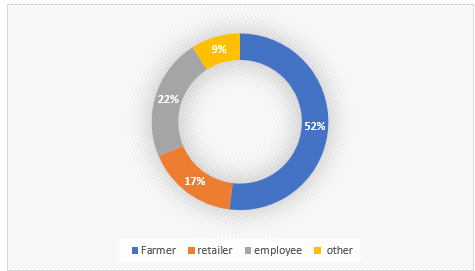
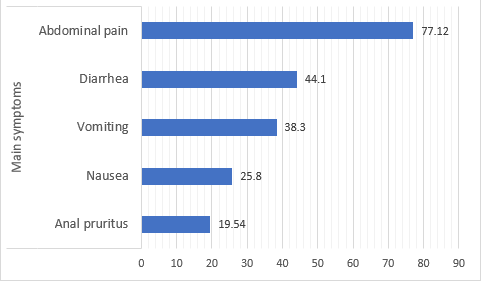
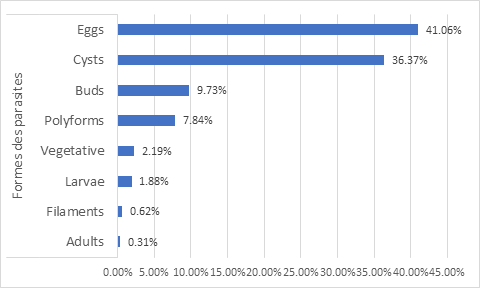
A total of 389 students were included. Boys were more heavily infested (53.92%), giving a sex ratio of 1.13. In Table 1, the 11-15 age group was more represented, with a percentage of 52% (202/389). Of the infested pupils, 53.20% (170/319) had farmers as parents and 22.00% (70/319) had wage-earning parents (civil servants/health workers/humanitarians), (Figure 1). Abdominal pain was the most represented symptom in this study (300/389), with a percentage of 77.12% (Figure 2). Of the389 students, 319 (82%) were infested with intestinal parasites. Helminths, particularly Ascaris lombricoides (31.34%), and protozoa such as Entamoeba histolytica (30.72%) and Giardia intestinalis (9.72%) were the most isolated. There was also a significant prevalence of yeasts (10.65%). A proportion of parasitized students (20/319) showed polyparasitism (6.26%) (Table 2,3). Eggs (41.06%) and cysts (36.37%) were the most isolated forms (Figure 3).
| Age Group | Number | Percentage |
|---|---|---|
| 5 years - 10 years | 92 | 24% |
| 11 years - 15 years | 202 | 52% |
| 16 years - 20 years | 79 | 20% |
| 21 years - 25 years | 16 | 4% |
| TOTAL | 389 | 100% |
Table 1: Age distribution of study population.
| Number | Percentage | |
|---|---|---|
| Ascaris | 100 | 31.34% |
| Giardia intestinalis | 31 | 9.72% |
| Hookworm | 9 | 2.82% |
| Anguillula | 6 | 1.88% |
| Schistosoma Haematobium | 8 | 2.50% |
| Whipworm | 3 | 0.94% |
| Trichomonas | 4 | 1.25% |
| Yeasts | 34 | 10.65% |
| Tænia | 5 | 1.52% |
| Pinworms | 1 | 0.31% |
| Polyparasites | 20 | 6.26% |
| Entamoeba histolytica | 98 | 30.72% |
| TOTAL | 319 | 100.00% |
Table 2: Frequency of intestinal parasites in the study population.
| Fréquence | Percentage | |
|---|---|---|
| Ascaris + E.H.H | 4 | 1.03% |
| Giardia + E.H.H | 8 | 2.06% |
| Schistosoma M + E.H.H | 2 | 0.51% |
| Schistosoma M + Levures | 1 | 0.26% |
| Hookworm + E.H.H | 1 | 0.26% |
| E.H.H + Yeasts | 1 | 0.26% |
| Schistosoma M + Giardia | 1 | 0.26% |
| Ascaris + Taenia + Yeasts | 1 | 0.26% |
| Giardia + Whipworm + E.H.H | 1 | 0.26% |
| TOTAL | 20 | 6.26% |
Table 3: Distribution of intestinal polyparasites in the Bocaranga study population.
Discussion
Our results are certainly underestimated, as we only used two parasitological techniques: direct examination with physiological water and staining with lugol. We included 389 pupils from different schools in this study period. Our results show a prevalence of 82.01% (319/389) of infested pupils. This result is higher than that observed in the work of Tchoumateu E [6] carried out from 2019 to 2020 at the Bossangoa Regional University Hospital in CAR, which was 22.33% and that of Benouis A. [7] in Algeria, who found 19.96%. The standard of living and hygiene of the study populations are thought to account for these differences. Male subjects predominate, with a sex ratio of 1.13. This result is practically like that obtained by Tchoumateu E [6], 55.08% for boys and 44.92% for girls, but different from that found by Ohouya DG [7] in Côte d’Ivoire, whose study focused on a population in the 0 to 5 age bracket and obtained 52% girls versus 48% boys. The difference between the results could be explained by the random constitution of the sample in our study. A high infestation rate was observed in the 11-15 age group, with a prevalence of 52%. Our result differs from that observed by Mostafo, et al. [8], in Morocco, showing 39.17% of children in the 2 to under 5 age brackets. The work of Benouis and his team [9] on children and adults has shown that the effect of patient age on the prevalence of intestinal parasitosis differs from one study to another. The results obtained in our work highlight a predominance of three symptoms: abdominal pain, diarrhea and vomiting, with percentages of 77.12%, 44.10% and 38.30% respectively. Mohammed Hadji [9] in Algeria, in his 2017 study, found a 66% rate of abdominal pain among cases. Tchoumateu E [6], in her work, objectifies physical asthenia and diarrhea, which are present at 93.83% in patients with suspected parasitosis, followed by vomiting and anorexia. This difference can be explained by the fact that older children are more objective in describing their symptoms. Helminths predominated, mainly Ascaris lumbricoides (31.34%), followed by protozoa, the main one being Entamoeba histolytica histolytica. Giardia intestinalis was noted in 9.72%. These results differ from those obtained in the study carried out by Tchoumateu E [6], where protozoa predominated, with Entamoeba accounting for 44.93% of parasites diagnosed, followed by Giardia lamblia at 23%. Similarly, work by Soumana A, et al. [10] in Mali, carried out in 2011 and published in an article in 2016, showed a protozoan rate of 86.4%, the most dominant of which was Giardia lamblia at 50%. In all these studies carried out in Africa, the predominance of parasites in children was almost entirely protozoan. The rate of polyparasitism was 6.26% in our study, highlighting biparasitism, the most frequent of which was the Gardia lamblia + E.H.H association (Table III). This rate was close to that of Tchoumateu E [6] who, in her work in Bossangoa in 2019, found 7.23% polyparasitism. Imane E [11] in 2016 found a rate of 18.40%, as did Adou-bryn D [12], in Côte d’Ivoire (16.9%). The study showed a predominance of parasite eggs (41.06%) followed by cysts (36.37%). This corroborates the results of studies carried out by other authors [6, 13, 14, 15, 16].
Conclusion
The aim of our study was to investigate the prevalence of intestinal parasitosis in schools in the town of Bocaranga, to help improve the management of these neglected tropical diseases. The study revealed that 82.01% of pupils were infested by parasites in 2023, the majority by helminths, specifically Ascaris lombricoidum, and protozoa, notably Entamoeba histolytica and Giardia intestinalis. These results show just how endemic intestinal parasitosis is in Bocaranga, and how much attention it deserves from health professionals in this part of the CAR.
Conflicts of interest
The authors declare that they have no conflicts of interest.
Acknowledgements
We would like to thank the health professionals at Bocaranga Hospital for their help throughout this work.
Ethical considerations
Authorization was obtained from the Director of Bocaranga Hospital, the health facility’s ethical authority. Data and samples were used in the strictest confidence and stored according to standards.
References
-
Collège des Universitaires de Maladies Infectieuses et Tropicales (2012) ePilly Editions Alinéa Plus. Paris pp: 975.
-
Belhamri N, Moutaj R (2014) Epidemiological profile of intestinal parasitoses in the Parasitology Mycology department at the Avicenne Military Hospital in Marrakech pp: 9.
-
WHO (2015) Geohelminthiasis. Fact sheet No. 366.
-
Guerrant RL, Oria RB, Moore SR, Oria M, Lima AA (2008) Malnutrition as an enteric infectious disease with long- term effects on child development. Nutr Rev 66(9): 487- 505.
-
Hamad I, Raoult D, and Bitar F (2016) Repertoire of eukaryotes in the human gastrointestinal tract: taxonomy and immunology 38(1): 12-36.
-
Tchoumateu E (2020) Etiologies of intestinal parasitoses among children aged 0–5 years at the Regional University Hospital of Bossangoa. Doctoral thesis in Medicine. University of Bangui, Central African Republic pp: 36-47.
-
Ohouya DG (2015) Prevalence of intestinal parasitoses among children aged 0–5 in the community of Anonkoi. Doctoral thesis in Medicine. Abidjan, Côte d’Ivoire pp: 97.
-
Mostafo J, Belgheyti D, El Kostali M, Fatimi S (2011) Prevalence of intestinal parasitoses in children referred for stool parasitological examination at the Moulay Abdellah Hospital in Salé. World Journal of Biological Research 004(1): 1-5.
-
Hadj M, Fatima Z, Mohammed A (2017) Study of the prevalence of intestinal parasitoses in children diagnosed at the Parasitology-Mycology Laboratory of the University Hospital of Tlemcen. Doctoral thesis in Medicine, Algeria, pp: 78.
-
Soumana A, Kamaye M, Saidou D, Dima H, Daouda B, et al. (2016) Intestinal parasitoses in children under five years old in Niamey, Niger. Mali Médical 31(4): 19-28.
-
Imane E, Erguig L, Ait LS, Sbihi M (2016) Infantile parasitic prevalence. Francophone Group of Hepatology Gastroenterology and Pediatric Nutrition. Marrakech, pp: 57.
-
Adou-Bryn D, Kouassi M, Brou J, Ouhon J, Assoumou A (2001) Overall prevalence of orally transmitted parasitoses in children in Toumodi (Côte d’Ivoire). Médecine d’Afrique Noire 48(10): 394-397.
-
Vidal E (2020) Symptoms and complications caused by intestinal worms. Eurekasanté.
-
Nidal B (2015) Epidemiological profile of intestinal parasitoses in the Parasitology-Mycology Department at Avicenne Military Hospital. Doctoral thesis in Medicine. Marrakech, pp: 115.
-
Senn N, Fasel E, de Vallière SB (2010) Digestive disorders associated with protozoa and helminths: management by the family physician. Rev Med Suisse 12(6): 2291- 301.
-
Lango-Yaya E, Ngalema T, Agboko FM, Bondom RL, Namzeka M, et al. (2021) Prevalence of parasitic infections due to protozoa identified at the National Laboratory of Clinical Biology and Public Health, Bangui, Central African Republic. European Scientific Journal (ESJ) 17(21): 115.
- Artificial Intelligence Empowers Global Infectious Disease Prevention and Control: Opportunities and Challenges
- Factors that Affect the Incidence of Babesia and Blood Donor Testing in Select States: A Regression Analysis
- Neuro-TB: The Battle between Tuberculosis and the Nervous System
- The Biological and Health Implications of Cat Fleas (Ctenocephalides felis): Assessing Zoonotic Risks and Hygiene Strategies
- Biostatistical Analysis of Medicinal Plants for Treating Schizophrenia
- Atraumatic Splenic Rupture Secondary to the Use of Anticonvulsants: A Case Report from Libya