
Stunting Service Management Model in the South-Central Timor Region, East Nusa Tenggara, Indonesia
South Central Timor is one of the regions with a high prevalence of stunting in Indonesia. The programs and policies that have been carried out have been unable to reduce these health problems effectively. This study resulted in an innovative service model based on intelligent Governance. The design of this study is a sequential explanatory model using the mixed method. The research subjects were 226 respondents and 527 midwives in 27 South Central Timor region health centres. The results of the analysis found that there are factors that inhibit the management of stunting management services in community health centres in South Central Timor Regency, including (a) tractability of the stunting problems, (b) diversity of group behaviour, (c) clarity of policy content, (d) accuracy of allocation of funding sources, (e) socioeconomic conditions of the community and the level of technological advancement, (f) official support for stunting prevention policies. The analysis results have an adjusted R2 (Adjusted R Square) value of 0.436. Service implementation needs to be carried out collaboratively and participatory, es pecially related to data, policies, budgets, coordination, socialization, and implementation.
Roslin Sormin EM¹, Salesman F*², Neolaka M¹ and Toda H¹
¹Nusa Cendana University, Indonesia ²Citra Bangsa University, Indonesia
Abbreviations
HCI: Human Capital Index; ICM: International Confederation of Midwife.
Introduction
Stunting is a serious problem experienced by any developing countries, including Indonesia. Stunting is an indicator of children’s well-being and an accurate reflection of social [1]. Malnutrition has affected 20% of children under five in developing countries. Stunting is a form of malnutrition when children have a low height for their age. The global prevalence of stunting in 2019 was 21.4%. Stunting is a syndrome in which linear growth failure is a marker of various pathological disorders related to increased Policy Article morbidity and mortality, loss of physical growth potential, decreased neurodevelopmental and cognitive function, and increased risk of chronic diseases in adulthood [2]. A country’s high prevalence of stunting will also correlate with the low Human Capital Index (HCI) [3]IQ 78.49, literacy ranking 62 out of 70 countries requires an extra strategy of adding technology skills to be able to manage technological disruption and collaborate with Artificial Intelligence (AI. Innovation in stunting management programs is urgently needed because it will impact a country’s future, especially in developing countries [4]. The latest data shows that around 148 million children under the age of five in the world are stunted; 37% are in Africa, and most (56%) are in Asia [5].
Indonesia is the second highest in Southeast Asia after Cambodia, with an HCI indicator of 0.55 [6]. Human Capital
Index This shows that the prevalence of stunting in every child born in Indonesia is, only 55% able to use their talents to generate income; the remaining 45% are unemployed and cannot be useIQ 78.49, literacy ranking 62 out of 70 countries requires an extra strategy of adding technology skills to be able to manage technological disruption and collaborate with Artificial Intelligence (AI. The cause of this remaining capacity is due to malnutrition, growth and development inhibition (stunting), and several other factors [7]. The results of the 2021 Indonesia Nutrition Status Survey conducted by the Ministry of Health show that the prevalence of ratestuntingin Indonesia in 2021 was 24.4%.
East Nusa Tenggara is one of the provinces in Indonesia with a prevalence of stunting with a high presentation of 37.9%; this means that 37 to 38 out of 100 children under five in East Nusa Tenggara are stunted. The results of several studies have found several determinant variables, which are the causes of the high prevalence of stunting in N.T.T. province, including lack of access to quality nutrition, high poverty rate, and lack of knowledge about healthy eating patterns [8]. In addition, environmental factors such as poor sanitation and lack of access to health services also play a role in stunting cases in this province [9, 10].
South Central Timor Regency is one of the areas with the highest prevalence of stunting cases in NTT, which is as much as 24.1%. A study conducted on a health survey found that the number of stunting cases in the region reached 48.30% Bapenas, 2019. Low education is another factor supporting the high prevalence of stunting in NTT Province. The results of a recent study in the African region, especially in low- income countries, found that the level of parental education contributes to knowledge of stunting-related interventions, nutrition management, and mitigation. A study based on ecological studies in 22 provinces of NTT found that the correlation between the prevalence of stunting and the poor population was 0.165 (p = 0.463), with unsuitable latrines of 0.420 (p = 0.052), and with unsuitable drinking water sources of 0.426 (p = 0.048). This study concludes that there is a relationship between environmental factors and the prevalence of stunting, so it is expected to prioritize interventions in areas with poor environmental health conditions in East Nusa Tenggara Province.
Joint efforts are needed between the government, the community, and related parties to overcome this stunting problem and improve the welfare of the people of NTT. Other determinants that also affect the high prevalence of stunting in NTT Province include low per capita income, low Human Capital Index (HCI) figures, and a high percentage of the population that is included in the poor category, central statistical data shows that the percentage of poor people in NTT province reaches 19.96%).
The Government of Indonesia has taken strategic steps to improve the health and quality of life of the community, including handling stunting. Programs to increase access to quality nutrition, education about healthy diets, and providing nutritional supplements for children in need have been massively carried out. However, the implementation of the program and the resulting outputs have not contributed to reducing stunting in the South Central Timor region.
The quality of human resources also dramatically affects the field of health public services [1]. Professional personnel in the health sector will significantly support a public service. Midwives are street-level bureaucrats who are at the forefront of handling stunting. Midwifery is a profession that is recognized nationally and internationally by several practitioners around the world. The definition of a midwife, according to the International Confederation of Midwife (ICM) in 1972, is a person who has completed a midwife education program recognized by the state and has obtained qualifications and been given permission to practice midwifery in the country and the context of stunting prevention in TTS Regency, midwives must be able to provide supervision, care and advice needed by women during pregnancy, childbirth and the postpartum period, leading labour and care for newborns and toddlers [11].
Looking at the description of the health problems above, it is necessary to develop a program innovation through Smart Governance based on the collaborative concept from the perspective of midwifery as street-level bureaucrats on handling stunting and using the latest concepts of Governance as a function of inter-organizational linkages [12]. This understanding is not only about the involvement of public institutions in policy formulation and implementation but also about the connection of various organizations to carry out public goals. Optimizing the concept of Smart governance on stunting problems will focus on the vital role of midwives in taking a governance approach to health challenges to reduce the prevalence rate of stunting in TTS Regency strategically in five dimensions, through (1) collaboration; (2) attachment; (3) regulations; (4) independent institutions and expert bodies; and (5) adaptive policies, resilient structures and forward-looking will be discussed in more depth using qualitative methods.
Health services are an essential component of the health system, designed to improve the population’s health, focusing on specific regional problems. The service sector includes individuals, groups, and communities that contribute to improving, expanding, providing, and utilising health services through effective Governance for public health. Effective health management involves implementing government strategies to address health challenges related to the prevalence of stunting in the South Central Timor region. These strategies include collaboration, training, regulation, independence, sustainability, and adaptive measures referred to as intelligent governance concepts.
Smart Governance signifies collaboration between various actors to overcome challenges and form new forms of human collaboration to achieve better outcomes and more open governance processes [13]; Governance in healthcare refers to the role of governments or other actors in influencing society, nation, or group as a whole in promoting health and healthcare services as a common goal [14, 15]. Good Governance involves using financial, material, and human resources to provide timely and quality services and involve them in decision-making, provision, and management processes [16]. Effective Governance requires government structures with adequate administrative and technical skills to manage health and programs [17].
Midwifery care is an integral part of the health service system provided by midwives, and it can be done independently, collaboratively, or by referral. Midwifery services are an integral part of health services, which are directed to realize family health according to the authority to achieve a happy and prosperous small family. The results of a study in one of Indonesia’s regions have provided evidence that continuous midwifery care for pregnant women (p=0.017) and exclusive breastfeeding education (p=0.009) are significantly correlated with the reduction of stunting prevalence in the Mapane region, Central Sulawesi [18]. The findings of the study also support findings in other countries, which found that the role of midwives in providing nutrition education, as well as the provision of antenatal care services, is one of the determinants (OR 1.51; 95% CI 1.18- 1.92) in the prevalence of stunting in the Bhutanese region [19]. Optimization of midwifery care in Smart Governance for Health is about how the government, through midwives, takes a governance approach to health challenges to reduce the prevalence rate stunting in TTS Regency strategically in five dimensions, through; (1) collaboration; (2) attachment; (3) regulations; (4) independent institutions and expert bodies; and (5) adaptive policies, resilient structures and foresight.
Method
This research is a Sequential explanatory using a combination of models where the first stage of the research was carried out using the quantity method and the second stage was carried out by qualitative methods [20]. The population in this study is all midwives in South Central Timor Regency who contribute to the decrease in the number of stunting, which totals 521 people and is spread across 37 health centres. The study involved 267 sample respondents who met the inclusion criteria and used Cluster sampling. The data was quantitatively analyzed based on multivariate regression using IBM SPSS Version 25 software.
Result
Management of Stunting Management Services at Health Centers in South Central Timor Regency
Collaboration This study found that descriptive statistical analysis for the variable “Collaboration” showed variations in respondents’ perception of the collaboration aspect in the context of stunting activities. The average overall score for this variable is 20.62, with a value range between 9 to 29 with an SEM of 0.237 (standard deviation ± 3.561). This shows that respondents’ collaboration level ranges around the average with relatively high precision, but there is a significant variation in their perception. Cross- sector, inter-institutional, inter-jurisdictional, strategic partnerships, and Governance that are multi-stakeholder, multi-level, deliberative, and networked are often not well differentiated.
These results illustrate that most respondents agree that their superiors are directing good cooperation among all parties to achieve common goals, indicating the importance of support from leaders in collaboration. The results of interviews with respondents showed that the dimension of collaboration in handling stunting is that midwives always collaborate with stakeholders in the TTS district to involve the community in reducing stunting, both those who have been affected and those who have not been affected, starting from midwives who convey information to the community to go to health facilities. The Family Assistance Team comprises Family Planning Cadres, Midwives and PKK Cadres.
To support this collaboration, the Midwives also formed an alliance with existing OPDs by forming the Stunting Reduction Acceleration Team at the district, sub- district, and village levels. Therefore, every year, a meeting is held to gather information about stunting in each region, after which the information obtained from the meeting is forwarded to PPTS.
Midwives can consult with various specialists in caring for mothers and babies, and midwives can provide primary care for mothers and babies. Midwives have a vital role in handling stunting, especially interventions in pregnant women, infants and toddlers, school-age children and adolescents of productive age. The results of this finding are in line with the opinion of Thoha (2002:68) that the implementation of good Governance lies in the constellation between three components, namely the people, the government and entrepreneurs who run in a cohesive, harmonious, congruent and comparable manner. Innovative Governance signifies collaboration among various actors to address social challenges.
Attachment Successful disease prevention, diagnosis, and treatment are only possible if citizens, governments, and citizens actively participate. Policies can no longer be implemented like that: success requires co-production, community involvement, and cooperation. This involvement can be a unit, from information provision to empowerment, consultation to co-production, delegation of authority, and final control over decisions.
Based on the results of the descriptive statistical analysis for the variable “Attachment,” it can be concluded that there is a variation in the perception of respondents related to the aspect of attachment in the context of handling stunting. The average overall score for this variable is 17.15, with a value range between 8 to 24 with an SEM value of 0.213 and an SD of 3.205. The low SEM value indicates that the average population estimate of the sample is entirely accurate, although there is a significant variation in the perception of attachment among the respondents.
Respondents tend to agree that attachment is needed between midwives, health centre staff and people who experience stunting to create a harmonious atmosphere in stunting services. This indicates an awareness of the importance of good interaction between health workers and the community in handling stunting. However, there are variations in perceptions related to other aspects.
This study reveals that interaction between the government, police, and communities affected by stunting is essential for a harmonious approach to handling stunting. However, there are variations in perception that are influenced by other factors. The study found that the services provided by health workers in TTS areas focus on community needs and the need for cooperation between the government, the community, and health workers. It also emphasizes the need for a more specific and community- based approach to improve the effectiveness and efficiency of stunting control programs.
Regulation The availability of stunting data in BPS TTS Regency is not used as a reference by OPD. Each OPD collects its data through a data system by name by address, while if carefully researched, organizational capacity development is a unity between organizations such as in the context of the system (Brown, 2001); Morison, 2001; Araya-Quesada, et al. (2010), community (Banyan, 2007), environment (OECD, 2008), Institution have the same orientation, namely how the dimensions of individuals and organizations can interact with the environment in developing their capacity. Systems and communities are the environments of organizations and individuals within the organization.
However, what is attributed to the regional apparatus organization in TTS Regency is that each agency also has a different calculation method from the other. This condition causes the absence of valid and reliable data integration to be used as a reference in harmonizing regional programs and work plans. In addition, the current data does not represent the calculation method set by Bappenas in the Metadata document for stunting indicators. Therefore, data integration is needed to design policies and regulations that are really on target to achieve the goals that have been set by Gandara (2008:9) or to be achieved.
Based on the results of the descriptive statistical analysis for the variable “Regulation,” it can be concluded that there are variations in the perception of respondents related to regulatory aspects in the context of stunting service management. The overall mean score for this variable was 17.36, with a value range between 9 to 25 with an SEM of 0.211 and an SD of 3.166, indicating considerable variation in the perception of regulation among respondents. However, the average population estimate of the sample was quite precise.
From a quantitative perspective, respondents generally showed diverse views related to government programs carried out partially and simultaneously according to SOPs. However, there is a tendency to agree with the results of the author’s interviews and observations, namely that there needs to be an agreement between the government, related agencies, the community and religious leaders on efforts to integrate stunting data and solve stunting problems. This shows the importance of collaboration and coordination between various related parties for the effectiveness of stunting handling. In addition, there are differences of opinion about the effectiveness of implementing self- regulation or self-control in managing stunting services.
Some respondents may see it as significantly successful, while others may view it differently. This emphasizes the importance of self-regulation in designing more effective stunting management policies and strategies based on data and coordination between agencies in the future.
Independent Institutions and Expert Bodies
The management of a health problem is not only a function of the government but also a function of local governments or agencies responsible for coordinating and harmonizing research on health issues. This management approach operates at a wide range of scales, from local to global, to manage power and influence in a rapidly changing world. The study found that health services in South Central Timor have several independent and non-governmental organizations, such as NGOs, Momentum, Women’s organizations, UNICEF, nutrition organizations, and the Indonesia Midwives Association.
However, non-governmental organisations need more independence and the ability to use data and information to refer to government stunting programs to avoid problems. The results of the observations in the study also found that the role of the government as a regulator is still not adequate and optimal in increasing the availability of information, coordination, and the ability of institutions to provide practical solutions in decision-making. The role of the government as a regulator must be flexible and adaptable to the new distribution of power. The study also found significant differences in respondents’ perceptions of independence and non-governmental organizations in the TTS stunting program. Respondents emphasized the importance of involving independent and non-governmental organizations in the program, although there are differences in interpretation of independence. This highlights the need for a clearer understanding of the role of independent and non-governmental organizations in TTS stunting programs.
Adaptive Policies, Resilient Structures and Foresight
The results of the descriptive statistical analysis for the variable “Adaptive Policy, Resilient Structure and Foresight” are also in line with the results of the author’s observations and interviews where it was found that the average overall score for this variable was 17.67, with a value range between 6 to 24 with an SEM value of 0.207, and an SD of 3.116, showing a significant variation in the perception of adaptive policies, Resilient structure, as well as foresight among respondents with high precision in estimating the average population.
This indicates that respondents show varying perceptions related to adaptive policies, resilient structures, and foresight in handling stunting. In general, there is an awareness of the importance of adaptive policies, which can adapt to change to achieve significant results. This shows an understanding of the importance of flexibility in formulating policies to face various challenges in handling stunting.
Obstacles to the Implementation of Stunting Management Services in Puskesmas in South Central Timor Regency
The study and analysis using the innovative governance theory model succeeded in identifying several obstacles that could hinder the management of stunting in health centres in the South Central Timor Regency. These obstacles are as follows.
Tractability of yhe Problems: The research findings show that the intervention program in TTS cannot be successful due to the technical complexity of the problem. If visualized in the context of research, it will be seen that the system of stunting management services at health centres in South Central Timor Regency has not been declared successful because the existing technical difficulties have not been resolved.
Diversity of Target Group Behavior: The results of the study found that the prevalence of stunting in TTS can be related to the need for proper planning and implementation of a program or community that can be homogeneous or heterogeneous. Homogeneous communities will find it easier to implement a program, while heterogeneous communities will find it more difficult or stressed. Research shows that if a program or community is planned and implemented correctly, the program will succeed, resulting in a high prevalence of stunting in TTS. Therefore, effective implementation must involve the administration or local government agencies involved in the program or the community affected by the stunting program and the proper planning and implementation of the program.
Clarity of policy content: A policy taken by the government must contain clear and consistent content. A policy with explicit content will facilitate and avoid distortion or deviation in its implementation. This is because if a policy already has explicit content, the possibility of wrong interpretation by the implementer will be avoided and vice versa; if the content of a policy is still unclear or floating, the potential for distortion or misunderstanding will be great. Integrated Stunting Reduction Interventions are implemented using a Holistic, Integrative, Thematic, and Spatial (HITS) approach.
Efforts to reduce stunting will be more effective if specific and sensitive nutritional interventions are carried out in an integrated manner. Several studies, both from within and outside the country, have shown that the success of an integrated approach carried out on priority targets in focus locations is to prevent and reduce stunting. Therefore, the intervention’s implementation will focus on specific districts/cities and villages. However, in its implementation, this specific and sensitive intervention has also yet to be successful due to the lack of funds and coordination between related agencies and the human resources of midwives in the TTS Regency area.
Accuracy of Fund Allocation: The study found a shortage of financial resources for stunting prevention services in the South Central Timor district, which results in a need for more funding for programs related to stunting reduction. The effectiveness of stunting prevention services is highly dependent on the availability of policy resources, which is critical to implementing the program—risk or ineffectiveness of funds in implementing stunting prevention.
The Socioeconomic Conditions of Society and the Level of Technological Advancement
Socioeconomic conditions in a society can be categorized into general, modern, and traditional. Modern society makes it easier to implement programs compared to traditional societies. Technology can help in implementing programs. Studies show that stunting treatment services in TTS areas are limited by the economic status of local communities, which do not provide health services. Socially, TTS residents do not prioritize stunting, believing that it is a threat from God. They do not care about their children because they always go to the womb and will be raised by their families. However, financial resources are not available in the TTS district to support stunting handling services, hampering the implementation of this program.
Support from Officials for Stunting Prevention Policies. The committee responsible for implementing health policies is an essential variable in health. The committee must be able to prioritize health policies and achieve those priorities. The study found that health services in the TTS region have a more significant environment, such as the National Health Agency and the TTS Health Agency. However, their implementation at the local level could be more optimal due to the lack of good interaction between local governments and OPDs to deal with the problem. This environment can be beneficial for implementing health policies in TTS, as the potential for positive or negative impacts on the implementation of health policies is very high if the committee has the necessary resources and support. Conversely, negative effects or adverse impacts on the implementation of health policies can lead to conflicts, as public health is considered a good relationship between government units and their environment.
Stunting Management Service Model in South Central Timor Regency
After conducting a situation analysis, the next stage is a quantitative analysis to find a determination coefficient that functions to evaluate the factors that affect the Stunting Management Health Service System. This model includes variables such as Adaptive Policy, Resilient Structure and Foresight, Regulation, Engagement, Independent Institutions and Expert Bodies, and Collaboration.
With the results that can describe how well this model matches the observed data and how these independent variables contribute to explaining the variation in the dependent variables, the adjusted R2 (Adjusted R Square) number of 0.436 is obtained. This shows that the percentage contribution of the influence of independent variables on dependent variables is 0.436 or 43.6%. According to Priyanto (2008), adjusted R2 is used as the determination coefficient for regression using more than two independent variables— the Error of the Estimate standard measures the number of regression model errors in predicting the Y value.
The results also show that the factors included in the model, such as Adaptive Policy, Resilient Structure, Forward- Looking Perspective regulation attachment to independent Institutions and Expert Bodies, and Collaborations, significantly contribute to the variation in health service systems related to stunting management.
However, there is still about 56.4% variation in the dependent variables that are not explained by this model, indicating that other factors outside the model that affect health services related to stunting management need to be considered. Therefore, to improve prediction and understanding of the observed phenomena, it is necessary to consider other factors that may affect the dependent variables and further evaluate the statistical validity of the predictors used in the model.
The above service model is made by adjusting the results of the research findings with the regulation of the President of Indonesia Number 59 of 2017 concerning the Implementation of the Achievement of Sustainable Development Goals. The regulation is also a commitment to ensure that the implementation and achievement of the SDGs are carried out in a participatory manner by involving all parties. To implement this policy, private sector midwives, civil society organizations and the community must work together and synergize to achieve inclusive development (Figure 1). The model of stunting management services at health centres in South Central Timor Regency into six cycles that continue to rotate, namely:
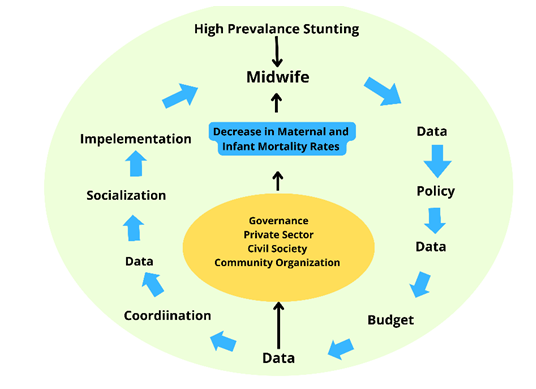
Data Efficiency, effectiveness, responsiveness, and stunting rate reduction programs will be right on target as one of the main agendas in TTS Regency if they are compiled based on accurate data and needs that are in accordance with the field context by mapping and integrating national targets and indicators into the Medium-Term Development Plan. These data can later be used as a reference for determining targets that must be achieved in each region in the TTS Regency.
Policy After the required data is met, the data can later be used as a reference for determining the target of reducing stunting rates that must be achieved in the region with the formulation of policies that are by the stunting problem in various regions in the TTS Regency.
Budget To implement the policy, an adequate budget must be accompanied by accurate data (data-based budget) so that the budget allocation can be mapped for each post and optimally absorbed for the policy implementation to reduce stunting rates in TTS Regency as one of the main agendas.
Coordination If the data and budget that have been prepared have been fulfilled, coordination is needed between institutions tasked with reducing the stunting rate in TTS Regency as one of the leading indicators in the region; this coordination can be in the form of equalization of goals and objectives, division of duties and authorities between organizations and individuals so that they do not overlap and equalization of data and information needed for the implementation of stunting rate reduction which is integrated in TTS Regency.
Socialization Policy socialisation is needed after the data, policies, budget, and coordination have been carried out and deemed sufficient. This is important considering that not all policies have been understood by every policy implementer, especially at the lowest level that directly deals with the community and the community itself, so socialization must be continuously carried out until policy-implementing institutions, policy- implementing individuals (midwives) and the community as policy recipients understand the implementation of reducing stunting rates in TTS Regency is one of the main agendas in the region.
Implementation The last stage is implementing the intervention policy to reduce stunting rates in the TTS Regency. This policy can be implemented when all the above stages are met. This is important considering that each indicator supports the other indicators, so if one of the indicators is not met, the stunting management service system at the health center in South Central Timor Regency will be poorly implemented.
Conclusion
The South Central Timor Regency’s stunting treatment program has qualitative and quantitative variations in collaboration, attachment, regulations, adaptive policies, and the involvement of independent institutions qualitatively and quantitatively, with variations that have yet to be optimally implemented. Several socio-cultural, socioeconomic, budgetary, and regulatory obstacles must be of particular attention before creating an effective service management model. Service implementation must be carried out collaboratively and participatoryly, especially about data, policies, budgets, coordination, socialization, and implementation.
References
-
de Onis M, Branca F (2016) Childhood stunting: a global perspective. Maternal & Child Nutrition 12 (S1): 12-26.
-
Thursday S, Sessions N, Dolan C, Sadler K, Cichon B, et al. (2022) The relationship between wasting and stunting in young children: A systematic review. Maternal & Child Nutrition 18(1): e13246.
-
Salesman F, Tapung MM (2022) The Quality Of Human Resources And The Scientific Culture Issue Post- Pandemic Covid-19 (A Case Study In Indonesia). Journal of Positive School Psychology 2022(6): 8894-8900.
-
Niragire F, Ndikumana C, Nyirahabimana MG, Mugemangango C (2022) Child stunting and associated risk factors in selected food-insecure areas in Rwanda: an analytical cross-sectional study. The Pan African Medical Journal 43: 111.
-
UNICEF (2023) Level and trend in child malnutrition. World Health Organization pp: 4.
-
Santoso H, Nugroho W, Surtinah N (2024) Handling Stunting in Indonesia : Challenges, Progress and Recommendations. 15(02): 1-4.
-
Salesman F, Akram M, Clemens Y, Gobang G (2021) Contributions to quality of health and education to improve the human capital index in Indonesia. International Research Journal of Public and Environmental Health 8(4).
-
Picauly I, Sarci D, Toy M, Gizi J, Masyarakat K (2019) Analisis Determinan Dan Pengaruh Stunting Terhadap Prestasi Belajar Anak Sekolah Di Kupang Dan Sumba Timur, Ntt.
-
Salesman F (2020) Potret Kesehatan Masyarakat di Nusa Tenggara Timur. Jakad Publishing.
-
Suratri MAL, Putro G, Rachmat B, Pracoyo N, Yulianto A, et al. (2023) Risk Factors for Stunting among Children under Five Years in the Province of East Nusa Tenggara (NTT), Indonesia. International Journal of Environmental Research and Public Health 20(2).
-
Sumiaty S, Nur Ali M, Muhammad H, Hafid F (2021) Roles of midwives and Indonesian midwives association in reducing risk factors for stunting in Indonesia. Open Access Macedonian Journal of Medical Sciences 9: 8-13.
-
Malodia S, Dhir A, Mishra M, Bhatti ZA (2021) Future of e-Government: An integrated conceptual framework. Technological Forecasting and Social Change 173: 121102.
-
Kickbusch I, Gleicher D (2014) Smart Governance for health and well-being: the evidence. Smart Governance for Health and Well-Being pp: 172.
-
Gordon D, McKay S, Marchildon G, Bhatia RS, Shaw J (2020) Collaborative Governance for Integrated Care: Insights from a Policy Stakeholder Dialogue. International Journal of Integrated Care 20(1): 3.
-
Junaid SB, Imam AA, Balogun AO, De Silva LC, Surakat YA, et al. (2022) Recent Advancements in Emerging Technologies for Healthcare Management Systems: A Survey. Healthcare (Basel, Switzerland) 10(10).
-
Sari A (2023) The Impact of Good Governance on the Quality of Public Management Decision Making. Journal of Contemporary Administration and Management (ADMAN) 1: 39-46.
-
Khosravi MF, Mosadeghrad AM, Arab M (2023) Health System Governance Evaluation: A Scoping Review. Iranian Journal of Public Health 52(2): 265-277.
-
Nurfatimah N, Ramadhan K, Entoh C, Longgupa LW, Hafid F (2021) Continuity of Midwifery Care Implementation to Reduce Stunting. Open Access Macedonian Journal of Medical Sciences 9(E): 1512-1516.
-
Aguayo VM, Badgaiyan N, Paintal K (2015) Determinants of child stunting in the Royal Kingdom of Bhutan: an in-depth analysis of nationally representative data. Maternal & Child Nutrition 11(3): 333-345.
-
John W, Creswell JDC (2024) Research design. In: 5th (Edn.), SAGE Publications.
- Ramsay Hunt Syndrome Presenting as Gait Imbalance without Facial Paralysis: A Case Report
- Unveiling Hidden Culprits: An Observational Study of Upper Gastrointestinal Endoscopy Findings in Symptomatic Cholelithiasis Patients
- Assessing Health Care Providers’ Proficiency in International Patient Safety Goals: A Study to Assess the Knowledge &Practice on Patient Safety in a Tertiary Care Teaching Hospital in Gujarat
- Challenges in Diagnosing Child Language Disorders
- Acute Small Bowel Obstruction Presenting as Gangrenous Jejunal Loop Secondary to Intestinal Endometriosis – A Rare Case Report
- A Single-Center, Prospective Study Focused on Quality Indicators, Success Rate, Features, Outcomes, and Indications of Endoscopic Retrograde Cholangiopancreatography (ECRP) Practice at a Tertiary Care Hospital