
Carpo-Metacarpal Dorsal Dislocation of the Fourth and Fifth Fingers in a Skier (A Case Report)
The carpometacarpal dislocations are rare injuries. The authors report two cases of dorsal carpometacarpal joint dislocations of the ulnar two fingers, treated by closed reduction and fixation with percutaneous Kirschner-wires. A plaster splint with the wrist in neutral position was applied for six weeks. Active physiotherapy of the fingers was started from four weeks after surgery, with a satisfactory result.
Introduction
Carpometacarpal dislocations of the fingers are rare lesions. The first case was described by Rivingtonin 1873 [1]. The diagnosis is suspected clinically and confirmed by radiology. The treatment consists of an emergency reduction, then stabilize by pins in case of unstable lesion followed by a plaster immobilization.
Clinical case
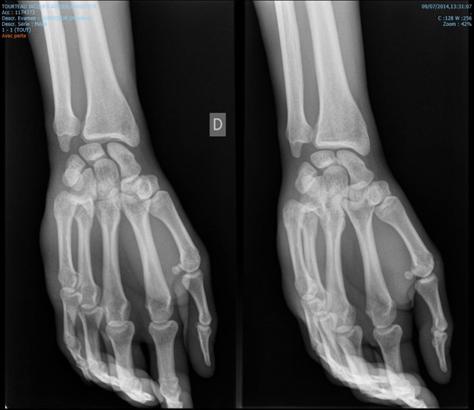
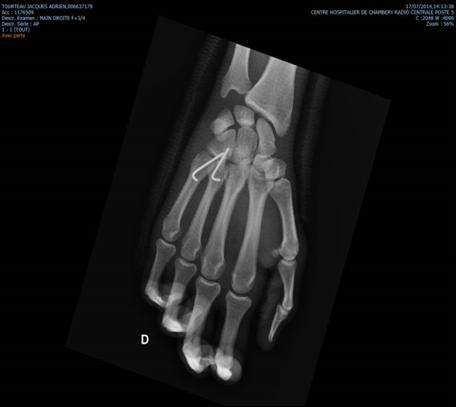
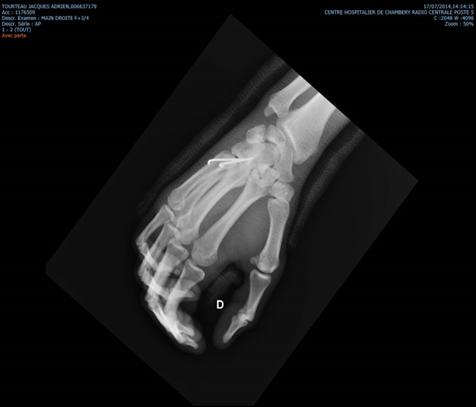
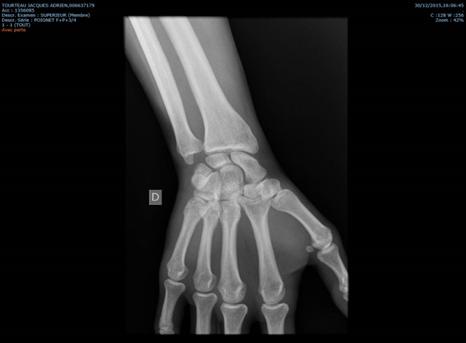
Mr K.R, a 25-year-old amateur skier, is admitted to the emergency department following a closed trauma of the right hand (direct fall on the metacarpal-phalangeal) causing pain and functional impairment. Clinical examination showed a slightedema and deformity of the dorsal aspect of the right hand. The frontal and lateral radiographs of the right hand showed a dorsal, pure, complete and insulated dislocation of the last two fingers (figure 1). The patient was operated on an emergency basis, under loco regional anesthesia, a trophy at the root of the limb. The closed-end carpometa carpal reduction was found to be easy, followed by a synthesis by pinning (figure 2). The wrist was immobilized by an intrinsic splint which was worn for six weeks, then the pins were removed after 8 weeks (figure 3). Active finger rehabilitation was undertaken as early as the fourth postoperative week, keeping the splint between the rehabilitation sessions. At 2 years of retreat, the functional result is satisfactory with good muscular strength and complete recovery of wrist mobility in flexion-extension and fingers. The work was resumed after three and a half months.
Discussion
The carpo-metacarpal articulation is a very stable articulation [2, 3]. All the authors agree to emphasize the extreme violence necessary to disorganize joint articulation [4]. This makes the carpo-metacarpal dislocation of the fingers a rare lesion. It concerns the young adult. Very violent trauma such as traffic accidents are the main ones. However, traumas of lower intensity, such as falls in height and punches, may cause dislocation of the moving metacarpal muscles [5]. If the diagnosis of this type of lesionis made urgently on aradiograph of the hand and the wrist of strict profile (although their interpretation is sometimes difficult) the prognosis is better. It is essential to carry out a strict profile incidence showing the direction of displacement of the metacarpal bases, an oblique incidence givingrise to mobile or fixed metacarpals and a frontal incidence. Some authors recommend complementary to modensitometry [2]. Reduction by external maneuvers with percutaneous pinning is a good treatment in the absence of associated vasculonuclear compression. Spindle stabilization of the carpometacarpal spacing may be oblique, intramedullary or cross-shaped [5]. The result of these carpometacarpal dislocations treated urgently is good and leaves few sequelae [6, 7, 8]. Several complications have been reported in the literature, such as residual hand pain, decreased gripping force, subluxations and secondary displacements [9]. Lawlis and Gunther [5] reported that patients with dislocation of the four carpometacarpal joints performed better than those with dislocation of the second and third rays [5, 10]. The fourth and fifth carpometacarpal joints must be inserted in slight flexion to preserve the curvature of the metacarpal arch [11, 12].
References
-
Kneife F (2002) Simultaneous dislocations of the five carpometacarpal joints. Injury 33: 846.
-
Masquelet AC, Nordin JY, Savary L, Poulizak C (1986) À propos d’un cas de luxation antérieure des quatre derniers métacarpiens. Ann Chir Main 5: 63-66.
-
Lynn AC, Emerson MD (2001) Total metacarpal dislocation. Emerg Med 20: 295-296.
-
Berg field TG, Dupuy TE, Aulicino PL (1985) Fracture- dislocation of all five carpometacarpal joint: a case report. J Hand Surg 10A: 76-78.
-
Lawlis JF, Gunther SF (1991) Carpometacarpal dislocation long term follow up. J Bone Joint Surg Am 73: 52-55.
-
Gore DR (1971) Carpometacarpal dislocation producing compression of the deepbranch of the ulnar nerve. J Bone Joint Surg Am 83: 701-704.
-
Schutt RC, Boswick JA, Scott FA (1981) Volar fracture- dislocation of the carpometacarpal joint of the index finger treated by delayed open reduction. J Trauma 21: 986-987.
-
Weiland AJ, Lister GD, Villareal-Rios A (1976) Volar fracture dislocations of the second and third carpometacarpal joints associated with acute carpal tunnel syndrome. J Trauma 16: 672-675.
-
Waugh RL, Yancey AG (1948) Carpometacarpal dislocations: with particular reference to simultaneous dislocation of the bases of the fourth and fifth metacarpals. J Bone Joint Surg Am 30A: 397- 404.
-
Loudyi D (2009) Luxation carpométacarpienne divergente des quatre derniers doigts. À propos d’un cas. Chir main 28: 168-170.
-
Ameziane L (2002) La luxation carpométacarpienne complète des doigts longs. À propos de 2 cas. Chir main 21: 309-312.
-
Gangloff D (2007) Les luxations carpométacarpiennes du cinquième rayon : étude descriptive à propos de 31 cas. Chir main 26: 206-213.
- Return to Work Among Manual Workers After the Latarjet Procedure: A Cohort Study of 43 Patients
- Refractory Pelvic Collection Following Modified Stoppa Approach for Both-Column Acetabular Fracture Fixation: A Case Report
- Comparative Study of Dynamic Knee Phenotypes Under Loaded and Unloaded Conditions: Clinical Impact
- Locked Intramedullary Nailing of the Tibia Using a Humeral Nail: A Care Case Report
- Subtalar Dislocation: About a Case Report
- Surgical Site Infection in Orthopedics in a Country with LimitedResources: Indications, Treatment and Results