
Financial Impact of Anterior Cruciate Ligament Injuries in Top- Eight European Football Championships
Purpose: Anterior Cruciate Ligament (ACL) rupture is one of the most severe injuries associated with soccer participation. This study aimed to analyze the financial and career impact ACL injuries have on top-level professional soccer players' careers compared to the results with healthy players. Methods: One-hundred ninety-two soccer players who sustained an ACL injury in the top-eight UEFA Championships during three consecutive seasons were enrolled for the study (ACLR group). A healthy control group was matched 1:1 to compare the data to the ACLR group. Outcome measures analyzed included the market value recorded at the time of injury compared to three seasons after return to sport. Results: No significant difference was recorded in the preoperative values (p=0.236). The control group's market value increase was significantly higher than the ACLR group in all the three seasons considered (p<0.05). Conclusion: The mean value of operated players remains unchanged in the first postoperative season and significantly increases after that. This finding confirmed the reliability of the current technique of ACLR in terms of return to sport. However, compared to the control group, the overall increase of the market value is significantly lower, leading to a less optimistic view.
Introduction
Anterior Cruciate Ligament (ACL) rupture is one of the most severe injuries associated with soccer participation, with possibly severe consequences for activity level and quality of life [1, 2]. After an ACL injury in a football player aiming to return to the pre-injury level, the current treatment in most cases is the ACL reconstruction (ACLR) [3, 4]. Nevertheless, many athletes with ACL injury do not return to full sports participation after ACLR and develop degenerative knee diseases [5]. Returning to sports at the pre-injury level is often the primary goal after ACLR in professional football players. Numerous studies have evaluated return to sports (RTS) after ACLR and noted that 63% to 94% of professional players successfully returned to high-level play with a possible impact on players’ careers, including their market value [6, 7, 8, 9].
In recent years, many attempts have been made to examine the financial impact of salary loss, teams’ underachievement, and other ACL injury-related variables. Lu et al. analyzed the relationship between injury, salary and team performance in the Australian soccer league [10]. A recent study showed the financial impact of underachievements due to injury in English Premier League teams [11].
The economic effect regarding ACL injuries has been recently investigated on American Football players’ careers, reporting an average loss of salary for National Football League (NFL) players approaching $2 million due to an ACL tear and reconstruction [12].
The purpose of this study was to analyze the financial and career impact ACL injuries have on top-level professional soccer players’ careers, comparing the results with healthy players. This study hypothesizes that professional soccer players’ market value is affected by the ACL injury, and it could be considered an overall indicator.
Materials and Methods
In this case-control retrospective study, the authors identified male soccer players who sustained an ACL injury in top-eight Championships (Serie A - Italy, Premier League - England, Ligue 1 - France, LaLiga - Spain, Bundesliga - Germany, Jupiler Pro League - Belgium, Liga NOS - Portugal, Premier Liga - Russia) as shown in UEFA Country Ranking during seasons 2014/15, 2015/16 and 2016/17. Outcome measures analyzed included the market value recorded at the time of injury compared to three seasons after RTS.
All data were collected before and after the initial injury using https://www.transfermarkt.com/. Transfermarkt is an independent German-based website and database that provides football information, such as scores, results, statistics, transfer news, and fixtures for each European professional football player. Market prices are expressed in currency euros (millions). Players were excluded if they did not play at least one season of the three after the injury or data are not available. All players belonging to the first team squads each season were eligible for inclusion. Players transferred to other clubs or players who ended their contracts due to injury-related problems were included. Players who give up soccer due to reasons other than the operated knee were excluded.
Return to the same level of play was defined as returning to the highest national league level, irrespective of country, and to the lower level of play as all levels below the highest national league. Statistical analysis was performed with SPSS version 25. Descriptive statistics were performed to summarize the data. Between-group differences were evaluated using the Wilcoxon rank-sum test (Mann-Whitney U test), and p-values <0.05 were considered statistically significant.
Results
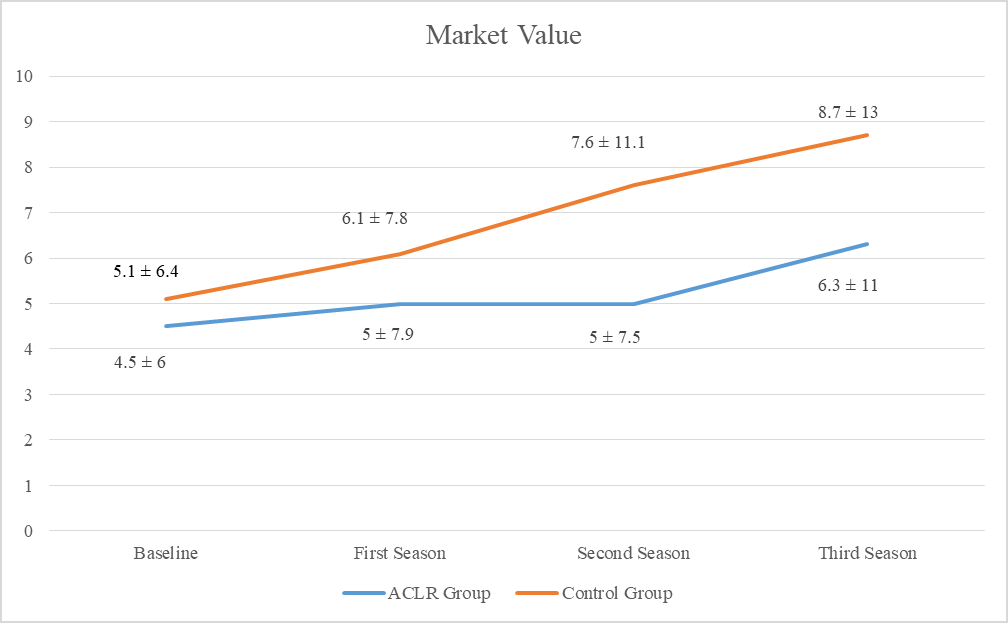
One-hundred ninety-two soccer players were included in the ACLR group. The postoperative players’ market value increased from a baseline value of 4.5 ± 6 million euros (range 0.1-32) to 5 ± 7.9 million euros (p=0.95) in the first season, to 5 ± 7.5 (p=0.043) in the second one and 6.3 ± 11 (p=0.024) in the third. In the control group, players’ market value increased from a baseline value of 5.1 ± 6.4 million euros (range 0.1-30) to 6.1 ± 7.8 million euros in the first season, to 7.6 ± 11.1 in the second one and 8.7 ± 13 in the third. No significant difference was recorded in the baseline values between the two groups (p=0.236). The control group’s market value increase was significantly higher than the ACLR group in all the three seasons considered (p<0.05). Data intergroup comparisons are shown in Table 1 and Figure 1. In the ACLR group, sixty-two players (32%) returned to the lower-level national league, and twenty-four (12.5%) ended their careers three seasons after surgery due to the operated knee. Retired players had an average pre-injury market value of 1.65 ± 1. 42 million, while those who did not retire had an average pre-injury market value of 5. 28 ± 6. 51 million (p<0. 05). The age at the time of injury of retired players was 28.0 ± 5.0 years, while the mean age of non-retired players was 25.0 ± 4.0 years (p<0. 05).
| ACLR Group (n=192) | Control Group (n=192) | PB | |
|---|---|---|---|
| Baseline ± SD | 4.5 ± 6 | 5.1 ± 6.4 | 0.236 |
| First season ± SD | 5 ± 7.9 | 6.1 ± 7.8 | 0.007 |
| Second season ± SD | 5 ± 7.5 | 7.6 ± 11.1 | <0.001 |
| Third season ± SD | 6.3 ± 11 | 8.7 ± 13 | <0.001 |
Table 1: Market Value. Values are in expressed in million Euro; SD, Standard Deviation; b boldface indicates statistical signific
Discussion
The main finding of this study is that, even if consider a value of 0 euros for the 12,5% of players forced to give up professional soccer due to injury or surgery related problems, the actual mean value of operated players remains unchanged in the first postoperative season and significantly increases after that. This finding confirmed the reliability of the current technique of ACLR in terms of RTS. However, comparing the value of injured players with the control group, the overall increase of the market value is significantly lower, leading to a less optimistic view. Despite the potentially severe negative impact of ACL injuries on professional soccer athletes’ careers, to the best of the authors’ knowledge, no studies have analyzed outcomes of ACL injuries in this population in terms of market value. Several papers have evaluated the clinical results of ACLR in professional athletes by assessing as an outcome their rate of return to sport and their performance [9, 13, 14]. Barth, et al. [15], analyzing 176 European professional football players after ACLR, states that 93.2% of athletes returned to play. Still, the performance level was significantly lower than the pre- injury level in terms of games played; minutes played, scored goals and fouls committed. The authors concluded that the ACL tear hurt the career of professional football players. This study shows that 32% of the players evaluated returned to play at a lower level than before the injury. In 12.5% of cases, they stopped their career in the three seasons following the injury. Mai, et al. [16] showed how the rate of return to the game could also vary in consideration of the sport taken into account. Considering the major American professional sports, he found an RTP of 95. 8% in the NHL (hockey), 85.5% in the NBA (basketball), 82.4% in the NFL (football), 81.0% in the MLB (baseball). Also, by assessing the performance level in the seasons following the RTP, the author showed how NFL players were those with the worst prognosis after the ACLR with a significant shortening of their career. Few studies, to the author’s knowledge, have assessed the impact of this type of injury from the point of view of the athletes’ economic value during the seasons following the injury. A recent study showed the economic effect of ACL injuries on American Football players’ careers.
After an ACL injury, NFL players are less likely to remain in the league and have a lower mean salary than uninjured controls. Overall, this results in a $2 million decrease in earnings over the next four seasons compared with uninjured controls [12]. Football is currently the leading sport in Europe, in terms of number of players and interest from fans. Combining this factor with how some investment fans’ interest teams ensure the best athletes’ performance makes it possible to understand how an injury as frequent and potentially disabling as the ACL tear represents an important fear for both athletes and their teams. This paper showed that the market value of players who suffered an ACL injury in the three seasons following the injury increased in majority of the athletes studied. This data, apparently positive, actually shows several aspects that need to be taken into account; in the control group, selected taking players with the same characteristics but who had not suffered an ACL injury, there was an increase in market value over the next three seasons significantly higher than the group of players who had suffered an ACL injury. Combining this significant data with the rate of players who have returned to play but at a lower level than in the seasons prior to the injury, and the rate of players who retired in the three seasons immediately following the injury, the ACL injury is still a factor that significantly affects the career of a top professional athlete.
Another significant finding is the correlation found between market value at the time of injury and retirement after ACLR. Players who retired in the three seasons following injury had a significantly lower market value than those who continued their careers (1. 65 ± 1. 42 million vs. 5. 28 ± 6. 51 million). This finding is partially associated with the age factor, which was higher in athletes who retired than in those who continued their careers. The average age of retired players was28. 0 ± 5. 0 years, although higher than that of non-retired athletes, not so old as to justify a higher retirement rate. There were a few limitations to this study. All data regarding ACL injuries were acquired through publicly available sources. The purpose of the study was to identify all players who had suffered an ACL injury during the seasons studied, and only injuries for which a news source describing the injury could be obtained were included in the analysis. It is certainly possible that some ACL injuries were missed though. Additionally, without available medical records or imaging, concomitant meniscus, collateral ligament, articular cartilage injuries, surgical technique, choice of graft, and rehabilitative protocols could not be categorized. Unfortunately, news reports describing these ACL injuries underreported concomitant injuries, and we were not able to analyze how this influenced players’ recoveries and the implications that these may have, and we were not able to analyze how this influenced players’ recoveries and the implications that these may have had on the market value attributed to players in the seasons examined.
Conclusion
The mean value of operated players remains unchanged in the first postoperative season and significantly increases after that. This finding confirmed the reliability of the current technique of ACLR in terms of return to sport. However, compared to the control group, the overall increase of the market value is significantly lower, leading to a less optimistic view. It is also necessary to consider the significant percentage of athletes who have switched to lower competitive categories in the seasons following the injury or, in some cases, ended their careers.
References
-
Hewett TE, Di Stasi SL, Myer GD (2013) Current concepts for injury prevention in athletes after anterior cruciate ligament reconstruction. Am J Sports Med 41(1): 216- 224.
-
Walden M, Krosshaug T, Bjorneboe J, Andersen TE, Faul O, et al. (2015) Three distinct mechanisms predominate in non-contact anterior cruciate ligament injuries in male professional football players: a systematic video analysis of 39 cases. Br J Sports Med 49(22): 1452-1460.
-
Ardern CL, Taylor NF, Feller JA, Webster KE (2012) Return-to-sport outcomes at 2 to 7 years after anterior cruciate ligament reconstruction surgery. Am J Sports Med 40(1): 41-48.
-
Ardern CL, Webster KE, Taylor NF, Feller JA (2011) Return to the preinjury level of competitive sport after anterior cruciate ligament reconstruction surgery: two- thirds of patients have not returned by 12 months after surgery. Am J Sports Med 39(3): 538-543.
-
Lohmander LS, Englund PM, Dahl LL, Roos EM (2007) The long-term consequence of anterior cruciate ligament and meniscus injuries: osteoarthritis. Am J Sports Med 35(10): 1756-1769.
-
Ardern CL, Taylor NF, Feller JA, Webster KE (2014) Fifty-five per cent return to competitive sport following anterior cruciate ligament reconstruction surgery: an updated systematic review and meta-analysis including aspects of physical functioning and contextual factors. Br J Sports Med 48(21): 1543-1552.
-
McCall A, Davison M, Andersen TE, Beasley I, Bizzini M, et al. (2015) Injury prevention strategies at the FIFA 2014 World Cup: perceptions and practices of the physicians from the 32 participating national teams. Br J Sports Med 49(9): 603-608.
-
McCall A, Dupont G, Ekstrand J (2016) Injury prevention strategies, coach compliance and player adherence of 33 of the UEFA Elite Club Injury Study teams: a survey of teams’ head medical officers. Br J Sports Med 50(12): 725-730.
-
Walden M, Hagglund M, Magnusson H, Ekstrand J (2011) Anterior cruciate ligament injury in elite football: a prospective three-cohort study. Knee Surg Sports Traumatol Arthrosc 19(1): 11-19.
-
Lu D, McCall A, Jones M, Steinweg J, Gelis L, et al. (2020) The financial and performance cost of injuries to teams in Australian professional soccer. J Sci Med Sport 24(5): 463-467.
-
Eliakim E, Morgulev E, Lidor R, Meckel Y (2020) Estimation of injury costs: financial damage of English Premier League teams’ underachievement due to injuries. BMJ Open Sport Exerc Med 6(1): e000675.
-
Secrist ES, Bhat SB, Dodson CC (2016) The Financial and Professional Impact of Anterior Cruciate Ligament Injuries in National Football League Athletes. Orthop J Sports Med 4(8): 2325967116663921.
-
Walden M, Hagglund M, Magnusson H, Ekstrand J (2016) ACL injuries in men’s professional football: a 15-year prospective study on time trends and return-to-play rates reveals only 65% of players still play at the top level 3 years after ACL rupture. Br J Sports Med 50(12): 744-750.
-
Zaffagnini S, Grassi A, Marcheggiani Muccioli GM, Tsapralis K, Ricci M, et al. (2014) Return to sport after anterior cruciate ligament reconstruction in professional soccer players. Knee 21(3): 731-735.
-
Barth KA, Lawton CD, Touhey DC, Selley RS, Li DD, et al. (2019) The negative impact of anterior cruciate ligament reconstruction in professional male footballers. Knee 26(1): 142-148.
-
Mai HT, Chun DS, Schneider AD, Erickson BJ, Freshman RD, et al. (2017) Performance-Based Outcomes After Anterior Cruciate Ligament Reconstruction in Professional Athletes Differ Between Sports. Am J Sports Med 45(10): 2226-2232.
- Return to Work Among Manual Workers After the Latarjet Procedure: A Cohort Study of 43 Patients
- Refractory Pelvic Collection Following Modified Stoppa Approach for Both-Column Acetabular Fracture Fixation: A Case Report
- Comparative Study of Dynamic Knee Phenotypes Under Loaded and Unloaded Conditions: Clinical Impact
- Locked Intramedullary Nailing of the Tibia Using a Humeral Nail: A Care Case Report
- Subtalar Dislocation: About a Case Report
- Surgical Site Infection in Orthopedics in a Country with LimitedResources: Indications, Treatment and Results