
Pyrrolizidine Alkaloids from Faujasiopsis flexuosa (Lam.) C. Jeffrey subsp. bourbonensis C. Jeffrey (syn. Faujasia flexuosa (Lam) Baker var. subcordata Cordem)
<p>A total of 136 mg of alkaloidal extract from leaves and 70 mg from stems of the endemic plant Faujasiopsis flexuosa (Lam) C. Jeffrey subsps. bourbonensis C. Jeffrey (syn. Faujasia flexuosa (Lam) Baker var. subcordata Cordem) growing on Réunion island was investigated for their content of pyrrolizidine alkaloids. The plant is used traditionally against dysentery, diabetes and asthma. Our investigation showed that fourteen pyrrolizidine alkaloids are contained in F. flexuosa. Two of them (senecionine and seneciphylline) show toxic side-effects. Therefore, medical preparations from this plant should only be used under strong restrictions.</p>
Introduction
Faujasiopsis flexuosa (Lam.) C. Jeffrey, subsp. bourbonensis C. Jeffrey (Asteraceae) (syn. Faujasia flexuosa (Lam) Baker var. subcordata Cordem) is an endemic species of the polymorphic species Faujasiopsis flexuosa (Lam.) C. Jeffrey growing on the Réunion island in the Mascarene islands [1]. Vernacular names are mostly related to the twisting aspect of this liana: “Liane zig-zag”, “Zigzag”. Traditionally F. flexuosa is used against dysentery, diabetes and asthma, depending on the subspecies and on the island [2, 3, 4, 5, 6]. Furthermore it has been reported that F. flexuosa shows free radical scavenging and antioxidant activities as well as antimicrobial effects and in vitro immunomodulating Journal of Natural & Ayurvedic Medicine
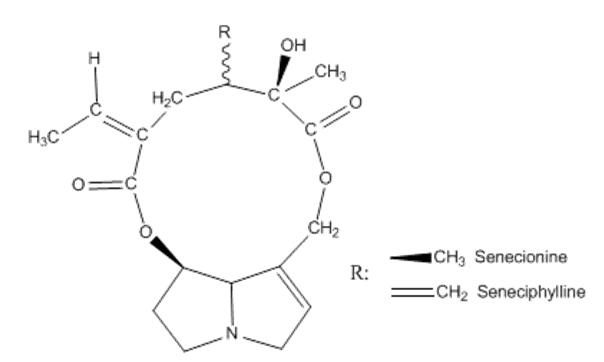
activity [7, 8, 9]. As the plant belongs to the tribe Senecioneae it was suspected to contain pyrrolizidine alkaloids (PAs) [10]. Many episodes of severe intoxications are reported caused by the use and uptake of medical remedies prepared from plant material which contains toxic PAs [11, 12]. To evaluate a possible human risk when using F. flexuosa medically we investigated the plant with respect to the occurrence of toxic PAs. Besides the non-toxic PAs O7-angeloylplatynecine, Platyphylline, Neoplatyphylline and three isomers of Platyphylline we isolated two toxic ones: Senecionine and Seneciphylline [11]. On account of the latter finding the medical use of the plant is only justified if herbal preparations from them are shown to be free of the toxic PAs.
Materials and Methods
Materials
Authentic samples of Faujasiopsis flexuosa subsp. bourbonensis were collected in Grand Etang (La Réunion, France) in November 2011 and were identified by E. Girard-Valenciennes, A. Marvilliers and Hermann Thomas. Vouchers specimens (REU08613, 08614, 08615) were deposited in the Botanical Herbarium of University of La Réunion.
Preparation of the Extracts
Dried ground aerial parts of F. flexuosa were extracted by accelerated solvent extraction (ASE) by the methods of Hubert et al. and Li et al. [13, 14]. This was performed by an ASE 300 apparatus equipped with a solvent controller (Dionex, Voisins Le Bretonneux, France). The system accelerates the extraction of organic compounds by using solvents at elevated temperatures and pressure. In our investigation we packed about 35g of dried and milled plant material into each extraction cell equipped with a glass-fiber filter (1µm) to prevent elution of particles into the collection vials. For each cell a sequence of extraction, consisting of 5 cycles, was repeated: three times for leaves, two times for stems. Each collected extract was purged with nitrogen for 2 minutes before the next cycle. At the end of the procedure all extracts were gathered and evaporated under reduced pressure to dryness under controlled temperature at 45°C. Extraction of 195 g of leave and 453 g of stem material yielded for each 8g dry extracts. After a liquid-liquid separation and purification with respect to alkaloids we obtained 135 mg (leaves) and 70 mg (stems) of crude alkaloid extracts. The extracts were combined, resolved in 3mL of dichloromethane and applied on a SPE column (500 mg Diolphase, Macherey & Nagel, Düren, Germany). The column was washed three times with dichloromethane (1 mL) and then eluted with 5 ml of a mixture of methanol- acetonitrile (1:1). The methanol-acetonitrile extract was evaporated to dryness under reduced pressure. For the GC and GC-MS analysis the extract was resolved in 1mL of a methanol-dichloromethane (1:1) mixture.
Chromatographical and Spectroscopical Identification of the PAs
The identification of the PAs were performed using a GC Hewlett Packard 5890, Series II, equipped with a NP- detector and an auto sampler 7673A and a GC-MS Hewlett Packard 5890 GCD equipped with an EI MS and an auto sampler 7673. In both cases a 60m Optima column was used (Macherey & Nagel, Düren, Germany; 0.25µm layer, 0.32mm diameter). Mobile phase: helium, 0.854mL/min. Automatic injection of 3µL. Injector-, detector- and GCMS transfer line-temperature: 300°C. MS: EM voltage 400. Temperature program: 170°C (5 min), 10°/min. up to 280°C (20 min). The PAs were identified by their MS decay and GC comparison with authentic reference samples isolated from natural sources.
Results
Identification of compounds EI-MS m/z (rel. int): Senecionine (7): 335 [M]+ C18H25NO5 (5.55), 307 (1.23), 291 (1.48), 246 (9.63), 220 (31.48), 138 (92.35), 136 (100), 120 (95.68), 94 (69.14), 80 (48.15). Seneciphylline: (8): 333 [M]+ C18H23NO5 (2.31), 305 (0.06), 289 (0.24), 246 (0.60), 220 (0.37), 138 (65.85), 136 (75.31), 120 (100), 94 (81.34), 80 (48.17). Platyphylline (9): 337 [M]+ C18H27NO5 (0.36), 320 (1.87), 309 (0.10), 266 (4.67), 211 (26.82), 140 (96.23), 136 (70.00), 122 (83.83), 96 (36.43), 82 (100). O7-angeloylplatynecine (1): 239 [M]+ C13H21NO3 (3.45), 221 (7.02), 140 (8.57), 139 (15.60, 122 (11.67), 95 (96.97), 82 (100). The structures of the PAs 2–6 (Table 1) could not be established on account of the low content, but could be classified to be non-toxic ones on account of the MS decay between m/z 140 to m/z 82. Neoplatyphylline and the isomers show a similar MS decay like Platyphylline and differ only in the intensities of the fragments and were identified by comparison with authentic samples.
- Journal of Natural & Ayurvedic Medicine
- S.No
- Alkaloid amount (%)
- 1
- O7-angeloylplatynecine
- 9.59
- 2 non-toxic PA
- 1.28
- 3 non-toxic PA
- 0.8
- 4 non-toxic PA
- 2.97
- 5 non-toxic PA
- 0.73
- 6 non-toxic PA
- 0.89
- 7
- Senecionine*
- 3.05
- 8
- Seneciphylline*
- 4.91
- 9
- Platyphylline
- 18.12
- 10
- Neoplatyphylline isomer
- 1.84
- 11
- Neoplatyphylline
- 38.74
- 12
- Platyphylline isomer A
- 11.56
- 13
- Platyphylline isomer B
- 4.12
- 14
- Platyphylline isomer C
- 1.4
- * = toxic PAs11
Table 1: PAs from F. flexuosa.
EUPATMEX #269 [modified by Helmut Wiedenfeld] Faujasiopsis flexuosa 2 FP 20ml GC mV $$ \mathrm {E} = \frac {1}{2} \mathrm {A} ^ {2} + \mathrm {B} ^ {2} $$
Discussion
The results of our investigation show that fourteen PAs could be identified occurring in F. flexuosa. The main alkaloids are the non-toxic ones Platyphylline, Neoplatyphylline, O7-angeloylplatynecine and 4 isomers of Platyphylline and Neoplatyphylline (the isomers are differing from the 2 PAs only in their relative intensity of the MS-decay). Two toxic alkaloids (Senecionine and Seneciphylline) could also be identified (Figure 1) [11].
11 - Neoplatyphylline
9 - Platyphylline
12 - Platyphylline isomere
8 - Seneciphylline
13 - Platyphylline isomere
7 - Senecionine
From 648 g of dried plant material we isolated 26.762 mg PAs; that means that the PA content in dried plant material is in a range of 0.004%. The amount of the two toxic PAs with 8% of the total PA-content occurs in a very low range (Table: 1). On account of this findings it seems not to be justified to ban the medical use of F. flexuosa. Nevertheless, we recommend to control the use: as two toxic PAs are contained, preparations from this plant should be monitored for the absence of toxic PAs to prevent a human risk and severe side-effects, especially in such cases where a medical application is intended over longer periods. Our results establish that the classification of F. flexuosa into the tribe Senecioneae and the subtribe Senecioninae is justified. For us, the botanical view of this plant draws the conclusion to be a member of the tribe Eupatorieae than Senecioneae. This is underlined by the fact that the name Eupatorium flexuosum is an accepted synonym for the species Faujasiopsis flexuosa [15]. But, as we found only PAs from the chemical class of macrocyclic diesters (O7-angeloylplatyphylline can occur in Senecioneae) and not open-chain mono-and/or diesters (as exclusively occurring in plants from the Eupatorieae tribe) this chemotaxonomical aspect verifies the actual classification.
References
-
Index de la flore vasculaire de La Réunion, 2015. 1. Version.
-
Gurib-Fakim A, Guého J, Bissoondoyal MD (1995) Plantes Medicinales de Maurice. Edition de l`Océan Indien, Roshill Maurice.
-
Gurib-Fakim, A, Sewraj MD, Gueho J, Dullo S (1996) Medicinal Plants of Rodrigues. Int J Pharmacogn 34 : 2-14.
-
Lavergne R (1999) Tisaneurs et Plantes Médicinales Indigènes de l'Ile de La Réunion, Editions Orphie, Livry-Gargan, France.
-
Mahomoodally MF, Subratty AH, Gurib-Fakim A, Choudhary MI, Khan SN (2012) Traditional Medicinal Herbs and Food Plants have the Potential to inhibit Key Carbohydrate Hydrolysing Enzymes in Vitro and reduce Postplandrial Blood Glucose. Scientific World J 2012: 1-9.
-
Picot CMN, Subratty AH, Mahomoodally MF (2014) Inhibitory Potential of five Traditionally used Native Antidiabetic Medicinal Plants on α-Amylase, α- Glucosidase, Glucose Entrapment and Amyolysis Kinetics in Vitro. Advances in Pharmacological Sciences 2014: 1-8.
-
Poullain C, Girard-Valencienne E, Smadja J (2004) Plants from Réunion island : evaluation of their free radical scavenging and antioxidant activities. J Ethnopharmacol 95(1): 19-26.
-
Narod FB, Gurib-Fakim A, Subratty AH (2004) Biological investigations into Antidesma madagascariense Lam. (Euphorbiaceae), Faujasiopsis flexuosa (Lam.) C. Jeffrey (Asteraceae), Toddalia asiatica (L.) Lam. and Vepris lanceolata (Lam) G. Don. J Cell Mol Biol 3: 15-21**.**
-
Mahomoodally MF, Mesaik A, Choudhary MI, Subratty AH, Gurib-Fakim A (2012) In vitro modulation of oxidative burst via release of reactive oxygen species from immune cells by extracts of selected tropical medicinal herbs and food plants. Asian Pac J Trop Med 5(6): 440-447.
-
Roeder E, Wiedenfeld H (2011) Pyrrolizidine Alkaloids in plants used in the traditional medicine of Madagascar and the Mascarene Island. Pharmazie 66(9): 637-647.
-
Wiedenfeld H, Edgar J (2011) Toxicity of pyrrolizidine alkaloids to humans and ruminants. J Phytochem Rev 10(1): 137-151.
-
Wiedenfeld H, Roeder E, Bourauel TH, Edgar J (2008) Pyrrolizidine Alkaloids. Structure and Toxicity. V&B unipress. Bonn University Press. ISBN : 978-3-89971- 426-5.
-
Hubert A, Wenzel KD, Manz M, Weissflog L, Engewald W, Schüürmann G (2000) High extraction efficiency for POPs in real contaminated soil samples using accelerated solve extraction. Analytical Chemistry 72(6): 1294-1300.
-
Li D, Shim JO, Fang Y (2006) Accelerated solvent extraction of nonylphenolic estrogene compounds from sediments. Chin J Analyt Chem 34: 633-663.
-
The Plant List : Faujasiopsis flexuosa (Lam.) C.Jeffrey.
- Management of Ear Keloid with Ksharsutra: A Case Study
- Yoga and Global Sustainability: A Holistic Path to One Earth, One Health
- Autoimmune Diseases in Ayurveda: A Narrative Review with Classical and Modern Perspectives
- Management of Cluster Headache Associated with Pituitary Apophysitis by CERT (Chakrasiddh Energy Release Technique): A Case Report on Energy Rebalancing
- Zygophyllum Geslini Coss : Biochemicals and Antioxidant Activity
- Observations of a Beginner Vaidya