
Classical Ayurvedic Management of Acne Vulgaris: A Case Report
Acne vulgaris is a chronic inflammatory disease of the pilo-sebaceous unit, characterized by papules, pustules and often scarring, mainly on the face, upper trunk and back. Acne vulgaris is a nearly universal skin disorder affecting 79 to 95% of youths. In today's era, stress, increasing pollution, changes in diet, lifestyle changes, hormonal changes and the number of youths suffering from acne vulgaris problem is increasing. In Ayurveda it can be called as Mukhadushika. It is otherwise called as Yuvanpidika (Acne vulgaris). In Sushruta Samhita, Mukhadushika is mentioned under the kshudraroga. Acharya Sushruta has described Mukhadushika as a particularly thorn-like eruption on the face of adolescents. According to Ayurveda, mukhadushika occurs due to vitiation of kapha dosha, vata dosha and raktadushti . In present case study, there is kaphavata dominancy with involvement of raktadosha. Patient was prescribed the Ayurvedic medicines Lodhradi lepa, Mahatiktaka ghritam, Dashamoola kwath churna on OPD basis. From this case study it can be concluded that Ayurvedic formulations are effective in the mukhadushika (Acne vulgaris).
Introduction
The skin is often referred to as the largest body organ and helps as the main protective fence against damage to internal tissues from trauma, ultraviolet light, temperature, toxins and bacteria. Everyone wants to look his/her face attractive, clean and good-looking. Even a small spot on the face especially of younger ones causes worry. This is one of the social stigmas. Acne is the scourge of mankind and the parody of youth. Acne vulgaris, one of the most commonly seen diseases in teenage years, it is a chronic inflammatory disease of pilo-sebaceous units, categorized by the development of comedones in forms of papules, pustules and less commonly nodule [1]. According to the Global Burden of Disease (GBD) study, Acne vulgaris affects approximately
85% of young adults with age group ranging from 12-25 years. Many research studies have reported acne in 79-95% in the age group of 16-18 years. In India, research studies have reported acne in 50.6% of boys and 38.13% of girls in the age group of 12-17 years.
Acne affects skin of the face, the upper part of the chest and the back. Acharya Charaka said that, ‘the skin is one of the important sense organs in all of five-sense organ’. It is called as Sparshendriya which occupies whole body and Manas (Mind) also [2]. In Ayurveda texts there is a group of diseases called Kshudra Roga [3], which include 44 diseases. According to Sushruta, 44 diseases have been described under this group. Mukhadushika (Acne vulgaris) is one of the diseases among them. Mukhadushika is a disease that occurs as papules resembling the sprout on the bark of the shalmali tree (Bombax malabaricum) appearing on the face and adolescents caused by vitiated kapha, vata dosha and Rakta dushti together which makes the face dreadful and also known as Yuvanapidika. Vitiation of Kaphadosha, Vatadosha and Rakta dushti lead to Mukhadushika according to Ayurveda. Two main kinds of chikitsa are described i.e., Shodhana chikitsa (purification) and Shamana Chikitsa (pacifying medicines) in Ayurveda treatment for Mukhadushika. Shodhana(purification) includes Vaman and Nasya, whereas Shamana (pacifying medicines) includes Lepa (local application)[4], Upanah (medicinal poultice) and Kshara (alkali) application . Also, several Ayurvedic proprietary medicines are available in the market for the treatment of acne.
Still Acne is a treatable disease. Mild cases require just topical therapy. But mild to severe needs both oral and topical treatment. Topical application with antibiotic agents (tetracycline, clindamycin) benzoyl peroxide and comedolytic drugs- tretinoin acid. These are irritant and drying preparations hence to be used at night. Oral low dose antibiotics e.g Tetracyclines, doxycycline [5]. Side effect of antibiotics loss of appetite, nausea and vomiting, rash, sensitivity to the sun etc, comparatively in Ayurvedic treatment there is likely to fewer side effects. In the present scenario, there are many treatment options available for the management of acne vulgaris. In this case report, we are going to discuss about a case study of acne vulgaris with its Ayurvedic management.
Case Report
A 23-years old Indian female presented in the OPD of NIA Jaipur in January 2022, with the complaints of Papules & pustules on face and back itching over lesions burning sensation also present after itching. Redness of face and neck with dull skin since 1 year also appeared mentally stressed. She had taken treatment of allopathic medicine, but did not get relief. There was no significant past history of any type of systemic illness found. On Ayurvedic parlance, the present case was diagnosed as mukhadushika based on the signs and symptoms described in classical texts.
Therapeutic Intervention
Patient was prescribed the following Ayurvedic medicines on OPD basis: Lodhradi lepa mix with water for external use described in Asthang hridaya, chikitsa sthan, and mukhadushika treatment. Internal medicines also prescribed as a combination of Suddha Gandhak and Panchnimba churna with honey twice a day before meals, Dashmoola Kwatha churna twice a day and Mahatikta Ghritam twice a day with food. Advised medicine and posology shown in Table 1.
| Drug | Anuoan | Duration | |
|---|---|---|---|
| 1 | Lodhradi lepa | Once a day for local application with luke-warm water | 15 day |
| 1 | (AH-ut-)32-03 | Once a day for local application with luke-warm water | 15 day |
| 1 | Lodhra | Once a day for local application with luke-warm water | 15 day |
| 1 | Dhanyaka | Once a day for local application with luke-warm water | 15 day |
| 1 | Vacha along with Sarshapa | Once a day for local application with luke-warm water | 15 day |
| 1 | Beej, Saindhava | Once a day for local application with luke-warm water | 15 day |
| 2 | Sudha gandhak 250mg + | With honey | 15 day |
| 2 | Panch nimba churna 3 gm | Twice a day | 15 day |
| 3 | Dashamoola kwath | 30 ml twice a day | 15 day |
| 4 | Mahatikta ghritam | 10 ml twice a day with food | 15 day |
Table 1: Advised Medicine and Posology.
Follow Up and Outcome
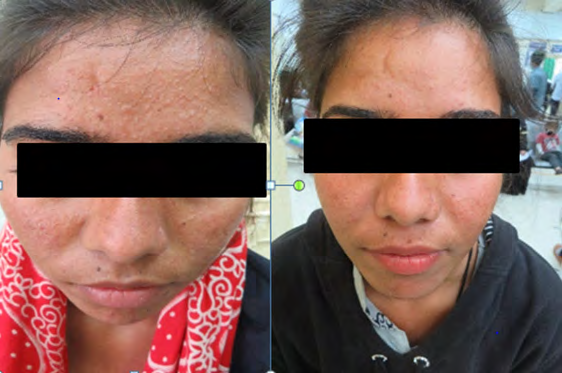
First follow up was taken after 15 days & same treatment was continued for next 15 days. Itching sensation, discoloration of back region and redness was relieved within 15 days. Second follow up was taken after next 15 days i.e.
after 1 month. Third follow up was taken after next 15 day i.e.,45 day and treatment continued, but combination of Sudha gandhak 250 mg and panchanimba choorna 3gmBD was stopped and lodhradilepa along with all medicine was continued. Before and after treatment grading of symptoms is shown in Table 2.
| Follow up | Duration | Symptoms | |||
|---|---|---|---|---|---|
| Papule | Itching | discoloration | Redness | ||
| 1 | 15 day | + | Nil | ++ | ++ |
| 2 | 30 day | + | + | Nil | |
| 3 | 45 day | Nil | Nil | + | Nil |
Table 2: Before and after treatment grading of symptoms.
Discussion
In this case study, patient got complete relief from symptoms of mukhadushika. and noticed the glow of the skin was also improved. Two main kinds of chikitsa are described i.e.,Shodhanachikitsa and Shamana Chikitsa in Ayurveda treatment for Mukhadushika. Shodhanaincludes Vaman and Nasya, whereas Shamana includes Lepa, Upanahand Kshara application.
In this case patient was having symptoms Vitiation of Kapha dosha, Vata dosha and Rakta dosha lead to Mukhadushika according to Acharya susruta. Ayurvedic drug management to disintegrate the pathogenesis of mukhadushika includes the drugs with following properties. Shamana Yogawas given as a combination of Sudha gandhak 250 mg and panchanimbachoorna 3gmBD, mahatiktaghrita 10 ml BD mix with food and dasha moola Kwatha 20 ml along with local application of lodharadi lepa described in Asthang hridaya, Uttara tantrta, Kshudraroga pratisheda adhyaya, Mukhadushika prakarana. Rasayana Chikitsa was also given mix with honey 5 gm orally on empty stomach. Main contents of panchanimba choorna are Nimba, Aragwadha, Amalaki, Marichaand Haridra [6]. This choorna has Pitta Shamaka, Kusthaghna and Kandughna properties. This Kalpais useful for vitiated Kapha Dosha, Rakta Dushti and kandu (itching).This combination was given with Anupana as dasha moola kwatha [7]. Contents of dasha moola kwatha are Prishniparni, Bruhati, Kantakari, Gokshur, Bilva, Agnimanth, Shyonak, Gambhari, Patala, Shaliparni. This Kwatha has vataghna, Kaphaghna, shothaghna (anti-inflammatory) and shoolanasaka (analgesic) property. Mahatiktak Ghrita (medicated ghee) was given orally mix with food twice a day [8]. It acts to pacify Vata and pitta Dosha.
Patient was adviced for local application of lodharadilepa once a day at area of lesion. Content of lodhradi lepa are lodhra, vacha and dhanyaka. Lodhradi Lepa is a topical administration which is predominantly Vata-kapha Shamaka which relievesin Vedana and Kapha dominant symptoms like Kandu and Shotha etc [9]. The main property of this lepa is reduce acne. In the concept of dhamanisharir Acharya Susruta explain the effect of lepa, abhyanga, parisheka etc. are carried through triykagata dhamanis [10]. Triyakgata dhamanis are divided into hundered and thousand in branches. They open up on the layer of twaka and they are responsible for carrying sweda and replenish rasa inside and outside; through only viryas of massage, bath and lepa enter into the body being transformed in skin.
Conclusion
Lodhradi lepa effectively disintegrated the pathogenesis of mukhadushika, provided good relief in papules, pustules and redness, discoloration on face, neck region and back and itching over papules. This case illustrates the effective management of Mukhadushika with classical Ayurvedic medicines with no adverse reactions.
References
-
Sushruta 2009 Nidanasthana, Susrutha Samhitha Dalhana Nibandasanraha. Chaukhamba Orientalia, Varanasi, India, 13(39): 323.
-
Kashinath Shastri 2013 Sutra Sthana, Charaka Samhita of Agnivesha with Vidyotini Hindi commentary. Chaukhambha Sanskrit Sansthan, Varanasi, India, 11(38).
-
Shastri AD 2005 Nidanasthana, Susruta Samhita Ayurved Tatva Sandipika. Chaukhamba Sanskrit Publication, Varanasi, India, 13(39).
-
Shastri B 2012 Yogaratnakara of Lakshmipati Shastri. Chaukhambha Prakashan, Varanasi, India pp: 272-273.
-
Chugh SN 2013 Test book of medicine Reprint edition. Arya Publications, New Delhi, India, pp:1237-1238.
-
Ambikadattav Shastri 2005 Bhaishjaratnavali Video 18 revised edition. Chaukhambha orientalia, Varanasi, India, 5/86-91.
-
Susruta 2005 Sutrasthana, Susruta Samhita AyurvedTatvaSandipika. In: Ambika Datta Shastri (Ed.). Chaukhamba Sanskrit Publication, Varanasi, India, 38: 67-69.
-
Tripathi B 2015 Sharangdhara, Madhyamakhanda Sharangdhar Samhita. Chaukhamba Surbharati Prakashana, Varanasi, India, pp: 136.
-
Sastri VL, Sastri BB 2012 Yogaratnakara hindi commentary, Kshudra roga nidana chikitsa prakaranam- 4th shloka. Chaukambha Prakashan Varanasi, India, pp: 282.
-
Susruta 2005 Sharirsthana, Susruta Samhita Ayurved Tatva Sandipika. In: Ambika Datta Shastri (Ed.). Chaukhamba Sanskrit Publication, Varanasi, India, 9(8- 9).
- Management of Ear Keloid with Ksharsutra: A Case Study
- Yoga and Global Sustainability: A Holistic Path to One Earth, One Health
- Autoimmune Diseases in Ayurveda: A Narrative Review with Classical and Modern Perspectives
- Management of Cluster Headache Associated with Pituitary Apophysitis by CERT (Chakrasiddh Energy Release Technique): A Case Report on Energy Rebalancing
- Zygophyllum Geslini Coss : Biochemicals and Antioxidant Activity
- Observations of a Beginner Vaidya