
Digital Technologies for Management of Dementia and Future Directions
Dementia is rising like an epidemic and the global burden of the disease is increasing with each passing day. Advancement in technologies has resulted in extended life and we will witness more prevalence of dementia in these elderly people. The fastest growth in the elderly population is taking place in China, India, and their south Asian and western Pacific neighbors and this country will face a daunting task in the management of dementia soon. The prevalence of vascular diseases such as diabetes further aggravates the situation. Luckily digital health technologies are becoming mature, and many approved technologies are available for use now. This study explores the potential of these technologies and maps them as a possible solution in the management of dementia. The findings of the study are useful for clinicians, health technology researchers, and health policymakers.
Introduction
Dementia is becoming a global health challenge worldwide. There were more than 55 million reported cases of dementia in 2020 and this number is growing with each passing day. The annual increase in the count is over 10 million, making it one new reported case every 3.2 seconds. According to Alzheimer’s Diseases International (ADI), the prevalence of dementia will double every 20 years, making 78 million by 2030 and 139 million by 20501. More than 60% of these live in low- and middle-income countries where the healthcare facility is inadequate to meet the existing demand for care (Figure 1). To address this pressing issue strategic planning is needed at the government level [1].
![Figure 1: Forecasted Growth of Dementia Globally [2].](/fulltextimages/9864/fig_1.png)
Understanding Dementia
There is a wider misconception that dementia is a disease or synonym for Alzheimer’s. Dementia is rather a physiological state in which a patient’s cognitive functioning such as thinking, remembering, and reasoning is impaired to such as extent that it compromises their quality of life. Common causes of dementia are Alzheimer’s disease, Vascular complications, Lewy body, and Frontotemporal, out of these first ones is the most common cause [3]. Dementia is classified into two groups, reversible (pseudo-dementia) and irreversible (non-pseudo-dementia). Irreversible dementia causes changes in behavior and personality. With the availability of superlative care, the number of people living longer is increasing [4]. These elderly people are at greater risk of developing dementia (about one-third of all people aged 85 or older may have some form of dementia) [5]. The fastest growth in the elderly population is taking place in China, India, and their south Asian and western Pacific neighbors. The prevalence of vascular diseases such as diabetes further aggravates the situation [6].
The research Objective for this study is to identify the technologies shaping the landscape for digital health. The study further maps these technologies for further solutions for the management of dementia.
Methods
This study uses focus group discussion to identify the leading digital technologies. The study further utilizes another focus group to map these technologies as a solution in the management of dementia. A focus group discussion is a research method that involves a group of individuals who are brought together to discuss a particular topic or issue of interest to the researcher. The purpose of the focus group discussion is to obtain data about the attitudes, opinions, beliefs, and perceptions of the participants on the topic under study. Typically, a focus group discussion involves a small group of participants, usually between 6-10 people, who are chosen based on their characteristics, such as age, gender, occupation, or other relevant criteria. This study uses two separate focus groups of 6 experts for two different objectives. The group is facilitated by VM who guides the discussion and ensures that all participants have an opportunity to share their opinions. One of the key advantages of focus group discussions is that they allow for in-depth exploration of the topic under study. By bringing together a group of individuals with different perspectives and experiences, the method can generate rich, detailed data that can be used to inform research and practice. Additionally, focus group discussions can be a cost-effective way of collecting data, as they allow for the collection of data from multiple participants in a single session.
Results and Discussion
Healthcare has witnessed increased digitalization in the recent past [7]. Digitalization has the potential to solve the triple problem of healthcare availability, accessibility, and affordability [8]. The authors of this article observe that SMACIR technologies are changing the landscape of healthcare. The details of the SMACIR are given in Figure 2.
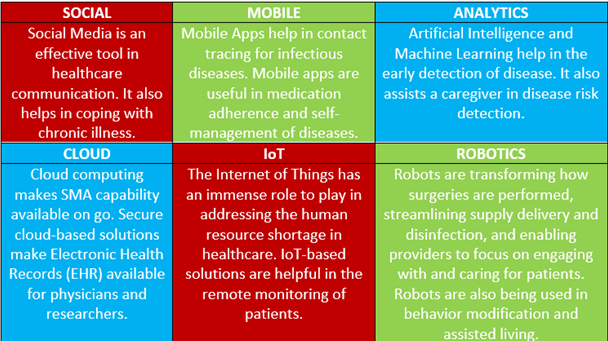
Source: Author’s Compilation Figure 2: SMACIR Technologies Changing Healthcare Landscape.
Technology-Assisted Dementia Management
People with dementia face various challenges in their daily routine such as (1) Wandering or Becoming Lost (2) Agitation and Anxiety (3) Poor nutrition (4) Feeling Isolated, and (5) Inability to Live Safely. Wearable and assistive technologies can help people with dementia to lead normal life. We have tried to analyze the digital technologies discussed in Figure 2 through the lenses of the Task Technology Fit model proposed by Goodhue and Thompson in their seminal work [9]. We propose that if technology characteristics (digital technologies) can achieve the tasks (challenges in living with dementia), it will lead to technology utilization and hence improved care (Table 1). We have further divided the capability level of these technologies into three categories (1) Established (2) Developing, and (3) Futuristic.
| SN | Dementia Challenge | Assistive Technology | Capability Level |
| 1 | Wandering or Becoming lost | loT, Mobile | Established |
| 2 | Agitation and Anxiety | Analytics, social, Mobile, Robotics | Developing |
| 3 | Poor Nutrition and medication | Mobile, Cloud, loT | Developing |
| 4 | Feeling Isolated | Social, Robotics | Futuristic |
| 5 | Inability to live safely | loT, Mobile, Cloud | Developing |
Table 1: ** Assistive Digital Technologies for Dementia.
Source: Author’s Compilation. Table 1: Assistive Digital Technologies for Dementia.
As depicted in Table 1, present digital technologies can address the challenges of living with dementia. IoT can help in monitoring the patient while mobile applications can track the location. Voice reminders can help lost patients in reaching their destinations. The voice-based application may further help in addressing agitation and anxiety, a common problem manifested with the progression of dementia. AI/ML-based solutions can even predict the episode and preempt it. Social robots can be used in behavioral training for people suffering from agitation and anxiety. Mobile Apps and IoT-based solutions can assist in medication reminders and the automatic dispensing of medicines. Cloud solutions keep doctors, attendants, patients, and pharmacists informed about nutrition and medications. Social Networks and Social Robots have an important role to play in addressing the feeling of isolation in dementia. While the former of these have developed later is still a futuristic technology. Wearable devices communicating with caregivers and attendants can help people with dementia live safely. IoT can help these people safely use appliances such as iron, stoves, coffee- makers microwaves, shaving razors, etc.
Conclusions
In the end, we propose policy levers to address the dementia problem in developing countries: (1) Detecting Dementia at an early stage, and (2) Creating Digital Health Ecosystem. Since dementia is irreversible it is imperative to identify it early so that progression can be slowed down. Artificial Intelligence can assist in the mass screening of brain images to identify them early. The next recommendation is to develop a digital health ecosystem for dementia soon. The countries which have a digital infrastructure for telemedicine available immensely benefited during the COVID-19 outbreak. The digital health ecosystem involves medical device companies, healthcare providers, patients, insurance providers, and the government [10]. In a resource- constrained environment, public-private partnership has an important role to play in creating a digital health ecosystem for dementia management. We recommend the inclusion of digital health in insurance coverage to propel its use. Governments also need to address the privacy and security issues related to these technologies to enthuse sustained interest in them. If implemented properly digital health has the potential to solve many challenges related to the management of dementia, but a lot needs to be done to reap those benefits.
References
-
Dementia statistics (2022) Alzheimer’s Diseases International.
-
Schwarzinger M, Dufouil C (2022) Forecasting the prevalence of dementia. The Lancet Public Health 7(2): e94-e95.
-
Dementia Causes (2022) Stanford Medicine.
-
Ho JY, Hendi AS (2018) Recent trends in life expectancy across high-income countries: a retrospective observational study. BMJ pp: 362.
-
(2022) What Is Dementia? Symptoms, Types, and Diagnosis, National Institute on Aging.
-
Sun H, Saeedi P, Karuranga S (2022) IDF Diabetes Atlas: Global, regional, and country-level diabetes prevalence estimates for 2021 and projections for 2045. Diabetes research and clinical practice 183: 109119.
-
Mishra V, Islam SMS (2021) Framework for the Adoption of Healthcare 4.0–An ISM Approach. In Disruptive Technologies for Society 5.0, CRC Press pp: 235-247.
-
Mishra V, Sharma MG (2022) Telemedicine as a frugal intervention to health care: A case of diabetes management. International Journal of Healthcare Management 15(2): 165-170.
-
Goodhue DL, Thompson RL (1995) Task-Technology Fit and Individual Performance. MIS Quarterly pp: 192-213.
-
Mishra V, Samuel C, Sharma SK (2015) Use of machine learning to predict the onset of diabetes. Int J Recent Adv Mech Eng 4(2): 9-14.
- Capacity Constraints in Pediatric Inpatient Psychiatric Care: A Cross-Sectional Analysis of Bed Availability and Geographic Access in North Carolina
- Why Healthcare Analytics Still Optimizes the Wrong Things
- Coding, Coverage, and Care: The Infrastructure of Transgender Health Inequities
- The Effect of Classroom Attendance on Academic Achievement of Management and Leadership Discipline of Nursing Students at Instituto Superior Cristal and Universidade de Dili, Timor-Leste, 2024: A Case Study
- The Role of Social Bonds in Facilitating Shared Investments and Resource Allocation: Addressing the “Wrong Pocket Problem” in Public Health and Healthcare
- Social-Cultural Factors Contributing to Antimicrobial Resistance in Livestock Farmers and Community Households in Kayonza District, Rwanda