
Possible Outbreak of Newcastle Virus Infection in the Face of Increasing Trend of Backyard Poultry Farm Management Interface in Nigeria: A Public Health and Food Security Threat
Introduction: Newcastle disease is a highly contagious illness and one of the "notifiable illnesses" on the World Health Organization list for Animal Health (OIE) Outcome. There are constantly new cases being reported as new NDV isolates from around the world. Newcastle disease poses a significant global economic threat to the poultry sector, causing highly contagious and transmissible diseases in birds with huge food security threat among the weak and vulnerable developing and underdeveloped countries Aim: The aim of this article borders on bringing to light the risk of possible Newcastle disease outbreak in Nigeria due to increasing poor management of poultry farms and poultry waste product. Furthermore, it will also underscore and outline various ways which can be adopted to prevent this poultry disease which is of great public health, economic and food security protection importance. Method/Methodology: This is a systematic review of published research articles focusing on Newcastle disease, epidemiology, pathogenicity, transmission and factors that can play important roles in the possible outbreak of the disease in poultries. Studies reviewed comprise of cross-sectional, prospective, longitudinal and observational studies. The study approach follows the systematic review of peer-reviewed published articles as well as online publications and articles derived from various databases with search keywords relevant to the topic of discourse. Findings and Results: The findings in this study highlight the endemicity of Newcastle virus disease in various part of the country, and how the severity of the disease is influenced by host characteristics, viral properties, and environmental factors. The study pointed out critical evidence-based possible reasons that could promote a new round of Newcastle disease epidemic outbreak as a result of poor poultry management practices such as high bird densities, poor poultry infrastructure, lack of quarantine of sick birds, mixed species rearing, free range system of poultry, poor waste disposal, lack of expertise, and insufficient biosecurity outcomes. However, the lack of education and awareness among farmers exacerbates the problem, hindering preventive measures. The complexity is increased by difficulties with vaccination, unrestrained bird movement through trading with neighboring countries and interstate, and a lack of diagnostic facilities. The consequences of an outbreak
Introduction
The world’s largest domestic animal stock, measured in terms of the number of animals, is poultry [1], and backyard flocks make up a large percentage of poultry production, especially in developing nations [2]. In these nations, villagers raise poultry to provide for their families’ food needs and as extra income sources. However, the use of backyard production techniques implies and promote lack of biosecurity measures and a higher risk of infectious diseases like Newcastle disease (ND) [3]. Poultry production globally, is threatened by the Newcastle disease (ND) [4]. It is the most economically important disease of birds. Narayanan MS, et al. [4] reported that it is caused by virulent strains of the avian Paramyxovirus serotype 1 (APMV1). It is a single stranded, non-segmented negative sense RNA virus [5]. The Newcastle disease virus (NDV) is a member of the family Paramyxoviridae in the genus Avulavirus. The Newcastle disease is designated APMV-1 among ten (10) serotypes of avian paramyxoviruses designated APMV-I to APMV-10 [6].
Newcastle disease is a highly contagious illness and one of the “notifiable illnesses” on the World Organization for Animal Health (OIE) list [7]. According to the OIE, outbreaks can occur anywhere that poultry is raised [7]. Every day, ND outbreaks happen globally, but they are particularly common in developing nations where the illness is enzootic, however, only a small number of countries report these cases to the OIE. Among the 54 African nations studied between January 2000 and December 2011 to determine how frequently ND outbreaks were notified to the OIE, only about 22 countries were found to have done so Gardner EG, et al. [8]. The transmission of NDV is through fecal-oral route Desalegn JM [9], and is easily spread from one bird to another. Direct contact with ill or unaffected birds carrying the virus typically results in the infection. Even clinically healthy birds with vaccinations are capable of excreting virulent virus following exposure. Moreover, contaminated poultry products, feed, water, equipment, people, and other animals can all indirectly transmit the virus [10]. Weather conditions, hygienic circumstances, housing structure and density, water and feed hygiene, and poultry farmers’ knowledge and qualifications are all non-infectious factors that play important roles in poultry health [11]. According to Awan MA, et al. [12] and Alexander DJ [13], movement of infected poultry or poultry products and poor management practices have been linked to increased risk of Newcastle disease outbreaks.
The Newcastle virus disease is regarded as a significant limiting factor for poultry production in low- and middle- income countries. The primary aim of this study is to highlight and underscore the various wrong poultry practices that can lead and fast-track possible outbreak of the Newcastle disease in our communities. Thus given the skeletal paucity of data and dependable literature and robust body of knowledge in the region on the above subject matter, it is strongly believed that, the findings generated from this study would help towards raising awareness on the factors and practices that can cause an increase of Newcastle disease burden in poultries in our remote communities. This will help policy makers to plan for the workable intervention that would reduce the burden and possible potential risk factors
Methodology
Study Approach
This study used a systematic review of selected, published articles as its methodology. This was done in accordance with the systematic review process outlined by Aveyard, who defined it as an approach in which explicit summaries of research evidence that are reliable and relevant to the study under investigation are extracted and presented after a critical evaluation of a particular body of knowledge. The retrieved articles were evaluated, synthesized and presented after their findings were extracted [14].
Search Strategy
The search strategy used in the development of this article involves the combination of relevant keywords employed in the search of databases such as Scopus, ResearchGate, Lancet, PubMed, Google Scholar, and Science Direct. Google searches were made at first and abstract of each of the article retrieved was read to ascertain the focus and determine its relevance to the topic under review, as well as identify the various ways in which it was employed in the searches made on the topic of discourse. Some of the keywords used in searching for information on the topic are “Newcastle disease,” “outbreak of Newcastle disease,” “prevalence of Newcastle disease,” “pathogenicity of Newcastle disease,” “transmission of Newcastle disease,” “poultry management,” and “poultry disease.” The generation of more hits was achieved by the combination of different Boolean operators with various keywords which certainly helped to provide general over view of the body of knowledge of key research interest.
Inclusion Criteria
Peer reviewed published primary research articles which aimed at exploring the Possible Outbreak of Newcastle Virus Infection in the Face of Increasing Poor Poultry Management which were published in English language. Meanwhile, articles that did not meet these criteria were excluded from this review. Also articles with rigorous evidence based peer review mechanisms were considered or included in the study
Exclusion Criteria
Any peer reviewed article that did not focus on the topic of the above research interest was not included. Secondly, article published in another language rather than English Language was not included in this study. Also those without peer review evidence were strongly rejected or excluded
Results
Following the search on electronic databases, published articles were retrieved, appraised/reviewed and findings collated. Following the coding of key words extracted from the study findings, four themes were generated. They include Newcastle disease virus, epidemiology of Newcastle disease, pathogenicity of Newcastle disease, poultry production and poor poultry management as a risk factor for Newcastle disease outbreak.
Background Knowledge
Newcastle Disease Virus
The Newcastle disease also called or fowl plague is caused by avian orthoavulavirus 1 (AOaV-1), previously known as Avian avulavirus 1 (AAvV-1) and commonly known as avian paramyxovirus type 1 (APMV-1) [15]. It is a geographically widespread viral agent that infects at least 236 species of birds including wild, peridomestic (dwelling in or around human habitations), and domestic birds [16]. According to the taxonomical classification of the International Committee on Taxonomy of Viruses [17], the Newcastle disease virus belongs to the genus Orthoavulavirus, subfamily Avulavirinae, family Paramyxoviridae, and order Mononegavirales [17, 18]. Avian paramyxovirus are divided into 12 different serotypes (APMV-1 to −12) and the Newcastle disease virus is designated as APMV-1 based on serological tests and the whole genome sequence of avian paramyxoviruses (APMVs) [19, 20].
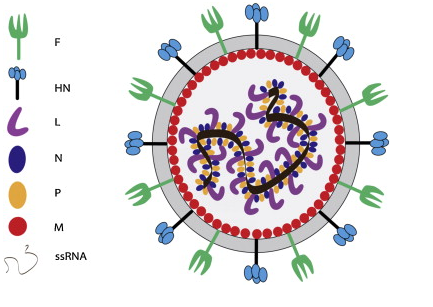
The APMV-1 virion structure is pleomorphic but mostly roughly spherical with diameters of around 100–500 nm Alexander DJ [21], Yusoff K, et al. [22] and a genome length of roughly 15,200 nucleotides (nt) [23]. The nucleic acid is a non-segmented and single-stranded RNA [24], with six essential genes from 3′ to 5′ direction that codes for six proteins- the nucleocapsid protein (N), phosphoprotein (P), matrix protein (M), fusion protein (F), hemagglutinin- neuraminidase protein (HN) and large polymerase protein (L) [25, 26]. Two additional non-structural proteins - protein V and protein W are expressed by RNA editing of the P mRNA [27]. The HN and F proteins are two spike projections on the viral envelope and together with the L genes, has been identified as significant predictor of virulence in the NDV [28, 29].
The constituent parts of the virus work together to accomplish all aspects of invasion and infection. Each protein performs a specific function and interacts with other proteins. The P and L proteins help the nucleocapsid protein to stabilize the encapsidation of the NDV genome [30]. The P protein facilitates the solubility of the nucleocapsid protein and is involved in the production of viral RNA [31]. The M protein serves as the virus’s backbone and is crucial for budding [32]. By controlling charged multivesicular body protein 4, it also encourages viral replication [33]. HN and F proteins are key factors for the virus to enter and release from host cells. The main functions of the F protein are hemolysis, cell fusion, and viral entrance [34]. It is synthesized from the precursor protein F0. Following cleavage into F1 and F2 polypeptides, it can mediate the fusion of the viral and cell membranes. The cleavage is carried out by host cell proteases, and the varying amino acid motifs at the cleavage site of F proteins affect how sensitive different strains of F proteins are to various proteases [35]. Additionally, the F protein’s particular amino acid sequence has a strong correlation with its tissue tropism with regard to the lung, spleen, and brain [36]. The largest protein in the virus is the L protein and supposedly is the most multifunctional protein in the virus. It is involved in the transcription and control of viral replication in cells, as well as genome replication [37, 38]. The RNA editing mechanism of the P gene produces the nonstructural proteins W and V. The host type I interferon (IFN) secretion and apoptosis are inhibited by the V protein, which creates an environment that is favorable for viral replication [39, 40]. The W protein is another RNA editing product of the P gene, and depending on the genotype of the viral strain, it may be produced in the cytoplasm or the nucleus [41].
Newcastle disease virus strains can be categorized as either class I or class II based on the nucleotide sequences of the F and L genes and genomic size [24]. Both classes comprise of fifteen genotypes (genotypes I-XV) [42, 43, 44]. Class I NDVs, which have a genomic size of 15,198 nucleotides Liu X, et al. [45], and are mainly avirulent to chickens, are occasionally isolated from wild aquatic birds and domestic poultry and comprise a single genotype [42, 44]. The bulk of virulent NDV strains and a few avirulent NDV strains belong to class II NDVs Alexander DJ, et al. [24] (Alexander and Senne, 2008). LaSota and Hitchner B1, which are utilized internationally as vaccine strains, are examples of Class II strains [42, 43, 44]. The class II contains 15 genetic groups including 10 previously established (I–IX, and XI) and five new genotypes (X, XII, XIII, XIV and XV) [42, 44].
History of NDV
The earliest outbreaks of Newcastle disease occurred in a poultry near Newcastle Upon Tyne, England, in 1926 [46]. About the same time, the disease was also documented in Java, Indonesia [47]. Doyle TM [48], coined the name “Newcastle disease” after the location of the first outbreak in Great Britain as a temporary solution, because he wished to avoid a descriptive name that could be mistaken with other illnesses. Historically, the disease is also called Ranikhet disease owing to its place of emergence in India [49]. After then, several ND outbreaks have been documented worldwide, including those in Korea, India, Sri Lanka, Japan, Australia, Egypt, Nigeria and the Philippines [49, 50, 51, 52, 53]. However, before 1926, there have been earlier accounts of similar disease outbreaks in Central Europe [54]. In particular, Newcastle disease is cited by Macpherson (1956) as the cause of the 1896 avian mortality in Scotland’s Western Isles. So, it is probable that ND did affect poultry before 1926. Yet, the outbreaks in Newcastle- upon-Tyne in 1926 led to the disease’s official identification as a recognized illness with a viral etiology [55]. Surprisingly, only two decades after its initial emergence did its global distribution progressively widen, causing the disease to become a well-established pandemic [56].
Nearly a century after its initial appearance, NDV has undergone remarkable evolution that has produced a high degree of genetic, pathogenicity, antigenic, and host range variation. Like other non-segmented RNA viruses, NDV’s genomic changes are mostly caused by the polymerase’s error-prone nature, which results in genetic variants known as quasispecies. A fundamental mechanism of virus evolution is represented by virus quasispecies harboring site mutations that are accumulating in the NDV genome and can cause apparent alterations in viral phenotypes under selection pressure [57, 58, 59]. The accumulation of genetic variants may lead to the formation of novel genotypes, which could account for the correlation between each ND panzootic and the appearance of novel genotypes.
Epidemiology of Newcastle Disease
According to the number of live-stock units lost for poultry species, ND was the fourth most significant disease, trailing behind highly pathogenic avian influenza, infectious bronchitis, and weakly pathogenic avian influenza [60]. After the first outbreaks of Newcastle disease in 1926 in Java, Indonesia and in Newcastle on Tyne in Great Britain Doyle TM [46], Kraneveld FC [47], between 1926 and 1981, four Newcastle disease panzooties occurred worldwide after multiple sporadic outbreaks in numerous nations around the world. The first panzootic outbreak of the disease occurred 20 years after it was originally discovered. From the 1930s until the 1960s, viruses of genotypes I, II, III, and IV were responsible for the first panzootic. The second panzootic outbreak, which spread more quickly than the first and touched nearly every continent, seems to have originated in the Middle East. Genotype V and VI viruses were the primary cause of the second panzootic, which occurred between the late 1960s and 1973. The significant shift that occurred in the poultry industry during the Second World War, which turned the sector into a commercial industry with a global reach, helped to facilitate this outbreak of the disease. During this time, wild bird species were transported by air into several countries, where the disease was then spread [61, 62, 63]. Due to the severity of the second panzootic disease, vaccinations were developed that significantly improved poultry protection [62]. The spread of the virus into disease-free areas has been aided by the widespread use of live vaccinations. The third panzootic illness outbreak, which lasted from 1968 to 1972, was brought on by the viscerotropic velogenic strain of the virus. Antigenic and genetic information on the virus, however, failed to establish the circumstances that gave rise to this third pandemic. From 1980 onward, there was a fourth pandemic, which started in the Middle East. Genotype VII NDV was responsible for this pandemic. It first mostly impacted domesticated and racing pigeons, but eventually spread to wild pigeons and other poultry livestock. It spread easily and was difficult to control because it affected animals that were susceptible to Newcastle disease virus and were not included in the vaccination program [64, 65].
Toward the beginning of the 20th century, ND was associated with the introduction of extensive commercial poultry production [66]. In nations where backyard poultry farming is widespread, the contribution of backyard poultry to the epidemiology of NDV is a major concern as virulent strains of NDV have been reported from backyard poultry [67, 68, 69]. More than 200 distinct species of poultry are susceptible to infection by the Newcastle disease virus [70]. Infections with Newcastle disease have been found in 241 bird species from 27 different bird orders [66]. The most vulnerable animals are chickens, then turkeys and waterfowl being the least. The virus is thought to be stored in wild birds with waterfowl considered a natural reservoir for NDV Takakuwa H, et al. [71], Miller PJ, et al. [72] as it mainly harbors the lentogenic strains [73]. The virus also infects humans and temporarily produces mild conjunctivitis and flu like symptoms [74].
There are constantly being reported new NDV isolates from around the world. Wherever there are poultry farms, outbreaks could happen because wild birds occasionally carry the virus without developing the illness [74]. Geographical locations have no bearing on how common certain NDV genotypes are. As a result, there exist various genotypes in America, Europe, Asia, and Africa [44]. Successive NDV outbreaks were reported from European continents and China [75, 76]. Except for Canada, the United States of America, and a few Western European nations where the disease is presently under control, NDV is endemic in Africa and other parts of the world [68]. Recent reports of NDV outbreaks come from Vietnam, Indonesia, Malaysia, and Cambodia [77]. The poultry sector is currently seriously threatened by genotype VII NDV, which is endemic in several countries in Asia and Africa [78, 79, 80].
There is still little information available regarding the history of the disease’s occurrence and spread throughout Africa. The disease was first reported in Africa in 1945, following the severe damage it caused to numerous flocks of poultry in South Africa as it spread over the entire nation [81]. A year later, it then appeared in Madagascar along a rail transportation network where multiple epidemics had place. The disease was thought to have entered Madagascar through the importation of fighting cocks and other poultry birds from South Africa [82, 83]. It was thought to have first occurred in Ethiopia in 1971 and to have been brought on by a velogenic strain [84]. It is unknown when the disease first spread to West, North, and East Africa. It is conceivable that it appeared in this area during the end of the Second World War and shortly after through wild birds, travel, and the trade in poultry, but this remains to be verified. However, years after the first description in South Africa, several serological studies carried out confirmed the presence of the disease in several countries on the continent: Nigeria Ezeokoli CD, et al. [85], Niger Courtecuisse C, et al. [86], Tanzania Minga UM, et al. [87], Cameroon Agbede G, et al. [88], Benin Spradbrow PH [89], Togo Grundler G, et al. [90].
After the classification of the virus in the family Paramyxoviridae, genus Avulavirus in 1955, it became an OIE notifiable disease. In 2011, the Inter-African Bureau for Animal Resources of the African Union received reports of Newcastle disease from 31 African nations, including those in West, East, Southern, and Northern Africa [91]. Outbreaks have also been reported in many countries throughout the continent. These include Sudan, Morocco, Burundi, Uganda, Burkina Faso, Côte d’Ivoire, Mauritania, Kenya, Ethiopia, Nigeria, Tanzania and Mozambique [12, 92]. Ninety six (96) NDV outbreaks in poultry from Cameroon, the Central African Republic, Côte d’Ivoire, and Nigeria were recorded in 2013 [93].
According to Halima HFWC, et al. [94], NDV and predators are the main causes of chicken losses in Northwestern Ethiopia. Similarly, Aboe PAT, et al. [95] have also shown that in Benin, Burkina Faso, Mali, Ghana, and Guinea, NDV is the major cause of mortality and morbidity in poultry. Several studies have shown the endemicity of this disease in traditional poultry farming in countries, such as Côte d’Ivoire Couacy-Hymann E, et al. [96], Kouakou AV, et al. [97], Nigeria Jibril AH, et al. [98], Daodu OB, et al. [99], Sudan Elmardi NA, et al. [100], Uganda Kasozi KI, et al. [101], Tanzania Wyatt A, et al. [102], Madagascar Rasamoelina-Andriamanivo H, et al. [103], Togo Langeois Q [104]. This disease, although not the main cause of death in Cameroon Fosta JC, et al. [105], Mali Sylla M, et al. [106], Burkina Faso Ouedraogo B, et al. [107], and Zimbabwe Mapiye C, et al. [108], is the second cause of death accounting for, on average, 35% of mortality in poultry birds.
Currently, the disease is enzootic in 33 African nations. Twenty five (25) African nations reported 25 new outbreaks of Newcastle disease to the OIE in 2019 [109]. The distribution of ND worldwide based on the data provided by the veterinary service departments of individual countries [74] are shown in the map below.
![Figure 2: The global scenario of Newcastle disease virus (NDV) outbreaks in different parts of the world [74] (OIE, 2018).](/fulltextimages/12258/fig_2.png)
Epidemiology of Newcastle Disease in Nigeria
The economic impact of the Newcastle disease outbreak was recently estimated, alongside other outbreaks such as infectious bursal disease (IBD) and avian influenza (AI), and reports showed that Newcastle disease is the most economically important, of all the diseases affecting poultry in Nigeria [110]. Its economic importance in Nigeria is due to its high mortality and morbidity in both locally and commercially raised chickens [111]. Newcastle disease constituted a total of 58% of all poultry disease outbreaks and resulted in a total cumulative loss of 13 million Naira [110]. In Nigeria, the disease has been detected in all the agro-ecological zones of the country Lawal JR, et al. [112], with the disease showing endemicity in several parts of Nigeria [113, 114, 115, 116].
Newcastle disease outbreaks have been reported in free-range village and exotic chickens, guinea-fowls, wild and captive birds, quail, dove, mallard duck, ostrich, turkey, vulture, eagle, sparrows, crows, parrot [111, 112, 113, 114, 115, 116, 117, 118, 119, 120, 121, 122]. In Nigeria, NDV has been noted to be widespread due to rapid expansion of the poultry industry, high stocking densities and inadequate biosecurity measures. These have created conditions conducive for the spread and maintenance of the endemicity which the disease has assumed with all strains of the virus being common [123]. The first documented confirmed outbreak of ND in Nigeria occurred between December 1952 and February 1953 in and around Ibadan [53]. The disease has since that time remained a major threat to the Nigerian poultry industry [124]. An average of 200 – 250 outbreaks of ND is reported annually in Nigeria [119, 123]. It still remains a major constraint to successful poultry production in Nigeria with outbreaks resulting to up to 100% mortalities [125].
| Year | Prevalence | Detection Technique | Remark | |
|---|---|---|---|---|
| Plateau State | January 2006 to June 2007 | 51.90% | Haemagglutination test and haemagglutination inhibition test | Rural household chickens and live birds markets [127]. |
| Bauchi | 2010 | 56.30% | Haemagglutination inhibition test | Unvaccinated local chickens at slaughter point [139]. |
| Nsukka, Nigeria | 2011 | 3.20% | Haemagglutination test and haemagglutination inhibition test | Unvaccinated healthy commercial chickens [134]. |
| Gombe State, Nigeria | 2004 – 2013 | 55% | Based on history, clinical signs and post – mortem findings | A 10 year retrospective study from 2004 – 2013. Data were collected from the State veterinary clinics’ record [112]. |
| Kubwa and Lugbe, Abuja, Nigeria | 2014 | 17% | Haemagglutination inhibition test | Healthy local chickens [115]. |
| Zamfara | 2014 | 32.50% | Competitive Enzyme Linked Immunosorbent Assay | Randomly selected households and live bird markets [98]. |
| Delta State of South-south Nigeria | 2014 | 23.60% | Haemagglutination Inhibition Test | Adult chickens from live bird markets [140]. |
| Kaduna metropolis of Kaduna State | October 2014 to April 2015 | 31% | Haemagglutination and Haemagglutination Inhibition Test | Backyard poultry and free-ranging poultry [141]. |
| Gwagwalada, Abuja, Nigeria | 2016 | 63.50% | Haemagglutination and Haemagglutination Inhibition Test | Local and exotic chickens in Gwagwalada, Nigeria [116]. |
| Kwara State, Nigeria | 2022 | 13.25% | Haemagglutination test and haemagglutination inhibition test | In slaughtered indigenous chickens in Ilorin [142]. |
| Kano, Northwest Nigeria | 2022 | 67.9% (ELISA) | Hemagglutination-inhibition test and indirect enzyme-linked immunosorbent assay (ELISA) | Live bird market [135]. |
| Kano, Northwest Nigeria | 2022 | 78.1% (HI) | Hemagglutination-inhibition test and indirect enzyme-linked immunosorbent assay (ELISA) | Live bird market [135]. |
| Maiduguri | 2023 | 34.40% | Haemagglutination and Haemagglutination Inhibition Test | Layers and broilers were sampled from different farms with reported outbreaks of ND. Village chickens, turkeys and ducks were sampled from live bird markets in Maiduguri Monday market; Shagari Low-cost A; and Lake Chad Basin within Maiduguri [143]. |
Table 1: Seroprevalence Study of ND in Local Chickens and Live Bird Markets in Nigeria.
Over time, epizootiology of Newcastle disease in Nigeria has been based mostly on conventional methods such as serology [113, 114, 115, 116, 117, 118, 119, 120, 121, 122, 123, 124, 125, 126, 127, 128] and biological characterization in conjunction with virus isolation [117, 119, 129, 130]. Antibodies to NDV have been found in several species of poultry across the nation using serological techniques [haemagglutination-inhibition (HI) or Enzyme-linked immune sorbent test (ELISA)] [130, 131, 132]. Seroprevalence investigations on birds carried out in several areas in Nigeria throughout the years revealed varied ranges from 38% to 74.3% [133]. In more recent seroprevalence studies (table 1), the figures have not considerably changed as the prevalence range from as low as 3.2% Sanni OOF, et al. [134] to as high as 67.9% Snoeck CJ, et al. [135], which goes to show that without a doubt, Newcastle disease (ND) is enzootic in Nigeria. Recently, attempts were made by using molecular techniques at defining the genotypes and molecular epidemiology of the circulating virus in West and Central Africa including Nigeria [93, 136, 137, 138].
Transmission of Newcastle Disease
There are several modes of transmission of NDV but primarily, transmission occurs through aerosol or oral routes [144]. Direct contact between healthy birds and sick or carrier birds, contact with the secretions and excretions of infected birds, and contact with contaminated items such as fomites which include things like food, water, equipment, buildings, people’s clothes, boots, sacks, and egg boxes or trays are some of the known ways that NDV is transmitted [55, 145]. Fleas, mice, insects, and dogs can also mechanically disseminate the Newcastle disease virus [146, 147]. When the virus is on the shell surface after hatching, handling of the chicks might potentially cause infection [74]. Newcastle disease viruses can survive for several weeks in the environment, especially in cool weather. However, the virus is destroyed rapidly by dehydration and by the ultraviolet rays in sunlight. Generally, virus is shed during the incubation period and for a short time during recovery. Birds in the pigeon family can shed the virus intermittently for a year or more. Other wild birds such as cormorants have also been shown to have caused outbreaks in domestic poultry [147].
Although clinically diseased chickens are the most important hosts for NDV, latently infected birds and survivors of natural infection, which still harbour the agent, may also act as reservoirs. Village chickens may be exposed naturally to virulent virus shed from recovered birds, vaccinated birds having various levels of antibodies in their blood, non – susceptible species carrying virulent virus or susceptible birds yielding virulent virus, which may have evolved from passages in birds of mesogenic viruses [148]. The virus is present in all parts of the carcass of an infected bird. The disease is very contagious. When the virus is introduced into a susceptible flock, virtually all the birds will be infected within two to six days [83, 147].
Pathogenicity of Newcastle Disease
Newcastle disease virus attaches to sialic acid-containing compounds such as gangliosides and N-glycoprotein receptors of the respiratory epithelium resulting in fusion of the virus to host cells. The virus binds to these receptors using its F and HN surface glycoprotein. The F protein is necessary for cell fusion, whereas the HN protein mediates cell attachment [149]. Newcastle disease virus infection primarily occurs when the virus envelope merges with the host cell membrane in a pH-independent manner. Additionally, infection can occur by caveolae-dependent endocytosis and receptor-mediated endocytosis [150]. The viral nucleocapsid is released into the cytoplasm once the virus envelope fuses with the host cell membrane. In the cytoplasm, the negative sense viral RNA is transcribed to produce the structural mRNAs with the help of virus-associated RNA-dependent RNA polymerase in a gradient fashion. The respective proteins are translated and folded using host cell machinery. Once a threshold of the first transcribed N mRNA is reached, the negative sense genomic RNA is converted to positive sense anti-genome template for the synthesis of new negative sense RNA genome. Following the initial binding of the N protein to RNA to create a helix, the P and L proteins are then integrated to form the nucleocapsids in the cytoplasm of the host cell [151]. After being transferred to the plasma membrane, the M protein binds the nucleocapsids to the surface glycoproteins F and HN. During this phase, the viral envelope is also put in place. And finally the new viral particles are released from the cells. During the release of infectious viral particles, the HN protein intervenes to eliminate sialic acid receptors through its neuraminidase activity [149].
Based on the pathogenicity observed in susceptible chickens, NDV can be classified into three pathotypes: velogenic, mesogenic and lentogenic [22]. The virulence of NDV depends upon the amino acid sequence at the cleavage site of the fusion protein (F), which plays a vital role in virus entry and pathogenesis [29, 152]. Low-virulent lentogenic NDV strains are those that induce subclinical infection and moderate respiratory or gastrointestinal illness. However, the disease produced by mesogenic strains are of intermediate virulence and cause respiratory infection with moderate mortality, while velogenic NDV strains are highly virulent and can result in mortality rates of up to 100% Alexander DJ [66], Ebrahimi MM, et al. [78], Pantin-Jackwood MJ, et al. [153], Ali A, et al. [154], which prompts trade restrictions and embargoes in the nations where the illness is present [65, 155]. Viscotropic and neurotropic velogenic strains are additional categories for velogenic strains. While neurotropic velogenic strains cause neurological and respiratory problems, viscerotropic velogenic strains cause fatal hemorrhagic lesions in the viscera [66, 156]. Because an understanding of the mechanisms behind the course of infection may enable a more effective preventative or therapeutic approach for viral infections, studying virulence and identifying viral drivers of disease severity is crucial.
Clinical Signs and Symptoms
The clinical symptoms of Newcastle Disease Virus (NDV) can be challenging to diagnose definitively, as they often resemble those of various other avian diseases, including highly pathogenic avian influenza, infectious bronchitis, infectious laryngotracheitis, fowl cholera, mycoplasmosis, and psittacosis [157]. NDV spreads rapidly through susceptible flocks, typically infecting them within 2 to 6 days of introducing diseased birds [83]. The virus is shed during various stages, including incubation, clinical illness, and a brief period of convalescence [55]. The clinical signs of NDV infection can vary widely and depend on several factors, such as the virus strain, bird species, host age (with young birds being most susceptible), concurrent infections, environmental stress, and immune status [147]. Young chickens infected with virulent strains may succumb suddenly without significant clinical symptoms, while older birds may experience a more prolonged illness characterized by respiratory distress, including rales, sneezing, and wet eyes, along with neurological manifestations [158]. In some cases, extremely virulent NDV strains can cause high mortality with few clinical signs. The onset of symptoms typically occurs between two and twelve days after exposure.
Newcastle disease virus can target different systems in the bird’s body, leading to distinct clinical signs. Some strains affect the nervous system, while others impact the respiratory or digestive systems. Clinical signs may include respiratory symptoms as well as nervous symptoms like tremors, wing and leg paralysis, twisted necks, circling, spasms, and paralysis. Additionally, digestive signs, including diarrhea, may be present. Egg production may decrease partially or completely, and abnormal eggs with unusual color, shape, or surface may be laid. Mortality rates can vary but may reach as high as 100% [147].
The severity of clinical manifestations in NDV infections depends on the virulence of the virus. Lentogenic strains typically cause mild respiratory or enteric disease and are considered low-virulent. Mesogenic strains have intermediate virulence and lead to respiratory infections with a moderate mortality rate. Velogenic strains can be further categorized into viscerotropic and neurotropic strains. Viscerotropic velogenic strains cause gastrointestinal ulcers, lymphoid depletion, and tissue necrosis in various organs. Neurotropic velogenic strains, on the other hand, result in symptoms such as dyspnea, depression, opisthotonos, head twisting, and paralysis [159].
NDV infections can also disrupt the gut flora of chickens, with increased pathogenic bacteria like Rhodoplanes and Clostridium and decreased beneficial bacteria like Paenibacillus and Enterococcus [160]. The virus has been detected in various organs, including the lungs, spleen, kidneys, trachea, bursal sac, glandular stomach, cecum, and liver of infected chickens and geese. Notably, it is found in the brain of chickens but not in geese [161]. Furthermore, NDV can cause damage to pancreatic tissue in chickens, resulting in reduced production and activity of pancreatic digestive enzymes, increased corticosterone and somatostatin levels, and decreased insulin production. This pancreatic damage may lead to a decline in growth performance [162]. In a separate study on an outbreak of NDV in wild pigeons in São Paulo, Brazil, in 2019, infected birds displayed neurological signs, along with observed bleeding in different tissues. Histopathological examinations revealed the infiltration of monocytes in various organs, including the brain, kidneys, ventricles, heart, and spleen [163].
Diagnosis
Based on their clinical presentation, poultry respiratory infections such avian influenza, infectious bronchitis, and infectious laryngotracheitis viruses are often mistaken with NDV [164]. Hence, observed clinical signs are not a reliable basis for diagnosis, but can serve as a guiding suspicion in the diagnosis process [165]. The direct detection of viral antigens, which can be accomplished by virus isolation of APMV-1 from swabs of live animals or organs removed from cadavers, is the basis for a definitive diagnosis of Newcastle disease. This approach is considered the gold standard for making a definitive diagnosis of ND and is frequently used to confirm the findings of other detection techniques [66, 166].
The sites of virus replication and the pathways of viral shedding dictate which samples are needed for virus isolation. Cloacal and oropharyngeal swabs taken in an isotonic solution with or without antibiotics are among the samples needed from live birds. In addition to the cloacal and oronasal swabs, samples from the lungs, kidney, liver, gut, spleen, and caecal tonsils should be obtained individually or in combination if the birds are already moribund or have recently passed away [152]. To isolate NDV, virus culture is readily performed on 9-11-day-old embryonated chicken eggs or a wide range of cells, including chicken embryo fibroblast cells, chicken embryo hepatocytes, African vervet monkey kidney cells, and chicken embryo reticulum cells [166]. Once the inoculated embryonated chicken eggs have been incubated at 37°C for 4–7 days, they are refrigerated at +4°C. The hemagglutination test (HA) is then used to determine whether the virus is present in the infected allantoic fluid. Nevertheless, confirmation of NDV infection can be achieved by utilizing molecular techniques or a hemagglutination inhibition test, as other viruses including avian influenza and APMVs may also exhibit HA activity [166]. The most used reference and confirmatory test for Newcastle disease serology is the hemagglutination inhibition (HI) test [166]. Serological diagnosis provides indirect evidence of NDV through antibodies that demonstrate infection. The test is based on the hemagglutinin of the viral envelope causing chicken red blood cells to agglutinate, and the particular antibodies inhibiting this hemagglutination [166]. Several isolates, including the North American cormorant isolates and several velogenic viruses isolated from Iranian zoo birds, do not agglutinate red blood cells. In the HI test, APMV-1 can cross-react with a few other avian paramyxoviruses, namely APMV-3 and APMV-7. This problem can be solved by a panel of monoclonal antibodies against these viruses [24, 167].
Antibody detection and quantification are also frequently achieved through the use of enzyme-linked immunosorbent assays (ELISAs). In order to detect antibodies, viral antigens are bound to antibodies on a microtiter plate. Other detection antibodies made in a different species against the chicken antigens bind to the viral antigens and combine with an enzyme to catalyze the reaction that results in a color shift. A spectrophotometer is then used to read the plate [65]. The ELISA test and the HI test have strong correlations [156, 166]. Other serological assays include the immunofluorescence test, the neutralizing antibody test, and the colloidal gold immune technique. However, the limitation of serological tests lies in the cross-reactivity between NDV and other homologous avian paramyxoviruses, which can give false positive results [168].
Although NDV can also be identified by the Agar gel immunodiffusion technique, hemolysis test, fluorescent antibody test, or detection of viral particle morphology by electron microscopy, none of these methods provide information about the pathotype of ND [169]. Molecular biology techniques have been employed to establish methodologies for the identification and isolation of NDV strains [65, 168].
Numerous laboratory procedures, including real-time reverse transcription polymerase chain reaction (RT-PCR), gel-based RT-PCR, restriction enzyme-based techniques, and rapid sequencing, have been developed. In addition, nested PCR, fluorogenic probe-based real-time RT-PCR, ligase chain reaction (LCR), intercalated DNA (SYBR Green), or light-extended fluorogenic primer (LUX) can also be employed. All of these assays have shown promising results, but most of them have some limitations and their ability to detect different virus types needs validation [168, 169]. The primary determinant of NDV pathogenicity is the NDV F gene, so RT-PCR methods to pathotype NDV often focus on this gene [168, 170, 171]. Mismatches between oligonucleotides (primers and/or probes) and cDNA templates are mostly caused by the large degree of nucleotide diversity in the NDV F gene, which has been made evident by the expansion of the gene sequence database over the past ten years. This could perhaps clarify the erroneous negative outcomes yielded by various real-time RT-PCR techniques [169]. Recently, another technique known as real-time reverse transcription isothermal loop amplification (RT-LAMP) has been created. Only NDV genotype VII was specifically detected by this technique, which is more sensitive and faster than real-time RT-PCR [172].
Poultry Production and Food Security
The increasing global population’s demand for food has resulted in tremendous growth in agricultural productivity during the past few years. The poultry industry is one of the animal industries with the fastest global growth [173]. The egg industry and the poultry meat industry are the two main sectors of the poultry industry [174]. The poultry subsector has had upward trajectory over the past 20 years, growing by 76% in developing nations and 23% in industrialized nations [175]. To meet growing demand, world poultry meat production soared from 9 to 133 million tones between 1961 and 2020, and egg production shot up from 15 to 93 million tones. In 2020, poultry meat represented almost 40 percent of global meat production [176]. Between 2015 and 2025, the compound annual growth rate of poultry protein is predicted to be +2.4% [177].
The global poultry sector is expected to continue to grow as demand for meat and eggs is driven by growing populations, rising incomes and urbanization [173]. The biggest growth in poultry production was seen in regions of Asia, South America, and Africa that are known for their rapid urbanization, poverty, and hot climates [177, 178]. Because it continues to be the quickest way to close the protein supply- demand gap in certain areas, the trend of rising chicken production is evident there.
There is no doubt that the poultry industry is quickly growing in sub-Saharan Africa. A large portion of Africa’s small farmers depend on poultry farming for stable employment and survival [179]. Poultry also makes a substantial contribution to food security and nutrition, providing energy, and essential micro-nutrients to humans, with short production cycles being one of its advantage [173]. For rural families, village poultry farming is a reliable source of high-quality protein, a treat during holidays, and a solid source of cash [180].
Due to its capacity to utilize diverse sources of feed, including agricultural and household residuals, along with byproducts from food processing, poultry farming stands out as an exceptionally efficient approach to animal husbandry [181]. Notably, there are two main ways that poultry production is carried out: the commercial/industrial poultry approach, which uses elaborate facilities, top-notch veterinary care, and good nutrition, and the village backyard poultry approach, which typically uses the least amount of money for housing, feeding, and health care [182]. Backyard systems make significant contribution to eggs and poultry meat production in Eastern Europe, South Asia, Sub-Saharan Africa and, to a lesser extent, East Asia and Latin America and the Caribbean [173]. The backyard systems contribute 8% of global egg production and 2% of global meat. While, the bulk of the world’s poultry production (up to 98% for meat and 92% for eggs) is produced by industrial poultry, primarily chicken and to a lesser extent turkey, duck, geese, and other species [173].
Poultry Production in Nigeria
In Nigeria, an increase in poultry production was actually noticed in the early 1980s. At this time, subsidy was introduced on day-old chicks (DOC) and feed ingredients by the government. Recently, the government supported small scale poultry farmers with DOC and other incentives at highly subsidized rates to boost poultry production through the Agricultural Transformation Agenda. These initiatives have encouraged several people, including civil servants, housewives, and artisans to embrace poultry production by keeping birds as part or full-time commercial ventures. As practiced in most developing economies, poultry production systems are generally categorized into two major groups, namely; subsistent (free-range) and commercial [183]. Based on biosecurity practices, FAO further categorizes poultry production systems into 4 sectors viz; sector 1 with high, sector 2 with high to moderate, sector 3 and 4 with low biosecurity. In Nigeria, sector 4 (free-range poultry) accounts for over 80 % of the poultry population [184].
The poultry industry plays a key role in economic development in sub-Saharan Africa; especially Nigeria [185, 186]. Nigeria has the largest annual egg production and second largest chicken population in Africa [187, 188]. About 85 million Nigerians are involved in poultry production (many on a small to medium scale) [187, 188]. The Nigerian poultry industry comprises about 180 million birds. Of these, 80 million chickens are raised in extensive systems,
60 million in semi-intensive, and the remaining 40 million in intensive systems [187, 188].
Despite the leading role of poultry production in the livestock industry, it’s not without challenges. The major impediments to traditional poultry production include endemicity of infectious diseases, predation, lack of proper health-care and biosecurity, poor feeding, and poor marketing information [189].
Discussion
The Newcastle disease has a large negative economic impact on the poultry sector globally [152, 190]. The virus causes rapidly transmissible and highly contagious gastrointestinal, neurological, and respiratory diseases in birds. The host factors (age, species, and immunological status), virus factors (tropism and virulence), and environmental factors (temperature, season, rainfall pattern, and relative humidity) all have an impact on how severe it is [191]. Several factors account for the origin, maintenance, and spread of NDV. These factors are mainly due to poor poultry management and they include; high poultry population, keeping of mixed species of poultry, widespread presence of wild birds, uncontrolled movement of birds, lack of quarantine, inadequate surveillance and monitoring, improper waste management, limited access to veterinary care and lack of education and awareness. These factors can play crucial roles in possible outbreak of new Newcastle disease outbreaks among poultry farmers. According to Amoia CFANG, et al. [192], African farmers are often unable to predict outbreaks of the disease, making it difficult for them to embark on preventive control measure. Some of the factors that may play crucial roles in possible Newcastle disease outbreak in are discussed below:
High Poultry Density
Over the years, there has been a notable increase in poultry population in Nigeria, driven by factors ranging from increasing consumer demand to the need for more income. This has resulted in farmers utilizing every available space so as to increase their production. In addition to increasing the stress on the birds thereby weakening their immune systems and making them more vulnerable to infections, such as ND World Health Organization [193], overcrowded poultry facilities serve as breeding grounds for Newcastle disease. This is because the virus can easily spread through respiratory secretions and feces droppings between chickens and other birds kept in close proximity. In a consultation, the WHO, FAO, and OIE noted that because of the sheer volume of intense bird-to-bird interaction, a higher flock density aids in the spread and amplification of disease agents [194].
Heterogeneity of Poultry Population
A high density of backyard poultry with co-rearing birds of different age groups may lead to a higher prevalence of NDV and increase the chance of losing all birds whenever epidemics such as Newcastle diseases occur [147, 195]. This is because, the NDV disease is easily spread among the different bird kinds. According to research by Biswas PK, et al. [196], the prevalence of ND was significantly associated with bird age, and older birds had a comparably bigger chance of having ND than relatively younger birds. Therefore, separating the housing of adult and young stock of any poultry will reduce the risk of cross-infections [197]. However, FAO recognizes that age separation would not be feasible in developing countries because most farmers keep a variety of ages of animals to assure output all year round, rather than selling all of them at one set age [198].
A common practice among local farmers is co-rearing backyard chicken, guinea fowl, ducks, and wild birds, including pigeons, on the same farm. This practice can result in the spread of disease among the different bird species [195]. Because of the variability of their bird populations, most family farms have a higher risk of contracting NDV [199, 200, 201]. Some species operate as carriers of the virus and can harbor it without showing any symptoms, which makes it easier for it to spread. This is the case with ducks, since they can infect susceptible chickens in mixed agricultural settings given that they are more resilient to Newcastle Disease than chickens are [202]. Additionally, wild birds also contribute to the maintenance of the virus in the poultry since lentogenic NDVs are common in migrating birds [203]. After infecting domestic fowl, these viruses have the capacity to develop and become pathogenic [204]. Although, a study by Olorunshola ID, et al. [142] in Kwara state showed that there was no significant relationship between types of birds and NDV infection.
Lack of Education and Awareness
There is a low level of public health information and communication awareness on disease among poultry farmers and general public Lau JTF, et al. [205], Ipara BO, et al. [206] and this is even more prevalent among backyard farmers. FAO revealed that one of the major constraints to the achievement of an effective poultry disease control strategy is the ignorance of poultry keepers on appropriate procedures such as vaccination, pen spacing, breeding, and withdrawal of sick birds. According to Okwor et al. [134], farmers in Nigeria have paucity of information about disease prevention. Adam VY, et al. [207] found that inadequate knowledge regarding the Newcastle disease virus, negative perceptions of ND, lack of basic training on animal health, preventive and control mechanisms all play a role in poor poultry management and increased disease outbreaks. In a resource limited country like Nigeria, where electrical power is individually generated by a few that could own power generator, information dissemination would be hampered as only few farmers may access the information timely in cases of outbreaks CFSPH [208], and this may affect the implementation of control and preventive measures. Continuous education and training programs for poultry farmers can help prevent outbreaks or manage outbreaks. The findings in a study by CFSPH [208], suggested that mass communication with electronic and radio media would be the most effective media of information dissemination to the farmers and the populace.
Poor Poultry Infrastructure
The most crucial housing fundamental is space since it dictates the quantity and kind of chickens that can be housed. Pests and diseases are less likely to spread when there is adequate ventilation [197, 209]. According to research, the bulk of Nigeria’s small poultry farms are run by inexperienced poultry farmers who are less concerned with new technologies relevant to the progress of poultry management abilities, and they operate in ill-equipped poultry houses [210]. With the disease being easily transmitted through various routes, including direct contact, airborne transmission, contact with secretions and bird droppings, excretions, contaminated materials like shoes, cars, food, or infected cages [55, 145, 211]. A poorly designed poultry with disposal, water and feed systems that are not working efficiently, can greatly contribute to outbreaks of Newcastle disease. Contaminated water sources and feed can introduce the virus to the poultry flock, especially when these systems are not regularly cleaned and maintained. Hence, it is important that good sanitation and sewerage system must be maintained at the poultry farms so that the spread of disease could be prevented. The study by Abah HO, et al. [212] also revealed that most farms do not have gate or fence thereby allowing unrestricted access to the farms by unauthorized visitors, animals, equipment or carriers of ND virus in to the farm. This practice would allow disease transmission as humans can serve as mechanical transmitters of ND [213, 214].
System of Poultry Farming
Over 70% of chickens are raised under free range systems by smallholder farmers in Africa [215, 216]. According to Olwande P, et al. [217], the birds in free range systems are kept with little or no care as the birds are allowed to roam freely [218]. This is a common practice among backyard farmers in Nigeria. The free-range poultry farming system, as a result, poses considerable challenges in the management of ND, as it exposes the birds to direct contact with parasites and disease-causing pathogens in the environment [219, 220].
This may also increase the chance of poultry’s being exposed to wild birds, which will in turn increase the disease risk of the backyard poultry.
Improper Waste Management
The poultry industry produces large amounts of solid waste. Globally, an excess of 90% poultry waste is spread on land close to the poultry farms [221]. The production of poultry results in: hatchery wastes, manure (bird excrement), litter (bedding materials such as sawdust, wood shavings, straw and peanut or rice hulls), remnants of drugs pesticides, and on-farm mortalities. The processing of poultry results in additional waste materials, including offal (feathers, entrails and organs of slaughtered birds), processing wastewater and biosolids [222]. Other wastes include carbon; small amounts of nitrogen and phosphorous; and trace amounts of chlorine, calcium, magnesium, sodium, manganese, iron, copper, zinc, potassium, arsenic and cobalt [223, 224, 225]. Roeper H, et al. [226] stated that a major problem coming along with the poultry production is the manure that needs to be taken care of, avoidance of proper treatment can become risky for environment and humans. Disposal of manure could influence the prevalence of Newcastle disease among indigenous chickens [227, 228]. The issues of effectively managing the waste generated by the chicken business becomes harder as it expands [229].
One of the strategies to prevent the spread of the disease is to reduce or limit the amount of time that vulnerable chickens come into contact with the virus, which can be achieved by effective waste management and sanitation in the farm [230]. In most backyard farms, the indiscriminate disposal of diseased birds’ carcasses and the droppings from sick birds contribute to the spread of viruses among poultry [228]. The success of transmission through inhalation of excreted droplets depends on various environmental factors such as temperature, humidity, and stocking density. Infected birds shed the virus through exhaled air, respiratory discharges, and feces during the incubation, clinical, and convalescent stages for a limited period [231]. In some farms, there are areas of dense foliage and abandoned objects littered around and close to the chicken houses. Bushy areas surrounding chicken farms would encourage the reproduction of rodents and insects, which would draw in wild birds and reptiles that could bring NDV onto the farm [232]. Given their potential access to chicken feed, these rodents and wild birds run the risk of contaminating the feed and litter with pathogen- laden excrement [213]. According to studies conducted in Ethiopia between 1983 and 1995, Yune and Abdela [147] and Mebrahtu K, et al. [233] found that ineffective sanitary and management control methods greatly increased the frequency and intensity of ND outbreaks. Hence, poultry waste management is essential for environmental protection, human health and safety, and safe poultry production.
Lack of Biosafety and Biosecurity Measures
Adequate biosafety and biosecurity precautions are among the best ways to prevent disease in chicken production. Biosafety is the application of containment principles, technology, and practices to avoid inadvertent release or unintentional exposure to infections and toxins while biosecurity describes the institutional and individual security measures intended to stop loss, theft, misuse, diversion, and the purposeful release of poisons and diseases [234]. Effective preventative and intervention approaches include enforcing stringent biosecurity protocols and putting policies in place to stop the entry (or transmission) of NDV into poultry facilities [235]. Many methods are used in biosecurity, including cleaning, disinfecting, accurate record keeping, following proper vaccination schedule, barring rodents and wild birds from accessing farms, and enforcing rigorous hygiene standards among farm workers and visitors [236, 237]. Most large farms have business interests that force the owners to take precautions against diseases, particularly if they think their flock is at risk and that the expense of an epidemic will exceed the cost of taking biosecurity measures [238].
Record-keeping measures such as tracking mortality, necropsy findings, laboratory diagnostic reports, are crucial for early disease detection and preventing the spread of NDV in poultry [236]. The risk caused by the failure of biosecurity measures in traffic management with respect to ND is highlighted by the unrestricted access of unauthorized personnel and animals in certain commercial poultry farms [184, 212]. Animals like dogs, cats, fox, and rodents shed the virus in their feces for as long as 72 hours after having eaten fouls carcasses so that they cause infection in the flock if they have access to contact with the chicken [239]. Therefore, there should be very little interaction between these animals and the chickens, and very few people should visit the poultry house. Additionally, poultry attendants residing outside the farm premises and not wearing protective gear can introduce pathogens onto the farm. The study by Abah HO, et al. [212] pointed out that farm attendants can potentially raise the possibility of introducing pathogens onto the farm as they can transport infectious disease agents to the farm on their clothing and shoes after visits to live poultry markets and other poultry farms. The likelihood of farm attendants and employees wearing house clothes and shoes on the farms increases when uniforms and shoes are not provided [240]. Other important biosecurity practices involved the exclusion of species such as pigeons, ducks, and other wild avian species that may be the carriers of diseases and control of pests such as insects and mice and minimizing stressful rearing situations. It is important to note that hardly any biosecurity measures are practiced in the backyard poultry rearing Marks FS, et al. [241] and this contributes to the high seroprevalence of NDV reported in backyard poultry [218, 242].
Purchasing Birds from Unidentified Farms
Buying birds from unknown farms increases the chance of ND spreading within the farm. Anosike FU, et al. [243], reported that most farmers do not have an idea of the farms that hatch the chicks they buy, as they buy from road side hawkers. In a questionnaire study conducted by Ibrahim UI, et al. [244], it was reported that when a poultry disease outbreak occurs, farmers typically take their sick birds to the markets to sell them off in order to reduce losses. Due to the likelihood that other farmers may buy these birds to replenish their chicken flocks and retain them for future breeding in different locations, this could result in an outbreak of the disease. While doing so, there is a chance that ND will spread to other susceptible birds kept in the same market, which might then spread to commercial poultry farms and naive village flocks that the infected birds are introduced to in the same vicinity. This suggests that supply from low-biosecurity farms likely contributes to the enzootic circulation of NDV [93]. A study by Jibirl AH, et al. [98], reported a higher prevalence rate of NDV among birds in live market when compared with chicken sampled from households. This may be due to the fact that live bird markets contribute to the persistence and spread of ND virus as these birds are exposed to birds from multiple sources having a higher tendency of circulating the virus and may serve as a source of infection to house hold chickens when introduced [245]. Similar studies conducted by Ameji ON, et al. [246] show 25.5% prevalence in live bird markets of Kogi State, Nigeria. Also, the practice of sourcing birds from more than one hatchery by the poultry farmers is a risky practice as this may encourage the introduction, maintenance and spread of pathogens into the farms which could result in disease outbreak [247].
Lack of Vaccination
The history of NDV vaccination spans more than 60 years. Immunity generated by vaccinations is thought to last for only 10–12 weeks. Since the disease rarely leaves survivors in unvaccinated flocks, periodic vaccines are necessary to provide adequate protection [248]. According to Miller PJ, et al. [249], there are two main types of vaccines: inactivated and live vaccines. The primary parameters influencing vaccination selection are immunogenicity, type (live or inactivated), and safety [66]. Even with vaccination, endemicity of ND persists as a serious issue in Africa and Asia. Recent reports have indicated the rapid spread of recently discovered sub-genotype viruses Rehmani SF, et al. [250], Hafez HM, et al. [251], which are phylogenetically distinct from circulating virulent strains. Consequently, it is critical to identify the circulating strains in each region and develop vaccines that are more genetically similar to the circulating strains in order to increase vaccine efficacy [65]. Practically speaking, ND immunization shields the bird from the more dangerous effects of the illness, but viral shedding and replication can still happen [252].
The majority of commercial poultry farmers administer vaccinations, which are seen to be the most efficient method of controlling ND. Olorunshola ID, et al. [142] showed that a probable presence of Newcastle disease is due to lack of vaccination. In nations where backyard poultry farming is prevalent, the contribution of backyard poultry to the epidemiology of NDV is a major concern. Numerous studies have reported the presence of highly pathogenic NDV strains in backyard chickens [67, 68, 69, 253]. This may be attributed to a lack of vaccines in their vicinity or a lack of knowledge among these farmers about the need of vaccination. It may also be difficult to maintain the cold chain due to inadequate refrigeration in the storage system and the thermolabile nature of vaccines, which require storage between +4 and 10°C in order to maintain their efficacy. In response to this issue, efforts have focused on developing vaccinations that are heat-stable. Young M, et al. [254] advise taking into account various aspects when choosing a vaccine, including cost, ease of transport, prior vaccination experience, availability of veterinary services, population distribution, and communications infrastructure, in order to ensure the success of vaccination campaigns in areas where vaccine access is limited.
Uncontrolled Movement of Birds through Trading
The predominant route of entry of ND into new areas without the disease is through the trade in live poultry, including species of wild birds that can harbor the ND virus. And the spread of the disease is further aided by movements of the chicken and poultry products between states, the subregion, and within. In West Africa, it is not uncommon to sell live birds, with some birds traveling hundreds of kilometers to reach their breeding, rearing, slaughter, and consumption locations [255]. The virulent NDV strains that are enzootically circulating in West and Central Africa exhibit increasing genetic diversity, as reported by Snoeck CJ, et al. [93]. The likelihood of new strains entering a nation can be heightened by border porosity [256]. The diversity of strains within each nation combined with extremely similar strains particularly those belonging to the subgenotypes XVIIa, XVIIIa, and XVIIIb found in several West and Central African nations indicate a high level of chicken commerce between them [93]. The genetic relatedness that the isolates from various parts of Nigeria share makes this clear. According to Solomon P, et al. [257], sequence similarity between NDV isolates from Nigeria and other countries ranged from 99.3 to 100%. Trade across state borders is also reflected in the similarity of strains found in different Nigerian states. These movements may contribute greatly to the introduction of NDV into areas where they were not prevalent. Seasonal high demand and movement also coincide with increased incidence of NDV in Nigeria Oladele SB, et al. [123], and may be compounded by environmental factors [258]. Insufficient surveillance for infectious diseases which has favoured the spread of these genotypes across many countries in the sub-region primarily because of commerce and movement of poultry and poultry products [111]. Hence, surveillance activities will aid in early detection and the development of successful preventative and control strategies.
Lack of Diagnostic Centres
Due to a shortage of testing facilities and lack of cost- effective field-based diagnostics, Newcastle disease remains an issue in underdeveloped nations [259]. Only eight out of eighteen countries in the West Africa sub-region had NDV sequences stored in their sequence repositories as of May 30, 2016. In contrast to the thousands of sequences of genotype VII that are currently available, which have been linked to the fourth ND panzootic [250]. There is also a low investment by farmers in veterinary care in free range systems. Poultry farms in Nigeria do not have accessible laboratories to have outbreaks investigated in a timely fashion. The majority of molecular and serological diagnostics are carried out in laboratories, requiring expensive equipment and reagents, specific maintenance requirements, and testing by trained personnel. In certain parts of the world, particularly in less developed economies, such resources as well as expertise might not be available. Therefore, it is still necessary to establish a straightforward, inexpensive, dependable, quick, and diagnostic technique as well as robust tools for the detection of NDV infection. This affects early detection of the circulating strain.
Lack of Quarantine facility for Sick Birds
In backyard poultry systems, eradication of the disease remains difficult because of the regular contact between infected birds and healthy birds which represents a continuous and unpredictable risk of virus spread. Most poultry farms are too small to create areas for quarantining of sick birds or the sick birds are allowed to roam about in the free ranging style. Roky SA, et al. [201] found higher risk of ND in the farms where sick birds were not isolated from the healthy birds than the farms where isolation of sick birds were practiced. Sick infectious birds shed viruses and might act as the source of infection for the rest of the birds on the farm [260]. Keeping such birds with the healthier birds in the same place increased the risk of disease in the farms. Hence, sick chickens should be isolated from the flock if there is an outbreak in the flock and the affected flock should be quarantined [209]. The dead chickens should be burned and buried to avoid contact of the virus with the healthy chickens. Other possible sources of infection like manure, or litter should be avoided or disposed at proper site and burned. Proper changing of clothes and foot wear during farm visits, cleaning and washing of each affected house and equipment particularly after and outbreak should be carried out [209]. In addition, the introduction of new birds into the backyard without quarantine observation, and the sale of already infected birds are also significant risk factors in the spread of the disease [200].
Conclusion
The poultry sector faces increasing issues due to poor poultry management, and the possibility of a Newcastle virus infection breakout looms massively, if urgent steps are not taken. The potential Newcastle virus infection outbreak is a clear reminder of the relationship between animal health, human health, and poultry management techniques. Beyond the direct financial losses to chicken farmers, the repercussions of such an outbreak could potentially disrupt the poultry supply chain, jeopardize food security, and endanger public health. In order to reduce the likelihood of a Newcastle virus epidemic, it is critical to understand how urgent it is to address the underlying reasons and put targeted measures into place. Through this discourse, the crucial interactions amongst substandard conditions, the occurrence of negligent management, and the increased vulnerability of poultry flocks to Newcastle disease have been elucidated. The crux of the matter lies in the pivotal role played by good poultry management practices in Newcastle disease prevention outcome.
Recommendation
This study demonstrates and underpinned the necessity of a paradigm change in the approach to poultry farming, with an emphasis on modern technology adoption, education, and training to provide poultry farmers with the knowledge and skills needed to effectively manage disease. Stakeholders, including farmers, policymakers, and researchers, have a responsibility to cooperate in order to develop a comprehensive and proactive plan and develop one health strategic strategy towards the probable epidemic outbreak of the above disease . Nonetheless, we can only ensure a robust and sustainable future for poultry farming while preserving the lives of farmers and the health of customers by working together to strengthen the sector against the impending public health and food security threat.
Acknowledgement
The authors are sincerely grateful to the technical support provided by the ICT Department of the Rivers State University, Port Harcourt for all their support during the assemblage of the materials for the study.
Conflict of Interest
There was no observed conflict of interest among authors to the best of our knowledge.
Funding
None.
References
-
(2012) FAO Stat. Production in Live animals.
-
Office International des Epizooties (OIE) (2014) World Animal Health Information Database. World Organization for Animal Health.
-
Conan A, Goutard FL, Sorn S, Vong S (2012) Biosecurity measures for backyard poultry in developing countries: a systematic review. BMC veterinary Research 8: 240.
-
Narayanan MS, Parthiban M, Sathiya P, Kumanan K (2010) Molecular detection of Newcastle disease virus using Flinders Technology Associates-PCR. Veterinarski Arhiv 80(1): 51-60.
-
Linde AM, Munir M, Zohari S, Ståhl K, Baule C, et al. (2010) Complete genome characterisation of a Newcastle disease virus isolated during an outbreak in Sweden in 1997. Virus Genes 41(2): 165-173.
-
(2013) Newcastle disease. World Organization for Animal Health.
-
(2023) Newcastle disease. World Organization for Animal Health.
-
Gardner EG, Alders R (2014) Livestock risks and opportunities: Newcastle disease and avian influenza in Africa 1. Planet Risk 2(4): 208-211.
-
Desalegn JM (2015) Epidemiology of village chicken diseases: a longitudinal study on the magnitude and determinants of morbidity and mortality- the case of Newcastle and infectious bursal disease. Addis Ababa University College of Veterinary Medicine and Agriculture, Department of Clinical Study.
-
Caupa I, Alexander DJ (2009) Avian Influenza and Newcastle Disease. A Field and Laboratory Manual. In: Caupa I, et al. (Eds.), 1st (Edn.), Springer Milano.
-
Carenzi C, Verga M (2009) Animal welfare: review of the scientific concept and definition. Italian Journal of Animal Science 8(1): 21-30.
-
Awan MA, Otte MJ, James AD (1994) The epidemiology of Newcastle disease in rural poultry: a review. Avian Pathology 23(3): 405-423.
-
Alexander DJ (1995) The epidemiology and control of avian influenza and Newcastle disease. Journal of Comparative Pathology 112(2): 105-126.
-
Aveyard H (2010) Doing a Literature Review in Health and Social Care. Open University Press.
-
(2020) International Committee on Taxonomy of Viruses.
-
Dimitrov KM, Abolnik C, Afonso CL, Albina E, Bahl J, et al. (2019) Updated unified phylogenetic classification system and revised nomenclature for Newcastle disease virus. Infection Genetics and Evolution 74: 103917.
-
(2019) International Committee on Taxonomy of Viruses (ICTV). Virus taxonomy.
-
Amarasinghe GK, Aréchiga CNG, Banyard AC, Basler CF, Bavari S, et al. (2018) Taxonomy of the order Mononegavirales: update 2018. Archives of virology 163: 2283-2294.
-
Terregino C, Aldous EW, Heidari A, Fuller CM, De Nardi R, et al. (2013) Antigenic and genetic analyses of isolate APMV/wigeon/Italy/3920-1/2005 indicate that it represents a new avian paramyxovirus (APMV-12). Archives of Virology 158(11): 2233-2243.
-
Afonso CL, Amarasinghe GK, Bányai K, Bào Y, Basler CF, et al. (2016) Taxonomy of the order Mononegavirales: Update 2016. Archives of Virology 161: 2351-2360.
-
Alexander DJ (2001) Newcastle disease. British Poultry Science 42(1): 5-22.
-
Yusoff K, Tan WS (2001) Newcastle disease virus: macromolecules and opportunities. Avian Pathology 30(5): 439-455.
-
Czeglédi A, Ujvári D, Somogyi E, Wehmann E, Werner O, et al. (2006) Third genome size category of avian paramyxovirus serotype 1 (Newcastle disease virus) and evolutionary implications. Virus Research 120(1-2): 36-48.
-
Alexander DJ, Senne DA **(**2008**)** Newcastle disease, other avian paramyxoviruses, and pneumovirus infections. In: Saif YM, et al. (Eds.), 12th (Edn.), Diseases of Poultry, Ames: Iowa State University Press, pp: 75-116.
-
Samuel AS, Paldurai A, Kumar S, Collins PL, Samal SK (2010) Complete genome sequence of avian paramyxovirus (APMV) serotype 5 completes the analysis of nine APMV serotypes and reveals the longest APMV genome. PLoS One 5(2): e9269.
-
Samal SK (2011) Newcastle disease and related avian paramyxoviruses. The Biology of Paramyxoviruses 1: 69-114.
-
Lamb RA, Parks GD (2007) Paramyxoviridae: the viruses and their replication. In: Knipe DM, et al. (Eds.), Fields Virology, Philadelphia, PA: Lippincott Williams & Wilkins, pp: 1449-1496.
-
Huang Z, Panda A, Elankumaran S, Govindarajan D, Rockemann DD, et al. (2004) The hemagglutinin- neuraminidase protein of Newcastle disease virus determines tropism and virulence. Journal of Virology 78(8): 4176-4184.
-
Panda A, Huang Z, Elankumaran S, Rockemann DD, Samal SK (2004) Role of fusion protein cleavage site in the virulence of Newcastle disease virus. Microbial Pathogenesis 36(1): 1-10.
-
Phuangsab A, Lorence RM, Reichard KW, Peeples ME, Walter RJ (2001) Newcastle disease virus therapy of human tumor xenografts: antitumor effects of local or systemic administration. Cancer Letters 172(1): 27-36.
-
Zhao Y, Liu H, Cong F, Wu W, Zhao R, et al. (2018) Phosphoprotein contributes to the thermostability of Newcastle disease virus. BioMed Research International.
-
Pantua HD, McGinnes LW, Peeples ME, Morrison TG (2006) Requirements for the assembly and release of Newcastle disease virus-like particles. Journal of Virology 80(22): 11062-11073.
-
Li X, Li X, Cao H, Wang Y, Zheng SJ (2013) Engagement of new castle disease virus (NDV) matrix (M) protein with charged multivesicular body protein (CHMP) 4 facilitates viral replication. Virus Research 171(1): 80-88.
-
Morrison TG (2003) Structure and function of a paramyxovirus fusion protein. Biochimica et Biophysica Acta (BBA)-Biomembranes 1614(1): 73-84.
-
Römer-Oberdörfer A, Werner O, Veits J, Mebatsion T, Mettenleiter TC (2003) Contribution of the length of the HN protein and the sequence of the F protein cleavage site to Newcastle disease virus pathogenicity. Journal of General Virology 84(11): 3121-3129.
-
Kim SH, Subbiah M, Samuel AS, Collins PL, Samal SK (2011) Roles of the fusion and hemagglutinin- neuraminidase proteins in replication, tropism, and pathogenicity of avian paramyxoviruses. Journal of Virology 85(17): 8582-8596.
-
Dortmans JCFM, Rottier PJM, Koch G, Peeters BPH (2010) The viral replication complex is associated with the virulence of Newcastle disease virus. Journal of Virology 84(19): 10113-10120.
-
Liang B, Li Z, Jenni S, Rahmeh AA, Morin BM, et al. (2015) Structure of the L protein of vesicular stomatitis virus from electron cryomicroscopy. Cell 162(2): 314-327.
-
Nan FL, Zhang H, Nan WL, Xie CZ, Ha Z, et al. (2021) Lentogenic NDV V protein inhibits IFN responses and represses cell apoptosis. Veterinary Microbiology 261: 109181.
-
Tong L, Chu Z, Gao X, Yang M, Adam FEA, et al. (2021) Newcastle disease virus V protein interacts with hnRNP H1 to promote viral replication. Veterinary Microbiology 260: 109093.
-
Yang Y, Xue J, Teng Q, Li X, Bu Y, et al. (2021) Mechanisms and consequences of Newcastle disease virus W protein subcellular localization in the nucleus or mitochondria. Journal of Virology 95(7): 1110-1128.
-
Huang Y, Wan HQ, Liu HQ, Wu YT, Liu XF (2004) Genomic sequence of an isolate of Newcastle disease virus isolated from an outbreak in geese: a novel six nucleotide insertion in the non-coding region of the nucleoprotein gene. Archives of Virology 149(7): 1445-1457.
-
Tsai HJ, Chang KH, Tseng CH, Frost KM, Manvell RJ, et al. (2004) Antigenic and genotypical characterization of Newcastle disease viruses isolated in Taiwan between 1969 and 1996. Veterinary Microbiology 104(1-2): 19- 30.
-
Diel DG, da Silva LH, Liu H, Wang Z, Miller PJ, et al. (2012) Genetic diversity of avian paramyxovirus type 1: proposal for a unified nomenclature and classification system of Newcastle disease virus genotypes. Infection, Genetics and Evolution 12(8): 1770-1779.
-
Liu X, Wang X, Wu S, Hu S, Peng Y, et al. (2009) Surveillance for avirulent Newcastle disease viruses in domestic ducks (Anas platyrhynchos and Cairina moschata) at live bird markets in Eastern China and characterization of the viruses isolated. Avian Pathology 38(5): 377-391.
-
Doyle TM (1927) A hitherto unrecognized disease of fowls due to a filter-passing virus. Journal of Comparative Pathology and Therapeutics 40: 144-169.
-
Kraneveld FC (1926) A poultry disease in the Dutch East Indies. Nederlands-Indische Bladen voor Diergeneeskunde 38: 448-450.
-
Doyle TM (1935) Newcastle disease of fowls. Journal of Comparative Pathology and Therapeutics 48: 1-20.
-
Edwards JT (1928) Annual Report IVRI. Inst. Indian Veterinary Research Institute 2014-2015.
-
Konno T, Ochi Y, Hashimoto K (1929) New poultry disease in Korea. Deutsche tierärztliche Wochenschrift 37: 515-517.
-
Alkiston HE, Gorrie CJR (1942) Newcastle disease in Victoria. Australian Veterinary Journal 18(2): 75-79.
-
Daubney R, Mansy W (1948) The occurrence of Newcastle disease in Egypt. Journal of Comparative Pathology and Therapeutics 58(3): 189-200.
-
Hill DH, Davis OS, Wilde JKH (1953) Newcastle disease in Nigeria. British Veterinary Journal 109(9): 381-385.
-
Halasz F (1912) Contributions to the knowledge of fowlpest (Veterinary Doctoral Dissertation). Budapest, Hungary: Communications of the Hungarian Royal Veterinary School. Patria I: 36.
-
Alexander DJ, Bell JG, Alders RG (2004) A Technology Review: Newcastle Disease - With Special Emphasis on its Effect on Village Chickens. Rome, Italy: FAO Animal Production and Health Paper pp: 161.
-
Ballagi-Pordany A, Wehmann E, Herczeg J, Belak S, Lomniczi B (1996) Identification and grouping of Newcastle disease virus strains by restriction site analysis of a region from the F gene. Archives of Virology 141(2): 243-261.
-
Duarte EA, Novella IS, Weaver SC, Domingo E, Wain- Hobson S, et al. (1994) RNA virus quasispecies: significance for viral disease and epidemiology. Infectious Agents and Disease 3(4): 201-214.
-
Kattenbelt JA, Stevens MP, Selleck PW, Gould AR (2010) Analysis of Newcastle disease virus quasispecies and factors affecting the emergence of virulent virus. Archives of Virology 155(10): 1607-1615.
-
Meng C, Qiu X, Yu S, Li C, Sun Y, et al. (2016) Evolution of Newcastle disease virus quasispecies diversity and enhanced virulence after passage through chicken air sacs. Journal of Virology 90(4): 2052-2063.
-
World Bank & TAFS forum (2011) World Livestock Disease Atlas: A Quantitative Analysis of Global Animal Health Data (2006-2009).
-
Francis DW (1973) Newcastle and psittacine 1970– 1971. Poultry Dig 32: 16-19.
-
Walker JW, Heron BR, Mixson MA (1973) Exotic Newcastle disease eradication program in the United States. Avian Diseases 17(3): 486-503.
-
Lancaste JE (1975) Symposium on Viscerotropic Velogenic Newcastle Disease (VVND) XV World’s Poultry Congress, New Orleans, USA 1974—The Summarizing Presentation. World’s Poultry Science Journal 31(3): 212-220.
-
Mase M, Imai K, Sanada Y, Sanada N, Yuasa N, et al. (2002) Phylogenetic analysis of Newcastle disease virus genotypes isolated in Japan. Journal of Clinical Microbiology 40(10): 3826-3830.
-
Dzogbema KFX, Talaki E, Batawui KB, Dao BB (2021) Review on Newcastle disease in poultry. International Journal of Biological and Chemical Sciences 15(2): 773- 789.
-
Alexander DJ (2000) Newcastle disease and other avian paramyxoviruses. Revue Scientifique et Technique- Office International des Epizooties 19(2): 443-455.
-
Munir M, Abbas M, Khan MT, Zohari S, Berg, M (2012) Genomic and biological characterization of a velogenic Newcastle disease virus isolated from a healthy backyard poultry flock in 2010. Virology journal 9: 46.
-
Dimitrov KM, Bolotin V, Muzyka D, Goraichu IV, Solodiankin O, et al. (2016) Repeated isolation of virulent Newcastle disease viruses of sub-genotype VIId from backyard chickens in Bulgaria and Ukraine between 2002 and 2013. Archives of virology 161(12): 3345-3353.
-
Ogali IN, Wamuyu LW, Lichoti JK, Mungube EO, Agwanda B, et al. (2018) Molecular characterization of Newcastle disease virus from backyard poultry farms and live bird markets in Kenya. International Journal of Microbiology.
-
Rauw F, Gardin Y, Palya V, van Borm S, Gonze M, et al. (2009) Humoral, cell-mediated and mucosal immunity induced by oculo-nasal vaccination of one-day-old SPF and conventional layer chicks with two different live Newcastle disease vaccines. Vaccine 27(27): 3631-3642.
-
Takakuwa H, ITO T, Takada A, Okazaki K, Kida H (1998) Potentially virulent Newcastle disease viruses are maintained in migratory waterfowl populations. Japanese Journal of Veterinary Research 45(4): 207-215.
-
Miller PJ, Decanini EL, Afonso CL (2010) Newcastle disease: evolution of genotypes and the related diagnostic challenges. Infection Genetics and Evolution 10(1): 26-35.
-
Jindal N, Chander Y, Chockalingam AK, De Abin M, Redig PT (2009) Phylogenetic analysis of Newcastle disease viruses isolated from waterfowl in the upper midwest region of the United States. Virology Journal 6: 1-9.
-
Office International des Epizooties (OIE) (2018) World Organisation for Animal Health: Disease Distribution Maps: Newcastle Disease.
-
Lindh E, Ek-Kommonen C, Väänänen VM, Alasaari J, Vaheri A, et al. (2012). Molecular epidemiology of outbreak-associated and wild-waterfowl-derived newcastle disease virus strains in Finland, including a novel class I genotype. Journal of Clinical Microbiology 50(11): 3664-3673.
-
Xie Z, Xie L, Chen A, Liu J, Pang Y, et al. (2012) Complete genome sequence analysis of a Newcastle disease virus isolated from a wild egret. Journal of Virology 86(24): 13854-13855.
-
Choi KS, Kye SJ, Kim JY, To TL, Nguyen DT, et al. (2014) Molecular epidemiology of Newcastle disease viruses in Vietnam. Tropical Animal Health and Production 46(1): 271-277.
-
Ebrahimi MM, Shahsavandi S, Moazenijula G, Shamsara M (2012) Phylogeny and evolution of Newcastle disease virus genotypes isolated in Asia during 2008-2011. Virus Genes 45(1): 63-68.
-
Xue C, Cong Y, Yin R, Sun Y, Ding C, et al. (2017) Genetic diversity of the genotype VII Newcastle disease virus: identification of a novel VIIj sub-genotype. Virus Genes 53(1): 63-70.
-
Mousa MR, Mohammed FF, El-Deeb AH, Khalefa HS, Ahmed KA (2020) Molecular and pathological characterisation of genotype VII Newcastle disease virus on Egyptian chicken farms during 2016–2018. Acta Veterinaria Hungarica 68(2): 221-230.
-
Gear JHS (1986) The history of virology in South Africa. South African Medical Journal 70(4): 7-10.
-
Rajaonarison JJ (1991) Note on the newly observed poultry disease in Madagascar. Production of vaccine against Newcastle disease in Madagascar. In: Buck G (Ed.), PANVAC, Debre Zeit, FAO, Debre Zeit. Addis Ababa, Ethiopia, FAO, pp: 22-26.
-
Maminiaina OF (2011) Characterization of Newcastle disease viruses (APMV-1), circulating in the highlands of Madagascar. Doctoral dissertation, University of Antananarivo.
-
Lefèvre PC, Martel JL (1975) Newcastle disease in Ethiopia: study of a strain. Rev Elev Med Vet Pays Trop 28(3): 283-286.
-
Ezeokoli CD, Umoh JU, Adesiyun AA, Abdu P (1984) Prevalence of Newcastle disease virus antibodies in local and exotic chicken under different management systems in Nigeria. Bulletin of Animal Health and Production in Africa 32(3): 253-257.
-
Courtecuisse C, Japiot F, Bloch N, Diallo I (1990) Serological survey on Newcastle and Gumboro diseases, pasteurellosis and pullorosis in local populations in Niger. Rev Elev Med Vet Pays Trop 43(1): 27-29.
-
Minga UM, Katule AM, Maeda T, Musasa J (1989) Potential and problems of the traditional chicken industry in Tanzania. Proceedings of the 7th Tanzania Veterinary Scientific Conference Arusha 7: 207-215.
-
Agbede G, Demey F, Verhulst A, Bell JG (1992) Prevalence of Newcastle disease in traditional breeding facilities for chickens in Cameroon. Rev Sci Tech 11(3): 805-811.
-
Spradbrow PH (1992) Newcastle disease in village chickens: control with thermostable oral vaccines. Hyperion Books. In: Proceedings of an International Workshop Held in Kuala Lumpur, Malaysia 39: 1-185.
-
Grundler G, Schmidt M, Djabakou K (1988) Serology of Newcastle disease and salmonellosis (S. gallinarum- pullorum) in poultry on small farms in Togo. Rev Elev Med Vet Pays Trop 41(4): 327-328.
-
Pan African Animal Resources (2013) Pan African Animal Resources Yearbook, pp: 1-104.
-
Lawal JR, El-Yuguda AD, Ibrahim UI (2016) Efficacy of feed coated Newcastle disease i2 vaccine in village chickens in Gombe State, Nigeria. Journal of Veterinary Science & Technology 7(4): 1-4.
-
Snoeck CJ, Owoade AA, Couacy-Hymann E, Alkali BR, Okwen MP, et al. (2013) High genetic diversity of Newcastle disease virus in poultry in West and Central Africa: cocirculation of genotype XIV and newly defined genotypes XVII and XVIII. Journal of Clinical Microbiology 51(7): 2250-2260.
-
Halima H, Neser FWC, Marle-Koster EV, De Kock A (2007) Village-based indigenous chicken production system in north-west Ethiopia. Tropical Animal Health and Production 39(3): 189-197.
-
Aboe PAT, Boa-Amponsem K, Okantah SA, Butler EA, Dorward PT, et al. (2006) Free-range village chickens on the Accra Plains, Ghana: Their husbandry and productivity. Tropical Animal Health and Production 38(3): 235-248.
-
Couacy-Hymann E, Kouakou AV, Kouame CK, Kouassi AL, Koffi YM, et al. (2012) Surveillance for avian influenza and Newcastle disease in backyard poultry flocks in Cote d’Ivoire, 2007-2009. Rev Sci Tech 31(3): 821-828.
-
Kouakou AV, Kouakou V, Kouakou C, Godji P, Kouassi AL, et al. (2015) Prevalence of Newcastle disease virus and infectious bronchitis virus in avian influenza negative birds from live bird markets and backyard and commercial farms in Ivory-Coast. Research in Veterinary Science, 102(10): 83-88.
-
Jibril AH, Umoh JU, Kabir J, Saidu L, Magaji AA, et al. (2014) Newcastle disease in local chickens of live bird markets and households in Zamfara State, Nigeria. International Scholarly Research Notices (1): 513961.
-
Daodu OB, Aiyedun JO, Kadir RA, Ambali HM, Oludairo OO, et al. (2019) Awareness and antibody detection of Newcastle disease virus in a neglected society in Nigeria. Veterinary World, 12(1): 112-118.
-
Elmardi NA, Bakheit MA, Khalafalla AI (2016) Phylogenetic analysis of some Newcastle disease virus isolates from the Sudan. Open Veterinary Journal, 6(2): 89-97.
-
Kasozi KI, Suna P, Tayebwa DS, Alyas M (2014) Newcastle disease virus isolation and its prevalence in Uganda poultry farms. Open Veterinary Journal, 4(1): 1-5.
-
Wyatt A, Grace D, Alders RG, Bagnol B, Young M, et al. (2014) Newcastle disease control in Chamwino District, Tanzania: Comparing different methods of vaccine delivery. Abstract of technical report, Nairobi, Kenya.
-
Rasamoelina-Andriamanivo H, Duboz R, Lancelot R, Maminiaina, OF, Jourdan M, et al. (2014) Description and analysis of the poultry trading network in the Lake Alaotra region, Madagascar: Implications for the surveillance and control of Newcastle disease. Acta Tropica, 135: 10-18.
-
Langeois Q (2015) Detection and characterization of avian respiratory viruses in West Africa. pp: 82.
-
Fosta JC, Rognon X, Tixier-Boichard M, Ngoupayou JN, Kamdem DP, et al. (2007) Exploitation of the local chicken (Gallus gallus) in the humid forest zone of Cameroon. Bulletin of Animal Health and Production in Africa 55(1): 59-73.
-
Sylla M, Traore B, Sidibe S, Keita SM, Diallo FC, et al. (2003) Epidemiology of newcastle disease in rural areas of Mali. Medicine, Environmental Science, Agricultural and Food Sciences: 130080710.
-
Ouedraogo B, Bale B, Zoundi SJ, Sawadogo L (2015) Characteristics of village poultry farming and influence of improvement techniques on its zootechnical performance in the Sourou province, North-West Burkinabe region. International Journal of Biological and Chemical Sciences 9(3): 1528-1543.
-
Mapiye C, Sibanda S (2005) Constraints and opportunities of village chicken production systems in the smallholder sector of Rushinga district of Zimbabwe. Livestock Research for Rural Development 17(10).
-
OIE World Animal Health Information System (2020) Weekly Animal Disease Sevice Global Report.
-
Sadiq MB, Mohammed BR (2017) The economic impact of some important viral diseases affecting the poultry industry in Abuja, Nigeria. Sokoto Journal of Veterinary Sciences 15(2): 7-17.
-
Shittu I, Sharma P, Joannis TM, Volkening JD, Odaibo GN, et al. (2016) Complete genome sequence of a genotype XVII Newcastle disease virus, isolated from an apparently healthy domestic duck in Nigeria. Genome Announcements 4(1): 10-1128.
-
Lawal JR, Jajere SM, Mustapha M, Bello AM, Wakil Y, et al. (2015) Prevalence of newcastle disease in gombe, northeastern nigeria: A ten-year retrospective study (2004-2013) British Microbiology Research Journal 6(6): 367.
-
Salihu AE, Chukwuedo AA, Echeonwu GON, Ibu JO, Chukwuekezie JO, et al. (2012) Seroprevalence of newcastle disease virus infection in rural household birds in Lafia, Akwanga and Keffi Metropolis, Nasarawa State Nigeria. International Journal of Agricultural Science 2: 109-112.
-
Wakawa AM, Abdu PA, Oladele SB, Sa’idu L, Mohammed SB (2012) Risk factors for the occurrence and spread of Highly Pathogenic Avian Influenza H5N1 incommercial poultry farms in Kano, Nigeria. Sokoto Journal of Veterinary Sciences 10(2): 40-51.
-
Abraham-Oyiguh J, Sulaiman LK, Meseko CA, Ismail S, Suleiman I, et al. (2014) Research Article Prevalence of Newcastle Disease Antibodies in Local Chicken in Federal Capital Territory, Abuja, Nigeria. International Scholarly Research Notices pp: 1-3.
-
Ameh JA, Mailafia S, Olabode OH, Adah BJ, Ogbole, ME, et al. (2016) Sero-prevalence of Newcastle disease virus antibodies in local and exotic chickens in Gwagwalada, Nigeria. Journal of Veterinary Medicine and Animal Health 8(11): 193-198.
-
Haruna ES, Shamaki D, Echeonwu GO, Majiyagbe KA, Shuaibu Y, et al. (1993) A natural outbreak of Newcastle disease in guinea-fowl (Numida meleagris galeata) in Nigeria. Revue Scientifique et Technique (International Office of Epizootics) 12(3): 887-893.
-
Nwanta JA, Abdu PA, Ezema WS (2007) Epidemiology, challenges and prospects for control of Newcastle disease in village poultry in Nigeria. World’s Poultry Science Journal 64(1): 119-127.
-
Ibu J, Okoyem J, Adulugba E, Chah K, Shoyinka S, et al. (2009) Prevalence of Newcastle disease virus in wild and captive birds in Central Nigeria. International Journal of Poultry Science 8: 574-578.
-
Olabode AO, Ndako JA, Echeonwu GO, Nwankiti OO, Chukwuedo AA (2010) Use of Cracked Maize as a Carrier for NDV 4 Vaccine in Experimental Vaccination of Chickens. Virology Journal 7: 67.
-
Geidam YA, Ayi VK, Umar II, Sunday J, Musa D, et al. (2013) Participatory Disease Surveillance in the Detection of Trans-Boundary Animal Diseases (TADS) in Borno State of Arid North-Eastern Nigeria. Bulletin of Animal Health and Production in Africa 61(2): 231-239.
-
Okwor EC, Eze DC (2010) Reared in South Eastern Savannah Zone of Nigeria. Research Journal of Poultry Sciences 3(2): 23-26.
-
Oladele SB, Abdu P, Esievo KAN, Nok AJ, Useh NM (2003) Prevalence of Newcastle Disease Virus Antibodies in Chickens Reared in Zaria. In: Proceedings of the 28th Annual Conference. Nigerian Society for Animal Production 28: 5-7.
-
Salihu AE, Joannis T, Onwuliri FC, Ibu JO, Masdooq AA, et al. (2010) Serological Evidence of Egg Drop Syndrome’1976 (EDS’76) in Free-Range Chickens at Chicken Market Sites in Jos, Nigeria. Turkish Journal of Veterinary & Animal Sciences 34(4): 403-406.
-
Adu FD, Edo U, Sokale B (1988) Newcastle Disease: The Immunological Status of Nigerian Local Chickens. Tropical Veterinarian 24: 149-152.
-
Musa U, Abdu PA, Dafwang I, Umoh JU, Saidu L, et al. (2009) Seroprevalence, Seasonal Occurrence and Clinical Manifestation of Newcastle Disease in Rural Household Chickens in Plateau State, Nigeria. International Journal of Poultry Science 8(2): 200-204.
-
Oyekunle MA, Talabi AO, Okeowo AO (2006) Serological Status for Newcastle Disease Virus in Unvaccinated Indigenous Chickens in Yewa Division of Ogun State, Nigeria. International Journal of Poultry Science 5(12): 1119-1122.
-
Echeonwu GON, Iroegbu CU, Emeruwa AC (1993) Recovery of Velogenic Newcastle Disease Virus from Dead and Healthy Free‐Roaming Birds in Nigeria. Avian Pathology 22(2): 383-387.
-
Shittu I, Joannis TM, Odaibo GN, Olaleye DO (2015) Epizootiology of Newcastle Disease in two Live Bird Markets in Ibadan, South Western Nigeria. Bulletin of Animal Health and Production in Africa 63(2): 249-255.
-
Saidu L, Manchang TK, Abdu PA (2004) Epidemiology and Clinicopathologic Manifestations of Newcastle Disease in Nigerian Local Chickens. Journal of Tropical Livestock Science 57(1-2): 35-39.
-
Ameji ON, Saidu L, Abdu PA (2015) Newcastle Disease Antibodies in Apparently Healthy Wild Birds in Kogi State, Nigeria. Research Journal of Veterinary Sciences 8(3): 52-60.
-
Nwanta JA, Abdu PA, Ezema WS (2008) Epidemiology, Challenges and Prospects for Control of Newcastle Disease in Village Poultry in Nigeria. World’s Poultry Science Journal 64(1): 119-127.
-
Okwor EC, Eze DC, Umeh M (2011) Newcastle Disease Virus Shedding among Healthy Commercial Chickens and its Epidemiological Importance. Pakistan Veterinary Journal 32 (3): 354-356.
-
Sanni OOF, Ella E, Sanni OS, Inabo H, luka SA, et al. (2022) Serological Evaluation of Newcastle Disease Protection among Broilers at a Live Bird Market in Kano, Northwest Nigeria, and its Epidemiological Significance. Journal of Immunoassay and Immunochemistry 43(5): 534-545.
-
Snoeck CJ, Ducatez MF, Owoade AA, Faleke OO, Alkali BR, et al. (2009) Newcastle Disease Virus in West Africa: New Virulent Strains Identified in Non-Commercial Farms. Archives of Virology 154(1): 47-54.
-
Borm SV, Obishakin E, Joannis T, Lambrecht B, Berg TVD (2012) Further evidence for the widespread co- circulation of lineages 4b and 7 velogenic Newcastle disease viruses in rural Nigeria. Avian Pathology 41(4): 377-382.
-
Solomon P, Bisschop S, Joannis TM, Shittu I, Meseko C, et al. (2012) Phylogenetic Analysis of Newcastle Disease Viruses Isolated from Asymptomatic Guinea Fowls (Numida Meleagris) And Muscovy Ducks (Cariana Moscata) in Nigeria. Tropical animal health and production 45(1): 53-57.
-
Nwankiti OO, Ejekwolu AJ, Ibrahim I, Ndako JA, Echeonwu GON (2010) Detection of Serum Antibody Levels Against Newcastle Disease in Local Chickens in Bauchi Metropolis, Bauchi State, Nigeria. African Journal of Clinical and Experimental Microbiology 11(2).
-
Abraham OJ, Sulaiman LK, Meseko CA, Ismail S, Ahmed SJ, et al. (2014) Seroprevalence Of Newcastle Disease Virus in Local Chicken in Udu Local Government Area of Delta State, Nigeria. International Journal of Advance Agricultural Research 2: 121-125.
-
Adanu WA, Umoh JU, Kabir J, Kwaga JKP, Otolorin GR, et al. (2021) Spatial Distribution and Seroprevalence of Newcastle Disease in kaduna state, Nigeria. Folia Veterinaria 65(1): 37-44.
-
Olorunshola ID, Daodu OB, Ogunyemi M, Folahan F, Omoregie S, et al. (2022) Seroprevalence of Newcastle Disease in Indigenous Chickens in Ilorin, Kwara State, Nigeria. Sokoto Journal of Veterinary Sciences 20(3): 179-185.
-
Sajo MU, Hamisu TM, Saidu AS, Haruna NM, Shettima YM, et al. (2023) Comparative Analysis of Newcastle Disease Virus Shedding from Naturally Infected Breeds of Poultry in Maiduguri, Nigeria. Sahel Journal of Veterinary Sciences 20(3): 33-37.
-
Li X, Qiu Y, Yu A, Chai T, Zhang X, et al. (2009) Degenerate primers based RT-PCR for rapid detection and differentiation of airborne chicken Newcastle disease virus in chicken houses. Journal of Virological Methods 158(1-2): 1-5.
-
Alders R, Spradbrow PB (2001) Controlling of Newcastle disease in village chickens. A field manual, Australian Centre for International Agriculture Research (ACIAR) Research monograph 82: 1-112.
-
Ullah S, Ashfaque M, Rahman SU, Akhtar M, Rehman A (2004) Newcastle disease virus in the intestinal contents of broilers and layers. Pakistan Veterinary Journal 24(1): 28-30.
-
World Organisation for Animal Health (2023) What is Newcastle disease.
-
de Leeuw OS, Hartog L, Koch G, Peeters BP (2003) Effect of fusion protein cleavage site mutations on virulence of Newcastle disease virus: non-virulent cleavage site mutants revert to virulence after one passage in chicken brain. Journal of General Virology 84(2): 475- 484.
-
Smith EC, Popa A, Chang A, Masante C, Dutch RE (2009) Viral entry mechanisms: the increasing diversity of paramyxovirus entry. The FEBS Journal 276(24): 7217-7227.
-
Cantin C, Holguera J, Ferreira L, Villar E, Munoz- Barroso I (2007) Newcastle disease virus may enter cells by caveolae-mediated endocytosis. Journal of General Virology 88(2): 559-569.
-
Lamb RA, Griffith D (2001) Paramyxoviridae: The viruses and their replication. In: Knipe DM, Howley PM, et al. (Eds.), Fields Virology.
-
OIE (2012) Newcastle disease. In: Manual of Diagnostic Tests and Vaccines for Terrestrial Animals Paris, France, pp: 1-19.
-
Maclachlan NJ, Dubovi EJ (2011) Paramyxoviridae. In: Maclachlan NJ, Dubovi EJ (Eds.), Fenner’s Veterinary Virology 4th (Edn.), Academic Press, pp: 299-235.
-
Pantin-Jackwood MJ, Costa-Hurtado M, Miller PJ, Afonso CL, Spackman E, et al. (2015) Experimental co- infections of domestic ducks with a virulent Newcastle disease virus and low or highly pathogenic avian influenza viruses. Veterinary Microbiology 177(1-2): 7-17.
-
Ali A, Abdallah F, Farag GK, Sameh K (2022) A Mini- Review on Newcastle Disease Virus in Egypt, With Particular References to Common Vaccines and Their Development. Zagazig Veterinary Journal 50(1): 19-36.
-
Getabalew M, Alemneh T, Akeberegn D, Getahun D, Zewdie D (2019) Epidemiology, Diagnosis & Prevention of Newcastle disease in poultry. American Journal of Biomedical Science and Research 16: 50-59.
-
Bello MB, Yusoff K, Ideris A, Hair-Bejo M, Peeters BP, et al. (2018) Diagnostic and vaccination approaches for Newcastle disease virus in poultry: The current and emerging perspectives. BioMed Research International 2018: 7278459.
-
Ewies SS, Ali A, Tamam SM, Madbouly HM (2017) Molecular characterization of Newcastle disease virus (genotype VII) from broiler chickens in Egypt. Beni-Suef University journal of Basic and Applied Sciences 6(3): 232-237.
-
Brown C, King DJ, Seal BS (1999) Pathogenesis of Newcastle disease in chickens experimentally infected with viruses of different virulence. Veterinary Pathology 36(2): 125-132.
-
Cui N, Huang X, Kong Z, Huang Y, Huang Q, et al. (2018) Newcastle disease virus infection interferes with the formation of intestinal microflora in newly hatched specific-pathogen-free chicks. Frontiers in Microbiology 9: 900.
-
Xiang B, Chen R, Liang J, Chen L, Lin Q, et al. (2020) Phylogeny, pathogenicity and transmissibility of a genotype XII Newcastle disease virus in chicken and goose. Transboundary and Emerging Diseases 67(1): 159-170.
-
Rehman ZU, Ren S, Butt SL, Manzoor Z, Iqbal J, et al. (2021) Newcastle Disease Virus Induced Pathologies Severely Affect the Exocrine and Endocrine Functions of the Pancreas in Chickens. Genes 12(4): 495.
-
Thomazelli LM, Sinhorini JA, Oliveira DB, Knöbl T, Bosqueiro TC, et al. (2021) An outbreak in pigeons caused by the subgenotype VI. 2.1. 2 of Newcastle disease virus in Brazil. Viruses 13(12): 2446.
-
Piacenti AM, King DJ, Seal BS, Zhang J, Brown CC (2006) Pathogenesis of newcastle disease in commercial and specific pathogen-free Turkeys experimentally infected with isolates of different virulence. Veterinary Pathology 43(2): 168-178.
-
Abdisa T, Tagesu T (2017) Review on Newcastle disease of poultry and its public health importance. J Vet Sci Technol 8(3): 441.
-
World Organisation of Animal Health (WOAH) (2022) Manual of diagnostic tests and vaccines for terrestrial animals. In: 12th (Edn.), Manual of diagnostic tests and vaccines for terrestrial animals.
-
Spickler, Rovid A (2016) Newcastle Disease. The Center for Food Security and Public Health, pp: 1-9.
-
Mao Q, Ma S, Schrickel PL, Zhao P, Wang J, et al. (2022) Review detection of Newcastle disease virus. Frontiers in Veterinary Science 9: 936251.
-
Cattoli G, Susta L, Terregino C, Brown C (2011) Newcastle disease: a review of field recognition and current methods of laboratory detection. Journal of Veterinary Diagnostic Investigation 23(4): 637-656.
-
Putri DD, Handharyani E, Soejoedono RD, Setiyono A, Mayasari NLPI, et al. (2017) Pathotypic characterization of Newcastle disease virus isolated from vaccinated chicken in West Java, Indonesia. Veterinary world 10(4): 438-444.
-
Abd Elfatah KS, Elabasy MA, El-Khyate F, Elmahallawy EK, Mosad SM, et al. (2021) Molecular characterization of velogenic Newcastle disease virus (sub-genotype VII.1.1) from wild birds, with assessment of its pathogenicity in susceptible chickens. Animals 11(2): 505.
-
Selim K, Adel A, Eid S, Shahein M (2022) Development of real time reverse transcription loop- mediated isothermal amplification assay for rapid detection of genotype VII of Newcastle disease viruses. British Poultry Science 63(6): 864-870
-
Mottet A, Tempio G (2017) Global poultry production: current state and future outlook and challenges. World’s Poultry Science Journal 73(2): 245-256.
-
Glatz P, Critchley K, Hill M, Lunam C (2009) The Domestic Chicken. Pig and Poultry Research Institute, University of Adelaide ANZCCART Fact Sheet A11, pp: 1-8.
-
Alders RG (2005) Poultry farming: Source of Profit and Pleasure. Rome: Food and Agriculture Organization of the United Nations, pp: 1-21.
-
FAO (2023) Gateway to poultry production and products.
-
Nan Dirk M (2018) Global and EU poultry outlook 2025: Shaping Hungarian poultry industry competitiveness in a fast-changing world.
-
Daghir NJ (2008) Poultry Production in Hot Climates. Wallingford: CAB International pp: 375.
-
Oakeley RD (2000) The limitations of a feed/water based heat-stable vaccine delivery system for Newcastle disease-control strategies for backyard poultry flocks in sub-Saharan Africa. Preventive Veterinary Medicine 47(4): 271-279.
-
Abubakar MB, El Yuguda AD, Yerima AA, Baba SS (2008) Seroprevalence of active and passive immunity against egg drop syndrome 1976 (EDS 76) in village poultry in Nigeria. Asian Journal of Poultry Science 2(1): 58-61.
-
Vaarst M, Steenfeldt S, Horsted K (2015) Sustainable development perspectives of poultry production. World’s Poultry Science Journal 71(4): 609-620.
-
Permin A, Hansen JW (1998) Epidemiology, Diagnosis and Control of Poultry Parasites. FAO, pp: 1-169.
-
Adeyemo AA, Onikoyi MP (2012) Prospects and challenges of large scale commercial poultry production in Nigeria. Agricultural Journal 7(6): 388-393.
-
Adene D, Oguntade A (2006) The structure and importance of the commercial and village based poultry industry in Nigeria. FAO, pp: 1-110.
-
Van der Sluis W (2007) Intensive poultry production. World Poultry 23(12): 28-30.
-
Mengesha M (2012) The Issue of Feed-Food Competition and Chicken Production for the Demands of Foods of Animal Origin. Asian Journal of Poultry Science 6(2): 31-43.
-
Heise H, Crisan A, Theuvsen L (2015) The poultry market in Nigeria: Market structures and potential for investment in the market. International Food and Agribusiness Management Review 18(1030-2016- 83098): 197-222.
-
FAO (2019) The future of livestock in Nigeria. Opportunities and challenges in the face of uncertainty. FAO, pp: 1-60.
-
Dinka H, Chala R, Dawo F, Bekana E, Leta S (2010) Major constraints and health management of village poultry production in Rift Valley of Oromia, Ethiopia. American-Eurasian Journal of Agricultural & Environmental Sciences 9(5): 529-533.
-
Joannis T, Ahmed M, Solomon P (2013) Nigeria: Country Report on Newcastle Disease, Geneva: Phase 3 – Supporting Food Security and Capacity Building in African Union Member States Through the Sustainable Control of Newcastle Disease in Village Chickens. Proceedings Newcastle Disease Coordination Meeting Addis Ababa, Ethiopia, pp: 73-77.
-
Oluwayelu DO, Adebiyi AI, Olaniyan I, Ezewele P, Aina O (2014) Occurrence of newcastle disease and infectious bursal disease virus antibodies in double- spurred francolins in Nigeria. Journal of Veterinary Medicine 2014: 106898.
-
Amoia CFANG, Nnadi PA, Ezema C, Couacy Hymann E (2021) Epidemiology of Newcastle disease in Africa with emphasis on Côte d’Ivoire: A review. Veterinary World 14(7): 1727-1740.
-
Siddique AB, Rahman SU, Hussain I, Muhammad G (2012) Frequency distribution of opportunistic avian pathogens in respiratory distress cases of poultry. Pakistan Veterinary Journal 32(3): 386-389.
-
World Health Organization (2004) Report of the WHO/FAO/OIE joint consultation on emerging zoonotic diseases. Food and Agriculture Organization of the United Nations, and World Organisation for Animal Health.
-
Sahoo N, Bhuyan K, Panda B, Behura NC, Biswal S, et al. (2022) Prevalence of Newcastle disease and associated risk factors in domestic chickens in the Indian state of Odisha. PloS One 17(2): e0264028.
-
Biswas PK, Biswas D, Ahmed S, Rahman A, Debnath NC (2005) A longitudinal study of the incidence of major endemic and epidemic diseases affecting semi- scavenging chickens reared under the Participatory Livestock Development Project areas in Bangladesh. Avian Pathology 34(4): 303-312.
-
Sonaiya EB, Swan SEJ (2004) Small-Scale Poultry Production Technical Guide. FAO, lle-lfe, Nigeria.
-
Alhaji NB, Odetokun IA (2011) Assessment of Biosecurity Measures Against Highly Pathogenic Avian Influenza Risks in Small‐Scale Commercial Farms and Free‐Range Poultry Flocks in the Northcentral Nigeria. Transboundary and Emerging Diseases 58(2): 157-161.
-
Capua I, Terregino C, Dalla Pozza M, Marangon S, Mutinelli F (2002) Newcastle disease outbreaks in Italy during 2000. Veterinary Record 150(18): 565-568.
-
Maho ANGN, Ndeledje N, Mopaté YL, Kana G (2004) Newcastle disease in southern Chad: epidemic peak periods and impact of vaccination. Rev Sci Tech 23(3): 777-782.
-
Roky SA, Das M, Akter S, Islam A, Paul S (2022) Determinants of Newcastle disease in commercial layer chicken farms in two districts of Bangladesh: A case- control study. Heliyon 8(8): e10229.
-
Onapa MO, Christensen H, Mukiibi GM, Bisgaard M (2006) A preliminary study of the role of ducks in the transmission of Newcastle disease virus to in-contact rural free-range chickens. Tropical Animal Health and Production 38(4): 285-289.
-
Hlinak A, Mühle RU, Werner O, Globig A, Starick E, et al. (2006) A virological survey in migrating waders and other waterfowl in one of the most important resting sites of Germany. Journal of Veterinary Medicine Series B 53(3): 105-110.
-
Shengqing Y, Kishida N, Ito H, Kida H, Otsuki K, et al. (2002) Generation of velogenic Newcastle disease viruses from a nonpathogenic waterfowl isolate by passaging in chickens. Virology 301(2): 206-211.
-
Fatiregun AA, Saani MM (2008) Knowledge, attitudes and compliance of poultry workers with preventive measures for avian influenza in Lagelu, Oyo State, Nigeria. The Journal of Infection in Developing Countries 2(2): 130-134.
-
Lau JTF, Kim JH, Tsui HY, Griffiths S (2008) Perceptions related to bird-to-human avian influenza, influenza vaccination, and use of face mask. Infection 36(5): 434-443.
-
Ipara BO, Otieno DJ, Nyikal RA, Makokha NS (2023) Farmers’ awareness and perceptions on Newcastle disease in chicken: Evidence from high and low rainfall regions of Kenya. Cogent Food & Agriculture 10(1): 2292869.
-
Adam VY, Qasim AM, Kazeem MO (2014) Assessment of the knowledge of poultry farmers and live poultry sellers to preventive and control measures on bird flu, Benin City, Nigeria. Epidemiology Research International 2014: 1-8.
-
CFSPH (2016) Paramyxovirus infection Newcastle Disease Avian Paramyxovirus- 1 Infection, Ranikhet disease. Iowa State University.
-
Oyeyinka RA, Raheem WK, Ayanda IF, Abiona BG (2011) Poultry farmers’ awareness and knowledge of improved production practices in Afijio, local government area, Oyo State, Nigeria. Journal of Agricultural Research and Development 1(1): 1-8.
-
Mbabazi EG, Nakaumu J, State A, Byarugaba DK (2012) Socioeconomic impact of Newcastle disease vaccination of village poultry on community free range farmers in Iganga District. In: Third RUFORUM Biennial Meeting. Entebbe, Uganda, pp: 543-548.
-
Abah HO, Abdu PA, Assam A (2017) Assessment of biosecurity measures against Newcastle disease in commercial poultry farms in Benue state, Nigeria. Sokoto Journal of Veterinary Sciences 15(3): 32-37.
-
Cardona CJ, Kuney DR (2002) Biosecurity on chicken farms. Commercial Chicken Meat and Egg Production, pp: 543-556.
-
Augustine C, Majaba DI, Igwebuike JU (2010) An assessment of biosecurity status of poultry farms in Mubi zone of Adamawa state, Nigeria. Journal of Agriculture and Veterinary Sciences 2: 65-67.
-
Ochieng J, Owuor G, Bebe BO (2013) Management practices and challenges in smallholder indigenous chicken production in Western Kenya. Journal of Agriculture and Rural Development in the Tropics and Subtropics 114(1): 51-58.
-
Mazimpaka E, Tukei M, Shyaka A, Gatari EN (2018) Poultry production and constraints in Eastern Province of Rwanda: case study of Rukomo sector, Nyagatare district. Tropical Animal Health and Production 50: 753- 759.
-
Olwande PO, Ogara WO, Okuthe SO, Muchemi G, Okoth E, et al. (2010) Assessing the productivity of indigenous chickens in an extensive management system in southern Nyanza, Kenya. Tropical Animal Health and Production 42: 283-288.
-
Wang Y, Jiang Z, Jin Z, Tan H, Xu B (2013) Risk factors for infectious diseases in backyard poultry farms in the Poyang Lake area, China. PloS One 8(6): e67366.
-
Ipara BO, Otieno DJ, Nyikal R, Makokha NS (2021) The contribution of extensive chicken production systems and practices to Newcastle disease outbreaks in Kenya. Tropical Animal Health and Production 53(1): 164.
-
Ogada S, Lichoti J, Oyier PA (2016) A survey on disease prevalence, ectoparasite infestation and chick mortality in poultry populations of Kenya. Livestock Research for Rural Development 28(12).
-
Moore PA, Daniel TC, Sharpley AN, Wood CW (1995) Poultry manure management: Environmentally sound options. Journal of Soil and Water Conservation 50(3): 321-327.
-
Williams CM (2013) Poultry waste management in developing countries. Poultry Development Reviews, pp: 46-49.
-
Kelleher BP, Leahy JJ, Henihan AM, O’dwyer TF, Sutton D, et al. (2002) Advances in poultry litter disposal technology–a review. Bioresource Technology 83(1): 27- 36.
-
Thyagarajan D, Barathi M, Sakthivadivu R (2013) Scope of poultry waste utilization. IOSR Journal of Agriculture and Veterinary Science 6(5): 29-35.
-
Dróżdż D, Wystalska K, Malińska K, Grosser A, Grobelak A, et al. (2020) Management of poultry manure in Poland–Current state and future perspectives. Journal of Environmental Management, 264: 110327.
-
Roeper H, Khan S, Koerner I, Stegmann R (2005) Low-tech options for chicken manure treatment and application possibilities in agriculture. Tenth International Waste Management and Landfill Symposium.
-
Otim MO, Kabagambe EK, Mukiibi GM, Christensen H, Bisgaard M (2007) A study of risk factors associated with Newcastle disease epidemics in village free- range chickens in Uganda. Tropical Animal Health and Production 39(1): 27-35.
-
Njagi LW, Nyaga PN, Mbuthia PG, Bebora LC, Michieka JN, et al. (2010) A retrospective study of factors associated with Newcastle disease outbreaks in village indigenous chickens. Bulletin of Animal Health and Production in Africa 58: 22-33.
-
Olexa MT, Goldfarb I (2008) Hazardous waste regulation: Biological and animal waste disposal. Food and Resource Economics Department, Florida Cooperative Extension Service, Institute of Food and Agricultural Sciences, University of Florida, USA.
-
Abdi RD, Amsalu K, Merera O, Asfaw Y, Gelaye E, et al. (2016) Serological response and protection level evaluation in chickens exposed to grains coated with I2 Newcastle disease virus for effective oral vaccination of village chickens. BMC Veterinary Research 12(1): 1-11.
-
Capua I, Alexander DJ (2009) Avian Influenza and Newcastle Disease: A Field and Laboratory Manual. In: Capua I, Alexander DJ (Eds.), Springer Science & Business Media.
-
Wakawa AM, Abdu PA, Oladele SB, Saidu L, Mohammed SB (2012) Risk factors for the occurrence and spread of highly pathogenic avian influenza H5N1 in commercial poultry farms in Kano, Nigeria. Sokoto Journal of Veterinary Sciences 10(2): 40-51.
-
Mebrahtu K, Teshale S, Esatu W, Habte T, Gelaye, E (2018) Evaluation of spray and oral delivery of Newcastle disease I2 vaccine in chicken reared by smallholder farmers in central Ethiopia. BMC Veterinary Research 14: 1-7.
-
Beeckman DS, Rüdelsheim P (2020) Biosafety and biosecurity in containment: a regulatory overview. Frontiers in Bioengineering and Biotechnology 8: 650.
-
Dimitrov K (2023) Newcastle Disease in Poultry (Avian Pneumoencephalitis, Exotic Newcastle Disease). MSD Manual Veterinary Manual.
-
Absalón AE, Cortés-Espinosa DV, Lucio E, Miller PJ, Afonso CL (2019) Epidemiology, control, and prevention of Newcastle disease in endemic regions: Latin America. Tropical Animal Health and Production 51(5): 1033- 1048.
-
Msami H (2020) Strategies for the prevention and control of infectious diseases (including Highly Pathogenic Avian Influenza) in Eastern Africa. Food and Agriculture Organization of the united states.
-
Sims LD (2008) Risks associated with poultry production systems. In International Conference Poultry in the Twenty-first Century. Bangkok, Thailand: Avian Influenza and beyond 1: 24.
-
Delahoy MJ, Wodnik B, McAliley L, Penakalapati G, Swarthout J, et al. (2018) Pathogens transmitted in animal feces in low-and middle-income countries. International Journal of Hygiene and Environmental Health 221(4): 661-676.
-
(2009) Biosecurity for farms and markets in nigeria. USAID (United States Agency for International Development), pp: 2-24.
-
Puro K, Sen A (2022) Newcastle disease in backyard poultry rearing in the Northeastern States of India: Challenges and control strategies. Frontiers in Veterinary Science 9: 799813.
-
Marks FS, Rodenbusch CR, Okino CH, Hein HE, Costa EF, et al. (2014) Targeted survey of Newcastle disease virus in backyard poultry flocks located in wintering site for migratory birds from Southern Brazil. Preventive Veterinary medicine 116(1-2): 197-202.
-
Anosike FU, Naanpose CD, Rekwot GZ, Sani A, Owoshagba OB, et al. (2015) Challenges of small-holder poultry farmers in Chikun Local Government Area of Kaduna State Nigeria. Proceedings of the 20 Annual conference of the Animal Science Association of Nigeria, pp: 302-306.
-
Ibrahim UI, Lawal JR, El-Yuguda AD (2016) Level of Newcastle disease vaccination awareness and its effects on village chicken production in Gombe State, Nigeria. Direct Research Journal of Agriculture and Food Science 4(3): 48-54.
-
Killian ML (2009) National veterinary services laboratories avian influenza and Newcastle disease diagnostics report. Proceedings of the 113th Annual Meeting of the United States Animal Health Association, pp: 590-593.
-
Ameji ON, Abdu PA, Saidu L (2011) Sero-Prevalence of avian influenza, Newcastle and Gumboro disease in chickens in Kogi State, Nigeria. Bulletin of Animal Health and Production in Africa 59(4): 411-418.
-
Warwick C, Arena PC, Steedman C (2012) Visitor behaviour and public health implications associated with exotic pet markets: an observational study. JRSM Short Reports 3(9): 63.
-
Guèye EF (2002) Family poultry research and development in low-income food-deficit countries: approaches and prospects. Outlook on Agriculture 31(1): 13-21.
-
Miller PJ, Afonso CL, El Attrache J, Dorsey KM, Courtney SC, et al. (2013) Effects of Newcastle disease virus vaccine antibodies on the shedding and transmission of challenge viruses. Developmental & Comparative Immunology 41(4): 505-513.
-
Miller PJ, Haddas R, Simanov L, Lublin A, Rehmani SF, et al. (2015) Identification of new sub-genotypes of virulent Newcastle disease virus with potential panzootic features. Infection Genetics and Evolution 29: 216-229.
-
Rehmani SF, Wajid A, Bibi T, Nazir B, Mukhtar N, et al. (2015) Presence of virulent Newcastle disease virus in vaccinated chickens in farms in Pakistan. Journal of Clinical Microbiology 53(5): 1715-1718.
-
Hafez HM, Attia YA (2020) Challenges to the poultry industry: Current perspectives and strategic future after the COVID-19 outbreak. Frontiers in Veterinary Science 7: 516.
-
Ferreira HL, Taylor TL, Absalon AE, Dimitrov KM, Cortés-Espinosa DV, et al. (2019) Presence of Newcastle disease viruses of sub-genotypes Vc and VIn in backyard chickens and in apparently healthy wild birds from Mexico in 2017. Virus Genes 55(4): 479-489.
-
Young M, Alders R, Grimes S, Spradbrow P, Dias P, et al. (2012) Control of Newcastle Disease in Village Chickens: A Laboratory Manual. In: Young M, et al. (Eds.), 2nd (Edn.), Canberra: ACIAR Monograph Australian International Center for Agricultural Research.
-
Bebay CE (2006) First assessment of the structure and importance of the commercial and family poultry sector in West Africa. Summary of national reports.
-
Tsaxra JB, Abolnik C, Kelly TR, Chengula AA, Mushi JR, et al. (2023) Molecular characterization of Newcastle disease virus obtained from Mawenzi live bird market in Morogoro, Tanzania in 2020–2021. Brazilian Journal of Microbiology 54: 3265-3273.
-
Solomon P, Abolnik C, Joannis TM, Bisschop S (2012) Virulent Newcastle disease virus in Nigeria: identification of a new clade of sub-lineage 5f from livebird markets. Virus Genes 44(1): 98-103.
-
Miguel E, Grosbois V, Berthouly-Salazar C, Caron A, Cappelle J, et al. (2013) A meta-analysis of observational epidemiological studies of Newcastle disease in African agro-systems, 1980–2009. Epidemiology & Infection 141(6): 1117-1133.
-
Roy P (2012) Diagnosis and control of Newcastle disease in developing countries. World’s Poultry Science Journal 68(4): 693-706.
-
Zhou Z, Shen B, Bi D (2020) Management of pathogens in poultry. Animal Agriculture, pp: 515-530.
-
Ganar K, Das M, Sinha S, Kumar S (2014) Newcastle disease virus: current status and our understanding. Virus Research 184: 71-81.
- Capacity Constraints in Pediatric Inpatient Psychiatric Care: A Cross-Sectional Analysis of Bed Availability and Geographic Access in North Carolina
- Why Healthcare Analytics Still Optimizes the Wrong Things
- Coding, Coverage, and Care: The Infrastructure of Transgender Health Inequities
- The Effect of Classroom Attendance on Academic Achievement of Management and Leadership Discipline of Nursing Students at Instituto Superior Cristal and Universidade de Dili, Timor-Leste, 2024: A Case Study
- The Role of Social Bonds in Facilitating Shared Investments and Resource Allocation: Addressing the “Wrong Pocket Problem” in Public Health and Healthcare
- Social-Cultural Factors Contributing to Antimicrobial Resistance in Livestock Farmers and Community Households in Kayonza District, Rwanda