
A Descriptive Study to Assess the Prevalence of Obesity among Female Bachelor Nursing Science Students
Background of the Study: Over the past decades, Saudi Arabia has become more and more westernized and is now one of the highest peaks in the prevalence of obesity and overweight. The aim of the study was to assess the prevalence of obesity among female Bachelor Nursing Science students at Northern Border University (NBU). Materials and Methods: A descriptive survey design with proportionate stratified random sampling techniques was used in this study. The College of Nursing, Female Section, NBU, was the setting of this study. Bachelor Saudi Nursing Science Students of the College of Nursing (Female Section) at NBU were the sample, with a sample size of 220. Ethical approval was obtained from NBU, and written consent was obtained from all participants in this study. A structured questionnaire was the research tool used for data collection. Results: 63.2% of the subjects had a normal body mass index (BMI), but the prevalence rate of overweight is 17.3%, and obesity I and II contribute to 14.8%. The majority (88.5%) of the participants had a family history of obesity. 27.3% of the subjects were not doing any physical activity, whereas 74% of them were always taking fast food. 87.4% of the participants were always watching TV or using a smart phone. 91% of the participants were between 18 to 23 years old. Recommendations to prevent obesity are healthy eating behaviors'; regular physical activity, reduce television time/ screen time, and other “Sit time, reduce stress and improve sleep. Conclusions: Help our young generations to develop good health habits like regular physical exercise, healthy lifestyle and healthy eating behaviours’ for maintaining normal BMI and in order to overcome the global crisis of obesity.
Introduction
Obesity is an abnormal or excessive fat accumulation that presents a risk to the health. The main cause of weight gain and obesity is the imbalance between the amount of calories you take in and the calories you burn. A body mass index (BMI) over 25 is considered as obesity and overweight [1].
In the Kingdom of Saudi Arabia (KSA), obesity (as Body Mass Index (BMI) of ≥30 kg/m2) and overweight (BMI of 25-29.9 kg/m2) represent an alarming threat for population health based on their high prevalence.
Background of the Study
Global statistics of obesity by sex, 38% of men and 40% of women were overweight, whereas 11% of males and 15% females were obese. According to the World Health Organization’s [2] report, the prevalence rate of overweight is 33.7% (women 39.5% and men 29.5%) and obesity 68.2% (women 69.2% and men 67.5%), respectively in the Kingdom of Saudi Arabia (KSA).
Obesity is considered one of the biggest health problems facing the world today as it puts us at the risk for many chronic diseases such as heart disease, diabetes, and blood pressure. Recent studies show that this is one of the most important causes of non-alcoholic fatty liver disease. This can lead to cirrhosis and liver cancer.
Over the past decades, Saudi Arabia is becoming more and more westernized and is now one of the highest peaks of the prevalence of obesity and overweight. Obesity is the top cause of concern; with 7 out of 10 have the problem of obesity.
Prevalence of obesity in the Kingdom of Saudi Arabia (KSA) shows an increasing trend towards obesity and overweight is the main cause of many other diseases, including arterial hypertension, diabetes mellitus, obstructive sleep apnea syndrome, hyperlipidemia, and osteoarthritis.
High prevalence rates for obesity and overweight are seen in Saudi Arabia due to the increasing westernization over the last few decades, leading to unhealthy eating, sedentary lifestyles, and weight gain.
So the researchers select this problem to assess the prevalence of obesity among female bachelor nursing science students, in order to detect and prevent obesity related issues and to create healthy young generation.
Statement of the Problem
A Descriptive Study to Assess the Prevalence of Obesity among Female Bachelor Nursing Science Students of Northern Border University (NBU).
Materials and Methods
Research Approach
Quantitative Research Approach.
Research Design
Descriptive Study. Through this study the researchers were assessed the prevalence of obesity by assessing following factors like family history, Body Mass Index, food pattern, habits, exercise, hobbies.
Study Location: This study was conducted at College of Nursing (Female Section), Northern Border University, Arar, Saudi Arabia.
Aim
Aim of the study was to assess the Prevalence of Obesity among Female Bachelor Nursing Science Students of Northern Border University.
Objectives of the Study
- Assess the socio-demographic variables of Bachelor Nursing Science Students of Northern Border University.
- Assess the Prevalence of Obesity Among Bachelor Nursing Science Students of Northern Border University.
Inclusion Criteria
- Female Bachelor Degree in Nursing Science students of NBU (Female Section).
- The students those who are willing to participate in the study.
Exclusion Criteria
- Male Bachelor Nursing Science students of NBU were excluded from the study.
- Students those who are having any critical illness
- Students those who are continuously absent for the period of 3 weeks from Bachelor Degree in Nursing Science Course
Sample Size and Characters
Population
Bachelor Nursing Science students.
Sample Size
The researchers were use G*Power to estimate the
sample size for this study because it will be implemented only in one course which contains 4 groups (First Year: 94, Second Year: 71, Third Year: 52 and Final Year: 52). The targeted sample size was 270, (which will be the total nursing students of female section).
Sampling Techniques: Stratified Random Sampling Techniques
After getting the IRB approval, the researchers explained the procedure to the students in the classroom. The researchers were asked the students about their willingness to participate in the study. Assuring them being part of this study will not impact their grades or performance evaluation in the classroom. So, participating in this study will be voluntary and will maintain anonymity and confidentiality of the subjects.
Study Sampling
The researchers divide the population into subgroups called strata based on the characteristics of which year the students are studying (First Year, Second Year, Third Year and Fourth Year). From each stratum the researchers were collected the data. Sample: Bachelor Saudi Nursing Science Students of College of Nursing, (Female Section) Northern Border University.
Setting of the Study
This study was conducted at College of Nursing, Female section, NBU, Saudi Arabia.
Study Location: College of Nursing, Female section, N BU, Saudi Arabia.
Data Collection (Process and Duration)
After Institutional Review Board (IRB) approval, the researchers were collected the students’ university emails addresses of all nursing students. Consent form was send to the student’s email. Overview of the study with aim and objectives were send to students email. Written consent was taken from the participants of the study. Structured questionnaire were used to collect the data from the subjects. Researchers were assessed the prevalence of obesity by assessing following aspects like the family history, Body Mass Index, food pattern, habits, exercise, hobbies etc. Assessment and observation were the techniques used by the researcher for data collection process. The researchers were use specific methods like observational method, and survey method [3].
Duration of the Study
Study period was for the duration of 2 months of the second semester for the academic year of 2022-2023 or 1443-1444 H.
- Methods of Wastes Disposal: Not applicable for this study
- Research Tool: Structured Questionnaire After review of literature and discussion with the expert in the field of nursing the researchers developed the tool. External & internal validity of the research tool will be done by experts of nursing profession. Alpha Cronbach test was used to assess for reliability of the research tool.
- Section I: Socio-demographic variables of the Bachelor Nursing Science Students of NBU
- Section II: Factors related to Prevalence of obesity
- Section II: Assessment of Prevalence of obesity
- Techniques: Observation, and assessment of BMI
- Ethical Consideration: Institutional Review Board (IRB) approval was obtained from NBU, to conduct the research study. The participants will be asked to complete the questionnaire if they willing to participate in the study. The researchers’ contact information will be available to all the participants to ask any questions or concerns. The researchers explained to the participants that
Analysis and Interpretation of Data
• Socio-demographic Data of the Subjects
being involved in the study would not affect their score or their performance evaluations in the class. The participants were assured that participation in the study did not include any physical risks. To ensure the participants’ rights and to protect their privacy, the data which will be collected from the participants were kept confidentially.
• Plan for Data Analysis The data were analyzed by using a Statistical Package for Social Science (SPSS) of version 23. Descriptive and inferential statistical test were be done for analysis. Frequency and percentage distribution were also assessed.
• Prevalence of Obesity
| Socio-Demographic Variables | Frequency (N) | Percentage (%) |
|---|---|---|
| Age | ||
| 18-20 years | 146 | 66.70% |
| 21-23 Years | 55 | 25% |
| 24-26 Years | 19 | 8.30% |
| Marital Status | ||
| Married | 36 | 16.40% |
| Single | 184 | 83.60% |
| Year of Study | ||
| First Year | 70 | 31.80% |
| Second Year | 60 | 27.20% |
| Third Year | 45 | 20.50% |
| Final Year | 45 | 20.50% |
Table 1: depicts that 66.7% of the subjects were between the age group of 18-20 Years, whereas 83.6% of the participants were sin
N=220 Table 1: depicts that 66.7% of the subjects were between the age group of 18-20 Years, whereas 83.6% of the participants were single. About 31.8% of the participants were first year students.
• Factors related to Prevalence of Obesity
| Frequency (N) | Percentage (%) | |
|---|---|---|
| Family History of Obesity | ||
| Yes | 195 | 88.90% |
| No | 25 | 11.10% |
| Family History of Diseases | ||
| Diabetes | 79 | 36% |
| Hypertension | 106 | 48% |
| No | 35 | 16% |
| Types of Physical Activity | ||
| No | 60 | 27.3 |
| Light | 75 | 34% |
| Moderate | 79 | 36% |
| Heavy | 6 | 2.70% |
Table 2: Shows that 88.9% of the participants were have the family history of obesity, whereas 36% of the subjects were have fami
Results of the Study
About 66.7% of the subjects were between the age group of 18-20 years, whereas 83.6% of the participants were single. About 31.8% of the participants were first year students.
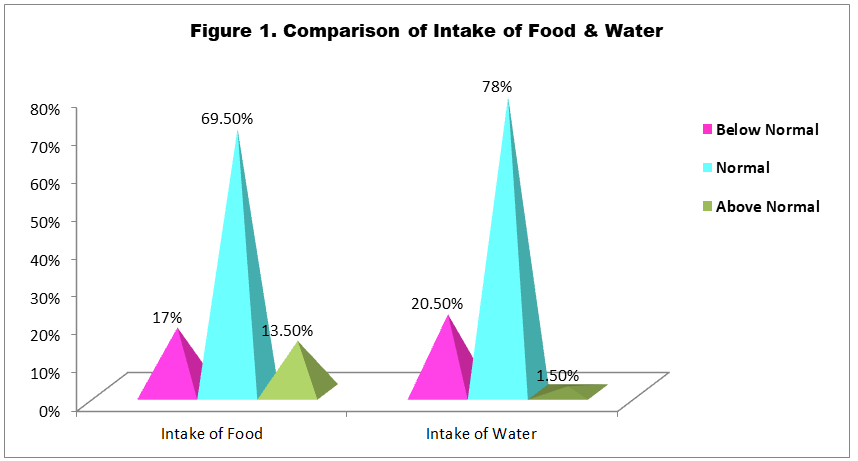
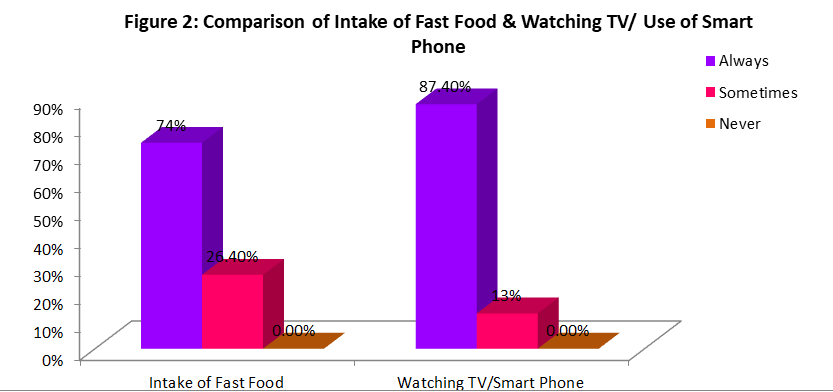
Most (88.9%) of the participants were have the family history of obesity, whereas 36% of the subjects were have the family history of Diabetes and 48% have Hypertension. 27.3% of the participants were not doing any physical exercise and 36% of the participants were doing moderate form of exercise. Majority (69.5%) and (78%) of the participants were having the habit of taking normal intake of food and water respectively. Most (74%) of the participants were always taking fast food, whereas majority (87.4%) of them are always watching TV or using different types of electronic gadgets.
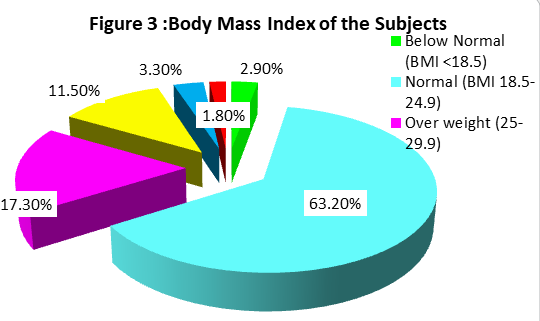
About 63.2% of the subjects were having Normal BMI, but the prevalence rate of over weight is 17.3%, and obesity I and II seen in 14.8% of the subjects .Most alarming finding is that 1.8% of the subjects were have the problem of morbid obesity (BMI >40 Kg/m2).
Discussion
Present study results depicts that 63.2% of the subjects were having Normal BMI, but the prevalence rate of over weight was 17.3% and obesity I & II contribute to 14.8%. Most alarming finding is that 1.8% of the subjects were have the problem of morbid obesity (BMI >40 Kg/m2). About 91% of the participants were between the age group of 18- 23 years. More than 88% of the participants were have the family history of obesity. All participants were females. It was supported with the study findings of Moalif AS, et al. [5], state that the age range of all of the sampled students was 18-35 years. The prevalence rate of overweight and obesity categories in the student population were 33.34% and 10.67% respectively. Obesity rate is higher in females. 50% of the student’s families are having family history of obesity. It was also consistent with the report of World Health Organization[2], the prevalence of overweight and obesity is 33.7% (women 39.5% and males 29.5%) and 68.2% (women 69.2% and men 67.5%), respectively, in the Kingdom of Saudi Arabia (Obesity in Gulf countries). A recent comprehensive survey that gathered information from every region of KSA found a prevalence of obesity of 24.7%.
Recommendations of the study
Following are the main recommendation for preventing obesity
- Advise the students to develop Healthy eating behaviors
- Choose healthier foods – Whole grains, fruits, Vegetables, healthy fats, proteins & water.
- Limiting unhealthy foods (refined grains and sweets, potatoes, red meat, processed meat) and sugary drinks
- Develop the habits of doing regular physical activity and to reduce sedentary activities by limiting television time/ screen time, and other “Sit time”- Playing Computer games / Videos,
- Help the students to reduce their stress
- Improve sleeping hours among the students
Conclusion
Knowledge on obesity can help the participants to control weight and overcome the consequences of obesity. Set realistic short term and long term goals for reducing weight. Make small changes to your daily diet rather than trying to make changes you can’t stick to for long. Making a change in your lifestyle - must change the activities and the way you eat, and you must avoid the food which may contribute to weight gain. Constantly follow the weight and exercise to lose weight. Stay away from fast food and follow a balanced diet. Stay away from drinks that contain sugars. Work on conducting sports activities. This study influenced the clarification of the effects of obesity and work on educating students in the College of Nursing about the need to be careful in eating food and drinks that cause obesity, in addition to enriching the research on the reality of university life, which has a great impact on the quality of food and how to follow the instructions that contribute in reducing the effects of obesity and its repercussions. Help our young generations to develop good health habits like regular physical exercise, healthy lifestyle and healthy eating behaviours for maintaining normal BMI and in order to overcome the global crisis of obesity.
References
-
(2022) World Health Reports.
-
(2023) Obesity and overweight. World Health Organization.
-
Allafi A, Al-Haifi AR, Al-Fayez MA, Al-Athari BI, Al-Ajmi FA, et al. (2014) Physical activity, sedentary behaviours and habits among Kuwaiti adolescents: gender difference. Public Health Nutrition 17(9): 2045-52.
-
Alqarni SS (2016) A review of prevalence of obesity in Saudi Arabia. Obesity & Eating Disorders 2: 2.
-
Moalif AS, Ajam WH, Safaa F (2021) Obesity Prevalence among the College Students. Clin Schizophr Relat Psychoses 15: S6.
- Capacity Constraints in Pediatric Inpatient Psychiatric Care: A Cross-Sectional Analysis of Bed Availability and Geographic Access in North Carolina
- Why Healthcare Analytics Still Optimizes the Wrong Things
- Coding, Coverage, and Care: The Infrastructure of Transgender Health Inequities
- The Effect of Classroom Attendance on Academic Achievement of Management and Leadership Discipline of Nursing Students at Instituto Superior Cristal and Universidade de Dili, Timor-Leste, 2024: A Case Study
- The Role of Social Bonds in Facilitating Shared Investments and Resource Allocation: Addressing the “Wrong Pocket Problem” in Public Health and Healthcare
- Social-Cultural Factors Contributing to Antimicrobial Resistance in Livestock Farmers and Community Households in Kayonza District, Rwanda