
Awareness of Endemics Fighting Agents about Sun Exposure
Introduction: Sunlight plays a crucial role in sustaining human life, however, its impacts vary according to factors such as duration of exposure, intensity and frequency. These impacts can be beneficial, such as the synthesis of vitamin D and the stimulation of melanin production, which have positive effects on the human body. However, inadequate and unprotected exposure to solar radiation can cause damage to the body, such as premature aging and, ultimately, the development of skin cancer. The objective of this study was to analyze whether awareness had an impact on the habits of Endemic Disease Control Agents in the municipality of Ourinhos-SP in relation to sun exposure. Method: The research was carried out using a questionnaire on sun exposure and photoprotection, which contains 11 questions regarding photoprotection and sun exposure habits, applied to 27 (twenty-seven) agents combating endemic vector diseases, in Ourinhos- SP, after a period of two months, the same questionnaire was administered again. Results: A total of 14.8% of participants do not apply sunscreen daily, while 40.7% of those who use sunscreen apply it twice a day and 92.6% use a hat, cap or visor as a protective measure against sunscreen. sun exposure. Conclusion: It is concluded that, despite the high risk of developing skin cancer, these professionals demonstrate greater awareness.
Introduction
Sunlight plays a crucial role in sustaining human life, however, its impacts vary depending on factors such as duration of exposure, intensity and frequency. These impacts can be beneficial, such as the synthesis of vitamin D and the stimulation of melanin production, which have positive effects on the human body. However, inadequate and unprotected exposure to solar radiation can cause damage to the body, such as premature aging and, ultimately, the development of skin cancer [1].
In the solar spectrum, ultraviolet B (UV-B) radiation is mainly responsible for most of the harmful effects associated with skin cancer. Meanwhile, ultraviolet A (UV- A) radiation is correlated with the emergence of malignant melanoma and can also accelerate aging. Both UV-A and UV-B can cause indirect damage through the formation of free radicals in DNA [1].
The prescription of sunscreens, together with proper guidance to patients on sun protection measures, is a fundamental part of dermatologists’ practice and can make a difference in obtaining more effective treatment results, as well as preventing acute and chronic effects. previously associated with sun exposure [2].
Applying sunscreen is recommended as a preventive measure against the development of conditions such as actinic keratosi , basal cell carcinoma , squamous cell carcinoma, melanoma and the sun-induced effects of aging. In 2018, national data indicated the occurrence of more than 170 thousand new cases in Brazil, while global data indicated an incidence of more than 1 million cases of skin cancer worldwide. Although precancerous lesions, such as actinic keratosis, and non-melanoma skin cancers generally have a low mortality rate, their treatment represents a significant burden on the healthcare system and is associated with a high rate of morbidity. Melanoma, although less common, has a substantially higher mortality rate [3].
Therefore, it is essential that health professionals are vigilant in identifying unusual skin signs that may indicate the possible occurrence of some type of skin cancer, such as, for example, protrusions or protuberances, wounds that do not heal, spots that show changes in color, texture, size, cause itching, pain or even bleed. Therefore, the diagnosis of skin cancer requires evaluation by a qualified professional, ensuring that the treatment adopted is the most appropriate, thus enabling early and safe intervention, thus increasing the patient’s recovery prospects [4].
Therefore, we must be aware that protection is the greatest means of prevention. Scientific evidence supports the effectiveness of daily use of sunscreens in preventing premature skin aging, offering a barrier against free radicals and preventing more severe damage. For those who work in environments exposed to sunlight, it is essential to adopt protective measures, such as the use of sunscreen, hats, sunglasses, long-sleeved t-shirts and other accessories that offer protection against solar radiation [5].
Endemic Disease Control Agents play a crucial role in the fight against diseases, carrying out surveillance, prevention, control of endemic diseases and health promotion activities. Its activities take place in the environment in which people live, which they are exposed to on a daily basis to the daily challenges faced by communities, such as security issues and vulnerable situations. This exposes them to various risks, such as psychosocial ones, and makes them more susceptible to excessive exposure to solar radiation, which, in turn, increases the risk of developing skin cancer due to long hours under the sun. Therefore, it is extremely important to implement prevention measures and awareness campaigns to encourage changes in habits and promote self-care among these professionals [6, 7]. The objective of this study was to analyze whether awareness had an impact on the habits of Endemic Disease Control Agents in the municipality of Ourinhos-SP in relation to sun exposure.
Methodology
A total of 27 participants, all of whom are agents fighting endemic diseases in the city of Ourinhos, in the state of São Paulo, were invited by the researchers for reasons of convenience. The age range of these participants ranged from 26 to 64 years old, with 16 of them being male and 11 female. To be eligible, they had to meet the following criteria: A) Be adults over 18 years old; B) Be agents to combat endemic diseases; C) Be fluent in Portuguese (Brazilian). Exclusion criteria included A) participants who did not work under sun exposure.
The research was carried out using a questionnaire on sun exposure and photoprotection adapted Lara RF, et al. [8], contains 11 questions regarding photoprotection and sun exposure habits. Lectures were given by health professionals and pamphlets were distributed with the aim of promoting awareness about the proper application of sunscreen and the necessary skin care. After a period of two months, the same questionnaire was administered again to check whether employees had changed their habits and become more aware. This research was conducted with agents combating endemic diseases, at the vector center in Ourinhos-SP, during the period from August to October 2023.
Results
For the convenience of the researchers, the participation of a group composed of 27 individuals was requested, all of whom act as agents to combat endemic diseases in the municipality of Ourinhos – SP. The age range of these participants ranged from 26 to 64 years old, 16 were male and 11 were female.
The questionnaires of the 27 (twenty-seven) participants were analyzed, on issues such as personal characteristics, use of sunscreen and sun exposure.
| Variable | N | % | |
|---|---|---|---|
| Sex | |||
| Masculine | 16 | 59 | |
| Feminine | 11 | 41 | |
| Age | |||
| 18-25 | |||
| 26-35 | 11 | 41 | |
| 36-45 | 9 | 33 | |
| Over 46 | 7 | 26 |
Table 1: Presentation of the characteristics of the participants regarding gender and age group. Source: Own preparation.
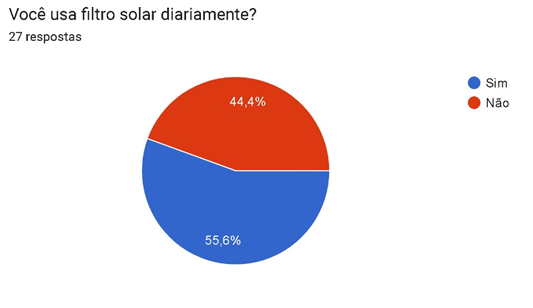
Participants were submitted to the adapted questionnaire on sun exposure and photoprotection , in the results Figure 1 shows that 44.4% of participants do not apply sunscreen daily.
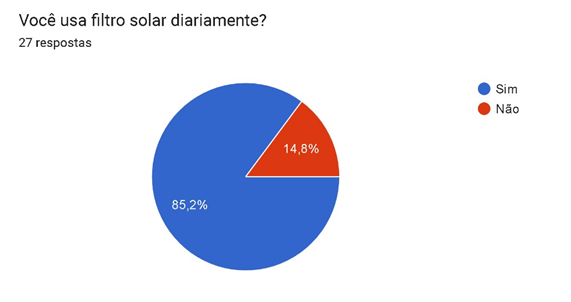
After two months, the same questionnaire was administered again, with a reduction in the percentage of participants who did not use sunscreen daily from 44.4% to 14.8% (Figure 2).
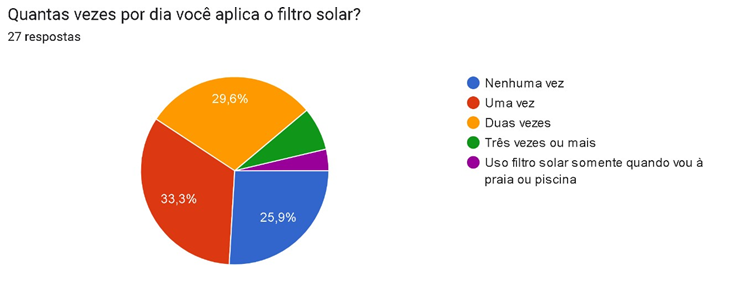
The results in Figure 3 show that 29.6% of participants apply sunscreen twice a day.
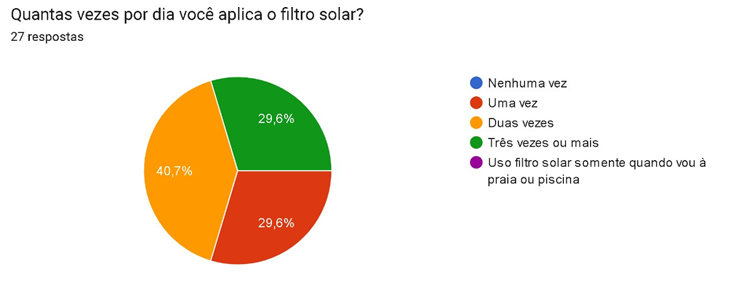
After two months, the same questionnaire was administered again, with an increase in the percentage of participants using sunscreen twice a day from 29.6 to 40.70 (Figure 4).
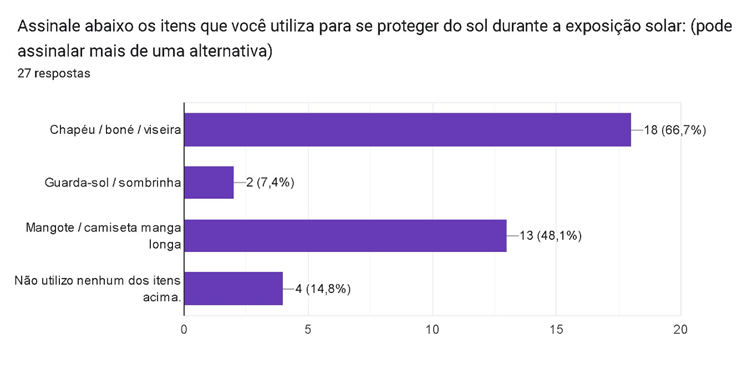
The results in Figure 5 show that 66.7% of participants use a hat, cap or visor to protect themselves from the sun.
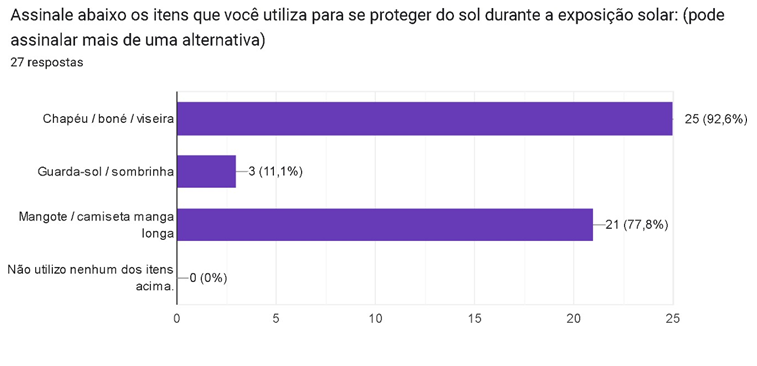
After two months, the same questionnaire was administered again, with an increase in the percentage of participants who use a hat, cap or visor to protect themselves from the sun from 66.7 to 92.6 (Figure 6).
Discussion
Based on the results, it is clear that participants are at high risk of developing malignant and premalignant skin lesions, even though only a minority of them are in the habit of using sunscreen daily.
According to the guidelines of the Brazilian Society of Dermatology [9], it is emphasized that sunscreen must be applied daily, regardless of direct exposure to the sun, and that the minimum recommended SPF is greater than 30.
According to the recommendations of Souza MLP, et al. [3], it is advisable that everyone use sunscreen in their daily routines, preferably with an SPF equal to or greater than 30, that offers protection against both UVA and UVB rays and that is resistant to water. Furthermore, it is recommended to apply sunscreen 15 minutes before sun exposure and renew the application every 2 hours. Therefore, in the case of the workers in question, it would be appropriate for them to apply sunscreen at least three times throughout the day.
In this study, even after awareness campaigns, it was observed that a large proportion of professionals continue to apply sunscreen only once a day, thus increasing the risk of skin cancer for these individuals.
According to the observations of Prestes CA, et al. [5], the importance of professionals who carry out their activities in places with direct exposure to sunlight adopting a series of safety measures was highlighted.
This includes not only applying sunscreen, but also wearing hats, sunglasses, long-sleeved shirts and other accessories that provide effective protection against the effects of solar radiation. In this context, agents fighting endemic diseases demonstrated that they are aware of the importance of sun protection. They reported using various methods to protect themselves from the sun, with the majority opting to use hats, caps and visors as their accessories of choice.
Final Considerations
The relevance of the topic on skin cancer and its preventive strategies originates from its high occurrence in Brazil, representing the most common type of cancer in the country’s population. This cancer is directly linked to continuous exposure to solar radiation and protective practices. Based on the findings of this study, we can conclude that, even given the high risk of developing skin cancer, these professionals are demonstrating greater awareness, changing their habits, such as increasing preventive care in relation to sun exposure, with the use of solar filter the main measure.
References
-
Rebelo EB, Oliveira KMR, Lobato TMX, Silva WG, Bandeira CCA, et al. (2018) Sun exposure and premature aging in beach workers in the city of Salinópolis/PA.
-
Addor FAS, Barcaul CB, Gomes EE, Lupi O, Marçon CR, et al. (2021) Sunscreen in dermatological prescription: review of concepts and controversies. An Bras Dermatol 97(2): 204-222.
-
Souza MLP, Brandão BJF (2019) Recommendations for the use of sunscreen: literature review.
-
Carminate CB, Rocha AB, Gomes BP, Nakagawa FNF, Oliveira GL, et al. (2021)Early detection of skin cancer in primary care, 2021.
-
Prestes CA, Cesconetto TCG (2021) The importance of sun protection. Southcoast Health.
-
Nobre RAP (2015) Occupational Sun Exposure In Community Health Agents of A Municipality of Minas Gerais.
-
Matos GCR, Silva JM, Silveira AM (2020)Work and health: the perspective of agents fighting endemic diseases in the city of Belo Horizonte Control agents of Belo Horizonte, Minas Gerais, Brazil. Rev bras saúde ocup 45.
-
Lara RF, Rodrigues RC, De Lima ER, Nassif PW (2013) Evaluation of Sun Exposure and Photoprotection Habits of Medical Students at Ingá Faculty. Brazilian Journal of Surgery and Clinical Research 4(2): 17-20.
-
(2020) Daily skin care. Brazilian Society of Dermatology (SBD).
- Capacity Constraints in Pediatric Inpatient Psychiatric Care: A Cross-Sectional Analysis of Bed Availability and Geographic Access in North Carolina
- Why Healthcare Analytics Still Optimizes the Wrong Things
- Coding, Coverage, and Care: The Infrastructure of Transgender Health Inequities
- The Effect of Classroom Attendance on Academic Achievement of Management and Leadership Discipline of Nursing Students at Instituto Superior Cristal and Universidade de Dili, Timor-Leste, 2024: A Case Study
- The Role of Social Bonds in Facilitating Shared Investments and Resource Allocation: Addressing the “Wrong Pocket Problem” in Public Health and Healthcare
- Social-Cultural Factors Contributing to Antimicrobial Resistance in Livestock Farmers and Community Households in Kayonza District, Rwanda