
Synthesis and Anticancer Evaluation of Novel Nicotinamide Derivatives Containing Sugars
A series of nicotinamide derivatives tailed with monosaccharides via hydrazones linkage have been synthesized and evaluated for their anticancer activity against the NCI tumor panel. These conjugates were synthesized by acid catalyzed condensation of N-(4-(hydrazinecarbonyl) phenyl) nicotinamide with corresponding monosaccharides. The newly synthesized compounds were characterized by 1H-NMR, 13C-NMR, IR and elemental analysis. Weak anticancer activity was observed against the NCI 60 cell line screening.
Introduction
Cancer is the main health challenge in most regions of the world and the second leading cause of death world-wide [1]. Currently, the main approaches used to treat cancers are surgery, radiotherapy, chemotherapy, and hormone therapy. Although these methods can have certain therapeutic effects on early tumors, they are often ineffective for patients with advanced and metastatic tumors. However, in many cases, they also have serious side effects. For example, chemotherapy drugs can also damage and even kill normal cells, causing serious side effects, such as hematology, gastrointestinal tract, and epithelial reactions [2]. Therefore, there is an urgent need for development of new lead structure for the synthesis of new, potent, and less toxic agents with short duration of therapy against cancer [3].
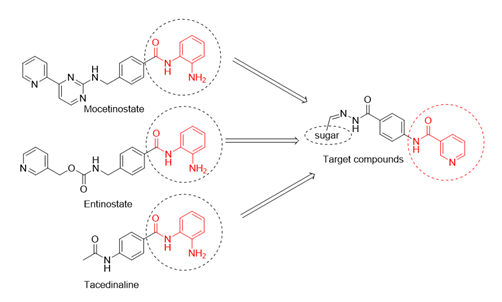
Benzamides containing drugs such as Entinostat, Mocetinostat and tacedinaline showed a good anti-tumor activity [4, 5, 6, 7, 8]. In addition, nicotinamide moiety is considered as bioisosteres of benzamide and has been found to exhibit good pharmacological activities such as anticancer [9, 10, 11], antioxidant [12], anti-inflammatory [13], and anti-bacterial ones [14]. On the other hand, Hydrazones containing an azometine -NHN=CH- group (Schiff base) are considered as an important class of compounds for drug discovery [15]. Such class of compounds have been reported to show anticancer [16, 17], antitubercular [18, 19], antimicrobial [20], antimalarial [21], antiviral [22], anti-inflammatory [23, 24] antiplatelet [25], antifungal [26], analgesic [27], antibacterial [28], and anticonvulsant [29] activities.
Structurally modified nucleosides as acyclic and C-nucleoside analogues showed variety of biological activities, including antiviral, antibiotic, and antitumor activities [30, 31, 32, 33, 34, 35]. The promising strategy of combinations of different scaffolds in new hybrid structures for synthesis of new drugs promoted us to attach carbohydrate residues to nicotinamide in order to find new biologically active leads with good solubility in biological systems. Herein, we wish to report on the synthesis of nicotinamide conjugates with sugar (Figure 1) and their anticancer evaluations against different human cell lines.
Chemistry
All chemical reagents were purchased from common commercial sources with the high percent purity. The melting points (°C) of the synthesized compounds were determined in open capillaries using Stuart Melting Point Apparatus, and are uncorrected. NMR spectra, IR spectra and elemental analyses (C, H, N) were carried out at Applied Nucleic Acid Research Center, Faculty of Sciences, Zagazig University, Zagazig, Egypt. Mass spectra were carried out at the Regional center of Mycology and Biotechnology, Al-Azhar University, Nasr City, Egypt. The IR spectra (KBr, cm-1) of compounds were recorded on Bruker Alpha FT-IR spectrometer. 1H-NMR and 13C APT NMR spectra were recorded on Bruker high performance Digital FT-NMR spectrometer advance III 400 MHz using dimethyl sulfoxide (DMSO)-d6 as solvent. Chemical shifts are reported in δ (ppm) relative to the internal tetramethylsilane (TMS) standard.
Mass spectra were obtained using a GC/MS Mat 112 S mass spectrometer under EI+ ionization technique/ mode. Elemental analyses were determined using the Vario MICRO cube (Elementar) CHNS analyzer. All reactions were monitored by thin layer chromatography (TLC) (Rf) on silica gel 60 GF245 (EMerck, Germany) using and UV lamp for visualization at a wavelength (λ) of 254 nm.
Experimental
Nicotinoylbenzotriazol (3)
To a solution of 1H-benzotriazole (4.76 g, 40mmol) in dichloromethane (100 mL), thionyl chlroide (1.48 mL, 20mmol) was added. The solution was allowed to be stirred at 25°C for 30min. After complete dissolving, nicoinic acid (1.23g, 10mmol) was added and the reaction was allowed to stir for additional 3hrs at 25°C. The reaction was diluted with dichloromethane (50mL) and the organic layer was washed with 1M sodium carbonate solution (3x 100ml) in a separating funnel. The organic layer was dried over anhydrous sodium sulfate and filtered. The solvent was evaporated under reduced pressure. The obtained white preciptate was crystallized from ethanol, yield 91%, m.p. = 101-102°C.
Ethyl 4-(nicotinamido) Benzoate (4)
To a solution of 1-nicotinoyl benzotriazole (3) (2.24 g, 10mmol) in THF (30 ml), ethyl 4-aminobenzoate (1.65g, 10mmol) was added. The mixture was refluxed for 8h. Then, the solvent was evaporated under reduced pressure. The residue was washed with petroleum ether, dried and crystallized from ethanol to give ethyl 4-(nicotinamido) benzoate (4) as white microcrystal in 86% yield (m.p. = 117- 119°C) [36].
1H NMR (400 MHz, DMSO-d_6) δ 10.75 (s, 1H, NH, exchangeable with D2O), 9.12 (d, _J= 1.6 Hz, 1H, C2-H of pyridine), 8.78 (dd, J = 4.8, 1.6 Hz, 1H, C6-H of pyridine),8.31 (d, J = 8.0 Hz, 1H, C4-H of pyridine), 7.99-7.92 (m, 4H, Ar-H), 7.58 (ddd, J = 8.0, 4.8, 0.8 Hz, 1H, C5-H of pyridine), 4.30 (q, J = 7.1 Hz, 2H, CH2), 1.32 (t, J = 7.1 Hz, 3H, CH3). 13C APT NMR (100 MHz, DMSO-d6) δ ppm: 165.3 (CO), 164.6 (CO), 152.4 (CH pyridine), 148.8 (CH pyridine), 143.3 (Ar-C), 135.6 (CH pyridine), 130.3 (C pyridine), 130.1 (Ar-CH), 124.9 (Ar-C), 123.5 (CH pyridine), 119.6 (Ar-CH), 60.5 (CH2), 14.2 (CH3). IR (KBr, cm-1): 3498, 3066, 2966, 1691, 1685, 1600, 1535. Analysis calcd. For C15H14N2O3: C, 66.66; H, 5.22; N, 10.36. Found: C, 66.76; H, 5.29; N, 10.41.
N-(4-(hydrazinecarbonyl)phenyl)nicotinamide (5)
A mixture of compound (4) (0.54 g, 2mmol) and hydrazine hydrate (98%) (0.15 mL, 3mmol) in dioxane (20mL) was heated under reflux for 10h. Excess solvent was evaporated and the separated solid was filtered, washed with ethanol and crystallized from acetic acid to give the hydrazide (5) as pale yellow crystals in 65% yield (m.p., 296-
298 °C). 1H NMR (400 MHz, DMSO-d_6) δ ppm: 10.62 (s, 1H, NH, exchangeable with D2O), 9.70 (s, 1H, NH, exchangeable with D2O), 9.12 (d, _J =1.6 Hz, 1H, C2-H of pyridine), 8.77 (dd, J = 4.8, 1.6 Hz, 1H, C6-H of pyridine), 8.30 (d, J = 8.0 Hz, 1H, C4-H of pyridine), 7.89- 7.81 (m, 4H, Ar-H), 7.58 (dd, J = 8.0, 4.8 Hz, 1H, C5-H of pyridine), 4.46 (s, 2H, NH2, exchangeable with D2O). 13C APT NMR (100 MHz, DMSO-d6) δ ppm: 165.5 (CO), 164.4 (CO), 152.3 (CH pyridine), 148.7 (CH pyridine), 141.3 (Ar-C), 135.6 (CH pyridine), 130.4 (C pyridine), 128.5 (Ar-C), 127.7 (Ar-CH), 123.5 (CH pyridine), 119.5 (Ar-CH). IR (KBr, cm-1): 3350, 3300, 3076, 2986, 1674, 1665, 1597, 1531. MS, m/z: 256 (M+). Analysis calcd. For C13H12N4O2: C, 60.93; H, 4.72; N, 21.86. Found: C, 60.95; H, 4.92; N, 22.05.
General Procedure for the Preparation of N-(4 (sugarhydrazonecarbonyl) phenyl) nicotinamide (5a-d)
To a solution of the hydrazide 5 (0.512 g, 2mmol)) in ethanol (20 mL) containing few drops of glacial acetic acid, the respective sugar (2mmol) in water (1mL) was added. The reaction mixture was heated under reflux for 6 h and the solvent volume was concentrated under vacuum and left to cool at room temperature. After cooling, the formed precipitate was filtered, dried and recrystallized from ethanol-DMF mixture to give the corresponding sugar hydrazone.
N-(4-( D-(+)-Galactose Hydrazonecarbonyl) phenyl)nicotinamide (5a)
Yield 72%; white crystals, mp 228-229oC; 1H NMR (400 MHz, DMSO-d_6) δ ppm: 11.53 (s, 1H, NH, Exchangeable with D2O), 10.67 (s, 1H, NH, Exchangeable with D2O), 9.12 9.12 (d, _J = 1.7 Hz, 1H, C2-H of pyridine), 8.78 (dd, J = 4.7, 1.7 Hz, 1H, C6-H of pyridine), 8.31 (d, J = 8.1 Hz, 1H, C4-H of pyridine), 7.96-7.85 (m, 4H, Ar-H), 7.83 (d, J = 6.1 Hz, 1H, N=CH), 7.59 (dd, J = 8.1, 4.8 Hz, 1H, C5-H of pyridine), 4.98 (d, J = 6.3 Hz 1H, OH, Exchangeable with D2O), 4.56- 4.50 (m, 1H, OH, Exchangeable with D2O), 4.44 ( t, J = 5.6 Hz, 1H, OH, Exchangeable with D2O), 4.39 (t, J = 5.6 Hz, 1H, OH, Exchangeable with D2O), 4.23-4.19 (m, 1H, alditolyl 1H), (d, J = 6.5 Hz 1H, OH, Exchangeable with D2O), 3.73 (q, J = 6.5 Hz, 1H, alditolyl 1H), 3.59-3.50 (m, 2H, alditolyl 2H), 3.46- 3.37 (m, 2H, alditolyl 2H). 13C APT NMR(100 MHz, DMSO-d6) δ ppm: 164.4 (CO), 162.4 (CO),153.7 (N=CH), 152.3 (CH, pyridine), 148.8 (CH, pyridine),141.8 (Ar-C), 135.6 (Ar-CH), 130.4 (C pyridine), 128.4 (CH, pyridine), 128.2 (Ar-C), 123.5 (Ar-CH), 119.5 (CH, pyridine), 72.4 (CH), 70.3 (CH), 69.8 (CH), 69.1 (CH), 63.1 (CH2). IR (KBr, cm-1): 3408, 3219, 3032, 2983, 1647, 1628, 1591; MS: m/z= 418.95 [M+]. Anal. calcd. For C19H22N4O7: C, 54.54; H, 5.30; N, 13.39. Found: C, 54.67; H, 5.34; N, 13.53.
N-(4-( D-(+)-Mannose hydrazonecarbonyl) phenyl)nicotinamide (5b)
Yield 67%; white crystals, mp 220-221 oC; 1H NMR (400 MHz, DMSO-d_6) δ ppm: 11.51 (s, 1H, NH, Exchangeable with D2O), 10.67 (s, 1H, NH, Exchangeable with D2O), 9.14-9.10 (m, 1H, C2-H of pyridine), 8.81- 8.76 (m, 1H, C6-H of pyridine), 8.35-8.27 (m, 1H, C4-H of pyridine), 7.98- 7.80 (m, 4H, Ar- H), 7.73 (d, _J = 6.6 Hz, 1H, N=CH), 7.62-7.55 (m, 1H, C5-H of pyridine), 5.25 (d, J = 5.2 Hz, 1H, OH, Exchangeable with D2O), 4.72 (t, J = 4.4 Hz, 1H, OH, Exchangeable with D2O), 4.51-4.44 (m, 1H, OH, Exchangeable with D2O), 4.37-4.27 (m, 2H, 2OH, Exchangeable with D2O), 3.75-3.45 (m, 6H, alditolyl 6H). 13C APT NMR(100 MHz, DMSO-d6) δ ppm: 164.4 (CO), 162.4 (CO),152.9 (N=CH), 152.3 (CH, pyridine), 148.7 (CH, pyridine),141.8 (Ar-C), 135.6 (Ar-CH), 130.4 (C pyridine), 128.5 (CH, pyridine), 128.4 (Ar-C), 123.5 (Ar-CH), 119.5 (CH, pyridine), 71.1 (CH), 70.8 (CH), 70.5 (CH), 69.4 (CH), 63.8 (CH2); IR (KBr, cm-1): 3470, 3216, 3036, 2959, 1645, 1618, 1589; MS: m/z (%) =418.35[M+]. Anal. calcd. for C19H22N4O7: C, 54.54; H, 5.30; N, 13.39. Found: C, 54.71; H, 5.36; N, 13.48.
N-(4-( D-(+)-Ribose hydrazonecarbonyl) phenyl)nicotinamide (5c)
Yield 73%; white crystals mp 220-221°C; 1H NMR (400 MHz, DMSO-d6) δ ppm: 11.50 (s, 1H, NH, Exchangeable with D2O), 10.67 (s, 1H, NH, Exchangeable with D2O), 9.12 (d, J = 1.5 Hz, 1H, C2-H of pyridine), 8.78 (dd, J = 4.6, 1.5 Hz, 1H, C6-H of pyridine), 8.31 (d, J = 8.0 Hz, 1H, C4-H of pyridine), 7.93-7.85 (m, 4H, Ar-H), 7.81 (d, J = 5.9 Hz, 1H, N=CH), 7.59 (dd, J = 8.0, 4.6 Hz, 1H, C5-H of pyridine), 5.05 (d, 1H, J = 5.9 Hz, OH, Exchangeable with D2O), 4.66- 4.53 (m, 2H, 2OH, Exchangeable with D2O), 4.42-4.30 (m, 2H, alditolyl H and OH, Exchangeable with D2O), 3.66-3.37 (m, 4H, alditolyl 4H). 13C APT NMR(100 MHz, DMSO-d6) δ ppm: 164.4 (CO), 162.4 (CO),153.3 (N=CH), 152.3 (CH, pyridine), 148.8 (CH, pyridine),141.9 (Ar-C), 135.6 (Ar-CH), 130.4 (C pyridine), 128.4 (CH, pyridine), 128.3 (Ar-C), 123.5 (Ar-CH), 119.5 (CH, pyridine), 73.6 (CH), 71.1 (CH), 70.3 (CH), 63.4 (CH2); IR (KBr, cm-1): 3490, 3226, 3057, 2945, 1644, 1634, 1593; MS: m/z (%) = 388.03[M+]. Anal.calcd. for C18H20N4O6: C, 55.67; H, 5.19; N, 14.43. Found: C, 55.73; H, 5.25; N, 14.51.
N-(4-( D-(+)-Arabinose hydrazonecarbonyl) phenyl)nicotinamide (5d)
Yield 68%; white crystals mp 220-221°C; 1H NMR (400 MHz, DMSO-d6) δ ppm: 11.50 (s, 1H, NH, Exchangeable with D2O), 10.67 (s, 1H, NH, Exchangeable with D2O), 9.16-9.08 (m, 1H, C2-H of pyridine), 8.82-8.75 (m, 1H, C6-H of pyridine), 8.34-8.26 (m, 1H, C4-H of pyridine), 7.93-7.84 (m, 4H, Ar- H), 7.81 (d, J = 6.0 Hz, 1H, N=CH), 7.62-7.55 (m, 1H, C5-H of pyridine), 5.27-524 (m, 1H, OH, Exchangeable with D2O), 5.04 (d, J = 6.0 Hz, 1H, OH, Exchangeable with D2O), 4.65-
4.54 (m, 1H, OH, Exchangeable with D2O), 4.40-4.31 (m, 1H, OH, Exchangeable with D2O), 3.95-3.82 (m, 1H, alditolyl 1H), 3.70 – 3.35 (m, 4H, alditolyl 4H). 13C APT NMR(100 MHz, DMSO-d6) δ ppm: 164.4 (CO), 162.4 (CO),153.3 (N=CH), 152.3 (CH, pyridine), 148.8 (CH, pyridine),141.9 (Ar-C), 135.6 (Ar- CH), 130.4 (C pyridine), 128.4 (CH, pyridine), 128.3 (Ar-C), 123.5 (Ar-CH), 119.5 (CH, pyridine), 73.6 (CH), 71.0 (CH), 70.3 (CH), 63.4 (CH2); IR (KBr, cm-1): 3450, 3225, 3057, 2927, 1642, 1633, 1592; MS: m/z (%) = 388.23[M+]; Anal.calcd. for C18H20N4O6: C, 55.67; H, 5.19; N, 14.43. Found: C, 55.81; H, 5.25; N, 14.51.
Results and Discussion
Chemistry
1H-benzo[d][1, 2, 3]triazol-1-yl)(pyridin-3-yl) methanone (3) was prepared according to the reported procedure by the reaction of nicotinic acid (1) With 1H-benzotriazole (2) (4 equiv.) and SOCl2 (2 equiv.) in DCM at 25oC in a good yield (91%) [37]. Refluxing of
1-nicotinoylbenzotriazole (3) with ethyl 4-aminobenzoate in THF afford ester intermediate (4) in 86% yield. The ester (4) was then allowed to undergo hydrazinolysis reaction by refluxing with hydrazine hydrate in dioxane to give N-(4- (hydrazinecarbonyl)phenyl) nicotinamide (5) as reported. Thus, reaction of latter hydrazide (5) with equimolar amounts of a number of monosaccharides; namely D-galactose, D-mannose, D-ribose and D-arabinose was performed to afford the proposed sugar hydrazones (6a-d) by heating in an aqueous ethanolic solution and a catalytic amount of acetic acid, respectively in 67-73% yields (Scheme 1). The 1H-NMR spectra of the afforded sugar hydrazones demonstrated the absence of the two proton signals of the NH2 group and existence of the attributed signals to the hydroxyl protons as well as the alditol chain protons. The resulting chemical shift of the methine proton (i.e., H-1) and existence of a signal assigned to the NH confirmed the acyclic form feature of the sugar part in the resulting sugar hydrazones. The IR spectra of sugar hydrazones (6a-d) showed the presence of characteristic absorption bands corresponding to the hydroxyl groups in the region 3200-3500 cm-1.
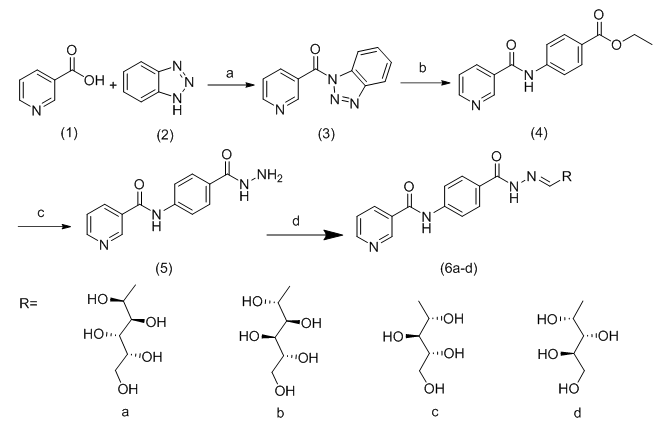
Scheme 1: Reagents and conditions: a) DCM, SOCL2, 250C, 3.5h. b) THF, ethyl 4-aminobenzoate, reflux, 8h. c) NH2NH2, dioxane, reflux, 10h. d) Appropriate aldoses, ethanol, acetic acid, reflux, 6h.
Anticancer Activity
Pharmacological evaluation of the anticancer activity was achieved on the compounds inconvertibly selected by National Institute of Health, Bethesda, USA, under the drug discovery program of NCI. All the finally synthesized 4 compounds have been registered on its website and all compounds have been selected and granted NSC codes: 821079, 821080, 821082 and 821081and screened for anticancer activity at a single high dose (10-5 M) in full NCI 60 cell lines.
Methodology of the in Vitro Cancer Screening
The human tumor cell lines of the cancer screening panel are grown in RPMI 1640 medium containing 5% fetal bovine serum and 2μL glutamine. The cells are inoculated into 96-well microtiter plates in 100 µL at plating densities ranging from 5000 to 40,000 cells/ well depending on the doubling time of individual cell lines. After cell inoculation, the microtiter plates are incubated at 37°C in the presence of 5% CO2, 95% air, and 100% relative humidity for 24 h prior to addition of experimental drugs.
After 24h, two plates of each cell line are fixed in situ with TCA (Tricarboxylic Acid), to represent a measurement of the cell population for each cell line at the time of drug addiction (Tz). Experimental drugs are solubilized in dimethyl sulfoxide at desired final maximum test concentration and stored frozen prior to use. At the time of drug addition, an aliquot of frozen concentrate is thawed and diluted to twice the desired final maximum test concentration with complete medium containing 50µg/mL gentamicin. Additional four, 10-fold or ½ log serial dilutions are made to provide a total of five drug concentrations plus control. Aliquots of 100 µL of these different drug dilutions are added to the appropriate microtiter wells already containing 100µL of medium, resulting in the required final drug concentrations.
After the following drug addition, the plates are incubated for an additional 48 h at 37°C, 5% CO2, 95% air, and 100% relative humidity. For adherent cells, the assay is terminated by the addition of cold TCA. Cells are fixed in situ by the gentle addition of 50 µL of cold 50% (w/v) TCA (final concentration, 10% TCA) and incubated for 60 min at 4°C. The supernatant is discarded, and the plates are washed 5 times with tap water and air dried. Sulforhodamine B (SRB) solution (100 µL) at 0.4 % (w/v) in 1 % acetic acid is added to each well, and plates are incubated for 10 min at room temperature. After staining, unbound dye is removed by washing 5 times with 1% acetic acid and the plates are air dried. Bound stain is subsequently solubilized with 10 mM Trizma base, and the absorbance is read on an automated plate reader at a wavelength of 515 nm.
For suspension cells, the methodology is the same except that the assay is terminated by fixing settled cells at the bottom of the wells by gently adding 50 µL of 80% TCA (final concentration, 16% TCA). Using the 7 absorbance measurements [time zero, (Tz), control growth (C), and test growth in the presence of drug at the 5 concentration levels (Ti)], the percentage growth is calculated at each of the drug concentrations levels. Percentage growth inhibition is calculated as: [(Ti-Tz)/(C-Tz)] × 100 for concentrations for which Ti ≥ Tz [(Ti-Tz)/Tz] × 100 for concentrations for which Ti < Tz.
Three dose response parameters are calculated for each experimental agent. Growth inhibition of 50% (GI50) is calculated from [(Ti-Tz)/(C-Tz)] × 100 = 50, which is the drug concentration resulting in a 50% reduction in the net protein increase (as measured by SRB staining) in control cells during the drug incubation. The drug concentration resulting in total growth inhibition (TGI) is calculated from Ti=Tz. The LC50 (concentration of drug resulting in a 50% reduction in the measured protein at the end of the drug treatment as compared to that at the beginning) indicating a net loss of cells following treatment is calculated from [(Ti- Tz)/Tz] × 100 = -50. Values are calculated for each of these three parameters if the level of activity is reached; however, if the effect is not reached or is exceeded, the value for that parameter is expressed as greater or less than the maximum or minimum concentration tested. The compounds that reduce the growth of any one of the cell lines by 32% or less are passed on for further evaluation in the full panel of 60 cell lines [38]. The growth percent (GP [%]) for tested compounds (Samples) against selected NCI-60 cancer cell lines at single concentration 10-5 M were shown in Table 1.
| Panel | Cell Line | GP [%] of Compound | |||
|---|---|---|---|---|---|
| 5a | 5b | 5c | 5d | ||
| Leukemia | CCRF-CEM | 102.91 | 102.62 | 99.16 | 98.48 |
| HL-60(TB) | 101.19 | 99.89 | 100.4 | 99.4 | |
| K-562 | 110.39 | 102.07 | 104.51 | 103.15 | |
| MOLT-4 | 114.04 | 106.93 | 108.59 | 113.3 | |
| SR | 103.45 | 99.94 | 99.9 | 95.7 | |
| Non-Small Cell Lung Cancer | A549/ATCC | 101.72 | 107.47 | 99.79 | 101.09 |
| EKVX | 106.84 | 107.78 | 104.8 | 100.47 | |
| HOP-62 | 112.6 | 105.39 | 97.55 | 101.62 | |
| HOP-92 | 111.03 | 106.12 | 102.6 | 103.36 | |
| NCI-H226 | 105.59 | 107.69 | 104.91 | 99.93 | |
| NCI-H23 | 109.66 | 109.09 | 100.52 | 107.39 | |
| NCI-H322M | 103.34 | 106.49 | 104.7 | 104.22 | |
| NCI-H460 | 108.19 | 106.59 | 104.23 | 107.89 | |
| NCI-H522 | 96.16 | 100.05 | 92.69 | 99.27 | |
| Colon Cancer | COLO 205 | 109.86 | 109.82 | 112.3 | 106.6 |
| HCC-2998 | 116.58 | 118.83 | 110.39 | 116.96 | |
| HCT-116 | 107.54 | 102.78 | 104.63 | 102.78 | |
| HCT-15 | 105.22 | 105.05 | 105.62 | 102.71 | |
| HT29 | 110.82 | 107.58 | 103.8 | 105.19 | |
| KM12 | 106.13 | 103.21 | 102.63 | 101.9 | |
| SW-620 | 107.65 | 101.52 | 102.51 | 98.89 | |
| CNS Cancer | SF-268 | 102.76 | 104.88 | 98.59 | 98.5 |
| SF-295 | 101.92 | 105.04 | 101.02 | 100.53 | |
| SF-539 | 106.08 | 101.45 | 98.54 | 103.01 | |
| SNB-19 | 97.41 | 102.03 | 97.71 | 98.71 | |
| SNB-75 | 92.58 | 95.95 | 97.44 | 90.34 | |
| U251 | 102.02 | 102.74 | 104.68 | 101.37 | |
| Melanoma | LOX IMVI | 104.01 | 99.19 | 99.05 | 101.27 |
| MALME-3M | 108.26 | 102.76 | 107.7 | 110.42 | |
| M14 | 114.38 | 97.83 | 102.3 | 105.75 | |
| MDA-MB-435 | 106.09 | 104.11 | 103.5 | 103.55 | |
| SK-MEL-2 | 108.95 | 112.39 | 118.4 | 119.52 | |
| SK-MEL-28 | 111.3 | 107.51 | 111.91 | 102.93 | |
| SK-MEL-5 | 104.48 | 104.32 | 104.27 | 106.18 | |
| UACC-257 | 102.09 | 97.7 | 99.76 | 99.98 | |
| UACC-62 | 95.54 | 99.69 | 96.17 | 99.49 | |
| Ovarian Cancer | IGROV1 | 110.47 | 105.59 | 107.16 | 109.13 |
| OVCAR-3 | 120.37 | 130.22 | 118.4 | 112.18 | |
| OVCAR-4 | 102.07 | 108.31 | 110.34 | 114.26 | |
| OVCAR-5 | 106.27 | 99.89 | 101.91 | 102.84 | |
| OVCAR-8 | 104.93 | 111.33 | 102.12 | 104.57 | |
| NCI/ADR-RES | 106.34 | 109.29 | 109.18 | 112.26 | |
| SK-OV-3 | 107.53 | 106.01 | 109.81 | 99.1 | |
| Renal Cancer | 786-0 | 112.59 | 109.71 | 104.99 | 105.58 |
| A498 | 107.49 | 91.56 | 99.3 | 101.89 | |
| ACHN | 102.74 | 105.27 | 109.08 | 100.76 | |
| CAKI-1 | 101.17 | 96.91 | 94.13 | 96.13 | |
| RXF 393 | 120.62 | 119.48 | 106.6 | 109.09 | |
| SN12C | 99.45 | 100.95 | 94.49 | 97.15 | |
| TK-10 | 105.52 | 98.06 | 104.43 | 105.52 | |
| UO-31 | 92.52 | 91.19 | 83.73 | 82.93 | |
| Prostate Cancer | PC-3 | 102.48 | 100.64 | 96.27 | 101.36 |
| DU-145 | 119.09 | 119.4 | 111.41 | 111.78 | |
| Breast Cancer | MCF7 | 94.84 | 97.31 | 91.97 | 92.63 |
| MDA-MB-231/ATCC | 100.01 | 95.18 | 94.49 | 102.35 | |
| HS 578T | 108.48 | 108.28 | 98.42 | 103.7 | |
| BT-549 | 105.72 | 107.53 | 101.88 | 99.02 | |
| T-47D | 100.11 | 102.21 | 99.18 | 96.11 | |
| MDA-MB-468 | 104.54 | 111.43 | 113.34 | 100.71 |
Table 1: Growth percent (GP [%]) for tested compounds (Samples) against selected NCI-60 cancer cell lines at single concentration
Conclusion
All the compounds submitted to the NCI 60 cell screen have been tested initially at a single high dose (10-5 M) in the full NCI 60 cell panel. The operation of this screen utilizes 60 different human tumor cell lines, representing leukemia, melanoma, and cancers of the lung, colon, brain, ovary, breast, prostate, and kidney. Among all synthesized derivatives, analogues (5d) N-(4-(D-(+)-Arabinose hydrazonecarbonyl) phenyl) nicotinamide and (5c) N-(4-( D-(+)-Ribose hydrazonecarbonyl)phenyl) nicotinamide which coupled with pentoses sugars were found to exhibit good anticancer activity as compare to the others (5a) and (5b) which coupled with hexoses sugars against Renal Cancer (UO-31) cell line. The mean growth percentage, range of growth percentage, and growth inhibition percentage relative to Renal Cancer (UO-31) cell line are depicted in Table 2.
| Compound no. | Mean growth | Range of growth | Most sensitive cell line | GI of most sensitive cell line percentage |
|---|---|---|---|---|
| percentage | percentage | |||
| 5a | 105.83 | - 7.48 To 28.10 | Renal Cancer (UO-31) | 7.48 |
| 5b | 104.75 | -8.81 To 39.03 | Renal Cancer (UO-31) | 8.81 |
| 5c | 102.88 | - 16.27 To 34.67 | Renal Cancer (UO-31) | 16.27 |
| 5d | 102.93 | -17.07 To 36.59 | Renal Cancer (UO-31) | 17.07 |
Table 2: Anticancer screening data of synthesized compounds against Renal Cancer (UO-31) cell line.
References
-
Eckhardt S (2002) Recent progress in the development of anticancer agents. Curr med chem Anticancer Agents 2(3): 419-439.
-
Ruijun W, Shi W, Yijun X, Mengwuliji T, Lijuan Z, et al. (2015) Antitumor effects and immune regulation activities of a purified polysaccharide extracted from Juglan regia. Int J Biol Macromol 72: 771-775.
-
Murphy ST, Case HL, Ellsworth E, Hagen S, Huband M, et al. (2007) The synthesis and biological evaluation of novel series of nitrile-containing fluoroquinolones as antibacterial agents. Bioorg Med Chem Lett 17(8): 2150- 2155.
-
Trivedi P, Adhikari N, Sk Abdul Amin, Jha T, Ghosh B (2018) Design, synthesis and biological screening of 2-aminobenzamides as selective HDAC3 inhibitors with promising anticancer effects. European Journal of Pharmaceutical Sciences 124: 165-181.
-
Li X, Zhang Y, Jiang Y, Wu J, Inks ES, et al. (2017) Selective HDAC inhibitors with potent oral activity against leukemia and colorectal cancer: Design, structure- activity relationship and anti-tumor activity study. Eur J Med Chem 134: 185-206.
-
Li Y, Wang Y, Xie N, Xu M, Qian P, et al. (2015) Design, synthesis and antiproliferative activities of novel benzamides derivatives as HDAC inhibitors. Eur J Med Chem 100: 270-276.
-
Cai J, Wei H, Hong KH, Wu X, Zong X, et al. (201) Discovery, bioactivity and docking simulation of Vorinostat analogues containing 1,2,4-oxadiazole moiety as potent histone deacetylase inhibitors and antitumor agents. Bioorg Med Chem 23(13): 3457-3471.
-
Xie R, Yao Y, Tang P, Chen G, Liu X, et al. (2017) Design, synthesis and biological evaluation of novel hydroxamates and 2-aminobenzamides as potent histone deacetylase inhibitors and antitumor agents. Eur J Med Chem 134: 1-12.
-
Rodrigues FA, Oliveira ACA, Cavalcanti BC, Pessoa C, Pinheiro AC, et al. (2014) Biological evaluation of isoniazid derivatives as an anticancer class. Sci Pharm 82(1): 21-28.
-
Kong X (2015) Design, synthesis and biological evaluation of thiourea and nicotinamide-containing sorafenib analogs as antitumor agents. Med Chem Comm 6(5): 867-870.
-
Qi B, Xu X, Yang Y, He H, Yue X (2019) Optimization and biological evaluation of nicotinamide derivatives as Aurora kinase inhibitors. Bioorg Med Chem 27(17): 3825-3835.
-
Aanandhi MV, Mansoori MH, Shanmugapriya S, George S, Shanmugasundaram P (2010) Synthesis and in vitro antioxidant activity of substituted pyridinyl 1, 3, 4 oxadiazole derivatives. Res J Pharm Biol Chem Sci 1(4): 1083-1090.
-
Blanco-Montenegro I, De Ritis R, Chiappini M (2007) Imaging and modelling the subsurface structure of volcanic calderas with high-resolution aeromagnetic data at Vulcano (Aeolian Islands, Italy). Bulletin of Volcanology 69(6): 643-659.
-
Fernandes EL, Magalhães A, Paes KC, De Souza MVN, Vasconcelos TRA, et al. (2006) Cyclisation of 2-chloro-N-(2-pyridinyl) nicotinamides to 5-oxo-5, 6-dihydrodipyrido [1, 2-a: 3 ‘, 2 ‘-e] pyrimidin-11-ium chlorides. Journal of Chemical Research 2006(2): 93-97.
-
Rollas S, Küçükgüzel SG (2007) Biological activities of hydrazone derivatives. Molecules 12(8): 1910-1939.
-
Cocco MT, Congiu C, Lilliu V, Onnis V (2006) Synthesis and in vitro antitumoral activity of new hydrazinopyrimidine- 5-carbonitrile derivatives. Bioorganic & Medicinal Chemistry 14(2): 366-372.
-
El‐Hawash SA, Habib NS, Kassem MA (2006) Synthesis of Some New Quinoxalines and 1, 2, 4‐Triazolo [4, 3‐a]‐quinoxalines for Evaluation of in vitro Antitumor and Antimicrobial Activities. Archiv der Pharmazie: An International Journal Pharmaceutical Medicinal Chemistry 339(10): 564-571.
-
Janin YL (2007) Antituberculosis drugs: ten years of research. Bioorganic & Medicinal Chemistry 15(7): 2479-2513.
-
Imramovský A, Polanc S, Vinsová J, Kocevar M, Jampílek J, et al. (2007) A new modification of anti-tubercular active molecules. Bioorganic medicinal chemistry 15(7): 2551-2559.
-
Rollas S, Gulerman N, Erdeniz H (2002) Synthesis and antimicrobial activity of some new hydrazones of 4-fluorobenzoic acid hydrazide and 3-acetyl-2, 5-disubstituted-1, 3, 4-oxadiazolines. Il Farmaco 57(2): 171-174.
-
Walcourt A, Loyevsky M, Lovejoy DB, Gordeuk VR, Richardson DR (2004) Novel aroylhydrazone and thiosemicarbazone iron chelators with anti-malarial activity against chloroquine-resistant and-sensitive parasites. Int J Biochem Cell Biol 36(3): 401-407.
-
Abdel‐Aal MT, El‐Sayed WA, El‐Ashry ESH (2006) Synthesis and antiviral evaluation of some sugar arylglycinoylhydrazones and their oxadiazoline derivatives. Arch Pharm (Weinheim) 339(12): 656-663.
-
Kalsi R (1990) Synthesis and anti-inflammatory activity of indolyl azetidinones. Indian Journal of Pharmaceutical Sciences 52(3): 129.
-
Salgın-Gökşen U, Gökhan-Kelekçi N, Göktaş O, Köysal Y, Kiliç E, et al. (2007) 1-Acylthiosemicarbazides, 1, 2, 4-triazole-5 (4H)-thiones, 1, 3, 4-thiadiazoles and hydrazones containing 5-methyl-2-benzoxazolinones: synthesis, analgesic-anti-inflammatory and antimicrobial activities. Bioorg Med Chem 15(17): 5738- 5751.
-
Silva GA, Costa LMM, Brito FCF, Miranda ALP, Barreiro EJ, et al. (2004) New class of potent antinociceptive and antiplatelet 10H-phenothiazine-1-acylhydrazone derivatives. Bioorganic medicinal chemistry 12(12): 3149-3158.
-
Loncle C, Brunel JM, Vidal N, Dherbomez M, Letourneux Y (2004) Synthesis and antifungal activity of cholesterol- hydrazone derivatives. European Journal of Medicinal Chemistry 39(12): 1067-1071.
-
Lima PC, Lima LM, da Silva KCM, Léda PHO, de Mirand ALP, et al. (2000) Synthesis and analgesic activity of novel N-acylarylhydrazones and isosters, derived from natural safrole. European Journal of Medicinal Chemistry 35(2): 187-203.
-
Capilla J, Serena C, Pastor FJ, Ortoneda M, Guarro J, et al. (2003) Efficacy of voriconazole in treatment of systemic scedosporiosis in neutropenic mice. J Antimicrobial Agents and Chemotherapy 47(12): 3976-3978.
-
Dimmock JR, Vashishtha SC, Stables JP (2000) Anticonvulsant properties of various acetylhydrazones, oxamoylhydrazones and semicarbazones derived from aromatic and unsaturated carbonyl compounds. European Journal of Medicinal Chemistry 35(2): 241- 248.
-
Hammerschmidt F, Peric B, Öhler E (1997) Synthesis of D-apio-β-D-furanosyl maleimide, an analogue of showdomycin with transposed hydroxymethyl group. Monatshefte für Chemie / Chemical Monthly 128(2): 183-190.
-
Franchetti P, Cappellacci L, Sheikha GA, Jayaram HN, Gurudutt VV, et al. (1997) Synthesis, Structure, and Antiproliferative Activity of Selenophenfurin, an Inosine 5‘-Monophosphate Dehydrogenase Inhibitor Analogue of Selenazofurin. J Med Chem 40(11): 1731-1737.
-
Makara GM, Keserû GM (1997) On the Conformation of Tiazofurin Analogues. J Med Chem 40(25): 4154-4159.
-
Nassar IF, Farargy AFE, Abdelrazek FM, Ismail NSM (2017) Design, synthesis and anticancer evaluation of novel pyrazole, pyrazolo [3,4-d] pyrimidine and their glycoside derivatives. Nucleosides, Nucleotides & Nucleic Acids 36(4): 275-291.
-
El Ashry ESH, El Kilany Y (1997) Acyclonucleosides: Part
-
tri-, tetra-, and pentaseco-Nucleosides**Part 1 can be found in Volume 67; Part 2 appears in Volume 68: 129- 215.
-
El-Sayed WA, El-Sofany WI, Hussein HAR, Fathy NM (2017) Synthesis and anticancer activity of new [(Indolyl)pyrazolyl]-1,3,4-oxadiazole thioglycosides and acyclic nucleoside analogs. Nucleosides Nucleotides Nucleic Acids 36(7): 474-495.
-
Hamoud MM, et al. (2020) Design, Synthesis, and Biological Evaluation of Novel Nicotinamide Derivatives as Potential Histone Deacetylase-3 Inhibitors. New Journal of Chemistry.
-
El‐Nachef C, Bajaj K, Koblick J, Katritzky AR (2012) Microwave‐Assisted Formation of Peptide–Vitamin Conjugates. European Journal of Organic Chemistry 2012(23): 4412-4419.
-
Szafranski K, Slawinski J (2015) Synthesis of Novel 1-(4-Substituted pyridine-3-sulfonyl)-3-phenylureas with Potential Anticancer Activity. Molecules 20(7): 12029-12044.
- Spectrophotometric Determination of Lanthanum (III) and Some Rare Earths with Xylenol Orange
- Introduction and Sources of Molluscicides
- Trimetazidine: An Antianginal Drug and Not Only!
- Nature Inspired Discovery and Development of Antibacterials: An Update
- Fungal Biodegradation of Polycyclic Aromatic Hydrocarbons (PAHs)
- Recent Approaches of Impurity Profiling in Pharmaceutical Analysis: A Concise Review