
Development of an Efficient Method in the Extraction of Silica from Rice Husk Ash
Rice is one of the major crops grown through the world. Once the paddy is separated from the rice grain, the husk is removed from the grain. This constitute one third of the total mass of grains, commonly known as “Rice Husk”. Rice husk is an agricultural waste abundantly available in producing countries. India alone produces 24 million tons of rice husks every year. Worldwide annual husk output is 80 million tons. Rice husk is considered as a form of waste from rice milling processes and are often left rot in field or burnt in open. But rice husk contains silica in range of 80-90% weight. The silica in rice husk exists in the hydrated amorphous from like silica gel which is easily extractable at a lower temperature range. Energy is also produced in the process which could be recovered in the form of heat or electricity
Introduction
‘India lives in villages not in towns’ as quoted by M.K Gandhi. Rice husk and rice husk ash (RHA) are interesting source of considerable levels of high quality silica, which has several applications. The production of silica at industrial scale is based on mechanical, physical, chemical and energy intensive thermal operations at high temperature using large amount of acids generating significant volumes of effluent. Using rice husk as the raw material two million tons of pure high grade silica can be produced to meet the high demand of various industries that are using it. The main states with large number of rice mills are Andhra Pradesh, Tamil Nadu, Karnataka and Kerala etc.
From Table 1 it is clear that silica is the major constituent of the rice husk ash. Burning of rice husk fuel generates heat for boiler. It can be economically viable raw material for production of silica gels and powders. Soluble silicates produced from silica are widely use in glass, ceramics as major components and in pharmaceuticals and cosmetics and detergent industries as bonding and adhesive agents. Silica also be produce as major precursors for a variety of Inorganic and Organometallics materials which have application in synthetic chemistry and in the films and coatings for electronics and optical materials.
- Content
- Percentage
- Adjusted Percentage
- A. SiO2
- 90.5
- 90
- B. CaO
- 1.48
- 1.307
- C. MgO
- 1.23
- 1.005
- D. MnO
- 1.09
- 2.356
- E. Fe2O3
- 1.54
- 1.16
- F. Al2O3
- 1.21
- 1.42
- G. Others
- 2.95
- 3
Table 1: Composition of Rice Husk Ash.
Materials & Methods
Advantage of Using RHA
In advantage in using rice husk as raw materials for precipitated silica are superior and cost effective compare to present technology of producing silica from quartz. Start from a raw materials of little no cost and value which otherwise cause environmental pollution. Process is energy efficient and also consumes much lower energy compare to alternative process involving fusion of selected quality of sand.
Silica in Rice Husk-An Overview
The plants belonging to graminae family namely, rice, wheat, barley, maize are the main source of biogenic the roots as dissolved monosilicic acid, and precipitated within cell as hydrated deposits. The monosilicic and by evaporation of polymerized to force a cellulose silica membrane. It has been formal that silica is highly concentrated in the inner and outermost of the epidermal twice. As a result, rice husks are relatively friable, brittle, and abrasive. The term white ash refers to residue obtained by complete combustion of rice husk. The structure of silica is shown in Figure 1.
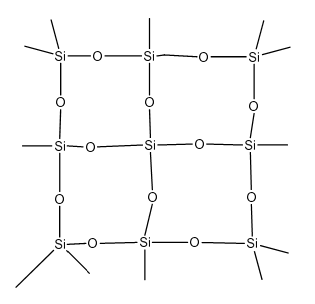
It shows that each ’Si’ atom is surrounded by four ‘O’ atoms and ‘O’ atom serve as a neighbour to two Silicon atoms thereby leading to condensation product with a formula SiO2. Silica occurs in nature mainly in three crystalline forms viz, quartz crystalline (hexagonal), crystobolite (white) and tridymite and also amorphous form like opal and silica in rice husk being biogenic origin in essentially of amorphous nature. But it can be connected into any of three crystalline forms by heat treatment at different temperature.
Precipitated Silica using Rice Husk Ash
Rice husk ash has a silica content of around of 80-90% most of which is in amorphous nature depending upon the temperature of combustion. The silica can be extracted economically by the proposed process which meets the requirements of the various industries. This novel process consists of four processes namely
- Digestion
- Precipitation
- Regeneration
- Calcination and Slaking In the processed the chemical used are recycled thus eliminating expensive effluent treatment plant operation cost.
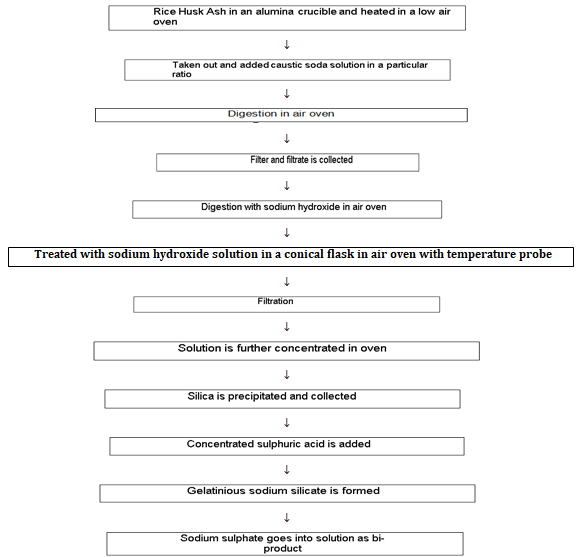
Digestion: 2NaOH+ash→ Na2SiO3 + H2O Precipitation: 2Na2SiO3 +2 CO2 → 2Na2CO3 + 2SiO2 Regeneration: Ca(OH)2 + Na2CO3 → 2NaOH + CaCO3 Calcination and Slaking: CaCO3 → CaO + CO2; Ca(OH)2 → CaO + H2O; CaO + H2O → Ca(OH)2 Digestion: Digestion refers to extraction of silica (insoluble) present in the ash to soluble salt in the form of sodium silicate (Na2SiO3). The required quantity of sodium hydroxide (ratio 1:1 with respect to dry ash) is dissolved in water and the ash is added after the temperature of the caustic reaches 95°C. Digestion temperature is around 95°C give optimum yield. The digestion is carried out at this temperature for a period of one hour, which is the optimum time established by the experimental results as decrease in time result in the decrease in the silica extracted further increase in time of digestion hardly increase the yield obtained. Hence the optimum time for extraction is around one hour at 95°C. Lower temperature extraction yields lower silica thus increasing the cost of extraction in the form of heat supplied.
Precipitation Flow Diagram (Figure 2):
Regeneration: Regeneration of the solution is the conversation of sodium carbonate to sodium hydroxide by the use of calcium hydroxide. Ca(OH)2 + Na2CO3 → 2NaOH + CaCO3 The regenerated sodium hydroxide is used for the digestion of fresh ash. Calcium hydroxide can be either purchased from the market and the resulting calcium carbonate can be sold at the market rate or calcium carbonate can be heated at around 850°C for converting it to calcium oxide which when comes in contact with water becomes calcium hydroxide. Resulting carbon dioxide can be used for the precipitation step. Calcination and Slaking: CaCO3 → CaO + CO2 Calcination is a thermal treatment process in presence of air in which decomposition of calcium carbonate (lime) gives calcium oxide and carbon dioxide. The reaction takes place at around 850°C in a reactor. Calcium oxide is made to react with water in a slaker to give calcium hydroxide and calcium carbonate is produce when sodium carbonate reacts with it. The carbon dioxide gas is produced is sent to the precipitation step.
Results and Discussion
Although there are different procedures to obtain silica from rice husk, the most important step is to first treat the rice husk with acid to remove any impurities such as metals that are present in the rice husk. The acid treatment also gives a surface area for the silica when it is precipitated. The next important aspect of producing nano silica powder depends on the carbonization temperature and duration of carbonization. Different groups of silica with different yields can be obtained based on the carbonization temperature and duration of carbonization. The activating agent, temperature and time of heating the pre-acid washing of rice husk. Concentration of activating agent, all influence the yield, surface area of the rice husk ash are the controlling parameters.
Application
Activated carbon obtained by the above procedure can be used in wastewater treatment as an absorbent to remove organics. Elemental silica is used as a constitutional of building materials. In amorphous form it is used as desiccant, adsorbent, refining agent filter, catalyst compound, etc. In vitreous form it is used in the manufacture of optical elements and glass wires. It is also used as a basic material for glass, ceramic and refractory industries. Other application includes in the manufacture of soluble silicate, silicon and its alloy, silicon carbide and silicon based chemicals and the silicones. It also finds uses in reinforcing filter in natural and synthetic rubber and is used in adhesives to enhance bond strength. Other uses include control of porosity in better separators, for controlling oil spillage, used in brake linings as anti-caking agent. It has also found used in cosmetics as an absorbent and thickening agent, in inks as thickening and matting agent, in tooth paste as an abrasive additive powder and in paper as filler for opacity and brightness polish as a mild abrasive. It can be used as a catalyst support for fine chemical synthesis.
Merits and Demerits
- Production of silica from Rice Husk Ash which is abundantly available from rice mills.
- Low temperature of processing hence energy conservation.
- The silica thus produced has got high market value can be exported and the potential to earn foreign exchange by the entrepreneurs.
- Solving unemployment problem.
- The demerit of this process that it requires rigorous washing to get silica to the impurity associated with it.
Scope for Future Work
Effect of three parameters (acid treatment, temperature and heating rate) on the formation of black particles in rice husk silica ash was studied. However, at low temperature (400°C) the oxidation of carbon in the acid treated rice husk is sluggish. Several efforts are being made to discover a suitable technology capable for producing large quantities of solar grade silicon at a cost less than $ 10/kg. An industrial by product can be converted to a high value added product by using a simple inexpensive method. A powder consisted of 92% of silica was prepared after calcinations of RHA at 700°C for 5 hours. Silica from rice husk can be prepared under controlled temperature without any chemicals treatment, the bulk of investigation indicate that producing silica ash composites directly or into related silica filler composites, suggest that improvement can be achieved in the composite. Performance by modifying the physical and chemical nature of the filler. The extent of improvement, however, is greatly influenced by the ability to control the many relevant characteristics of the filler. A systematic study from a thermodynamics point of view is expected to provide the user with a better understanding of the parameters that are significant and relevant. The husks on leaching with acetic acid and oxalic acid of different concentrations followed by thermal treatment resulted in products with improve properties like purity, reactivity, brightness, surface area and pore volume. The leaching with mineral acids like HCl and HNO3 of different concentrations followed by thermal treatment and measurement of properties showed that the acid treatment is almost equally effective in improving the silica properties.
Potentials and Feasibility of the Idea
Paddy being the major crop in Indian context, the rice husk is largely abundant which is the raw material our concern. The proposed method has got immense potential in converting rice husk ash into silica and hence the feasibility is very high at low cost compared to any other possible methods.
Conclusion
- Procedure adopted in this project to prepare precipitated silica from rice husk. The ash was successful and practically very sound. This innovative idea can be used out in future in the precipitated silica industries. The manufacture of silica from rice husk ash works out to be very cheap and cost effective as the main raw material, the rice husk ash can be obtained at low cost. Activated carbon obtained as the by-product has good market value.
- A general procedure is outlined for silica precipitation and activated carbon from rice husk. The effect of different parameters like temperature of carbonization, temperature of mixture feed into the reactor, production of ash and conversation of silica has been reviewed. Precipitation of silica carried out at 500°C, 600°C, 650°C and 700°C using 5%, 10%, 15% and 20% sodium hydroxide.
- Analysis of yields of silica and activated carbon under progress.
References
-
Ghosh R, Bhattacherjee S (2013) A Review Study on Precipitated Silica and Activated Carbon from Rice Husk. J Chem Eng Process Technol 4: 4.
-
Todkar BS, Deorukhkar OA, Deshmukh SM Dr. Babasaheb Ambedkar Technological University, Lonere-402103, Maharashtra (India). Datta Meghe College of Engineering, Airoil, Navi Mumbai, Maharashtra.
-
Gandhi H, Tamaskar AN, Parab H, Purohit S (2015) Journal of Basic and Applied Engineering Research 2(4): 330-333.
-
Kalapathy U, Procter A, Shultz J (2000) A simple method for production of pure silica from rice husk ash. Bioresource Technology 73(3): 257-262.
-
Setyawan N, Hoerudin, Wulanawati A (2019) Simple extraction of silica nanoparticles from rice husk using technical grade solvent: effect of volume and concentration. Earth and Environ Sci 309: 012032.
-
Abu Bakar R, Yahya R, Gan SN (2016) Production of High Purity Amorphous Silica from Rice Husk. Procedia Chemistry 19: 189-195.
-
Davinder Mittal (1997) Silica from Ash-A Valuable Product from waste material. Resonance.
-
Mukunda HS (2003) Dept. of Aerospace Engineering HSc and execution of Advance Bio Residue Energy Technology Society (ABETS), Silica from Rice husk, Bengaluru.
-
Precipitated silica from Rice Husk Ash IPSIT, Indian Institute of Science Precipitated Silica Technology.
-
Dhirendra, Srivastav RP (1988) Practical Applied Chemistry, Pune Vidyarthi Griha Prakashan, Pune.
- Spectrophotometric Determination of Lanthanum (III) and Some Rare Earths with Xylenol Orange
- Introduction and Sources of Molluscicides
- Trimetazidine: An Antianginal Drug and Not Only!
- Nature Inspired Discovery and Development of Antibacterials: An Update
- Fungal Biodegradation of Polycyclic Aromatic Hydrocarbons (PAHs)
- Recent Approaches of Impurity Profiling in Pharmaceutical Analysis: A Concise Review