
A Sulfur Contain Calixarene as a Rapid Cationic and Anionic Sensor
Thiacalixarenes a subclass of ‘’third era’’ calixarenes, show many fascinating highlights, for example: broadened ring size, effortless substance alteration, and metal complexation because of the nearness of connecting sulfur molecules. The thiacalixarene framework is a remarkable host with huge conceivable outcomes for functionalization not just at the upper and lower edge yet in addition at the connecting sulfide bridges. Changed thiacalixarenes have been utilized for some applications, for example, the discovery and partition of naturally significant cations, anions, and bio-analytes, emulating sub-atomic rationale doors and gadgets.
Introduction of Supramolecule
Supramolecules are molecular assemblies that are held together by intermolecular forces as opposed to by covalent bonds. A few highlights innate to such arrangement make them perfect possibility for use as chemosensors, including:
Ease of Arrangement
Supramolecules can frame exceptionally requested what’s more, complex frameworks without the requirement for covalent bond development, which maintains a strategic distance from long synthetic processes and encourages quick sensor improvement.
Versatile Nature
The generally frail nature of the intermolecular associations that underlie supramolecular assemblies implies that the gatherings are versatile and can change their designs because of an assortment of outside boosts, including the presentation of the respect analyte. Such configurational changes, thus, regularly lead to a quantifiable change in an optical sign, counting fluorescence and assimilation changes.
The capacity to identify a wide assortment of analytes under a wide assortment of certifiable conditions is basic for various applications and in a wide scope of clinical, scientific, political, and security domains. Comprehensively, scientific experts have been profoundly effective at creating identification strategies for little natural atoms [1, 2], anions [3, 4] and cations [5, 6], organic macromolecules including peptides [7, 8] and oligonucleotides [9] what’s more, entire cells [10, 11] and creatures, including microscopic organisms (bacteria) [12, 13] and organisms fungi) [14, 15]. Outstanding successes incorporate the utilization of these systems for the identification of 2,4,6-trinitrotoluene (TNT) [16, 17] noticeable all around above land mines [18] for division of tumor limits to empower profoundly powerful tumor resection surgeries [19] and for the identification of microorganisms in food [20] liquid [21] and the human body.
In all cases, the sane plan of synthetic sensors or chemosensors for location applications requires intensive thought of all system segments:
- The analyte, characterized as the objective for identification.
- The recognition component, characterized as the part of the sensor that perceives the analyte.
- The transducer, characterized as the sensor segment that reacts to the nearness of the analyte with an adjustment in signal.
- The condition (environment) (solvent [22] : gas-phase condition [23] and solid-state backing [24, 25, 26])
- All other exploratory boundaries, including the system temperature also, the convergences all things considered.
Calixarenes
Calixarenes are the third era of this supramolecular has particles and among with this three age calixarenes are easy to combine and changed with examination of crown ethers and cyclodextrins [27]. Calixarenes which are cyclic oligomers in structure made out of phenolic units related with methylene gathering and unmistakably demonstrated conformational properties and pit that can oblige diverse guest species. Calixarenes are integrated by the base- catalyzed condensation reaction of p-alkyl-phenols and it tends to be changed by some functionalization of its upper and lower edges [28, 29]. Calixarenes are as such known as macrocycles with boundless possibilities that are not pondered other normal hosts [30]. Using these sorts of fabricated parts different calixarene-based receptor has been coordinated and their abilities have been utilized in various habits, for instance, in chromatography, sensory, and partition chemistry applications [31]. Calixarenes are classified in to the main two types
- Heteracalixarenes.
- Heterocalixarenes.
Where, hetero atoms for example, N, S, and O replace the scaffold methylene group is called as Heteracalixarenes and where, heterocyclic moiety for example, Furan and Pyrroles replace the phenolic group is called as Heterocalixarenes [32].
Thiacalixarenes (TCA)
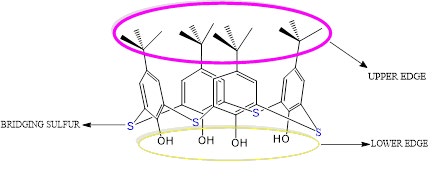
Thiacalixarenes are organized as heteracalixarene components since they contain sulfur particles rather than the regular methylene gatherings [33, 34]. Thiacalixarene (TCA) rose in 1997 as individuals from the heteracalixarene family and have since gotten broad thought from the supramolecular arrange. Miyanari S, et al. [32] uncovered a further auxiliary class of calixarene family, the p-tert-butyl thiacalixarenes (where, n= 4, 6, 8), in which all the methylene bridges of the calixarene were reliever by sulfide bonds (Figure 1). Conversely with the essential characteristics of the customary calixarene moiety, thiacalixarene is continuously Attractive a direct result of the going with reasons:
- The size of the ring of thiacalixarene than that of calixarene is 15% greater because of the more drawn out bond length of carbon-sulfide connect, when diverged from Carbon–Carbon (c-c) [35].
- The ring linkages affiliating sulfur (S) with the phenolic oxygen’s may demonstration pleasantly in the wake of limiting metal particles.
- Basic changes in sulfide connect by the oxidation to shape a sulfoxide and sulfone derivatives can change the properties of depression structure by the structures of calix benzene rings.
Modification of TCA
Modification of thiacalixarene is surely an immediate and valuable approach to expand the rundown of elements of these thiacalixarenes. As a rule, the adjustment techniques created for calixarene can be promptly adjusted to thiacalixarene. In any case, in this segment, we will limit ourselves to a conversation on the modification strategies explicit to thiacalixarenes. The chemical functionalization of thiacalixarene has prompted an incredible assortment of subsidiaries with altered solubilities, complexation capacities and conformational mobilities for the combination of more intricate supramolecular frameworks. The nearness of four crossing over sulfur particles in the macrocyclic skeleton of thiacalixarenes empowers valuable change of the thiacalixarene skeleton by oxidation of the sulfide scaffolds to sulfoxides or sulfones [36, 37, 38]. Every one of these adjustments changes the system of the Chapter macrocycle, along with the possible correlation with calixarenes. Thus, thiacalixarenes can likewise be modified on the upper and additionally lower edge, making them alluring as sub-atomic bases for getting superior receptors of ions and molecules. We discus derivatizations with the different type which is given below
- Modification of Lower rim
- Modification of Upper rim
- Modification of Sulfide Bridges
Modification of Lower Rim
For the alteration of thiacalixarenes there are wide choice of assortment inside the strategies have been accounted for here to previously. For the functionalization of lower edge significant technique is ‘adjustment of hydroxyl’s gatherings (phenolic hydroxyl gatherings). Hydroxyl groups are dynamic species and might encounter reactions with different reagents. With an abundant number of different ether and ester groups thiacalixarenes have been substituted. Distinctive conformers will be separated because of inconsistent gatherings are adequate to forestall interconversion. Regularly two sorts adjustment in response strategy for thiacalixarenes are goes through (1) alkylation: The alkylation with ethyl bromo-acetate and simple halo- alkanes derivation of thiacalixarenes are happens in nearness of different metal carbonates (M2CO3, where M=K+, Na+, Cs+) give different items with various compliances like 1,3 alternate, 1,2 alternate, cone, partial cone [39] and (2) esterification.
Modification of Upper Rim
Functionalization at the upper edge of TCA have been done chiefly by methods for two techniques
- Electrophilic aromatic substitution (SEAr) reaction at para-position of phenolic gatherings [40].
- Ipso-substitution by electrophilic bunch at tert-butyl gatherings.
Modification of Sulfide Bridges
With contrasted with traditional calixarene nearness of sulfide bunches in thiacalixarene is restrictive attribute of it which can experience oxidation to sulfonyl and sulfinyl N N N N N N Ag+ O O S S S S OR OR Scheme 1: Fluorescent mechanism of compound with Ag+.
capacities. As a result of sulfur particle in the spot of methylene spanned it very well may be go through with some one of kind applications. Which can’t relevant on customary calixarenes. Presently, oxidation of thiacalixarene with the nearness of some oxidant like H2O2 (hydrogen peroxide) or NaBO3 (sodium perborate) or TFA (trifluoroacetic acid) in some natural solvents gives sulfone subordinates and sulfoxide subsidiaries; which are the consequence of transformation sulfide extension to sulfone and sulfoxide subsidiaries [36, 41].
TCA Applications
TCA have endless preferences for functionalization at lower edge, upper edge, and Sulfide Bridge. Presently, with contrast with classic calixarene thiacalixarene have great awaiting capacity with metal particles as a result of sulfide group present at crossing over position. Thiacalixarene have functionalized for good restricting proclivity with delicate and hard metal particles with fuse of oxygen. TCA have been functionalized for the location of different anions, cations and neutral analytes. In different uses of thiacalixarenes have been accounted for as self-amassed coordination systems, sub-atomic switches, attractive materials, rationale entryways and luminescent materials.
Cationic Spectroscopic Sensors (UV/Fluorescent Sensors)
Zeng X, et al. [42, 43] (Scheme 1) announced fluorescent sensor of thiacalixarene which is functionalized from lower edge having triazole ring as cationic restricting destinations with 1,3 substitute conformation with explicitly bind Ag+ particles with colossal improvement of the monomer emanations of pyrene with ratiometric fluorescence conduct. This all report proposed that triazole moiety is answerable for the good affinity with Ag+ particle since nearness of nitrogen atom on it and coordination by the ionophoric pit and sulfur molecule of TCA.
Ag+
N N
N N
N N
O O
S S S
S
OR OR
R=CH2COEt R=CH2Ph
Sharma PR, et al. [44] (Scheme 2) announced tetra pyrene-Connected chemosensor in cone-conformation of thiacalixarene. In hydrous medium it gives consistence conduct with metal particles. The chemosensor showed high selectivity to Fe3+ particles by fluorescence smothering of excimer emanation of pyrene units in light of converse Fe+3 S S Reverse PET S S O O O O O O O O HN NH HN NH photo induced charge move to carbonyl oxygen from pyrene units. In nearness of any variation cations, anions, amino acids, blood serum the selectivity isn’t influenced. That is the reason it utilized as particular sensor in living cells (PC3 cells) for Fe+3 particles.
S
S
S S
O O O
O
Fe+3
O HN
NH NH HN O O
O
Scheme 2: Fluorescence binding mechanism of compound with Fe3+ ions.
Anionic Spectroscopic Sensors (UV/Fluorescent Sensors)
Jain VK, et al. [45] (Scheme 3) integrated the fluorescent chemosensor with two quinoline moieties which depend on thiacalixarene equipped for fluoride particles. They watched outflow spectra of various anions like Cl-, F-, Br-, H2PO4 -, I- and CH3COO- in tetra butyl ammonium salt (TBA) with acetonitrile F - S S S S OH OH O O O O N N H H N N Scheme 3: Proposed binding modes of compound with F- ions.
Bhalla V, et al. [46] (Scheme 4) integrated fluorescent chemosensor for fluoride particles with two naphthyl moiety of thiacalixarene. Given moiety don’t give emission spectra with given receptor however with the expansion of F- (fluoride) particle into the moiety it gives emission spectra band. That consequence of spectra gives the data about the higher selectivity of fluoride particles with given as dissolvable solvent. Compound gives watched outflow spectra at 408nm with expansion of fluoride particles (F-) it gives 470nm spectra which demonstrated the red shift while another anions don’t gives changed in adsorption spectra. This changed of spectra gives the data about association of electronegative fluoride (F-) particles with given moiety because of hydrogen holding.
S
S S S
OH OH O
O
O O
N N
H H
F -
N N
receptor. The expansion in emission spectra in persuaded by the fluoride particles (F-) in portrayed by the intramolecular pi-pi (π-π) connection emission arrangement among two naphthyl moiety. This intramolecular connection is held because of intermolecular restricting cooperation of fluoride particles with - NH gathering of thiourea moieties.
O O
F -
S S S
S
O O
ICT
NH HN
S S
N N
Scheme 4: Proposed binding mode of compound with F- Figure.
Kumar R, et al. [47] (Scheme 5,6) integrated fluorogenic chemo-sensors for fluoride particles and cyanide particles of thiacalix [4] arene in different modes. The closeness of fluoride particles starts the fluorescence release to ‘on state’ and the proximity of cyanide particles results in ‘ratiometric direct.
O O
O O
S S S O O
S
F - CN -
S S S O O
S
ICT
NH HN
N N
S S
S S
NH HN
F - CN -
N N
O O
S S S
S
O O
N N
S S
N N
F -
This pyrene based fluoride sensors gives intramolecular charge move system (ICT) and high determination to fluoride (F-) with upgraded Monomer discharges and cyanide (CN-) particle with ratiometric character.
O O
S S S O O
S
N N
S S
N N
Scheme 5: Fluorogenic sensors for fluoride and cyanide ions of TCA.
O
O
O O O
O
O O
O O
S S S O O
S
F - CN -
S S S O O
S
ICT
NH HN
N N
S S
S S
NH HN
F - CN -
N N
O
O O
O O
S S S O O
S
N N
S S
N N
Scheme 6: Fluorogenic sensors for fluoride and cyanide ions of TCA.
Aim and Scope of Work
The key points of the mini review which help researcher to understand the importance of the sulfur contain calixarene.
- The presence of hetero atom (Sulfur atom) at bridge position is responsible for the unique behavior in the calixarene. In addition to that, sulfur atom improving the binding ability with different kinds of analytes.
- The modifications at upper rim, Lower rim and Bridge position garnish the calixarene as a more distinguishable spectroscopic sensor.
- The distinguishable behaviors of such hetro atom like N, S, and O facilitate the cation sensing through metal- hetero atom non covalent interaction which promote the binding mode and mechanism of electron as well as proton transfer.
- As the anion sensing is concerned, the sulfur containing calixarene is very unique because of the larger cavity and proper functionalization at the lower rim or upper rim improves the hydrogen bonding with the anions. The ability helps to expand the anion sensor mechanism in terms of the lower detection limit and rapid sensing.
References
-
Chaudhuri S, DiScenza DJ, Smith B, Yocum R, Levine M (2017) Array-based detection of isomeric and analogous analytes employing synthetically modified fluorophore attached β-cyclodextrin derivatives. New Journal of Chemistry 41(23): 14431-14437.
-
Beyeh NK, Jo HH, Kolesnichenko I, Pan F, Kalenius E, et al. (2017) Recognition of Viologen Derivatives in Water by N-Alkyl Ammonium Resorcinarene Chlorides. J Org Chem 82(10): 5198-5203.
-
Chi X, Peters GM, Hammel F, Brockman C, Sessler JL (2017) Molecular recognition under interfacial conditions: Calix [4] pyrrole-based cross-linkable micelles for ion pair extraction. J Am Chem Soc 139(27): 9124-9127.
-
Fatila EM, Twum EB, Sengupta A, Pink M, Karty JA, et al. (2016) Anions stabilize each other inside macrocyclic hosts. Angewandte Chemie International Edition 55(45): 14057-14062.
-
Harding Lepage P, Peytavi R, Bergeron MG, Leclerc M (2011) Amplification strategy using aggregates of ferrocene-containing cationic polythiophene for sensitive and specific electrochemical detection of DNA. Anal Chem 83(21): 8086-8092.
-
Boonkitpatarakul K, Wang J, Niamnont N, Liu B, Mcdonald L, et al. (2016) Novel turn-on fluorescent sensors with mega stokes shifts for dual detection of Al3+ and Zn2+. ACS Sens 1(2): 144-150.
-
Yuan Y, Zhang R, Cheng X, Xu S, Liu B (2016) A FRET probe with AIEgen as the energy quencher: dual signal turn-on for self-validated caspase detection. Chemical Science 7: 4245-4250.
-
Zhang R, Sung SH, Feng G, Zhang CJ, Tang BZ, et al. (2018) Aggregation-induced emission probe for specific turn- on quantification of soluble transferrin receptor: An important disease marker for iron deficiency anemia and kidney diseases. Anal Chem 90(2): 1154-1160.
-
Woo HY, Nag OK, Kim J, Kang M, Bazan GC (2008) Water- soluble polyelectrolytes for FRET-based DNA detection. Molecular Crystals and Liquid Crystals 486: 244/[1286]- 1249/[1291].
-
Gade AM, Meadows MK, Ellington AD, Anslyn EV (2017) Differential array sensing for cancer cell classification and novelty detection. Org Biomol Chem 15(46): 9866- 9874.
-
Le ND, Yesilbag Tonga G, Mout R, Kim ST, Wille ME, et al. (2017) Cancer cell discrimination using host–guest “doubled” arrays. J Am Chem Soc 139(23): 8008-8012.
-
Zhang Q, Savagatrup S, Kaplonek P, Seeberger PH, Swager TM (2017) Janus emulsions for the detection of bacteria. ACS Cent Sci 3(4): 309-313.
-
Disney MD, Zheng J, Swager TM, Seeberger PH (2004) Detection of bacteria with carbohydrate-functionalized fluorescent polymers. J Am Chem Soc 126(41): 13343- 13346.
-
Fang Y, Ramasamy RP (2015) Current and prospective methods for plant disease detection. Biosensors 5(3): 537-561.
-
Pieczywek PM, Cybulska J, Szymańska-Chargot M, Siedliska A, Zdunek A, et al. (2018) Early detection of fungal infection of stored apple fruit with optical sensors–Comparison of biospeckle, hyperspectral imaging and chlorophyll fluorescence. Food control 85: 327-338.
-
Rose A, Zhu Z, Madigan CF, Swager TM, Bulović V (2005) Sensitivity gains in chemosensing by lasing action in organic polymers. Nature 434: 876-879.
-
Narayanan A, Varnavski OP, Swager TM, Goodson T (2008) Multiphoton fluorescence quenching of conjugated polymers for TNT detection. J Physl Chem C 112(4): 881-884.
-
Williams VE, Yang JS, Lugmair CG, Miao YJ, Swager TM (1999) Design of novel iptycene-containing fluorescent polymers for the detection of TNT. In: Detection and Remediation Technologies for Mines and Minelike Targets IV, International Society for Optics and Photonics, pp: 402-408.
-
Prince AC, Jani A, Korb M, Tipirneni KE, Kasten BB, et al. (2017) Characterizing the detection threshold for optical imaging in surgical oncology. J Surg Oncol 116(7): 898- 906.
-
Bruno JG, Sivils JC, Phillips T (2017) Aptamer–Magnetic Bead Quantum Dot Sandwich Assays for Foodborne Pathogen Detection: Pros, Cons, and Lessons Learned. Journal of AOAC International 100(4): 895-899.
-
Zhang H, Yang S, Beier RC, Beloglazova NV, Lei H, et al. (2017) Simple, high efficiency detection of microcystins and nodularin-R in water by fluorescence polarization immunoassay. Analytica Chimica Acta 992: 119-127.
-
Kundu A, Anthony SP (2018) Triphenylamine based reactive coloro/fluorimetric chemosensors: Structural isomerism and solvent dependent sensitivity and selectivity. Spectrochimica Acta A Mol Biomol Spectrosc 189: 342-348.
-
Potyrailo RA (2017) Toward high value sensing: monolayer-protected metal nanoparticles in multivariable gas and vapor sensors. Chem Soc Rev 46(17): 5311-5346.
-
Calvo NL, Maggio RM, Kaufman TS (2018) Characterization of pharmaceutically relevant materials at the solid state employing chemometrics methods. Journal of Pharmaceutical and Biomedical Analysis 147: 538-564.
-
Huang L, Wang Z, Zhu X, Chi L (2016) Electrical gas sensors based on structured organic ultra-thin films and nanocrystals on solid state substrates. Nanoscale Horiz 1(5): 383-393.
-
Shi W, Friedman AK, Baker LA (2017) Nanopore sensing. Anal Chem 89(1): 157-188.
-
Shokova E, Kovalev V (2003) Thiacalixarenes-a new class of synthetic receptors. Russian Journal of Organic Chemistry 39: 1-28.
-
Makha M, Raston CL (2001) Direct synthesis of calixarenes with extended arms: p-phenylcalix [4,5,6,8] arenes and their water-soluble sulfonated derivatives. Tetrahedron Letters 42(35): 6215-6217.
-
Vicens J, Böhmer V (2012) Calixarenes: a versatile class of macrocyclic compounds. Springer Science & Business Media.
-
Böhmer V, Gutsche CD (1998) Calixarenes Revisited; Stoddart, JF, Ed, Monographs in supramolecular chemistry. The Royal Society of Chemistry: Cambridge.
-
Iki N, Kabuto C, Fukushima T, Kumagai H, Takeya H, et al. (2000) Synthesis of p-tert-butylthiacalix [4] arene and its inclusion property. Tetrahedron 56(11): 1437-1443.
-
Kumagai H, Hasegawa M, Miyanari S, Sugawa Y, Sato Y, et al. (1997) Facile synthesis of p-tert-butylthiacalix [4] arene by the reaction of p-tert-butylphenol with elemental sulfur in the presence of a base. Tetrahedron letters 38(22): 3971-3972.
-
Iki N, Miyano S (2001) Can thiacalixarene surpass calixarene?. Journal of inclusion phenomena and macrocyclic chemistry 41: 99-105.
-
Gutsche CD (2001) Synthesis of calixarenes and thiacalixarenes. Calixarenes 1-25.
-
Akdas H, Bringel L, Graf E, Hosseini MW, Mislin G, et al. (1998) Thiacalixarenes: Synthesis and structural analysis of thiacalix [4] arene and of p-tert-butylthiacalix [4] arene. Tetrahedron Letters 39(16): 2311-2314.
-
Iki N, Kumagai H, Morohashi N, Ejima K, Hasegawa M, et al. (1998) Selective oxidation of thiacalix [4] arenes to the sulfinyl-and sulfonylcalix [4] arenes and their coordination ability to metal ions. Tetrahedron Letters 39(41): 7559-7562.
-
Mislin G, Graf E, Hosseini MW, Mislin G, De Cian A, et al. (1998) Sulfone-calixarenes: a new class of molecular building block. Chemical Communications 13: 1345- 1346.
-
Mislin G, Graf E, Hosseini MW, De Cian A, Fischer J (1999) Synthesis and Structural Analysis of mercaptothiacalix [4] arene. Tetrahedron Lett 40: 02586-02586.
-
Morohashi N, Narumi F, Iki N, Hattori T, Miyano S (2006) Thiacalixarenes. Chemical Reviews 106(12): 5291-5316.
-
Parola S, Desroches C (2004) Recent advances in the functionalizations of the upper rims of thiacalix [4] arenes. A review. Collection of Czechoslovak Chemical Communications 69(5): 966-983.
-
Morohashi N, Iki N, Sugawara A, Miyano S (2001) Selective oxidation of thiacalix [4] arenes to the sulfinyl and sulfonyl counterparts and their complexation abilities toward metal ions as studied by solvent extraction. Tetrahedron 57(26): 5557-5563.
-
Ni XL, Zeng X, Redshaw C, Yamato T (2011) Synthesis and evaluation of a novel pyrenyl-appended triazole- based thiacalix [4] arene as a fluorescent sensor for Ag+ ion. Tetrahedron 67(18): 3248-3253.
-
Ni XL, Zeng X, Hughes DL, Redshaw C, Yamato T (2011) Synthesis, crystal structure and complexation behaviour of a thiacalix [4] arene bearing 1, 2, 3-triazole groups. Supramolecular Chemistry 23(10): 689-695.
-
Kumar M, Kumar R, Bhalla V, Sharma PR, Kaur T, et al. (2012) Thiacalix [4] arene based fluorescent probe for sensing and imaging of Fe3+ ions. Dalton Transactions 41(2): 408-412.
-
Darjee SM, Mishra DR, Bhatt KD, Vyas DJ, Modi KM, et al. (2014) A new colorimetric and fluorescent chemosensor based on thiacalix [4] arene for fluoride ions. Tetrahedron Letters 55(51): 7094-7098.
-
Kumar M, Kumar R, Bhalla V (2009) F−-Induced ‘turn- on’fluorescent chemosensor based on 1, 3-alt thiacalix [4] arene. Tetrahedron 65(22): 4340-4344.
-
Kumar M, Kumar R, Bhalla V (2013) Differential fluorogenic sensing of F-versus CN-based on thiacalix [4] arene derivatives. Tetrahedron Letters 54(12): 1524- 1527.
- Spectrophotometric Determination of Lanthanum (III) and Some Rare Earths with Xylenol Orange
- Introduction and Sources of Molluscicides
- Trimetazidine: An Antianginal Drug and Not Only!
- Nature Inspired Discovery and Development of Antibacterials: An Update
- Fungal Biodegradation of Polycyclic Aromatic Hydrocarbons (PAHs)
- Recent Approaches of Impurity Profiling in Pharmaceutical Analysis: A Concise Review