
Isolation of Three New Substituted Disaccharides from Leaves and Stems of Phlox Drummondii
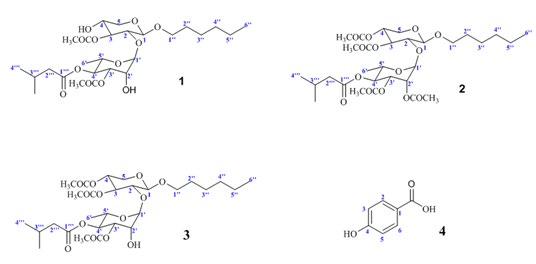
We currently work with fresh, undried and uncrushed flowers, leave and stems which were used to avoid the formation of artifacts through aerial oxidation and enzymatic degradation. These studies have led to the isolation of three new constituents. 2-O-(β-3′-O-acetyl,4′-O-isovaleroyl-rhamnopyranosyl)-1-O-hexyl,3-O-acetyl-β-xylopyranose (Compound 1), 2-O-(β-2′,3′- Di-O-acetyl,4′-O-isovaleroyl-rhamnopyranosyl)-1-O-hexyl,3,4-di-O-acetyl-β-xylopyranose (Compound 2) and 2-O-(β-3′-Oacetyl,4′-O-isovaleroyl-rhamnopyranosyl)-1-O-hexyl,3,4-di-O-acetyl-β-xylopyranos, along with one known 4-hydroxy benzoic acid have been isolated from the leaves and stems of Phlox drummondii. Their structures have been established through chemical and spectral studies including two dimensional NMR (COSY 450 , NOESY, HMQC and HMBC) experiments.
Huma Aslam Bhatti*, Aneela Naz, Rubina, Samina naz and Shaheen Faizi
H.E.J. Research Institute of Chemistry, University of Karachi, Pakistan
Keywords: Phlox drummondii; Polemoniaceae; Xylopyranose; Rhamanose
Introduction
The genus Phlox belongs to American family Polemoniaceae [1], which has about 15 genera and 300 species [2]. The generic name of Phlox means flame, alluding to the general brilliance of flowers [3]. This genus comprises about 70 species of hardy herbaceous perennials and half- hardy shrubs and annuals distributed in North and South America [4], Europe and Asia. Phlox drummondii, an annual phlox is a 45 cm (11/2 foot) branching plant with usually reddish purple blooms. It has given rise to many cultivated forms with petals of two colors and a star-like shape. It originated in Texas, USA [5] but has now cultivated all over the world.
Careful sifting of literature revealed that very little phytochemical work had been done on the genus Phlox, while no pharmacological work has been reported on its various parts. Using different solvent systems and preparative chromatography techniques on the extract of leaves and stem of phlox drummondii leads to the isolation of three novel compounds: 2-O-(β-3′-O-acetyl,4′-O-isovaleroyl- rhamnopyranosyl)-1-O-hexyl,3-O-acetyl-β-xylopyranose (Compound 1), 2-O-(β-2′,3′-Di-O-acetyl,4′-O-isovaleroyl- rhamnopyranosyl)-1-O-hexyl,3,4-di-O-acetyl-β- xylopyranose (Compound 2) and 2-O-(β-3′-O-acetyl,4′-O- isovaleroyl-rhamnopyranosyl)-1-O-hexyl,3,4-di-O-acetyl- β-xylopyranose (Compound 3) along with one known constituents that is 4-hydroxy benzoic acid (Compound 4) (Figure 1). These compounds were characterized by different spectroscopic techniques including UV, IR, EI-MS, FAB, 1H NMR and 2D-NMR techniques for new compounds.
Results and Discussion
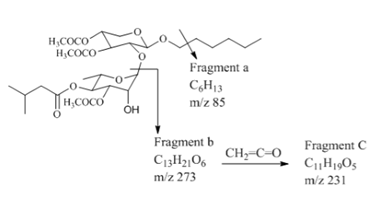
The molecular formula of compound 1 was established as C26H44O12 with the aid of FAB mass spectrometry (negative- ion mode, [M-1]+ at m/z 547), while HR EIMS had important mass fragment ions at m/z 273.1338 (d), 231.1261 (e) and 85.0653 in (Figure 2). In the UV spectrum shown maxima at λ = 203nm which indicated absence of chromophore and Its IR spectrum shown the presence of hydroxyl group (ν = 3455cm-1) and ester moiety (ν = 1738 and 1162-1021 cm-1). The 13C NMR and 1H NMR signals of compound 1 is represented in (Table 1). In the DEPT spectrum of 13C NMR shown 26- resonance, out of the six were CH3, seven CH2, ten CH and three quaternary Carbons. The 1H NMR showed signals of anomeric protons at δ 4.40 (d, J = 6.5 Hz) and δ 5.02 (d, J = 1.6 Hz) represented the xylose and rhamnose sugar moieties, and J-values of that sugars; supported its β- and α- orientations [6]. The methyl signal of rhamnose sugar was appeared at δ 1.16 (d, J = 6.2 Hz, H-6′). The downfield signals of H-3, H-3′ and H-4′at δ 4.87 (t, J = 8.3 Hz, H-3), 5.15 (dd, J = 3.0 Hz, 9.8 Hz, H-3′) and 5.02 (t, J = 9.8 Hz, H-4′) as compared to simple disaccharides. Slowing K, et al. [7] revealed the acylated nature of disaccharides, which was also confirmed by the presence of two acetoxy methyl groups as singlets at 2.12 (3-COCH3) and 2.01 (3′- COCH3) and a isovaleryl moiety at C-4′. Two methyl groups appeared as a doublet at δ 0.93 (J = 6.5 Hz), while CH2 shown multiplet at δ 2.14-2.15 and methine proton signal appear at δ 2.08 as multiplet. Triplet of doublet for proton H-1′′a give a signal at δ 3.81 (J = 7.1 Hz, 7.1 Hz and 9.3 Hz) and H-1′′ b at δ 3.49 (J = 6.6 Hz, 6.6 Hz and as 9.3 Hz) and these were assigned to be diastereotopic methylene proton of a hexyloxyl moiety and remaining proton appears as a multiplet of H-2′′ at δ1.58, H-3′′ at δ1.32 and H-4′′, H-5′′ at δ1.24 and one triplet signal is appearing for H-6′′ at δ 0.86 with J = 7.0 Hz.
| Position | δH(multiplicity; J in Hz) | δC |
|---|---|---|
| 1 | 4.40, d (6.5) | 101.52 |
| 2 | 3.67, dd (6.5, 8.3) | 74.75 |
| 3 | 4.87, t (8.3) | 78.14 |
| 4 | 3.71, dt (4.8, 8.3, 8.3) | 69.2 |
| 5a | 4.08, dd (4.8, 11.8) | 64.98 |
| 5b | 3.31, dd (8.3, 11.8) | |
| 1’ | 5.02, d (1.6) | 99.56 |
| 2’ | 3.96, dd (1.6, 3.0) | 69.64 |
| 3’ | 5.15, dd (3.0, 9.8) | 71.56 |
| 4’ | 5.08, t (9.8) | 70.78 |
| 5’ | 4.17, dq (6.2, 9.8) | 66.74 |
| 6’ | 1.16, d (6.2) | 17.35 |
| 1″ | 3.81, (H-a) td (7.1,9.3) | 69.89 |
| 3.49, (H-b) td (6.6, 9.3) | ||
| 2″ | 1.58, m | 29.72 |
| 3″ | 1.32, m | 26.1 |
| 4″ | 1.24, m | 31.93 |
| 5″ | 1.24, m | 22.69 |
| 6″ | 0.86, t (7.0) | 14.1 |
| 1‴ | - | 172.11 |
| 2‴ | 2.14-2.15, m | 43.4 |
| 3‴ | 2.00, m | 25.63 |
| 4‴ | 0.93, d (6.5) | 22.33 |
| 5‴ | 0.93, d (6.5) | 22.33 |
| 3-OCO | - | 171.99 |
| 3-OCOCH 3 | 2.12, s | 20.98 |
| 3′-OCO | - | 169.75 |
Table 1: 1H (300 MHz) and 13C (100 MHz) NMR data of compound 1 in CDCl3.
Further structure of the compound was also supported by HMBC, HMQC, COSY, and NOESY spectra. Its COSY spectrum illustrates the 1H-1H correlation of H-1(δ 4.40) with H-2 (δ 3.67) and H-3 (δ 4.87) with H-2 (δ 3.67) and H-4 (δ 3.71), while H-4 (δ 3.71) shows a correlation with H-5a (4.08) and H-5b (δ 3.31) for xylose sugar and rhamnose sugar; The connectivity’s of H-1′ (δ 5.02) with H-2′ (δ 3.96), H-3′ (δ 5.15) with H-2′ (δ 3.96) and H-4 (δ 5.08), H-4′ with H-5′ (δ 4.17), and H-5′ with H-6′ (1.16) are shown. HMBC correlation is represented in Figure 3, where an Anomeric proton of the xylose sugar is linked with the hexyl group predicted by its up field signal and is also confirmed by 3J-correlation of H-1 (δ4.40) with C-1′′ (δ 69.89) and H-1′′ (δ 3.81, 3.49) with C-1 (δ 101.52). Same while the anomeric proton of rhamnose sugar showed 3J-correlation of H-1′ (δ5.02) with C-2 (δ74.75) of the xylose sugar. Whereas H-2 (δ 3.67) of the xylose moiety is also linked with C-1′ (δ 99.56) of rhamnose sugar. Quaternary carbon of ester moiety of C-3 (δ171.99) show 2J-correlation with its methylene proton (δ 2.12), and also 3J-correlation with H-3 (δ4.87) at xylose sugar. Same connectivity was observed in rhamnose sugar, here quaternary carbon of ester moiety at position C-3′′ show 2J-connectivity with methylene proton and 3J-correlation with proton at postion H-3′′. At the C-4′ position of rhamnose sugar, isovaleryl group is attached and its connectivity is also confirmed by HMBC correlation. Here H-4′ (δ 5.08) show 3J-connectivity with C-1‴ (δ172.11), H-2‴ (δ 2.14-2.15) show 2J-connectivity with also C-1‴ (δ172.11) and H-4‴ (δ 0.93) with C-2‴ (δ43.40) show 2J HMBC correlation.
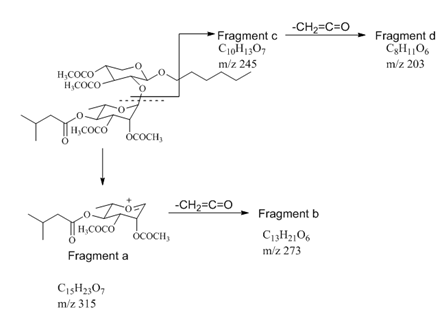
Compound 2 was obtained as a white powder. FAB (-ve) gave its molecular ion peak at 631 and revealed its molecular formula as C30H48014. EIMS show base peak at m/z 315 (fragment a) and other fragments ion peak shown in (Figure 3). The UV spectrum shown maxima at λ = 203nm, indicated absence of chromophore in this compound. Its IR spectrum gives several peak at the range of 1755-1715, indicated presence of ester moiety in that compound. 13C NMR and 1H NMR (Table 1) spectra were closely similar to the spectra of compound 1 except for some chemical shift values, such as H-4 and H-2′ which gives downfield signals as H-4 (δ 4.83, dt, J = 8.9 Hz, 5.6 Hz) and H-2′ (5.00, dd, J = 1.6 Hz, 3.2 Hz) because of the presence of ester group rather than OH in compound 1. Four acetoxy methyl proton appear at δ 2.08, δ 2.04, δ 1.98, and 1.93 ppm [8, 9, 10]. Compound 3 was obtained as solid wax. FAB (-ve) gives molecular ion peak at m/z 589 [M-H+], was indicated its molecular formula as C28H46O13, confirmed by its fragments ion peak m/z 273.1334 (C13H21O16) and m/z 231.1260 (C11H19O5) in HR-EIMS. The UV spectrum shown maximum absorbance at λ = 203nm, indicated absence of chromophore in structure. 1HNMR is closely similar to Compound 1 (Table 2). Except only shifting of downfield signals at position 4 due to presence of acetoxy group.
| 1 | 2 | ||
|---|---|---|---|
| Position | δH(multiplicity; J in Hz) | δC | δH(multiplicity; J in Hz) |
| 1 | 4.39, d (6.9) | 101.58 | 4.31, d (7.5) |
| 2 | 3.61, dd (6.9, 8.9, 8.9) | 75.85 | 3.60, dd (7.5, 10.0) |
| 3 | 5.16, t (8.9) | 73.57 | 5.14, t (10.0) |
| 4 | 4.83, dt (5.6, 8.9) | 69.57 | 4.85, m |
| 5a | 4.00, (H-a) dd (5.6, 11.3) | 62.34 | 3.83, m |
| 5b | 3.31, (H-b) dd (8.9, 11.3) | ||
| 1′ | 4.90 br.s (W = 2.0Hz) 1/2 | 97.62 | 5.30, d (1.5) |
| 2′ | 5.00, dd (3.2, 1.6) | 70.22 | 4.08, dd (1.5, 3.0) |
| 3′ | 5.21, dd (3.2, 10.0) | 68.71 | 5.08, dd (3.0, 10.0) |
| 4′ | 5.05, t (10.0) | 70.74 | 4.94, t (10.0) |
| 5′ | 4.17, dq (10.0, 6.3) | 66.71 | 4.21, dq (10.0, 6.5) |
| 6′ | 1.14, d (6.3) | 17.29 | 1.09, d (6.5) |
| 1′′ | 3.78, (H-a) td (7.1, 7.1, 9.0) | 69.91 | 3.80, m |
| 3.47 (H-b) td (6.9, 6.9, 9.0) | |||
| 2′′ | 1.54, m | 29.7 | 3.49, m |
| 3′′ | 1.29, m | 26.04 | 1.53, m |
| 4′′ | 1.23, m | 31.93 | 1.30, m |
| 5′′ | 1.23, m | 22.69 | 1.22, m |
| 6′′ | 0.83, t (6.9) | 14.11 | 1.22, m |
| 1‴ | - | 172.08 | 0.88, t (7.0) |
| 2‴ | 2.12, m | 43.36 | 2.12, m |
| 3‴ | 2.10, m | 25.65 | 2.09, m |
| 4‴ | 0.90, d (6.6) | 22.27 | 0.95, d (7.0) |
| 3-OCOCH 3 | - | 170.1 | |
| 3-OCOCH 3 | 1.98, s | 20.72 | 2.11, s |
| 4-OCOCH 3 | - | 170.25 | |
| 4-OCOCH 3 | 2.08, s | 20.85 | 2.01, s |
| 2′-OCOCH 3 | - | 170.19 | |
| 2′-OCOCH 3 | 2.04, s | 20.85 | 2.01, s |
| 3′-OCOCH 3 | - | 169.83 | |
| 3′-OCOCH 3 | 1.93, s | 20.72 |
Table 2: 1H (300 MHz) and 13C (100 MHz) NMR data of compound 2 in CDCl3.
Experimental
General
1H NMR and 13C NMR spectra was recorded on Bruker
Avance NMR and operating at 500 MHz and 400 MHz and signals was represented in δ (ppm) with reference to TMS and its coupling constant was expressed in Hz. ESIMS was recorded in LCMSQQQ, while FAB spectra was recorded in JEOL-600 H-2. PTLC was carried out with pre-coated silica gel GF254.
Plant Material
The Leaves and Stems of Phlox drummondii were collected in the month of March from the PCMD (ICCBS) Garden. A voucher specimen (KUH GH No. 67342) is deposited in Department of Botany, University of Karachi, Karachi.
Extraction and Isolation
Fresh Leaves and Stems of Phlox drummondii (50g) were initially soaked in Hexane (70ml) for 4-days in order to extract non-polar compounds than it was filter through filter paper and extract were collected as a filtrate. Solvent were evaporated at room temperature, crude materials were obtained, washed with pet-ether and soluble and insoluble both parts were separated, while Hexane insoluble waxy part show single spot on TLC. After characterization of this compound by FAB, HR-EIMS, UV, IR, 1HNMR, 13C NMR and 2DNMR, it is revealed that new compound that is Compound 1.
After the extraction of Hexane fraction, in leaves and stems; Dichloromethane was added and soaked for 4 days. After that it was filter through filter paper, filtrate was collected again and in remaining methanol was added in order to isolate polar compounds and then kept for extraction. After 4 days it was filter through filter paper, filtrate was evaporated and washed with ethyl-acetate and by preparative thin layer chromatography (1;1 ethyl acetate and Hexane) we get Compound 2, Compound 3, and Compound 4. The structure of compounds was confirmed by different spectroscopic techniques such as FAB, HR-EIMS, UV, IR, 1H NMR, 13C NMR and 2D-NMR.
2 - O - ( β - 3 ′ - O - a c e t yl , 4 ′ - O - i s ova l e royl - rhamnopyranosyl)-1-O-hexyl,3-O-acetyl-β- xylopyranose (1)
White, solid wax; [a]22 D - 9.732 (c 0.10, CHCl3), UV (MeOH) lmax 203nm; IR (KBr) nmax: 3455, 2950-2845, 1738, 1475, 1363, 1162-1021 cm-1; 13C and 1H NMR data, see Table 1. FAB (+ve): m/z 549 [M+H] +, FAB (-ve): m/z 547 [M+H]– (calcd for C26H44O12, 548.2833); HREIMS: m/z 273 (fragment a), 231 (fragment b), 85 (fragment c) (Figure 2).
2-O-(β-2′,3′-Di-O-acetyl,4′-O-isovaleroyl- rhamnopyranosyl)-1-O-hexyl,3,4-di-O-acetyl-β- xylopyranose (2)
White, solid wax; [a]22 D +2.249 (c 0.10, CHCl3), UV (MeOH) lmax 203nm; IR (KBr) nmax: 2930-2851, 1755-1715, 1444, 1138-1021, cm-1; 13C and 1H NMR data, see Table 2. FAB (+ve): m/z 633 [M+H] +, FAB (-ve): m/z 631 [M+H] – (calcd for C30H48O14, 632.3044); HREIMS: m/z 315 (fragment a), 273 (fragment b); EIMS: m/z 245 (fragment c) and 203 (fragment d) (Figure 3).
2 - O - ( β - 3 ′ - O - a c e t yl , 4 ′ - O - i s ova l e roy l - rhamnopyranosyl)-1-O-hexyl,3,4-di-O-acetyl-β- xylopyranose (3)
White, solid wax; [a]22 D +2.249 (c 0.10, CHCl3), UV (MeOH) lmax 203nm; IR (KBr) nmax: 3440, 2839, 2852, 1735, 1460, 1359, 1168-1024 cm-1; 1H NMR data, see Table 2. FAB (+ve): m/z 591 [M+H] +, FAB (-ve): m/z 589 [M+H] – (calcd for C28H46O13, 590.2938); EIMS: m/z 85 (fragment a); HREIMS: m/z 273 (fragment b) and 231 (fragment c).
4-Hydroxybenzoic acid (4)
White, Crystalline solid; UV (MeOH) lmax, 247 and 203nm; IR (KBr) nmax: 3384, 1733, 1540 cm-1; 1H NMR (CD3OD, 500 MHz): δ 6.73 (d, J=8.5 Hz, H-3, H-5, 2H), 7.85 (d, J=8.5 Hz, H-2, H-6, 2H)
Acknowledgement
One of the authors, Aneela Naz thankfully acknowledges the Higher Education Commission (HEC) of Pakistan for awarding her HEC fellowship under the scheme of HEC-Merit Scholarship.
References
-
Channell R (2004) The conservation value of peripheral populations: the supporting science. In Proceedings of the species at risk 2004 pathways to recovery conference. Victoria, British Columbia, Canada: Species at Risk 2004 Pathways to Recovery Conference Organizing Committee, pp: 1-17.
-
Johnsons LA, Schultz JL, Soltis DE, Soltis PS (1996) Monophyly and generic relationships of Polemoniaceae based on matK sequences. American J of Botany 83(9): 1207-1224.
-
Wherry E (1955) The genus Phlox, Monograph III. Morris Arbor, Philadelphia.
-
Erbe L, Turner B (1962) A Biosystematics study of the Phlox cuspidata-Phlox drummondii complex. American Midland Naturalist 67(2): 257-281.
-
Whitehouse E (1945) Annual Phlox species. American Midland Naturalist 34(2): 388-401.
-
Zhang QW, Ye WC, Che CT, Zhao SX (1999) A new cycloartane saponin from Cimicifuga acerina. J Asian Nat Prod Res 2(1): 45-49.
-
Slowing K, Sollhuber M, Carretero E, Villar A (1994) Flavonoid glycosides from Eugenia jambos. Phytochemistry 37(1): 255-258.
-
Dorling K (2008) RHS AZ Encyclopedia of garden plants. UK, 1136.
-
Faizi S, Naz A, Bano S, Farooq AD, Azhar S, et al. (2016) Phytochemical, Antioxidant and Antimicrobial Activities of Flowers of Phlox Drummondii. Hamdard Medicus 59: 2-4.
-
Mabry TJ, Yoshioka H, Sutherland S, Woolhand S, Rahman W, et al. (1971) New C-glycosylflavones from Phlox drummondii. Phytochemistry 10(3): 677-679.
- Spectrophotometric Determination of Lanthanum (III) and Some Rare Earths with Xylenol Orange
- Introduction and Sources of Molluscicides
- Trimetazidine: An Antianginal Drug and Not Only!
- Nature Inspired Discovery and Development of Antibacterials: An Update
- Fungal Biodegradation of Polycyclic Aromatic Hydrocarbons (PAHs)
- Recent Approaches of Impurity Profiling in Pharmaceutical Analysis: A Concise Review