
Heroism Science in Ego-Governing and Educable Human Resilience
This article explains the conceptual origins of ego-governing as a kind of creative thinking and attempts at educational governmentality, including why ego governing/governance but not self-governing/governance. The concept of ego-governance and its formation logic in spacial Bildung (including space, education, field, and Bildung) are used to explain the becoming of ego-resilience as an ideal ego of heroism image in ego-governance. This paper takes the conception of ego-resilience in selfgovernance in ego-governmentality as an example, dedicating ego-resilience and social (ego) resilience from self-governing to social governmentality. This paper emphasizes that ego-governing is educable, and education should take some responsibility for individual self-governing anomie and propose a necessity of ego-governmentality education and the possibility of ego educational assessment before mental diagnosis.
Introduction
The ego is a modification of the id (the oldest and most primitive psychic agency), representing the biological foundations of personality-that emerge as a result of the direct influence of the external world [1]. Sociologist Durkheim also argues fuses opposites and insists on the principle that any educational program that presents itself in its modern form must transform personal autonomy into self-control [2]. The best system for a child is the one that teaches him the best self-control [3].
The ego is the self’s evaluation of its activities in life, and the ego is known but never a knower. In contrast, the self in Conceptual Paper knowing itself is the knower, an object of knowledge. The self knows and fights and can know that it knows and fights, as the ego cannot [4]. In this sense, the epistemological and agency of self is limited governable, while the known ego is governable and performed. Limited governance of self is not the content of education because educators have no way to educate themselves about the unknown. In this sense, what can be taught is ego-governance. Modern pedagogy, for example, believes that schools are only a preassurance that everyone has the ability to overcome themselves [1]. The ego of people endows the ability to overcome them. In this sense, ego-governing works in education compared with self-governing. According to Foucault, governmentality is the “techniques and strategies by which a society is rendered governable [5], especially the reasoned way of governing best or the best possible way of governing “ [6].
Correspondingly, techniques and strategies by which an individual is rendered governable, and the best ones mean the most effective governable represent ego governmentality. In this sense, ego-governing is supposed to be a set of policies and techniques that make it self-governable. In this sense, Durkheim’s self-control has something related to self- governance. Moreover, each child should be his ego-king, responsible for governance, and should be taught an effective ego-governance strategy. From the perspective of modern pedagogy, only by establishing such an ego-governance mechanism (ego governmentality) can we make it possible for everyone to be able to overcome themselves.
The ego is known, and the process of knowing is probably similar to Bildung. Bildung, a German word related to the verb bilden and the verbal noun bild, refers to a liberal education derived from experiences that are products of a culture industry [7, 8]. “From the inside” and “motivation of action” are more in line with the characteristics of “Bildung” in this study for its “personality” and “internal and external needs of nature” [9]. People gain some learning through self-reflection in the process of interacting with the world to improve ego development, which seems to be the mediating process of the noosigns-noosphere (the ego formation as a result of the direct influence of the external world in this sign progressions) between the inside and external world. The mediating process of the noosigns-noosphere can be a metaphor of Deleuze’s cinematic time-image that the recall of the past, the description of present memories and the expectation of the future go through a process of sign progressions as time-images in the brain screen [10].
The relations between various elements within the ego are time, and psychic structures are temporal in nature, especially “when we speak of object-representation, object- presentation, drive the presentation, a concept of time is implied in which ‘present’ is understood as an active process- to present something” [11]. Deleuze and relevant scholars initiate the analysis of the becoming of ego. Time-image articulates a new regime of the cinematographic image in the brain screen by a series of sign progressions: opsigns (visually acquired signs), sonigns (auditory signs), hyalosigns (the readable and thinking crystal image), chronosigns (images clustering through temporalities), and noosigns (construction of the filmic event through the mediating process between the cinematic image in brain screen and external world) from the lens of poststructuralism. The noosigns resonate with the conception of Bildung in some way. In this sense, no signs-noosphere, ego development, Bildung met in a way, especially reflecting on “a collection of beliefs [12] about oneself that embodies the answer to ‘Who am I?’ [13]”, “the person I want to be” and “how to learn to be”, which also reflects the meaning of ego and heroism as ideal ego in this article.
Education’s function is to help individuals become what they are or make what kinds of people for society. Teaching includes all parts of the soul and must appeal to the whole of psychology in education [14]. This is because before the concept of “science” appeared in history, religion played a role in education through the guidance and salvation of the soul [15]. Heroism is living for the immortal soul [16, 17]. Heroism science embedded in education is the ego ideal and realizes “governing by worth” in society. Logos, ethos, and pathos in narratives reflect a psychological and sophisticated social-cognitive approach with implications for both neuroscience and artificial intelligence [18]. In this sense, if the individual opportunity existed in politics of personality [8], the opportunity of the ideal ego of heroism probably happens in ego-governing in self-governance of personalings (Figure 1).
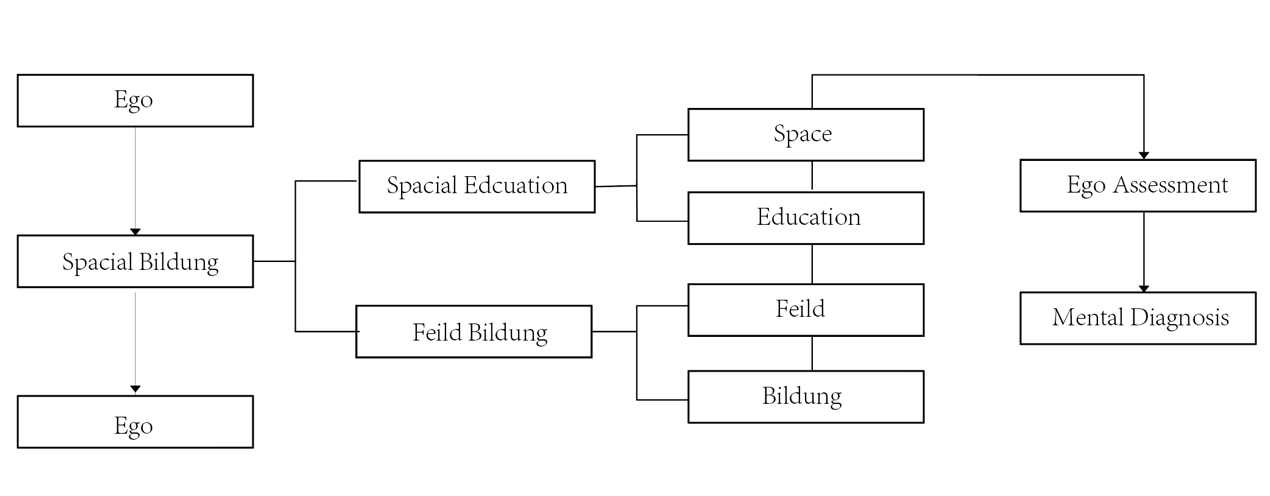
Deleuze deconstructs ego as” Ego=Ego- The double transformation of the real and fiction - ‘I is another”. The elements of time and space require an extraordinary encounter with man’s personality to produce something new, which constitutes the “story concerning the subject- object relationship and development of this relationship. The resolution is from ego to ego, which couples the decoupling between what the character sees subjectively and what the camera sees objectively. The story in space frees the ego from the model of truth that penetrates it. The ego =ego form of identity (or its degenerate form, they = them) [19]. If all the images and sounds seen in the field are transformed into a movie-like brain screen, self-governance can be Bilden and continuously generated in this process.
Ego resilience as an educable ego-governing for individuals, for example, should be resourceful and adaptive when confronted by new situations, which is related to “ego control and resiliency” [20]. In this sense, vulnerabilities may have some ego control and resiliency problems in the topological representation of ego structure, which should be located and detected in ego governance to build ego resilience. Individuals learn from each other’s self- governance through multiple fields to build their own resilience during the Bildung of interactions with the world (spacial Bildung), which drives the heroism of resilience to flow through society and perform as social resilience.
Social resilience is the abilities or capacities to tolerate, absorb, cope with and adjust to environmental and social threats of various kinds for social entities (individuals, organizations, or communities). Social resilience comprises three dimensions, coping capacities, adaptive capacities, and transformative capacities, which have the potential to be crafted into a coherent analytic framework that can build on scientific knowledge from the established concept of social vulnerability and offer a fresh perspective on today’s challenges of global change [21]. The basic question of social resilience is “resilience to what? What is the threat or risk we examine? Threats are usually assumed to originate externally regarding social units, but they might also stem from internal dynamics or interaction between the two, especially for vulnerabilities [22]”. Correspondingly, there are severe deficiencies in the education, space, field, and education of vulnerable groups, which reflects the social resilience of structural inequality. In this sense, this search for ways to build social resilience is revealed to be a technical and political issue [21]. In this sense, if the social opportunity existed in the politics of society [8], the opportunity to build social resilience probably happens in heroism science of the ideal social ego in political society.
This article proposes the concept of ego-governance and argues that there are educable techniques of ego- governmentality to help individuals promote ego development. In addition, this paper argues that individuals can improve the level of ego governance through a multifield learning approach and that ego governance may be culturally influenced by socially constructed heroism. The heterogeneity of individual ego-governance is influenced by four factors: the influence of space, education, field, and Bildung. Therefore, before making a mental diagnosis, education should examine and be vigilant about educational deficiencies in ego governance to build ego resilience and social resilience.
Acknowledgment
I want to thank Dr. J Fu, an alumnus friend of the Chinese University of Hong Kong, who is a Chinese entrepreneur who inspired me in ego governance. Moreover, I want to thank Editor Teresa Christine for her trust and great help.
Funding
This article has been supported by the China Scholarship Council and the funding number is 202106140077.
References
-
Lapsley DK, Stey PC (2011) Id, ego, and superego. Encyclopedia of human behavior. In: 2nd (Edn.), Elsevier, pp: 1-10.
-
Ramos do ÓJR (2003) The disciplinary terrains of soul and self-government in the first map of the educational sciences (1879-1911). Beyond empiricism: On criteria for educational research. Studia Paedoagogica 34: 105- 116.
-
Buisson FÉ (1882) Dictionary of pedagogy and primary instruction. Hachetteet cie, 1(2).
-
Bertocci PA (1945) The psychological self, the ego, and personality. Psychological Review 52(2): 91-99.
-
Lemke T (2015) Foucault, governmentality, and critique. Routledge.
-
Foucault M, Davidson AI, Burchell G (2008) The birth of biopolitics: lectures at the Collège de France, Springer.
-
Løvlie L, Standish P (2002) Introduction: Bildung and the idea of a liberal education. Journal of Philosophy of Education 36(3): 317-340.
-
Bai J (2022) Logos and Ethos: Heroism and Social Bildung in China. Heroism Science 7(1): 1-27.
-
Martin JL (2003) What is field theory?. American Journal of Sociology 109(1): 1-49.
-
Deleuze G (1998) The Brain Is the Screen. Discourse 20(3): 47-55.
-
Loewald HW (1962) The superego and the ego-ideal. Int J Psychoanal 43: 264-268.
-
Leflot G, Onghena P, Colpin H (2010) Teacher–child interactions: relations with children’s self‐concept in second grade. Infant and Child Development 19(4): 385- 405.
-
Flook L, Repetti RL, Ullman JB (2005) Classroom social experiences as predictors of academic performance. Developmental Psychology 41(2): 319-327.
-
Compayré G (1895) Theoretical and practical pedagogy course. Delaplane.
-
Popkewitz TS (2020) Salvation, redemption & desire in the making of the nation. De Gruyter, pp: 55-80.
-
Pugh T, Wallace DL (2006) Heteronormative heroism and queering the school story in JK Rowling’s Harry Potter series. Children’s Literature Association Quarterly 31(3): 260-281.
-
Minion M (2016) Living for the Soul: Dolly’s Heroism in Anna Karenina.
-
Allison ST (2016) The initiation of heroism science. Heroism Science 1(1): 1-9.
-
Deleuze G (2020) 9. Cinema II: The Time-Image. In: Philosophers on Film from Bergson to Badiou. Columbia University Press, pp: 177-199.
-
Block J (1993) Ego-Resilience through Time. ERIC, pp: 1-18.
-
Keck M, Sakdapolrak P (2013) What is social resilience? Lessons learned and ways forward. Erdkunde 67(1): 5-19.
-
Gallopín GC (2006) Linkages between vulnerability, resilience, and adaptive capacity. Global Environmental Change 16(3): 293-303.
- Systematic Review and Meta-analysis Investigating the Prevalence of Depression, Anxiety, Loneliness and Help seeking among International Students
- Family Experiences and their Interpretations as a Source of Adaptive Behaviour in Young Adults: A Qualitative Model of Adaptive Behaviour
- The Development of Responsibility in Teenage Mothers: A Qualitative Model
- Post-Truth Reality: Worldwide Infodemia and Mental Health Concerns during and Post COVID-19 Pandemic Scenarios
- Psycho-Emotional Rehabilitating Means of Overcoming Extreme and Stressful Impact
- The Paradox of Humbleness, Arrogance and the Concept of Fluid Individuality