
Through the Lens of Childhood Experiences: A Look into the Epigenesis of the Eriksonian Mistrust
The evolution of self-concept stems from the established idea that it silhouettes the perception of oneself. This inquiry, with 10 individuals constructed by the design of narrative research had explored and magnified the emergence and transcendence of mistrust through the lenses of childhood experiences. The in-depth interviews confirmed one of the main tenets of Erik Erikson that the epigenesis of mistrust is factored by the degree of relationship between the child and the mother or any of the parents. Furthermore, the results illuminated that the beginning of mistrust comes in a dichotomy being the offshoot of the unconscious feeling of betrayal that happened when the unconscious demand of the child was not gratified by the parents in the early years of life, and its constancy characterized by reoccurrence, painful recollection, and feeling unseen in the individual’s persona. The meanings constructed from the experiences elucidated that mistrust is not only seen through behavioral manifestations but is also felt by the individual. Hence the axiom that had been yielded is that the unconscious advent of mistrust, while can be repressed, can always be in transference to any form. Moving forward, as informants go through life’s seasons, a sequential inquiry is deemed recommended to see the extent of constancy or changes in their perspectives, vis-à-vis how it subsides or resurfaces over time. In hindsight, this inquiry not only echoes one to be critical but also teaches empathy, thereby grounded further the epigenesis of self-understanding.
Introduction
Self-concept, through its logic, is the understanding of a person about the self. This understanding is influenced by certain dimensions that are both coming from the internal and external stimuli of the environment. In the ‘bio-ecological systems model’ of Urie Bronfenbrenner, these stimuli could be categorized into certain systems ranging from those of direct influence to those of indirect relations on the growing child, such that self-understanding is a continuous process of development regardless of its flows and progression [1]. The premise of this inquiry is built by the claim of Erik Erikson’s psychosocial development theory that environmental influence, particularly on how earlier experiences gradually build upon the next and result in one’s personality, i.e., the degree to which parents’ affection is translated on rearing the child becomes an element of creating a balance of what he called as a syntonic dimension (positive) and dystonic dimension (negative) of the personality and sense of the self [2]. This inquiry had evolved from personal insights that given that self-understanding stands its ultimate relevance to all persons, this study had explored the self-concept of selected 10 informed individuals through in-depth interviews and analyzed and interpreted the meanings behind their experiences. Nevertheless, this had not been undertaken to predispose, test or dispute Erikson’s theory, rather it merely embarked on the theory by looking into the self-concept of the chosen informants.
Constructs of the Inquiry
In this initial onset of life, it’s a known natural phenomenon for the child to be incapable of determining things e.g., specific words to utter in communicating and to use in describing and labeling things around, but what’s certain in this phase is the capability of feelings for it’s the emotion that fuels their existence which then is indicated by crying regardless of the levels and dimensions of feelings. Klein M [3] saw human infants as constantly engaging in a basic conflict between the life instinct and the death instinct. As the ego subdues integration, preference for gratifying sensations over frustrating ones becomes natural to the infant. In their attempts to deal with this dichotomy of good and bad feelings, infants organize their experiences into positions or ways of dealing with both internal and external objects. Furthermore, as to survive is innate and no less critical on the child, expressing a certain kind of ‘demand’ in which the child feels necessary for survival takes place. This specific demand can be described as the need for a scaffold or support, protection, and security that whatever may happen someone is there however it must be noted that the degree and levels for which it must be granted are relative as they say ‘one child is different from another’. Now regardless, when this ‘certain kind of demand’ is not being met, it would unconsciously engrave a feeling of being betrayed which then influences the thoughts and behaviors that all constitute the emergence of mistrust. The child grows to have trust issues within the self and with people that would be commonly translated to fears, insecurities, hatred, and feeling unseen.
The social and cultural conditions especially childhood experiences are largely responsible for shaping personality. People who don’t have their needs for love and affection satisfied during childhood develop basic hostility toward their parents and as a consequence, suffer from basic anxiety. Horney K [4] theorized that people combat basic anxiety by adopting one of the three fundamental styles of relating to others: moving toward people, moving against people, or moving away from people. Normal individuals may use any of those modes of concerning people, but neurotics are compelled to rigidly believe just one. The ‘basic intrapsychic conflict’ that emerges from compulsive behavior transcends either an idealized self-image or self-hatred. This idealized self-image is being expressed as a neurosis. Self-hatred, on the other hand, is termed and described as alienation from self.
The comprehension of the informants’ self-concept in the context of the Eriksonian psychosocial development theory anecdotes contends the cutting edge of these important tenets: first, self-concept development takes place according to the ‘epigenetic principle’ i.e. one part arises out of another and has its own time of ascendency that does not entirely replace earlier components; and second, in every stage of life there is an interplay of the dichotomy- conflicting interaction between the harmonious element and the disruptive element, syntonic and dystonic respectively. For instance, as vividly expressed in this paper, during infancy basic trust (syntonic) is opposed to basic mistrust (dystonic). Both, however, are necessary for proper adaptation, whereas an infant who learns only to mistrust becomes overly suspicious and cynical; and third, at each stage, the conflict between the dystonic and syntonic elements although may produce an ego strength, noticeably on the testimonies of the informants when such is left too little i.e., a child who doesn’t acquire sufficiency of its demand e.g., trust will develop the antithesis or the opposite of hope [5].
Methodology
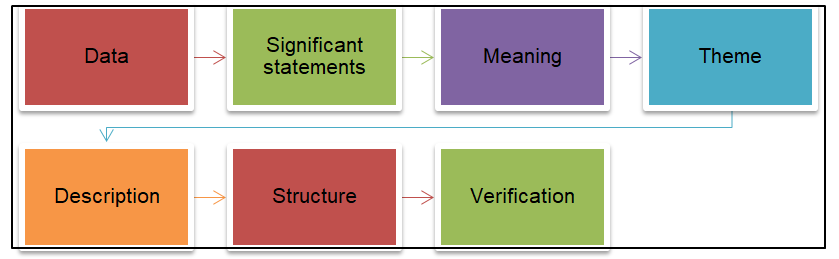
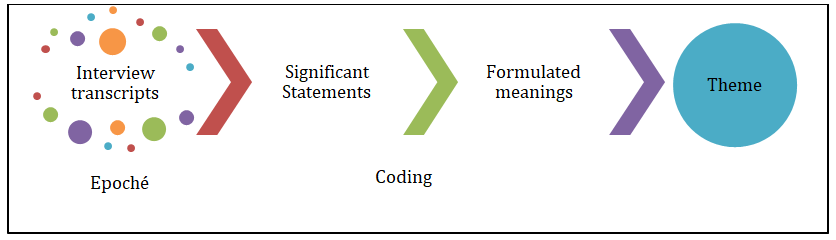
The study is qualitative by its nature and tradition employing the narrative inquiry design, for which the data collection was done through one-on-one interviews, such that the responses given by the informants were the insights of their self-analysis of childhood experiences and observations from a vantage point of view. From the transcripts, reflexive thematic analysis was done in which significant statements were highlighted and coded, thereby themes appeared.
Ethical Annotations
This inquiry adhered and appraised to the ethics of research. The informant participated based on profound decision and consent, through the inquiry’s basic information, rights, and the process of ensuring the privacy of identity and confidentiality of responses.
Data Collection and Analysis
In the interviews, the questions had their way of making them look back on certain episodes in their childhood, for as long as they could remember. The thematic analysis had been done in analyzing and interpreting the collected data, utilizing the Colaizzi method [6] that had been influenced by the Heideggerian interpretive approach [7], i.e., life experiences such as childhood can only be interpreted and explained only in the context of the totality of the experiences in the past, the present and the future [8]. In doing so, ‘epoche’ or bracketing had safeguarded those personal judgments and assumptions did not spoil the process of collecting the data, upon which data saturation took place in the occurrence of redundancy (Figures 1 & 2) [9].
Results
Theme 1- The Emergence of Mistrust
The affection comes in varying degrees, when translated to actions towards the child and when it’s being the child itself. It’s relayed as caring for the child as it came out from the mother’s womb, it is at most indicated by the way the mother held the infant and provides for the needs. It must be noted though that infant’s language is through crying no matter what and how it feels- feeling hungry, uncomfortable, uneasy, or just merely wanting to say anything but is only limited to crying it out due to the natural inability to utter words at this state. Hence, the emotional state of the mother at this point is of utmost critical for if it’s positive then the actuation of the said affection wouldn’t be absent or limited and the infant unconsciously feels that it gets the degree of affection demanded from the mother. However, if the disposition is the other way around for reasons like the said pregnancy had been a troubling episode all along for the mother may it is physical or emotional, it would create problems in translating the kind of affection that had been demanded.
This demanded affection unconsciously becomes the building block of the development of trust in the child (trust towards people, trust within the self). If the kind of affection demanded by the infant had been responsively gratified and delivered by the mother, it gives an impression on the child the subconscious feeling of being secured all along because there is someone to confide with every time there are certain needs that at least one person can give. This builds the capacity to trust someone or certain people and the self later on in approaching the real world, that whatever may happen there is someone to rely on. However, if such affection has not been felt because of abandonment issues, trauma, or disappointment towards the parents, then it unconsciously creates a block, in rippling effect, on the capacity to trust, making the child withdrawn and isolated and eventually develop extreme self-reliance all along, for it gives the impression that no one out there, like in the case of Informant 1:
“My mother was in college when she became pregnant. She comes from a very poor family with 10 siblings. Being one of the elder ones, she had the responsibility of helping the family. Her education was a sort of charity from her aunties as a working student all along, transferring from one aunt to another just to make her education possible. Then she met my father, as one of the tenants of her aunt’s boardinghouse in Cebu, who was also her distant relative. For a time, they developed a kind of closeness that later on became unorthodox. Then months after my mother became pregnant. Certainly not the right timing for both of them especially to my mother and at the same time the shame that it caused for they were relatives. It was ultimately emotionally torturing for my mother. So, by the time that I was born, my mother decided to go back to school and left me and carried on with her life as it happened, and only got me at that time that she felt she was ready.” Informant 1.
When asked about the matter of trust, Informant 1 vividly responded that he is extremely independent and relies on himself so heavily all the time, implying that he trusts no one but himself, “I prefer to keep everything to myself. I don’t know but it’s just that I’m comfortable that way. It’s like I just think that people have ways of ruining things.” Informant 1.
Observably, Informant 1 most of the time isolates himself from the rest of the group, and when asked why he simply responded that he’s shy. He thinks that people may not understand him or judge him as he believes to himself that he’s different. At first sight, he certainly is not a confident type of person, and in all situations, as he added he could not control doubting himself in all situations, and this has been constantly indicated in-class activities like the way he presents himself during recitations and report presentations. He always sounded as if he was unsure of his answers and even his ideas in those moments that he is asked to share. Informant 1 described himself as an unseen character, and for him, he’s comfortable that way. Interestingly he added that there are types of people down the road- the winner or those people who keep on winning at everything; the ‘wanter’, those who keep on wanting even it means stamping people on the feet; the lucky ones, whom he described as the lucky ones who get things without even doing anything; and the unseen characters, those which people tend or choose to not see.
“Summer of 2011, I came to my father’s house for a visit. His wife and children (my half-brother and sister) were kind enough to welcome me home. So, I took a visit and agreed to spend the night. It was awkward, but it wasn’t just that. At the table during breakfast the morning after which was our first decent encounter because he kept on going in and out of the house when I came, he asked me about how I was at school and anything just to start a conversation, but then he said: “let’s just be a little stiff when we talk a little bit”. They all laughed as if it was like a joke or something, but I never felt that embarrassed in all my life. You see, Sir I’m gay, and being soft-spoken and modest is my nature. I was so ashamed of myself at that moment, and even now I still do. So right after breakfast, I wanted to go home while outside the house he just said ‘just wait for a motorcycle there’, then he turned his back, and the memory of that keeps on haunting me since. Every time I remember that I still feel the hurt and how it crippled me.” Informant 1.
These confessions implied that Informant 1 did not receive the kind of affection he unconsciously needed from both of his parents characterized by abandonment issues and trauma respectively, beginning at that time that his mother was too young and unprepared to rear him given the delicate situation there was plus that first and last personal interaction with his father indicating that he did not feel accepted for who he is as a person. All these have their way of negatively influencing him to distrust other people resulting in withdrawal and preference for isolation and the constant doubting of his very own self, seeing his very own self as the unseen character. When asked how it feels growing up with his mother, he described his mother as someone who controls his behaviors and worries too much about him, which turned out to be his ultimate reason for wanting to live separately ever since college, as such is suffocating as he described it: “When I went on for college, I took it as my chance of finally getting rid of her (his mother). So, I do not go home that often compared to my board mates and friends, except if it’s Christmas, you know out of respect and I cannot bear staying at home for more than 3 days with them. I’d rather just be on my own.” Informant 1.
Similarly, Informants 4, 5, and 6 also find it difficult at establishing trust in people. As they looked back, like Informant 1, their parents have also let them down during their childhood. For informant 4: “I don’t trust people easily. When I was a child, I have a painful experience with my father. I assumed that he would protect me but he was very cruel instead.” Informant 4.
This disappointment towards the parents by Informant 4 is further extended to being dominantly cautious, that most of the time she weighs things as they could and consider if things would be beneficial for her which sometimes, she finds herself creating her set of criteria on what she considers as right or wrong. Observably Informant 1 is very reserved and only interacts with a few people in the class. And when asked if she could rate how much she knows herself, she gave a rating of 6, adding that for most of the time, despite being too reserved and cautious, she remains unsure about her personality. As she described her parents, she shared that all along as she grows up her mother’s attention has been seemingly devoted to his brother, making her find solace in her playing all by herself. She always feels no affection from her mother and her father is too strict which gives too many restrictions on her. Informant 5 thinks of himself as dominantly cautious, “I do not trust a person easily. It takes time for me to trust a person because I feel like I have to know them better first and know their qualities for me to assess if they are to be trusted. Because I’m a bit of an over-thinker and will think that they are just going to break my trust. That is why I became self- reliant” Informant 5.
Although he always says to himself that he should not care at all because it won’t matter but as he described it, he could control his mind from contradicting it. He feels like someone is always watching him when he is in a crowded place fearing that people will judge him in anyways- “I always fear change and doing something different. I always feel guilty even if I made nothing wrong and it was another person’s fault.” Informant 5.
This had been indicated by the way he behaves himself during group work. Mostly he slouched when I make the class groups select a leader. And at one time that he was selected; he seemed to bother right at the start of the work till it was finished. Growing up his parents has too many restrictions and too little affection towards him, sharing that they always demand him to follow everything that they say. It was suffocating, he said, despite that at some point he tried his best to understand them. Looking back, he believes that he missed a lot in his childhood and teen-aged life (comparing himself to others).
In the case of Informant 6, his mistrust is rooted in his personal belief that he’s different and that no one seems to get her- “I don’t trust people easily. Because I think that people don’t take me seriously, I seem so unimportant to them. They find me uninteresting. Actually, I can sense it, when I’m around their actions are limited, they become more cautious and sometimes I feel like I’m the center of their conversations, that’s why I often distance myself from people. I always tend to limit my actions because I’m more concerned about how people will react. My consciousness tells me I’m not worth it and that I lack something that will make me achieve more success” Informant 6.
Given the kind of behaviors portrayed by people when she is around, resulting in her being very cautious of her actions and behaviors worrying about how people would take them, implying that her self-esteem is low. When asked about the way her parents deal with her, she then shared that they impose too many restrictions and that playing with other children outside had always been limited. As such, it could be drawn that perhaps because of this kind of restriction that growing up Informant 6 becomes unsure of her very own behaviors in dealing with people fearing that it may not be accepted as she is unsure of how people outside their home behave daily and that in anything that she does her parents are the only ones who could validate. But arguably, her parents could not stay with her every second by the time she’s going to school, and such solitary behavior is often associated by teachers as a desirable behavior of behaving, not realizing that unconsciously there’s no one in the room that no can say that in any behavior she chooses to exhibit, no one is there to validate unless she’s at home. But at home, her parents are already used to her behaviors, and there is no chance at all to do validation.
Theme 2- The Constancy of Mistrust
The so-called mistrust, which emerged from the ungratified affection from the parents during the child’s early years, will remain engraved in the person’s psyche. Over time, as the child starts to put him/herself out there in the society as an individual, what comes naturally is the capacity to make choices, and interact with people, e.g., classmates, peers, fraternity mates. In effect for a time and for another time unconsciously such ‘mistrust’ will be repressed regardless of its ways of being translated into actions. But like any other repressed feeling, it has its way of regressing in the forms of feeling betrayed, feeling unseen, fear, inferiority, and hatred. It acts like drug addiction, while it wears off it has its way of coming back that haunts the person no matter the capacity to move on. This reoccurrence comes along with painful recollection and the constant feeling of being unseen. But as it may seem the person will never get over it, hence having difficulty transcending it. Unconsciously it reflects the self. Perhaps there would be ways of managing it. But it will always be there as a hallmark of the identity as a person. Given the deep conversation with Informant 1, when asked how he is now after all of those deeply emotional life episodes he experienced when he was in his early years as a child, he took a pause and confessed: “I don’t know, Sir. I’m living, that’s for sure, trying my best to fulfill my ambitions. But I always feel it. It’s always in my head. Believe it or not, I’ve tried so many ways already you know forgetting it and moving forward, and no matter how countless I attend praise and worship it’s in me. It’s not like I’m depressed about it or I need help for it, but it’s just as it is.” Informant 1.
When asked if he already has shared this with someone besides me, he said that there’s no one else worthy of sharing such; asking him why he thinks that way, he continued: “I tried, but oftentimes those people upset me. I think a single behavior of a person speaks if he is capable of handling and keeping a secret. Maybe that’s why I never had a best friend, and you know long-term relationships because I confront the moment, I sense that things won’t be all right and choose to end it right away. You know I don’t want to be betrayed or left out or feeling embarrassed.” Informant 1.
Indicatively, such feeling of fear of being left out could be associated with the painful recollection of what Informant 1 had experienced in his childhood, starting from his mother who constantly left him thereby making him vulnerable to certain painful experiences and that one time that his father turned his back on him, all making him feel that there is no one out there who can protect him, such that the mistrust is further translated to being calculative on other persons’ behaviors that become indications for him as not worthy of his trust. And the ungratified affection he unconsciously demanded from his parents becomes an act of betrayal for him, as in the society ideal parenting is portrayed as giving the kind of love and affection that the child needs and deserves vis-à-vis accepting their child no matter what and that each child is a blessing, but for him, he never had this from both of his parents. Henceforth, this reoccurrence leaves him unconsciously feeling betrayed by them, for which his trust had been broken at that time he was still unaware of what trust is, and by extension the feeling of not being chosen contrary to the ideal picture of a parent choosing his child. Because of this, he feels he can only trust himself and no one else. He will never get over that betrayal, the feeling of not being chosen. As he moves on with his life, such remains and acts as a constant ingredient of his choices, the kind of interaction or relationship he can give to anyone in his lifetime, and his very own self-perception. The delicate trail is that the future moments such as disappointments and frustrations he may encounter in his life would be associated with these. This is partly true in the case of Informants 7 and 10, although however, their experiences were different from that of Informant 1 as they both had a very strict father who bit them every time, they do something that is against the rules their father had set, i.e., as shared by Informant 7: “My father has a horrible temper. I have 6 siblings, all of us are girls and I’m the youngest. Plenty of times when we were younger (even now) that our father would beat us whenever we do something that is not pleasing to him. For instance, I was I think Grade 2 at that time that I interrupted him while he was talking to our neighbors. I asked for 5 pesos for my recess at school. That day I was completely unaware that I upset him, but after school that was the time that he scolded me telling me that what I did was misbehavior. I said that I was just asking for a penny for my recess as I was leaving for school at that time. It got him even more furious so he bit me using his belt and I cried so hard. That was the first time that I felt that certain anger towards my father. It has then gotten worst when during my second year of high school when I came home very late because I hanged out with friends, of course, I lied when I asked permission from him that morning that it even made him so angry that he slapped me saying cursed words to me. That’s why I don’t blame why our eldest chose to marry so early and my other sibling left home after high school because we never felt loved by our very own father.” Informant 7.
When asked if they hate their fathers, their responses implied that what pissed them off is that they could not understand why. Being overprotective because they are all girls meant nothing to Informant 7, sounding that it’s not enough reason for the way their father is being a father to them; and for Informant 8, “It’s not only about the beating, it’s the fact that it’s being done to you by your father”. Informant 8.
Because of this traumatic experience, the fear that emerged during their childhood towards their father remains and is further extended to Informant 7’s fear towards men, that she never had a boyfriend and that whenever he sees a man with the same figure as his father, she feels that fear right away. What’s crucial in Informant 7’s case is that she tends to associate men with figures like his father all capable of beating her, thereby unconsciously controlling her behavior making her close her doors and sets that wall on her, which is quite noticeable with her choice of friends who are all girls. Informant 9’s whole confession implied that she associated that affection she unconsciously needed from her parents in her earlier years and even now with achievements in school like what her siblings do- “Our eldest and my younger sister were valedictorians in their respective batches, and my parents have always been outspokenly proud. We have so many medals in our house but none of those is mine. I’m not intelligent, not even an honor student. I remember how excited my parents were during my brother’s graduation from elementary, but during my time after that year, I only had one ribbon (the one that says ‘graduate’). I never heard anything from my parents. They never scolded me for being a low achiever, but I could sense through their actions that it’s different when they interact with my siblings. With them, there seems to be excitement but to me, it’s just bland. At some point way back in high school, I tried to be on the honor’s list but I was unable to do it, tried to have a placement in the student body four times but failed at having a spot; joined a quiz bowl once but didn’t make it, my younger sibling managed to become the champion at that time. I’m not intelligent”. Informant 9.
The thing that she could never be as intelligent as her siblings, gives her the feeling of being unseen and thereby an impression that she could never get that kind of affection coming from her parents to her. As she added, she often feels intimidated by her smart classmates with the way she behaves during group work in which there was that particular activity in class wherein all groups would have to express their collective ideas about a certain topic, that t became suddenly apparent through her gestures that she wanted to add more to what their group leader shared. When
her attention was called, she just said “No further addition Sir” Informant 9. It felt at that time that she wanted to add something but was too hesitant to share, which normally happens to a lot of students. It did not only was noticeable once but throughout the semester with all of the group work, which is different from how compelling, aggressively opinionated she is in individual academic papers like she is a completely different person in her writings. It seemed that she is inferior to herself, that anyone acting smart becomes a reminder to her that she is no good compared to her younger siblings and that she is not enough. She has gotten used to the idea that she is not intelligent and that she doesn’t know her intelligence. When asked about her siblings’ achievements she then shared that her elder sister was the editor-in-chief during their high school days and had competed at regional levels for campus journalism. The idea of her inclining writing appears unbelievable to her as her sister is blatantly good at it, not to mention the awards. It appears that her inferiority revolves around her self-established thought that there is no spotlight for her and her talent.
The slapping moments left a certain wound in Informant 10 that till this day she could not seem to get over with, as reflected with her facial expression, the sigh for a few seconds, and the blank stare for a moment- “My mother became different when my brother was born. I could not understand her in those days eventually even now as I often find myself loathing her. It was like she was always angry, irritable, and easily agitated that I even witnessed her a couple of times pinching my brother late at night for crying endlessly, and then woke me up blaming him for it which made me feel guilty. There was even a time that she fought with my uncle that she just blurted out of proportion and screamed. And one thing that I could not seem to forget was that she slapped me for not being able to find the blanket that she asked me to find, that was the first; then another time when I could not find something (I can any longer remember what that was). Yes, my mother slapped me on my face not once but twice when I was a kid. And I will never forget that”. Informant 10.
The experience gave a painful recollection to her because her mother became its total opposite at that period when slapping is not normally being experienced by children as a form of punishment by the parents. She even added that if only she has a choice she would have wanted to get away and leave her behind. The thing about Informant 10 is that she never has gotten over the anger that she has had toward his mother since that period of her life. Perhaps at that time, she was unconscious of that said anger because it could be sensed to her that she understood that her mother was going through a tough time in that period. But that anger elevated to a form of hatred that affected the way she sees and relates to her mother at this point of maturity.
Perhaps her mother was able to surpass it years after and is well now but she could not notice because of that engraved feeling she has towards her. What’s critical is that where else would this repressed feeling be translated? And the possible impact it may give to her when she becomes a mother to her child or when faces a sort of vulnerability in the future. Upon conception, as the child approaches the world, the senses gradually activate as they process things vis-à-vis John Locke’s ‘tabula rasa’ theory, predisposing that an individual is born without built-in mental content, and therefore all knowledge comes from experience or perception [10].
Conclusion and Recommendation
It’s natural for a child to unintentionally expect affection from the parents. Tenderness, caring, support, acceptance, and security are all feelings that come to mind while thinking of this attachment. It is unconscious because it cannot yet define or determine a sensation, and hence does not grasp what affection is at that developmental level, and the degree to which the child should ideally feel this attachment is relative. When a child’s relative affection isn’t reciprocated, it generates a seed of mistrust that grows and develops within the child. It is further unconsciously translated by the child as a form of betrayal, resulting in difficulty trusting oneself or others and it is because trust was broken before it was learned; or a trauma generalizing that all people are of the same kind as the parents are; or a source of inferiority that lives within, affecting the established self-perception; or an uncured hatred affecting the interaction with the parents, influencing the established self-perception; or the ‘mistrust’ that now has arisen and developed in a dormant state within the child. Naturally, as the child grows and the interaction systems expand, it is repressed for a time and then repressed again, but it will always be regressed depending on the type of incident that triggers it. There may be ways to manage it, but it will always be etched in a person’s mind, altering and influencing ideas, decisions, and actions, and ultimately the way one carries the self and presents the identity in society [11].
Demanding a specific level of affection from parents is innate and natural, beginning at conception and continuing through childhood. This tendency begins as unconscious and eventually becomes aware. This affection is difficult to measure and determine because it is relative, i.e., the degree to which one newborn requires may not be the same as that of others. Unhappiness with this has a significant impact on a person’s self-concept. It arose as a sort of unconscious betrayal with mistrust as a byproduct, namely mistrust of one and others. It appears and leaves its stamp on the persona, influencing the degree to which interactions, relationships, and self-perception are developed. There may be ways to cope with it, but it remains etched, whereas it emerges when provoked, characterized by feelings of being invisible, dread, inferiority, and hatred, depending on events that the self unconsciously associates it with, such as the first informant’s instance. Parenting is a world unto itself, replete with a plethora of factors that interact and influence how the young child develops into a self-contained individual. The study signals the start of yet another in-depth investigation, but it also serves as a reminder of how one influence and is influenced by others. In everything that there is and will be, “life happens at the crossroads before the self realizes it.”
References
-
Elliott S, Davis JM (2020) Challenging taken-for-granted ideas in early childhood education: A critique of Bronfenbrenner’s Ecological Systems Theory in the age of post-humanism. Research Handbook on Childhood Nature: Assemblages of Childhood and Nature Research, pp: 1119-1154.
-
Feist J, Feist GJ, Roberts TA (2018) Theories of personality. McGraw-Hill Education.
-
Klein M, Steiner J (2017) Lectures on Technique by Melanie Klein. Routledge, pp: 1-148.
-
Horney K (2014) New ways in psychoanalysis. Routledge, pp: 1-316.
-
Erikson E (1993) Childhood and Society reissued. WW Norton & Company, London, UK.
-
Mackey S (2005) Phenomenological nursing research: methodological insights derived from Heidegger’s interpretive phenomenology. Int J Nurs Stud 42(2): 179- 186.
-
Kelly M, Millar M, Dowling M (2015) Understanding the key tenets of Heidegger’s Philosophy for Interpretive Phenomenological Research. International Journal of Qualitative Methods 15(1): 1-8.
-
Smith J, Flowers P, Larkin M (2009) Interpretative Phenomenological Analysis: Theory, Method and Research. Sage Publications, pp: 1-240.
-
Faulkner SL, Trotter SP (2017) In‐Depth Interviews. The International Encyclopedia of Communication Research Methods, pp: 1-2.
-
Duschinsky R (2012) Tabula Rasa and Human Nature. Philosophy 87(4): 509-529.
-
Cervone D, Pervin LA (2015) Personality: Theory and research. John Wiley & Sons.
- Systematic Review and Meta-analysis Investigating the Prevalence of Depression, Anxiety, Loneliness and Help seeking among International Students
- Family Experiences and their Interpretations as a Source of Adaptive Behaviour in Young Adults: A Qualitative Model of Adaptive Behaviour
- The Development of Responsibility in Teenage Mothers: A Qualitative Model
- Post-Truth Reality: Worldwide Infodemia and Mental Health Concerns during and Post COVID-19 Pandemic Scenarios
- Psycho-Emotional Rehabilitating Means of Overcoming Extreme and Stressful Impact
- The Paradox of Humbleness, Arrogance and the Concept of Fluid Individuality