
Epidemiological Aspects and Therapeutic Indications of Tibial Plateau Fractures in Adults: About 84 Cases Observed in Yaounde
Background: Tibial plateau fractures are a frequent reason for hospital admissions in traumatology. Their incidence is on a rise because of the advent of motor cycles in correlation with the embryonic state of urbanisation in our country. Also, their management is not always adequate given our peculiar socio-economic context and the still frequent, resort to traditional bone settlers at the expense of codified conventional methods all these in a poor resource country with a health system whose technical facilities are not homogenous. Methodology: We carried out a descriptive ambispective cross sectional study over a period of 05 years at the Orthopaedic and Traumatologic Surgery wards of Yaoundé Central Hospital. Results: Our results are based on the evaluation of a sample of 84 patients. In our series, the mean age of injured patients was 46.2 years with a male predominance (sex ratio=1.8). Motor cycles accidents were the main aetiologies (69%). All the 80 patients who opted for surgery globally had good results (83.3% after a follow-up period of 28.5 months) as compared to the patients who received orthopaedic treatments which all presented poor functional results according to the IKSS (International Knee Society score) criteria. Patients with unstable incomes were four times more proned to have poor functional results following treatment and two times more proned to consult traditional bone settlers («Yanda»). Discussion: The epidemiological profile of the patients and the clinical and prognostic aspects corroborated with the few studies that have been carried out in Africa in the similar environmental conditions. Conclusion: We are convinced that this study will serve to ameliorate the therapeutic planning for this severe fracture with joint involvement, especially in our settings characterized by socio-economic difficulties and the still frequent resort to traditional bone settlers.
Introduction
The tibial plateau represents the proximal extremity of the tibial bone. It spreads transversally offering a larger articular surface on which it distributes the important constraints to which it is subjected. They are often the site of fractures. These fractures involve the spongious metaphyso-epiphyseal block of the proximal extremity of the tibial bone. They represent 7% of all lower limb fractures. Consequently, these fractures constitute an important entity especially as they have an intraarticular localisation and thus eventually lead to potential complications in the knee region [1]. They are more common among the male gender (sex ratio = 2.9) and occur averagely at the age of 42.7. The most frequent aetiologies are road traffic accidents and they mostly involve the lateral plateau [2]. Given the increasing occurrence of this entity within the emergency centers of our country, we got interested in the reality of these fractures in our context. In this light, the purpose of this work was to determine the epidemiological profile, the functional outcomes of the patients operated and the therapeutic indications of fractures of tibial plateau in adults in a tertiary health structure in the city of Yaoundé - Cameroon.
Methods
This was a descriptive ambispective and cross- sectional study done over a period of five years. The retrospective phase spanned from 2012 to 2016 while the prospective phase from January to May 2017. The study was done in the Orthopedicand Traumatologic Surgery wards of Yaoundé Central Hospital.For the purposes of evaluating their functional results, patients were called back for physical examination of the operated knee.
We selected files of all patient aged over 16 years, admitted at Yaoundé Central Hospital (HCY) for fractures of the tibial plateau. The retrospective phase consisted in the analysis of the records of patients treated in these wards during our study period. Data collected during the clinical re-evaluation included sociodemographic characteristics of patients, fractures profiles, therapeutic and prognostic elements. We classified the fracture lesions observed on X-ray films using the Schatzker classification (Types I to VI).We equally classified the trauma according to the three (03) principal elementary lesions which aresplits, split-depression and mixed fractures. For the prospective phase, we examined the patients after the final treatment (orthopedic or surgical treatment) was carried out.The evaluation of the functional outcome was done using the International Knee Society Score (IKSS). The data collected were recorded on a predesigned data sheet and the statistical analysis was carried out using the software EPI INFO 7.0. We set the significance level at 5% and mean values were expressed with their confidence intervals at 95%.Fisher’s exact test and Chi Squared test were used to compare qualitative variables depending sample size.
Results
Socio-demographic profile: The average age of patients in our series was 46.2 years with a slight male predominance (sex ratio =1.8). Patients with unstable economic incomes were the most exposed population in our study. Etiopathogenic and Radiological Profile: Road traffic accidents involving motorcycles were the most aetiology of the trauma in our series (Figure 1). The most common type of fracture was split-depression fractures (type II of the Schatzker classification), representing 31% of the cases.
accidents Figure1: Aetiology of trauma. Therapeutic and prognostic profile: The average time lapse from incident to management in our series was 14.7 days and depended considerably on the stability of the patient’s financial income (Table1).
| IKSS< | IKSS> 70% | ||||||||||||
|---|---|---|---|---|---|---|---|---|---|---|---|---|---|
| p-value | |||||||||||||
| Variables | 70% | RR | |||||||||||
| (n= 14) | (n= 70) | (ɑ= 0,05) | |||||||||||
| Type of treatment | 0,0005 | 8 | |||||||||||
| Orthopedic % (n= 4) | 4,8 (04) | 00 (00) | |||||||||||
| Surgical % (n= 80) | 11,9 (10) | 83,3(70) | |||||||||||
| Financial revenues | 0,025 | 4,08 | |||||||||||
| Stable | 2,4 (02) | 38,1 (32) | |||||||||||
| Unstable | 14,3 (12) | 45,2 (38) |
Table 1: Treatment modalities with respect to the functional outcomes and income. Patients with unstable financial income were ap
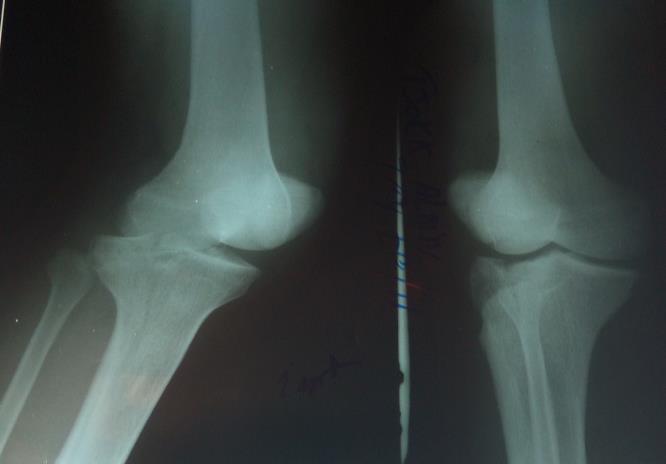
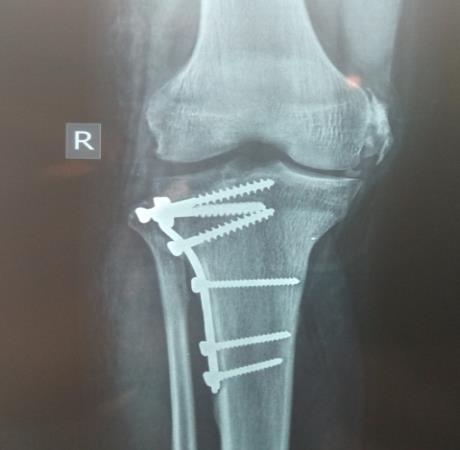
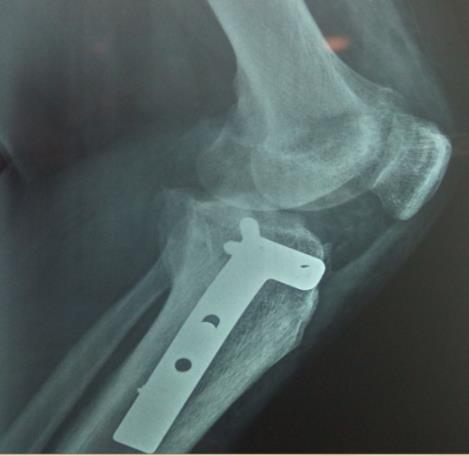
Table 1: Treatment modalities with respect to the functional outcomes and income. Patients with unstable financial income were approximately twice more likely to visit traditional bone settlers ("Yanda") and represented 19% of the cases. In our series, we recorded 80 cases of surgical treatment of tibial plateau fractures. The AO support plates could be used alone in unicondylar fractures (Figure 2), whereas in the bicondylar fractures and in Schatzker VI types, the so-called "eiffel tower" mountings were the most suitable and most reliable
Discussion
The tibial plateau fractures occurred predominantly in young adult males. Our results were consistent with those found at Limoges in 2011 and at the Ouahigouya two years later [3, 4]. This can be explained by the fact that this population group is hyperactive and are therefore more exposed to trauma. Patients with unstable financial incomes were the most affected especially as most of the latter had small subsistence jobs, in poorly organized structures, providing no health coverage systems. They included motorcycles riders and traders and laborers. This result was consistent with a study conducted in Cotonou in 2011 where the "Zemidjans" (motorcycle drivers) also represented the main category of traumatized patients in their study, in a socio-economic context no too different from our own [5]. Road traffic accidents were the main etiologyof fractures found in our series. In 2016, they occupied the main etiologies (90%) in a study carried out at the Yaoundé Central Hospital on floating knees [6]. In Lomé in 2013 and Cotonou two years earlier, studies on tibial plateau fractures reported 98.1% and 84% respectively of cases secondary to road traffic accidents [2, 5]. This could be explained, on the one hand, by the growth of two- wheeled transport in Africa in general and Cameroon in particular and on the other hand by increasing urbanization in our country. The predominant involvement of the lateral tibial plateau was not exclusive to our study, as it is traditionally described in the literature [4, 7, 8]. This could be explained by the difference in density between the two tibial tuberosities: 236 Kg / cm² against 142 Kg / cm² [9]. Unicondylar fractures were most represented with Schatzker type II (31%) being the most frequent. This is consistent with findings from two articles published in China in 2008, which reported 64% and 48% lateral unicondylar lesions with a majority of the Schatzker types II (31 and 39% respectively) [7, 8]. Similarly, a predominance of lateral unicondylar fractures (41%) was reported at the Flinders Medical Center in Australia in the same year, with Schatzker type II being the most frequent (29%) [10]. No patient in our series had been operated upon at emergency. The average delay for management was 14.7 days. This was close to the results observed in Burkina Faso, where no patient had also been operated upon at emergency. Nevertheless the average timeframe before operation was 7 days, which was half of that observed in our series [4]. This could be explained by the peculiar socio-economic context and health system of our country which is still in emergence and so does not always make it possible to operate the patients urgently or according the standards observed in more developed countries. The high frequency of osteosynthesis (95.2%) was in line with the recommendations observed in the literature both in Africa and worldwide. In fact, in a study published in Holland in May 2015, surgery was the best option for definitive treatment of tibial plateau fractures [11]. This resort to surgery could be explained by the fact that conservative treatment of these fractures has been proven expose the patients to many complications. Conservative management techniques are increasingly abandoned because of the high frequency of joint stiffness, secondary displacements and vicious calluses to which patients are usually exposed. On the other hand, it should be emphasized that 19% of patients went to traditional bone settlers in order to receive care. This could be explained by ancestral beliefs and traditions that are still deeply rooted in the minds of our patients, even in the presence of proven cases of fractures. In our series, we found 83.3% of satisfactory results (excellent and good, in 35 patients) according to the IKSS score evaluated after an average follow-up period of 28.5 months. This is in line with those found in Turkey in 2007, which reported 66.7% of satisfactory results (20% excellent results and 46.7% good results, according to the IKSS score with a 32-month follow-up) [12]. This could be due not only to the adoption of surgical treatment as a definitive treatment, but it could also be due to the adequacy of the osteosynthesis technique used with the types of fractures observed. Surgical treatment was the best therapeutic modality to offer to patients better functional outcomes; this was evident as patients treated by an orthopedic means in our series were 8 times more likely to develop poor functional results than those treated surgically. In fact, the current trend in the treatment of fractures of the tibial plateau is surgery in view of the need for anatomical reduction for this fractures whose surgical indication of principle [13, 14]. Regarding surgical treatments, epiphyseal plates were the most frequently used means of osteosynthesis, most especially supporting plates in T and L of the AO (Figure 2). In literature, supporting plates have been described [2, 5], but the pre-molded plates (locked or not) represent the gold standard because of their better adaptability to the proximal tibia [11, 14, 15]. However, these plaques are very expensive and are therefore not available in the therapeutic arsenal of the Cameroonian surgeon, which explains the use of AO supporting plates in our context.
Nevertheless, the supporting AO plates can be used in all types of fractures (classified according to Schatzker). However, in the event of depression, an elevation of the plateau is necessary before any stabilization of the fracture site. In bicondylar fracture and Schatzker VI types, eiffel tower mounts were the most suitable and most reliable. On the other hand, the use of roller screws in unicondylar fractures with depression proved unsuccessful in view of the results observed in our series.
Conclusion
At the end of our study, it was found that fractures of the tibial plateau at the Yaoundé Central Hospital occurred predominantly among young adult males with unstable economic incomes following a motorcycles road accident. Surgical treatment was the best therapeutic option given the articular nature of these fractures. Unicondylar fractures showed good functional results after osteosynthesis by supporting AO plates used in isolation, whereas bicondylar and Schatzker's type VI fractures required eiffel tower mounting for better stability. Finally, concerning the poorly codified traditional therapies, they should only act in addition to surgery during the rehabilitation phase.
References
-
Mierniczek W, Mizia E, Zawilinski J, Matyja A (2009) Anatomical aspects and procedures in plateau fractures. Folia Med Cracov 50(3-4): 129-144.
-
Abalo A, Ouedraogo S, James YE, Walla A, Dossim A (2011) Fractures des plateaux tibiaux: aspects épidémiologiques et thérapeutiques. J Rech Sci Univ Lome 13(1): 47-53.
-
Siegler J, Galissier B, Marcheix PS, Charissoux JL, Mabit C, et al. (2011) Ostéosynthèse percutanée sous arthroscopie des fractures des plateau tibiaux: évaluation à moyen terme des résultats. Rev Chir Orthop Février 97(1): 48-53.
-
Sawadogo M, Dakouré P, Tall M, Kafando H, Ouédraogo S, et al. (2013) Fracture des plateaux tibiaux au Centre Hospitalier Régional de Ouahigouya: résultats du traitement chirurgical. Orth Emerg Afr 2(5): 19-21.
-
Vignon KC, Chigblo SP, Ouangre A, Tidjani FI, Some IB, et al. (2016) Aspects épidémiologiques et thérapeutiques des fractures des plateaux tibiaux à Cotonou. Research fr 3: 1526.
-
Handy D, Lamah L, Bayiha JE, Essomba DL, Ngo Nonga B, et al. (2016) Lésions concomittantes aux genoux flottants et gravité. Pan Afr Med J 25: 83.
-
Xiao-jun D, Liu Y, Lin G, Guang-xing C, Gang D (2008) Arthroscopically assisted treatment for Schatzker type I-V tibial plateau fractures. Chin J Traumatol 11(5): 288-292.
-
Chan YS, Chiu CH, Lo YP, Chen AC, Hsu KY, et al. (2008) Arthroscopy-assisted surgery for tibial plateau fractures: 2-to 10-year follow-up results. Arthroscopy 24(7): 760-768.
-
Simon P, Kempf JF, Hammer D (1989) Les difficultés dans le traitement chirurgical des fractures unitubérositaires complexes. Table Ronde Journée de Printemps de la Sofcot. Rev Chir Orthop 75: 138-140.
-
Russell N, Tamblyn P, Jaarsma R (2008) Tibial plateau fractures treated with plate Fixation: to lock or not to lock. Eur J Orthop Surg Traumatol 19(2): 75-82.
-
Van Dreumel R, Van Wunnik B, Janssen L, Simons P, Janzing H (2015) Mid- to long-term functional outcome after open reduction and internal fixation of tibial plateau fractures. Injury 46(8): 1608-1612.
-
Subasi M, Kapukaya A, Arslan H, Ozkul E, Cebesoy O (2007) Outcome of open comminuted tibial plateau fractures treated using an external fixator. J Orthop Sci 12(4): 347-353.
-
Conserva V, Vicenti G, Allegretti G, Filipponi M, Monno A, et al. (2015) Retrospective review of tibial plateau fractures treated by two methods without staging. Injury 46(10): 1951-1956.
-
Timmers TK, Van der Ven DJ, De Vries LS, Van Olden GD (2014) Functional outcome after tibial plateau fracture osteosynthesis: a mean follow-up of 6 years. The Knee 21(6): 1210-1215.
-
Ehlinger M, Rahme M, Moor B, Di Marco A, Brinkert D, et al. (2012) Reliability of locked plating in tibial plateau fractures with a medial component. Orthop Trauma Surg Res 98(2): 173-179.
- Psychogenic Erectile Dysfunction in Late Adulthood: A Case Report on Clinical Intervention and Intimacy Restoration
- Clinical Trials on COVID-19 in 2025: A New Chapter in Global Health Research
- Innovations and Challenges in Contemporary Medical Clinical Trials: An Editorial Perspective
- Innovations and Challenges in Contemporary Medical Clinical Trials: A Critical Perspective
- Reimagining Clinical Trials: The Power of Continuous Feedback from Medical Reports
- Factors Influencing Brain Drain: Perspectives from a Medical School in Turkey