
Effects of Binge Watching on Psychological and Behavioral Changes on Various Age Groups
This paper mainly aims at finding out the impacts and consequences of binge watching. Social distancing and lockdown due to COVID-19 pandemic substantially impacted individual’s daily habits and well-being. Within such a context, digital technology may provide a welcome source of alternative forms of connection and entertainment. Indeed, streaming services showed a remarkable increase in membership subscriptions throughout the period considered. A total of 315 participants were taken into this study from 8th July to 31st august 2021 through google forms. The study examined the anthropometric, nutritional, dietary as well as the binge-watching factors such as psychological and behavioural using questionnaire research method. The respondents of the study were between 18 to 50 years of age, majority being students and working professionals from southern part of India i.e., from Karnataka state which included 4 districts such as Bangalore, Mysore, Hassan and Hubli. Results showed that majority of the students were addicted towards these online platforms and it has led them to anxiety, stress, depression as well as some behavioural changes resulting in isolation, lagging behind at their academic and work performance. It was clearly seen that respondents were also affected on their food and dietary intake in turn having a drastic effect on their health and life style. Therefore, these findings hold an implication on avoiding the addiction towards tv shows/ series in order to make them lead a healthy life style without any distractions.
Introduction
According to Oxford’s definition of binge-watching is to watch multiple episodes of a television program in rapid succession, by means of DVDs or digital streaming [1]. Binge watching is also defined as the impulsive behaviour of the user to consume one episode after the other, even completing a season of a web series at a time in order to curb curiosity [2]. The shift towards binge watching has been enabled by the development of video streaming technologies that are now prevalent both online and on TV said that binge watching refers to watching videos, usually tv shows, for a long period of time in one sitting [2, 3]. As we see that our younger generation are getting more addicted towards the internet’s accessibility as the nation is becoming techno savvy and makes young people get easily access to many types of video content. However, the addiction to or dependency on media content were considered as the main possible characteristics of binge-watchers [4]. Further, binge-watchers were found to more likely be depressed or lonely than non-binge-watchers [5].
The behaviour of watching a video has been changed because of technology [6]. Binge watching is treated as the most popular among the consumers as it is a self-determined viewing behaviour. Here the users (consumers) can decide themselves what to watch, when to watch and not to follow the broadcasting schedule [7]. Found that viewers tend to adjust their eating habits in accordance with their television viewing habits in their study, they revealed that users usually indulge in binge watching just to manage their mood swings and relax themselves [8]. Binge watching is also been considered, as a reward to repair their mood after a long and tiring day by few of the users. Furthermore, those adults who tend to watch television often consume more of high calorie snacks, fast food, soft drinks, alcohol and less nutritious food such as fruits and vegetables. In addition, prolonged television viewing also interferes with sleep disturbances, lack of sleep and alterations in melatonin levels, thus affecting the sleeping patterns of viewers [8, 9]. Certainly, there is increased fatigue, insomnia and poor sleep quality are which is associated with higher frequency of binge watching, in addition it is mediated by cognitive pre-sleep arousal which is potentially attributed to the greater narrative involvement and character identification occurring when binge watching [10]. Watching television for prolonged periods of time also has ramifications pertaining to cognition, emotion and mental health. Cognitive effects include deficits in concentration and attention span [11, 12]. After frequent usage of television, viewers are reporting that their alertness has been decreased and difficulties in concentrating at particular concept when compared to before they began [12]. Addicted viewers also experience emotional consequences.
They report that their mood is either the same or worse after watching television for a prolonged period of time and the experience of heavy viewing is less enjoyable [12]. Few have reported that continuous viewers have been underwent Para social breakups with characters when the character was taken off the show or the show ended, resulting in loneliness and depression [13]. Higher levels of loneliness and depression have also been associated with binge watching behaviour, along with anxiety and fatigue [4, 10, 14]. These physical health ramifications due to prolonged television exposure have been extensively researched and it is stated as a sedentary activity. Higher exposure to television is also been associated with physical inactivity among adults, especially for female college students whose physical exercise is negatively correlated with television viewing [15, 16]. Even though this activity is gaining popularity worldwide. It is claimed that binge-watching shows may have similar addictive and harmful qualities to those of eating junk food, mood alteration, feeling emotional or sometimes maybe getting addicted. Indeed, current study attempt to shed light on these issues. With these, the present study was planned with the objectives to assess the existing sociodemographic status, work pattern and general background, to evaluate the nutritional status, food and nutrient intake (through oral questionnaire) and to see the impact of binge watching on psychological factors and behavioural changes in different age groups from different states and countries through google forms.
Materials and Methodology
The major emphasis of the present study was on the impact of binge watching, dietary and nutritional knowledge. Various factors affecting the nutritional and health status of students and working professions were considered for the study from various parts of the Karnataka state and different countries.
Selection of Area
The selected area was of southern parts of India especially from Karnataka state i.e., Bangalore, Mysore, Hassan, Hubli and countries such as USA, Canada and Australia.
Selection of Subject
The subjects for the study were selected from various college students and employees of different age. The age group of the subject were from 18-50 years.
Sample Size
Targeted total sample size was 315 participants from different parts Karnataka state and few were from worldwide.
Background information
Standard questionnaires were developed for data collection for the information like; background information, anthropometric measures, socioeconomic status and other binge-watching related factors.
Methodology
The participants were given the necessary information about the research, and the mode through which information was collected, was through google forms broadcasted using mainstream social media (such as WhatsApp, Facebook, Twitter, Instagram) for collecting data. The participants were assured of the information’s confidentiality, allowing them to give honest answers without fear or inhibition. The survey was carried out from 8th July 2021 to august 31st 2021. Only the completed surveys were considered for the analysis. The time taken by the participants to fill the questionnaires were approximately about 4-5 minutes.
Selection of Tools and Measures
Demographic Questionnaire: The demographic questionnaire collected information about age, gender, education qualification, occupational status and family type to describe the sample. Anthropometric Assessment: The anthropometric measures were assessed by developing the oral questionnaires of the height, weight and BMI were calculated. Dietary and nutritional assessment: The food frequency questionnaires were prepared and the respondents were asked to fill it up. Food intake was analysed and it differed from eating junk foods or outside foods to eating at home, number of meals consumed for per day, food preferred and type of food habit while binge watching were also assessed and recorded. Binge watching questionnaires: The 2 major factors were considered i.e., the psychological and behavioural changes related several questionnaires were asked to the respondents. It included the time spent on tv/web series, number of episodes they watch at a stretch, whether it causes any anxiety, mood swings, what device they use, do they feel disturbed if they miss the episodes and many more questions were asked to the respondents.
Computation of the Data
The categorization and classification of the data in tables and graphs was undertaken. The frequencies and percentages in each class were worked out for interpretation of the findings using Microsoft excel software.
Results and Discussions
The findings of the study, “A survey on effects of binge watching on psychological and behavioral changes on various age groups” are discussed under the following heads.
General background
As indicated as earlier 315 participants were assessed from 4 different districts of Karnataka state and from abroad those who binge watch. The name, contact number and email address were assessed by the respondents. By doing this we were able to collect the general information about the participants and it made our study easier. Abroad (other countries): USA, Canada and Australia The following districts from Karnataka were taken into consideration: District 1: Bangalore District 2: Mysore District 3: Hassan District 4: Hubli
Sociodemographic Characteristics
Age: The selected 315 participants were classified according to their chronological age and are presented below in the Table 1. The distribution according to age indicated that about 74.1% (numbers) of the respondents were 18 to 24 years age. As much as 17.2 % were in the age group of 25 to 34 year whereas 3.6% were under 18 years and 3.9% were of 35 to 44 years of age. Only around 1.4% participants were above 44 years. The participants between 18-24 years of age group dominated in age wise distribution. The findings of the study revalued that majority (74.1%) of the respondent age group was 18-24 years.
| Age in years | Bangalore (104) | Mysore (105) | Hassan (43) | Hubli (43) | Other countries (20) | |||||
|---|---|---|---|---|---|---|---|---|---|---|
| No | % | No | % | No | % | No | % | No | % | |
| Under 18 | 3 | 2.8 | 4 | 3.8 | 1 | 2.3 | 2 | 4.6 | - | - |
| 18-24 | 66 | 63.4 | 85 | 80.9 | 37 | 86 | 34 | 79 | 14 | 70 |
| 25-34 | 28 | 27 | 11 | 10.4 | 4 | 9.3 | 4 | 9.3 | 6 | 30 |
| 35-44 | 6 | 5.7 | 5 | 4.7 | 1 | 2.3 | 1 | 2.3 | - | - |
| Above 44 | 1 | 0.96 | - | - | - | - | 2 | 4.6 | - | - |
| Total | 104 | 100 | 105 | 100 | 43 | 100 | 43 | 100 | 20 | 100 |
Table 1: Distribution of the respondents according to their age.
Grand total=315 Table 1: Distribution of the respondents according to their age.
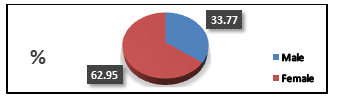
Gender: Out of 315 participants around 109 participants were male and remaining 206 were female. The overall total gender percentage is represented below. By this we found that majority of the respondent were female.
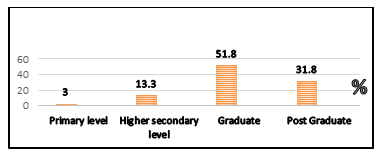
Education: When the respondents were asked for their education qualification it was seen that 51.8% them hold a graduate degree whereas 31.4% are postgraduates and 13.3% have completed their higher secondary level of education. The present survey data is represented below in figure 2. Education is an important factor related to service. Education is more than an economic investment: it is an essential input upon which life, development and the survival of one depends. The results thus indicates that the majority of them were graduates. Most of them were graduates as per these findings.
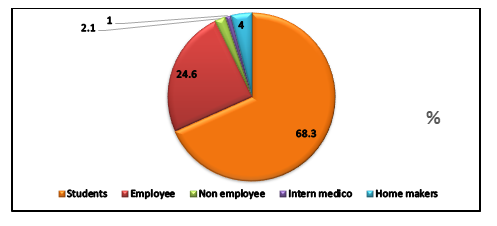
Occupation: As seen in figure 3, around 68.3% participants were students and 24.6% were employees there was also a small percentage of homemakers i.e., around 4%, 2.1% of them were non employees and 1% of intern medico. It was seen that majority of them were students from all the 4 districts.
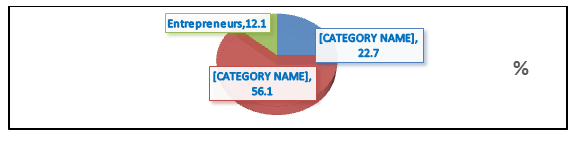
Type of job: Occupation was taken as the means of livelihood and then the participants were categorized into government and private jobs. As shown in the below figure 4 occupation of participants was on Government, private job and entrepreneurs. It was found that 56.1% of respondents had private job and only 22.7% of respondents had government job. Out of 132 employees around 12.1% participants run their own business.
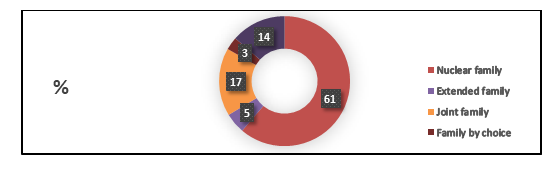
Family type: In the present study 315 participants were assessed for noting down the type of family they belong. Migration for earning has become continuous process and it has affected the concept of joint family and given rise to nuclear family as shown in figure 5. It was found that majority of them stay in nuclear family i.e., 61%, only 17% belong to joint family and 14% stay independently. It was seen that only 10 participants i.e., 3% stay by choice and 5% stay in an extended family. More than half of the respondents had nuclear family. Job opportunities and strategies for survival had compelled the people to move from one place to the other. This mobility has compelled to form nuclear families and restrict the family size.
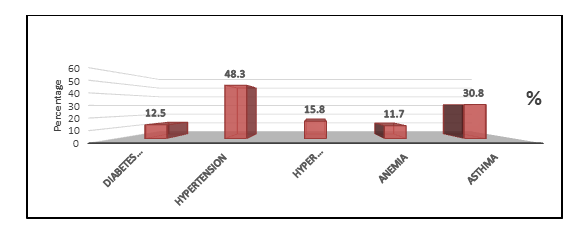
Health history: It was observed that from figure 6 about 48.3% are suffering from hypertension and one fourth of respondents had asthma. Out of 120 responses 11.7% were anaemic, about 12.5% have diabetes and 15.8% suffered from hyper cholesterolemias.
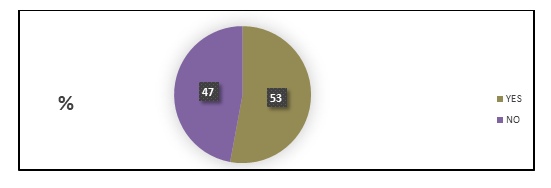
Eye related problems: As it was a study related to binge watching people were assessed on whether they wear glasses with power lens or contact lenses. As indicated in figure 7 we could see that around 53% of respondents wore glasses with power or contact lenses and 47% denied wearing any.
Anthropometric Measures
Body mass index: Body mass index (BMI) is a measure of weight adjusted for height, calculated as weight in kilograms divided by the square of height in meters (kg/m2). Although BMI is often considered an indicator of body fatness, it is a surrogate measure of body fat because it measures excess weight rather than excess fat. Furthermore, studies have shown that BMI levels correlate with body fat and with future health risks. High BMI predicts future morbidity and death. Therefore, BMI is an appropriate measure for screening of obesity and its health risks. BMI was used as the indicator to determine both the individual and collective general nutritional status.
| Nutritional status | Bangalore (104) | Mysore (105) | Hassan (43) | Hubli (43) | Other Countries (20) | |||||
|---|---|---|---|---|---|---|---|---|---|---|
| No | % | No | % | No | % | No | % | No | % | |
| Underweight | 11 | 10.5 | 27 | 25.7 | 10 | 23.2 | 12 | 27.9 | 3 | 15 |
| Normal | 46 | 44.2 | 35 | 33.3 | 19 | 44.1 | 22 | 51.1 | 12 | 60 |
| Overweight | 17 | 16.3 | 14 | 13.3 | 7 | 16.2 | 5 | 11.6 | 3 | 15 |
| Pre-obese | 18 | 17.3 | 16 | 15.2 | 5 | 11.6 | 3 | 6.9 | 1 | 5 |
| Obese type 1(obese) | 4 | 3.8 | 6 | 5.7 | 1 | 2.3 | - | - | 1 | 5 |
| Obese type 3(super Obese) | 1 | 0.9 | - | - | - | - | - | - | - | - |
Table 2: Nutritional status of the participants.
Dietary Assessment
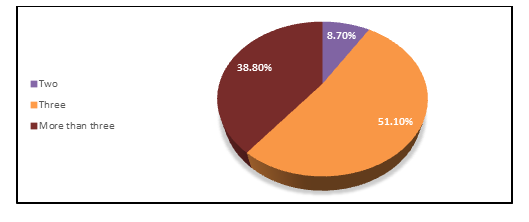
Number of meals consumed per day The relationship between health and food plays an important role in one’s life. Many people follow certain recommendations on what they eat, quantity, frequency in which they eat and the way they consume. The total respondents of the study were asked to assess on number of meals they consume per day, it was seen that 51.1% of participants consumed three meals per day whereas 38.8% said that they consume more than three meals per day and about 8.7% of participants consume only two meals per day. Hence, it is seen that maximum of people consume three meals per day and they have got a healthy lifestyle.
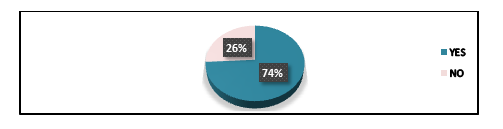
Eating preference while binge watching People are nowadays addicted to a condition during which many habitually eat, irrespective of hunger level. In 295 responses it was found that three fourth of the respondent’s that is 74% prefer while they binge watch and it is seen that minority of participants i.e., 26%, have declined the need of eating while binge watching. As per the results 74% of them prefer eating while binge watching, this may lead increase in food intake than the regular consumption without their knowledge which may result to lifestyle diseases like obesity.
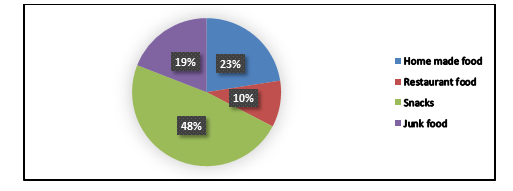
Type of food they prefer
As per the given responses, it was seen that 45% of them preferred snacks, around 17.8% preferred junk food whereas 9.4% preferred restaurant food. Twenty one percent referred home-made food. The intake of snacks and junk food is not a good practice and as a result, individuals’ step into many lifestyle diseases such as obesity, diabetes, gastric disturbances and many more. Regular intake of snacks and junk food will have an effect on one’s health in the long run.
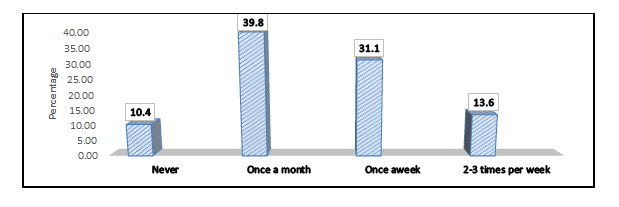
Frequency of eating at restaurant’s
In the total survey of 315 members, it was found that everyone consumed outside food often in restaurants. Maximum people consume junk food than healthy food. It was also observed that the subject spent their money for eating restaurant food is much more i.re., around 31.1% of them said that they eat restaurant food once a week, 13.6% reported they eat outside food 2-3 times per week and 39.8% said once a month. Only 10.4% denied eating outside food. As the lifestyle changes, we can see people also changing according to it. Consumption of restaurant food frequently may alter their well-being.
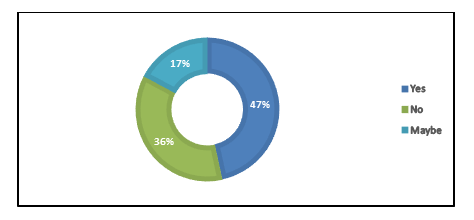
Increase in weight due to binge watching “There’s convincing evidence in adults that the more television they watch, the more likely they are to gain weight or become overweight or obese,” says [17, 18]. As per the saying it was found that 46.6% of respondents had increased their weight and few i.e., 17.2% are not sure whether thay have gained weight or not. 36.2% of them reported saying they have not noticed any changes in the weight. We can infer that due to excess eating while binge watching and reduced physical activity has made them gain weight.
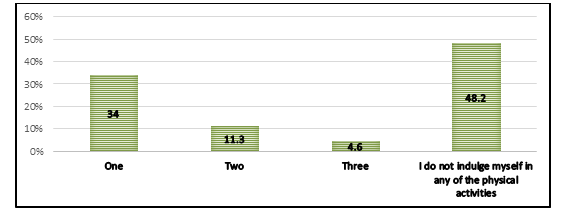
Physical activity
Physical activity/physical exercise of the subjects was recorded. It was observed that 48.2% of the subjects did not perform any physical exercise, spend time in playing, yoga, gym, swimming etc whereas 34% of the subjects performed exercise such as gym, swimming and yoga for one hour; followed by 11.3% who did these activities two times and 4.6% of them did physical exercise, spent time in playing three hours per day. Majority of participants do not indulge in any physical activity. This will have an influence on health.
Psychological Factors
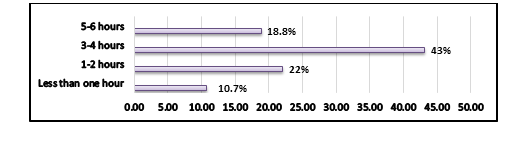
Time spent on binge watching: When respondents were asked about the average time spent on binge watch during lockdown on a daily basis, 43% agreed that they spend 3-4 hours, 22% spend 1-2 hours whereas 18.8% spend 5-6 hours on binge watching while 10.7% spend less than one hour on screen. Longer the time spent on tv shows will intern affect them in various ways.
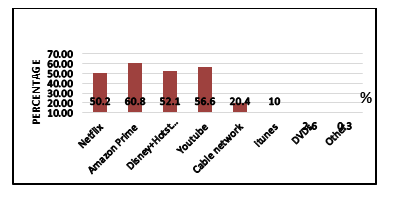
Platforms used to binge watch: Currently, there are several OTT platforms that offer online video streaming. In this questionnaire, the respondents were asked about their favourite online platform for streaming video content, where 61% said amazon prime as their favourite online platform. Fifty-seven percentage of respondents chose YouTube, while 52.1% chose Disney+hotstar, 50.2% agreed they use Netflix, 20.4% of them chose cable network, around 10% choose iTunes, DVDs 2.60% and 0.3% choose others as their answer. This clearly states that the majority is interested in subscribed video streaming on Netflix, amazon prime, Disney+hotstar rather than free video streaming for other OTT platforms.
Whom do they binge watch: When this question was assessed to 315 participants, out of 315 responses only 295 responses were considered, majority of them told they binge watch alone that is 78.3%, 11% usually binge watch with friends and 10.7% watch along with family. It is clearly seen that how psychologically it is affecting the youth nowadays and make them isolated from others. We can assume that due to lack of time spent with family/friends or feeling of loneliness may motivate them to binge watching.
Devices used to binge watch
Figure 16 indicates that 63.8% of them use smartphone/ tablets, 18.8% use PC/laptop and 11.7% use smart tv. As movies and shows are easily accessible through smartphone, thereby it has brought them convenience to binge watch.
Disturbed behaviours when they avoid or miss watching the shows: When the above question was asked it was seen that 50% of respondent’s have felt disturbed when they missed or avoided shows.
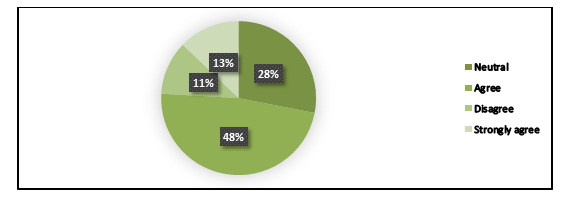
Leading to isolation due to binge watching: Loneliness is not lack of company. Loneliness is lack of purpose. Studies have proved that isolation and loneliness are the central causes of depression and despair. Around 60% of the respondents strongly believe that binge watching causes isolation. And it is observed clearly in the given graph that hardly 11% strongly disagreed to the statement. Twenty- eight percent of them are neither agreeing nor disagreeing. As people involved themselves in binge watching rather than spending quality time with family and friends, resulting in isolation.
Binge watching is harmful: Our respondents strongly agreed to the fact that binge watching is harmful. The survey clearly showed that 69.3% felt that binge watching is harmful while the rest 30.7% of them didn’t. This shows that many of the respondents are aware of the consequences of binge watching.
Behavioral Changes
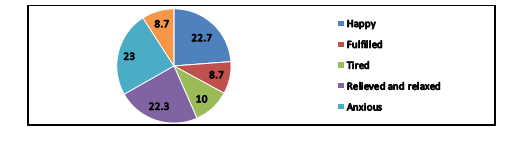
Elements about binge watching: Each person has got their own perceptions and opinions hence this question was assessed to all 315 respondents and in the figure 18 below the data have been represented. As per the responses by the subjects it was seen that 23% of them feel very anxious after they binge watching, 22.3% of them have felt relieved and relaxed, 22.7% of participants have even felt happy, whereas 8.7% of them go disappointed because it’s over while, 8.7% feel fulfilled. As per the results there were mixed reasons, while some felt happy, relaxed and fulfilled after binge watching while others felt tired, anxious and disappointed because the show is over.
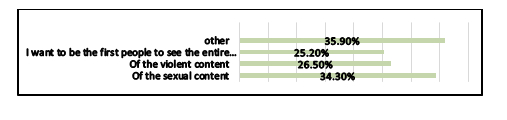
Reasons for binge watching: By knowing the reasons why people binge watch we could relate it to the behavioral changes in some of them. Majority of them said that they binge watch because of the sexual and violent content in it i.e., around 34% and 27%. Twenty five percent of the respondents feel that they want to be among the first person to see the entire series. These reasons might sometimes be implemented on them and can even behave or make them behave that way as well. Thirty six percent of them choose other as their option. This shows certain Tv shows may bring bad influence on viewers.

Figure 19: Reasons for binge watching. Anxious behaviours: It is important to know that anger is a basic human emotion. It is a normal reaction when we feel frustrated, blocked, hurt or cheated. Here 62.2% of respondents have agreed that they happen to react abruptly, raising their voice or speaking rudely when someone disturbs them while they are watching a tv series. This habit will inturn results in several kind of behavioural changes on youth. Only about 37.8% of them said they don’t feel anxious when someone disturbs them. This shows some of the bad behavioural changes inculcated due to its addiction.
Statement on anxiety: When this statement was imposed it was clearly found that 41% of them agreed telling binge watching causes anxiety, 14% strongly agreed, 24.3% were bit confused about this behavior and 16.5% respondents disagreed with this statement. Anxiety can be detrimental to many people due to the stress they face.
Mood disturbance: In this question the respondents were asked about the disturbed behaviors they feel when they avoid or miss watching the shows and around 51% of them have felt disturbed and 49.2% have not felt it. This shows the impact binge watching has played on one’s life, it has taken a toll on their life and affecting them.
Addiction towards alcohol, smoking or drugs: Figure 21 indicates that 40.3% of people watch tv series just because of the attraction towards alcohol, smoking or drugs and 59.7% don’t watch due to it. This is one of the most harmful disadvantages faced due to binge watching. Some shows influence viewers and make them imitate their favourite characters.
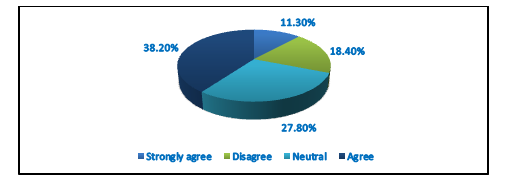
Unproductive behaviors: Three hundred and fifteen responses were received and it was found that 38.2% of participants agreed that binge watching causes unproductive behavior, along with 11.3% people who strongly agreed and 18.4% disagreed with this. Twenty eight percent was found to be in a neutral state.

Opinions on self-control: A mixed response was obtained for this statement as 44% disagreed, while 25% agreed and around 31% respondents had a neutral opinion on the same. Binge watching makes them feel that they are in control of what they are watching, when they are watching and where.
Conclusion
Based on the results of this survey we can come to a conclusion that the younger generation are attracted towards these online platforms/tv shows and are addicted even after knowing the harmful effects of binge watching. Our survey has showed us how binge watching has created changes in one’s life. Binge watching has brought psychological effects, differences in their daily physical activities, sometimes even alters body mass index, behavioral changes in addition to isolation but sometimes plays a good companion to overcome the boredom and loneliness that one faces in their lifetime. Young adults are prone to higher risks in this phenomenon because of their unmonitored times spent consuming media and certain habits formed during childhood which track into adulthood. A lot of people might look at binge watching a show as a lazy and unproductive activity while in reality it can become a new shared interest or even make one smarter and more alert. Binge watching a series is a harmless pleasure that can bring one closer to other people and exercise one to have a faster mind. Binge-watching has got its own benefits and few drawbacks as well. However, If we do it on balance, binge watching can be worth doing from time to time. As we faced lockdown due to the COVID 19 pandemic, people have drastically changed their way of watching tv series and shows. The consumption patterns have increased and has made them watch tv shows or series on an online platform whenever they want, wherever they want and however longer they wish to watch. This has created the latest trend in the nation and have made people run behind it.
References
-
Matrix S (2014) The Netflix effect: Teens, binge watching, and on-demand digital media trends. Jeunesse: Young People, Texts, Cultures 6(1): 119-138.
-
Dhenuka A, Bohra A (2019) Binge-Watching: Web-Series Addiction amongst Youth. DSIMS 2(1): 1-8.
-
Abreu J, Nogueira J, Becker V, Cardoso B (2016) Survey of catch-up tv and other time-shift services: a comprehensive analysis and taxonomy of linear and nonlinear television. Telecommunication Systems 64(1): 57-74.
-
Devasagayam R (2014) Media Bingeing: a qualitative study of psychological influences. Proceedings of the Marketing Management Association. Spring, pp: 40.
-
Schweidel DA, Moe WW (2016) Binge watching and advertising. Journal of Marketing 80(5): 1-19.
-
Susanno R, Phedra R, Murwani IA (2019) The Determinant Factors of the Intention to spend more time binge-watching for Netflix Subscriber in Jakarta. Journal of Research in Marketing 10(3): 807-812.
-
Horeck T, Jenner M, Kendall T (2018) On binge-watching: Nine critical propositions. Critical Studies in Television: The International Journal of Television Studies 13(4): 499-504.
-
Van den Bulck J (2000) Is television bad for your health? behaviour and body image of the adolescent “couch potato”. Journal of Youth and Adolescence 29(3): 273- 288.
-
Sigman A (2007) Visual voodoo: The biological impact of watching TV. Biologist 54(1): 12-17.
-
Exelmans L, Van den Bulck J (2017) Binge viewing, sleep, and the role of presleep arousal. Journal of Clinical Sleep Medicine 13(8): 1001.
-
Christakis DA, Zimmerman FJ, DiGiuseppe DL, McCarty CA (2004) Early television exposure and subsequent attentional problems in children. Paediatrics 113(4): 708-713.
-
Kubey R, Csikszentmihalyi M (2002) Television addiction is no mere metaphor. Scientific American 286(2): 74-80.
-
Eyal K, Cohen J (2006) When good friends say goodbye: A parasocial breakup study. Journal of Broadcasting & Electronic Media 50(3): 502-523.
-
Sung YH, Kang EY, Lee WN (2015) An exploratory study of motivations for binge watching behaviour. In American academy of advertising. Conference. Proceedings. American Academy of Advertising (Online), pp: 169.
-
Buckworth J, Nigg C (2004) Physical activity, exercise, and sedentary behaviour in college students. Journal of American College Health 53(1): 28-34.
-
Meyer AM, Evenson KR, Couper DJ, Stevens J, Pereria MA, et al. (2008) Television, physical activity, diet, and body weight status: the ARIC cohort. International Journal of Behavioural Nutrition and Physical Activity 5(1): 68.
-
Frisancho AR (2008) Anthropometric standards: an interactive nutritional reference of body size and body composition for children and adults. 2nd (Edn.), Ann Arbor: University of Michigan Press.
-
Kleiman RE, Greer FR (2014) American Academy of Pediatrics Committee on Nutrition. Assessment of Nutritional Status. Pediatric Nutrition. 7th (Edn.), Elk Grove Village, IL.
- Psychogenic Erectile Dysfunction in Late Adulthood: A Case Report on Clinical Intervention and Intimacy Restoration
- Clinical Trials on COVID-19 in 2025: A New Chapter in Global Health Research
- Innovations and Challenges in Contemporary Medical Clinical Trials: An Editorial Perspective
- Innovations and Challenges in Contemporary Medical Clinical Trials: A Critical Perspective
- Reimagining Clinical Trials: The Power of Continuous Feedback from Medical Reports
- Factors Influencing Brain Drain: Perspectives from a Medical School in Turkey