
In-Plane Membrane Ordering and Topological Defects
Intrinsic properties of biological membrane constituents dominantly influence the shape of biological membranes and consequently their functionality. This impact is in particular pronounced if anin-plane membrane order is present. In such cases topological defects (TDs) inevitable appear if membranes’ topology is different from the toroidal one. TDs give rise to spatial non homogeneities which might trigger various functional responses in membranes, such as membrane fission, tabulation and vesiculation. In the paper we describe minimal continuum-type models which consider in-plane ordering within membranes focusing on TDs. We consider cases with nematic-type orientational (quadrupolar) ordering. We first present the Deviatoric Curvature (DC) model and the Minimal Extrinsic Curvature (MEC) model, respectively. The DC model demonstrates that the deviatoric curvature plays similar role as an external ordering field. Using the MEC model we show that membrane structures possess TDs which obey classical topological theorems. Finally, we present the Landau-type modelling which is particularly adequate in studies focusing on impacts of TDs.
Introduction
Membranes of biological cells are complex systems consisting of lipid molecules, proteins and many other components [1]. Their key properties could be inferred using a relatively simple continuum-type geometrically based models. Within them membrane configurations are determined using a two dimensional (2D) curvature field [1, 2, 3]. The diversity of different membrane configurations enormously increases if a global or local membrane in- plane ordering is present [4, 5, 6, 7, 8]. This could arise due to anisotropic shapes of membrane embedded constituents [3, 4, 6, 9], tilted lipid acyl chains within membrane layers [7], membrane attached anisotropic proteins [8], or by some other means. Resulting ordering is commonly modelled by the so-called p-atic fields [7], invariant under in-plane rotations for 2 / p π . Most cases refer to p=1, p=2 and p=6, where ordering fields could be described by a vector field, quadrupolar (nematic) field and complex hexatic order parameter field, respectively. If an in-plane ordering exists it could exhibit topological defects (TDs) [11, 12]. TDs are the consequence of symmetry breaking mechanisms which are ubiquitous in nature. They could be locally stabilized by topological factors where microscopic details are not relevant. Consequently, physics of topological defects exhibits several universalities [11, 12, 13], spanning the physics of condensed matter systems, particle physics and cosmology. Deep understanding of TDs might unravel fundamental workings of nature. Namely, there are strong evidences that fields represent fundamental entities of nature [14]. If this is the case then the fundamental particles are emergent phenomena and TDs might explain their local stability, as originally suggested by Lord Kelvin and mathematically demonstrated by Skyrme [15]. In our study we will consider point TDs in effectively 2D systems. Some representative TDs for p=2 type fields exhibiting the head-to-tail invariance are shown in Figure 1. At origin of TDs the relevant field is not uniquely defined and is consequently melted. The linear size of the defect core, where ordering is essentially melted, is given by the relevant order parameter correlation lengthξ. The key property of TDs in 2D is their winding number m [11, 12]. It determines a number of rotations of the field along a line enclosing the defect core counter clock-wise. TDs with m>0 and m<0 are commonly referred as defects and antidefects, respectively. The total charge of TDs within a system is conserved for fixed boundary conditions (if the field is not melted). In several cases TDs behave similar to electric charges, i.e., a pair of like charges repels each other and TDs of opposite charges attract each other. Therefore, pairs {+m,-m} tend to annihilate into a defect-less state [16].
![Figure 1: At origin of TDs the relevant field is not uniquely defined and is consequently melted. The linear size of the defect core, where ordering is essentially melted, is given by the relevant order parameter correlation lengthξ. The key property of TDs in 2D is their winding number m [11,12]. It determines a number of rotations of the field along a line enclosing the defect core counter clock-wise. TDs with m>0 and m<0 are commonly referred as defects and antidefects, respectively. The total charge of TDs within a system is conserved for fixed boundary conditions (if the field is not melted). In several cases TDs behave similar to electric charges, i.e., a pair of like charges repels each other and TDs of opposite charges attract each other. Therefore, pairs {+m,-m} tend to annihilate into a defect-less state [16].](/fulltextimages/1827/fig_1.jpeg)
In biological membranes exhibiting in-plane ordering TDs unavoidable form for topologies different from the toroidal one [17]. They give rise to localized non- homogeneities which might be involved, or even trigger various cellular features (e.g., budding, cell fission, cross- membrane transport) [1, 5, 9]. In this paper we consider common models of membranes used to study their in- plane ordering.
Stability of Topological Defects
The total winding number mtot hosted by a closed membrane exhibiting in-plane ordering is given by Gauss- Bonnet and Poincare-Hopf theorems [18]:
$$ m _ {t o t} = \chi = 2 (1 - g) = \frac {1}{2 \pi} \oiint_ {\zeta} K d ^ {2} \bar {r}. $$ Here χ stands for the Euler characteristics of the surface ζ, g is the genus (number of holes within the surface), and K is the Gauss curvature of an infinitesimally small $$ d \zeta = d ^ {2} \vec {r} $$
ρ. For example, for spherical
(toroidal) structure it holds mtot=2 (mtot=0). Number of
TDs for a given geometry is p-atic field dependent. In
planar geometries the energy cost F
Δ
of a topological
defect scales as
2 F m Δ ∝
[19, 20]. Consequently, if one
enforces within a region a topological defect of charge m it
tends to decay into pelementary T Dsbearing charges
m0=1/p. Therefore, for a simple spherical geometry one
expects four m=1/2 TDs.
Furthermore, spatially nonhomogeneous Gauss
curvature could have strong impact on the number and
positions of TDs. Interaction between K and TDs is well
embodied in the Effective Topological Charge Cancellation
(ETCC) mechanism [21]. In it one assigns an effective
topological charge ∆𝑚𝑒𝑓𝑓= ∆𝑚+ ∆𝑚𝐾 to each surface
patch ζ Δ
characterized by its average characteristic
Gaussian curvature surface patch
1 𝐾 =
𝐾𝑑2𝑟 ζ Δ . (2)
ζ Δ The quantity ∆𝑚 refers to the topological charge of “real” TDs. On the other hand ∆𝑚𝐾 represents the spread curvature topological charge defined by
1 2π 𝐾𝑑2𝑟 ζ Δ . (3)
∆𝑚𝐾= −
The ETCC mechanism claims that in each surface patch there is neutralization tendency to cancel $\Delta m_{eff}$. This can be achieved by redistribution of existing TDs or via creation of additional pairs $\{defect, antidefect\}$. The latter could be realized if a structure exhibits strong enough localized elastic distortions [17, 21, 22, 23]. This behavior arises because the TDs with positive (negative) topological charge are attracted to the regions exhibiting negative (positive) Gaussian curvature, as originally suggested in Refs. [22, 23].
**Modeling of Ordered Membranes**
Below we focus on effectively 2D systems exhibiting in-plane nematic ordering. We review some of the existing different models of membrane ordering addressing spontaneously emergent nematic ordering.
**Deviatoric Curvature Model**
One could use the so called Deviatoric Curvature model [4, 5, 6, 9] to describe the onset of nematic-type in-plane ordering due to anisotropic nature of membrane constituents. These are modelled by 2D anisotropic nanoplates of area $a_0$ [6, 24]. Their geometry is determined by the intrinsic curvature tensor
$$C^{(m)} = C_1^{(m)} \left( \vec{e}_1 \otimes \vec{e}_1 \right) + C_2^{(m)} \left( \vec{e}_2 \otimes \vec{e}_2 \right).$$
Here $\{ \vec{e}_1^{(m)}, \vec{e}_2^{(m)} \}$ and $\{ C_1^{(m)}, C_2^{(m)} \}$ label eigenvectors and eigenvalues of the tensor, respectively, and $\otimes$ marks the tensorial product. The actual membrane shape is given by the effective curvature tensor field
$$C = C_1 \left( \vec{e}_1 \otimes \vec{e}_1 \right) + C_2 \left( \vec{e}_2 \otimes \vec{e}_2 \right)$$
determined by the eigenvectors $\{ \vec{e}_1, \vec{e}_2 \}$ and eigenvalues $\{ C_1, C_2 \}$. The corresponding interaction energy density is expressed in terms of invariants formed by the mismatch curvature tensor [6, 25]
$$M = R C^{(m)} R^{-1} - C.$$
Here $R = \left( \vec{e}_1 \otimes \vec{e}_1 + \vec{e}_2 \otimes \vec{e}_2 \right) \cos \theta + \left( \vec{e}_1 \otimes \vec{e}_2 - \vec{e}_2 \otimes \vec{e}_1 \right) \sin \theta$ stands for the rotation tensor, and $\theta$ refers to the angle between $\vec{e}_1$ and $\vec{e}_2$ in the tangent plane of the membrane characterized by the surface normal $\vec{v} = \vec{e}_1 \times \vec{e}_2 = \vec{e}_1^{(m)} \times \vec{e}_2^{(m)}$. It follows [4, 5, 6]
$$w = \kappa \left( \left( H - H^{(m)} \right)^2 + D^2 - 2 D D^{(m)} \cos(2\theta) + D^{(m)^2} \right),$$
where $\kappa > 0$ is the curvature modulus. The quantities $H = \left( C_1 + C_2 \right)/2$, $H^{(m)} = \left( C_1^{(m)} + C_2^{(m)} \right)/2$, $D = \left| C_2 - C_1 \right|/2$, $D^{(m)} = \left| C_2^{(m)} - C_1^{(m)} \right|/2$ determine the mean curvature, mean intrinsic curvature, curvature deviator, and mean curvature deviator, respectively.
The ensemble average of the local orientational ordering is given by [26]
$$\eta = \left\langle \cos(2\theta) \right\rangle = \frac{\int_0^{2\pi} \cos(2\theta) e^{-w a_0 \beta} d\theta}{\int e^{-w a_0 \beta} d\theta} = \frac{I_1(x)}{I_0(x)},$$
where $I_1$ labels the Bessel function of $n$-th order and $x = 2\kappa a_0 DD^{(m)}\beta$.
Note that in the case of an isotropic intrinsic element Equation (7) yields
$$w = \kappa \left( \left( H - C_0 \right)^2 + D^4 \right),$$
where $C_1^{(m)} = C_2^{(m)} = C_0$. Taking into account terms up to the $2^{nd}$ order in the curvature tensor expansion and for $C_0=0$ one reproduces the "classic" Helfrich membrane curvature model.
**Minimal Extrinsic Curvature Model**
The nematic orientational ordering could appear also due to attached thin rod-like nano-objects, as for example BAR proteins [8]. The corresponding minimal model, where we assume that nano-objects are represented by thin flexible rod-like objects, may be given by the following expression for the free energy density $f = f_c + \phi f_n + f_{mix}$, where [8]
$$f_c = \frac{\kappa}{2} H^2,$$
$$f_n = \frac{\kappa}{2} \left( C - C_n \right)^2,$$
$$f_{mix} = \frac{k_\beta T}{a_0} \left( \phi \ln \phi + (1 - \phi) \ln(1 - \phi) \right).$$
The first contribution $f_c$ stands for the classical Helfrich spontaneous curvature term [2], where we assume isotropic intrinsic membrane constituents. The term $f_n$ is the elastic curvature density contribution of the flexible anisotropic rod-like nano-objects attached to the membrane surface. This energy term is weighted by the rigidity constant $\kappa_m > 0$. The constant $C_m$ represents the locally enforced intrinsic curvature of the attached nano-object. The third term $f_{mix}$ describes the configurational entropy contribution of the attached rod-like objects of surface area $a_0$. We refer to this model as the Minimal Extrinsic Curvature model [8].
The local curvature $C$, experienced by the attached flexible nano-rod, can be expressed as
$$C = C_1 \cos^2 \theta + C_2 \sin^2 \theta = H + D \cos(2\theta).$$
Here $\theta$ describes the angle between the normal plane of the 1st principal curvature and the normal plane in which the nano-rod is lying.
The above described models are usually solved for axial membrane shape symmetry and are mainly used to determine qualitatively different membrane shapes [1, 2, 6, 8]. A membrane shape is in the Cartesian coordinate frame $(\vec{e}_x, \vec{e}_y, \vec{e}_z)$ commonly parametrized as
$$r = \rho(s) \cos(\varphi) e_x + \rho(s) \sin(\varphi) \vec{e}_y + \rho(s) \vec{e}_z.$$
where $\varphi \in [0,2\pi]$, and $s$ describes the arc-length of the membrane profile in the $(x,z)$ plane. Numerical details are described in [21]. The above model for orientational ordering of thin rod-like molecules can be further generalized by considering the orientational ordering of small plate-like flexible nanodomains embedded in the membrane [24] or flexible plate-like nano-objects attached to the membrane [27].
**Landau-Type Mesoscopic Model**
In order to emphasize role of orientational degrees of freedom the Landau-type modelling is commonly used [21, 28, 29]. To take into account the head-to-tail invariance it is necessary to introduce the tensor nematic order parameter [29]
$$Q = \lambda (\vec{n} \otimes \vec{n} - \vec{n}_\perp \otimes \vec{n}_\perp).$$
The quantity $\lambda$ determines the amplitude field, the unit director field $\vec{n}$ determines mesoscopic local membrane in-plane orientation, $\vec{n} \cdot \vec{n}\perp = 0$, and the membrane surface normal is defined as $\vec{v} = \vec{n} \times \vec{n}\perp$.
In terms of invariants in terms of $C$ and $Q$ we express the free energy density $f = f_c + f_e^{int} + f_e^{(ext)}$, where we take into account only the most essential terms of our interest. Quantities $f_c$, $f_e^{int}$, $f_e^{(ext)}$ stand for condensation, intrinsic elastic and extrinsic elastic term, respectively. We express them as [21, 29, 30]
$$f_c = -A \text{Tr} Q^2 + B \left( \text{Tr} Q^2 \right)^2,$$
$$f_e^{int} = k_i \text{Tr} \left( \nabla_s Q \right)^2,$$
$$f_e^{(ext)} = k_e \text{Tr} \left( Q C^2 \right).$$
The coefficients $A$ and $B$ are positive material constants, $k_i$ and $k_e$ stand for the representative intrinsic and extrinsic curvature elastic constants, $\nabla_s = (L - v \otimes v) \nabla$ is the surface gradient operator [29] and $\nabla$ represents the conventional gradient operator.
The model introduces several intrinsic (material dependent) length scales. The most important is the order parameter correlation length which we define as
$$\xi = \sqrt{\frac{k_i}{A}}.$$
**Membrane Nematic Order and Topological Defects**
In the following we present some demonstrative results of presented mesoscopic continuum models focusing on in-plane membrane orientational ordering.
The Deviatoric Elastic model enforces orientational ordering if deviatoric terms $D$ and $D_m$ are different from zero. For simplicity we restrict to axially symmetric configurations. The ordering term in Equation (7) displays external-field like structure. The corresponding field strength monotonously increases with increasing value of $D$ and $D_m$. Anisotropic membrane constituents orient along the direction for which eigenframes of tensors $C$ and $C^{(m)}$ coincide. The degree of nematic ordering $\eta = \left\langle \cos(2\theta) \right\rangle$ is plotted in Figure 2 as a function of dimensionless quantity $x = 2\kappa a_0 DD^{(m)} \beta$. The nematic ordering is absent if $\eta = 0$. Within this model nematic ordering is absent at umbilical points where $C_1 = C_2$. Therefore, the essential message that this model reveals is that anisotropic membrane constituents introduce an external field-type contribution in the interaction potential which is present in membrane areas.
$$ \mathrm {w h e r e} C _ {1} \neq C _ {2} $$
. Note that the model yields only
information on local degree of ordering and does not take
into account global topologically imposed constrains.
Note that in general the distribution of the orientational
ordering of the membrane components over the whole
membrane and the global shape of the membrane are
interdependent and determined by the minimum of the
membrane free energy [5].
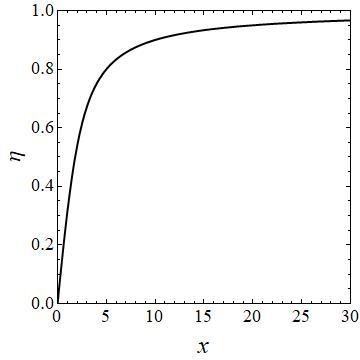
Figure 2: The degree of local nematic ordering η as a function of ( ) 0 2 m x a DD κ β = . We next consider the model described by the free energy density Eq.(10) within the Minimal Extrinsic Curvature model. In this treatment the nematic ordering arises due to the ordering of attached flexible rod-like nano-objects, to which we henceforth refer to as the rods. In this modelling one restricts to axially symmetric configurations of membranes. The variational parameters are the membrane shape, in-plane orientational ordering and spatially dependent concentration φ of the rods. We calculate the parameters by minimizing the free energy functional (see Eq.(10)) for a given average concentration ave φ of nano-rods assuming constant membrane volume and its surface area. Some representative results are shown in Figures 3 and 4. In Figure 3 we plot membrane shapes with superimposed orientational ordering for a fixed relative volume v and Cn on increasing the average concentration of rods ave φ . As it can be seen the bottom part of membranes becomes increasingly spherical on expense of pronounced tubular extrusion. The rods align along the meridians. The Gauss-Bonnet and Poincare-Hopf theorems are obeyed: the total topological charge of structures equals two. The vortex-like topological defect of strength m=1 is localized at the poles of the structures.
Furthermore, on increasing Cn the rods become increasingly attracted to the tubular membrane extrusion. This is even more evident in Figures 4 where we increase the rods’ imposed curvature Cn. for a fixed average concentrationφave . Namely, in the tubular part of the membrane the mismatch between preferred curvature of rods and local curvature of membrane could be efficiently minimized. Consequently, the rods are expelled from the spherical part where curvature is significantly lower with respect to Cn.. We remark that also in extreme case shown in Figure 4c the topological theorems are obeyed. A defect of strength m=1 resides at the top pole of the structure. The other m=1 TD residing in the bottom part of the structure is not visible because the nematic ordering there is absent.
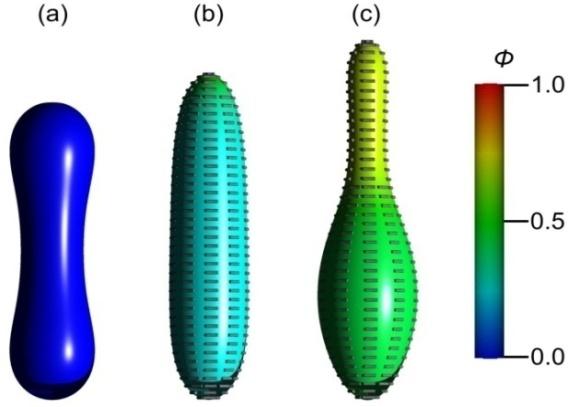
Figure 3: Membrane shapes with superimposed orientational ordering for a fixed relative volume v and Cn on increasing the average concentration of rods ave φ .(a) 𝜙𝑎𝑣𝑒= 0.0 , (b) 𝜙𝑎𝑣𝑒= 0.25 , (c) 𝜙𝑎𝑣𝑒= 0.5 . 𝐶0 = 0 , 𝑣= 0.66 , 𝐶𝑛= 8 , 𝜅𝑛= 𝜅, 𝜅= 30𝑘𝐵𝑇, 𝑅0 = 250 nm , 𝑎0 = 100 nm2. 𝑅0 stands for the radius of a sphere which has the same surface as the membrane. 𝐶𝑛 is expressed in units of 1/R0.
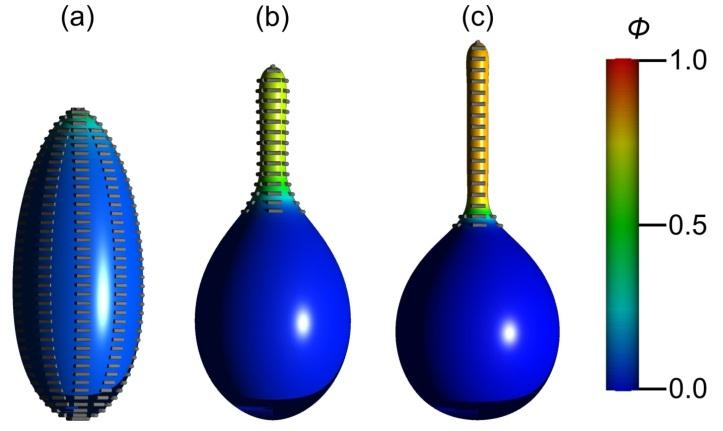
on increasing 𝐶𝑛. (a) 𝐶𝑛= 10 , (b) 𝐶𝑛= 12 , (c)
𝐶𝑛= 14. 𝐶0 = 0, 𝑣= 0.85, 𝜙𝑎𝑣𝑒= 0.1, 𝜅𝑛= 𝜅, 𝜅= 30𝑘𝐵𝑇,
𝑅0 = 250 nm, 𝑎0 = 100 nm2.
Finally, we discuss the model given by Equation (14)
which focuses mainly on nematic ordering for a given
membrane shape. Note that the term weighted by the
constant ke mimics deviatoric-type term that was first
introduced via the deviatoric elastic model [6]. In Figure 5
we show typical nematic ordering for a tubular-type
nematic structure. In Figure 5a we depict structure in the
{s, φ } parameter plane, where s determines the
membrane arc-length and v is the azimuthal angle in the
(x,y) plane of the Cartesian coordinate system (x,y,z) of
the axially symmetric membrane shape. In this modelling
we allow solutions which break the axial symmetry. In the
case shown three m=1/2 TDs are formed in the spherical
part of the membrane exhibiting 𝐾 > 0, one m=-1/2 TD in
the neck area where 𝐾 < 0, and m=1 TD at the bottom
pole of the membrane, where 𝐾 > 0. The total charge
equals two in accordance with Eq.(1). Furthermore, the
distribution of TDs is in line with the ETCC mechanism,
although the structure is not totally “topologically
neutralized”. For this purpose one would need stronger
local distortions which would enable formation of an
$$ \text{additional pair} \quad \{\text{defect, antidefect}\} = \{1 / 2, - 1 / 2\}. \mathrm {The} $$
resulting structure would possess four m=1/2, two m=-
1/2 and one m=1 topological defects in the top spherical-
like part, neck region, and bottom tubular extrusion,
respectively.
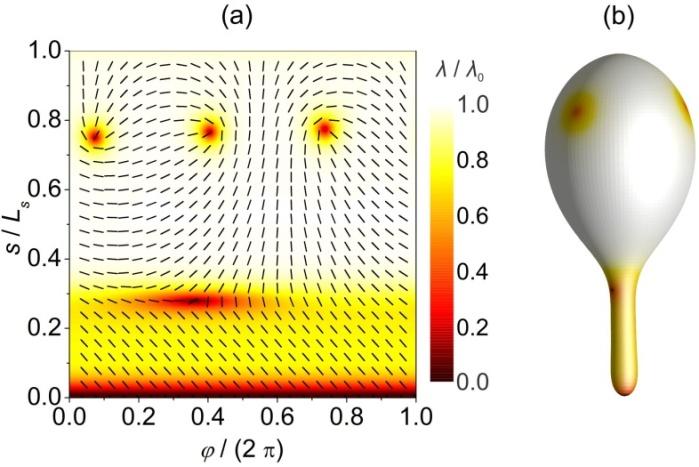
Figure 5: (a) The nematic ordering scaled with respct to its bulk value 0 λ in the {s, φ } parameter plane. Ls determines the total membrane’s shape length. b The membrane shape where we indicate positions of TDs. 𝐶0 = 0 , 𝑣= 0.85 , 𝐶𝑛= 12 , 𝜙𝑎𝑣𝑒= 0.1𝜅𝑛= 𝜅, 𝜅= 30𝑘𝐵𝑇, 𝑅0 = 250 nm, 𝑎0 = 100 nm2, ki= 𝜅, ke=0, 𝑅0/𝜉= 60.
Conclusions
We considered different mesoscopic-scale continuum models taking into account nematic-type in-plane membrane ordering. The Deviatoric Elastic model [3, 4, 5, 6] introduces local nematic ordering via anisotropic embedded or attached membrane constituents characterized by the two principal curvatures ( ) ( ) 1 2 m m C C ≠ . The local ordering tendency of orientational ordering field-like term is proportional to the local membrane curvature deviator
1 2 ( ) / 2 C C − . The term enforcing orientational ordering in the interaction potential adopts an external ordering
field-type structure which is without direct interactions
between the membrane components effective only in
membrane parts where
$$ C _ {1} \neq C _ {2}. $$
. Note that the external
membrane curvature and the orientational ordering of
the anisotropic membrane components over the whole
membrane surface are actually interdependent and
determined by the minimum of the total membrane free
energy [5], i.e. the local membrane curvature is not only
imposed by the intrinsic shape of the membrane
components, but also by the global geometrical constrains
and the minimum of the total membrane free energy.
The Deviatoric Elastic model thus gives both, the
information on the local degree of the nematic ordering
over the whole membrane surface and the equilibrium
membrane shape [5].
Nematic-type order can be also enforced by rod-like
attached nano-objects (rods). An example represent BAR
family members [8] which impose locally preferred
curvature due to their intrinsic curved shape. A hosting
membrane responds by adopting a shape which
compromises membrane local curvatures and local
curvature imposed by rods. In the model the rods are
allowed to move within the membrane and one imposes
an axial symmetry. The resulting structures exhibits TDs.
However, the imposed axial symmetry allows only TDs of
integer strength m=1. The detailed in-plane nematic
ordering description requires introduction of tensor
nematic order parameter. This takes into account both
orientation and amplitude of the ordering. We have
shown that TD configuration obeys ETCC mechanism.
A more detailed in-plane nematic ordering description requires introduction of the tensor nematic order parameter. The latter describes both orientation and amplitude of the orientational ordering. For a demonstrative purpose we show impact of membrane curvature on number and position of TDs in a membrane possessing a tubular extrusion. In spherically shaped membranes one expects typically four m=1/2 TDs which satisfies classical topological theorems. However, a tubular extrusion introduces a localized area where the Gaussian curvature is strongly positive and a neck region exhibiting negative Gaussian curvature. Such geometry enforces m=1 topological defect at the tip of a tubular extrusion. On the other hand a strong enough negative Gaussian curvature could trigger formation of pairs {defect, antidefect} bearing topological charges {1/2,-1/2}. Such configurations of TDs reflect tendency of “topological neutrality” of a total membrane structure in which spatially nonhomogeneous Gaussian curvature is “neutralized” by TDs. To conclude, TDs might play important role in membranes. For example, TDs are sources of localized spatial nonhomogeneitie which could nucleate structural changes necessary for a specific membrane functional response. Furthermore, physics of TDs exhibits several universality. Therefore, lessons learned by studying TDs in biological cells could be useful also for other branches of physics.
References
-
Iglič A, Drobne D, Kralj-Iglič V 2015 Nanostructures in biological systems: theory and applications, CRC Press, pp: 534.
-
Helfrich W (1973) Elastic properties of lipid bilayers: theory and possible experiments. Z Naturforsch C 28(11): 693-703.
-
Kralj-Iglič V, Svetina S, Žekš B (1996) Shapes of bilayer vesicles with membrane embedded molecules. European Biophysics Journal 24(5): 311-321.
-
Kralj-Iglič V, Heinrich V, Svetina S, Žekš B 1999 Free energy of closed membrane with anisotropic inclusions. European Biophysics Journal B 10(1): 5-8.
-
Kralj-Iglič V, Babnik B, Gauger DR, May S, Iglič A (2006) Quadrupolar Ordering of Phospholipid Molecules in Narrow Necks of Phospholipid Vesicles. Journal of Statistical Physics 125(3): 727-752.
-
Iglič A, Babnik B, Gimsa U, Kralj-Iglič V 2005 On the role of membrane anisotropy in the beading transition of undulated tubular membrane structures. Journal of Physics A Mathematical and General 38(40): 8527.
-
Ramakrishnan N, Ipsen JH, Sunil Kumar PB (2012) Role of disclinations in determining the morphology of deformable fluid interfaces. Soft Matter 8(11): 3058-3061.
-
Mesarec L, Góźdź W, Kralj-Iglič V, Kralj S, Iglič A (2016) Closed membrane shapes with attached BAR domains subject to external force of actin filaments. Colloids Surf B Biointerfaces 141: 132-140.
-
Kralj-Iglič V, Iglič A, Hägerstrand H, Peterlin P (2000) Stable tubular microexovesicles of the erythrocyte membrane induced by dimeric amphiphiles. Physical Review E 61: 4230-4234.
-
Akabori K, Santangelo CD (2011) Membrane morphology induced by anisotropic proteins. Phys Rev E Stat Nonlin Soft Matter Phys. 84(6 pt 1): 061909.
-
Mermin ND (1979) The topological theory of defects in ordered media. Rev Mod Phys 51: 591.
-
Kurik MV, Lavrentovich OD (1988) Defects in liquid crystals: homotopy theory and experimental studies. Physics-Uspekhi 31(3): 196-224.
-
Repnik R, Ranjkes R, Šimonka V, Ambrožič M, Bradač Z, et al. (2013) Symmetry breaking in nematic liquid crystals: analogy with cosmology and magnetism. Journal of Physics Condensed Matter 25: 404201.
-
Hobson A (2013) There are no particles, there are only fields. American Journal of Physics 81(3): 211.
-
Skyrme T (1962) A unified field theory of mesons and baryons. Nuclear Physics 31: 556-569.
-
Bradač Z, Kralj S, Žumer S 2011 Early stage domain coarsening of the isotropic-nematic phase transition. The Journal of chemical physics 135: 024506.
-
Jesenek D, Kralj S, Rosso R, Virga EG (2015) Defect unbinding on a toroidal nematic shell. Soft Matter 11(12): 2434–2444.
-
Kamien RD (2002) The geometry of soft materials: a primer. Reviews of Modern Physics 74(4): 953.
-
Lavrentovich OD (1998) Topological defects in dispersed liquid crystals, or words and words around liquid crystal drops. Liquid Crystals 24(1): 117-126.
-
Kralj S, Murray B, Rosenblatt C (2017) Decomposition of strongly charged topological defects. Physical review E 95(4): 042702.
-
Mesarec L, Góźdź W, Iglič A, Kralj S 2016 Effective topological charge cancelation mechanism. Scientific Reports 6: 27117.
-
Bowick M, Nelson DR, Travesset A (2004) Curvature- induced defect unbinding in toroidal geometries. Physical Review E 69(4): 041102.
-
Vitelli V, Turner AM (2004) Anomalous coupling between topological defects and curvature. Physical Review Letters 93(21): 215301.
-
Iglič A, Lokar M, Babnik B, Slivnik T, Veranič P, et al. (2007) Possible role of flexible red blood cell membrane nanodomains in the growth and stability of membrane nanotubes. Blood Cells, Molecules and Diseases 39: 14-23.
-
Kralj-Iglič V, Remškar M, Vidmar G, Fošnarič M, Iglič A (2002) Deviatoric elasticity as a possible physical mechanism explaining collapse of inorganic micro and nanotubes. Physics Letters A 296(2-3): 151-155.
-
Iglič A, Kralj-Iglič V, Božic B, Bobrowska-Hägerstrand M, Isomaa B, et al. (2000) Torocyte shapes of red blood cell daughter vesicles. Bioelectrochemistry 52(2): 203-211.
-
Iglič A, Slivnik T, Kralj-Iglič V 2007 Elastic properties of biological membranes influenced by attached proteins. Journal of Biomechanics 40(11): 2492-2500.
-
MacKintosh FC, Lubensky TC (1991) Orientational order, topology, and vesicle shapes. Physical Review Letteers 67(9): 1169.
-
Kralj S, Rosso R, Virga EG (2011) Curvature control of valence on nematic shells. Soft Matter 7(2): 670-683.
-
Napoli G, Vergori L (2012) Extrinsic curvature effects on nematic shells. Physical Review Letters 108(20): 207803.
- Solution-Processed Chiral Perovskites for Biomedical Applications
- Nanotechnology in Health Chemistry and Medicine: Current Challenges and Future Directions
- Human Exposure to Micro- and Nanoplastics: Pathways, Toxicity, and Intervention Strategies
- Exosome Nanomedicine for Cancer Therapy
- Micro and Nanoplastics–Plastisphere, Biotoxicity, Impact on Human Health, and Mitigation Strategies
- Process Validation of Cefixime Powder for Suspension Dosage Form, 50 mL