
Methylation of the Cryopreservative N-Methylacetamide into N,N-Dimethylacetamide in the Living Body
The polar molecule dimethyl sulfoxide (DMSO) protects against freeze-induced damage by interfering with the polarised water arrangement during ice nucleation inside both nucleated and anucleated cells. Although DMSO is a useful cell cryopreservative, the oxidation and lone pair electrons due to the d-orbital effect of the sulfinyl group cause cytotoxicity. Replacement of the sulfinyl group in DMSO with an amide group yields N-methylacetamide (NMA). DMSO and NMA have similar dipole moments and association properties. Because NMA retains the two methyl groups present in DMSO, which are known to confer permeation ability to DMSO, using NMA rather than DMSO attenuates cell death due to cryopreservation, both by ensuring sufficient cryopreservation action and by reducing cytotoxicity. Because the molar concentrations of the cryopreservatives, which are much higher than those of saline, can injure cells and cause cytotoxicity, the fact that the minimum concentration that can provide similar cryopreservative activity of NMA is lower than that of DMSO is helpful, even if complete removal of the cryopreservative is not achieved after thawing, which can occur in the clinical setting. Moreover, it is possible NMA can be methylated, producing N,N-dimethylacetamide (DMA), which exhibits hepatotoxicity via methyltransferase and methane, in the living body. Because no DMA was detected in rat tail surface gas within 80 min after injection of NMA solution into the abdomen, NMA was found not to be metabolised into DMA in the body. Therefore, it was determined that there was no potential for NMA to be methylated and produce hepatotoxic DMA in the living body.
Introduction
Dimethyl sulfoxide (DMSO; H3C-SO-CH3; Figure 1) consisting of one sulfinyl group [-S(O)-] bound to two methyl groups [-CH3] is known to be a useful cryopreservative for living cells [1, 2]. Replacement of the sulfinyl group [-S(O)-] in DMSO with a carbon monoxide [-C(O)-] yields acetone [H3C-C(O)- CH3], as shown in Figure 1. Although the three carbons and one oxygen in acetone form one plane, the oxygen in DMSO is not included in the plane formed by two carbons and one sulphur because of to the d-orbital effect (Figure 1) [3]. The sulphur atom can adopt various valence states owing to the existence of unoccupied d-orbitals (d-orbital effect), similar to the behaviour of transition metals [4]. DMSO is metabolised to dimethyl sulphide [H3C-S-CH3] with release of reactive oxygen species (oxidation) [5]. The oxygen atom protruding from the plane, formed by two carbons and one sulphur in DMSO, exposes the lone pair of electrons, which is related to unwanted chemical reactions [6]. Oxidation reactivity and the lone pair of electrons of the sulfinyl group in DMSO often lead to cytotoxicity and side effects in living systems [1, 2, 7, 8] despite the usefulness of DMSO [9, 10]. N-Methylacetamide (NMA; H3C-CO-NH-CH3; Figure 1) is obtained by replacement of the sulfinyl group [-S(O)-] in DMSO with an amide group [-C(O)-N(H)-]. Because the amide group is naturally involved in bioprocesses [11, 12], the toxicity of NMA toward cryopreserved human cellsis lower than that of DMSO [13]. The electric dipole moments, measured in D (Debye) [14], of water (H2O), glycerol, acetone, NMA, and DMSO are 1.88, 2.68, 2.84, 3.71, and 3.96, respectively (Figure 1) [11, 15]. Polar molecules associate due to their electric forces. Liquid water molecules constitute hydrogen-bonded (associated) clusters, i.e., solid nuclei that exist within the liquid phase [16, 17]. These solid nuclei then grow to form ice crystals, i.e., ice nucleation. Two DMSO molecules can form a dimer in aqueous solution [18]. Many molecules of NMA form chains via peptide bonding in an aqueous solution [19], similar to the formation of the α-helix [11, 12]. As DMSO and NMA have similar dipole moments and can both associate to form clusters, they are thought to be able to suppress ice crystal growth. Replacement of the hydrogen atom [H] in the amide group [-CO-NH-] in NMA with a methyl group [CH3] yields N, N-dimethylacetamide (DMA; [H3C-CO-N(CH3)-CH3]; Figure 1). The addition of organic polar molecules, such as DMSO, NMA, or DMA, to the culture medium for murine erythroleukaemia cells successfully induces erythropoietic differentiation [20, 21]. Because the high permeation ability of DMSO is associated with its two methyl groups, which are also present in NMA and DMA, NMA and DMA may also be able to pass through cell membranes and prevent the formation of ice crystals within the cell. However, DMSO and glycerol cannot easily pass through sperm membranes. Therefore, NMA and DMA have higher permeation ability for the membrane of sperm cells than DMSO or glycerol, despite the common use of DMSO and glycerol for cryopreservation of sperm. NMA is used in the cryopreservation of bovine spermatozoa [22] and fowl semen [23, 24], and DMA was found to be an effective cryopreservative for fish [25, 26], oyster [27], quail [28], koala [29], and rabbit semen [30]. Thus, better cryopreservation characteristics require enhanced permeation ability in addition to lower cytotoxicity, which varies according to cell type. Methyltransferase can replace a hydrogen atom in biomolecules with methyl groups [31], and methane has been shown to be present in living tissues [32]. Thus, it is possible for NMA to be methylated into DMA by methyltransferase and methane. Although DMA is known to be a useful cryopreservative for sperm [25, 26, 27, 28, 29, 30], DMA is hepatotoxic [33]. Although NMA is a cryopreservative with lower cytotoxicity than DMSO, the hepatotoxicity of DMA becomes apparent if NMA is methylated into DMA in the body. The methylation of NMA into DMA in the living body can be evaluated based on analysis of tail skin gas after injection of NMA into the rat abdomen [34]. Thus the aim of the present study was to evaluate the potential of NMA to be methylated and produce hepatotoxic DMA in the living body.
![Figure 1: Although the three carbons and one oxygen in acetone form one plane, the oxygen in DMSO is not included in the plane formed by two carbons and one sulphur because of to the d-orbital effect (Figure 1) [3]. The sulphur atom can adopt various valence states owing to the existence of unoccupied d-orbitals (d-orbital effect), similar to the behaviour of transition metals [4]. DMSO is metabolised to dimethyl sulphide [H3C-S-CH3] with release of reactive oxygen species (oxidation) [5]. The oxygen atom protruding from the plane, formed by two carbons and one sulphur in DMSO, exposes the lone pair of electrons, which is related to unwanted chemical reactions [6]. Oxidation reactivity and the lone pair of electrons of the sulfinyl group in DMSO often lead to cytotoxicity and side effects in living systems [1,2,7,8] despite the usefulness of DMSO [9,10]. N-Methylacetamide (NMA; H3C-CO-NH-CH3; Figure 1) is obtained by replacement of the sulfinyl group [-S(O)-] in DMSO with an amide group [-C(O)-N(H)-]. Because the amide group is naturally involved in bioprocesses [11,12], the toxicity of NMA toward cryopreserved human cellsis lower than that of DMSO [13]. The electric dipole moments, measured in D (Debye) [14], of water (H2O), glycerol, acetone, NMA, and DMSO are 1.88, 2.68, 2.84, 3.71, and 3.96, respectively (Figure 1) [11,15]. Polar molecules associate due to their electric forces. Liquid water molecules constitute hydrogen-bonded (associated) clusters, i.e., solid nuclei that exist within the liquid phase [16,17]. These solid nuclei then grow to form ice crystals, i.e., ice nucleation. Two DMSO molecules can form a dimer in aqueous solution [18]. Many molecules of NMA form chains via peptide bonding in an aqueous solution [19], similar to the formation of the α-helix [11,12]. As DMSO and NMA have similar dipole moments and can both associate to form clusters, they are thought to be able to suppress ice crystal growth. Replacement of the hydrogen atom [H] in the amide group [-CO-NH-] in NMA with a methyl group [CH3] yields N, N-dimethylacetamide (DMA; [H3C-CO-N(CH3)-CH3]; Figure 1). The addition of organic polar molecules, such as DMSO, NMA, or DMA, to the culture medium for murine erythroleukaemia cells successfully induces erythropoietic differentiation [20,21]. Because the high permeation ability of DMSO is associated with its two methyl groups, which are also present in NMA and DMA, NMA and DMA may also be able to pass through cell membranes and prevent the formation of ice crystals within the cell. However, DMSO and glycerol cannot easily pass through sperm membranes. Therefore, NMA and DMA have higher permeation ability for the membrane of sperm cells than DMSO or glycerol, despite the common use of DMSO and glycerol for cryopreservation of sperm. NMA is used in the cryopreservation of bovine spermatozoa [22] and fowl semen [23,24], and DMA was found to be an effective cryopreservative for fish [25,26], oyster [27], quail [28], koala [29], and rabbit semen [30]. Thus, better cryopreservation characteristics require enhanced permeation ability in addition to lower cytotoxicity, which varies according to cell type. Methyltransferase can replace a hydrogen atom in biomolecules with methyl groups [31], and methane has been shown to be present in living tissues [32]. Thus, it is possible for NMA to be methylated into DMA by methyltransferase and methane. Although DMA is known to be a useful cryopreservative for sperm [25-30], DMA is hepatotoxic [33]. Although NMA is a cryopreservative with lower cytotoxicity than DMSO, the hepatotoxicity of DMA becomes apparent if NMA is methylated into DMA in the body. The methylation of NMA into DMA in the living body can be evaluated based on analysis of tail skin gas after injection of NMA into the rat abdomen [34]. Thus the aim of the present study was to evaluate the potential of NMA to be methylated and produce hepatotoxic DMA in the living body.](/fulltextimages/1765/fig_1.jpeg)
The Potential of NMA to be Methylated into DMA
Because methyltransferases strictly identify specific molecules required for biological activity, the potential for the methyltransferase to change NMA into DMA in living bodies is low [31]. In addition to the methyltransferase, methane may bind to NMA to generate DMA [32]. Because DMA has been reported to exhibit hepatotoxicity [33], animal experiments are necessary to show that NMA does not change into DMA in the living body in order to ensure that NMA is a safe cryopreservative. Two rats (male, 9 weeks of age, weighing 220–250 g) were used. An NMA solution containing water, 0.9% (w/v) NaCl, and 5% (w/v) NMA was prepared, and 1 mL of the NMA solution was injected into the abdomens of the rats. The gas collected from the surface of the rat tail was analysed using gas chromatography mass spectrometry (GC/MS 2010; Shimadzu) with a Inert Cap WAX column (GL Sciences; inner diameter, length, and film thickness: 0.32 mm, 30 m, and 1.0 µm, respectively) [34]. Because DMA does not exist in the mammalian body, the probability that NMA is methylated into DMA was determined by measuring the molar concentration ratio of DMA to NMA in the rat tail surface gas. In order to determine the exact molar concentration ratio of DMA to NMA, the intensities of the mass spectra of NMA and DMA at similar molar concentrations were compared before measurement. Temporal changes in the molar concentration ratio between NMA and DMA contained in the gas from the tail surfaces of the two rats are shown in Figure 2. The time t in min was set to 0 when the NMA solution was injected. The molar concentration ratio was measured for the two rats at 10 min before the injection (t = -10). After the injection, the ratios were measured at t = 20, 50, and 80 min for one rat (no. 1) and at t = 15, 30, 45, 65, and 85 min for rat no. 2. These measurement times t are denoted by the central times of each gas collection performed for 10 min. The concentrations of NMA and DMA in the tail gas of rat nos. 1 and 2 were the same at 10 min before injection. Because both NMA and DMA do not exist in the body, these two intensity levels were assumed to be the accurate limit of detection determined by the noise level. Notably, the concentration of NMA peaked at t = 20 min (rat 1) and t = 15 min (rat 2), then decreased until over t = 80 min. The DMA concentration was maintained at almost constant values, whereas the NMA concentration increased and then decreased for rats 1 and 2. There were no correlations between the NMA and DMA concentrations. Therefore, we concluded that NMA as a cryopreservative was not methylated into DMA in the living body.
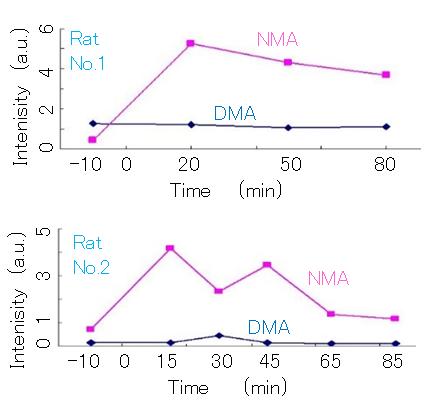
Figure 2: Temporal changes in the molar concentrations of NMA and DMA contained in the gas perspired from the tails of two rats (nos. 1 to 2). The time t was set to 0 min when the NMA solution was injected into the abdomens of the two rats. The molar concentrations for the two rats were determined ten minutes before the injection (t= -10 min). After the injection, the concentrations were determined at t = 20, 50, and 80 min for rat no. 1 and at t = 15, 30, 45, 65, and 85 min for rat no. 2.
Discussion
Because methyltransferase and methane are present in the living body, NMA may be methylated into DMA. Although DMA is a useful cryopreservative for sperm, it exhibits hepatotoxicity. The molar concentrations of NMA and DMA appearing in the rat tail surface gas were measured using GC/MS after injection of NMA solution into the rat abdomen. While the NMA concentration increased and then decreased in the rat tail gas, the DMA concentration remained constant for 80 min after the injection. Because no correlations were detected between NMA and DMA concentrations, NMA was assumed to not be metabolised into DMA in the living body. Therefore, the safety of NMA as a cryopreservative with lower cytotoxicity and side effects was confirmed.
Conclusion
The cryopreservative NMA is expected to induce only minor freezing-induced damage and cryopreservative- induced cytotoxicity because NMA is produced by replacing the cytotoxic sulfinyl group in DMSO with an amide group, maintaining the high cell permeability of DMSO caused by the methyl group. Because NMA may be methylated and transformed into DMA, which shows hepatotoxicity, rat tail gas was investigated after injection of NMA solution into the abdomen. GC/MS analysis of rat tail gas showed that NMA did not create hepatotoxic DMA in the rat body, thereby confirming the safety of NMA as a cryopreservative. In future studies in our laboratory, we plan to develop safe cryopreservatives for various cell types using the methods described in this study and to further confirm the safety and efficacy of NMA and other polar molecules in different cell types.
Acknowledgements
We are grateful to Dr. Tetsuo Ohkuwa, Professor Emeritus of Nagoya Institute of Technology, for the technical support with animal experiments. T.O. is grateful to the late Dr. Ken-ichi Goto, Professor Emeritus of Osaka University, and the late Dr. Isao Kamiya, Professor Emeritus of Nagoya University, for their insightful suggestions. This study was partly supported by a Grant- in-Aid from Japan Society for the Promotion of Science (No. 22850114).
References
-
Szmant HH (1971) Chemistry of DMSO. In: Jacob SW, et al. (eds.), Basic Concepts of DMSO. Marcel Dekker, New York, pp: 1-7.
-
de la Torre JC (1983) Dimethyl Sulfoxide: The Golden Maze Dilemma. Annals of the New York Academy of Sciences 411.
-
Thomas R, Shoemaker CB, Ericks K (1966) The molecular and crystal of dimethyl sulfoxide, (H3C)2SO 21. Acta Cryst 21: 12-20.
-
Kauzmann W (1957) Quantum Chemistry An Introduction (Academic Press, New York).
-
Clark T, Murray JS, Lane P, Politzer P (2008) Why are dimethyl sulfoxide and dimethyl sulfone such good solvents?. J Mol Model 14(8): 689-697.
-
Epstein WW, Sweat FW (1966) Dimethyl Sulfoxide Oxidations. Chemical Reviews 67(3): 247-260.
-
Chitambar CR, Massey EJ, Seligman PA (1983) Regulation of transferrin receptor expression on human leukemic cells during proliferation and induction of differentiation. Effects of gallium and dimethylsulfoxide. J Clin Invest 72(4): 1314-1325.
-
Hanslick JL, Lau K, Noguchi KK, Olney JW, Zorumski CF, et al. (2009) Dimethyl Sulfoxide (DMSO) Produces Widespread Apoptosis in the Developing Central Nervous System. Neurobiol Dis 34(1): 1-10.
-
White EH, Steinmetz MG, Miano JD, Wildes PD, Morland R (1980) Chemi- and bioluminescence of firefly luciferin. J Am ChemSoc 102(9): 3199-3208.
-
Markarian SA, Aatryan AM, Grigoryan KR, Sargsyan HR (2006) Effect of diethylsulfoxide on the thermal denaturation of DNA. Biopolymers 82(1): 1-5.
-
Edsall J T, Wyman J (1958) Biophysical chemistry, Academic Press, New York.
-
Branden C, Tooze J (1999) Introduction to Protein structure 2nd (Edn.), Garland Publishing, New York, pp: 16.
-
Osuga T, Shimizu N, Takanashi M, Tamura Y, Makino S, et al. (2017) N-Methylacetamide for cryopreservation – an alternative to dimethyl sulfoxide. Nanomed Nanotechnol 2(2): 000121.
-
Debye P (1929) Polar Molecules. Dover Publishing, New York.
-
McClellan AL (1974) Tables of experimental dipole moments. Rahara Enterprises, California.
-
Frohlich H (1960) Theory of dielectrics: dielectric Constant and Dielectric Loss. Clarendon, Oxford, p. 63.
-
Osuga T, Tatsuoka H (2009) Magnetic-field transfer of water molecules. J Appl Phys 106(9).
-
Koga Y (2017) Solution thermodynamics and its application to aqueous solutions : a differential approach. Elsevier, Amsterdam.
-
Mizushima S (1954) Structure of molecules and internal rotation. Academic Press, New York.
-
Ohta Y, Tanaka M, Terada M, Miller OJ, Bank A, et al. (1976) Erythroid cell differentiation: Murine erythroleukemia cell variant with unique pattern of induction by polar compounds. Proc Nat Acad Sci 73(4): 1232-1236.
-
Collins SJ, Ruscette FW, Gallagher RE, Gallo RC (1978) Terminal differentiation of human promyelocitic leukemia cells induced by dimethyl sulfoxide and other polar compounds. Proc Nat Acad Sci 75(5): 2458-2462.
-
Jeyendran RS, Graham EF (1980) An evaluation of cryoprotective compounds on bovine spermatozoa. Cryobiology 17(5): 458-464.
-
Sasaki K, Tatsumi T, Tsutsui M, Niinomi T, Imai T, et al. (2012) A method for cryopreserving semen from yakido roosters using N-methylacetamide as a cryoprotective agent. Japan Poultry Science 47: 297- 301.
-
Lee HJ, Kim SK, Jang HJ, Kang KS, Kim JH, et al. (2012) Cryopreservation of Korean Oge chicken semen using N-methylacetamide. Cryo Letters 33(6): 427-434.
-
Morris IV JP, Berghmans S, Zahrieh D, Neuberg DS, Kanki JP, et al. (2003) Zebrafish sperm cryopreservation with N,N-dimethylacetamide. Biotechniques 35: 956-968.
-
Muchlisin ZA (2005) Current Status of Extenders and Cryoprotectants on Fish Spermatozoa Cryopreservation. Biodiversitas 6(1): 66-69.
-
Kawamoto T, Narita T, Isowa K, Aoki H, Hayashi M, et al. (2007) Effects of cryopreservation methods on post-thaw motility of spermatozoa from the Japanese pearl oyster, Pinctada fucata martensii. Cryobiology 54(1): 19-26.
-
Kowalczyk A (2008) The Effect of cryopreservation process on morphology and fertilizing ability of Japanese quail (coturnix japonica) spermatozoa. Cryo Letters 29(3): 199-208.
-
Zee YP, Holt WV, Gosalves J, Allen CD, Nicolson V, et al. (2008) Dimethylacetamide can be used as an alternative to glycerol for the successful cryopreservation of koala (Phascolarctoscinereus) spermatozoa. Reproduction Fertility and Development 20(6): 724-733.
-
Iaffaldano N, Iorio MD, Rosato MP (2012) The cryoprotectant used, its concentration, and the equilibration time are critical for the successful cryopreservation of rabbit sperm: Dimethylacetamide versus dimethylsulfoxide. Theriogenology 78(6): 1381-1389.
-
Velichkova P, Himo F (2005) Methyl Transfer in Glycine N-Methyltransferase. A Theoretical Study. J Phys Chem B 109(16): 8216-8219.
-
Nose K, Nunome Y, Kondo T, Arai S, Tsuda T (2005) Identification of gas emanated from human skin: methane, ethylene, and ethane. Anal Sci 21(6): 625- 628.
-
Clayton GD, Clayton FE, Patty FA (1994) Industrial Hygiene and Toxicology 4th (edn.), Vol.II Part E Toxicology, John Wiley & Sons Inc., New York.
-
Yamai K, Funada T, Ohkuwa T, Itoh H, Tsuda T (2012) Aceton Concentration in Gas Emanating from Tails of Diabetic Rats. Analytical Sciences 28: 511-514.
- Solution-Processed Chiral Perovskites for Biomedical Applications
- Nanotechnology in Health Chemistry and Medicine: Current Challenges and Future Directions
- Human Exposure to Micro- and Nanoplastics: Pathways, Toxicity, and Intervention Strategies
- Exosome Nanomedicine for Cancer Therapy
- Micro and Nanoplastics–Plastisphere, Biotoxicity, Impact on Human Health, and Mitigation Strategies
- Process Validation of Cefixime Powder for Suspension Dosage Form, 50 mL