
Forced Degradation of an EphA2-Antibody Directed Nanotherapeutic Incorporating a Novel Docetaxel Prodrug
EphA2-ILs-DTX-DEAB is an antibody directed nanoparticle (ADN) that targets Ephrin receptor A2 (EphA2) with a specific single-chain variable fragment (scFv) conjugated to the surface of the liposome. It entered Phase I clinical trials in March 2017 for the treatment of patients with various solid tumors. We subjected the drug product EphA2-ILs-DTX-DEAB and the drug substance DTX-DEAB to acid/base stress testing conditions and identified major degradation products by comparing them to reference standards. There were significant differences in degradation profiles of the free drug vs an encapsulated drug. A greater degree of acid degradation was observed for EphA2-ILs-DTX-DEAB compared with free DTX-DEAB, indicating the influence of drug microenvironment on overall chemical stability.
Introduction
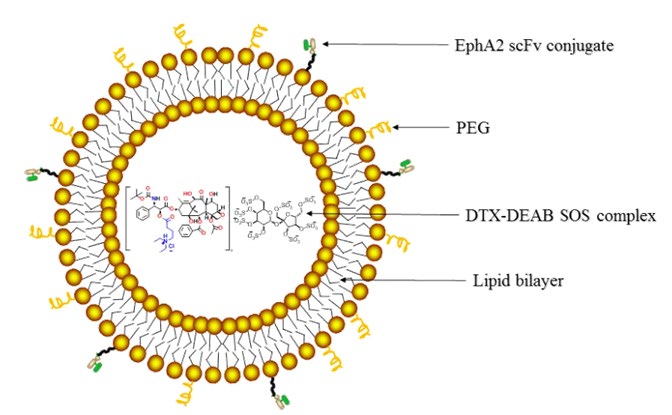
EphA2-ILs-DTX-DEAB is an antibody directed nanoparticle (ADN) that targets Ephrin receptor A2 (EphA2) with a specific single-chain variable fragment (scFv) conjugated to the surface of the liposome [1]. EphA2-ILs- DTX-DEAB liposome is comprised of a small unilamellar lipid bilayer vesicle, approximately 110 nm in diameter, which encapsulates an aqueous space containing the prodrug docetaxel-2′-O-diethylamino butanoyl mesylate (DTX-DEAB) (Figure 1) in a gelated or precipitated state, as the sucrosofate salt. The prodrug, DTX-DEAB, is stable both in the acidic liposomal interior (pH 3-4) during storage and while in circulation, but is hydrolyzed to the active docetaxel upon release from the liposome and entering physiological pH (pH~7.4). As has been demonstrated previously [2], liposomal encapsulation may favorably alter the pharmacokinetic properties and pharmacology of a chemotherapeutic relative to the free drug. Encapsulation confers stability of the chemotherapeutic while in circulation, but the stability profile of encapsulated drugs is likely impacted by the physical state of the drug in the liposome as well as the internal pH. The aqueous interior of EphA2- ILs-DTX-DEAB was designed to be mildly acidic in order to create a transmembrane ion gradient that aids the loading of weakly basic DTX-DEAB. Mildly acidic interior of the liposome not only allows protonation of prodrug leading to a stronger interaction with the poly anionic trapping agent but also helps in keeping the hydrolytically sensitive prodrug from premature conversion to docetaxel. EphA2-ILs-DTX- DEAB was administered intravenously by dispersing it in a sterile aqueous buffered solution suitable for parenteral administration to a human in Phase I clinical trial in patients with solid tumors (NCT03076372). Stress testing of free DTX-DEAB and EphA2-ILs-DTX-DEAB are helpful not only in understanding the stability of the drug product but also in identifying the likely degradation products and providing additional insights into the degradation pathways of the encapsulated drug. The purpose of this study is to qualitatively assess the stability and identify degradation products of both free DTX-DEAB and EphA2-ILs-DTX-DEAB when subjected to acidic and basic extremes for prolonged periods of time at various temperatures. These forced degradation studies were monitored by high-performance liquid chromatography (HPLC) and liquid chromatography- mass spectrometry (LC-MS). Identification of degradation products was achieved primarily by chromatographic comparison to the impurity reference standards, either obtained commercially or chemically synthesized.
Methods and Materials
Reagents
Standards: N-DeBoc-DTX [(N-de(tert-butoxycarbonyl)- docetaxel)] (Toronto Research Chemicals, Catalog No:D289235, Lot No:4-RGP-120-1), Impurity E [10-deacetyl baccatin III] (Tecoland Corporation, Catalog No:130101), Impurity II [7-epi-10-deacetyl baccatin III] (Toronto Research Chemicals, Catalog No:D198260, Lot No:11- MAR-76-1), Impurity III [7-epi-10-oxo-10-deacetyl baccatin III] (Toronto Research Chemicals, Catalog No:O850100, Lot No:11-NOT-109-7), DTX [Docetaxel, anhydrous] (Hubei Haosun Pharmaceutical Co.,Ltd., Catalog No: 130306), Impurity B [10-oxo-docetaxel] (Tecoland Corporation, Catalog No:121001), Impurity C [7-epi-docetaxel] (Tecoland Corporation, Catalog No:120301), Impurity D [7-epi-10- Oxo-docetaxel] (Tecoland Corporation, Catalog No: 120901) and DMSO (Sigma Life Sciences, Catalog No:D2650, Lot No: RNBC9043) were all purchased from commercial suppliers.
N-DeBoc-DTX [(N-de(tert-butoxycarbonyl)-docetaxel)]: 1HNMR (300 MHz, CDCl3): δ = 8.06 (d, 2H), 7.62 (t, 1H), 7.51 (t, 2H), 7.39 (m, 4H), 7.30 (m, 1H), 6.13 (t, 1H), 5.64 (d, 1H), 5.20 (s, 1H), 4.93 (d, 1H), 4.28–4.35 (m, 3H), 4.26 (m, 1H), 2.52–2.62 (m, 1H), 2.25 (s, 3H), 2.02–2.07 (m, 1H), 1.90 (s, 3H), 1.82 (m, 1H), 1.75 (s, 3H), 1.21 (s, 3H), 1.11 (s, 3H) ppm. MS (ESI) m/z: 708.2 [M+H]+ Liposome Dissociation Solvent (LDS) is 1% acetic acid in methanol. 5 mL of glacial acetic acid (JT Baker P/N 9522-05) was added to 495 mL of HPLC grade methanol (JT Baker P/N 9070-03).
N-DeBoc-DTX-DEAB (N-De(tert-butoxycarbonyl)- docetaxel-2′-O-diethylaminobutyrate hydrochloride): An analytical sample of N-deBoc-DTX-DEAB was prepared by incubating DTX-DEAB in 98% formic acid (Fluka, Catalog No:56302) for 1 h at room temperature at a concentration of 100 mg/mL. After 1 h, the reaction mixture was diluted to 100 µg/mL in LDS, filtered over a 0.2 µm syringe filter (Nalgene, Catalog No:180-1320) and used for analysis directly. MS (ESI) m/z: 893.4 [M + FA – H]. The procedure is similar to the one described in by Sekhar et al. [3].
Preparation of Samples
Impurity Standards: Individual impurity standards (DTX, DTX-DEAB, 7-epi-DTX, Impurities B, C, D, E, II and III) were made to a final concentration of 100 µg/mL in LDS by serial dilution from their 5 mg/mL DMSO stock solutions for injection to HPLC.
N-deBoc-7-epi-DTX and N-deBoc-7-epi-DTX-DEAB Impurity Standards: The reaction mixture in formic acid after 1 h incubation was diluted to a final concentration of 100 µg/ mL in LDS for HPLC and in 5:95 ACN/Water + 0.1% formic acid for LC-MS, respectively. The solutions were filtered over a 0.2 µm syringe filter (Nalgene, Catalog No: 180-1320) and injected to HPLC and LC-MS for analysis.
Impurity Standard spiking mix: 100 µL each of the above 100 µg/mL standard solutions were mixed in a single vial and vortexed for 30 seconds to make up the spiking impurity standards mix that was directly injected into the HPLC and LC-MS for analysis.
Synthesis of DTX-DEAB
Docetaxel (5.31 g, 6.57 mmol), 4-diethylamino butyric acid hydrochloride (1.29 g, 6.57 mmol), EDAC.HCl (2.52 g, 13.15 mmol), and DMAP (0.96 g, 7.88 mmol) were all weighed into a 250 mL round bottomed flask under Ar. To this 100 mL of anhydrous DCM was added at rt under Ar and stirred at rt for 18 h. HPLC after 18 h shows 91% product with no docetaxel remaining. The reaction was stopped, diluted with 30 mL of 1:3 mixture of DCM:MeOH and washed with 20 mL of 1N aqueous HCl. The aqueous layer was washed twice with a mixture of 30 mL DCM and 5 mL MeOH. The combined organic portions were dried on sodium sulfate, filtered and evaporated to give a white solid. The solid was dissolved in ~8 mL of chloroform and directly loaded on a 80 g cartridge and flash chromatography was performed using 0–15% MeOH/CHCl3. Fractions 30–49 were pooled together, 0.5 mL of 0.05N HCl in 2-propanol was added and evaporated under 35 ºC to give 5.21 g of a white solid (80% yield). 1H NMR (500 MHz, CDCl3): δ = 8.11 (d, 2H), 7.65–7.57 (m, 1H), 7.56–7.46 (m, 2H), 7.45–7.29 (m, 5H), 6.29–6.12 (m, 1H), 5.99 (d, 1H), 5.68 (d, 1H), 5.58–5.40 (m, 1H), 5.31 (d, 1H), 5.24 (s, 1H), 4.96 (d, 1H), 4.38–4.08 (m, 5H), 3.91 (d, 1H), 3.20–2.30 (m, 3H), 2.70–2.52 (m, 2H), 2.50–2.42 (m, 2H), 2.25–2.05 (m, 3H), 1.94 (s, 3H), 1.92–1.78 (m, 2H), 1.75 (s, 3H), 1.50–1.35 (m, 9H), 1.32 (s, 9H), 1.30–1.20 (m, 6H), 1.12 (s, 3H) ppm. MS (ESI) m/z: 949.4 [M+H]+
Conversion of DTX-DEAB Hydrochloride to DTX- DEAB
To solution of DTX-DEAB hydrochloride (1 g) in CHCl3/ MeOH (2/1 v/v, 100 ml), was added 20% w/v aqueous sodium methanesulfonate solution (pH 3.9, 25 ml). The mixture was shaken vigorously for 2 minutes in a separation funnel, stood still for 5 minutes. A clear phase separation was obtained. The lower organic layer was collected, dried over anhydrous sodium sulfate for 30 min, filtered, and rotary evaporated to dryness. Drying under high vacuum overnight yielded DTX-DEAB as a white powder, yield 1.02 g, 95%. 1HNMR (500 MHz, CDCl3):δ = 10.44 (br s, 1H), 8.11 (d, 2H), 7.62 (t, 1H), 7.52 (t, 2H), 7.41 (m, 2H), 7.37 (m, 2H), 7.29 (t, 1H), 6.17 (t, 1H), 5.68 (d, 1H), 5.49 (dd, 1H), 5.31 (t, 1H), 5.25 (s, 1H), 4.96 (dd, 1H), 4.32 (d, 1H), 4.28 (m, 1H), 4.19 (d, 1H),
3.91 (d, 1H), 3.19–3.14 (m, 4H), 3.11–2.98 (m, 2H), 2.80 (s, 3H), 2.63 (m, 2H), 2.57 (m, 1H), 2.46 (s, 3H), 2.43 (m, 2H), 2.31–2.27 (m, 2H), 1.95 (br s, 3H), 1.88 (m, 1H), 1.74 (s, 3H), 1.39 (t, 3H), 1.35 (t, 3H), 1.33 (s, 9H), 1.22 (s, 3H), 1.13 (s, 3H) ppm. MS (ESI) m/z: 949.4 [M+H]+
Synthesis of 7-Epi-DTX-DEAB
Synthesis of 7-epi-DTX-DEAB was achieved by coupling 4-diethylamino butyric acid hydrochloride to commercially available 7-epi-DTX. In a reaction volume of 1.8 mL of anhydrous dichloromethane (DCM), 93.8 mg of 7-epi- DTX (0.116 mmol, 1 equiv.) was combined with 27.3 mg of 4-diethylaminobutyric acid hydrochloride (0.139 mmol, 1.2 equiv.), 44.5 mg of 1-ethyl-3-(3-dimethylaminopropyl) carbodiimide hydrochloride (0.232 mmol, 2 equiv.), and 21.3 mg of 4-dimethylamino pyridine (0.174 mmol, 1.5 equiv.). The reaction was allowed to stir at room temperature for 20 h. After completion, the reaction mixture was directly loaded onto a 4 g RevelerisTM silica gel cartridge pre-equilibrated with DCM and high performance flash chromatography was performed on a RevelerisTM flash system using 227nm UV detection. Fractions 12-17 were pooled, acidified with 0.5 mL of 0.05 N HCl in isopropyl alcohol and evaporated to dryness in a rotary evaporator at room temperature. The solid obtained was lyophilized overnight to give a fluffy white solid. The final isolated product was 94% pure and yielded 56.0 mg (51% isolated yield).
Free DTX-DEAB and DTX Forced Degradation Conditions
Forced degradation of free DTX-DEAB and DTX under acidic and basic conditions was carried out in 0.1 N HCl and 0.1 N NaOH, respectively. 12 mg of drug (DTX or DTX-DEAB) was weighed into a 25 mL volumetric flask and a solution was made up to 25 mL with 1:1 ACN/Water. For acid tests, 1 mL of 0.1 N HCl was added and allowed to stand at rt for 4 and 20 h. For bas tests, 200 µL of 0.1 N NaOH was added and allowed to stand at rt for 4 and 20h. At the time of analysis samples were drawn and made to 100 µg/mL in LDS for HPLC analysis and 100 µg/mL in 5:95 ACN/Water + 0.1% formic acid for LC-MS analysis. Incubated samples were checked for pH prior to and after time course of the experiment; there was minimal pH drift during the course of the experiment (<0.05 pH units).
Epha2-Ils-DTX-DEAB Forced Degradation Conditions
Forced degradation of EphA2-ILs-DTX-DEAB was carried out at two different pH (2 and 10) and at two different temperatures (25 and 40 °C), for a total of four different conditions. Traditionally used strong acid and bases such as HCl and NaOH could not be used for EphA2- ILs-DTX-DEAB in order to preserve lipid bilayer and the integrity of the liposome during the course of the study. The degradation was thus carried out using 100 mM glycine buffer. Additionally, osmolarity of the glycine degradation buffer (pH2 and 10) was adjusted with 12% (w/v) sucrose to match the osmolarity of the liposomal storage buffer in order to prevent premature liposome rupture. Liposome stock formulations were opaque yet homogenous solutions with a DTX-DEAB concentration of 6.0 mg/mL in a pH 5.5 buffer containing 5 mM citrate, and 250 mM NaCl. Samples for forced degradation of EphA2-ILs-DTX-DEAB were prepared by diluting the liposome stock ten-fold to 0.6 mg/mL into an appropriate glycine stress condition buffer; these samples remained slightly opaque and homogenous. After incubation of the forced degradation samples for an appropriate amount of time (4, 20, and 80 hours), samples were diluted and quenched to 0.12 mg/mL using LDS. Mixing of this quenched sample resulted in a clear solution that was injected for HPLC and LC-MS analysis. Incubated samples were checked for pH prior to and after time course of the experiment; there was minimal pH drift during the course of the experiment (< 0.05 pH units).
Equipment and Analytical Conditions
DTX-DEAB degradation products were analyzed primarily by HPLC. Additional data supporting HPLC analysis was obtained by LC-MS. A Dionex Ultimate 3000 system (Pump, Column Compartment, Autosampler, RS Variable Wavelength Detector) was used for HPLC analysis using a Phenomenex Synergy 4 μm Polar-RP 80 Å, 250 x 4.6 mm column for chromatographic resolution. HPLC data was analyzed and processed with Chromeleon 6.80 SR8 Build 2623. Samples were run with a 4 °C sample tray, 25 °C column oven, and UV monitoring at 227 nm. For HPLC, solvents A and B were water + 0.1% (v/v) trifluoroacetic acid (TFA) and acetonitrile + 0.1% (v/v) TFA respectively. For each condition, 50 μL of sample was analyzed using a linear gradient of 30-68 %B over 23 minutes then back to 30%B for a total run of 30 minutes at a 1.0 mL/min flow rate.
An Acquity UPLC (Sample Manager – FTN, Quarternary Solvent Manager, Column Manager, TUV Detector, QDa Detector) was used for LCMS using an Acquity UPLC BEH C18 1.7 μm, 2.1 x 50 mm column. LCMS data was processed using MassLynx V4.1 SCN 888. Samples were run with a 10 °C sample tray, 40 °C column oven, cone voltage 20v and UV monitoring at 227 nm. For LCMS solvents A and B were water + 0.1% (v/v) formic acid (FA) and acetonitrile +0.1% (v/v) FA. For each condition, 10 μL of quenched sample was injected and analyzed using a linear gradient of 5-95 %B over 15 minutes at a 0.5 mL/min flow rate.
Identification of Degradation Products
The identity of degradation products was primarily deduced by comparative HPLC analyses between forced degradation samples and authentic standards that were either purchased commercially or prepared synthetically. Whenever applicable and possible, NMR and LC-MS analysis was further used to assign or corroborate peak assignment and/or provide masses of different compounds.
Results and Discussion
Forced degradation studies are a valuable tool in understanding the drug behavior and help development of a stability indicating assay for a pharmaceutical product. Subjecting the drug substance and the drug product to exacerbated conditions and identifying the resulting products help understand possible degradation pathways, foresee potential stability related problems early on in the development and help generate more stable formulations [4].
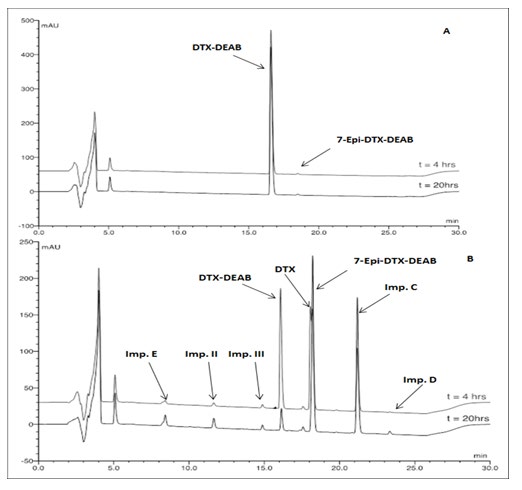
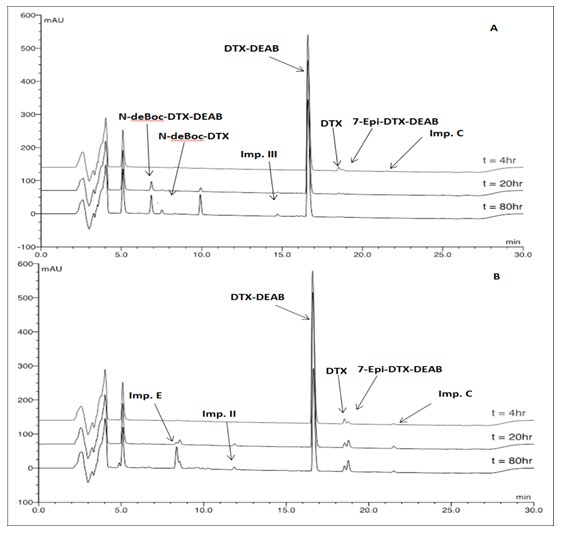
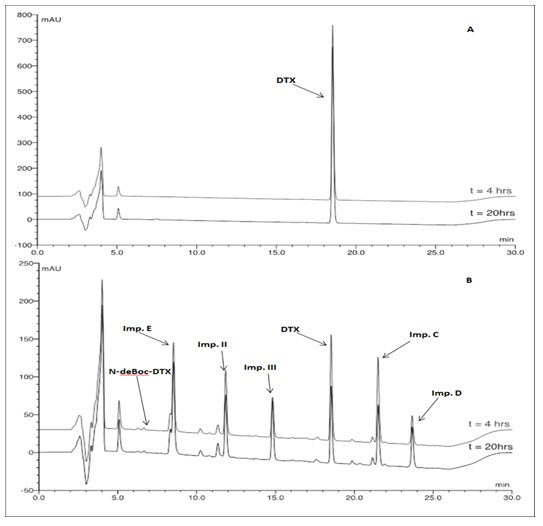
A number of previous studies have looked into forced degradation, isolation and characterization of impurities in docetaxel [5, 6, 7]. Formulation of an active drug as a liposome influences physicochemical and pharmacological properties of the encapsulated drug in a number of ways. Chemical stability of the encapsulated drug is influenced by its complexation with the trapping agent, pH and high concentration resulting in compaction in the interior of the liposome. Encapsulation also significantly influences pharmacological properties of the drug such as rate of clearance and metabolism. Running stress study concurrently on the drug substance (DTX-DEAB) and the drug product (EphA2-ILs-DTX-DEAB) allows identification of impurities that are either not degradation products or those formed due to degradation of formulation excipients. In the present study, acid and base degradation of DTX-DEAB and EphA2-ILs-DTX-DEAB resulted in a number of degradation products, majority of which could be characterized using the comparative HPLC and LC-MS methodology described in the Methods. Figures 2 and 3 display chromatogram overlays for the time course degradation of DTX-DEAB and EphA2-ILs- DTX-DEAB respectively. All degradation products that could be identified are labeled in the figures. Table 1 summarizes the degradation products of all the different treatment conditions by order of their relative retention time (RRT) with respect to DTX-DEAB. Where possible, corresponding LC-MS retention time and ESI- adducts is included. At the impurity levels of theses degradation studies, not all degradation products observed by HPLC were observable on LC-MS. In order to get a qualitative assessment of the stability of the prodrug DTX-DEAB, acid and base degradation of the parent drug DTX was also performed as a control in the present study (Figure 4). All of the degradation products of DTX have been observed in previous studies [6, 7].
Effects of different pH on Degradation on DTX- DEAB and EphA2-ILs-DTX-DEAB
Acid and base degradation of DTX-DEAB and EphA2- ILs-DTX-DEAB resulted in different profiles of degradation products under acidic and basic conditions. Notably there were significant differences observed in degradation profiles of free DTX-DEAB and EphA2-ILs-DTX-DEAB in both identity and relative extent of degradation. Due to the mildly acidic interior of the liposome, prodrug DTX-DEAB was designed to remain stable at low pH and rapidly hydrolyze to DTX at neutral pH when released from EphA2-ILs-DTX-DEAB. Thus, expectedly DTX-DEAB exhibited greater stability in acid degradation conditions leading to 7-epi-DTX-DEAB as the only detectable impurity after 4 and 20 h (Fig. 2A). Whereas base degradation resulted in docetaxel and multiple previously known docetaxel degradation products (Figure 2) [7]. Impurities E, II, III, C, D, DTX and 7-epi-DTX-DEAB were the degradation products in the base degradation study of DTX-DEAB (see Table 1).
| Name | Structure | RRT (HPLC) | DTX-DEAB | EphA2-Ils-DTX- DEAB | DTX | |||
|---|---|---|---|---|---|---|---|---|
| Acid | Base | Acid | Base | Acid | Base | |||
| N-deBoc-DTX- DEAB | 0.41 | X | ||||||
| N-deBoc-DTX | 0.45 | X | X | |||||
| 10-deacetyl baccatin III (Impurity E) | 0.52 | X | X | X | ||||
| 7-epi-10- deacetyl baccatin III (Impurity II) | 0.71 | X | X | X | ||||
| 7-epi-10-oxo- 10-deacetyl baccatin III (Impurity III) | 0.89 | X | X | X | ||||
| DTX-DEAB | 1 | X | X | X | X | |||
| DTX (Docetaxel) | 1.1 | X | X | X | X | X | ||
| 7-Epi-DTX-DEAB | 1.15 | X | X | X | X | |||
| 7-epi-DTX (Impurity C) | 1.3 | X | X | X | X | |||
| 7-epi-10-oxo- DTX (Impurity D) | 1.45 | X | X |
Table 1: Degradation Products of DTX-DEAB, EphA2-ILs-DTX-DEAB and DTX.
Impurity E (10-deacetyl baccatin III, Figure 2B, 3B and 4B, r.r.t. 0.52, m/z = 589 [M + FA - H]-) was observed only under basic degradation conditions of DTX-DEAB, EphA2- ILs-DTX-DEAB and DTX. While Impurity E starts to appear as early as 4 h in base degradation of DTX-DEAB and DTX, it only appears after 20 h (Figure 3B) in the degradation of EphA2-ILs-DTX-DEAB and increases over time, indicating that encapsulation of the drug offers some level of protection to the drug from hydrolysis under these conditions. Similar to Impurity E, Impurity II (7-epi-10-oxo-10-deacetyl baccatin III, Figure 1B, 2B and 3B, r.r.t. 0.71, m/z = 589 [M + FA – H]-) only appeared in base degradation of DTX-DEAB, DTX and EphA2-ILs-DTX-DEAB.
Formation of degradation Impurity III (7-epi-10-oxo- 10-deacetyl baccatin III, Figure 2B, 3A and 4B, r.r.t. 0.89, m/z = 587 [M + FA – H]-) also brings forth the differences in degradation profiles between a free and an encapsulated drug. While base degradation of DTX-DEAB and DTX result in Impurity III, it was only observed under acidic degradation conditions of EphA2-ILs-DTX-DEAB. Similarly, Impurity C (7-epi-DTX , Figure 2B, 3 and 4B, r.r.t. 1.3, m/z = 853 [M + FA – H] -) while only formed in base degradation of free drugs, it was observed both in acid and base degradation of EphA2- ILs-DTX-DEAB. It appears that Impurity C degrades under acidic conditions after initial buildup (Figure 3A 4 h vs 20 and 80 h), but remains stable under basic conditions (Figure 3B).
Impurity D (7-epi-10-oxo-DTX, Figure 2B and 4B, r.r.t. 1.45, m/z = 851 [M + FA – H] -) also appears to be unique to free drug degradation as this product did not appear in the case of EphA2-ILs-DTX-DEAB degradation.
Degradation product 7-epi-DTX-DEAB (Figure 2 and 3, r.r.t. 1.15, m/z = 994 [M + FA –H]-) is unique to the drug substance DTX-DEAB. This assignment was confirmed by comparative HPLC analysis to a synthetically prepared standard as well as LC-MS and NMR. Epimerization at the 7-position of DTX is well known and has previously been described as a degradation product for DTX. 4 While 7-epi- DTX-DEAB is formed under both acid and basic conditions for both free and liposomal DTX-DEAB, it is formed to a greater extent under basic conditions. During base degradation of free DTX-DEAB (Figure 2B), it builds up as an intermediate degradation product and likely undergoes hydrolysis of the prodrug functionality to yield Impurity C and other degradation products. In the case of EphA2-ILs- DTX-DEAB degradation, under acidic conditions there is an initial buildup followed by a disappearance of 7-epi-DTX- DEAB, whereas under basic conditions it remains a stable degradation product.
It is remarkable to note that the degradation product N-deBoc-DTX-DEAB (Figure 3A, r.r.t. 0.41, m/z = 894 [M + FA – H] -) was only observed in acid degradation of EphA2- ILs-DTX-DEAB but not the free drug. A tert-butoxycarbonyl (Boc) protecting group is susceptible to acid hydrolysis, but this higher degree of hydrolysis of an encapsulated drug over a free drug highlights the effect of drug microenvironment on its stability. A high concentration of drug densely packed into a liposome with an acidic interior is likely causing an increased rate of hydrolysis of the Boc group. Similarly, degradation product N-deBoc-DTX (Figure 3A, r.r.t. 0.45, m/z = 752 [M + FA – H] -) was observed under acid degradation of EphA2-ILs-DTX-DEAB but not of the free drug DTX- DEAB. These differences in acid degradation of free drug vs liposomal drug are even more significant given the usage of buffer for incubation of EphA2-ILs-DTX-DEAB as opposed to 0.1 N HCl for free drugs. Although the majority of the peaks appearing in this degradation studies were identified, a degradation peak appearing at 9.9 min (Figure 3A) in the acid degradation study of EphA2-ILs-DTX-DEAB at 20 and 80 h has not been identified. Efforts are underway to identify, isolate and characterize this peak.
Effects of Temperature on Degradation of Liposomal DTX-DEAB
For both the acidic and basic conditions, forced degradation at 40 °C increased the overall abundance of degradation products relative to incubation of the samples at 25 °C. However, despite this difference, the number of degradation products in either acid or basic conditions remained the same; no new degradation products appeared.
Summary and Conclusion
An acid and base degradation study of EphA2-ILs-DTX- DEAB, an antibody directed nano liposomal formulation of a docetaxel prodrug DTX-DEAB was carried out at two different temperatures. Degradation of the drug substance DTX-DEAB and the parent drug DTX were carried out in parallel as controls and all of the major degradation products resulting from the study were identified. The study brings to light significant differences in degradation profiles of a free drug vs an encapsulated drug and highlights the significance of such a study to understand the overall stability of the drug product.
References
-
Kamoun WS, Kirpotin DB, Huang ZR, Tipparaju SK, Noble CO, et al. (2019) Antitumour activity and tolerability of an EphA2-targeted nanotherapeutic in multiple mouse models. Nat Biomed Eng 3: 264-280.
-
Drummond DC, Noble CO, Hayes ME, Park JW, Kirpotin DB (2008) Pharmacokinetics and in vivo drug release rates in liposomal nanocarrier development. J Pharm Sci 979110: 4696-4740.
-
Sekhar NM, Vishweshwar P, Acharyulu PVR, Anjaneyulu Y (2012) Alternative Synthesis and the Determination of Absolute Configuration of Docetaxel. an Anticancer Drug. Synth Comm 42(23): 3482-3492.
-
Sharma MK, Murugesan M (2017) Forced Degradation Study an Essential Approach to Develop Stability Indicating Method. J Chromatogr Sep Tech.
-
Rao BM, Chakraborty A, Srinivasu MK, Devi ML, Kumar PR, et al. (2006) A stability-indicating HPLC assay method for docetaxel. J Pharm Biomed Anal 41(2): 676- 681.
-
Vasu Dev R, Moses Babu J, Vyas K, Sai Ram P, Ramachandra P, et al. (2006) Isolation and characterization of impurities in docetaxel. J Pharm Biomed Anal 40(3): 614-622.
-
Kumar D, Tomar RS, Deolia SK, Mitra M, Mukherjee R, et al. (2007) Isolation and characterization of degradation impurities in docetaxel drug substance and its formulation. J Pharm Biomed Anal 43(4): 1228-1235.
- Solution-Processed Chiral Perovskites for Biomedical Applications
- Nanotechnology in Health Chemistry and Medicine: Current Challenges and Future Directions
- Human Exposure to Micro- and Nanoplastics: Pathways, Toxicity, and Intervention Strategies
- Exosome Nanomedicine for Cancer Therapy
- Micro and Nanoplastics–Plastisphere, Biotoxicity, Impact on Human Health, and Mitigation Strategies
- Process Validation of Cefixime Powder for Suspension Dosage Form, 50 mL