
A Review on Recent Insights of Intelligent Carbon Dots for Live Tracking and Bioimaging Applications
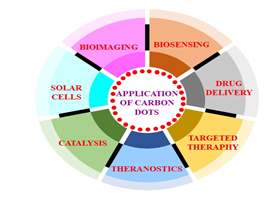
Carbon Dots (CDs) were the emerging carbon-based fluorescent nanomaterial, zero-dimensional structure with size less than 20nm. It has a wide application in different fields due to its unique structure and incredible properties. Recently, scientists were experimenting the CDs in the field of biological sensing, drug delivery, photodynamic therapy, photocatalysis, and solar cells. In this review we discussed about the CDs and its synthesis method, application in the field of drug delivery and bioimaging with live tracking in cancerous cell. Further, we discussed about how the CDs is efficient in drug delivery and sensing the apoptotic cells due to the immense properties like photostability, high brightness, prominent biocompatibility, and spontaneous penetration capabilities.
Introduction
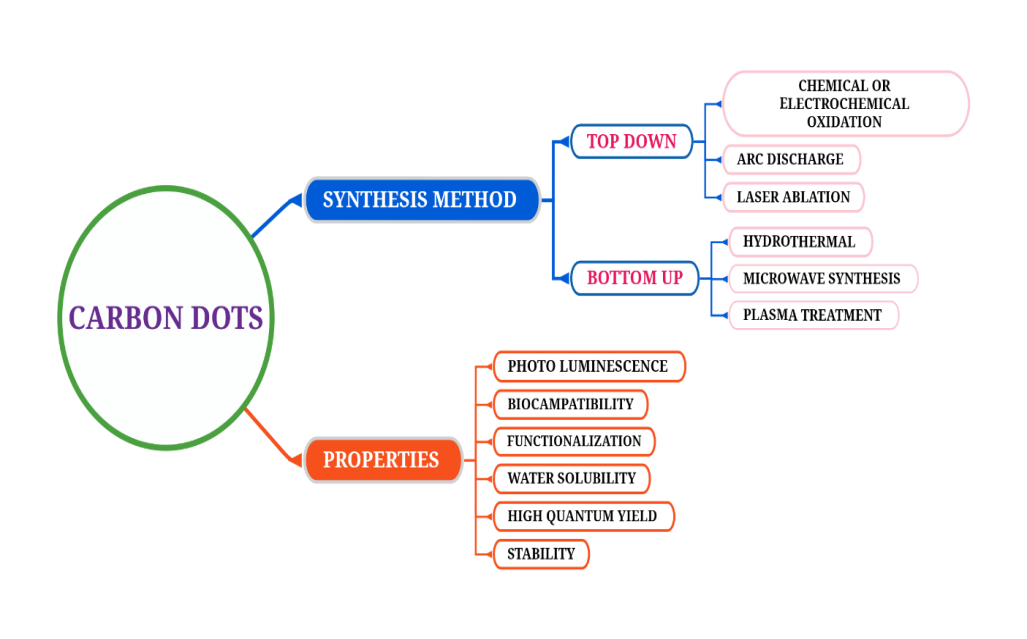
Carbon dots (CDs) are regarded as a type of 0-Dimensional carbon dominated nanomaterial with a size of generally less than 20 nm, numerous functional groups or polymer chains, and sp2/sp3 carbon skeleton. At present scientists extensively uses carbon dots (CDs) due its significant applications in photoelectric devices, healthcare, drug delivery etc., carbon dot is a fluorescent nanomaterial, it is highly effective due to its chemical properties. Their great water solubility and ease of blending with other materials without phase separation are due to the abundance of surface groups and polymer chains, including carboxyl, hydroxyl, amine, etc. Additionally, the abundance of functional groups makes CDs versatile sensor candidates that are simple to modify with different organic or polymeric molecules. Due to the varying degrees of carbonization of CDs, the central carbon core structure, made up of sp2/sp3 carbon atoms, may exhibit amorphous or graphite like carbon forms [1] (Figures 1 & 2).
Classification of CDs and its Significant Properties
- Graphene quantum dots (GQDs) - Due to their tiny size, lack of toxicity, biocompatibility, high photo stability, programmable fluorescence, and water solubility, they showed potential for biomedical applications [2]
- Carbon quantum dots (CQDs) - their potent and controllable fluorescence emission characteristics, which allow for applications in sensing, optronics, catalysis and biomedicine [3]
- Carbonized polymer dots (CPDs) - It boasts greater stability, better compatibility, simpler customization and functionalization, and a wider range of applications due to its size of less than 20 nm [4]
- Carbon Nano dots (CNDs) - due to their excellent hydrophilic nature, chemical inertness, good biocompatibility, simplicity of functionalization, and resistance to photobleaching, it has caused a great deal of enthusiasm [5].
Carbon Dots for Drug Delivery Applications
The luminous CDs made of folic acid and carrageenan can be a useful cargo for cancer cells that express the folate receptor on their surface. The produced CDs revealed outstanding photostability, biocompatibility, and water solubility. Under various pH conditions, the CDs served as a nanovehicle for the anticancer medicine capecitabine [6]. Kong at al developed a Doxorubicin (DOX) conjugated to CDs by electrostatic interaction. In this study drug loading efficiency (DLE) and drug loading content (DLC) revealed that CDs have a reasonably high drug loading capacity. The CDs DOX complex demonstrated superior antitumor effectiveness on MCF 7 cells as compared to free DOX, as well as higher cellular absorption [7]. Duan et al developed doxorubicin-CD system for adjuvant treatment. Here, this drug delivery system depending on doxorubicin hydrochloride (DOX), carbon dots (CDs), and hyaluronic acid (HA) was presented with the anticoagulant heparin (Hep) as an adjuvant treatment, which obviously improved the system’s blood compatibility. The CDs HA Hep/DOX system’s drug release procedure was responsive to both HA and pH value [8]. The amount of water that chitosan film could absorb decreased by roughly seven times after being impregnated with carbon dots. The GAB isotherm was used to interpret the equilibrium moisture uptake (EMU) records of the unloaded and loaded with carbon quantum dots (CQD) chitosan films. Related factors were also assessed. Finally, it was discovered that the plain Ch and Carbon dots loaded sample Ch/CNP had moisture permeability capabilities of 1758 and 956 g/m2/day, respectively. As CDs were included into the film matrix, the amount of bovine serum albumin (BSA) that was adsorbing to the surface fell from 24.2 mg/m2 for the plain sample to 14.1 mg/m2 [9]. Yu developed a DOX loaded CD polyethylenimine by electrostatic interactions. The outcomes demonstrate that this approach not only enhances selective release profile but also extends the time of drug release and enhances tumor-killing effectiveness.
Carbon Dots for Bioimaging and Live Tracking in Cancerous Cells
Carbon dots have significance properties such as great water solubility, low toxicity, satisfactory biocompatibility, and superior tissue permeability which makes them a popular choice for biomedical imaging and cancer therapy. Aside from their ability to tune surface functions, CDs also have exceptional photostability, high brightness, prominent biocompatibility, and spontaneous penetration capabilities. CDs have demonstrated excellent potential for use as biological system probes and are particularly alluring for imaging guided biomedical applications [10]. In order to stop tumour growth, sophisticated advanced techniques for early cancer diagnosis are becoming increasingly important. Many different types of cancer cells can be efficiently probed by FL imaging using specially functionalized CDs that can pierce them. The HO-8910 ovarian cancer cells have been infused into a six-well plate and allowed to attach for 24 hours at 37 °C. After that, DOX-CDs were treated with the cells to promote cellular uptake. The media was removed after 4 hours of incubation, and the cells were then rinsed three times with cold PBS and fixed for 10 minutes in 4% paraformaldehyde. Finally, a fluorescent microscope was used to view the morphology as well as fluorescence dispersion of the cells [11]. Employing both cell-based assays and mice xenograft tumours, the anticancer efficacy of the Galic Acid based CDs (GACDs). The findings showed that GACDs can be employed as an anticancer drug as well as a bioimaging material, indicating their tremendous promise in upcoming therapeutic applications [12]. Due to less interference from the auto fluorescence of the biological matrix and less photodamage to biological tissues, red emissive carbon dots (CDs) has designed by zhao et al with increasing attention in biological domains. Here, N and P co-doped red emissive carbon dots (RCDs) were initially made utilising a quick hydrothermal approach involving o-phenylenediamine with phosphoric acid as the basic materials. The absolute fluorescence quantum yield (QY) of the RCDs in water was 15% and they showed excitation independent emission peaks at 622 nm. The same method used to create RCDs was also employed to create N doped yellow emissive carbon dots (YCDs) with o-phenylenediamine at the same time. The use of both CDs for in vitro cell imaging was effective. By contrasting the surface states and optical characteristics of YCDs and RCDs, it was found that the surface states of both CDs are related to the photoluminescence (PL) of the CDs, with the surface carboxyl group being primarily responsible for the yellow emission while the new surface state created by doping phosphorus atoms into the RCDs is responsible for the red emission. More significantly, at 532 nm laser irradiation, the RCDs significantly reduced the proliferation of tumour cells and displayed remarkable anticancer activity [13].
Gadolinium - Carbon dots (Gd-CDs) were used to mark doxorubicin (DOX) loaded apoferritin (AFn) nanocages for bimodal imaging (optical and magnetic resonance imaging or MRI) and cancer treatment. Moreover, folic acid was linked to the exterior of AFn in order to achieve effective, targeted distribution. The ability of the as-obtained system (Gd CDs/AFn (DOX)/FA) to treat cancer was evaluated using tumor-bearing mice over the course of a 14-day research. The findings demonstrate that, in comparison to clinically recognized DOX in the same dose, Gd-CDs/AFn (DOX)/FA might gradually decrease tumour growth. It was intended to be a flexible system that serves as an imaging, targeting, and treatment agent [14]. Pal, et al. developed a carbon dot with a size of 4 to 5 nm of spherical nanoparticles with high colloidal stability. In the biolabeling of bacteria, S. aureus served as the Gram-positive test organism and E. coli DH5 as the Gram-negative test organism. Strong biolabeling capacity and low cytotoxicity was observed for CDs in colon cancer (HCT-15), lung cancer (A549), and mouse fibroblast (NIH 3T3) [15] cell lines.
Conclusion
The current studies on the carbon dots (CDs) a carbon- based nanomaterial (CNPs) had a huge advancement in the field of drug delivery, biological sensing, photodynamic therapy, photocatalysis, and solar cells. Recently the CDs has showed efficient drug loading content (DLC) in the field of drug discovery and drug delivery and also it emerged in the field of biosensing especially in detecting tumorous cells. Further studies on CDs would give us the wide range of applications in different field [16, 17, 18].
Acknowledgement
The authors acknowledge Rathinam Technical Campus, Coimbatore for their support.
References
-
Xia C, Zhu S, Feng T, Yang M, Yang B (2019) Evolution and synthesis of carbon dots: from carbon dots to carbonized polymer dots. Advanced Science 6(23): 1901316.
-
Younis MR, He G, Lin J, Huang P (2020) Recent advances on graphene quantum dots for bioimaging applications. Frontiers in Chemistry 8: 424.
-
Lim SY, Shen W, Gao Z (2015) Carbon quantum dots and their applications. Chemical Society Reviews 44(1): 362- 381.
-
Liu J, Li R, Yang B (2020) Carbon dots: A new type of carbon-based nanomaterial with wide applications. ACS Central Science 6(12): 2179-2195.
-
Li Y, Zhao Y, Cheng H, Hu Y, Shi G, et al. (2012) Nitrogen- doped graphene quantum dots with oxygen-rich functional groups. Journal of the American Chemical Society 134(1): 15-18.
-
Das P, Ganguly S, Agarwal T, Maity P, Ghosh S, et al. (2019) Heteroatom doped blue luminescent carbon dots as a nano-probe for targeted cell labelling and anticancer drug delivery vehicle. Materials Chemistry and Physics 237(1): 121860.
-
Kong T, Hao L, Wei Y, Cai X, Zhu B (2018) Doxorubicin conjugated carbon dots as a drug delivery system for human breast cancer therapy. Cell proliferation 51(5): e12488.
-
Duan Q, Ma L, Zhang B, Zhang Y, Li X, et al. (2020) Construction and application of targeted drug delivery system based on hyaluronic acid and heparin functionalised carbon dots. Colloids and Surfaces B: Biointerfaces 188: 110768.
-
Kandra R, Bajpai S (2020) Synthesis, mechanical properties of fluorescent carbon dots loaded nanocomposites chitosan film for wound healing and drug delivery. Arabian Journal of Chemistry 13(4): 4882- 4894.
-
Liu Q, Guo B, Rao Z, Zhang B, Gong JR (2013) Strong two-photon-induced fluorescence from photostable, biocompatible nitrogen-doped graphene quantum dots for cellular and deep-tissue imaging. Nano letters 13(6): 2436-2441.
-
Sun Y, Zheng S, Liu L, Kong Y, Zhang A, et al. (2020) The cost-effective preparation of green fluorescent carbon dots for bioimaging and enhanced intracellular drug delivery. Nanoscale research letters 15(1): 55.
-
Lu S, Liu L, Wang H, Zhao W, Li Z, et al. (2019) Synthesis of dual functional gallic-acid-based carbon dots for bioimaging and antitumor therapy. Biomaterials science 7(8): 3258-3265.
-
Zhao J, Li F, Zhang S, An Y, Sun S (2019) Preparation of N-doped yellow carbon dots and N, P co-doped red carbon dots for bioimaging and photodynamic therapy of tumors. New Journal of Chemistry 43(16): 6332-6342.
-
Yao H, Su L, Zeng M, Cao L, Zhao W, et al. (2016) Construction of magnetic-carbon-quantum-dots- probe-labeled apoferritin nanocages for bioimaging and targeted therapy. International journal of nanomedicine 11: 4423.
-
Pal T, Mohiyuddin S, Packirisamy G (2018) Facile and Green Synthesis of Multicolor Fluorescence Carbon Dots from Curcumin: In Vitro and in Vivo Bioimaging and Other Applications. ACS Omega 3(1): 831-843.
-
Li H, Kang Z, Liu Y, Lee ST (2012) Carbon nanodots: synthesis, properties and applications. Journal of Materials Chemistry 22(46): 24230-24253.
-
Li H, Yan X, Kong D, Jin R, Sun C, et al. (2020) Recent advances in carbon dots for bioimaging applications. Nanoscale Horizons 5(2): 218-234.
-
Hailing Y, Xiufang L, Lili W, Baoqiang L, Kaichen H, et al. (2020) Doxorubicin-loaded fluorescent carbon dots with PEI passivation as a drug delivery system for cancer therapy. Nanoscale 12(33): 17222-17237.
- Solution-Processed Chiral Perovskites for Biomedical Applications
- Nanotechnology in Health Chemistry and Medicine: Current Challenges and Future Directions
- Human Exposure to Micro- and Nanoplastics: Pathways, Toxicity, and Intervention Strategies
- Exosome Nanomedicine for Cancer Therapy
- Micro and Nanoplastics–Plastisphere, Biotoxicity, Impact on Human Health, and Mitigation Strategies
- Process Validation of Cefixime Powder for Suspension Dosage Form, 50 mL