
Superparamagnetic Iron Oxide Nanoparticles [SPION] and its Diversified Applications in the Medical Field: A Mini-Review
Late 21st century, extensive research has been carried out on nanoparticles due to their significant role in a supercapacitor, energy storage, sensing, catalysis, green gas production, and photocatalysis due to their semiconductor behavior, costeffective and simple methodology. The utilization of nanoparticle (NP) material provides numerous advantages in biomedical applications due to its unique properties. Superparamagnetic iron oxide nanoparticles (SPIONs) have been recognized in numerous fields including nanobiotechnology, biomedical engineering, and many other fields for their inestimable applications. Superparamagnetic properties and the smaller size of SPIONs are the major reasons for its utilization in various fields. In this study, we focused on different roots to synthesize the ION Super Paramagnetic Iron oxide nanoparticles [SPION), and biomedical applications due to their non-toxic in biological systems.
Introduction
Nanotechnology is an emerging scientific multidiscipline which deals with particles or materials at a size range of 1 - 100 nm [1]. A particle at this nanoscale range can facilitate easy adsorption, absorption, and penetration due to increased molecular interaction. The unique characteristics of these particles compared to their bulk material, make them be extensively studied in research and development of various fields such as medical, environmental, biomedical, electrical, and communication, etc [2].
Intrinsic features of nanoparticles (NPs) such as selective targeting capabilities and superior efficiency have attracted wide scope in the medicinal field. The metal and its oxide- based nanoparticles have an enormous list of properties that include non-toxicity, antimicrobial activity, antifungal, anti-insecticidal, cardiovascular, anticancer, cholesterol- lowering, imaging, medical tools, bone replacement, diagnostic tests, hormone therapy, immune suppressants [3]. potential drug delivery systems, hyperthermia agents, and magnetic resonance imaging contrast agents catalysts for environmental remediation [4, 5, 6].
Most reported metallic and its oxide NPs in the field of biomedical applications the iron (Fe), copper (Cu), zinc (Zn), Silver (Ag), selenium (Se), magnesium (Mg), gold (Au), aluminum (Al), cerium (Ce), palladium (Pd), titanium (Ti)
and Cobalt (Co), etc. because they exhibit remarkable and district properties [7, 8].
Among the various range of nanoparticles, iron oxide nanoparticles possess an important place due to their superparamagnetic nature, their small size, and their wide range of uses Iron represents the fourth most common element in the earth’s crust and is ubiquitous within nature, industry, and basic consumer products. The prevalence of iron in nature, in its various oxidized forms, in combination with low extraction costs, has made finding potential applications for iron oxide nanoparticles (IONPs) highly attractive. From an industrial perspective, iron oxides are mined to support the production of building materials, pigments, and nutritional supplements. Ninety-eight percent of mined iron oxide is converted to steel for use in consumer products [2].
Magnetic nanoparticles constituted of iron oxides, namely maghemite (i.e., γ-Fe2O3) and magnetite (Fe3O4), play a key role. The use of magnetic carriers for biomedical applications was developed in 1963 when Meyers described the accumulation of iron oxide particles in dogs using an externally applied magnet [8]. Since then, magnetic nanoparticles were intensely exploited in biomedicine, as they possess magnetism, strong relaxing behavior on water protons, and radiofrequency absorption proclivity. These peculiar properties add to the typical features of diamagnetic nanomaterials such as drug targeting to specific tissues, an improvement in drug solubility and therapeutic index, extension of drug half-life in the target organ, and immunogenicity reduction.
Principal preparation methods of SPIONs have Advantages and Disadvantages. Coprecipitation Rapid synthesis with high yield but, Problem of oxidation and aggregation. Hydrothermal reactions Narrow size distribution and good control, but,scalable Long reaction times. High temperature decomposition Good control of size and shape, High yield Furthers steps needed to obtain water stable suspension. Microemulsion gives Control of particle size but, Poor yield and large amounts of solvent required, excess of surfactant to eliminate.
The most commonly used method is co-precipitation of Fe2+ and Fe3+ ions in a basic aqueous media is the simplest way, but usually nanoparticles are polydispersed and poorly crystallized. To avoid these disadvantages, thermal decomposition methods have been employed to produce SPIONs with monodispersity and uniform crystalline. Subsequently, the hydrophobic iron oxide nanoparticles can be coated with phospholipids, silica, or amphiphilic polymers as shells to display good solubility and biocompatibility in vivo. From all the above observations, we conclude that, there are several methods to prepare SPION and their various biomedical application in precisely [9].
Results and Discussions
Synthetic Roots
Synthesis strategies of size- and shape-controlled SIONPs have attracted enhanced attention for magnetic theragnostic applications. To date, many investigations have been done to control the size, shape, dispersity, and biocompatibility to ultimately provide appropriate particles for specific usage. Many reports have demonstrated effective protocols for the fabrication of the size-controlled, tunable shape, uniform, biocompatible, and monodisperse SIONPs Shown in Figure 1 [9].
![Figure 1: (A-D) TEM image of SPIONs: (A) spherical 27, (B) cubic 27, (C) nanoring 25, (D) flower-like 25; (E-P) SEM image of SPIONs: (E) mushroom-like particles 15, (F) cube-like particles 15, (G) plate-shaped particles 14, (H) rhombohedral shaped superstructures 14, (I) ellipsoid like 3D superstructures 14, (J) Nanorod 24, (K) Nano husk 24, (L) Distorted cubes 24, (M) Porous spheres 24 and (N) Self-oriented flowers 24, (O) star-shaped hexapod 26, (P) concave octahedrons 26 [9].](/fulltextimages/10760/fig_1.png)
Figure 1: (A-D) TEM image of SPIONs: (A) spherical 27, (B) cubic 27, (C) nanoring 25, (D) flower-like 25; (E-P) SEM image of SPIONs: (E) mushroom-like particles 15, (F) cube-like particles 15, (G) plate-shaped particles 14, (H) rhombohedral shaped superstructures 14, (I) ellipsoid like 3D superstructures 14, (J) Nanorod 24, (K) Nano husk 24, (L) Distorted cubes 24, (M) Porous spheres 24 and (N) Self-oriented flowers 24, (O) star-shaped hexapod 26, (P) concave octahedrons 26 [9].
Generally, there are three major pathways for the synthesis of the SPIO, which contain chemical, physical, and bio-mediated methods [10, 11, 12, 13, 14].
Chemical Method
Chemical method including various methods, which have been performed in solution media. Methods such as Chemical precipitation, hydrothermal, sol-gel, flow injection, hydro/solvothermal, sonochemical, Sono electrochemical, wet chemical reduction, thermal decomposition, microwave assistance, microemulsion and, ultrasonic irradiation [15]. The synthesis of SPIO NPs is a complex process because of their colloidal nature. Other difficulties listed are experimental conditions and purification. However, the most common method for the production of SPIO NPs is the chemical coprecipitation method of iron salts.
Physical Methods
Physical methods include laser-ablated vortex fluidic–mediated method, gas-phase method, ball-milling, mechanical grinding, and lithography [2]. Among them, the mechanical grinding method is simple, and cost-effective but has some drawbacks in obtaining a good morphology. Gas-phase synthesis considers the most common method due to its flexibility for fabricating single or multicomponent NPs. Also, this method can provide controllable particle size, shapes, and well-defined morphology.
Green Methods
green methods are commonly known as environment- friendly methods because they are easy, adjustable, non-toxic, cost-effective, and biocompatible [16]. They have attracted tremendous attention. Typical, microbial enzymes, plant phytochemicals, Fungai, and alga, can be used as mediators for the synthesis of SPIO NPs.
We discussed here some of the methods in brief.
Chemical Methods
Co-Precipitation: is the most popular technique for SIONPs preparation. which uses a mixture of ferric and ferrous with a molar ratio of 1:2 under ambient or high temperature. IONPs synthesis can be processed with or without gas protection. During the NP preparation, controlling the PH value is a very important concern as nucleation of the NPs grows faster with the PH above 10 or 11. In a recent study SIONPs with super magnetic property was prepared through the co-precipitation method at the ambient temperature where action-bacterial metabolites (as a reducing agent) were added to a FeCl3 solution with a molar ratio of 1:1. Thus, the co-precipitation method has been used with various biomolecules and surfactants [2, 15].
High-Temperature Thermal Decomposition: The use of a co-precipitation technique contributes to rapid particle preparation but with different limitations, such as non- controlling domains for particle size and size distribution of NPs. However, to overcome these limitations, a high- temperature thermal decomposition technique is employed for the synthesis of SIONPs, types of thermal decomposition may be classified into conventional reaction methods as is primarily processed under the ambient temperature and after that subsequently heated in an unclosed or closed reaction vessel, and hot-injection method as precursors were injected within the heated reaction mixture. Most of the processes in the coprecipitation method are under ambient temperature, which can affect the low crystallinity of SIONPs. To maximize the efficiency of the reaction, it might be possible to heat the solution at a temperature slightly below the reaction temperature. Stabilizers have a vital role to play in the preparation of SIONPs with a high monodispersed that amine, oleic acid, 1-tetradecane, and 1- octadecene are some of the most common stabilizers for the proper nucleation and crystallinity enhancement procedure as well as for attaching additives to nuclei for the preparation of small NPs. An organic solvent dispersion containing the iron–oleate complex and a surfactant were slowly heated up to the boiling point of the solvent to produce monodisperse IONPs [15].
Hydrothermal and Solvothermal: Synthesis Compared with other methods, this method circumvents the limitations of co-precipitation by generating high-quality IONPs with close distribution and particle size control, as well as improving their magnetism and degree of crystallinity. The SIONPs with a suitable feature, controllable synthesis process, size, shape, and high crystallinity can be obtained through hydrothermal methods. It is known that the hydrothermal method employs a non-aqueous process since an organic solvent (solvothermal system) is a replacement for water for the reaction medium. Another advantage of using hydrothermal and solvothermal is the easy process-ability that the common method is stirring of Fe salts, urea, sodium citrate, and acetate in ethylene glycol to obtain homogeneous dispersion and then transferring to an autoclave (Teflon stainless steel) and closed to increase the temperature up to 200°C for 24 h [3].
Sol–Gel Reactions and Polyol Method: The sol-gel reaction is a wet-chemical method in which iron alkoxides and salts undergo reactions of condensation and hydrolysis. Principally, the initial element of the precursor commences by a colloidal solution functioning like a precursor a merged system of a complex polymer or separated particles. This process has involved a sol with a high dispersion of either polymers or colloidal particles in a solvent. A liquid phase is surrounded by a gel made up of three elemental continuous networks. Colloidal particle agglomeration leads to the formation of the colloidal gel and then the sub- colloid aggregation prepares the polymeric sub-formation of the particles for the formation of the polymer gel. For the synthesis process, the polyol method employs a reduction reaction while the sol-gel method uses an oxidation reaction. Thus, it is understood that the polyol method is contrary to the sol-gel method. In the process of the polyol technique, the interparticle aggregation can be avoided through tuning of the NPs formation by the polyol which rules as a solvent and also a reducing agent and a stabilizer. In the common reaction procedure, the suspension of polyol and iron precursor is stirred at the boiling temperature of the polyol. In comparison to the hydrothermal process, the polyol technique does not require the application of high pressure, thus the use of a Teflon-lined stainless-steel autoclave is unnecessary. In addition, compared with the co-precipitation technique, polyol, and sol-gel methods have various benefits including the facile dispersion in aqueous media owing to the existence of hydrophilic ligands on the SIONP surface. Besides, factors implicated in the process such as pH, temperature, and concentration of the reagents can interfere with the final crystallinity of the product. However, the precursors used in the reaction are costly, and the resulting nanoparticles may display high permeability and low wear resistance [11, 15].
Microemulsion: In microemulsion, the surfactant molecules can be created at the interface border area of oil and water by monolayer. The surfactant molecules with hydrophobic tails and hydrophilic head groups are respectively dissolved within the oil phase and water phase and also contrariwise. The metal salts, and different components, may be mixed in the water phase, while a combination of various olefins (or alkenes) and hydrocarbons can be mixed in the oil phase. In terms of IONP synthesis with tailored form and dimension, the microemulsion can be categorized into direct and reversed methods (respectively, oil dispersed in water, o/w, and water dispersed in oil, w/o). The most common surfactants for SIONP preparation are sodium dodecyl sulfate (SDS), cetyltrimethylammonium bromide (CTAB), bis (2-ethylhexyl) sulfosuccinate (AOT), and polyvinyl pyrrolidone (PVP). Besides, changing items of the preparation including the nature of surfactants, the droplet size, and the concentration of the primary reactants provide tuneable properties of SIONPs such as size and dynamic structure. Using microemulsion methods have advantages such as stability, proper mixing with a co-surfactant, and clarity [15].
Sonochemical Method: Acoustic cavitation and chemical influences of ultrasound are principal concerns in oncolysis or sonochemical methods. New materials with a complex design can be generated by high-intensity ultrasound without applying high temperature and pressure during a short period of reaction. The irradiation of ultrasound provides high acoustic waves and cavities or bubbles with swing resulting in the possible assembly of ultrasound strength efficiently to prepare the NPs with suitable formation and small size. Thus, the sonolysis technique is employed for the preparation of IONPs with or without functionalized groups as the ferro or ferrous salt solutions are sonicated under room temperature and pressure [15].
Microwave-Assisted Synthesis Microwave-assisted synthesis is a relatively simple and recent method, in which a mixture containing the iron precursors is exposed to microwave electromagnetic radiation, causing molecule reorientation, and strong and homogeneous internal heating. This system has been used for a long term in the household microwave oven for heating food. Although, microwave- assisted synthesis has been used in reaction methodology just from the last decade. Microwave heating is also one of the scale-up processes with a uniform reaction environment, which provides an opportunity for the large-scale industrial production of high-quality nanomaterials. The molecules redundancy has resulted from its high incitement by the external electrical field incitement to influence vigorous inner heating. Microwave irradiation is a special form of heat energy that offers a clean, cheap, and convenient strategy for heating [2].
Physical Methods
Gas-Phase Deposition: Vapor deposition methods include physical vapor deposition (PVD) and chemical vapor deposition (CVD). Both methods give different results and products when metals, especially iron, are used as raw materials. In this process, particle formation occurs either through supersaturation of precursor molecules present in the gas phase or through solidification by heat treatment of the composite on the surface where the entire assembly is in an inert atmosphere. This process leads to the production of fine-grained powders and nanocomposites/films, in this case fine iron oxide nanoparticles. The particles thus formed are thus entrapped in the sediments, making them rough, uneven and less adherent. CVD, on the other hand, is used to produce high-quality iron oxide thin films or nanotubes. Overall, the particles produced by vapor deposition are mostly purer compared to liquid-based synthesis. This is because water adds few unwanted microorganisms and other impurities if they are not present in the vapor or gas phase. Therefore, the risk of contamination in syntheses using vapor deposition techniques can be eliminated. In the case of iron oxide, the decomposition of iron acetylacetone or iron trifluoroacetylacetonate at 400–500°C and 300°C, respectively, yields particulate iron oxide or iron oxide nanoparticles by including a reduction step at a later stage. I know it can be generated. 46]. A major advantage of vapor deposition is the large volume and ease of manipulation of particle synthesis. However, it has the disadvantage that the size of the nanoscale particles cannot be maintained throughout the experiment. SPION properties such as particle size, crystallinity, porosity, cohesion, stoichiometry and chemical homogeneity are generated using this method [2].
Electron Beam Lithography: Electron-beam lithography is a method in which a patterned electron beam is directed onto a resin-coated substrate to selectively lift off exposed or unexposed areas of the resin [12]. Therefore, this nanoparticle synthesis method involves focusing an electron beam to create small nanoparticles, which is superior to conventional techniques such as photolithography [13]. This technique is widely used to fabricate magnetic nanorods and nanorings from metal thin films spin-coated with organic resins [14]. A narrow electron beam creates a pattern on a metal film, which is immersed in a solvent bath. This lifts the excess metal and evaporates it to produce nanoparticles smaller than 50nm. E-beam lithography techniques offer small particles but also have drawbacks such as high manufacturing costs, time-consuming processes, potential problems in electronic scanning, and limited resolution [6].
Pulsed Laser Ablation: This method of synthesis is simple as well as a promising technique to produce nanoparticles within a controlled temperature, pressure, density etc., these conditions cannot be maintained much effectively in other methods. When the ablation produces a plasma plume at high temperature and pressure having ionized species of the target and solvent, they react with the ablated material to form metastable particles through nucleation and growth. Due to its fastness, simplicity, cost-effective process made them a successful practice than other methods. Laser ablation technique involves the ablation of an iron precursor bulk material for iron oxide nanoparticles, which is present in a container having any particular solvent medium of choice and focusing a laser beam with known parameters such as intensity, wavelength, diameter etc., onto the bulk material. There are more reports for the synthesis of iron oxide nanoparticles using laser ablation method including the report where six different HPLC grade solvents like tetrahydrofuran, acetonitrile, dimethylformamide, dimethylsulfoxide, toluene and ethanol with iron precursor were used to produce iron oxide nanoparticles of size about 15 nm. Although this method is widely used, it also has drawbacks related to the ablation process and technical issues. High kinetic energies of some species can cause resputtering, and non-uniform energy distribution in the laser beam can cause non-uniform energy profiles in the plume.
Laser-Induced Pyrolysis: Laser pyrolysis is used for large scale production where fuel-to-air ratio during combustion and vapour pressure of the gaseous precursor was varied. Particles of size 2–7 nm are commonly obtained by pyrolysis method. In this process, a laser is used to heat iron precursor gaseous mixture to produce dispersed iron oxide nanoparticles. Although this method does produce small- sized particles, there is a difficulty in obtaining a uniformly sized nanoparticle for the initial droplets or gaseous mixture and the final nanoparticles made by this process does have a very broad size distribution.
Power Ball Milling: In this process, the powdered mixture is subjected to high-energy collision using balls present in the mill which produces fine, uniform oxide nanoparticles with good dispersion. This mechanical alloying or ball milling process requires the proper balance between the powdered mixtures to form alloys as they are cold-welded and fractured. The particle size and properties of the iron oxide nanoparticles are highly dependent on the rotational time and rotational speed of the ball mill. There are different types of mills available when working with ball milling technique namely planetary mill, oscillating mill, vibrating mill etc. Amongst all, the planetary mill is said to be efficient in the production of iron oxide nanoparticles. Nanoparticles produced using planetary ball-mills on an industrial scale has been developed. Ball-milling technique has been used by researchers to produce uniform & small-sized iron oxide nanoparticles and their different properties/activities have been tested already . Apart from dry milling, wet milling can also be used to produce iron oxide nanoparticles. The drawback of this technique is agglomeration due to fine particle interaction which can be ruled out using additives such as surfactants and ultrasonication of the particles [2, 15].
Combustion: Among all other physical methods of preparation, combustion method, also called as solution combustion method is said to be one of the most undemanding processes since the other process requires longreaction time and has a single step involved in the nanoparticles preparation process. The precursor reactants are prepared as a homogenous mixture and heated using fuels up to 1500 ℃ and as a result, crystalline powders are formed that posses nano-sizes. Since this process involves dealing with high temperatures, due to their thermal decomposition rates and which would yield maghemite with size 30 nm approximately. Simpler precursors could be used to produce magnetite through combustion methods. Another type of this combustion process is microwave combustion (MC) which is an eco-friendly, economic and environmentally friendly synthetic strategy and works by converting and transferring microwave energy into heat by rapid kinetics to form final product within few minutes.
Biosynthesis or Green Synthesis
Biosynthesis or Green Synthesis is a low price of processing and biocompatibility are two significant advantages of using this method. Iron oxide nanoparticles produced using biological entities such as bacteria, fungi, plant extracts and protein-mediated. Although these are more environment friendly, the particles produced might be less stable, non-uniform with less homogeneity and more agglomeration, because of the above-stated reasons, there have been relatively fewer reports on biological agent mediated synthesis of iron oxide nanoparticles. This synthesis happens naturally as the formation of iron oxide nanoparticles require the environmental parameter, like pH, pO2, pCO2, redox potential, temperature. Different metal salts including FeCl3·6H2O and FeCl2·4H2O can be reduced by microbial enzymes as well as plant extract to prepare their particular NPs. Albeit the main challenge of the biosynthesis method is controlling the size and magnetic properties of SIONPs by adding reducing agents such as plant extract and bacteria [1, 2, 3, 4, 5].
Properties and Characteristics of SPIONs
Iron ore itself exists in the form of magnetite, hematite and other iron oxides. SPIONs are composed of magnetite, maghemite, or other ferrites less than 100 nm in size with superparamagnetic properties. Due to the manifestation of superparamagnetism, SPIONs have become novel nanoparticles as they can be controlled by an applied external magnetic field. This has led SPIONs to find particular application in biomedicine to exert controlled effects at target sites. It can be used as a scavenger or to raise the temperature around cancer cells. Since simple SPIONs cannot meet this property, the surface must be coated with biopolymers or other biocompatible chemical molecules to achieve the desired effect. Another important property is dispersion. Due to their high surface area to volume ratio, bare nanoparticles are easily oxidized in aqueous systems and form aggregates. Therefore, there is a need to modify the surface of these nanoparticles so that they can be used in a wide range of applications. Nanoparticle size and shape play an important role in nanoparticle properties. Only particles with uniform surfaces and sizes below 20 nm are said to exhibit superparamagnetic behavior and become permanently magnetized in the presence of an external magnetic field. However, agglomeration is a big problem here as well. Therefore, various strategies and methods should be integrated to prevent nanoparticles from agglomerating and maintain a stable monodisperse state. Functionalization of these nanoparticles promotes monodispersity and facilitates binding to other metals, drugs, or other molecules of interest. By combining with other nanoparticles, the properties of the nanoparticles are improved, and they can also be used as multifunctional entities [16, 17, 18, 19, 20, 21].
Biomedical Applications
SIONPs are widely used nanoscale materials in both diagnostic and therapeutic fields because of their unique features. This section highlights various applications of SIONPs from the recently published literature [2, 3, 4, 5, 6, 7, 8, 9].
- Thermal and biomedical application.
- Antimicrobial
- Anticancer,
- Treatment for in human bone marrow cell and molecular cell binding.
- MRI: Cell labeling, Molecular imaging
- Specially targeted drug delivery
- Magnetic hyperthermia and photothermal therapy
- Triggering gene therapy
- Stem cell therapy
- Immunotherapy
- Protein and enzyme activation or removal
- Drug delivery
- Invitro bioseparation
- Sensing and biosensing Here, we discussing some of important biomedical applications.
Magnetic Resonance Imaging (MRI)
Magnetic Resonance Imaging (MRI) has been successfully done with the help of SPIONS which became a revolution in the field of diagnostics. These SPION are less toxic, superparamagnetic and hence are widely used for a plethora of medical applications. The therapeutics that are administered can be monitored using the SPIONsas MRI contrasting agents. MRI uses nanoparticles of size less than 5 nm. Recent advances have enabled the tracking of stem cells by using SPION. The success or failure of the administered therapy and the clearer image of organ structure can be obtained by using SPION. Magnetic particle imaging (MPI) is a recent imaging technique which is used widely for imaging cancer cells, neuro imaging, inflammation imaging etc. MPI is much superior to MRI, here the cell localization is most accurate
Magnetic Hyperthermia (MHT)
MHT is the response of SPIONs to an external alternative magnetic field in the form of dissipation of heat energy where the temperature of SPION is raised above 45℃. Due to alternative magnetic field (AMF), SPION express magnetization reversal dynamics which is governed by two rotational mechanisms – Brownian alignment and Neels rotation. The force imparted on the particle in solution to rotate on itself with a fixed magnetic moment is defined as Brownian alignment whereas Neels rotation occurs when the magnetic moment restructures the electronic spins of the particle such that the particle reorients to the applied field . As a struggle from this dual force, SPIONs in AMF produces heat energy. However the release of heat energy (hyperthermia) is predominantly pronounced to be the effect of Neel rotation [11]. MHT is widely encouraged for the treatment of cancer than radiation therapy or chemotherapy. These SPIONs can be intravenously injected to the target site such as tumour and is exposed to an external alternating magnetic field (AMF). By doing so the dipole of the SPIONs shift following the direction of applied alternating magnetic field thereby generating heat energy (Figure 2). This rapid increase in temperature kills the local cancerous cells. Further, the SPIONs can be loaded with an anticancer agent to increase the efficacy and induce apoptosis in tumour cells.
![Figure 2: Scheme of cancer therapy by hyperthermia using SIONP [22].](/fulltextimages/10760/fig_2.png)
Environmental Remediation
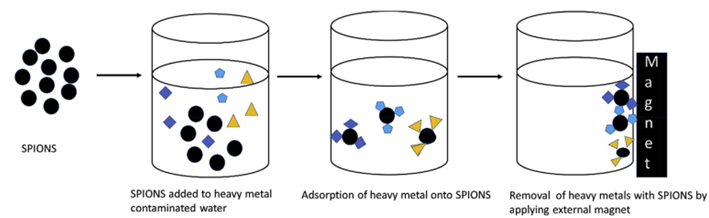
SPIONs are highly investigated to discover its remarkable role in environmental remediation. Heavy metal contamination in potable water resources has become a widespread topical crisis due to industrialization and improper discharge of effluents [23]. This puts mankind and the ecosystem into a potent risk of heavy metal toxicity and biomagnification [34]. The most common heavy metals pollutants are arsenic, lead, mercury, cadmium, chromium, aluminium etc. Chronic exposure of these heavy metals will lead to paralysis, mental retardation, birth defects, autism, psychosis, brain damage, kidney damage, muscular weakness, and may even cause death in humans [25]. With the fact that nanoparticles offer better molecular interaction for its small size, SPIONs were checked for the removal of heavy metals from water sources. It was found that SPIONs were capable to adsorb these heavy metals onto its surface through electrostatic interactions and ultimately eliminated the heavy metals from the liquid phase shown in Fig. 3. SPIONs have been reported to remove synthetic dyes where the adsorption was dependent on the pH and electric charge of the adsorbent and adsorbate.
Targeted Drug Delivery
In Traditional methods, the drugs are administered either orally or intravenously. Further, the administered drugs enter the systemic circulation before reaching the site of injury. But as this process continuous most of the drug is lost before it reaches to the targeted site leads to lower bioavailability of drug [26, 27, 28, 29, 30, 31, 32]. However, in modern medical researchers have shown that SPIONs can be used as competent drug carriers upon suitable fabrication which could prevent oxidation, to sustain the drug molecules and also to limit the intrusion of the reticuloendothelial system (RES), further increasing the in-vivo retention time within the circulatory system. These nanoparticles are extremely small and hence can cross the biological barrier easily [33]. To increase its bioavailability and to remain dispersed these SPIONs are encapsulated by biopolymers which are both biocompatible and biodegradable [34]. These SPIONs can be used to administer a drug directed to a more specific site where there is a need for therapy rather than the usual methods of direct administration of bare drug [35].
Tissue Engineering
Use of iron oxide nanoparticles for tissue repair was a breakthrough in the field of nanotechnology. Protein linked nanoparticles placed between the damaged tissue and the subsequent increase in temperature above 50℃ join two adjacent tissues. Further, gold-coated SPIONs can be used for tissue repair and tend to absorb light. Stem cells are considered as a boon to tissue engineering due to their pluripotent nature. Coupling of these with the SPIONs would aid in site-specific repair. Other proteins can also be linked to facilitate the repair mechanism. SPIONs are also used to track, target and localize the stem cells at the tissue damage site [36] where mesenchymal stem cells were magnetized using SPIONs with the optimal intake by the cells and these were used to enhance the retention of these stem cells at the affected site for tissue engineering as well as the MR- visualization for cell tracking.
Antimicrobial Activity
Bacterial infections are among the most important infectious diseases. The extensive research studies have been goingon, achieving new antimicrobial medicines, which is isolated from different sources, and the differences of physical and structural variations of antibacterial, antifungal and antiviral isolations play an important role in antimicrobial studies. Figure 4 shows the specific three classifications from biomedical applications. According to the progress in the development of antibacterial agents, there are still special attentions to find new antibacterial agents due to the development of multidrug-resistant bacteria. In many cases, the change in the property of material in the nanorange certainly occupies a definite position in this field. It is clearly understood due to the enhancement of performances of sensitivity and detection limit down to single molecule detection. At the same time, the different combinations of nanomaterials, according to its characteristic feature, are capable to increase the performances of microbial application. The 17 bacterial species are named as follows: Vibrio harveyi, Vibrio alginolyticus, Vibrio vulnificus, Vibrio parahaemolyticus, Vibrio cholerae, Bacillus subtilis, Bacillus cereus, Aeromonas hydrophila, Streptococcus agalactiae, Staphylococcus aureus, Staphylococcus intermedius, Staphylococcus epidermidis, Edwardsiella tarda, Pseudomonas aeruginosa, Enterococcus faecalis, Klebsiella pneumoniae and Escherichia coli [37]. Among these bacterial species, the five bacteria respond for iron oxide nanoparticles, such as Bacillus subtilis, Bacillus cereus, Aeromonas hydrophila, Escherichia coli and Staphylococcus aureus. The magnetisation measurements of the iron oxide nanoparticles prepared at 800°C exhibit a ferromagnetic behaviour at room temperature for all the samples.The hematite nanoparticles have an outstanding antimicrobial efficiency against some bacterial pathogens. It is concluded that further exploration of this field is needed to develop eco- friendly bionanomaterials for biomedicines[38, 39, 40, 41].
![Figure 4: Differences between antiviral, antibacterial and antifungal activity[42].](/fulltextimages/10760/fig_4.png)
Conclusions and Future Perspectives
The favorable features of SPIONs have drawn significant attention in abundant applications in biomedical sciences. As a result, there has been excellent progress in the synthesis of magnetic iron oxide NPs, which lead to improved diagnostic and therapeutic strategies. Generally, the preparative methods for the synthesis of SIONPs are classified into three major pathways—physical, chemical, and biological methods—which have been discussed in this review. And also, summarised the biological applications of the SIONPs. Overall, further work is required to truly realize the potential of SIONPs in healthcare and biotechnology [43, 44].
References
-
Li J, Wang Q, Han Y, Jiang L, Lu S, et al. (2023) Development and application of nanomaterials, nanotechnology, and nanomedicine for treating hematological malignancies. J Hematol Oncol 16(65).
-
Jamkhande PG, Ghule NW, Bamer AH, Kalaskar MG (2019) Metal nanoparticles synthesis: An overview on methods of preparation, advantages and disadvantages, and applications. Journal of drug delivery science and technology 53: 101174.
-
Sangaiya P, Jayaprakash R (2018) A Review on Iron Oxide Nanoparticles and Their Biomedical Applications. J Supercond Nov Magn 31: 3397-3413.
-
Zhao P, Na L, Didier A (2013) State of the art in gold nanoparticle synthesis. Coordination Chemistry Reviews 257(3-4): 638-665.
-
Hasan S (2015) A review on nanoparticles: their synthesis and types. Res J Recent Sci 4: 9-11.
-
Tong L, Zhao M, Zhu S, Chen J (2011) Synthesis and application of superparamagnetic iron oxide nanoparticles in targeted therapy and imaging of cancer. Frontiers of medicine 5: 379-387.
-
Thorek DLJ, Chen AK, Czupryna J, Tsourkas A (2006) Superparamagnetic iron oxide nanoparticle probes for molecular imaging. Annals of biomedical engineering 34(1): 23-38.
-
Yadollahpour A (2015) Magnetic nanoparticles in medicine: a review of synthesis methods and important characteristics. Orient J Chem 31: 271-277.
-
Billings C, Langley M, Warrington G, Mashali F, Johnson JA (2021) Magnetic particle imaging: current and future applications, magnetic nanoparticle synthesis methods and safety measures. International Journal of Molecular Sciences 22(14): 7651.
-
Yi Xiang JW, Xuan S, Port M, Jean Marc I (2013) Recent advances in superparamagnetic iron oxide nanoparticles for cellular imaging and targeted therapy research. Current pharmaceutical design 19(37): 6575- 6593.
-
Tuli HS, Kashyap D, Bedi SK, Kumar P, Kumar G, et al. (2015) Molecular aspects of metal oxide nanoparticle (MO-NPs) mediated pharmacological effects. Life Sci 143: 71-79.
-
Douziech Eyrolles L, Marchais H, Hervé K, Munnier E, Soucé M, et al. (2007) Nanovectors for anticancer agents based on superparamagnetic iron oxide nanoparticles. Int J Nanomedicine 2(4): 541-550.
-
SC Patel, Patel RC, Saiyed MA (2011) Toxicology Perspective of Nanopharmaceuticals: A Critical Review. International Journal of Pharmaceutical Sciences and Nanotechnology 4(1).
-
Soetaert F, Korangath P, Serantes D, Fiering S, Ivkov R (2020) Cancer therapy with iron oxide nanoparticles: Agents of thermal and immune therapies. Adv Drug Deliv Rev 65(83): 163-164.
-
Miyazawa T, Itaya M, Burdeos GC, Nakagawa K, Miyazawa T (2021) A critical review of the use of surfactant-coated nanoparticles in nanomedicine and food nanotechnology. Int J Nanomedicine 9(16): 3937-3999.
-
Vinardell MP, Mitjans M (2015) Antitumor activities of metal oxide nanoparticles. Nanomaterials 5(2): 1004- 1021.
-
Elahi N, Rizwan M (2021) Progress and prospects of magnetic iron oxide nanoparticles in biomedical applications: A review. Artif Organs 45(11): 1272-1299.
-
Nyström AM, Fadeel B (2012) Safety assessment of nanomaterials: Implications for nanomedicine. J Control Release 161(2): 403-408.
-
Alphandéry E (2020) Iron oxide nanoparticles for therapeutic applications. Drug Discov Today 25(1): 141- 149.
-
Viswanathan VK, Subramanian S, Manoharan SRR, Moon A (2019) Nanotechnology in Spine Surgery: A Current Update and Critical Review of the Literature. World Neurosurg 123: 142-155.
-
Martinkova P, Brtnicky M, Kynicky J, Pohanka M (2018) Iron Oxide Nanoparticles: Innovative Tool in Cancer Diagnosis and Therapy. Adv Healthc Mater 7(5).
-
MK Teli, S Mutalik, GK Rajanikant (2010) Nanotechnology, and Nanomedicine: Going Small Means Aiming Big. Curr Pharm Des 16(16):1882-1892.
-
Labouta HI, Schneider M (2013) Interaction of inorganic nanoparticles with the skin barrier: Current status and critical review. Nanomedicine 9(1): 39-54.
-
Laurent S, Mahmoudi M (2011) Superparamagnetic iron oxide nanoparticles: promises for diagnosis and treatment of cancer. Int J Mol Epidemiol Genet 2(4): 367- 390.
-
Shahabadi N, Falsafi M, Mansouri K (2016) Improving antiproliferative effect of the anticancer drug cytarabine on human promyelocytic leukemia cells by coating on Fe3O4 at SiO2 nanoparticles. Colloids Surf B Biointerfaces 141: 213-222.
-
Zhao J, Castranova V (2011) Toxicology of nanomaterials used in nanomedicine. J Toxicol Environ Health B Crit Rev 14(8): 593-632.
-
Donaldson K, Duffin R, Langrish JP, Miller MR, Mills NL, et al. (2013) Nanoparticles and the cardiovascular system: A critical review. Nanomedicine 8(3): 403-423.
-
Haase C, Nowak U (2012) Role of dipole-dipole interactions for hyperthermia heating of magnetic nanoparticle ensembles. Phys Rev.
-
Kalber TL, Ordidge KL, Southern P, Loebinger MR, Kyrtatos PG, et al. (2016) Hyperthermia treatment of tumors by mesenchymal stem cell-delivered superparamagnetic iron oxide nanoparticles. Int J Nanomed 11: 1973-1983.
-
Giustini AJ, Petryk AA, Cassim SM, Tate JA, Baker I, et al. (2010) Magnetic nanoparticle hyperthermia in cancer treatment. Nano Life 1(1-2): 17–32.
-
Bae YH, Park K (2011) Targeted drug delivery to tumors: myths, reality and possibility. J Contr Release 153(3):198-205.
-
Laurent S, Saei AA, Behzadi S, Panahifar A, Mahmoudi M (2014) Superparamagnetic iron oxide nanoparticles for delivery of therapeutic agents: opportunities and challenges. Expet Opin Drug Deliv 11(9): 1449-1470.
-
Veiseh O, Gunn JW, Zhang M (2010) Design and fabrication of magnetic nanoparticles for targeted drug delivery and imaging. Adv Drug Deliv Rev 62(3): 284-304.
-
Shubayev VI, Pisanic TR, Jin S (2009) Magnetic nanoparticles for theragnostic. Adv Drug Deliv Rev 61 (6): 467-477.
-
Paul T, Basu S, Sarkar K (2014) SPION-mediated soil DNA extraction and comparative analysis with conventional and commercial kit-based protocol. 3 Biotechnology 4: 669-677.
-
Sabale S, Kandesar P, Jadhav V, Komorek R, Motkuri RK, et al. (2017) Recent developments in the synthesis, properties, and biomedical applications of core/ shell superparamagnetic iron oxide nanoparticles with gold. Biomater Sci 5(11): 2212-2225.
-
Fatima H, Kim KS (2016) Magnetic nanoparticles for bioseparation. Kor J Chem Eng 34: 589-599.
-
Bao F, Yao JL, Gu RA (2009) Synthesis of magnetic Fe2O3/Au core/shell nanoparticles for bioseparation and immunoassay based on surface-enhanced Raman spectroscopy. Langmuir 25(18) 10782-10787.
-
Kerans FFA, Lungaro L, Azfer A, Salter DM (2018) The potential of intrinsically magnetic mesenchymal stem cells for tissue engineering. Int J Mol Sci 19(10): 3159.
-
Tchounwou PB, Yedjou CG, Patlolla AK, Sutton DJ (2012) Heavy metal toxicity and the environment. Experientia Suppl 101: 133-164.
-
Ali H, Khan E (2019) Trophic transfer, bioaccumulation, and biomagnification of nonessential hazardous heavy metals and metalloids in food chains/webs—concepts and implications for wildlife and human health. Hum Ecol Risk Assess 25(6): 1353-1376.
-
Jaishankar M, Tseten T, Anbalagan N, Mathew BB, Beeregowda KN (2014) Toxicity, mechanism and health effects of some heavy metals. Interdiscipl Toxicol 7(2): 60-72.
-
Samrot AV, Sahithya CS, Selvarani AJ, Pachiyappan A, Kumar SS (2019) Surfaceengineered super- paramagnetic iron oxide nanoparticles for chromium removal. Int J Nanomed 2019: 8105-8119.
-
Wanna Y, Chindaduang A, Tumcharern G, Phromyothin D, Porntheerapat S, et al. (2016) Efficiency of SPIONs functionalized with polyethylene glycol bis(amine) for heavy metal removal. J Magn Magn Mater 414: 32-37.
- Solution-Processed Chiral Perovskites for Biomedical Applications
- Nanotechnology in Health Chemistry and Medicine: Current Challenges and Future Directions
- Human Exposure to Micro- and Nanoplastics: Pathways, Toxicity, and Intervention Strategies
- Exosome Nanomedicine for Cancer Therapy
- Micro and Nanoplastics–Plastisphere, Biotoxicity, Impact on Human Health, and Mitigation Strategies
- Process Validation of Cefixime Powder for Suspension Dosage Form, 50 mL