
Laser-Ablation-Synthesized Ag/Zno-Dye Nanocomposite for Linear and Nonlinear Optical Applications
In this research, the effect of zinc oxide nanoparticles ZnO, Ag_ZnO on the optical properties of absorption and emission was studied, as the emission spectrum of the rhodamine B dye was fluorescent with the addition of nanoparticles of ZnO, Ag_ ZnO, and the nonlinear optical properties of three dyes: rhodamine B, methylene blue, and saffron dye. The nonlinear optical response of saffron dye with Ag_ZnO B compound showed the highest nonlinear response upon impact. For the 405 nm laser, the nonlinear refractive index is large. This coincides with the maximum absorption of the dye, which explains the increased nonlinear refractive index. Interestingly, the addition of zinc nanoparticles increased the nonlinear response of all dyes and demonstrated greater nonlinear properties for Ag_ZnO. The addition of silver improved the nonlinear response of the dyes, as the Ag_ZnO structure strongly absorbs most of the visible spectrum and even the near-infrared region of the electromagnetic spectrum. Which gives greater absorption efficiency. The nonlinear refractive index was good when adding ZnO and Ag_ZnO nanoparticles.
Introduction
Metals and their oxide nanoparticles at the nanoscale Have a significant interest across various applications due to their interesting properties resulting from quantum confinement effects, which delete alter their physicochemical characteristics compared to bulk materials [1, 2]. These metal nanoparticles have been used in diverse fields, including optics, sensors, and photocatalysis, owing to their unique features such as optical properties, large surface areas, and crystalline structures, metal nanoparticles are used wide range of applications [3, 4]. For instance, they can be utilized as optical limiter materials to protect a highly sensitive optical components from the intense energy of lasers and keep their nonlinear optical properties (NLO). Nanostructured materials have these properties where they can act as passive optical limiters by reducing or blocking optical transmittance when expose to laser energy that exceed a specific thresholds [5]. Zinc oxide (ZnO) is an inorganic material and recognized for their interesting properties like particle size, morphology, surface charges and UV illumination; therefore, they have been used in many applications [6]. Incorporating silver (Ag) into ZnO nanostructures had a significant attention because they offer unique attributes [7, 8], especially for biomedical applications due to their antimicrobial properties [9]. Moreover, ZnO
nanoparticles (NPs) are effective photocatalysis and can degrade hazardous industrial wastewater dyes [10]. Silver nanoparticles (Ag NPs) share similar properties with ZnO NPs, and their combination enhance their biomedical and therapeutic effects. For instance, bimetallic nanoparticles exhibit antimicrobial activity and excellent photocatalytic properties for wastewater treatment [11]. Laser ablation in liquid (LAL) technique allows synthesis of metal and metal oxide nanoparticles without the need for metal precursors, reductants, or capping agents [12, 13]. Heterocatalysts, including various metal oxides and metal sulfide heterojunction photocatalysts (e.g., SnO2, Bi2WO6, CuO2, TiO2, CdS), have been employed for color degradation [14]. Semiconductor photocatalysts, like ZnO, are favored due to their stability and tunable bandgap. ZnO, with its 3.2 eV bandgap, has gained widespread recognition as a potent photocatalyst, offering strong oxidation capabilities and being readily available and non-toxic compared to alternative materials [15]. ZnO Has high photo oxidation capabilities make it a preferred choice for photocatalytic applications [16]. On the other hand, zinc oxide (ZnO) as a photocatalyst has limitations due to Having a large band gap, which necessitates ultraviolet (UV) light for photon absorption with wavelengths below 387 nm, and rapid charge carrier recombination, Leading to limit its utility in wastewater treatment [17]. In this study, we investigated the linear and nonlinear optical properties of ZnO and ZnO-Ag nanoparticles and their effects on the linear and nonlinear optical properties of organic dyes, such as rhodamine B, methylene blue, and saffron. Linear properties were examined through absorption and fluorescence spectroscopy techniques, while nonlinear properties were studied using the Z-scan technique [18]. Laser dyes are complex molecules with diverse ring structures, leading to complex absorption and emission spectra.
Experimental Part
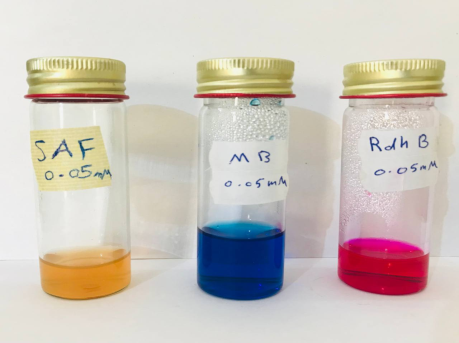
Two different colloidal solutions were synthesized in order to investigate the effect of the ZnO and Ag-ZnO nanoparticles on the optical properties of Rhodamine B, methylene blue, and saffron dyes. First, ZnO nanoparticle colloid was prepared by laser ablation of Zn plate with a thickness of 1 mm and a purity of 99.99% in distilled water. Then, Ag-ZnO NPs were synthesized by ablation of Ag target in freshly prepared ZnO NPs colloidal solution. The laser ablation process was carried out using an Nd: YAG laser that provides 5 ns laser pulses with a wavelength of 1064 nm and a repetition rate of 4 Hz. The laser beam was focused horizontally to the surface of the target kept inside the distilled water. The laser energy was 700 mJ and the ablation process was carried out for 700 number of pulses. Each dye of Rhodamine B, methylene blue, and saffron were mixed with ZnO and Ag-ZnO NPs separately. The linear optical properties, fluorescence emission and nonlinear optical properties of dyes and prepared NPs were analyzed by UV– Vis spectroscopy, fluorescence emission spectrometry and z-scan techniques respectively. Morphology and article size of ZnO and Ag-ZnO NPs were analyzed using TEM (Figures 1-3).


Results and Discussion
Characterization of Colloidal ZnO and Ag_ZnO Solution
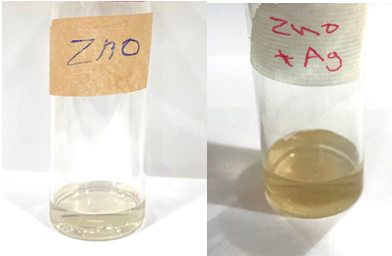
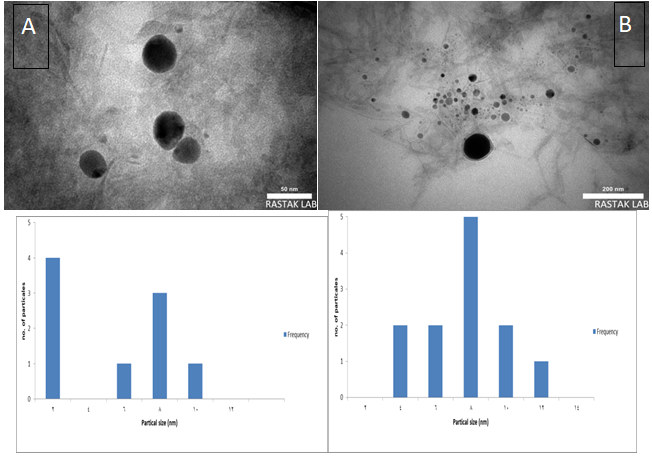
During the laser ablation process of Zn plate, the deionised water at first appeared colorless and transparent but after a few minutes it began to change to light grayish- white which confirms the generation of ZnO nanoparticles (Figure 4). This is due to the surface plasmon resonance (SPR) Of ZnO nanoparticles, after introducing Ag metal through laser ablation, the color of the colloidal material changes to yellow-brown. This color change is attributed to the formation of colloidal material containing Ag and the formation of Ag_ZnO. This was also confirmed by TEM analysis as shown in Figure 5 which gave the structural morphology of the Ag_ZnO core–shell particles. The darker part in image was considered to be the Ag core particles and the light color place is the ZnO shell layer. Shows the statistical analysis of particle size distribution, and that both ZnO and Ag-ZnO nanoparticles are spherical in shape and are not agglomerated. The average size of ZnO nanoparticles measures approximately 5.77 nanometers, while the average size of Ag_ZnO NPs is around 8.39 nanometers.
Linear Optical Studies: Absorption and Fluorescence Emission
Linear absorption of ZnO, Ag_ZnO NPs: The UV-vis absorption spectra of Ag _ ZnO nanoparticles are shown in Figure 6. The spectrum of pure ZnO nanoparticles shows a broad spectrum from 300 to 400 and exhibits a distinct peak in the absorption spectrum at 248 nm. Pure ZnO nanoparticles show a UV absorption edge at 325 nm. Another spectrum shows a Ag_ZnO solution and the absorption spectrum appears to contain two absorption peaks, the first at a wavelength of 243 nm and the other at a wavelength of 404 nm.
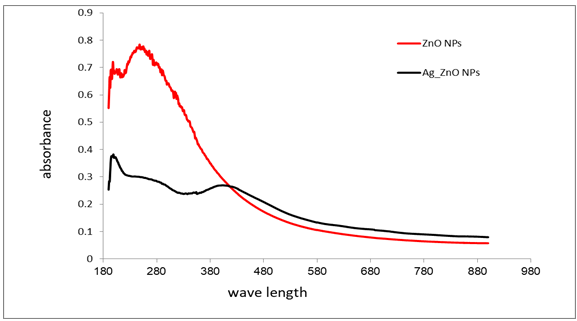
We can distinguish characteristic ZnO peak in the UV region between 300–400 nm due to intrinsic absorption when electrons transition from the valence band to the conduction band [19]. The Figure 6 shows the absorption spectrum of nanoparticles of ZnO and Ag_ZnO composition based on the absorbed wavelength. It is clear from Table 1 that the composite ZnO nanocore has an absorption peak in the UV region. While the Ag_ZnO structure strongly absorbs most of the visible spectrum and even the near-infrared region of the electromagnetic spectrum, the absorption spectrum of core- shell zinc oxide with silver (Ag-ZnO) can be explained by the presence of silver nanoparticles on the surface of the zinc oxide core. The introduction of silver nanoparticles enhances the absorption properties of the composite material, allowing it to absorb a wider range of wavelengths, including UV to IR regions of the electromagnetic spectrum [20, 21]. The formation of a silver shell over the zinc oxide core creates a synergistic effect between the two materials, resulting in improved electromagnetic wave (EMW) absorption performance [22].
| NPs | Absorption Peak Value | λ (nm) max | α(cm-1) |
|---|---|---|---|
| ZnO | 0.784287 | 248 | 60.21 |
| Ag_ZnO | 0.269627 | 404 | 20.7 |
Table 1: Absorption spectrum characteristics of ZnO, Ag_ ZnO NPs.
Absorption of rhodamine B, methylene blue and saffron dyes before and after mixing with ZnO and Ag_ZnO NPs: The effect of delete ZnO and Ag_ ZnO nanoparticles (NPs) on the absorption spectra of rhodamine B, methylene blue and saffron dyes is shown in Figure 7.
It is obvious from Figure 7 below that both ZnO and Ag- ZnO nanoparticles affect the absorption spectrum peaks of all dyes where the absorption spectra of all dyes were decreased by adding both ZnO and Ag-ZnO nanoparticles. The absorption spectra of Rdh B, MB and SAF dyes were decreased by adding both ZnO, Ag_ZnO nanoparticles, which indicates that the presence of nanoparticles affects the absorption spectrum peaks of the dyes. This can be attributed to the interaction between the Ag nanoparticles and the dye molecules, leading to a decrease in the intensity of the absorption peaks. When the nanoparticle concentration is higher than the dye concentration, the dye absorption spectrum decreases due to the interaction between the plasmon absorption of silver nanoparticles and the absorption of dye molecules. This reaction results in a decrease in the absorption spectrum of the dye, as evidenced by an increase in optical density. The exact mechanism of this interaction and its impact on the absorption spectra would require A variety of processes can result in quenching, such as excited state reactions, energy transfer, complex-formation and collisional quenching (Table 2) [23].
![Figure 7: It is obvious from Figure 7 below that both ZnO and Ag- ZnO nanoparticles affect the absorption spectrum peaks of all dyes where the absorption spectra of all dyes were decreased by adding both ZnO and Ag-ZnO nanoparticles. The absorption spectra of Rdh B, MB and SAF dyes were decreased by adding both ZnO, Ag_ZnO nanoparticles, which indicates that the presence of nanoparticles affects the absorption spectrum peaks of the dyes. This can be attributed to the interaction between the Ag nanoparticles and the dye molecules, leading to a decrease in the intensity of the absorption peaks. When the nanoparticle concentration is higher than the dye concentration, the dye absorption spectrum decreases due to the interaction between the plasmon absorption of silver nanoparticles and the absorption of dye molecules. This reaction results in a decrease in the absorption spectrum of the dye, as evidenced by an increase in optical density. The exact mechanism of this interaction and its impact on the absorption spectra would require A variety of processes can result in quenching, such as excited state reactions, energy transfer, complex-formation and collisional quenching (Table 2) [23].](/fulltextimages/11841/fig_7.png)
| Samples | Absorption Peak Value | λ (nm) max | α(cm-1) |
|---|---|---|---|
| rhodamine B | 2.903 | 549 | 222.86 |
| rhodamine B + ZnO NPs | 2.706 | 553 | 207.716 |
| rhodamine B + Ag_ZnO NPs | 2.642 | 545 | 202.804 |
| methylene blue | 2.789 | 658 | 214.113 |
| methylene blue +ZnO NPS | 2.204 | 665 | 169.203 |
| methylene blue + Ag_ZnO NPS | 1.909 | 664 | 146.513 |
| Saffron | 2.097 | 249 | 160.973 |
| Saffron +ZnO NPS | 1.406 | 250 | 107.919 |
| Saffron + Ag_ZnO NPS | 1.792 | 252 | 137.539 |
Table 2: Absorption Spectra of Dyes in the Presence of ZnO and Ag_ZnO NPs.
Effect of ZnO, Ag_ZnO NPs on the Fluorescence of Rhodamine B, Methylene Blue and Saffron dyes: Rhodamine B dye dissolved in water showed a fluorescence emission when excited with 587 nm light. It is clear from Figure 8 that the fluorescent emission intensity of the dyes Enhanced by adding ZnO, Ag_ZnO nanoparticles summarize the fluorescence of Rhodamine B dye before and after addition of nanoparticles.
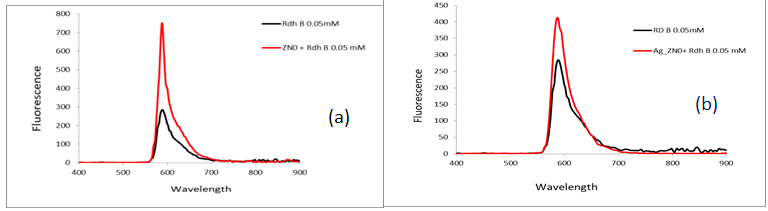
It is clear from Table 3 that the fluorescence of dyes was increased by adding ZnO and Ag-ZnO nanoparticles. The fluorescence spectra showed that the highest fluorescence intensities of both pure rhodamine B dye and the dye solution with Ag_ZnO nanoparticles were observed at wavelengths between 550 and 650 nm. The higher fluorescence intensity of the dye solution with Ag_ZnO nanoparticles can be explained by FRET. FRET occurs when a donor molecule in an excited state transfers its energy to an acceptor molecule in the ground state. In this case, the Ag_ZnO nanoparticles act as the donor molecules, while rhodamine B dye molecules act as the acceptor molecules. The excited rhodamine B dye molecules transfer their energy to nearby Ag_ZnO nanoparticles, which can then re-emit the energy as photons of light. This leads to a higher fluorescence intensity in the presence of ZnO-Ag nanoparticles [24]. Through the above interpretation, the results confirm that nanoparticles of ZnO and Ag_ZnO can enhance the fluorescence emission intensity of the rhodamine B dye, through plasmon interaction of the metal surface. This result indicates that the ZnO shell was used to maintain a certain distance between the fluorescent mole cule and the metal core, which caused the interaction between the surface plasmon and excitation light field to produce a FL emission enhancement. Furthermore, the ZnO shell layer also could enhance the FL emission of dye, which was caused by the change in photonic mode density and/or reduction in self-quenching of fluorophores for ZnO nanostructure [25].
| Dye | λ (nm) max | Fluorescence |
|---|---|---|
| rhodamine B | 584 | 284.88 |
| rhodamine B + ZnO NPs | 587.8 | 752.02 |
| rhodamine B + Ag_ ZnO NPs | 586.9 | 413.81 |
Table 3: Fluorescence Spectroscopy rhodamine B Data (a) ZnO NPs, (b) ZnO_Ag NPs.
Methylene blue dye that dissolved in water showed fluorescence emission upon excitation with 664 nm light. It is clear from Figure 9 that the fluorescent emission intensity of the dyes was decreased by adding ZnO, Ag-ZnO NPs only.
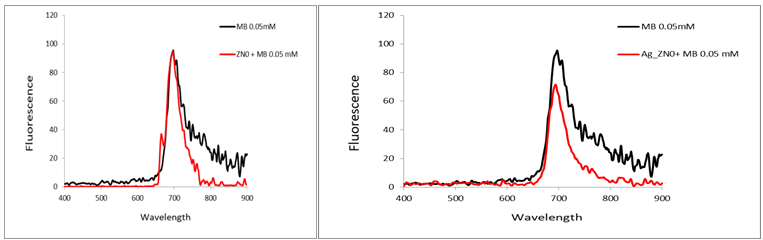
The reduced fluorescence of the dye solution with nano_Ag_ZnO can be explained by a phenomenon called “fluorescent polarization”. Fluorescence polarization was observed in the dye solution with nano-ZnO-Ag due to the attachment of methylene blue dye molecules to the Ag_ZnO nanoscale surface. When methylene blue absorbs light, it moves to a higher energy level. As the electrons in methylene blue are bound to the Ag_ZnO nanosurface, they can absorb the absorbed light, preventing the electrons from returning to the base energy level quickly. As a result, less fluorescent light is released, leading to the lower fluorescence of the dye solution with nano-Ag_ZnO (Table 4).
| Dye | λ (nm) max | Fluorescence |
|---|---|---|
| methylene blue | 697 | 95.54 |
| methylene blue + ZnO NPs | 695.9 | 94.82 |
| methylene blue + Ag_ZnO NPs | 693.1 | 71.6 |
Table 4: Emission spectrum characteristics of methylene blue dye before and after adding (a) ZnO NPs, (b) Ag_ZnO NPs.
Nonlinear Optical Analysis
The results in Table 5 showed that both ZnO and Ag_ZnO nanoparticles have negative nonlinear refractive index. At a wavelength of 405 nm, the nonlinear refractive index (NNRI) of Rhodamine B and methylene blue And saffron dyes was studied before and after the addition of ZnO and Ag_ZnO nanoparticles. The results showed a nonlinear refractive index and third-order nonlinear sensitivity at 405 nm for all dyes. The results confirmed that the addition of ZnO and Ag_ ZnO improved the nonlinear properties of rhodamine B and methylene blue dye. As shown for the refractive index values listed in Figure 10.
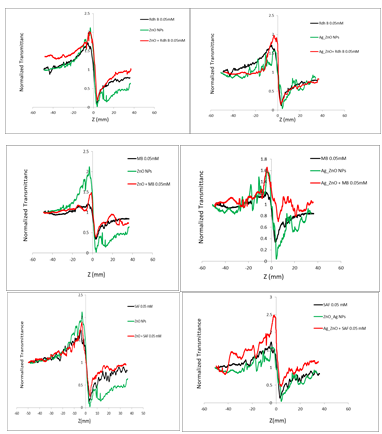
As can be seen from Figure 7b, the NNRI of Rdh B and methylene blue dye was increased by adding ZnO NPs because the wavelength of laser (405 nm) lies in the absorption spectrum of ZnO NPs. This led to an increase in NNRI of rhodamine B and methylene blue dye by heat transfer from ZnO NPs to the dye solution which enhances the thermal Kerr effect [26]. As seen from Figure 10, the NNRI of Rdh B and MB dye was increased after adding Ag_ZnO NPs under the influence of 405 nm. Laser wavelength can be absorbed by Ag_ZnO NPs because its wavelength (405 nm) lies within the surface Plasmon band of Ag_ZnO NPs added to Rdh B and MB dye, this led to an increase in NNRI of MB dye by heat transfer from ZnO NPs to the dye solution. This means that the photon energy was converted to heat when the surface Plasmon band of Ag nanoparticles in dye solution was excited by irradiation of a 405 nm laser leading to increasing the NNRI [27]. As shown in Table 5 of the absorption spectrum, the introduction of silver nanoparticles enhances the absorption properties of the composite material, allowing it to absorb a wider range of wavelengths, including UV to IR regions of the electromagnetic spectrum. This led to the enhancement of the nonlinear properties of the dyes by adding Ag_ZnO NPs more than ZnO NPs.
| Samples | P(Mw) | I (MW/m2) 0 | L (m) eff | ΔT | n₂ (m2/W) |
|---|---|---|---|---|---|
| ZnO NPs | 13.5 | 91.056 | 0.00096743 | 2.103448 | 3.91*10-12 |
| Ag_ZnO NPs | 12.74 | 85.9301 | 0.00096961 | 1.537669 | 3.02*10-12 |
| Rdh B | 13.5 | 91.056 | 0.00098994 | 1.60559 | 2.92*10-12 |
| Rdh B + ZnO | 13.5 | 91.056 | 0.00098301 | 1.832727 | 3.36*10-12 |
| Rdh B +Ag_ZnO | 13.27 | 89.505 | 0.00099022 | 1.834064 | 3.39*10-12 |
| MB | 13.3 | 89.707 | 0.00099672 | 0.877841 | 1.61*10-12 |
| MB +ZnO | 13.27 | 89.505 | 0.00098909 | 1.092205 | 2.02*10-12 |
| MB +Ag_ZnO | 13.27 | 89.505 | 0.00099839 | 0.958917 | 1.76*10-12 |
| saffron | 2.75 | 18.548 | 0.0009572 | 1.591954 | 1.47*10-11 |
| SAF+ ZnO | 2.75 | 18.548 | 0.00097957 | 1.645325 | 1.48*10-12 |
| SAF+ Ag_ZnO | 2.75 | 18.548 | 0.0007244 | 2.021482 | 1.84*10-11 |
Table 5: Nonlinear properties of rhodamine B, methylene blue And saffron dye before after adding ZnO, Ag_ZnO NPs.
Conclusions
The study investigated the absorption, fluorescence, and nonlinear optical properties of rhodamin B, methylene blue, and saffron dyes in the presence of ZnO and ZnO-Ag nanoparticles. The addition of nanoparticles significantly affected the optical properties of the dyes. For instance methylene blue showed decreased absorption due to fluorescent polarization. The presence of ZnO, ZnO-Ag nanoparticles enhanced the fluorescence emission of rhodamin B, the behaviour showed that fluorescence polarization and fluorescence enhancement can be achieved by attaching dye molecules to nanoscale surfaces and nanoparticles, respectively. The fluorescence properties of the dye solutions were found to be influenced by their interactions with the nano-ZnO-Ag and ZnO-Ag nanoparticles. The addition of ZnO, Ag_ZnO nanoparticles to rhodamine dye random lasers leads to improved characteristics and a lower lasing threshold. The plasmonic enhancement induced by nanoparticles increases energy transfer and fluorescence quenching for MB. Saffron did not exhibit significant fluorescence emission. The study also found that ZnO and ZnO-Ag nanoparticles improved the nonlinear optical properties of all three dyes. The presence of silver nanoparticles in ZnO-Ag nanoparticles induced surface Plasmon resonance, leading to enhanced nonlinearity at 405 nm for all dyes. The study concludes that the addition of nanoparticles can significantly modify the optical properties of dyes, making them more suitable for various applications, including photovoltaic devices, solar energy conversion, and random lasers media.
References
-
Mostafa AM, Mwafy EA, Awwad NS, Ibrahium HA (2021) Linear and nonlinear optical studies of Ag/Zn/ ZnO nanocomposite thin film prepared by pulsed laser deposition technique. Radiation Physics and Chemistry 179: 109233.
-
Mostafa AM, Mwafy EA (2020) The effect of laser fluence for enhancing the antibacterial activity of NiO nanoparticles by pulsed laser ablation in liquid media. Environmental Nanotechnology Monitoring & Management 14: 100382.
-
Chandrakala V, Aruna V, Angajala G (2022) Review on metal nanoparticles as nanocarriers: Current challenges and perspectives in drug delivery systems. Emergent Materials 5(6): 1593-1615.
-
Saravanan A, Kumar PS, Karishma, S, Vo DVN, Jeevanantham S, et al. (2021) A review on biosynthesis of metal nanoparticles and its environmental applications. Chemosphere 264(2): 128580.
-
Ramteke SP, Anis M, Baig MI, Algarni H, Muley GG (2019) Optimizing optical traits of ammonium zinc sulphate hydrate crystal exploiting Nd3+ for photonic device applications. Optik 197: 163219.
-
Radzimska KA, Jesionowski T (2014) Zinc oxide-from synthesis to application: a review. Materials 7(4): 2833- 2881.
-
Rai M, Yadav A, Gade A (2009) Silver nanoparticles as a new generation of antimicrobials. Biotechnology advances 27(1): 76-83.
-
Sportelli MC, Izzi M, Volpe A, Clemente M, Picca RA, et al. (2018) The pros and cons of the use of laser ablation synthesis for the production of silver nano- antimicrobials. Antibiotics 7(3): 67.
-
Dutta G, Sugumaran A (2021) Bioengineered zinc oxide nanoparticles: Chemical, green, biological fabrication methods and its potential biomedical applications. Journal of drug delivery science and technology 66: 102853.
-
Batra V, Kaur I, Pathania D, Sonu, Chaudhary V (2022) Efficient dye degradation strategies using green synthesized ZnO-based nanoplatforms: A review. Applied Surface Science Advances 11: 100314.
-
Tehri N, Vashishth A, Gahlaut A, Hooda V (2022) Biosynthesis, antimicrobial spectra and applications of silver nanoparticles: Current progress and future prospects. Inorganic and Nano-Metal Chemistry 52(1): 1-19.
-
Burdușel AC, Gherasim O, Grumezescu AM, Mogoantă L, Ficai A, et al. (2018) Biomedical applications of silver nanoparticles: an up-to-date overview. Nanomaterials 8(9): 681.
-
Pyatenko A, Shimokawa K, Yamaguchi M, Nishimura O, Suzuki M (2004) Synthesis of silver nanoparticles by laser ablation in pure water. Applied Physics A 79: 803- 806.
-
Iqbal Y, Malik AR, Iqbal T, Aziz MH, Ahmed F, et al. (2021) Green synthesis of ZnO and Ag-doped ZnO nanoparticles using Azadirachta indica leaves: Characterization and their potential antibacterial, antidiabetic, and wound- healing activities. Materials Letters 305: 130671.
-
Wang Z, Ye X, Chen L, Huang P, Wang Q, et al. (2021) Silver nanoparticles decorated grassy ZnO coating for photocatalytic activity enhancement. Materials Science in Semiconductor Processing 121: 105354.
-
Zhu X, Liang X, Wang P, Dai Y, Huang B (2018) Porous Ag-ZnO microspheres as efficient photocatalyst for methane and ethylene oxidation: Insight into the role of Ag particles. Applied Surface Science 456: 493-500.
-
Pant B, Park M, Kim HY, Park SJ (2016) Ag-ZnO photocatalyst anchored on carbon nanofibers: Synthesis, characterization, and photocatalytic activities. Synthetic Metals 220: 533-537.
-
Anugrahwidya R, Yudasari N, Tahir D (2020) Optical and structural investigation of synthesis ZnO/Ag Nanoparticles prepared by laser ablation in liquid. Materials science in semiconductor processing 105: 104712.
-
Chi D, Huang S, Yue S, Liu K, Lu S, et al. (2017) Ultra- thin ZnO film as an electron transport layer for realizing the high efficiency of organic solar cells. RSC advances 7(24): 14694-14700.
-
Babeer AM, Aamir L (2019) Zinc oxide/silver sulfide (ZnO/Ag2S) core-shell type composite for wide range absorption of visible spectra: Synthesis and characterization. Nano Hybrids and Composites 25: 84- 89.
-
Gan F, Jiang Y, Yao Q, Deng J, Cheng L, et al. (2023) Construction of core-shell ZnO@ ZnO/FeNi microrods with improved impedance matching and electromagnetic wave absorption performance. Ceramics International. 49(15): 25074-25084.
-
Beyene G, Senbeta T, Mesfin B (2019) Size dependent optical properties of ZnO@ Ag core/shell nanostructures. Chinese Journal of Physics 58: 235-243.
-
Muhammed LA, Abbas RM, Haddawi SF (2023) Investigate the influence of Ag Nps on surface plasmon resonance. In AIP Conference Proceedings 2977(1): 040039.
-
Zhao Y, Ding Y, Peng X, Zhou M, Liang X, et al. (2015) The structure, morphology, and the metal-enhanced fluorescence of nano-Ag/ZnO core–shell structure. Applied Nanoscience 5: 521-525.
-
Yang J, Zhang F, Chen Y, Qian S, Hu P, et al. (2011) Core-shell Ag@ SiO2@ mSiO2 mesoporous nanocarriers for metal- enhanced fluorescence. Chemical Communications 47(42): 11618-11620.
-
Shokoufi N, Hajibaba SN (2019) The third-order nonlinear optical properties of gold nanoparticles- methylene blue conjugation. Optics & Laser Technology 112: 198-206.
-
Borge VV, Patil RM, Dwivedi PR (2022) Photocatalytic Decomposition of Rhodamine B Dye Using Copper Oxide Nanoparticles Prepared from Copper Chalcone Complexes. International Journal of Nanoscience 21(5): 2250039.
- Solution-Processed Chiral Perovskites for Biomedical Applications
- Nanotechnology in Health Chemistry and Medicine: Current Challenges and Future Directions
- Human Exposure to Micro- and Nanoplastics: Pathways, Toxicity, and Intervention Strategies
- Exosome Nanomedicine for Cancer Therapy
- Micro and Nanoplastics–Plastisphere, Biotoxicity, Impact on Human Health, and Mitigation Strategies
- Process Validation of Cefixime Powder for Suspension Dosage Form, 50 mL