
Revolutionizing Dosage Form Design The Impact of 3D Printing in Pharmaceuticals
3D printing is revolutionizing pharmaceutical manufacturing by creating personalized dosage forms and intricate drug delivery systems. This technology offers flexibility and precision, enhancing patient compliance, reducing side effects, and improving treatment effectiveness. It excels in producing complex geometries that alter drug release mechanisms, making it difficult to achieve with conventional methods. Key considerations for developing 3D-printed pharmaceuticals include patient population, molecule type, dosage accuracy, and regulatory compliance. Despite its advantages, 3D printing faces technical challenges and regulatory hurdles. Collaborative efforts between industry experts and regulatory bodies are essential for establishing clear guidelines and standards. Ultimately, 3D printing holds the potential to decentralize production, enhance treatment efficacy, and create a more sustainable and patient-centric pharmaceutical industry.
Abbreviations
CAD: Computer-Aided Design; FDM: Fused Deposition Modeling.
Introduction
The advent of 3D printing technology is revolutionizing dosage form design in the pharmaceutical industry. This innovative approach, also known as additive manufacturing, allows for the creation of complex and personalized medication structures that were previously unattainable through traditional manufacturing methods. The roots of 3D printing trace back to the 1980s when it was primarily used for creating prototypes in various industries. Today, it offers unparalleled precision, enabling the production of dosage forms tailored to individual patient needs, enhancing therapeutic efficacy, and minimizing side effects.
Letter to Editor
By facilitating the incorporation of multiple drugs into a single dosage form, this technology supports polypharmacy management, improving patient compliance and outcomes. Additionally, 3D printing enables rapid prototyping and manufacturing, significantly reducing the time and cost associated with drug development. This flexibility allows for on-demand production, essential for personalized medicine and addressing niche markets with specific therapeutic requirements. The ability to manipulate drug release profiles through innovative design and material selection further underscores the potential of 3D printing to transform pharmaceutical practices. As regulatory frameworks evolve to accommodate these advancements, the integration of 3D printing in pharmaceuticals promises to usher in a new era of personalized, efficient, and effective healthcare solutions. This paper explores the transformative impact of 3D printing on dosage form design, highlighting its benefits, challenges, and future prospects in the pharmaceutical landscape [1, 2].
Types of 3D Printing
The 3D printing industry has experienced substantial growth, introducing new technologies and terminology. 3D printing serves as a nexus between art and science, facilitating the swift and accurate fabrication of intricate structures and components. The techniques covered by the ASTM categorization system include deposition, binding, and polymerization. These techniques are used in a variety of sectors, including drug delivery systems, medical devices, and biomedical applications Zahir A, et al. [3]. Medical uses span a wide array, encompassing medical models, implants, tools, aids, prostheses, and biomanufacturing. In 2012, ASTM International established a standard terminology, categorizing additive manufacturing technologies into seven overarching groups [4].
Transforming Dosage Form Design: The Influence of 3D Printing in Pharmaceuticals
The landscape of pharmaceutical manufacturing is undergoing a transformation with the advent of 3D printing, enabling the creation of three-dimensional objects from digital designs. This innovative method constructs items layer by layer, seamlessly joining each new layer to the one below using precise movements of the print head or base plate. The flexibility of 3D printing allows pharmaceutical companies to design personalized dosage forms and complex drug delivery systems, which enhance patient compliance, reduce side effects, and improve treatment effectiveness.
A variety of 3D printing platforms are available, each with unique input materials and operational principles, tailored to specific types of 3D printers. For example, products like Spritam are designed for particular printers, such as those using ZipDose technology and inkjet 3D printing. Traditional pharmaceutical manufacturing, on the other hand, depends on the dosage form and production method, with tablets typically produced by compression or molding and capsules filled with powders or granules. The choice between 3D printing and conventional methods is influenced by factors like product complexity, production speed, and cost [5, 6].
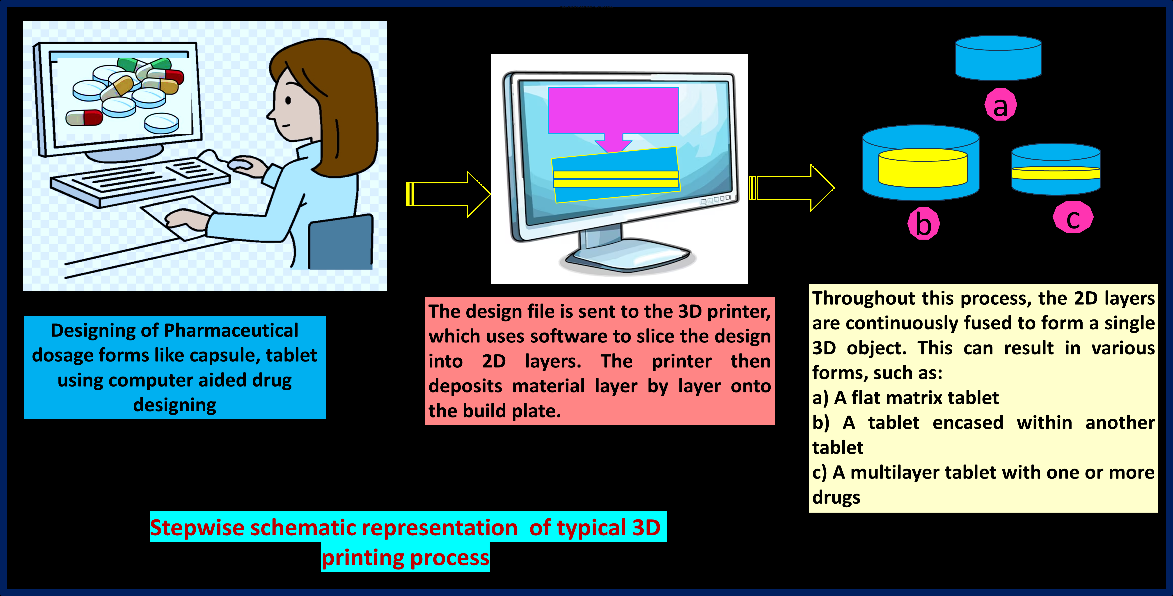
While 3D printing can replicate traditional dosage forms, its real strength lies in producing intricate geometries such as spherical, cylindrical, pyramidal, and multi- layered structures. These complex designs can alter drug release mechanisms, enabling bimodal release patterns that conventional methods cannot easily achieve. Recent advancements highlight the precise arrangement of drugs and excipients in multiple layers of solid oral dosage forms. Key considerations in developing 3D printed pharmaceuticals include the target patient population (individual or group- based), molecule type, dosage accuracy, delivery route, and quality attributes. Additionally, manufacturing processes, regulatory requirements, and cost-effectiveness play crucial roles. By assessing these factors, companies can ensure successful product development. Pharmaceutical companies choose 3D printing platforms based on product design, considering material compatibility, printing speed, and precision, while ensuring compliance with regulatory standards and cost constraints. Pharmaceutical companies can utilize various 3D printing platforms depending on the computer-aided design-generated internal, external, and functional design of the product. Despite the diversity in 3D
printer functionalities, most follow a schematic similar to Figure 1 and adhere to the sequential steps outlined below for pharmaceutical manufacturing [7].
The use of 3D printing in pharmaceuticals has revolutionized dosage form design by transforming the process from digital design to production and post- processing treatments. The process involves using computer- aided design (CAD) software to create a 3D digital model of the pharmaceutical product, which is then converted into a machine-readable file format. The printing software then slices the surfaces into individual printable 2D layers, sending digital instructions to the printer, determining where to print scaffolding support material and guiding the movement of the print head. Raw materials are processed into various forms, such as granules, filaments, dry mixed powder, or binder solutions, which may contain active pharmaceutical ingredients. The automated process adds and solidifies these components layer by layer to form the final product. Post- printing treatments, such as drying, sintering, or polishing, may be necessary. The choice of a printer type depends on factors such as large-scale production feasibility, transition challenges, production rate vs. market demand, consistency and adaptability of individual doses, integration of advanced pharmaceutical development, manufacturing, and quality assurance, compliance with cGMP qualifications and validation standards, software process management, and software validation [8].
Limitations and Challenges of 3D Printing
3D printing, while offering significant advantages to the pharmaceutical industry, also comes with notable limitations and challenges. Though it shows promise, especially in the production of medical devices (MDs), various obstacles need to be addressed before it becomes widespread in pharmaceuticals. The primary technical challenges involve production efficiency, which can range from as short as two minutes to as long as two hours, depending on the process. Despite this, a significant advantage of 3D printing in pharmaceuticals is its potential to decentralize production. By enabling small-scale manufacturing in local pharmacies or hospitals, it can bring production closer to patients, enhancing accessibility and customization [9].
Different 3D printing methods present their own unique challenges. For instance, laser-based systems require safer and more varied starting materials. Other methods face issues with drying processes or the need for high temperatures to ensure stability and address polymorphism concerns. To tackle these problems, researchers have successfully optimized Fused Deposition Modeling (FDM) technology for printing thermolabile drugs, like ramipril, by modifying the excipients used. Regulatory hurdles also pose significant challenges. The 510(k) pathway is the most commonly used strategy for gaining market access for 3D-printed medical devices. However, there are currently no established guidelines specifying the standards that producers must meet before submitting products for review. In May 2016, the FDA issued draft guidance that outlines technical considerations for 3D-printed medical devices, including nonbinding recommendations related to production, testing, and characterization. The FDA strongly encourages feedback from these professionals to refine and enhance the guidelines. Collaboration between regulatory bodies and industry experts is crucial to developing clear, practical standards that ensure the safety, efficacy, and quality of 3D-printed pharmaceutical products. While 3D printing holds great promise for the pharmaceutical industry, particularly in terms of decentralizing production and customizing treatments, significant technical and regulatory challenges must be addressed. Overcoming these hurdles requires ongoing research, technological advancements, and close collaboration between regulatory authorities and industry experts [10, 11].
Conclusion
3D printing in pharmaceuticals is revolutionizing dosage form design, allowing for personalized medicine and enhancing production efficiency. This technology offers precision and flexibility, enabling the creation of complex drug delivery systems that were previously unattainable with traditional manufacturing methods. By tailoring pharmaceuticals to meet individual patient needs, 3D printing can enhance therapeutic efficacy and minimize adverse effects. Personalized medicine is one of the most significant impacts of 3D printing in pharmaceuticals, as it allows for customization of dosage forms based on a patient’s unique medical profile. This personalization improves patient adherence and outcomes, paving the way for more effective treatment regimens, especially for those with complex or rare conditions. 3D printing also promotes sustainability and efficiency in drug production, minimizing material waste and enabling on-demand production. This shift lowers production costs and contributes to a more environmentally friendly pharmaceutical industry. The regulatory landscape for 3D-printed pharmaceuticals is evolving, with agencies recognizing the need to establish guidelines for safety, efficacy, and quality. Collaborative efforts between regulatory bodies, industry stakeholders, and academic institutions are crucial for developing robust standards and fostering innovation. In conclusion, 3D printing in pharmaceuticals holds the promise of significantly improving patient care and transforming the future of pharmaceutical manufacturing.
Acknowldgments
The authors would like to express their sincere gratitude to Jaihind College of Pharmacy for their invaluable guidance and support.
References
-
Desu PK, Maddiboyina B, Vanitha K, Gudhanti SNKR, Anusha R, et al. (2021) 3D Printing Technology in Pharmaceutical Dosage Forms: Advantages and Challenges. Curr Drug Targets 22(16): 1901-1914.
-
Souto EB, Campos JC, Filho SC, Teixeira MC, Gomes CM, et al. (2019) 3D printing in the design of pharmaceutical dosage forms. Pharm Dev Technol 24(8): 1044-1053.
-
Zahir A, Mahmood U, Nazir A, Hussain T, Abid S (2022) Biomaterials for medical and healthcare products. Med Text from Nat Resour pp: 43-86.
-
Ranjan R, Kumar D, Kundu M, Chandra Moi S (2022) A critical review on Classification of materials used in 3D printing process. Mater Today Proc 61: 43-49.
-
Samiei N (2020) Recent trends on applications of 3D printing technology on the design and manufacture of pharmaceutical oral formulation: a mini review Beni- Suef Univ J Basic Appl Sci 9: 1.
-
Ameeduzzafar, Alruwaili NK, Rizwanullah MD, Bukhari SNA, Amir MD, et al. (2018) 3D Printing Technology in Design of Pharmaceutical Products. Curr Pharm Des 24(42): 5009-5018.
-
Moldenhauer D, Nguyen DCY, Jescheck L, Hack F, Fischer D, et al. (2021) 3D screen printing – An innovative technology for large-scale manufacturing of pharmaceutical dosage forms. Int J Pharm 592: 120096.
-
Norman J, Madurawe RD, Moore CMV, Khan MA, Khairuzzaman A (2017) A new chapter in pharmaceutical manufacturing: 3D-printed drug products. Adv Drug Deliv Rev 108: 39-50.
-
Iftekar SF, Aabid A, Amir A, Baig M (2023) Advancements and Limitations in 3D Printing Materials and Technologies: A Critical Review. Polymers 15(11): 2519.
-
Ko CH (2021) Constraints and limitations of concrete 3D printing in architecture. J Eng Des Technol 20(5): 1334- 1348(15).
-
Tsioukas V, Pikridas C, Karolos IA (2019) Challenges, opportunities, and limitations in 3D printing. 3D Print Appl Med Surg pp: 151-155.
- Solution-Processed Chiral Perovskites for Biomedical Applications
- Nanotechnology in Health Chemistry and Medicine: Current Challenges and Future Directions
- Human Exposure to Micro- and Nanoplastics: Pathways, Toxicity, and Intervention Strategies
- Exosome Nanomedicine for Cancer Therapy
- Micro and Nanoplastics–Plastisphere, Biotoxicity, Impact on Human Health, and Mitigation Strategies
- Process Validation of Cefixime Powder for Suspension Dosage Form, 50 mL