
Modelling of Charged Dark Energy Stars in a Tolman IV Spacetime
In this paper, we obtained a new class of solutions for the Einstein-Maxwell field equations with a charged anisotropic matter distribution considering the dark energy equation of state r p = ωρ , where ω is the dark energy parameter, is the radial pressure and is the energy density. We have chosen a form for the metric potential proposed for Tolman (1939) known as Tolman IV type potential. We found that the physical properties as the radial pressure, the anisotropy, energy density, mass function are regular and well behaved in the stellar interior but the strong energy condition is violated. The models are consistent with the upper limit on the mass of compact stars for Her X-1, 4U1538-52 and SAXJ1808.4-3658.
Introduction
The general theory of relativity is the most useful gravity theory to understand the behavior of stellar matter subjected to strong gravitational fields as neutron stars, white dwarfs and quark stars and gravitational collapse [1, 2]. In the search of solutions of Einstein’s field equations, it is important to mention the pioneering works of Schwarzschild K [3], Tolman RC [4], Oppenheimer JR, et al. [5] and Chandrasekhar S [6]. Schwarzschild K [3] obtained interior solutions that allows describing a star with uniform density, Tolman RC [4] generated new solutions for static spheres of fluid Oppenheimer JR, et al. [5] studied the gravitational equilibrium of neutron stars using Tolman’s solutions and Chandrasekhar S [6] produced new models of white dwarfs in presence of relativistic effects.
Current astronomical data as the measurements of supernovas of type Ia and microwave background radiation are the most direct evidences of the accelerated expansion of the universe [7]. The explanation for this cosmological behavior in the framework of general relativity requires assumption that a considerable part of the Universe consists of a hypothetical dark energy with a negative pressure component [8], which is a cosmic fluid parameterized by an equation of state p pω = with 1 1 3 ω −≤ < − where p is the spatially homogeneous pressure and ρ the dark energy density [9, 10, 11, 12, 13]. The interval of values of ω comes from the Friedman cosmological models which assume isotropic pressures p. The range for which 1 ω < − has been denoted as phantom energy and possesses peculiar properties, such as negative temperatures and the energy density increasing to infinity in a finite time, resulting in a big rip [8, 9, 10]. It also provides a natural scenario for the existence of exotic geometries such as wormholes [11, 12, 13].
The existence of dark energy fluids comes from the observations of the accelerated expansion of the Universe and the isotropic pressure cosmological models give the best fitting of the observations but when these kind of fluids are taken to the scenario of star model and gravitational collapse the anisotropy may be important [14]. According Lobo FSN [9] the notion of dark energy is that of a homogeneously distributed cosmic fluid and that when extended to inhomogeneous spherically symmetric spacetimes, the pressure appearing in the equation of state shows a negative radial pressure; the tangential pressure must be determined by applying the general stability formalism developed by Lobo FSN, et al. [15]. Chan et al. [14] have proposed that the mass function is a natural consequence of the Einstein´s field equations and hence can be a core factor with a homogeneous energy density, described by the Lobo´s first solution [9]. Malaver M, et al. [16] presented a new model of dark energy star by imposing specific choice for the mass function that corresponds to an increase in energy density inside of the star. Bibi R, et al. [10] obtained a new class of solutions of the Einstein-Maxwell field equations representing a model for dark energy stars with the equation of state pr=-ρ. Malaver M, et al. [17] found a new family of solutions to the Einstein-Maxwell system considering a particular form of the gravitational potential Z(x) and the electric field intensity with a linear equation of state that represents a model of dark energy star. Malaver M, et al. [18] generated a dark energy star model with a quadratic equation of state and a specific charge distribution. Dayanandan B, et al. [19] studied the properties of dark energy stars with anisotropic fluid distribution using Tolman IV type gravitational potential. More recently, Malaver, et al. [20] obtained new solutions of Einstein’s field equations for dark energy stars within a Buchdahl spacetime by considering nonlinear electromagnetic field. According to Chan R, et al. [15] the denomination of dark energy is applied to fluids which violate only the strong energy condition (SEC) given by 2 0 r t p p ρ + + ≥ where ρ is the energy density, pr and pt are the radial pressure and tangential pressure, respectively. The dark energy star may possible have an origin in a density fluctuation in the cosmological background but it is uncertain how such inhomogeneities in the dark energy, may be formed [9].
Recently, astronomical observations of compact objects have allowed new findings of strange stars that adjust to the exact solutions of the 4-D Einstein field equations; data on mass maximum, redshift and luminosity are some of the most relevant characteristics for verifying the physical requirements of these models [21]. A great number of exact models from the Einstein-Maxwell field equations have been generated by Gupta YK, et al. [22], Kiess TE [23], Takisa MP, et al. [24], Malaver M, et al. [25], Malaver M [26, 27], Ivanov BV [28] and Sunzu JM, et al [29]. In the development of these models, several forms of equations of state can be considered [30]. Komathiraj K, et al. [31], Malaver M [32], Bombaci I [33], Thirukkanesh S, et al. [34], Dey M, et al. [35] and Usov VV [36] assume linear equation of state for quark stars.
Feroze T, et al. [37] considered a quadratic equation of state for the matter distribution and specified particular forms for the gravitational potential and electric field intensity. Takisa MP, et al. [24] obtained new exact solutions to the Einstein- Maxwell system of equations with a polytropic equation of state. Thirukkanesh S, et al. [38] has obtained particular models of anisotropic fluids with polytropic equation of state which are consistent with the reported experimental observations. Malaver M [39] generated new exact solutions to the Einstein-Maxwell system considering Van der Waals modified equation of state with polytropic exponent. Tello- Ortiz F, et al. [40] found an anisotropic fluid sphere solution of the Einstein-Maxwell field equations with a modified version of the Chaplygin equation of state. Malaver M, et al. [41, 42] modeled a compact star with anisotropic matter distribution considering the new version of Chaplygin fluid equation of state [41, 42].
The analysis of compact objects with anisotropic matter distribution is very important, because that the anisotropy plays a significant role in the studies of relativistic spheres of fluid [43, 44, 45, 46, 47, 48, 49, 50, 51, 52, 53, 54, 55]. Anisotropy is defined as t r p p ∆= − where rp is the radial pressure and is the tangential pressure. The existence of solid core, presence of type 3A superfluid, magnetic field, phase transitions, a pion condensation and electric field are most important reasonable facts that explain the presence of tangential pressures within a star [36, 56]. Many astrophysical objects as X-ray pulsar, Her X-1, 4U1820-30 and SAXJ1804.4-3658 have anisotropic pressures. Bowers RL, et al. [55] include in the equation of hydrostatic equilibrium the case of local anisotropy. Bhar P, et al. [57] have studied the behavior of relativistic objects with locally anisotropic matter distribution considering the Tolman VII form for the gravitational potential with a linear relation between the energy density and the radial pressure. Malaver M [58, 59], Feroze T, et al. [37, 60] and Sunzu JM, et al. [29] obtained solutions of the Einstein-Maxwell field equations for charged spherically symmetric space-time by assuming anisotropic pressure.
With ongoing PHYSICS research breakthrough understanding of the general relativistic quantum vector time, studying nature of time, shows nonlinear aspects of time which aren’t explainable with a mere scalar property of time that we use in our clocks (arithmetic time), but would require knowledge of tensor PHYSICS [61]. Currently, research is underway to determine rank level of this tensor, which group theory points to being more than four, having both vector and scalar aspects, based on operator algebra PHYSICS [61]. Algebraic vector time would be most prevalent in the quantum astro levels, where sense gives field effect to time [61, 62]. It’s quite noteworthy that vacuum flat space may be characterized by error function solutions with diffusion Fick’s formulation that corresponds with Schrodinger equation at this level [62] which is linked to signal/noise ratio of a distorted noisy superluminal general condensate [63, 64].
The aim of this paper is to generate new class of solutions which represents a potential model of dark energy stars whose equation of state is rp ωρ = with charged anisotropic matter distribution using Tolman IV solution for the gravitational potential Z and a particular form for the electric field intensity. The system of field equations has been solved to obtain analytic solutions which are physically acceptable. We assume that the denomination dark energy is applied to fluids which violate the strong energy condition and not satisfy the causality conditions [9]. This article is organized as follows, in Section 2, we present Einstein´s field equations. In Section 3, we make a particular choice of gravitational potential Z(x) that allows solving the field equations and we have obtained new models for dark energy stars. In Section 4, a physical analysis of the new solutions is performed. Finally in Section 5, we conclude.
Einstein-Maxwell Field Equations
We consider a spherically symmetric, static and homogeneous spacetime. In Schwarzschild coordinates the metric is given by
2 2 ( ) 2 2 ( ) 2 2 2 2 2 ( sin ) r r ds e dt e dr r d d ν λ θ θ ϕ = − + + + (1) where ( )r ν and ( )r λ are two arbitrary functions.
The Einstein field equations for the charged anisotropic matter are given by ( ) 2 2 2 2 1 2 1 1 2 e e E r r λ λ λ ρ − − − + = + (2) ' 2 2 2 2 1 2 1 1 2 r e e p E r r λ λ ν − − − − + = − (3) ( ) λ ν λ ν ν ν λ − ′ ′ ′′ ′ ′ ′ + + − − = +
2 2 2 1 2 t e p E r r
(4)
2 2 1 ( ) e r E r
λ σ − ′ = (5)
where ρ is the energy density, rp is the radial pressure, E is electric field intensity, is the tp tangential pressure and primes denoting differentiations with respect to r. Using the and 2 2 2 ( ) ( ) r A y x e ν = with arbitrary constants A and c>0, suggested by Durgapal MC, et al. [65], the Einstein field equations can be written as transformations, 2 x cr = ,
2 1 2 2 Z E Z x c c ρ − − = + (6)
2 1 4Z 2 rp y Z E = y x c c − − − (7)
2 4 4Z 2xZ 2 tp y y E xZ +( + ) +Z = y y c c + (8) t r p p = + ∆ (9)
2 1 4 1 2 y y Z E xZ Z x c y y x c ∆ − = + + + − (10) ( ) 2 2 4_cZ xE_ E x σ = + (11) is the charge density, t r p p ∆= − is the anisotropic factor and dots denote differentiation with respect to x. With the transformations of [65], the mass within a radius r of the sphere takes the form x m(x)= x E dx ρ ∗+ ∫ (12)
1 4c ( ) 2 3/2 0
where
1 2 Z Z c x ρ ∗ − = −
The interior metric (1) with the charged matter distribution should match the exterior spacetime described by the Reissner-Nordstrom metric:
1 2 2 2 2 2 2 2 2 2 2 2 2 2 1 1 ( sin ) M Q M Q ds dt dr r d d r r r r θ θ ϕ − = − − + + − + + + (13) where the total mass and the total charge of the star are denoted by M and q2, respectively. The junction conditions at the stellar surface are obtained by matching the first and the second fundamental forms for the interior metric (1) and the exterior metric (14). In this paper, we assume the following equation of state rp = ωρ (14) where ω is the dark energy parameter.
New Class of Model
In order to solve the Einstein field equations, in this research we have chosen particular forms for the metric potential Z(x) and the electric field intensity E. Following Tolman RC [4] and Lighuda AS, et al. [66] we take the forms, respectively ( )( ) ( )
1 1 ( ) 1 2
ax bx Z x ax + − = +
(15) ( )( ) ( )
2 1 1 ( ) 2 1 2
ax bx E = kxZ x kx C ax
+ − = + (16) where a is a real constant and k ˃ 0. The metric potential is regular at the origin and well behaved in the interior of the sphere. The shape of the electric field is a monotonic increasing function, regular at the centre, positive and remains continuous inside of the star.
Substituting eq. (15) and eq. (16) in eq. (6) we obtain
2 (1 ) 2 (1 ) (1 )(1 ) 1 2 4 (1 )(1 )
a b abx b ax a bx kx ax bx ax c a ax bx
+ + + + − − − + − + = + − + +
ρ (17) ( )
2
1 2 ax Replacing (17) in (14) we have for the radial pressure
2 (1 ) 2 (1 ) (1 )(1 ) 1 2 4 (1 )(1 )
a b abx b ax a bx kx ax bx ax p c a ax bx
+ + + + − − − + − + = + − + +
(18) ω r ( )
2
1 2 ax Using (17) in (12), the expression of the mass function is
2 2 3 2 3 2 3
| x | |
|---|---|
| 4c | c |
( ) ( )
| 2 (2a+b ) | |
|---|---|
| 64a 3c | ac |
(19) With (15) and (16) in (11), the charge density is
2 2 2 4 2 3 1 1 2 1 1 2 1 1 2 1 2 1 1
( )( )( ) ( )( ) ( )( ) ( )( )
kc ax ax bx ax ax bx bx ax ax ax ax bx
ax σ + + − + + − − + + − + − = + (20)
( )
1 2 With (15), (16) and (17), the eq. (7) becomes ( ) ( )( ) ( )
( ) ( )
1 2 1 1 2 1 2 1
ax ax bx a bx b ax
+ − + − − − + − + + + + − + − = − + + − + − + − + − + − + + ( ) ( )( ) ( ) ( )( ) ( )( )
1 2 1 2 1 2 1 2 1 1
x ax ax ax ax ax bx y kx a ax bx kx ax bx y ax bx x ax bx ω (21) ( )( ) ( ) ( )( ) ( )
4 1 1 1 1 4 1 1 4 4 1 1
2
1 1 2 ax ax Integrating (21) we obtain
2 4 a b a A a b ω ω + − = − + (22)
( )
6 5 2 4 a b a b B a b ω ω + + + = − + (23)
where ( ) ( ) 1
k D ω + = − (25)
(24) 2 C ω = and
8 The metric functions can be written as
2 ( ) 1 2 1 1
r ax e ax bx λ + = + −
( )( ) (26) ( ) ( ) ( )
2 2 2 2 2 ( ) 2 2 2 1 1 1 2 1 A B C r Dx e A c ax bx ax e ν − = + − + (27) and the anisotropy is given by for ( ) − + + − + − + + + + − − + − ∆= + + − + + − + − − + − − + +
2 2 2 A A a ABab Aa C AaEx ax bx ax ax ax ax
B B b a C C xc ax bx BbCa BbEx ax bx ax bx bx ax
( ) ( )( ) ( )
2 2
8 2 4 2 1 aCEx E E x ax
(28)
2 2 ( ) ( ) ( )( ) ( )
− − + + − + − + +
+ + + − + − + + − + − + + − + +
1 1 2 1 1 a bx b ax a ax bx
kx ax bx a b a abx ax ax
Elementary Criteria of Physical Acceptability
For a model to be physically acceptable, the following conditions should be satisfied [10, 38]: (i) The metric potentials 2_e_ λ and 2_e_ ν assume finite values throughout the stellar interior and are singularity-free at the center r=0. (ii) The energy density ρ should be positive and a decreasing function inside the star . (iii) The radial pressure also should be positive and a decreasing function of radial parameter but for negative pressure this condition is not satisfied.
(iv) The density gradient 0 d dr ρ ≤ for 0 r R ≤≤ .
(v) The anisotropy is zero at the center r=0, i.e. Δ(r=0) =0. (vi) Any physically acceptable model must satisfy the causality condition, that is, for the radial sound speed
2 r sr dp v dρ = , we should have
2 0 1 sr v ≤ ≤ but the dark energy case this condition nor is it satisfied. (vii) The consideration of dark energy is applicable only to fluids that violate the strong energy condition. (viii) The charged interior solution should be matched with the Reissner–Nordström exterior solution, for which the metric is given by the equation (13).
The conditions (ii) and (iv) imply that the energy density must reach a maximum at the centre and decreasing towards the surface of the sphere.
Physical Features of New Model
For the new models, the metric potentials 2_e_ λ and 2_e_ ν have finite values and positive in the stellar interior. At the origin r=0, ( ) 2 0 1 e λ = , ( ) ( ) 2 2 0 2 2 1 1 B e A c ν = − and = = ′ ′ = = . This verifies that the metric potentials are regular at the center and well behaved. The energy density is positive and decreasing from the center to the surface of the star. In the origin ( ) ( 0) 3 r c a b ρ = = + ( ) ( ) 2 ( ) 2 ( )
0 0 0 r r r r e e λ ν and ( ) ( 0) 3 rp r c a b ω = = + therefore the energy density will be non-negative in r=0 and ( 0) 0 rp r = < .
For the density gradient inside the stellar interior, we obtain ( )( ) ( ) ( )
2 2 2 3 2 2 3 2
10 2 1 1 2 1 2 1
abcr Kcr acr bcr aKc r bcr bKc r acr d dr acr
ρ − + − − − + + = + + + + + − − − + − − +
2
1 2 ( ) ( ) ( )( )
2 2 2 2 3 2 2
4 2 1 2 1 1 1
acr a b abcr b acr a bcr aKc r acr bcr
(29) ( )
ac r bcr abcr acr a cr acr bcr
− + + − + − − + + +
( ) ( ) ( )
2 2 3 2 2 2
1 2 1 2 1 2
acr acr acr For the first fundamental form, at the boundary r=R the solution must match the Reissner–Nordström exterior space–time as:
1 2 2 2 2 2 2 2 2 2 2 2 2 2 1 1 sin M Q M Q ds dt dr r d d r r r r θ ϕ − = − − + + − + + + ( ) r ≥ R and therefore, the continuity of and across the boundary r=R is
2 2 2 2 2 1 M Q e e R R
ν λ − = = − + (30)
M and Q represent the total mass and charge inside the fluid sphere, respectively. By matching the interior metric function Z(x) with the exterior Reissner-Nordström metric at the boundary r=R ( )( )( ) 2 2 4 2 2
(31) In the surface of the star ( ) 0 rp r R = = and for the second fundamental form we have ( ) ( ) ( )
2 4 8 2 3 6 2 2 4 2 2 2 3 2 6 3 2 7
Ka bc R ab a Kc R a b Ka Kb c R a ab K cR + − + − + + + −
( )
3 0 a b + + =
(32) In the table 1 shows the values of the physical parameters a, b, K and the stellar masses. Following Dayanandan and Smitha [19] have been chosen for a and b the values a=0.0031 and b=0.0045.
| K | a | b | M(M ) ʘ |
|---|---|---|---|
| 0.00031 | 0.003 | 0.005 | 0.9 |
| 0.00033 | 0.003 | 0.005 | 0.83 |
| 0.00034 | 0.003 | 0.005 | 0.8 |
| 0.00035 | 0.003 | 0.005 | 0.77 |
Table 3: Parameters k, a, b and new stellar masses.
Mʘ = sun’s mass Table 1: Parameters k, a, b and new stellar masses.
2 σ , d dr ρ and
2
2 E c , Figures 1-5 represent the plots of M,
with the radial coordinate for different values of K. In all the graphs we considered c=1.
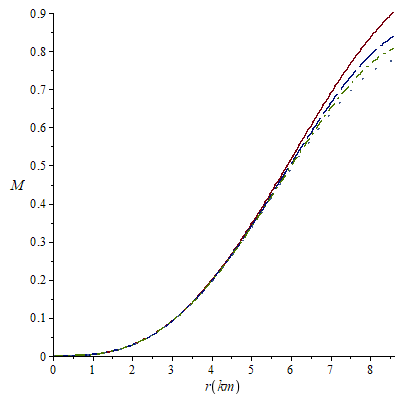
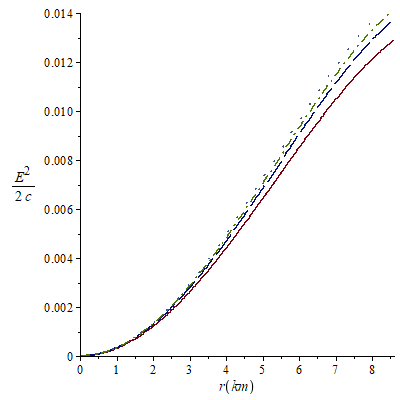
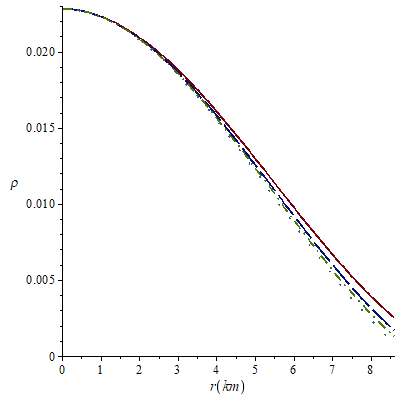
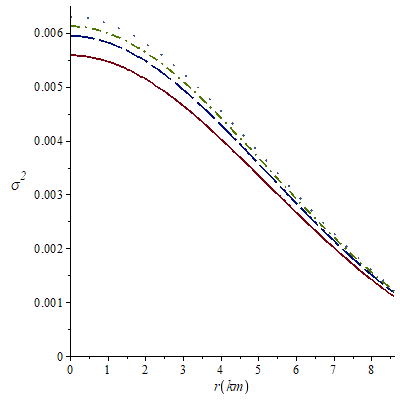
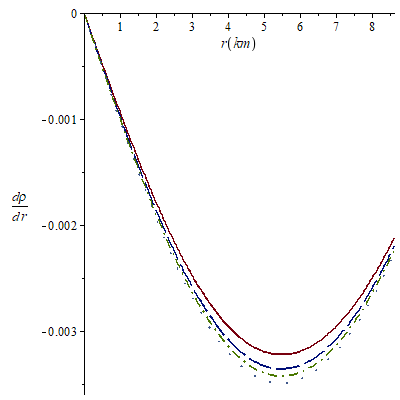
The behavior of mass function, electric field intensity and charge density with the radial parameter inside the star are presented in Figures 1-3 respectively. The Figures show that these physical variables are non-negative, the mass function and electric field are monotonically increasing throughout the fluid distribution while the charge density shows a decrease for all the chosen K values. Higher values of K mean an increase in electric field intensity and charge density, that is ˃ 0 for 0 ≤ r ≤ R, and a decrease in the values associated with the mass function. In Figure 4 is noted that energy density is monotonically decreasing and non- negative function and shows a decrease in density with the radial coordinate with an increase in the values of K. In the Figure 5 is shown that for the gradient density ˂ 0 with the radial parameter for all the values of K, which is a condition for the physical acceptability of the model.
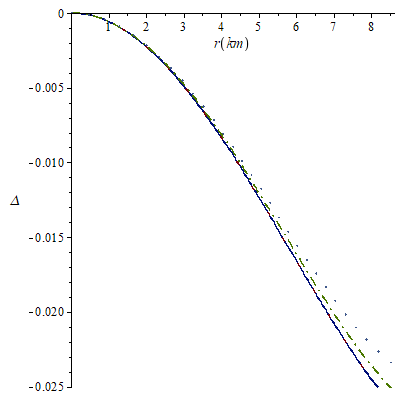
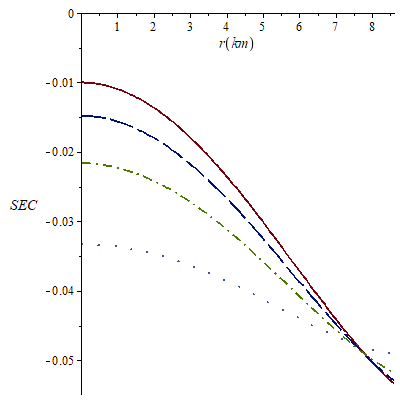
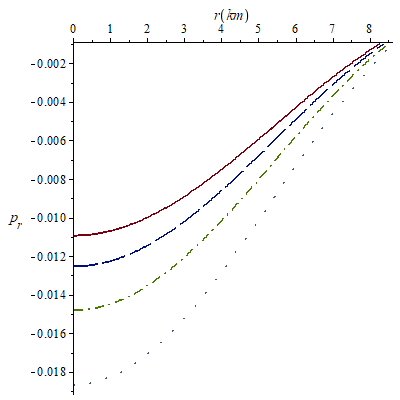
The Figures 6-8 show the dependence of , anisotropy Δ and strong energy condition (SEC) respectively with the radial coordinate for different values pf ω . In all the cases a=0.0031, b=0.0045, K=0.00034 and c=1. In Figure 6 the radial pressure is negative and not a decreasing function of the radial parameter and takes lower values when ω is increased. The anisotropy is plotted in Figure 7 and it shows that vanishes at the centre of the star, Δ(r=0)=0 and we can also note that Δ admits higher values with a decrease of ω for ω=-0.65 and ω=-0.82 . The Figure 8 shows that the strong energy condition is violated for all ω values considered.
We can compare the values calculated for the mass function with observational data of some astrophysical objects such as SAXJ1808.4-3658, 4U1538-52 and HerX-1 [67, 68, 69, 70, 71]. The values of the stellar masses for these compact stars are tabulated in Table 2.
| Compact Star | Masses M(M ) ʘ |
|---|---|
| SAXJ1808.4-3658 | 0.903 |
| 4U1538-52 | 0.87 |
| HerX-1 | 0.85 |
Table 4: The approximate values of the masses for the compact stars These masses will be expected to have quantum effects, since
Table 2: The approximate values of the masses for the compact stars These masses will be expected to have quantum effects, since per ongoing research of time and environment, the state of the clock affects environment vacuum oscillations, analogous to neutrino oscillations that change the flavor of the quark-gluon-plasma [72, 73, 74, 75]. The underlying mass effects on dwarf compact stars, similar to mass of white dwarfs [6], perhaps will rationalize variations of energy density, pressure, mass function, charge density, anisotropy, the electric intensity of field, demonstrated successfully above [76, 77, 78, 79, 80, 81, 82, 83, 84, 85, 86, 87, 88, 89, 90].
The possibility of the existence of dark energy, responsible for the accelerated expansion of the Universe, is a topic of great interest in theoretical physics. In this context, the generalization of the gravastar picture with the inclusion of an interior solution governed by the equation of state p=ρω with ˂ -1/3, will be denoted by a dark energy gravastar or dark energy star in agreement with the Chapline definition [89]. Another possible explanation can be deduced from Nojiri S, et al. [90] where the dark energy star equation of state was generalized to include an inhomogeneous Hubble parameter dependent term, possibly resulting in the nucleation of a dark energy star through a density perturbation.
Conclusion
- In this work we found new class of solutions which represents a potential model for dark energy stars considering Tolman IV-type metric potencial.
- The radial pressure, energy density, anisotropy, mass function, charge density and all the coefficients of the metric behaves well inside the stellar interior and are free of singularities - In this model, the consideration of dark energy star is applied only to the cases where parameter ω not satisfy the strong energy condition.
- The obtained solutions match smoothly with the exterior of the Reissner–Nordström spacetime at the boundary r=R, because matter variables and the gravitational potentials of this work are consistent with the physical analysis of these stars.
- The new models satisfy all the requirements for a compact negative energy stellar object and may be used to model relativistic configurations in different astrophysical scenes. We considered some known compact stars such as SAXJ1808.4-3658, 4U1538-52 and HerX-1 in order to verify observational data with the model proposed in this research. We have noted that the new stellar masses generated using the new model are in a range acceptable to realistic stars.
- Current findings of the James Webb Telescope of six earlier formed massive galaxies have lent proof of the quantum nature with anisotropic matter astrophysics associating dark energy stars. These are quite possibly mirroring manifestation of nature of time that recent studies show nonlinear time clocks due to vector and scalar aspects, modeled to tensor of rank more than four for time. Vector nature of time will be evident only in quantum and astrophysical level and not in mesoscopic level explicitly resultant of sense giving field effects to time, space, or time-space, or neither.
- The origin of the universe may have linkage to noisy superluminal general condensate, that may portray dark energy. With random process, distorted fields may arise, in essence noise generating signal probabilistically as logic: noise =>: :<= noise + signal. Evaporation of the noise generates signals, condensation of signal reverts as noise, thus eternal genesis and annihilation events may proceed forever in nature.
References
-
Kuhfitting PK (2011) Some remarks on exact wormhole solutions. Adv Stud Theor Phys 5: 365-367.
-
Bicak J (2006) Einstein equations: exact solutions. Encyclopaedia of Mathematical Physics 2: 165-173.
-
Schwarzschild K (1916) On the gravitational field of a sphere of incompressible fluid according to Einstein’s theory. Math Phys Tech pp: 424-434.
-
Tolman RC (1939) Static Solutions of Einstein’s Field Equations for Spheres of Fluid Phys Rev 55: 364-373.
-
Oppenheimer JR, Volkoff G (1939) On Massive Neutron Cores. Phys Rev 55: 374-381.
-
Chandrasekhar S (1931) The Maximum mass of ideal white dwarfs. Astrophys J 74: 81-82.
-
Sushkov S (2005) Wormholes supported by a phantom energy. Phys Rev D 71: 043520.
-
Lobo FSN (2005) Stability of phantom wormholes. Phys Rev D 71: 124022.
-
Lobo FSN (2006) Stable dark energy stars. Class Quant Grav 23: 1525-1541.
-
Bibi R, Feroze T, Siddiqui A (2016) Solution of the Einstein-Maxwell Equations with Anisotropic Negative Pressure as a Potential Model of a Dark Energy Star. Canadian Journal of Physics 94(8): 758-762.
-
Malaver M (2013) Black Holes, Wormholes and Dark Energy Stars in General Relativity. Lambert Academic Publishing, Berlin, pp: 1-65.
-
Morris MS, Thorne KS (1988) Wormholes in spacetime and their use for interstellar travel: A tool for teaching general relativity. Am J Phys 56: 395-412.
-
Visser M (1995) Lorentzian wormholes: From Einstein to Hawking. In: 1st (Edn.), AIP Press, New York, USA, pp: 412.
-
Chan R, da Silva MAF, Villas da Rocha JF (2009) On Anisotropic Dark Energy. Mod Phys Lett A 24: 1137- 1146.
-
Lobo FSN, Crawford P (2005) Stability analysis of dynamic thin shells. Class Quant Grav 22: 4869-4886.
-
Malaver M, Esculpi MA (2013) Theoretical Model of Stable Dark Energy Stars. IJRRAS 14(1): 26-39.
-
Malaver M, Esculpi M, Govender M (2019) New Models of Dark Energy Stars with Charge Distributions. International Journal of Astrophysics and Space Science 7(2): 27-32.
-
Malaver M, Kasmaei HD (2020) Analytical Models of Dark Energy Stars with Quadratic Equation of State. Applied Physics 3: 1-14.
-
Dayanandan B, Smitha TT (2021) Modelling of dark energy stars with Tolman IV gravitational potential. Chinese Journal of Physics 71: 683-692.
-
Malaver M, Iyer R, Kar A, Sadhukhan S, Upadhyay S, Güdekli E (2022) Buchdahl Spacetime with Compact Body Solution of Charged Fluid and Scalar Field Theory. Arxiv pp: 1-21.
-
Bhar P, Govender M (2019) Charged compact star model in Einstein-Maxwell-Gauss-gravity. Astrophys Space Sci 364: 186.
-
Gupta YK, Maurya SK (2011) A class of charged analogues of Durgapal and Fuloria superdense star. Astrophys. Space Sci 331: 135-144.
-
Kiess TE (2012) Exact physical Maxwell-Einstein Tolman-VII solution and its use in stellar models . Astrophys. Space Sci 339: 329-338.
-
Mafa Takisa P, Maharaj SD (2013) Some charged polytropic models. Gen Rel Grav 45: 1951-1969.
-
Malaver M, Kasmaei HD (2020) Relativistic stellar models with quadratic equation of state. International Journal of Mathematical Modelling & Computations 10: 111-124.
-
Malaver M (2017) New Mathematical Models of Compact Stars with Charge Distributions. International Journal of Systems Science and Applied Mathematics 2(5): 93-98.
-
Malaver M (2018) Generalized Nonsingular Model for Compact Stars Electrically Charged. World Scientific News 92(2): 327-339.
-
Ivanov BV (2002) Static charged perfect fluid spheres in general relativity. Phys Rev D65 104011 pp: 1-23.
-
Sunzu JM, Maharaj SD Ray S (2014) Quark star model with charged anisotropic matter. Astrophysics Space Sci 354: 517-524.
-
Sunzu JM (2018) Realistic Polytropic Models for Neutral Stars with Vanishing Pressure Anisotropy. Global Journal of Science Frontier Research: A Physics and Space Science 18(2): 1-14.
-
Komathiraj K, Maharaj SD (2007) Analytical models for quark stars. International Journal of Modern Physics D 16(11): 1803-1811.
-
Malaver M (2016) Analytical models for compact stars with a linear equation of state. World Scientific News 50: 64-73.
-
Bombaci I (1997) Observational evidence for strange matter in compact objects from the x- ray burster 4U 1820-30. Physical Review C 55(3): 1587- 1590.
-
Thirukkanesh S, Maharaj SD (2008) Charged anisotropic matter with a linear equation of state. Class and Quantum Gravity 25(23): 235001.
-
Dey M, Bombaci I, Dey J, Ray S, Samanta BC (1998) Strange stars with realistic quark vector interaction and phenomenological density-dependent scalar potential. Phys Lett B 438(1-2): 123-128.
-
Usov VV (2004) Electric fields at the quark surface of strange stars in the color-flavor locked phase. Physical Review D 70: 067301.
-
Feroze T, Siddiqui AA (2011) Charged anisotropic matter with quadratic equation of state. General Relativity and Gravitation 43: 1025-1035.
-
Thirukkanesh S, Ragel FC (2012) Exact anisotropic sphere with polytropic equation of state. Pramana Journal of physics 78(5): 687-696.
-
Malaver M (2013) Analytical model for charged polytropic stars with Van der Waals Modified Equation of State. American Journal of Astronomy and Astrophysics 1(4): 41-46.
-
Tello-Ortiz F, Malaver M, Rincón A, Gomez-Leyton Y (2020) Relativistic Anisotropic Fluid Spheres Satisfying a Non-Linear Equation of State. The European Physical Journal C 80(371).
-
Malaver M, Iyer R (2022) Analytical Model of Compact Star with a New Version of Modified Chaplygin Equation of State. Applied Physics 5(1): 18-36.
-
Malaver M, Iyer R (2023) Charged Stellar Model with Generalized Chaplygin Equation of State Consistent with Observational Data. Universal Journal of Physics Research 2(1): 43-59.
-
Esculpi M, Malaver M, Aloma E (2007) A Comparative Analysis of the Adiabatic Stability of Anisotropic Spherically Symmetric solutions in General Relativity. General Relativity and Gravitation 39: 633-652.
-
Cosenza M, Herrera L, Esculpi M, Witten L (1982) Evolution of radiating anisotropic spheres in general relativity. Physical Review D 25: 2527-2535.
-
Herrera L (1992) Cracking of self-gravitating compact objects. Phys Lett A 165: 206-210.
-
Herrera L, Nuñez L (1989) Modeling ‘hydrodynamic phase transitions’ in a radiating spherically symmetric distribution of matter. The Astrophysical Journal 339: 339-353.
-
Herrera L, Ruggeri GJ, Witten L (1979) Adiabatic Contraction of Anisotropic Spheres in General Relativity. The Astrophysical Journal 234: 1094-1099.
-
Herrera L, Jimenez L, Leal L, Ponce de Leon J, et al. (1984) Anisotropic fluids and conformal motions in general relativity. J Math Phys 25(11): 3274.
-
Malaver M (2014) Quark Star Model with Charge Distributions. Open Science Journal of Modern Physics 1(1): 6-11.
-
Malaver M (2014) Strange Quark Star Model with Quadratic Equation of State. Frontiers of Mathematics and Its Applications 1(1): 9-15.
-
Malaver M (2018) Charged anisotropic models in a modified Tolman IV space time. World Scientific News 101: 31-43.
-
Malaver M (2018) Charged stellar model with a prescribed form of metric function y(x) in a Tolman VII spacetime. World Scientific News 108: 41-52.
-
Malaver M (2016) Classes of relativistic stars with quadratic equation of state. World Scientific News 57: 70-80.
-
Sunzu J, Danford P (2017) New exact models for anisotropic matter with electric field. Pramana-J Phys 89(3): 1-9.
-
Bowers RL, Liang EPT (1974) Anisotropic Spheres in General Relativity. Astrophys J 188: 657-665.
-
Sokolov AI (1980) Phase transitions in a superfluid neutron liquid. Sov Phys JETP 52(4): 575-576.
-
Bhar P, Murad MH, Pant N (2015) Relativistic anisotropic stellar models with Tolman VII spacetime. Astrophys Space Sci 359(1): 13.
-
Feroze T, Siddiqui A (2014) Some Exact Solutions of the Einstein-Maxwell Equations with a Quadratic Equation of State. J Korean Phys Soc 65(6): 944-947.
-
Iyer R (2023) Algorithm it Quantitative Physics Coding Quantum Astrospace Timeline. Oriental Journal of Physical Sciences 8(2).
-
Iyer R (2024) An exact new solution of the Schrodinger equation with a zero potential energy analogous to Fick’s equation of diffusion. Physics & Astronomy International Journal 8(1): 59-63.
-
Iyer R (2023) Preliminary Results Genesis Distorted Fields Quantum Mechanism within Superluminal Quagmire. Canadian Journal of Pure and Applied Sciences 17(3): 5745-5760.
-
Iyer R (2000) Absolute Genesis Fire Fifth Dimension Mathematical Physics. Engineeringinc com International Corporation, pp: 63.
-
Durgapal MC, Bannerji R (1983) New analytical stellar model in general relativity. Phys Rev 27(2): 2-15.
-
Lighuda AS, Maharaj SD, Sunzu, JM, Mureithi EW (2021) A model of a three-layered relativistic star. Astrophys Space Sci 366(8): 76.
-
Mathias AV, Sunzu JM (2022) Regular quark star model with pressure anisotropy. Pramana J Phys 96(62): 1-10.
-
Fan YZ, Han MZ, Jiang JL, Dong SS, Shao PT (2024) Maximum gravitational mass MTOV= Mʘ inferred at about 3% precision with multimessenger data of neutron stars. Phys Rev 109(4): 4-15.
-
Razina O, Tsyba P, Meirbekov B, Ratbay M (2019) Cosmological einstein–maxwell model with g-essence. International Journal of Modern Physics D 28(10): 1950126.
-
Nabulsi RAE (2009) Maxwell brane cosmology with higher-order string curvature corrections, a nonminimally coupled scalar field, dark matter- dark energy interaction and a varying speed of light. International Journal of Modern Physics D 18(2): 289- 318.
-
Podolsky J, Papajcik M (2022) All solutions of einstein- maxwell equations with a cosmological constant in 2+1 dimensions. Phys Rev D 105(6): 6-15.
-
Iyer R, Oneill C, Malaver M, Hodge J, Zhang W, et al. (2022) Modeling of Gage Discontinuity Dissipative Physics. Canadian Journal of Pure and Applied Sciences 16(1): 5367-5377.
-
Markoulakis E, Konstantaras A, Chatzakis J, Iyer R, Antonidakis E (2019) Real time observation of a stationary magneton, Results in Physics 15: 102793.
-
Iyer R, Malaver M, Taylor E (2023) Theoretical to Experimental Design Observables General Conjectural Modeling Transforms Measurement Instrumented PHYSICS Compendium. Research Journal of Modern Physics 2(1): 1-14.
-
Malaver M, Kasmaei H, Iyer R (2022) Magnetars and Stellar Objects: Applications in Astrophysics. Eliva Press Global Ltd, Moldova, Europe, pp: 274.
-
Malaver M, Iyer R (2023) Some new models of anisotropic relativistic stars in linear and quadratic regime, International Astronomy and Astrophysics Research Journal 5(1): 1-19.
-
Malaver M, Iyer R (2022) Charged Dark Energy Stars in a Finch-Skea Spacetime. arXiv pp: 1-20.
-
Malaver M, Kasmaei H, Iyer R, Sadhukhan S, Kar A (2021) Theoretical model of Dark Energy Stars in Einstein- Gauss Bonnet Gravity. Applied Physics 4(3): 1-21.
-
Iyer R (2022) Quantum Physical Observables with Conjectural Modeling: Paradigm shifting Formalisms II: A Review. Oriental Journal of Physical Sciences 7(2): 50- 66.
-
Iyer R (2023) Algorithm of time preliminary theoretical results pointing to space geometry physics transforms. Canadian Journal of Pure and Applied Sciences 17(2): 5673-5685.
-
Iyer R (2023) Strong gravity versus weak gravity: fiber transforms gravity- bundle - strings: preliminary results. Canadian Journal of Pure and Applied Sciences 17(2): 5697-5703.
-
Falcon N (2023) Modified Gravitation and Mach’s Principle: An Alternative to the Dark Matter and Dark Energy Cosmological Paradigm. Open J of Astro 1(1): 000103.
-
Malaver M, Iyer R, Khan I (2022) Study of Compact Stars with Buchdahl Potential in 5-D Einstein-Gauss-Bonnet Gravity, Physical Science International Journal 26 (9-10): 1-18.
-
Caldwell RR, Dave R, Steinhardt PJ (1998) Cosmological Imprint of an Energy Component with General Equation of State. Phys Rev Lett 80(8): 1582.
-
Xu L, Lu J, Wang Y (2012) Revisiting generalized Chaplygin gas as a unified dark matter and dark energy model. Eur Phys J C 72: 1883.
-
Pourhassan B (2013) Viscous modified cosmic chaplygin gas cosmology. Int J Modern Phys D 22(9): 1350061.
-
Ray PS, Ransom SM, Cheung CC, Giroletti M, Cognard I, et al. (2013) Radio detection of the fermi LAT blind search millisecond pulsar J1311-3430. The Astrophysical Journal Letters 763(1): L13.
-
Ho WCG, Heinke CO, Chugunov A (2019) XMM-Newton detection and spectrum of the second fastest spinning pulsar PSR J0952-0607. The Astrophysical Journal 882(2): 128.
-
El-Nabulsi RA (2006) Phase transitions in the early universe with negatively induced supergravity cosmological constant. Chinese Physics Letters 23(5): 1124.
-
El-Nabulsi RA (2013) Nonstandard lagrangian cosmology. Journal of Theoretical and Applied Physics 7: 58.
-
Chapline G (2004) Dark energy stars. Proceedings of the 22nd Texas Symposium on Relativistic Astrophysics at Stanford, CA.
-
Nojiri S, Odintsov SD (2004) Inhomogeneous equation of state of the universe: Phantom era, Future singularity and crossing the phantom barrier. Phys Rev D 72(2): 023003.
- Early Universe: Hadronic Crystals Coherent Micro Gravitational Wave Emitters PHYSICS Part II
- The Solar System Constraint Maze: A Scientific Dead-End Revealing the Interuniversal Machine
- Assessment of Radiofrequency Radiation from 2G and 3G Mobile Phone Handsets
- Early Universe Magneto-Gravitational Coupling Genesis Physics: Part I
- Falsifiability of the Classical Law of Gravitation and Unveiling the Time-temperature Entanglement of the Universe
- Origin of Ancient Civilisations The Southern Hemisphere’ Scenario