
Non-Equilibrium Thermodynamics in the Non-Canonical Scalar Field Perturbed Space-Time: Stability Analysis
The space-time of the Universe has been perturbed under a scalar field ϕ considering the minimum coupling between and the background metric. The solutions of Einstein field equations have been obtained under perturbed geometry and the corresponding conservation equation shows the non-equilibrium thermodynamic prescription of the cosmic fluid. Following the stability criteria of the cosmic fluid along with the laws of thermodynamics, some constraints have been imposed on the choice of ϕ.
Introduction
The popular explanation for the recent cosmic evolution pattern is the introduction of cosmological constant Λ. Although it fits excellently with the observation, it suffers from two serious issues namely coincidence problem and cosmological constant problem from theoretical point of view [1, 2, 3]. Now it is claimed that the vacuum energy associated with Λ is not constant, rather it decays into the other matter components. In some models, Λ is replaced by some phenomenological choices for variable (time dependent) cosmological constant or cosmological scalar field φ to resolve the above the issues. In some models, the interaction between ϕ and the cosmic fluid has been interpreted as a non-equilibrium thermodynamic process with a dissipative cosmic fluid. Under such non-equilibrium thermodynamic prescription, various transport mechanism like particle creation, diffusion etc. have been assumed to set up the theoretical interpretation of the cosmic evolution pattern [4, 5, 6, 7, 8, 9, 10, 11, 12]. In most of the works, the effective energy- momentum tensor Tµυ is assumed to be the function of φ so that it wouldn’t effect the background, ( 1 2 R Rg g KT µν µν µν µν φ − + = , the dimension factor of φ has been chosen as unity for convenience) [13, 14]. In some cases, the Klein-Gordon equation of the usual cosmic fluid (the scalar field with canonical Lagrangian ( ) 1 2 L V µ µ φ φ φ = ∂ ∂ − ) has been modified under curved space-time ( also coupling with gravitational field) ( ) 2 0 m R ξ φ + + = Ω [15]. But all of such prescriptions have only one side of the gravitational effect on the system i.e. estimation of a modified cosmic fluid under gravity without changing the background space-time. In this work, I have shown the effective change in the background metric which leads to exhibit the non- equilibrium thermodynamic phenomena (particle creation- annihilation process) during the cosmic expansion.
The modification of the background space-time is found due to the coupling with a specific form of the matter source. Here the suitable matter source has been chosen in the form of a non-canonical scalar field from phenomenological arguments. The coupling with non-canonical scalar field leads to the perturbation in the background metric [16]. As per literature, there is possibly no model which describes the perturbation in space-time with canonical scalar field. In this work also, no change has been found in the original the metric due to coupling with a canonical field ( ( ) ( ) , L X V X φ = − is the canonical kinetic term). Hence it is reasonable to choose a non-canonical field because any source with canonical Lagrangian can at best add an extra source term with the energy-momentum tensor but it cannot change the background metric. These arguments have been comparatively shown in the Section - II.
The modification in the background metric effectively alters the dynamics (evolution dynamics and thermodynamics) of the cosmic fluid.
The Friedmann equations under the modified space- time yields the conservation equation (non- conservation) of the cosmic fluid under the non-equilibrium thermodynamic phenomena like particle creation. This work is such a model of perturbed space-time which leads to the non-equilibrium thermodynamic evolution of the Universe. Also considering the 2nd law of thermodynamics along with stability criteria of the cosmic fluid, some restrictions on ϕ have been made in this work.
Non-Equilibrium Thermodynamics of Cosmic Fluid in Scalar Field Perturbed Space-Time
Non-canonical scalar field is a general k-essence field with non-canonical kinetic term like ( ) ( ) , L T X V φ φ = − ) with T X ≠ where 1 2 uv X g µ ν φ φ = ∇ ∇ , the canonical kinetic term. The non-canonical scalar field ϕ minimally coupled to the background metric gµυ yields the action [16, 17, 18, 19, 20, 21, 22], ( ) 4 , , S g d x gL X κ µν φ φ = − ∫ (1) Here the energy momentum tensor is given by, X T L g L υ υ υ µ µ µ φ φ ∇ ∇ + = − (2) with X L L X ∂ = ∂ . Now applying variational principle, one can − = − find the equation of motion 1 1 0 kS δ δφ in the form, g
2 2 0 L L X X Gµ µ υ υ φ φ φ ∂ ∂ ∇∇ + − = ∂∂ ∂ (3)
1 µυ υ µυ µφ φ = + ∇
G L g L L L x X
∇ ∂ + ∂
X XX where 1 2 2
with ln 1 2 ln X
2
2 XX L L X ∂ = ∂
and obviously 1 2 ln 0 X In L X ∂ + > ∂
for a suitable and well defined Lagrangian. Hence, the inverse metric is given by,
1 2 ln 1 2 ln 2 2
υ υ µυ µυ µ µυ µ φ φ φ φ ∂ = + − = − ∇ ∇ ∇ ∇ ∂ + + (4) L L L L G L g g X L XL C L XL x XX X XX X x XX S x XX
1 2 ln 1 2 ln − ∂ = + ∂
where x S L C X
the sound speed. After a
conformal transformation, one gets the metric of perturbed space-time as [23, 24]
C L G G g L L XL µυ µυ υ µ υ µ φ φ = = − + ∇ ∇ (5)
S XX
2 X X XX In general a non-canonical scalar field has a general DBI-type of Lagrangian ( ) ( ) , 1 1 2 L X f X φ φ = − − . Gangopadhyay D, et al. [23] in several works, used such lagrangian for successful exhibition of emergent gravity and other phenomena [23, 24, 25, 26, 27]. Some modifications are also found in general DBI lagrangian for incorporating the effect of K-essence.
In this work, the nonlinear Dirac -Born- Infield type of Lagrangian has been chosen in the form ( ) ( ) 1 2 L m X φ υ φ = − − − . This form of lagrangian corresponds to the relativistic particle in Minkwoski space- time. For example 1 2 L m X = − − for free particle,
2 2 1 1 2 2 L m X mω φ = − − − for harmonic oscillator, etc. Hence,
one has the simplest form of perturbed metric as, G g µυ µυ µ υ φ φ = −∂ ∂ (6) Notably, for canonical Lagrangian ( ) L X υ φ = − , one has G g µυ µυ = (no change in original metric). Here the term perturbed metric has been used to mean the effective K-essence metric which is changed by some extra additive perturbing term from the original back ground. Here in this case, the perturbing metric has been found as, gµυ µ υ δ φ φ −∂ ∂ .
In this work, the background metric is chosen as a flat FLRW Universe [ ( )( ) ( ) 2 2 2 2 2 2 ds G dx dx dt a t dx dy dz witha t µ υ µυ = = − + + , with a(t) as the scale factor of the Universe] and hence the perturbed metric with minimally coupled scalar field can be found in the form ( ) 2 v ds G dx dx µ µυ = of equation (6),
2 . . . . 2 2 2 2 2 2 2 2 2 2 2 1 2 x y z x y z ds dt a dx a dy a dz dxdt dydt dzdt φ φ φ φ φφ φφ φφ = − − + + + + + − + + ( ) ( ) ( ) (7), xi and t xi φ φ φ φ ∂ ∂ = = ∂ ∂ . If the the scalar field φ is chosen to be the explicit function of i.e. ( )t φ φ = time only i.e. t φ φ = , then the perturbed metric can be simplified as, .
where
2 . 2 2 2 2 2 2 1 ds dt a dx dy dz φ = − − + + (8)
( ) Here for a well-defined space-time, 2 1 φ < must be followed.
One may apply Einstein field equation 1 8 2 R Rg GT µυ µυ µυ π − = (taking speed of light in vacuum c = 1) to obtain the evolution of the thermodynamic parameters of the cosmic fluid under perturbed space- time with Rµυ as Ricci tensor and R G R µυ µυ = being the Ricci scalar, G is the gravitational constant and can be taken as 1 for suitable scaling of unit. The energy - momentum tensor, ~ T G T α µυ αυ µ = is chosen as a perfect fluid and hence, ( ) , , , . T diag P P P α β ρ ρ = − − − and P are the density and pressure of the cosmic fluid respectively. Hence Einstein field equation yields the modified form of Friedmann equations, ( ) 2 2 3 8 1 H πρ φ = − (9) (10) ( )( ) 2 2 2 2 8 1 1 H H P φφ π ρ φ φ = = − − − − a H a = dH H dt = . The above modified friedmann equations (9) and (10) can also be written as (in the form of original Friedmann equations) with , Hubble parameter and
2 3 8 H πρ = and ( ) 2 8 H P P π ρ − = + + (11)
where ( ) ( ) 2 2 1 , 1 P P φ ρ ρ φ = − = − are the effective pressure and density respectively of the cosmic fluid in modified back ground.
2 1 4 1 P H φφ π φ = −
can be treated as a dissipative pressure term arisen due to the effect of perturbation with scalar-field φ . Hence the conservation equation of the modified thermodynamic state of the fluid can be found as, ( ) 3 0 H P P ρ ρ + + + = (12) where interestingly the original fluid sustains its conservation equation without any dissipation ( ) 3 0 H P ρ ρ + + = .
So, one can claim that under unperturbed space-time the cosmic fluid is a conservative fluid. But due to perturbation in space-time some extra degrees of freedom will be added with the original fluid and the effective fluid system becomes dissipative. Hence under perturbed Universe, even a conservative fluid may execute non-equilibrium thermodynamic phenomena (example- particle creation - annihilation process) under suitable conditions.
Effectively, such a system can be treated as a two fluid system with a non-dissipative barotropic fluid ( with density ρ) and a dissipative barotropic fluid ( with density ( ) 2 φ ρ ρφ = − ) of same barotropic index ω (say). Hence, φ ω ρ ρ ρ = = = ( ) ( ) P P P φ and also the effective density of the combination of the two fluids is additive i.e. ( ) ( ) . φ φ ρ ρ ρ ρ = + is the energy density of the extra added degrees of freedom induced by the perturbation. The two fluids satisfy the individual conservation relation as, ( ) 3 1 0 H ρ ω ρ + + = (13a) (13b) ( ) φ φ ρ φ ω ρ φ ∂ + + − = ∂ ( ) ( ) 3 1 2 0 H t Now equations (13a) and (13b) along with equation (11) yield ( ) 3 2 3 2 3 2 2 0 0 a aa a a ω γ ρ φφ − + − + = (14) ( ) where ( ) 1 γ ω = + and ( ) 0 0 0 , t t t ρ ρ = = being a reference epoch of time. The equation (14) can also be written in terms of Hubble parameter as, (15)
2 2 2 3 2 0 1 H H H φφ γ φ + + = −
Particle Creation Mechanism
The non-equilibrium thermodynamics of cosmic fluids can be described as particle creation- annihilation process. Lima JAS, et al. [28] introduced an unknown non-collisional term Pg as an extra source term in Boltzman equation to incorporate the effect of gravitation induced particle creation process.
( ) g f f p p p C f p x p
µ µ α β αβ µ µ ∂ ∂ −Γ = + ∂ ∂
(16) where µ αβ Γ are christoffel symbols and C(f ) is the total collisional term. The above boltzman equation (16) describes the evolution of phase space density ( ) , f x p µ µ (here µ = 0, 1, 2, 3). The particle number density is related to f as g n f x p d p µ µ π = ∫ (17) ( ) ( ) 3 3 , 2 with g, the number of spin degrees of freedom. Under mass shell condition, f can be taken independent of temporal momentum (p0) i.e. ( ) , i f f x p µ − = with i = 1, 2, 3. Hence the equation (16) can be assumed in simplified form under unperturbed space-time as, ( ) 0 0 0 i g i f f p Hp p C f p x p − − − − ∂ ∂ − = + ∂ ∂ (18)
0 p E −= and i i p ap − − = . Following Lima’s intuition [28]
Here
3 g i f P p p H p
µ α β αβ λ Γ ∂ = − Γ ∂
, one gets
3 1 3 f f H p t H p ∂ Γ ∂ = − ∂ ∂ (19)
after neglecting the collisional term C(f ). Γ is the particle creation rate. Now following equation (17), one has the particle number non-conservation equation
3 1 0 3 n H n H Γ + − = (20)
In this work, an attempt is taken to incorporate the particle creation process in the boltzman equation without introducing any extra source term. Instead of taking any intuition, Boltzman equation has been simplified under perturbed geometry (equation (8)) and one finds ( ) 2 3 1 f f E H p C f t t φ ∂ ∂ − − = ∂ ∂ (21) Now imposing equation (17), one finds
3 2 3 3 1 2
dn g d p H n f dt E φ π + − = ∫ (22)
( ) ( ) Here also neglecting the effect of collisional term, the particle number non-conservation equa- tion can be written as,
2 3 1 0 dn H n dt φ + − = (23)
Clearly the effect of perturbation leads to the dissipation in particle number conservation with particle creation rate ( ) 2 3 1 1 H φ φ Γ = − − − . Also comparing with Lima’s intuition, one may relate the scalar field with the extra particle creation source term in perturbed space-time as ( ) ( ) 2 1 1 g i f p p µ β αβ φ λ φ ∂ Ρ = − − − Γ ∂ (24) Hence the gravitation induced particle creation process can be assumed as a result of perturbation of underlying space-time by a scalar field. Hence these phenomena can be termed as scalar field induced particle creation mechanism.
Emergence of Cosmic Space and Entropy Correction, 2nd Law of Thermodynamics
The effect of the scalar field on the entropy of the system (Universe) will be studied through the Padmanabhan’s equation regarding the emergence of cosmic space. In the present context, the energy density is taken additive hence the degrees of freedom will also be additive following the equipartition law of energy. Therefore the original equation for an expanding system [29, 30] ( ) Surrounding Bulk dv dt N N α − is modified for a two fluid system as, ( ) ( ) ( ) Surrounding Surrounding Bulk Bulk d N N N N dt φ φ ν = − − + (25) taking the proportionality constant as unity. Here the degrees of freedom on the surface of the Hubble sphere,
4 , Surrounding N S S = being the entropy on the horizon and
2 / E Bulk N Komar T = , is the degrees of freedom in the bulk of the unperturbed system. The terms Surrounding N φ and ( ) Bulk N φ are the extra degrees of freedom on the surface and in the bulk respectively arisen due to the scalar field.
Now, the komar energy of the original fluid, ( ) 3 4 / 3 3 1 / EKomar P H π ρ = − + , the horizon temperature,
2 / T H π = and hence one may find from the equations (9) and (25),
4 4 3 4 3 Surrounding Bulk a H N N P a π ρ π − = − + + (26) ( )
For the effective dissipative fluid, one can also take, ( ) ( )
φ Bulk E N P P T H
2
4 16 2 3 3 φ φ π = = − + (27)
( ) ( ) Komar Hence one obtains the form of ( ) Surrounding N φ from equations (10), (26) and (27) as,
3 2 4 . 1 Surrounding N H
φ π φφ φ = −
( ) (28) Now the effective entropy of the system is found as, + = = + − ( ) φ φφ Surrounding Surrounding eff N N S S H ( ) 2 1 4 1 (29) φ where S π = is the entropy of the unperturbed Universe. In the present context, the scalar field Lagrangian is assumed like a relativistic free particle as
2 1 L m φ = − − (30)
where m is the mass of the particle. Hence from equation (3), one finds for the Lagrangian of equation ( ) 2 3 0 1 H φ φ φ + = − (31) Therefore the effective entropy of the Universe in such condition will be, ( ) 2 1 3 eff S S φ = − (32) To satisfy the 2nd law of thermodynamics 0 eff S > , one has
2 6 0 1 3 S S φφ φ − > −
(33) The above equation (33) can also be written asper equation (31) as ( ) 2 2
2 1 9 0 1 3 H H H
φ φ − − > −
(34) φ Now from equation (15) and (31), equation (34) is found as ( ) 2 2
2 2 1 3 2 1 3
φ φ γ φ φ − − < −
(35) Hence one may constrain the value of φ as
1 3 7' F ω ω + < +
(36) where 2 F φ =
Thermodynamic Aspects of Scalar Field: Stability Analysis
The thermodynamic features of a cosmic fluid depend on the sign of the thermodynamic derivatives like specific heats (Cp, Cv), compressibilities (Ks, KT) and expansibility (α) of that fluid [31, 32]. Within an isolated system which undergoes thermodynamic work done due to the continuous expansion of volume, a stable fluid must possess the positive values of all these thermodynamic derivatives i.e.
, ,K ,K , 0 p T S C Cυ α ≥ (37)
Specific Heats of Cosmic Fluid
The specific heats of a fluid can be obtained from the relations E h C C T T υ υ ∂ ∂ = = ∂ ∂ , P P (38) where E ρυ = , total internal energy of the fluid and ( ) 1 h E PV E ω = + = + , enthalpy of that fluid. T is the absolute temperature of the universe. From equation (13a), one has the solution of energy density of the conservative fluid as, ( ) 3 1 0_a_ ω ρ ρ − + = (39) with ( ) 0 0 0 . t t ρ ρ = is a reference epoch of time with ( ) 0 1 a t = . Hence the expression of ρ˜ can be found as ( ) ( ) 3 1 2 0 1 a ω ρ φ ρ − + = − (40) The above equation (40) can be written in the differential form as ( ) ( ) 2 ln 1 ln ln 1 d d d ρ ω υ φ = − + + − (41)
3 0 v v a = , is the volume of the universe with ( ) 0 0 v v t t = = , volume of the universe at reference epoch. Again asper first law of thermodynamics and idea of entropy, one has where ( ) 1 d dS dT d T dT T υ ρ ρ ω υ = + + (42)
Considering entropy S as state variable of volume (v) and temperature (T), one finds
1 ln ln d T d ω ρ ω + = (43)
Therefore, it is found from equations (41) and (43),
( ) 2 ln ln ln 1 1 d T d ω ω υ φ ω = − + − + (44)
Again from equations (41) and (44), one obtains the evolution of energy with temperature as,
1 2 1 0 0 1 T E E T
( ) ω φ + = −
(45) with ( ) 0 0 E E t = and ( ) 0 0 T T t = . Now, One has the time evolution of temperature of universe under particle creation mechanism as, ( ) 3 0 T H T ω + −Γ = (46)
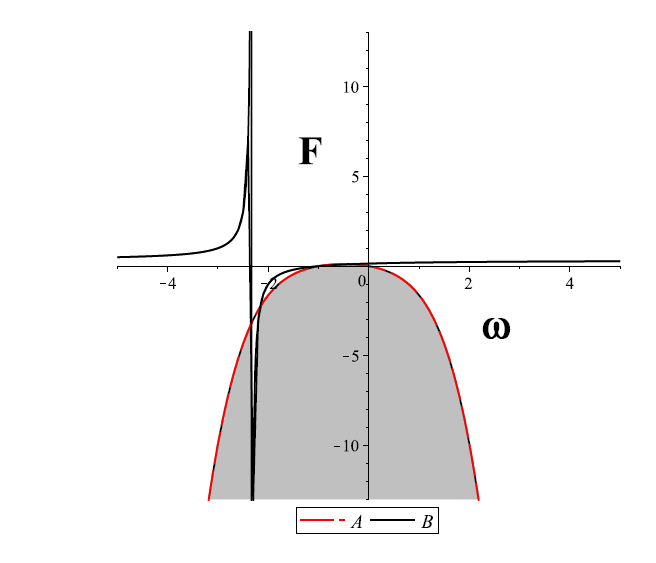
` Figure 1: Stability region for ( ) 2 1 1 , : , : 2 3 7 1
+ + = = = + − , The shaded ω ω ω φ ω F F A B F F
area for 0 ω > represents the stability region for φ .
Hence in the present context, one finds from equations (23) and (46),
2 3 1 T H T ω φ = − (47)
Therefore one can estimate the specific heats at constant volume (Cv) and at constant pressure (CP) of the fluid in the form from equations (38), (45) and (47) as, = = + + + −
2 , 1 ln 3 1
P E d C C C F d T H
υ υ φφ ω ω ω φ ( ) ( )
(48)
3 2 2 From equation (31) CP can be simplified for relativistic free particle as,
2 ( )
| ω | 1−φ2 |
|---|
which eventually yields following the condition of equation (44)
2 (50) ( ) ( )
| ω | 1−φ2 |
|---|
Compressibility and Expansibility of the Cosmic Fluid
Considering the volume (v) of a system as a function of temperature (T) and pressure (P), one has T d dT K dP υ υα υ = − (51)
1 T P K T υ υ ∂ = − ∂ ,
with 1 P T υ α υ ∂ = ∂
, the expansibility and the isothermal compressibility. So, one may write P K T υ α ∂ = ∂ (52) T Following P C T υ υ ω = , one has = + = + − + − + ( ) 2 1 ln 1 ln 1 ln 3 ln ln 1 1 d d T d T T d a d ω ω α ω ω ω ω φ ω (53) From equation (52), it can be easily found that αυ ω = (54) T K Cυ Note that there is a well-known thermodynamic relation between specific heats and compressibilities as K C K C
ν = (55) s T P
Hence, one also has from equations (54) and (55),
s P K C αυ ω = (56)
Constraints on Scalar Field from Stability Analysis
For the cosmic fluids with constant barotropic index (ω), the expressions of α and Cp can be simplified as,
2 ( ) (57)
| ω | 1−φ2 |
|---|
Clearly following the stability conditions of equation (37), one can impose the constraint on ϕ as, ( ) 1 ω ω + ≤ − F (58)
2 1 F and also ω > 0 . The condition of equation (36) according to the 2nd law of thermodynamics must also be followed by scalar field in the stable scenario. Hence equations (36) and (58) con- straints the stability region of the scalar field. These two conditions are represented graphically and the stability region has been displayed in Fig-1. It is clear that the stable region belongs the negative values of 2 φ.
Discussion
This work accomplishes a successful attempt to correlate the dynamics of a non-canonical scalar field fluid and the non-equilibrium thermodynamic mechanism. Generally, the cosmic evolution pattern (especially the late time acceleration) is explained under the non-equilibrium thermodynamic expansion of the cosmic fluid system. These explanations are mostly based on the phenomenological choices of the dissipative cosmic fluid. The non-conservative term in the continuity equation of the dissipative cosmic fluid is assumed to govern the non-equilibrium thermodynamics (i.e. particle creation-annihilation mechanism, diffusion etc). But there is neither any firm argument/evidence behind the existence of such dissipative cosmic fluid nor any mechanism which can transform the usual cosmic fluid in to a dissipative one.
In this work, I have shown how these non-equilibrium thermodynamic processes may occur with a non-canonical scalar field cosmic fluid. The novel aspect of this work is the non- equilibrium thermodynamic mechanism from the alteration of the background metric. The usual fluid will be transformed into a dissipative one in a modified back ground due to the interaction with a non-canonical fluid. Importantly the thermodynamic aspects associated with the evolution of perturbed space-time also has been analysed and some restrictions have been imposed on ϕ for thermodynamically well behaved cosmic evolution pattern. The key outcomes of this model is that the space-time perturbed with real scalar field never be thermodynamically stable. Only complex scalar field following the restrictions may be the suitable candidate for thermodynamically stable Universe. Also the dark energy (ω < 0) with constant equation of state will not be thermodynamically stable in perturbed universe and this result agrees with previous works on stability criteria of cosmic fluid [31, 32] finally, it is hoped that the phenomenological choices for complex ϕ (obeying the restrictions) may have the possible answers to the recent observational data of cosmic evolution scenario.
Acknowledgements
The author SM acknowledges UGC for awarding Research fellowship and also thanks Prof. Subenoy Chakraborty, Dept. of Mathematics, J.U. for his valuable suggestions.
Data Availability
It is the author’s intention to make the data that have been used to determine this result and publish this article as free and easily available as possible to permit readers to reproduce these results.
References
-
Steinhardt PJ (2003) A quintessential introduction to dark energy. Phil Trans Roy Soc Lond A 361(1812): 2497.
-
Weinberg S (1989) The cosmological constant problem. Rev Mod Phys 61(1).
-
Padmanabhan T (2003) Cosmological constant—the weight of the vacuum. Phys Rept 380(5-6): 235-320.
-
Perez A, Sudarsky D, Wilson-Ewing E (2021) Resolving the H0 tension with diffusion. Gen Rel Grav 53(1): 1-12.
-
Benisty D, Guendelman EI (2017) Interacting diffusive unified dark energy and dark matter from scalar fields. Eur Phys J C 77(6): 396.
-
Benisty D, Guendelman E, Haba Z (2019) Unification of dark energy and dark matter from diffusive cosmology. Phys Rev D 99(12): 123521.
-
Franchi J, Le Jan Y (2007) Relativistic diffusions and Schwarzschild geometry. Comm Pure Appl Math 60(2): 187-251.
-
Hermann J (2010) Diffusion in the general theory of relativity. Phys Rev D 82(2): 024026.
-
Maity S, Chakraborty S (2021) Continuous cosmic evolution with diffusive barotropic fluid: First-order thermodynamic phase transition. International Journal of Modern Physics A 36(29): 2150199.
-
Calogero S (2011) A kinetic theory of diffusion in general relativity with cosmological scalar field. JCAP 11: 016.
-
Calogero S (2012) Cosmological models with fluid matter undergoing velocity diffusion. J Geom Phys 62(11): 2208-2213.
-
Haba Z (2010) Relativistic diffusion with friction on a pseudo-Riemannian manifold. Class Quant Grav 27(9): 095021.
-
Maity S, Chakraborty S (2022) Is Cosmic Evolution Process with Diffusive Fluid Equivalent to a Heat Engine. IJMPA37 3: 9.
-
Maity S, Chakraborty S (2021) Continuous cosmic evolution with diffusive barotropic fluid: First-order thermodynamic phase transition. IJMPA 36(29): 2150199.
-
Pimentel LO, Pineda F (2021) Particle creation in some LRS Bianchi I models. Gen Rel Grav 53(7): 62.
-
Vikman A (2007) K-essence: Cosmology, causality and Emergent Geometry, Dissertation at the Faculty of Physics, Arnold Sommerfeld Center for Theoretical Physics, the Ludwig Maximilian University of Munich, Munchen, pp: 1-119.
-
Babichev E, Mukhanov V, Vikman A (2006) Escaping from the black hole. JHEP 09: 061
-
Babichev E, Mukhanov V, Vikman A (2008) k-Essence, superluminal propagation, causality and emergent geometry. JHEP 0802: 101.
-
Akhoury R, Gauthier CS, Vikman A (2008) Stationary configurations imply shift symmetry: no Bondi accretion for quintessence/k-essence. Journal of High Energy Physics 2009: 1-17.
-
Chimento LP (2004) Extended tachyon field, Chaplygin gas, and solvable k-essence cosmologies. Phys Rev D 69(12): 123517.
-
Visser M, Barcelo C, Liberati S (2002) Analogue Models of and for Gravity. Gen Rel Grav 34: 1719-1734.
-
Scherrer RJ (2004) Purely Kinetic 𝑘 Essence as Unified Dark Matter. Phys Rev Lett 93(1): 011301.
-
Gangopadhyay D, Manna G (2012) The Hawking temperature in the context of dark energy. Eur Phys Lett 100(4): 49001.
-
Gangopadhyay D, Manna G (2014) The Hawking temperature in the context of dark energy for Reissner– Nordstrom and Kerr background Eur Phys Lett 74: 2811.
-
Born M, Infeld L (1934) Foundations of the new field theory. Proc Roy Soc Lond A 144(852): 425.
-
Manna G (2020) Gravitational collapse for the K-essence emergent Vaidya spacetime. Eur Phys Lett 80(9): 813.
-
Manna G, Mazumder B, Das A (2020) Thermodynamics for the k-essence emergent Reissner–Nordstrom–de Sitter spacetime. Eur Phys Lett 135(1): 107.
-
Lima JAS, Baranov I (2014) Gravitationally Induced Particle Production: Thermodynamics and Kinetic Theory. Phys Rev D 90(4): 043515.
-
Chang-Young E (2016) Friedmann equation and the emergence of cosmic space. PoS FFP 14: 077.
-
Yang K, Liu YX, Wang YQ (2012) Emergence of cosmic space and the generalized holographic equipartition. Phys Rev D 86: 104013.
-
Barboza EM, Nunes RC, Abreu EMC, Neto JA (2015) Thermodynamic aspects of dark energy fluids. Phys Rev D 92(8): 083526.
-
Maity S, Bhandari P, Chakraborty S (2019) Universe consisting of diffusive dark fluids: thermodynamics and stability analysis. Eur Phys J C 79(1): 82.
- Early Universe: Hadronic Crystals Coherent Micro Gravitational Wave Emitters PHYSICS Part II
- The Solar System Constraint Maze: A Scientific Dead-End Revealing the Interuniversal Machine
- Assessment of Radiofrequency Radiation from 2G and 3G Mobile Phone Handsets
- Early Universe Magneto-Gravitational Coupling Genesis Physics: Part I
- Falsifiability of the Classical Law of Gravitation and Unveiling the Time-temperature Entanglement of the Universe
- Origin of Ancient Civilisations The Southern Hemisphere’ Scenario