
India's Breakthrough in Triple Star System Research: A New Era in Planetary Science
India has achieved a landmark in astronomical research by uncovering critical details about GG Tau A, a rare triple-star system approximately 489 light-years away. Spearheaded by Dr. Liton Majumdar at NISER, Odisha, the discovery sheds light on how planets form under complex gravitational conditions. This research not only elevates India’s stature in global astrophysics but also contributes significantly to the understanding of planetary evolution in multi-star environments.
Editorial
India has achieved a landmark in astronomical research by uncovering critical details about GG Tau A, a rare triple-star system approximately 489 light-years away. Spearheaded by Dr. Liton Majumdar at NISER, Odisha, the discovery sheds light on how planets form under complex gravitational conditions. This research not only elevates India’s stature in global astrophysics but also contributes significantly to the understanding of planetary evolution in multi-star environments.
Unveiling the Triple-Star Enigma
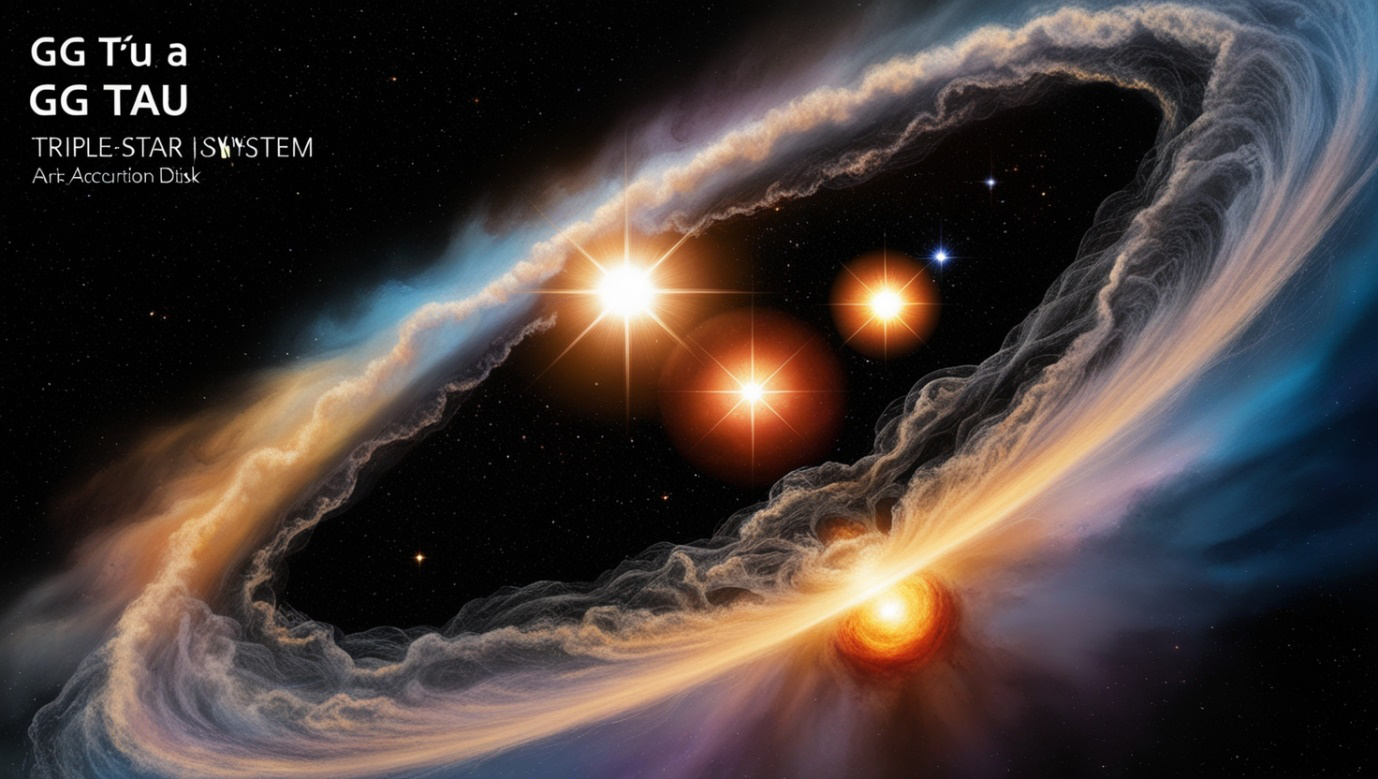
GG Tau A is no ordinary star system. Unlike the Sun’s solitary existence, it comprises three gravitationally interlinked stars. Such configurations are rare, making GG Tau A, a valuable subject for studying the intricate dynamics of planetary formation. Its youth—estimated between 1 and 5 million years—offers a unique snapshot of the early stages of star and planet development. At its heart lies a protoplanetary disk of gas and dust, whose behaviour is shaped by the gravitational interactions of all three stars.
The Role of Icy Regions in Planet Formation
Observations using state-of-the-art radio telescopes in Chile’s Atacama Desert focused on the disk’s cold zones, with temperatures plummeting to 12–16 Kelvin. These icy regions enable molecules like carbon monoxide to freeze onto dust grains, forming the building blocks of planets. The team highlighted the importance of such extreme conditions for dust particles to stick together, eventually growing into planets. This research underscores that multi-star systems can host unique environments conducive to planet formation, even under gravitational stress.
India’s Growing Space Legacy
This discovery comes as India continues its impressive strides in space exploration. Following the Chandrayaan-3 and Aditya-L1 missions, which underscored India’s prowess in lunar and solar studies, this breakthrough positions the country as a leader in deep-space research. The GG Tau A project also reflects India’s growing contribution to international scientific collaborations, utilizing global observatories to address fundamental questions about the universe.
Global Significance and International Perspectives
The international scientific community has lauded India’s achievement as a milestone in understanding planetary diversity. Historically, most exoplanetary studies focus on single-star systems, like our solar system. By probing the dynamics of multi-star systems, India is helping rewrite existing models of planetary evolution. Esteemed astrophysicists globally have recognized the implications of this discovery for studying exoplanets in binary and trinary systems, which could harbour unique types of worlds unlike anything seen before.
Strengthening India’s Space Vision
India’s space missions, managed by ISRO and institutions like NISER, align with its broader vision to explore the universe and inspire technological innovation. Projects like Gaganyaan and upcoming deep-space probes demonstrate a commitment to extending human understanding of space, underpinned by cost-efficient, high-impact science. These missions, complemented by achievements like the GG Tau A discovery, are reshaping how India is perceived in the global scientific arena.
A Paradigm Shift in Planetary Science
This discovery is not merely a national achievement but a vital contribution to global astronomy. By decoding the physics of multi-star systems, India is paving the way for new frontiers in exoplanetary studies and potentially identifying environments where life could emerge. GG Tau A exemplifies the diversity of the cosmos and the innovative spirit driving India’s space endeavours (Figure 1).
- Early Universe: Hadronic Crystals Coherent Micro Gravitational Wave Emitters PHYSICS Part II
- The Solar System Constraint Maze: A Scientific Dead-End Revealing the Interuniversal Machine
- Assessment of Radiofrequency Radiation from 2G and 3G Mobile Phone Handsets
- Early Universe Magneto-Gravitational Coupling Genesis Physics: Part I
- Falsifiability of the Classical Law of Gravitation and Unveiling the Time-temperature Entanglement of the Universe
- Origin of Ancient Civilisations The Southern Hemisphere’ Scenario