
Immutable Universe in which the Big Bang Occurred Resolution of the Singularity and of the Origins of Gravity of Dark Energy and Dark Matter
In this paper, we presented a new cosmological model referred as Immutable Universe U0 in which the Big Bang probably occurred. The singularity is well resolved and the origins of time, of dark energy and of dark matter and the cause of the expansion of the Universe are enlightened. In addition, the origin of gravity is pointed out. The possible existence of "nonluminous" black photons moving in U0 at the speed cd>c (speed of the light) that may explain possible conversion of dark energy to dark matter and vice versa is also discussed. The content of this work may be of great interest to cosmologists who focus their research on the origins of dark energy and dark matter along with their relationship to the expansion of our Universe and on the multiverse theory. Note that none of our current laws can explain the properties of dark matter in the U0 Universe. The reason is that our laws only govern the behavior of ordinary matter in the Universe born after the Big Bang. We therefore need to invent new laws of physics that will incorporate the existence of dark photons propagating at the speed of cd>c.
Abbreviations
CDM: Cold Dark Matter; IAU: International Astronomical Union.
Introduction
In 1913, the American astronomer Vesto Melvin Slipher (1875-1969) observed first the extraordinary radial velocities of the spiral nebulae, as revealed by the enormous “red shifts” of the absorption lines in their spectra [1]. He showed that the Andromeda Nebula is approaching the solar system at an average speed of 300 km/s. He devoted much of his time to this type of study, in order to verify whether all spiral nebulae have such rapid displacements [2, 3]. This discovery of Slipher provided the first evidence for the now widely held theory of an expanding universe. In 1922, the Russian physicist and mathematician Alexander Friedmann (1888-1925) first published a theory of the expansion of the universe in his popular science book published in the German journal Zeitschrift für Physik. This work constitutes in the history of cosmology, the first popularized formulation of the concepts of expanding or contracting universes and cosmic singularity [4]. In 1927, the Belgian astrophysicist Lemaitre G [5] wrote his paper entitled "A homogeneous universe of constant mass and increasing radius, accounting for the radial velocity of extragalactic nebulae" [5]. Lemaitre thus linked the expansion of the universe resulting from cosmological solutions of general relativity and observations on the escape velocity of extragalactic nebulae. Lemaitre G [5] proposed the hypothesis of the "primitive atom" to explain the origin of the Universe by introducing the Notion of zero moment. For him, if the universe is expanding today, in the past, it was much denser, one distant day. Revised and corrected over time, this conception became the Big Bang theory [4, 6].
**Main Experimental Facts that have led to the Validation of the Big Bang Model**
Beginning in 1920, the American astronomer Hubble E [7] began observing the redshift of the spectrum of one of several galaxies using the Hooker telescope at the Mount Wilson Observatory in California.
Hubble E [7] observed that the different points are distributed approximately on a line [7]. He then showed that the variation of the velocity with the distance is linear according to the law:
$$v = H_0 d$$
[1]
This law expresses the fact that the Universe is expanding. This suggests that it had an origin that was later called the Big Bang. In this law, H0 denotes the Hubble constant. The subscript « 0 » is used to indicate the value of the constant at the present time. Hubble E [7] own measurement of his constant gave the value $H_0 = 558$ km/s/Mpc. This leads to an age of the Universe too short (2 billion years) compared to the geological estimate of the age of the Earth (located at about 3.5 billion years) [6].
The constant $H_0$ was first estimated at Palomar Observatory in California in 1958 by American astronomer Allan Sandage (1926-2010). He found the value $H_0 = 75$ km/s/Mpc [8]. In 2001, this value was estimated at $H_0 = 72 \pm 8$ km/s/Mpc [9]. Today, calculation models give the value $H_0 = 67.9 \pm 1.5$ km/s/Mpc [10] or $H_0 = 70$ km/s/Mpc [11]. This last value of the Hubble constant then means that the Universe extends 70 km per second faster every 3.263 million light-years (since 1Mpc = 3.263 light-years).
In 1927, Lemaitre G [5] had shown that galaxies move away from each other at a speed approximately proportional to their distance. For this reason, Hubble's law [1] was renamed the Lemaire-Hubble law at the 30th General Assembly of the International Astronomical Union (IAU) held from 20 to 31 August 2018 in Vienna, Austria.
The Big Bang model thus rejects the second cosmological model based on steady-state theory proposed in the late 1940s by British astronomers Hoyle F [12], Austrian Gold T, et al. [13] and Austro-British Bond H, et al. [12, 13]. This cosmological model of Hoyle-Gold-Bondi assumes that the Universe is eternal and immutable, is unable to account for many astrophysical observations such as the existence of the cosmic microwave background (CMB), the abundance of chemical elements in the universe (that of He in particular: the composition of all stars is close to H (80%), He (18%), other elements 2%), the end of stars (case of the Sun), the end of the Universe, etc. Hoyle F [12], with his strong personality, was not kind to his scientific opponents [12, 13]. At a meeting in Pasadena in 1960, he mocked Lemaitre G [5] by welcoming him with these words: "This is the Big Bang man." Hoyle will however bring double water to the mill of the Big Bang theory: first by finding his name (which for him was a sign of derision), and more seriously by helping to solve the question of the abundance of chemical elements in the Universe [4].
In 1965, the discovery of the CMB by American physicists Penzias AA, et al. [14] was the decisive argument in favor of the Big Bang theory [14]. CMB is microwave radiation ($\lambda = 30$ cm (1 GHz) to 1 mm (300 GHz)] very homogeneous at 2.7 K and has bathed the Universe for about 13.8 billion years and cools during its expansion. Note that the existence of the CMB was predicted in 1948 by the Russian physicist and astronomer naturalized American Georges Gamow (1904-1968) and the American cosmologists Ralph Asher Alpher (1921-2007) and Robert Herman (1914-1997). Working on a model of a hot Big Bang, they put forward the hypothesis of a primordial universe composed only of neutrons (which would later decay into protons). Using material density estimates of the time, they estimated the temperature of the CMB at 5K [6]. Thus, from 1965, cosmologists admire that the Universe was born from a great explosion (Big Bang) of the primitive atom of Lemaitre about 13.8 billion ago.
Figure 1 provides a brief description of the timeline of the evolution of the Universe after the Big Bang.
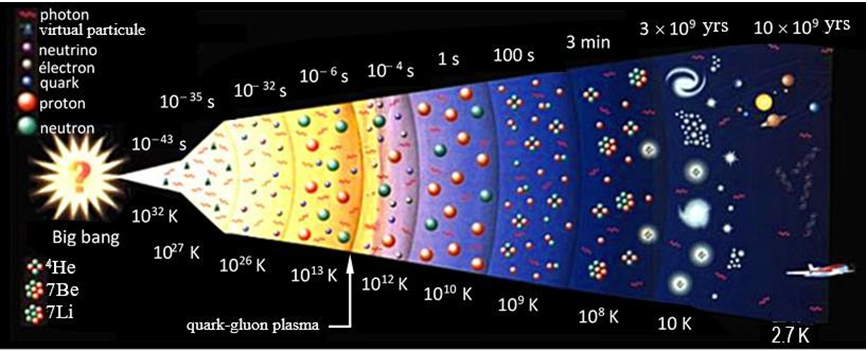
As shown in Figure 1, there is a question mark stating that our Universe was indeed born at an “instant 0” predicted by Lemaitre G [5] and that we now call Big Bang or initial singularity. But a paradox remains: we cannot speak of an initial moment since this “moment” time does not exist in the same way as space. This is the great weakness of the Big Bang model that we seek to elucidate in this work. What happened before? No one has the answer. In the following, we give a summary of the main ideas on the immutable Universe we developed during our recent conference at the University Gaston Berger of Saint-Louis in Senegal [15].
Model of the Immutable Universe in which the Big Bang Occurred, Resolution of the Singularity
The question mark admitted by many cosmologists’ means that our Universe was born at an “instant 0” predicted by Lemaitre G [5] and which is now called Big Bang or initial singularity. But a paradox remains: we cannot speak of an initial moment since this “moment” time does not exist as well as space. This is the great weak point of the Big Bang model. What happened before? No one has the answer. In the following, we give a summary of our current research on the resolution of the singularity.
One of the most troubling questions about the Big Bang is when did time begin? Science does not have a conclusive answer yet, but at least two potentially testable theories plausibly hold that the universe-and therefore time-existed well before the big bang [16]. So, the existence of an universe before the Big Bang is a very exciting field of research. Our contribution regarding this matter is described below.
Logic would suggest that we postulate the existence of a primitive eternal U0 universe before - Big Bang where Lemaitre’s primitive atom exploded (Figure 2). U0 is an eternal and infinite universe in which all events are stationary: the notions, age (temporal evolution) and death do not exist. A living being, any object has a fixed age and therefore lives eternally. However, space in the U0 Universe is elastic. This justifies the possibility of the expansion of our universe in U0 since the Bing Bang.
![Figure 2: Universe U0 where the Big Bang probably occurred at time t0 = 0. So there is no singularity. Our universe from the Big Bang has since expanded into the primitive eternal universe U0 [15].](/fulltextimages/13689/fig_2.png)
We must also imagine that we are not the only civilizations in the $U_0$ Universe. There must probably be other Big Bang that caused the creation of other universes in $U_0$. We put forward the fundamental hypothesis that primitive balls of dark gaseous matter were placed at different $O$ points ($x_O$, $y_O$, $z_O$) of the $U_0$ universe. This dark matter that absorbs all radiation and visible matter is the opposite of our ordinary matter that we call gray matter (like the black body and the gray body). Each ball was animated by its own rotational motion (analogous to the rotational motion of the earth around the axis of the poles).
Then, dark energy was injected into one of the balls (Figure 2). The gaseous dark matter ignited. This caused a high radiation pressure at a temperature above 1032 K. Under the effect of this pressure, the primitive ball exploded at the moment $t_0 = 0$ in the universe $U_0$. There followed the expansion of a new universe (our universe) from that initial moment. Our universe is therefore expanding into the eternal and unchangeable universe $U_0$. Other universes can logically be created in the $U_0$ Universe given its infinite extent. These different universes are likely populated by beings endowed with intelligence superior or inferior to ours.
**Origin of Dark Energy and its Effect on the Expansion of the Universe**
The Universe most likely contains four types of matter: photons, neutrinos, atoms and molecules constituting baryonic matter and an unknown form of matter called dark matter (probably made up of as yet undetected elementary particles). Cosmological parameters are quantities involved in the description of cosmological models. The latter are used to correctly describe the observable Universe by adjusting them so as to account for all cosmological observations. Let us cite some cosmological parameters (their current values are given in parentheses: the Hubble constant $H_0$ (current value of the Hubble parameter)
- the Hubble constant $H_b$ (current value of the Hubble parameter $H: H_0 = 67.9 \pm 1.5 \text{ km} \times \text{s}^{-1} \times \text{Mpc}^{-1}$);
- the parameter noted $\Omega_m$ linked to the matter including classical matter ($\Omega_b$, "b" put for baryonic) and dark matter ($\Omega_{DM}$ "DM" put for Dark Matter): $\Omega_m = \Omega_b + \Omega_{DM}$ ($\Omega_b = 0.03; \Omega_{DM} = 0.27; \Omega_m = 0.3$);
- the related parameter to radiation $\Omega_r$ (it is today negligible, worth less than 0.01% of the energy content of the universe, then $\Omega_r < 10^{-4}$);
- the parameter linked to the cosmological constant, also called dark energy $\Omega_L$ ($\Omega_L = 0.7$; the latter therefore represents nearly 70% of the mass-energy content of the universe), the cosmological parameter $\Omega_k$ linked to the curving of space-time, etc.
Dark energy is an unknown form of energy that affects the universe on the largest scales. Its primary effect is to drive the accelerating expansion of the universe. Assuming that the lambda-CDM model of cosmology is correct, dark energy is the dominant component of the universe, contributing 68% of the total energy in the present-day observable universe while dark matter and ordinary (baryonic) matter contribute 26% and 5%, respectively, and other components such as neutrinos and photons are nearly negligible [17, 18]. Dark energy's density is very low: $6 \times 10^{-10} \text{ J/m}^3 \approx 7 \times 10^{-30} \text{ g/cm}^3$, much less than the density of ordinary matter or dark matter within galaxies. However, it dominates the universe's mass–energy content because it is uniform across space [19].
The ΛCDM (Lambda cold dark matter) or Lambda-CDM model is a parameterization of the Big Bang cosmological model in which the universe contains three major components: first, a cosmological constant denoted by Lambda (Greek $\Lambda$) associated with dark energy; second, the postulated cold dark matter (abbreviated CDM); and third, ordinary matter. The letter $\Lambda$ (lambda) represents the cosmological constant, which is associated with a vacuum energy or dark energy in empty space that is used to explain the contemporary accelerating expansion of space against the attractive effects of gravity. In cosmology and physics, cold dark matter (CDM) is a hypothetical type of dark matter. Cold refers to the fact that the dark matter moves slowly compared to the speed of light, giving it a vanishing equation of state. Dark indicates that it interacts very weakly with ordinary matter and electromagnetic radiation. The theory of cold dark matter was originally published by Peebles PJE [20]. The first observational evidence for dark energy's existence came from measurements of supernovae. Type 1A supernovae have constant luminosity, which means they can be used as accurate distance measures. Comparing this distance to the redshift (which measures the speed at which the supernova is receding) shows that the universe's expansion is accelerating [21]. In very recent publication, it is proposed that dark energy is produced by a combination of black holes and the expansion of the universe [23]. But it should be remembered that, the exact nature of dark energy remains a mystery, and explanations abound [22]. Based on the above, i; It is clear that the origins of dark energy and dark matter are not known. According to our cosmological model described in Figure 1, dark energy and dark matter are produced in the and injected continuously in our Universe. This can allows us to explain the origin of gravity, that of the expansion of the Universe and how the Universe will end.
**Explanations of the Origin of Gravity and the Rotation of All Bodies in the Universe**
Today, scientists are asking the question: why do the stars rotate on their axis? The planets around the Sun, the Galaxy on its axis? Here is one of the possible answers (Daniel Pfenniger. http://obswww.unige.ch›):
The question of why the stars rotate on their axis raises the fundamental problem of the origin of rotation. At first glance, if the initial Universe has no proper rotation and every part of the Universe is purely expanding, with no local rotation, we should not get rotating stars! In fact, what happens is that during the expansion of the Universe, gravitational instability is triggered at a critical moment. It is this instability that is at the origin of all the stars and structures that we know: when gravity becomes stronger than thermal pressure (which tends to homogenize), the tendency to collapse in on oneself dominates. Thus, small initial fluctuations in the density of matter are greatly amplified over time. The same is true of small fluctuations in turnover. “Eddies” of all sizes form and amplify spontaneously, much like whirlpools in a river. Thus the total amount of rotation is indeed very small, but almost all the stars rotate! It can be said that for every star that rotates in one direction there is another that rotates in the opposite direction, so that the total rotation cancels out.
But there is a problem with this answer that we find very interesting: what is the origin of gravity? Without the latter, small rotational fluctuations or “vortices” of all sizes could not be formed. Our U0 model of the Universe sheds light on the very origin of gravity and the rotation of all bodies in our Universe.
We hypothesize that the initial natural rotational kinetic energy of the ball was transferred to all matter formed in the era of the Great Unification when the Universe is rich in photons, quarks, electrons, neutrinos and virtual particles. This transfer was mainly in the form of rotational and translational kinetic energy (according to the principle of conservation of energy). This explains the origin of gravity and, by extension, the rotational motion of all the stars in our Universe (including the gravitational rotational motion of electrons in atoms).
Explanations of the Origin of the Expansion of the Universe and its Destiny
The preceding transfer of energy in the form of kinetic energy can explains the phenomenon of recession (leakage) of galaxies. But the expansion of the Universe is explained by considering that dark matter (md) is permanently injected into our Universe to “inflate” it like a balloon into which air is injected. This “swelling" of the Universe justifies its expansion since the Big Bang. The expansion will stop when dark matter is no longer injected. This will result in a disruption of the balance of gravitational forces and a scattering of stars and galaxies in all directions, thus marking the beginning of the end of the Universe.
In the recent past, we postulated a fundamental equation giving the power radiated by a star in accelerated motion in any gravitational field [24]. This equation allows the calculation of the radius of black holes as well as the calculation of the evaporation time of planets and stars as part of the model of gravitational collapse of the centers of rotation in solar systems and in galactic systems.
The analogy of the death of our Universe can be made with that of the Sun. The latter consumes hydrogen via a fusion reaction at a temperature of 10 million kelvins to produce helium-4. The depletion of this nuclear fuel will trigger the end of the Sun [25].
By analogy, our Universe feeds on the dark matter with which it is filled. When it is no longer injected into our Universe from the outside, its expansion will fade away, thus inducing the beginning of the end of the world. Finally, dark energy Ed and dark matter satisfy the mass- energy equivalence relationship Ed = mcd (conversion of dark energy to dark matter and vice versa). This then assumes the existence of “non-luminous” black photons moving in the Universe U0 at the speed cd>c (speed of the light photon) [26, 27, 28, 29].
Note that none of our current laws can explain the properties of dark matter in the U0 Universe. The reason is simple: our laws only govern the behavior of ordinary matter in the Universe born after the Big Bang. We therefore need to invent new physical laws that will incorporate the existence of dark photons propagating with the speed cd > c [30, 31, 32, 33].
Summary and Conclusion
In this paper, we have presented a new cosmological model referred as Immutable Universe U0 in which the Big Bang occurred. Origins of dark energy and of dark matter are enlightened in this work in the framework of the Immutable Universe U0 model. In addition, the origin of gravity involving the rotational motions of the bodies in our Universe is pointed out. The possible existence of “non-luminous” black photons moving in the Universe U0 at the speed cd > c (speed of the light photon) that may explain the possible conversion of dark energy to dark matter and vice versa is also highlighted in this work. The content of this work may be of great interest to cosmologists who focus their research on the origins of dark energy and dark matter and their relationship to the expansion of our Universe and on the multiverse theory.
References
-
Slipher VM (1913) The Radial Velocity of the Andromeda Nebula. Lowell Observatory Bulletin 2(8): 56-57.
-
Bremond A, Chabot H (2006) At the dawn of the discovery of the expansion of the Universe. History & measurement 21(2006): 157-186.
-
Bremond A (2008) Vesto Melvin Slipher (1875-1969) and the birth of extragalactic astrophysics. Astrophysics, Claude Bernard University, France, pp: 891.
-
Luminet JP (1997) The Invention of the Big Bang. Editions du Seuil, Paris, pp: 192.
-
Lemaitre G (1927) A homogeneous Universe of constant mass and increasing radius accounting for the radial velocity of extra-galactic nebulae. Annal Soc Sci Brux Série A47: 49-59.
-
Charlassier R (2010) Measurement of polarization anisotropies of the cosmic microwave background with the QUBIC bolometric interferometer. Paris Diderot University, Paris pp: 206.
-
Hubble E (1929) A relation between distance and radial velocity among extra-galactic nebulae. Proc Nat Acad Sci 15(3): 168-173.
-
Boisson T (2018) How old is the universe and how is it determined. Physics (QR).
-
Freedman WL, Madore BF, Gibson BK, Ferrarese L, Kelson DD, et al. (2001) Final Results from the Hubble Space Telescope Key Project to Measure the Hubble Constant. Astrophysical Journal 553: 47-72.
-
Choi SK, Hasselfield M, Ho SP, Koopman B, Lungu M, et al. (2020) The Atacama Cosmology Telescope: a measurement of the Cosmic Microwave Background power spectra at 98 and 150 GHz. JCAP 12: 045.
-
Lombriser L (2020) The mystery of the expansion of the Universe finds a solution. Physics Letters B pp: 3.
-
Hoyle F (1948) A new model for the expanding universe. Mon Not Roy Ast Soc 108: 372-382.
-
Bondi H, Gold T (1948) The steady-state theory of the expanding universe. Mon Not Roy Ast Soc 108: 252-270.
-
Penzias AA, Wilson RW (1965) A measurement Of Excess Antenna Temperature At 4080 Mc/s. Astrophysical Journal Letters 14: 419-421.
-
Sakho I (2023) Origin of chemical elements: from the Big Bang to explosive nucleosynthesis. Journées scientifiques UFR SAT/UGB, University Gaston Berger, Sénégal.
-
Veneziano G (2006) The Myth Of The Beginning Of Time. Scientific American 290(5): 54-49.
-
Lonappan AI, Kumar S, Ruchika, Dinda BR, Sen AA (2018) Bayesian evidences for dark energy models in light of current observational data. Physical Review D 97(4): 043524.
-
Ade PAR, Aghanim N, Alves MIR, Armitage-Caplan C, Arnaud M, et al. (2013) Planck 2013 results. I. Overview of products and scientific results. Astronomy and Astrophysics 571: 1-48.
-
Steinhardt PJ, Turok N (2006) Why the cosmological constant is small and positive. Science 312(5777): 1180- 1183.
-
Peebles PJE (1982) Large-scale background temperature and mass fluctuations due to scale-invariant primeval perturbations. ApJ 263: L1-L5.
-
Peebles PJE, Bharat R (2003) The cosmological constant and dark energy. Reviews of Modern Physics 75(2): 559- 606.
-
Carrol SM (2001) The Cosmological Constant. Living Rev Relativity 4(1): 1.
-
Farrah D, Croker KS, Zevin M, Tarlé G, Faraoni V, et al. (2023) Observational Evidence for Cosmological Coupling of Black Holes and its Implications for an Astrophysical Source of Dark Energy. ApJ L 944: L31.
-
Sakho I (2016) Energy Dissipated by an Aster Accelerated in a Gravitational Field: Estimation of the Lifetime of a Planet or a Star Being Destroyed. J Astrophys Aerospace Technol 4(2): 1-5.
-
Slipher VM (1914) Spectrographic Observations of Nebulae. Popular Astronomy 23: 21-24.
-
N’Guessan KJF, Sakho I, Gogon BDLH (2024) Validation of the TOPAS Monte-Carlo Code of the Off-Field Dose of a 6 MV Synergy Linac. Journal of Biosciences and Medicines 12: 38-54.
-
Gning MT, Sakho I (2024) Photoionization Study of S4+ Ions Using the Modified Atomic Orbital Theory. Iranian Journal of Science 48: 531-540.
-
Gning MT, Sakho I (2024) Extended calculations of resonance energies and quantum defects for oxygen like Ne III using modified atomic orbital theory. Proceedings of the Indian National Science Academy.
-
Gning MT, Sakho I (2024) Resonance Energies of Autoionizing Rydberg Series from the Single Photoionization of the 4s24p2 (3P1) and 4s24p2 (1D2) Excited States of the Br3+ Ion. Physics of Particles and Nuclei Letters 21(3): 434-446.
-
Sakho I (2024) Minimize or even Eradicate Cheating by Applying the “Everyone for Himself, God for All” Evaluation Method. International Journal of Humanities Social Sciences and Education (IJHSSE). 11(3): 1-19.
-
Sakho I (2024) Confirmation of The Pickering Prediction of Planet P Located At 75.5 AU from The Sun. A J Planetary Space Sci 3(3): 135.
-
Gning MT, Sakho I (2024) Photoionization Study of Iron- Group Elements (Fe, Co, and Ni): Comparison of Theory and Experiment. Physics of Particles and Nuclei Letters 21(5): 1014-1035.
-
Sakho I (2024) New Method Of Estimation Of The Speed Of Light In Vacuum Using Q-Values Of Beta-Décay- Transitions in Mirrors Nuclei. Schrödinger Journal of Physics Education 20.
- Early Universe: Hadronic Crystals Coherent Micro Gravitational Wave Emitters PHYSICS Part II
- The Solar System Constraint Maze: A Scientific Dead-End Revealing the Interuniversal Machine
- Assessment of Radiofrequency Radiation from 2G and 3G Mobile Phone Handsets
- Early Universe Magneto-Gravitational Coupling Genesis Physics: Part I
- Falsifiability of the Classical Law of Gravitation and Unveiling the Time-temperature Entanglement of the Universe
- Origin of Ancient Civilisations The Southern Hemisphere’ Scenario