
Some Glimpses of Ancient Indian Astronomy and Mathematics
Ancient Astronomy; Religion; Mathematics
Introduction
It has been pointed out by many authors that life in ancient India was dominated by religion. Mathematics was created for designing yagnakunds and altars for various types of havans. Astronomy was developed to regulate religious rituals. More mathematics was created to meet the needs of this astronomy. Most of Hindu astronomy was given in Religious books and most of Hindu mathematics was given in books on Hindu astronomy.
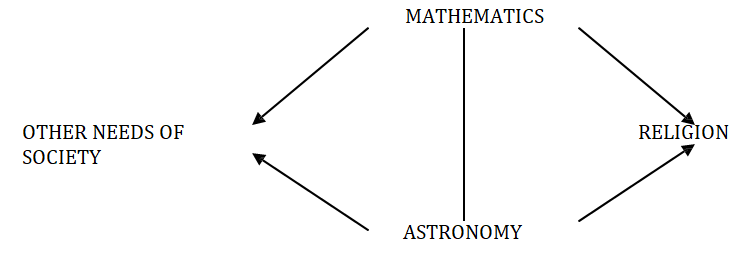
The close relation between mathematics and astronomy has continued in modern times also, though mathematics has many users other than astronomers (and religion does not need mathematics very much now). Moreover, modern astronomy also depends on many other disciplines like physics, chemistry, biology etc. (which had not developed to the same extent as mathematics in ancient India).
Brief History of Ancient Indian Astronomy
For convenience, this history is divided into two periods: (a) The Pre-Siddhanta Period (b) The Siddhanta Jyotish Period. The Pre-Siddhanta Period: It is further divided into four parts. • Pre-Vedic Astronomy Though there is no direct reference to astronomy in the antiquities found in the excavations of Mohenjodaro and Harappa, yet it is believed that a civilization so highly developed could not do without a calendar based on astronomy.
• Vedic period astronomy There are many astronomical references in the vedas, particularly there is Yajurveda based on practical observations of moon and stars which existed for providing the calendar to enable the priests to perform yagnas. That was used to be performed at different times and points of the year and the day respectively.
- A day was reckoned from sunrise to sunset and the night was reckoned from sunset to sunrise. Each was divided into fifteen mahurats. The mahurats were named differently for each day and night of the dark and bright fortnights of a lunar month.
- Besides these, there were three divisions of a day (Purvahna, Madhyahna and Sayahna) and five divisions of a day (Pratah, Sangava, Madhyama, Aparahna and Sayahna) for rough division of time. The month lunar month used was the lunar month and all 30 days of the lunar months were given specific names. There were two groups of Vedic people, one reckoned a month from full moon to full moon, and the other from new moon to new moon.
- A year considered of twelve months (Madhu, Madhava, Shukra, Shuchi, Nabha, Nabhasya, Isha, Urja, Sahas, Sahasya, Tapas and Tapasaya), spread over six seasons (Vasanta, Grishma, Varsha, Sharad, Hemanta and Shishira). Later, with the discovery of Nakshatras, the names of months were changed to their present names. Chaitra, Vaishakh etc. The solar year was also started to be used along with the lunar month, and a thirteenth month Amhaspati was introduced to regulate calculations.
There were two Ayans in a year namely Uttarayana and Dakshinayana marking the period of northward and southward motion of the sun. A Vishwa day (an equinaxal day) is mentioned between the two aryanas. A yuga is also mentioned, but it is meant only for a period of five years in the Vedic period.
The Moon moves around the path of the Sun (ecliptic) within the belt along which its maximum celestial longitude is five degrees north or south. A Nakshatra system was supposed to consist of 27 Nakshatras, all of which were named in Vedic times were slightly different from their present names.
Among the planets, Brahspati (Jupiter), Shukra (Venus) and Rahu are mentioned, but it is not easy to see how those who constantly watched the Nakshatras, could have left the other planets unnoticed. Comets and meteors (Dhumketu and Ulkas) are clearly mentioned. There is no mention of a seven-day week or zodiac signs (rashis) in the Vedias. Vedanga Jyotish Period of Astronomy For every Veda, rules were given for calculating astronomical results in a text called Vedanga Jyotish supposed to be written by the unknown writer Leghadha. The period might be about the thirteenth century B.C. A period of five years was called Yuga and the names of the five years were Samvastar, Parivastar, Idavastar, Anuvastar and Idvastar.
A solar year was supposed to consist of 366 days. A Yuga was supposed to consist of 1830 civil days, sixty two (synodic) months of moon, thirty omitted tithes, two intercalary months and five mean revolutions of the sun. Vedanga Jyotish dealt only with rough calculations of solar and lunar elements. There were no calculations for planets.
Mahabharata Period of Astronomy During this period, Indian had knowledge of 5 planets; they observed them in the framework of Nakshatras belt and in conjunction with one another. They knew about the retrograde motions of planets and they attached astrological significance to all these phenomena. They had a time scale of Kalpayuga of 4.32 x 10⁹ years and of a Mahayuga of 4.32 x 10⁶ years consisting of Kalyuga of 432000 years. Dwapuryuga of 864000 years. Treta Yuga of 1296000 years and Satyuga of 1728000 years.
Siddhartha Jyotish Period of India Astronomy Siddhartha Jyotish means a system which gives rules for calculating time, motions of planets etc., from the beginning of the universe (Sreshtiad) to the end (pralya). A book is called Karana if it gives rules for calculating astronomical events from a fixed epoch, other than the beginning of yuga of Kalpa. The period in which these books were written is called the Siddhanta Jyotish period.
There are following Five Siddhanta Books which are Supposed to be written either by Immortal Beings or by Sages:
- Paithamaha or Brahma Siddhanta
- Vasishtha Siddhanta
- Romaka Siddhanta
- Paulisa Siddhanta
- Surya Siddhanta The Surya Siddhanta is the most accepted and scientific book as its calculations are based in recorded coordinates of Nakshatras.
It is believed that the Surya Siddhanta was written in about 280 AD.
It is claimed that the third and fourth of the Siddhanta books may have foreign influence since these have, at some places, greater resemblance to Greek astronomy than to Indian astronomy. However, the most accurate out of these is the Surya – Siddhanta which is certainly related to Indian astronomy. All these five Siddhartha‟s were edited by the famous astronomer Varaha Mihira, in his famous work Pancha Siddhantika.
There are other Following Books on Astronomy, Written Later, by Outstanding Mathematicians and Astronomers: • Aryabhatiya: It was written by Aryabhata 1 (421 Shaka), whose fifteen hundredth Anniversary we celebrated in 1976 and after whom we named our first satellite. This was the first book on astronomy supposed to be written by a non-divine being. The book also contains chapters on arithmetic, algebra and trigonometry, and gives the first tables for trigonometric functions. Details about this book are given in Chapter III „The Aryabhatiya‟ [1]. • Brahma Sphuta Siddhanta (revised system of Brahma) by Brahmagupta (550 Shaka): This book gives accurate rules for finding positions of planets, and corrects errors in earlier works. Bhaskarachrya considered Brahmagupta as Ganit Chakra Churamani first gem among the circle of mathematicians. • Baswati Karan by Shatanand (1021 Shaka): This book uses centimal multiplication and division system. • Siddhanta Shiromani by Bhaskaracharya (1036 Shaka): This book is the most comprehensive and gives a complete account of Indian astronomy till that time. It also discusses the obliquity of the ecliptic and its effect on the equation of time. This contains four parts, namely Lilavati, Bijaganita, Goladhaya and Grahaganita. • Grahalagyam by Ganesh (1442 Shaka): This book is useful for those who have only limited knowledge of mathematics. • Siddhanta –Tattave Viveka by Kakalaka Bhatt (1530 Shaka): it is a good book on mathematical astronomy.
Books Written in Kerala The Following Books in Ancient Astronomy were also Written in Kerala:
- Deva Keralam, Sukra keralam was written about the seventh century AD.
- Sarkaranarayaneeyam, by Sarkaranarayana of the ninth century AD. This book refers to an astronomical observatory and its instruments established by a contemporary king Ravi Verma.
- Venwaroham by mahadevan, discusses trigonometry and planetary motions.
- Karan Paddhati written in 1431 AD.
- Sadratnamala by Sakara Vaiman, written in about 1530 AD.
- Tantra Samgraham by Nilkantha, written in about 1500 AD.
- Yukti Bhasa by Brahmadatta, written in 1639, AD.
The last five books are in verse from and give infinite series expressions for sin x, cos x and tan x about two and half centuries earlier than in Europe. The series called as Gregory‟s series for tan-1x was also known in India more than two centuries earlier than in Europe.
In fact astronomy is a practical subject and use of instruments plays a great role for its success. Therefore, ancient Indian astronomers were aware of the fact and designed appropriate instruments for measurements of astronomical data. Thus the construction and use of such of instruments was described in every book of astronomy as a chapter.
The earliest instrument available in Vedic times was Turya consisting of a quadrant circle with a movable tube through the centre and resting on the arc of the quadrant, which is graduated in degree and minutes. Through the tube, the heavenly bodies were observed, and the angle made by the tube with the vertical gave the zenith distance called Natansk and its complement unantash or altitude. During the Vedanga Jyotish period, a water clock was also developed. Chapter XIII of Surya Siddhanta discusses the construction of an auxiliary sphere, a Sankuyantra or gnomon, the Cakrayantra, Mayur yantra, vanayantra, etc. Brahmagupta discusses, in Brahma Sphuta Siddhanta, seventeen instruments by which observations could be made.
Bhaskaracharya gave the description of an additional instrument called Phalak yantra. Another instrument called Dhruvmrey Yantra was devised by Padmanabhan in the fourteenth century. Yantra Cintamani, written by Chakardan, was a separate book on instruments.
An observatory appears to have been constructed at Ujjain or Avanti and it is the same place where the present observatory stands. Another observatory, Man Mandir, was constructed by Raja Man Singh at Varanasi, and a number of instruments were added to it by Raja Jai Singh who also built the observatory at Jaipur as well as the city of Jaipur around it. He described all instruments except rasivlaya, for which an effort was made by Garret in 1907 to reconstruct it. However in the process, he changed it completely. Raja Jai Singh also built the observatory at Delhi
Discussion of Ancient Indian Astronomy
We start by stating a quotation from 0. Neugebauer’s, A History of Ancient Mathematical Astronomy‟ a scholarly work comprising 3 volumes and more than 1200 pages, published in 1976.
In spite of some pioneering was work done by H.T Colebrook (1765-1837), G. Thibault (1848-1914) and others, there is need of the study of Hindu astronomy as it is still incomplete. For that a lot of uninvestigated manuscript material is available in India as well as in western countries. Thus, it is suffice to remark that many hundreds of planetary tables are still easily accessible in American libraries. A preliminary study of this material has revealed a great number of parameters for lunar planetary tables.
However, the planetary tables which based on methods to great extent are so far not encountered in western materials; the first reason is that the planetary positions are computed for whole year as a function of the Aries. Secondly, when these methods were developed, we did not know, the extent texts suggesting the date of the fourteenth century AD. This statement clearly establishes the need for a massive research effort and also is a testimonial to the originality of Indian work on astronomy.
There is a feeling that there has been some Greek influence on Indian astronomy, and one of the two Siddhartha‟s shows this influence. However, the Surya Siddhartha‟s which is purely Indian is far superior to them, and this was due entirely to the great mastery of ancient Indians over arithmetic and algebra, while the Greeks were superior in geometry.
The independence of the two developments is testified by the fact that the parameters used are different; the methods of correction are different, the styles of presentation are different and mathematical backgrounds are somewhat different. Moreover, Indian astronomy was influenced much more by the needs of astronomy, Ujjain, the important centre of Indian astronomical activities, was taken as having zero longitude.
There are some practical subjects and astronomy is one of them where truth is obtained by successive approximations. In case any approximation method comes to wrong, the Hindus were always ready to give up that method, and also were prepared to improve that. Beginning with Panch Siddhantika, each succeeding work gives more accurate method than the earlier one.
Indian astronomy ultimately exercised greater influence on the development of modern western astronomy, than on Greek or Babylonian system, because of the influence of arab astronomical works on western scholars. Of special importance in Arabic astronomy was the Khandakhadyaka of Brahmagupta, written in 665 Ad, and known to the Arabs as the A/- Arkand. Thus, parameters from this work and Indian planetary theories found their way, through Arabic scholars, especially through al-Khwarizmi, into Western European astronomy. The most glaring example of this influence is the use of the zero meridian of “Arien” (Ujjain).
Discussion of Ancient Indian Mathematics
Sulva Sutras: There are seven sulva sutras known by the name of Bodhayana, Apasthamba, Katyayanam, Manava, Maitrayana, Varaha and Vishuta. They belong to the period 800 BC to 500 BC. A large number of simple geometrical constructions imparting knowledge are giver in the following theorems:
- The diagonal of a rectangle divides it into two equal parts
- The diagonals of rectangle bisect each other.
- The perpendicular, drawn from the vertex of an isosceles triangle to its base, bisects it.
- A rectangle and a parallelogram on the same base and between the same parallels are equal in area,
- The diagonals of a rhombus bisect each other at right angles
- The Pythagoras theorem known after his name states that the square of the Hypotenuse is equal to the sum of squares of base and perpendicular.
- Irrational numbers were first used and the approximation to 2 as 1 + 1/3 + 1/3.4 + 1/3, 4.34 were given first time. Problem in the construction of alters which required the solution of simultaneous linear equations in integers were solved and illustrated.
1. Jain Mathematics belongs to the period from about 500 BC to 100 BC. It gives elementary formulae for menstruation, approximate values of square roots (eg √10 correct to 13 places of decimals), approximation of √10, some concepts of infinity, laws of indices and the formulae for permutations and combination. 2. The Bakshali near Peshawar in 1081 AD, is believed to be long to the fourth century AD, it contains problems on fractions (method of false position), arithmetic &
geometric progressions, solution of indeterminate equations, approximation to surds, solution of quadratic equations and simultaneous linear equations.
3. Aryabhata (476 AD) gave the algorithm for finding cube roots, sum of squares and cubes of first numbers, approximation of by 3.1416, mensuration formulae and tables for sin 0.
4. Brahmagupta (598 AD) solved the indeterminate equation $Nx^2 + 1 = y^2$ in integers, gave the sum of geometrical progression, determined the right angled triangles and cycle quadrilaterals with rational sides, gave interpolation formulae and the formulae for the area of a cyclic quadrilateral.
5. Mahavircharya wrote his famous work, Ganita Sara Sangraha, 850AD. It contains problems on arithmetic, on quadratic equations, on the general formulae for cube root, on unit fractions, on construction of cyclic quadrilaterals of any given area and result for the ellipse.
6. Bhaskaracharya (Born 1114AD) wrote siddhanta shiromati at the age of thirty six, wherein he systematized mathematics known at that time. It gave formulae for surface area of a sphere and its volume, volume of frustums of a pyramid, problems on permutations and combinations, problems on quadratic equations and indeterminate equations. Bhaskara also gave some results which show that he could almost have discovered the calculus [2].
7. After Bhaskara, new mathematics was not searched except in Kerala, where a great deal of mathematical work was done. Ganit Kaumudi by Narayan Pandita of the fourteenth century, and the work of Madhava, are pioneers. These were followed by Tantra Sangraha and Aryabhatiyam of Sakara Varman, Karana Paddhati, Digganita and kariya Kranakara. In these works, series for sin $x$, cos $x$, tan-1 $x$, etc., are given at least two hundreds years be fore they were found in Europe.
8. The result $$\lim_{x \to \infty} \frac{1^p + 2^p + \dots + (n-1)^p}{n^{p+1}} = \frac{1}{P+1}$$ was also given by some other authors. Karana Paddhati gave the value of $\pi$ correct to 10 places of decimals, and Sadratanma corrected it to 17 places. In about 1500 AD Nilkantha also illustrated that the ratio of the circumference to the diameter could never be expressed as the ratio of two integers.
The Greeks at an early stage and the Chinese at a later stage highly influenced Hindu mathematicians in ancient India, however, Hindu mathematician also contributed a lot to the development and research of mathematics.
There is two –fold nature of mathematics. The first one it deals with quantitative relationships between material objects and that finds applications in business, economics sciences, etc. The second one, it postulates these theorems and carry them to their logical conclusions. From this point of view, mathematics can also be considered as philosophy.
The Decimal System
In fact the main aspect of mathematics have been its origin in the counting, weighing and measuring which are required in primitive trade. These have also included the invention of the numerals which were developed in the Hindu-Arabic system including the zero and that made the place value of possible. At the time of introduction the numerals and the zero were not considered as being of particular importance as other systems of numerals were also in vogue. However, these were as valuable as the ones from which our familiar symbols were derived.
The most important fundamental contribution of ancient India to the progress of civilization is the invention of the decimal system of numeration, including the invention of the number zero. The characteristic feature of the system is the usage of nine digits and a symbol for zero to denote all integral numbers and assigning place value to the digits. That system was known as the Decimal System [3].
Dr S.R. Rao, a well-Known archeologist, has professed a new theory according to which it was the Harappans who gave to the world the decimal system of measurement and the use of gold as a medium of exchange. According to his view, Harappans produced gold discs which were made in a particular ratio of weight. As mentioned in the Arthasastra the unit was known as gunja, conforming to the Suvarna mashaka.
The gold discs of various sizes found at Lathal and hitherto mistaken for pendants, weighed exactly 50, 100, 2500, 2750, 2800, 2900, 3000, 3250 milligrams, thus indicating a decimal system [4].
Further Dr. Rao elaborated that Harappans introduced the decimal system for linear measurement and for weighing delicate objects like gold and precious stones. They also described the divisions marked on the Lothal ivory scale in decimal system which were the smallest known divisions in the ancient world and each division measured 1.7mm. However, the scales found at Harappa, Mohenjodaro and Lothal were all differently marked, but were interrelated.
Dr. Rao said,"The vast structures, such as the dockyard at Lothal, were well proportioned in terms of the Lothal Linear scale, The Harappa pan measurement system was continued in lather days. The ten division of the Lothal scale were equal to one angula mentioned in the arthasastra." According
to his view, Harappans achieved “great accuracy” in the measurement of fundamental units of length as well as time. The smallest unit of length was 1.7 mm and that a mass was 50 mg.
There is also a school of thought, which believes that, in spite of lack of direct evidence of a great deal of mathematics, the high level of mohenjodaro and Harappa civilizations with well-planned cities, pucca houses with ventilation and a highly developed irrigation system could not have been Possible, Without a corresponding strong development of mathematics, Numerals and Zero Symbols To understand the profundity of the invention of place numerals ,one realizes the difficulty of marking progress in arithmetic using other systems, for example the Greek systems of numerals I,II,X,C, etc. The Greek method of representing numbers by geometrical segments, and the slow progress of mathematics in the West, before the advent of the Indian systems in the West, are glaring examples. Those were the handicaps which the people were facing, because west people were not acquainted with the Indian decimal system [5].
The important of the decimal systems of numeration can best be appreciated in the words of Laplace (1749-1827), one of the greatest mathematicians of all time. He wrote “the idea of expressing all quantities by nine figures (or digits), whereby is imparted to them both an absolute value and by position, is so simple that this very simplicity is the reason for our not being sufficiently aware how much admiration it deserves” The symbol for zero was invented and thereafter the idea of a zero became common property. Thus, the men who devised numerals and a symbol for zero did a great service to civilization. But neither the names of these persons nor the period they lived are known with identity, as the numerals had not been in use for centuries. That was because the history of mathematics in India reached the stage of preserving the names of important contributors, much later.
In an article in the American Mathematical Monthly, Professor G.B. Holstead shows that the zero existed in Indian at the time of Pin Gala‟s work Chhandas-Sutra a work on prosody before 200 BC.He remarks: the importance of the creation of the zero mark can never be exaggerated.
No single mathematical creation has been more potent for the general on-go of the intelligence and power. In fact the zero symbols were used in metric by Pin Gala (before 200BC) in his Chhandas-Sutra [6, 7].
Concluding Remarks
- Indian astronomy did not get as much recognition abroad as it should have, partly because of prejudices of foreigners and partly because of the vagueness of its predictions and lack of sufficient efforts to explain these lucidly.
- Efforts were not made to study the development of mathematics and astronomy in ancient Babylonia, Egypt China, Arabia, etc. to find out the interaction between India and other civilizations.
- It may noted that we have not included sixteen sutra and thirteen sutra ascribed by Swami Krishna Tirath Maharaj to the Atharvaveda. According to Swami ji from these sutras the answer to every can be obtained in one line only. This is because of the fact that there is absolutely no evidence of these sutras being part of Vedas or having influence on later development of mathematics in India or in the world. References
1. Gupta RC (1992) On some mathematical rules from the Aryabhatiya, Indian Journal of History of Science 12(2): 200-206.
2. Bhaskara (1945) Maha-Bhaskariyaand Laghu- Bhaskariya, Anandashram Sanskrit Granthawali.
3. Hooda DS, Kapur JN (2001) Aryabhata-Life and Contributions. In: 2nd (Edn.), New Age International Publishers.
4. Jha SK, Jha M (1990) A study of the value of known to ancient Hindu and Jaina Mathematicians. J Bihar Math Soc 13: 38-44.
5. Singh AN (1927) On the Indian method of root extraction. BCMS 18: 123-140.
6. Smith DE (1987) History of mathematics. In: Swarup AK, Shukla KS (Eds.), Proceeding of the International Astronomical Union Collegiums held in New Delhi, Cambridge University Press, Dover Publications, India.
- Early Universe: Hadronic Crystals Coherent Micro Gravitational Wave Emitters PHYSICS Part II
- The Solar System Constraint Maze: A Scientific Dead-End Revealing the Interuniversal Machine
- Assessment of Radiofrequency Radiation from 2G and 3G Mobile Phone Handsets
- Early Universe Magneto-Gravitational Coupling Genesis Physics: Part I
- Falsifiability of the Classical Law of Gravitation and Unveiling the Time-temperature Entanglement of the Universe
- Origin of Ancient Civilisations The Southern Hemisphere’ Scenario