
Cosmic Baby, Intelligent Computing-Decoding the Secrets Inside the Neutron Stars: A possibility
Neutron stars are among the densest, extreme, compact astrophysical objects in the universe. Discovery of Cosmic Baby , i.e. Swift J1818.0 – 1607 provides us three important information: i) existence of “Triaxial Star” is possible, (ii) new born magnetar exhibits its triaxiality as a triaxial magnetar, and (iii) characteristics of cosmic baby can be applicable to the sources that show magnetar-like activities. Recent simulation studies on merger of binary neutron star system hint that (a) merging of binary neutron star system can lead to a large amplification at magnetar level i.e. ~ 1016 G and (b) magnetar is formed prior to collision and stable magnetar within a time period of 100ms at post-merger scenario. It is suggested that formation of a triaxial magnetar is possible in binary neutron stars merger. Artificial intelligent based Intelligent Computing simulation provides us many unseen, unimaginable (but with realistic possibilities) scenarios in neutron star binary system. But scenarios of magnetar formation and it’s exhibition as triaxial magnetar in a binary neutron star merger are still remained as undetected. It is hopeful that intelligent computing will be capable to fulfill this in near future as well as to rethink about known facts of neutron star physics.
Abbreviations
AI: Artificial Intelligence; ML: Machine Learning; NN: Neuro- symbolic Networks; LLM: Large Language Models; DM: Diffusion Models; EoS: Equation of State; TOV: Tolman- Oppenheimer-Volkoff; SPINN: Straight forward Pulsar Identification; NM: Nuclear Matter; GW: Gravitational Waves; SGRs: Soft Gamma Ray Bursts; GRB: Gamma Ray Burst; GRMHD: General Relativistic Magnetohydrrodynamic; ANN: Artificial Neural Networks.
Introduction
Through the discovery of computer by Alan Turing [1] in 1936 man first got a taste of computer and also its higher performing power than the human. Gradual development of computer system man also get another valuable teaching that present day computer design and its higher generation version can be a futuristic probe of understanding the unseen, unknown realistic scenarios so that scientists or astronomers may get an idea of actual / realistic situation or scenarios. At present, numerical simulations play that role. But for obtaining the deeper knowledge artificial intelligent based computing system acts like an Aladdin Magic Lamp (in Arabian stories this lamp can do all the impossible task) available on the scientists’ hand (Figure 1).

Regarding Artificial intelligence pioneer Alan Turing [1] was a founding father of artificial intelligence and of modern cognitive science. He was considered as a leading early exponent of the hypothesis that the human brain is in large part a digital computing machine. Not only that his theoretical idea was that a cortex at birth is an “un- organized machine” but if it gone through proper “training” then in future it becomes an organized “into a universal machine or something like it.” Turing’s prediction comes true in late 2022, when the advent of ChatGPT re-ignited it’s magical characteristics in all fields from human related to cosmological .
Artificial intelligence (AI) is a set of technologies that enable computers to perform a variety of advanced functions, including the ability to see, understand and translate spoken and written language, analyze data, make recommendations, and more which are un-imaginable to us . In realistic sense, artificial intelligence (AI), particularly useful for deep learning, is a physical foundation of computing system that works from algorithm to programming (i.e. as on-chip design representing deep learning application — finally image style creation).
Astrophysics plays an important role towards understanding the universe and its compact objects. Scientists believe that only and only computational methods have the capability to unravel the mysteries of the cosmos. In other words, artificial intelligent (AI) has emerged as a powerful astrophysical toolkit through which scientists can analyze the observed/experimental data, modeling complex phenomena and finally make ground breaking discoveries. In the universe neutron stars have the densest forms of matter inside it with so intense gravitational field such that they often serve as natural laboratories where theories of gravity and matter under extreme conditions can be tested.
Since its discovery in 1967 to till date the available amount of experimental data is “increasing” with the development of observational techniques. The fact is these massive data are basically from different experiments i.e. information on different aspects of the same object or system. As a result, for obtaining a complete understanding of physics involved with that system one needs
- first to combine all these data; and then
- to analyze the resultant of combined data successfully.
It is a challenge to the scientists / astronomers to handle this kind of complexity of the data and massive parameters in the model.
Neutron stars are extreme objects whose inner matter can take or exotic forms but problem is astrophysicists cannot see what is inside. In this paper I shall limit the discussion on (a) the role of artificial intelligence (AI), (b) based on different AI Neural Network platforms what are the new information obtained on neutron star properties, in particular uncovering the hidden patterns and extracting valuable insights associated with neutron stars in the form of single neutron star i.e. pulsars, magnetars and finally new information through the AI based numerical simulation computing of binary system.
Neutron Stars and its Different Forms
Neutron stars are superdense objects with a radius of ~ 10km and the mass of (1.4 – 2.5) M⊙, M⊙ being the mass of the sun. It is also believed that neutron stars are born from supernova explosions that lead to such compression of matter resulting which such a colossal masses within a small volumes. More over, the magnetic field strength at the surface of a typical neutron star may reach ~ 1011 – 1012 G and for a magnetar (i.e. highly magnetized neutron star) ~ 1013 – 1014 G (Figure 2).
![Figure 2: shows schematic illustration of the structure of a neutron star. The outermost layers of a neutron star, the atmophere, envelope, and crust are shown . Note that (i) Superfluidity in the crust is schematically represented in inset “A”, (ii) a diagram of the pasta phases in the crust is shown in inset “B” and (iii) The core is separated into the outer core, which has the structure given in inset “C”. The inner core (marked ?) whose nature is currently unknown Page D, et al. [2].](/fulltextimages/13709/fig_2.png)
Figure 2: shows schematic illustration of the structure of a neutron star. The outermost layers of a neutron star, the atmophere, envelope, and crust are shown . Note that (i) Superfluidity in the crust is schematically represented in inset “A”, (ii) a diagram of the pasta phases in the crust is shown in inset “B” and (iii) The core is separated into the outer core, which has the structure given in inset “C”. The inner core (marked ?) whose nature is currently unknown Page D, et al. [2].
The Role of AI
The recently developed machine learning (ML) or AI – driven technology provides a way to solve this big data problem. This means that in the scope of scientific research with increasing complex and multidimensional domains, AI has emerged as a critical tool for driving innovation and advancing knowledge. AI methodologies begin with the models, such as Large Language Models (LLM), Diffusion Models (DM) and Neuro-symbolic Networks (NN), to transform both the theoretical and experimental across the diverse subfields including astrophysics, particle physics cosmology, quantum mechanics, condensed matter and biophysics. Again each AI model offers unique strengths [3].
• LLMs: These enhance literature synthesis and facilitate collaborative research;
• Diffusion Models (DM): these provide potent tools for simulating the complex systems (such as high energy collisions, quantum phase transitions) • Neuro-symbolic Networks (NN): that enable interpretability application through combination of data driven learning and adherence of physical laws.
The amalgamation of astrophysics, astronomy and AI offer a new paradigm to study the cosmos through vast amount of data, identifying subtle patterns and decipher complexities that were previously beyond human reach.
Functions of AI
Basically, AI is a branch of computer science aiming to study and develop theories, methods, techniques and applied systems resulting which the outputs of simulations are alike but beyond of human intelligence i.e. mimic human intelligence that enabling to perform higher level applications.
The Main Functions of AI Out of its Multimodal Functions are: • Data Analysis and Processing: AI enables to process and analysis vast amount of astronomical data collected from telescopic observation via space mission; algorithms to identify patterns by removing noise and to extract valuable insights from complex datasets. • Astrophysical Simulations: AI enhances astrophysical simulations as well as accelerating simulations of complex phenomena, such as bursts, gravitational interactions. • Data-driven Astronomy: AI-powered algorithm can find hidden relationships and patterns in large datasets and help in uncovering new insights that leading to unexpected discoveries. • Gravitational Wave Astronomy: AI algorithms can process data obtained from LIGO, VIRGO detectors, and help in detecting and characterizing gravitational waves originated from black hole mergers and neutron stars collisions.
Areas that AI Can Unlock Neutron Star Properties
Various observations, such as radio , gamma ray, X-ray bursts, giant flares, gravitational wave radiation through ground based observatories and space based satellite telescopes on different forms of neutron stars i.e. isolated neutron stars, pulsars, magnetars show that neutron star’s properties — mass, radius, moment of inertia, equation of state (EoS), tidal deformability, etc are the most important areas that need relativistic information for modeling of neutron star [4, 5]. So, AI can examine the stability of neutron star and its other parameters of structural stability by employing machine learning algorithms and neural networks. AI is capable to investigate the following neutron star’s properties:
- Neutron star and the Tolman-Oppenheimer-Volkoff (TOV) Equations [5]
- Neutron superfluidity in neutron star (using AI neural network) [6]
- Implications of neutron superfluidity (as neutron superfluidity promotes insights into neutron stars. AI can shed light on their cooling mechanisms, their rotation, glitch, etc.) [6]
- Quantum phenomena in low density neutron matter inside neutron star [6]
- Modified TOV equation in the presence of non-zero cosmological constant term ʌ [7]
- Neutron star mass – radius relation [8]
- Detecting hyperon in neutron star [9]
- New bounds on neutron star’s internal pressure and their maximum masses
- Uncertainty quantification from neutron star probability distribution to equation of state [10]
- Thermonuclear flames
- Intriguing connection between neutron star and supernova remnant
- Binary neutron star merger evolutionary sequences
- Unusual Magnetic Field structure, etc.
AI Evaluated Improvements in Neutron Star Properties
Pulsar (i.e. Rotating Neutron Star) Identification
Using the Neural Network Morello Y, et al. [11] introduced a new identification technique, (called Straight forward Pulsar Identification (SPINN)) and applied this method to identify known
![Figure 3: Schematic diagram representing (A) top – without NN and bottom with NN applied to pulsar identification in a known pulsar survey. (B) bottom clearly shows the improved result as obtained by Morello V, et al. [11].](/fulltextimages/13709/fig_3.png)
Pulsar candidate from a pulsar survey. Figure 3 shows clearly the improved results in AI inferred as : • 60 known pulsar from the bench mark data set; • New: 32 additional known pulsars not included in the bench mark data set; • New: 5 faint single pulse candidates those are emitting multiple periodic signal. Further investigation needs to identify them.
Distribution of the Actual Observational Data
In an investigation for quantifying the uncertainty in the equation of state (EoS) of neutron star matter by using the neutron star probability distribution of the observational parameters for different neutron stars (Figure 4).
![Figure 4: Shows AI inferred results of the distribution of the actual observational data as obtained by Fujimoto Y, et al. [10]. The M-R region from the inferred EoS distribution (shown by the red band) is overlaid with the uncertainty estimated from the AI based method proposed by Fujimoto Y, et al. [10].](/fulltextimages/13709/fig_4.png)
Figure 5: Represents a new curve for EoS with the uncertainty as estimated by Fujimoto Y, et al. [10] using their AI based proposed method (indicated by red colour marking this work). The colored lines and bands are the mean values and the errors, respectively. (For details see the text of ref. [10]). Nuclear Matter Equation of State (EoS) Inside Neutron Star The Significant Results are:
- the contour of the 68% credible region covers the density function following the Bayesian statistics except for the GW170917, J1614-2230 and J0438+0432 data (known) [11];
- In the case of pulsars J1614-2230 and J0348+0432 the data is uniformly distributed along the R while in M direction not uniformly but limited within 68% confidence interval (New);
- By including newly data for the pulsars (i.e. rotating neutron stars) PSR J1614-2230, PSR J0348+0432, PSR J0030+0451, PSR J0740+6620 and neutron stars in binary system GW170817 with the previously available data (used by Fujimoto Y, et al. [12]) Fujimoto Y, et al. [10] found a new uncertainty curve (Figure 5) in a band covering the mean values and the errors, respectively ( for details see the text of ref. [10]). This implies that.
- the AI inferred EoS exhibits a slightly steeper transition from a soft EoS at low density to a stiff EoS at the middle density area compared to that in the previous work (New) [12].
![Figure 5: Represents a new curve for EoS with the uncertainty as estimated by Fujimoto Y, et al. [10] using their AI based proposed method (indicated by red colour marking this work). The colored lines and bands are the mean values and the errors, respectively. (For details see the text of ref. [10]). Nuclear Matter Equation of State (EoS) Inside Neutron Star **The Significant Results are:** • the contour of the 68% credible region covers the density function following the Bayesian statistics except for the GW170917, J1614-2230 and J0438+0432 data (known) [11]; • In the case of pulsars J1614-2230 and J0348+0432 the data is uniformly distributed along the R while in M direction not uniformly but limited within 68% confidence interval (_New_); • By including newly data for the pulsars (i.e. rotating neutron stars) PSR J1614-2230, PSR J0348+0432, PSR J0030+0451, PSR J0740+6620 and neutron stars in binary system GW170817 with the previously available data (used by Fujimoto Y, et al. [12]) Fujimoto Y, et al. [10] found a new uncertainty curve (Figure 5) in a band covering the mean values and the errors, respectively ( for details see the text of ref. [10]). This implies that. • the AI inferred EoS exhibits a slightly steeper transition from a soft EoS at low density to a stiff EoS at the middle density area compared to that in the previous work (New) [12].](/fulltextimages/13709/fig_5.png)
![Figure 6: represents the flow of AI based NN platform with the inferred result as obtained by Guo LL, et al. [13]. (adopted from ref. [13] and for details see the text also).](/fulltextimages/13709/fig_6.png)
To study the constrain on the behavior of the EoS of nuclear matter (NM) inside neutron star w. r. to the properties of nuclear matter at saturation density Guo LL, et al. [13] developed a neural network platform (i.e. NNPlatform) and found (Figure 6) their newly constructed AI based NN Platform can:
- enable to provide reasonable predictions of parameter space;
- offer new hints on the area of constraints of hadron interactions (New).
- This new area shows the NN platform is capable to estimate the parameters of this new model at a certain precision when both the properties of nuclear matter around saturation density and global properties of neutron stars can be saturated (New).
Detection of Gravitational Wave Signal from Binary Neutron Star Merger
For swift detection of identity of gravitational waves (GW) originated from binary neutron star system and to distinguish them from noise as well as signals produced from black holes merger Mogushi K, et al. [14] developed a new network system, called “ NNETFIX” (Neural NETwork to FIX gravitational wave signals coincide with short duration glitch in detector data) algorithm. The advantage of this network is transient GW signals can be recalculated by reconstructing the missing data portions caused by overlapping glitches. Figure 7 shows the reconstructing stages of this AI based NNETFIX system and capable successfully to reconstruct the signal to noise ratio greater than 20, in the case of binary black hole merger.
![Figure 7: Schematic diagram showing the extraction and detection of GW signals originated from binary neutron star mergers using artificial neural networks (ANN) (Adopted from ref. Mogushi K, et al. [14]).](/fulltextimages/13709/fig_7.png)
![Figure 8: Magnetic field configuration of PSR J0030+0451 as observed by Kalapotharakov C, et al. [15] by using their AI based Monte Carlo technique. Note that: the open (closed) magnetic field lines are depicted by the cyan (yellow) lines. Both polar caps (i.e., origins of the open magnetic field lines) clearly lie below the rotational equator (denoted by the white stripe) implying that multipolar field rather than dipolar field (for details see the text in ref [15])](/fulltextimages/13709/fig_8.png)
Figure 8: Magnetic field configuration of PSR J0030+0451 as observed by Kalapotharakov C, et al. [15] by using their AI based Monte Carlo technique. Note that: the open (closed) magnetic field lines are depicted by the cyan (yellow) lines. Both polar caps (i.e., origins of the open magnetic field lines) clearly lie below the rotational equator (denoted by the white stripe) implying that multipolar field rather than dipolar field (for details see the text in ref [15])
Multipolar Magnetic Field of Millisecond Pulsar
Exploring the AI based Markov Chain Monte Carlo technique Kalapotharakov C, et al. [15] investigate the magnetic field configuration with offset dipole plus quadrupole components of the NICER detected X-ray wave form of pulsar PSR J0030+0451, reproduce the observed X-ray light curve (Figure 8) and found degeneracy i.e. diverse field degeneracy implying that this millisecond pulsar PSR J0030+0451 has multipolar magnetic field rather than usual dipole magnetic field.
Thermonuclear Flame from Neutron Star
Supernova explosions give the birth of neutron stars. Therefore, thermonuclear flame covers the surface of a neutron star. The compositions of the stars have an important relationship between the neutron star’s mass and its radius. Because so far observed neutron stars are found mostly in binary system i.e. a neutron star have a companion and X-ray bursts occur when accumulates on the surface of the neutron star from its companion. Due to neutron star’s strong gravitational field, the accumulated materials is then compressed at such a level that a thermo-nuclear explosion.
![Figure 9: Represents the snapshot of X-ray bursts emitted from the plasma-envelope of neutron star.( Adopted from ref. Zingale, et al. ref. [16]; Credit: Universe Today).](/fulltextimages/13709/fig_9.png)
Explosion will occur. Numerical simulation (Figure 9) results support this but the main fact how matter behaves at the extreme densities inside the neutron star is still unclear. Theoretical calculations shows that the equation of state (EoS) (i.e. a description of how the intense pressure and energy inside neutron star respond to the possible change or consequences in its density, temperature and composition. The 3D simulation shows that X-ray burst flares spread at different rates depending on the physical condition of the neutron star.
Recently Soni, et al. [17] considered high temperature phase transition occurrence in the inner core of a highly magnetized neutron star (i.e. magnetar). The consequences of this phase transition are:
• This phase transition dynamically align the magnetic moment of all the neutrons inside the star and as a result, a large magnetic field is produced in the core.
• A large change of flux, therefore, give rise a situation such that it acts as a shielding or screening current in the surrounding high conductivity plasma i.e. envelope attached with the neutron star’s (i.e. magnetar) surface so that no flux or field is allowed to exit to the surface.
• On the other side, ambipolar diffusion inside the core assist this field to reach directly to the crust of the star which is capable to dissipate energy through neutrinos and X-rays.
• In this context, due to ohmic dissipation in the crust the upwelling field cleaves in the form of fluxes and X-rays radiation until the screening currents are damped and star’s surface dipole magnetic field reaches to its final value i.e. a new one which is more than the previous one.
• This implies that X-ray radiation emitted from the neutron star surface is almost in the same rate in all direction [17].
1. New Fact Known: X-ray burst spreading on the neutron star’s surface depending on the various physical condition in the interior of the star.
![Figure 10: Represents the scenario — when the mass of a merging pair of neutron stars is below a threshold, a “double-size” neutron star will form before collapsing into a black hole. (adopted from Shibata et al ref [18]).](/fulltextimages/13709/fig_10.jpeg)
2. Unsolved Issue: In realistic case — X-ray burst flares face the encounter of turbulence during propagation. This creates convective burning in the accumulated (i.e. accreted) matter.
Binary Merger
Shibata, et al. [18] showed in their numerical simulation study of binary neutron stars system that if the mass of neutron stars in binary system are below a threshold, then their merging will produce a new star with “double in size” (Figure 10) before collapsing into a blackhole.
The dynamical simulation study, performed by Horowitz, et al. [19], hints that the neutron star crust is very strong and capable of supporting the production of mountains that generate gravitational waves.
These gravitational waves are detectable in large scale interferometers while Gittins, et al. [20], considering several deformation forces, showed in their calculation that the crust of a neutron star can support maximum ellipticity of the order ~ 10–8–10–7 i.e. before merging a neutron star will suffer a triaxial phase and neutron star turns into a triaxial star [21, 22, 23].
For example, in the case of GW190814 Parui RK [24] showed that low mass companion neutron star was a triaxial star before merging or collision.
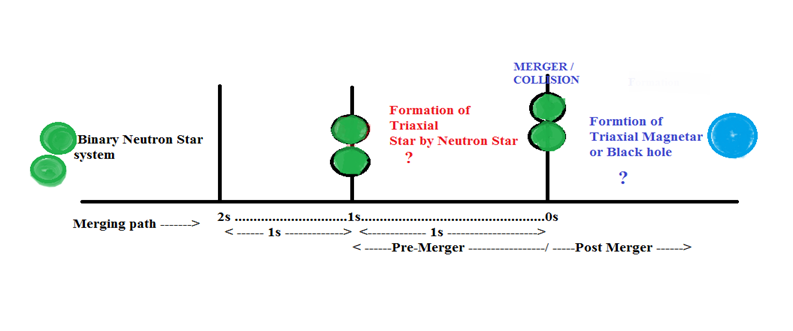
It has been observed in simulation studies on binary systems , containing low mass companion neutron star or two neutron stars with one of them companion neutron star, that the last 2 s time period only before merging or collision is very crucial. So far our present knowledge (see Figure 11) last 1s before collision is totally unknown.
Whether neutron star turns into a triaxial star, (i.e. pre- merger) and in post merger transformation into triaxial neutron star or blackhole both may be possible (Figure 11).
In another simulation study Field J, et al. [25] attempted to search the possible scenario just at about 5 millisecond after merger through comparing two different simulations of neutron star merger.
This study demonstrates that as the two neutron stars orbit one another, it releases ripples in space time in the form of gravitational waves. The ripples produced actually sap energy from the orbit until the two revolving stars eventually collide and merge into a single object (Figure 11).
![Figure 12: Shows snapshot of collision (A) and formation of a single object (B) as observed by Field et al during their simulation study of neutron stars merger (adopted from Field, et al. [25]).](/fulltextimages/13709/fig_12.png)
A
![Figure 13: Artist’s impression on the possible view of the aftermath of binary neutron star merger (adopted from ref. Xue YQ, et al. [28]).](/fulltextimages/13709/fig_13.png)
Theoretically, out of the two evolving neutron stars the primary one accretes matter from the companion neutron star. During the orbiting phase both the neutron stars gradually lose energy through the emission of gravitational waves. As the orbiting phase allows the two neutron stars come closer and closer, eventually they merge and produce a blackhole. Problem arises when the total mass of light neutron star pairs less than 2 or 3 M⊙ . On that case a giant , double size neutron star transform into a black hole within a fraction of a second.
The gravitational wave event GW170817 [26] was a binary neutron stars merger event. Detection of X-ray counterpart of this event and analysis of the measured parameters at the time of observation provide valuable information such as :
- Detected X-ray emission coincides with the location of kilonova transient i.e.
- it provides the missing observational link between soft gamma ray bursts (SGRs) and gravitational wave emission from the merger.
- This confirms the collimated nature of the gamma ray burst (GRB) emission. _
- _Swift and NuSTAR observational data analysis confirm the detection of a blue kilonova.
- This event also confirms the detection of X-ray emission and UV emission.
- The said kilonova/macronova was powered by the radio- active decay of massive neutron-rich nuclides which was produced through r-process.
- It also confirmed the emergence of a Lanthanide-rich kilonova.
- This new detection of neutron rich nuclei i.e. the observational fingerprint of neutron star merger reveals the fact on the production of heavy elements in the whole universe.
- Recent detection of kilonova along with a long duration gamma ray burst compelled us to rethink about the association of long duration GRB with kilonova.
New Fact Known: 1. Formation of blue kilonova in the binary neutron star merger ( i.e. GW170817) is confirmed. 2. This Kilonova are powered by radio-active decay of massive neutron rich nuclei created through r-process.
Unsolved Issues: Theoretical and observational based conventional concept is: long duration GRBs (> 2s) are typically associated with supernovae, while short duration GRBs (less than two seconds) are commonly associated with neutron star merger. Direct observational evidence of a hybrid event in GRB 211211A [27] raised a chance of occurrence of long GRB in GW170817.
Note that the possible scenarios that may be faced by neutron star merger is shown in Figure 13.
![Figure 14: Represents the magnetic field structure of a dipolar neutron star as seen (left) outside the neutron star, and Complex structure inside the star. Magnetic field lines are indicated by brown colour (adopted from ref. [29]) Neutron Star with Very Strong Magnetic Field (i.e. Magnetar) Earlier it is mentioned that binary neutron star merger will leave a black hole. But in realistic scenario may be different i.e. in between collision phase and black hole formation there may be some other object formation or intermediate object formation.](/fulltextimages/13709/fig_14.png)
Neutron Star with its Unusual Strong Magnetic Field (Magnetar)
Neutron stars are superdence extreme objects with radius 10 Km and the mass ~ 1.4 – 2.5 M⊙ . They are born in two ways:
- One way it arises as a result of supernova explosion. In that case electrons merge with protons, form neutron, and finally a colossal mass in a small volume in the form of neutron stars.
- Gravitational Wave data analysis suggests some neutron stars may form from binary neutron star system.
However, neutron stars have a variety of forms like normal neutron star with surface magnetic field ~ 1012G ; pulsars having surface magnetic field ~ 1012 – 1013 G ; High magnetic rotation powered pulsars with surface magnetic field ~ 1013 – 1014 G, magnetars with surface magnetic field ~ 1013 – 1015 G. While interior magnetic field strength can be one or two order more than that of the surface fields. In case of magnetar, this internal field strength may be even more i. 1017 – 1020 G. This means that internal magnetic field of a neutron star is in a complex structure.
Figure 14 shows the observation of the interior magnetic field of a neutron star obtained by Gourgouliatos B, et al. [29] during their numerical simulation study. In general, the magnetic field of a neutron star is apparent only because this star is seen through a certain angle relative to the observer.
This implies that neutron star can be grouped into two families: i) the first one are those where the magnetic field manifests itself throughout the whole spin cycle, while ii) the other one includes those neutron stars where their magnetic fields are not measured fully. For example, neutron star in the GRO J2058 + 42 system. In this case, scientists are able to go insight into the internal structure of the magnetic field only at a certain phase of its rotational/ spin period. For understanding the realistic magnetic field structure of this neutron star need further advanced level simulations in future.
![Figure 15: Shows the evolutionary scenarios of the rest-mass density in g cm−3 on the equatorial plane for model B0 evolved with the highest resolution (h ∼ 180 m). Note that the different panels show respectively the initial conditions (t = 0), the inspiral, the time of the merger (t ∼ 15 ms), the post-merger phase, and the formation of the “ultraspinning” NS i.e. Magnetar (last two panels). (adopted from ref [31] and for details see text of this reference).](/fulltextimages/13709/fig_15.png)
Figure 14: Represents the magnetic field structure of a dipolar neutron star as seen (left) outside the neutron star, and Complex structure inside the star. Magnetic field lines are indicated by brown colour (adopted from ref. [29]) Neutron Star with Very Strong Magnetic Field (i.e. Magnetar) Earlier it is mentioned that binary neutron star merger will leave a black hole. But in realistic scenario may be different i.e. in between collision phase and black hole formation there may be some other object formation or intermediate object formation.
In order to understand this problem Giacomazzo B, et al. [30] performed simulation study considering Kelvin- Helmoltz shear instability (which leads to small scale dynamo activity) and found, at dynamo simulation condition, the developed magnetic field is ~ 1016 G (which is magnetar level field strength). This means that from binary neutron star merger
- a magnetar is expected; and
- post merger phase electro-magnetic radiation in the form of short gamma ray burst is possible.
In another investigation with fully general relativistic simulation of binary neutron star merger Giacomazzo B, et al. [31] showed that for a binary merger of two equal mass neutron stars with gravitational mass M ~ 1.2 M⊙ it is possible in some merger cases a stable magnetized neutron star or magnetar (Figure 15).
This result suggests that this newly formed magnetar is responsible for the emission of electromagnetic counterparts of gravitational wave signal and also for gamma ray bursts.
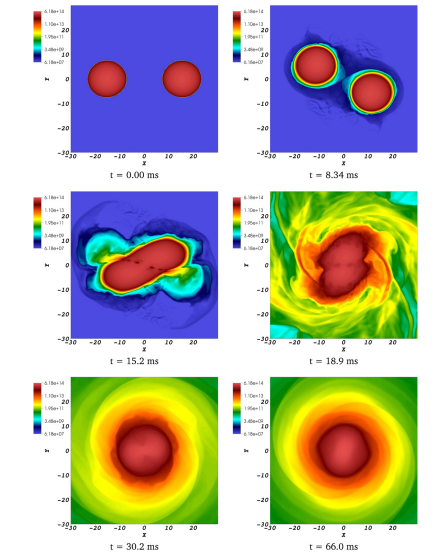
Figure 15: Shows the evolutionary scenarios of the rest-mass density in g cm−3 on the equatorial plane for model B0 evolved with the highest resolution (h ∼ 180 m). Note that the different panels show respectively the initial conditions (t = 0), the inspiral, the time of the merger (t ∼ 15 ms), the post-merger phase, and the formation of the “ultraspinning” NS i.e. Magnetar (last two panels). (adopted from ref [31] and for details see text of this reference).
In this context, another significant result is the formation of long-lived magnetar in the first 100 ms in a binary merger. Ciolfi R, et al. [31] obtained this result during their general relativistic magnetohydrrodynamic (GRMHD) simulation of the merger process and their results support.
- formation of a long-lived magnetar in first 100 ms after collision in a binary neutron star merging.
- the observational evidence of short gamma ray burst GRB 170817A in the gravitational wave event GW170817
- long standing hypothesis of the association of soft gamma repeater (SGR) with binary neutron star merger.
New Facts Known:
- In post merger scenario - a long-lived magnetized neutron star i.e. magnetar will form in the first 100 ms after the merger
- simulation based observed evidence of short gamma ray bursts is confirmed which is matched with the realistic scenario i.e. the detected gamma ray bursts GRB 170817A in the event GW170817.
- Confirmed the association of soft gamma repeater (SGR) with neutron star binary GW170817.
Unsolved Issues:
- What happens after 100ms i.e. newly formed magnetar in post merger phase? i.e. magnetar will stable and continues its magnetar phase or turns into black hole?
- What will be the scenario when an amalgamated magnetized neutron star i.e. magnetar is formed? Note that Xue YQ, et al. [32] attempted to find that scenario through Artist’s impression (Figure 15) which is based on their observed result of simulation.
- Will the association of SGR with binary neutron star merger be valid of for other binary neutron star mergers?
- What will be the transient path i.e. how a magnetar (i.e. magnetized neutron star) will turn into a black hole?
- It is proposed by Parui RK [24] that just before collision or merger one of the neutron stars turns into a triaxial magnetar and also triaxial magnetar exists in post merger phase. Question is: if so, then what will be the longevity of that triaxial magnetar?
- Triaxial phase is a realistic scenario. For confirmation, higher version of present generation computer is essential.
Cosmic Baby and New Born Magnetar
In 2020 the discovery [33] of Cosmic Baby i.e. Swift J1818.0 – 1607 with surface magnetic field~ 2.7 x 10¹⁴ G and age ~ 240 years plays an important role in the physics of neutron star. It is the youngest magnetar out of 31 detected magnetar so far. Using the measured parameters at the time of discovery Parui RK [23, 24, 34] estimated its internal magnetic field (Bint) and deformation (ϵ) due to such ultra- strong internal magnetic field as: Bint 8.924 x 10¹⁷ G and ϵ = 8.9 x 10⁻³, respectively and suggested that
- It is a triaxial star and will exhibit its triaxiality for next 760 years.
- It’s triaxial phase arises from its birth phase. This implies that
- a newly born magnetar with such internal strong magnetic field will suffer from triaxial phase.
Other Significant Contribution of Cosmic Baby are: Characteristics of cosmic baby can be applicable to a new born magnetar, to the sources of magnetar-like activities.
New Fact Known:
- As the magnetic field is amplified at the magnetar level i.e. ~ 1016 G in a binary neutron star system during merging, so it is expected that the resultant yield after collision is a newly born magnetar; and
- Will definitely be deformed i.e. a Triaxial magnetar will form and exhibit its triaxial nature. For example: rotation powered pulsars PSRJ1119-6127, PSRJ1846-0258 exhibited magnetar–like activities. Using the observed values and inferred magnetic field strengths Parui RK [34] shows that these two pulsars are exhibiting as triaxial stars and will continue for next ~ 212Kyr and ~ 15Kyr, respectively.
Unsolved Issue: Parui RK [34] suggested that as the cosmic baby has obtained its triaxial nature from its birth time, the same can be applicable to binary neutron star merging. As newly born magnetars, i.e. in binary neutron system one magnetar is formed at the time of 1s before collision and the second one magnetar after collision within 100ms , are produced in this merger it implies that triaxial magnetars possibly be formed. Advanced level simulation is required to confirm this.
Conclusion
Simulation studies with super computer employing AI is an emergence of intelligent computation in a new form of computing paradigm that offers the scientists to reshape the unknown, unimaginable ideas in the era of big data. One of the significant results is the detection of gravitational wave produced in binary systems. Again, applying the Gravitational Wave scientists are trying to find other unsolved issues that are remained as secrets of the universe. Artificial intelligent computing is in its infancy and will reach its highest supremacy in future certainly. Neutron star is one of the most unknown extreme compact object in the universe. It is also a gold mine where a variety of experiment can be done in order to search the realistic phenomena like plasma behavior in its envelope, superfluidity, superconductivity and elastic properties in its crust related to X-ray and gamma ray bursts, hybrid nature i.e. quark deconfinement, asymptotic freedom in the center, etc. In this study I have considered only the result of intelligent computing in plasma associated envelope of a neutron star and deformation of neutron star in a binary merger. Main unsolved issues are the realistic formation of magnetar and its trixial nature in binary neutron star merger. Theoretical estimation based possible magnetar formation is shown in Figure 13.
We are hopeful that the intelligent computing simulations will be capable to show the possible realistic scenarios in future and hint us to rethink about our known facts of binary neutron star system.
Acknowledgement: The author expresses his sincere gratitude to the anonymous referee for his /her invaluable comments and fruitful suggestions. He is greatly indebted to Prof. Jiang Sheng for his significant comments and suggestions. He wishes to thank Prof. H N K Sarma, Dept. of Physics, Manipur University, B K Ganguly, Mrs. Tapati Parui and specially to Rajarshi Parui for his help in computer works. Author Contribution: I have done the complete manuscript. Funding: Not applicable. Data Availability: Data sharing is not applicable as no data sets were analyzed. Ethical Conduct: Not applicable.
References
-
Bowman JP (2019) The impact of Alan Turing formal methods and beyond, in Lecture Notes in Computer Science. 11430: 202-235.
-
Page D, Latimer JP, Prakash M, Steiner AW (2013) Stellar Superfluid.
-
Patil B (2023) AI in Astronomy. Int J Adv Res Sci Commun Tech 3: 476.
-
Kastaun W, Ohme F (2024) Modern tools for computing neutron star properties. Arxiv: 2401: 11346.
-
Sotiriou TP, Faraoni V (2010) f (R ) Theories of Gravity. Rev Mod Phys 82: 45.
-
Fore B, Kim JM, Carleo G, Hjorth-Jensen M, Lovato A, et al. (2023) Dilute neutron matter from neural-network quantum states. Phys Rev Res 5: 033062.
-
Durrani I (2024) AI investigates the stability of a neutron star and the cosmological constant. Researchgate pp: 38565368.
-
Lobato RV, Chimanski EV, Bartulani CA (2022) Cluster structures with Machine Learning support in Neutron Star M – R relations. XLIV Brazilian workshop on Nuclear Physics. J Phys Conf Series 2340: 012014.
-
Carvalho V, Ferreira M, Providencia C (2020) Detecting hyperons in Neutron Star : A machine Learning approach. Phys Rev D 110: 123016.
-
Fujimoto Y, Fukushina K, Kamata S, Muraso K (2024) Uncertainty quantification in the machine learning approach. Arxiv J High Ener Phys 2401: 12688.
-
Morello V, Barr E D, Bailes M (2014) SPINN: A straightforward machine learning solution to the pulsar candidate selection problem. MNRAS 443: 1651-1662.
-
Fujimoto Y, Fukushima K, Murase K (2021) Mapping neutron star data to the equation of state using the deep neural network. Phys Rev D 101: 054016.
-
Guo LL, Xiong JY, Ma Y, Ma YL (2024) Insights into neutron star equation of state by machine learning. Astrophys. J arXiv 2309: 11227.
-
Mogushi K, Quitzow-James R, Cavaglia M (2021) NNETFIX: An artificial neural network denoising engine for gravitational wave signal. Arxiv 2101: 04712.
-
Kalapotharakov C, Wadiasingh Z, Harding A K, Kazanas D (2021) The Multipolar Magnetic field of the millisecond Pulsar PSR J0030+0451. Astrophys J 907: 63.
-
Zingale M, Eiden K, Katz M (2023) Comparing early evolution of Flames in X-ray bursts in 2D and 3D. Astrophys J 592 : 160.
-
Soni V, Bhattacharya D, Patel S (2019) Magnetar Signature -the U Curve. MNRAS 482: 5336.
-
Shibata M, Taniguchi K, Uryu K (2005) Merger of Binary Neutron stars with realistic EOC in full general relativity. Phys Rev D 71 : 084021.
-
Horowitz E J, Kadou K (2009) Breaking strain of neutron star crust and Gravitational Waves. Phys Rev Lett 102: 191102.
-
Gittin P, Andersson N (2021) Modelling neutron star Mountains in relativity. MNRAS 507: 116-128.
-
Parui RK (2023) A Remark on “Do triaxial supermassive compact star exist.? Int Astron Astrophys Res J 5: 33.
-
Parui RK (2023) A new compact star — the “ Triaxial Star “— and the detection of a Cosmic Baby : A possibility. Int Astron Astrophys Res J 5: 38.
-
Parui R (2024) Cosmic Baby and the detection of a new compact star — the “Triaxial Star “ : A possibility. Astrophys. Space Sci 368: 46.
-
Parui RK (2024) Unravelling the mystery of Cosmic Baby : Triaxiality and Resolving the companion identification problem of GW190814. Open Acc. J Astron 2: 000129.
-
Fields J, Prakash A, Breschi M, Radice D, Bernuzzi S, et al. (2023) Thermal effects in Binary Neutron Star mergers. Astrophys. J Lett 952: L36.
-
Abbott BP, Abbott R, Abbott (2017) Multi-messenger observation of a binary neutron star merger. Astrophys. J Lett 848: L12.
-
Troja E, Fryer CL, O’Connor B, Ryan G (2022) A nearby long gamma ray burst from a merger of compact objects. Nature 612: 228-231.
-
Gourgouliatos KN, Wood TS, Hollenbbach R (2016) Magnetic field evolution in Magnetar’s crust through 3D simulation. PNAS 113: 3944 -3349.
-
Giacomazzo B, Zrake J, Duffell PC, MacFadyen A , Perna R (2015) Producing magnetar magnetic fields in the merger of binary neutron stars. Astrophys J 809: 39.
-
Giacomazzo B, Perna R (2013) Formation of stable magnetars from binary neutron star merger. Astrophys. J Lett 771: L26.
-
Ciolfi R, Kastaun W, Kalinani JV, Giacomazzo B (2019) First 100ms of a long-lived magnetized neutron star formed in a binary neutron star merger. Phys Rev D 100: 023005.
-
Xue YQ, Zheng XC, Li Y, Brandt WN (2019) A magnetar- powered X-ray transient as the aftermath of a binary neutron star merger. Nature 568: 198-201.
-
Esposito P, Rea N, Borghese A, Coti-Zelati F (2020) A very young Radio-loud Magnetar. Astrophys J Lett 896 : L30.
-
Parui RK (2024) Cosmic Baby-Does it hint at PSRJ1119- 6127 a Triaxial Star : A possibility. Revised version is under preparation.
- Early Universe: Hadronic Crystals Coherent Micro Gravitational Wave Emitters PHYSICS Part II
- The Solar System Constraint Maze: A Scientific Dead-End Revealing the Interuniversal Machine
- Assessment of Radiofrequency Radiation from 2G and 3G Mobile Phone Handsets
- Early Universe Magneto-Gravitational Coupling Genesis Physics: Part I
- Falsifiability of the Classical Law of Gravitation and Unveiling the Time-temperature Entanglement of the Universe
- Origin of Ancient Civilisations The Southern Hemisphere’ Scenario