
Effect of Postoperative Bleaching on Clinical Performance of Three Contemporary Composite Resins
Objectives: To evaluate the clinical performance of three contemporary nano-composite resins placed in class IV cavities in maxillary teeth after in-office bleaching over one-year follow-up period. Methods: 15-subjects (selected according to specific criteria) with class IV cavities were divided into three groups according to the restorative material: Beautiful-II (Shofu Dental Corporation, USA), Ceram-x-mono (DeTrey, Dentsply, Germany) and IPS-Empress-Direct (Ivoclar Vivadent, USA). Each group was randomly restored with the (A1) shade of the same restorative material type (n=12). Clinical evaluation was carried out before bleaching (baseline), two days after, 3-months, 6-months, and one-year post-bleaching. Color match, retention, anatomic form, surface roughness, recurrent caries, marginal discoloration, and marginal integrity were evaluated using modified Ryge criteria. (A) and (B) scores were considered clinically acceptable, while (C) and (D) scores were considered clinically unacceptable. The data were statistically analysed using ANOVA and Chi-square test (Ð¥2). Results: The three groups showed statistically significant difference in color match between teeth and composite restorations after in-office bleaching. Post-bleaching color match was maintained within the acceptable range except for ISP-Empress-Direct group, which was inferior in color match and marginal integrity at one-year evaluation period and needed replacement. The survival rate of the three materials was 100%. All other evaluated parameters (anatomic form, surface roughness and marginal integrity) were considered clinically acceptable in one-year evaluation period. Conclusion: Postoperative In-office bleaching had no detrimental effect on any of the composite resins used over one-year period. When bleaching is used in conjunction with direct restoration, postoperative bleaching can be successfully performed by matching the anticipated whitened tooth shade using medium opaque nanohybrid composites. Using high translucent enamel and opaque dentin shade might not be recommended when in-office bleaching is planned. When postoperative bleaching is planned, the choice of the restorative material may influence the clinical outcome and long term success.<br />Clinical relevance: There are various ways to use bleaching in conjunction with direct restoration. Preoperative bleaching may prolong the treatment phase. Postoperative bleaching may save time and effort if we can select a suitable composite resin that is resistant to bleaching and can match the anticipated color after bleaching.
Introduction
In-office vital tooth bleaching has increased popularity in modern dentistry because it is the fastest and most effective way to treat discoloration. This technique uses high concentration hydrogen peroxide (25-40% HP) that breakdown to produce free radicals that can oxidize the organic stains, changing teeth color, increasing its value and thus improving aesthetics [1]. Yet, careful case selection, diagnosis and treatment planning is imperative to achieve good results. In some clinical situations, managing teeth discoloration is challenging. For instance, when discoloration is present in conjunction with tooth defect that needs to be restored, it is essential to take a decision either to do preoperative or postoperative bleaching. Preoperative bleaching may require sealing of tooth defects prior to bleaching in order to avoid direct penetration of the bleaching gel to dentinal tissues and subsequent hypersensitivity. Additionally, a waiting time of at least ten-days is necessary before doing any direct bonding which prolongs the time needed for treatment. When postoperative bleaching is decided, clinicians’ express concerns about the effect of bleaching products on the restorative materials, which may demand a refurbishment or a further time consuming replacement procedure. These concerns include the influence of various bleaching agents on the physical properties, surface topography, and marginal integrity of restorative materials. In the literature, some investigators indicated that HP can penetrate the surface of a restoration and attack its components and can further affect surface roughness (Ra) and microhardness [2, 3]. Others however reported no significant changes [4]. The controversy in the results could not allow clinicians to come up with a concrete answer to their concerns and might advocate that the effect of HP on resin composites is material dependent. Recently, composite resins have undergone several modifications in formulation to improve their mechanical and optical properties [5]. There are variable compositions with different components of organic matrices, filler types and filler loading such as ceramic reinforced (ceromers), organically modified and glass infiltrated nano-and microhybrid composites (oemocers). The excellent physical characteristics and mechanical properties of these restorative materials have been described by the manufacturers. Although there have been a number of in vitro studies on discoloration of direct resin composites, little information is known on the color stability of ceromers, ormocers and giomers [6]. Although laboratory investigations are crucial for early assessment of the behaviour of dental restorations post- bleaching, studies that indicated potential changes in the physical properties of composite resin restorations after bleaching could not demonstrate the clinical relevance of these changes and recommended further clinical research. The objective of this study was to evaluate the effect of in-office bleaching on the clinical performance of three contemporary hybrid composite resins; a giomer (Beautiful II), a ceromer (IPS Empress) Direct, and an ormocer (Ceram. x. mono) over one year.
Materials and Methods
Study design and patient selection
This is a prospective randomized clinical trial that took place in Clinics of Faculty of Dentistry, Beirut Arab University, Lebanon. The study design was approved by the Ethical Committee of Dental Research and IRB of Beirut Arab University (IRB approval code: 2014H-005-D- R-0018). A total of 15-patients attending the Outpatient Clinic in Faculty of Dentistry, BAU were selected according to specific criteria (Table 1). Patients eligible for this study were informed about the details and signed a consent form.
| Inclusion criteria | Exclusion criteria | ||||
|---|---|---|---|---|---|
| Motivated 18-years or older | Systemic diseases or taking medication that cause discoloration | ||||
| Good oral health | Severe bruxism, tooth clenching, or unstable occlusion | ||||
| Having one or more vital anterior defective class IV that require restoration or class III with labial extension | History of hydrogen- peroxide product sensitivity | ||||
| Having baseline shade A3 | Users of bleaching products in the past three years. | ||||
| Teeth are free of visible cracks, no signs of preoperative sensitivity | Cavities with sub-gingival wall extensions |
Table 1: Inclusion and exclusion criteria.
Preoperative clinical evaluation was carried out including medical and dental history, radiographs, assessment of pulp vitality and tooth sensitivity. All subjects underwent dental prophylaxis before the restorative and bleaching procedure. Tooth color was evaluated using Vita Classic shade guide that was ranked from lightest to darkest. Color was double checked by Easy shade Spectrophotometer in the “single tooth shade” mode (VITA Zahnfabrik H Rauter GmbH & Co KG, Bad Säckingen, Germany).
Grouping
Subjects were randomly divided into three groups according to the type of restoration: Group 1: A total of 12-cavities were restored with a Giomer (Beautiful II, Shofu Dental Corporation, USA). Group 2: A total of 12-cavities were restored with a Ormocer (Ceram. x. mono, DeTrey/Dentsply, Germany). Group 3: A total of 12-cavities were restored with a Ceromer (IPS Empress Direct, Ivoclar Vivadent, Schann, Liechtenstein).
Operative procedures
Thirty-six conservative class IV cavities were prepared just to include the defective area with a marginal bevel in enamel using No.330 carbide burs (SS White) and 80 μm diamond burs (Intensive; Lugano, Switzerland) under continuous water cooling. Finishing was done using 25 μm finishing diamond burs (Intensive). Cavities were cleaned and etched with 37% Phosphoric acid (Dentsply Detrey) for 15 sec, rinsed with water spray for 20 sec and blot dried. Prime & Bond NT (Dentsply Detrey) was applied and left undisturbed for 20 sec, air-thinned for 5 sec, and light-cured for 40 sec. Shade A1 was selected for all the restorations to overcome the teeth color changes after bleaching. For group 1 and 2, monochromatic A1 composite resin was used while for group 3 (IPS Empress), multichromatic opaque A1 dentin and translucent enamel shades were used. Cavities were restored incrementally under rubber dam isolation. The finishing and polishing of the restoration was done at the same visit using medium, fine, and super fine polishing discs (Sof-Lex system; 3M ESPE) with a slow-speed hand piece. In-office bleaching was carried out using Zoom (Discus Dental, Canada) according to manufacturer instructions following 4-bleaching sessions. Oral hygiene instructions included the recommendation to use a soft toothbrush and toothpaste with a low abrasive ability for the duration of the study.
Clinical evaluation
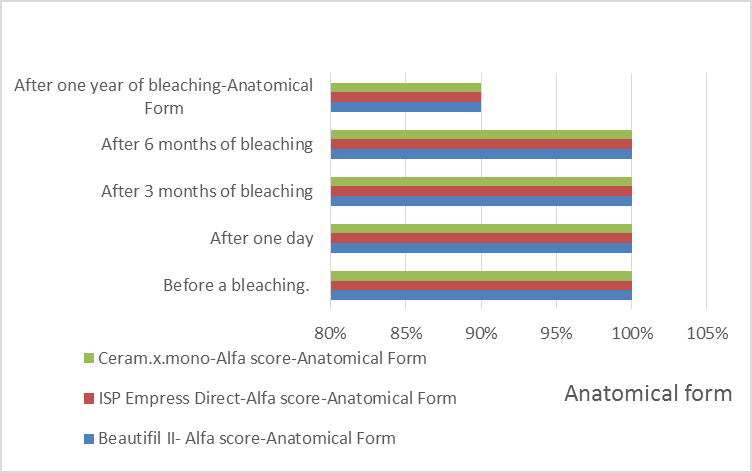
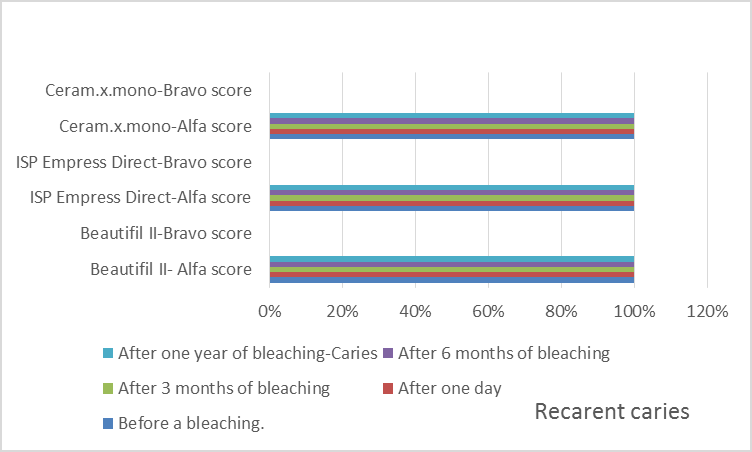
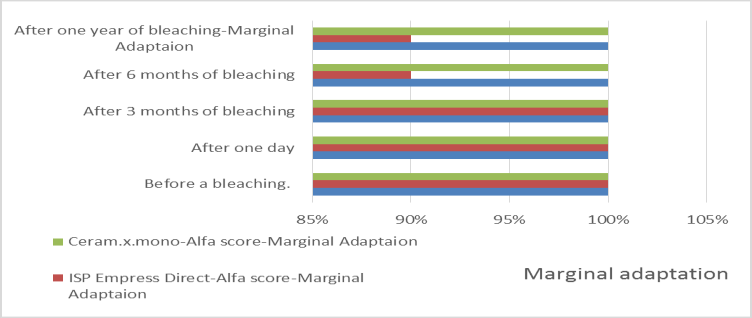
Restorations were evaluated one-week after insertion and before bleaching (baseline), two days, three months, six months, and one year after bleaching using modified Ryge criteria for retention, color match, marginal discoloration, caries, anatomic form, marginal adaptation, and surface roughness. To eliminate bias, assessments were performed in a blinded design where two examiners had no preliminary information about the type of restorations assign scores after they reached an agreement. Score A (Alpha) indicates the clinically ideal restoration. Score B (Bravo) is a clinically acceptable situation except for retention and secondary caries. Score C (Charlie) indicates clinically unacceptable restorations that must be replaced. Data were collected and analysed using SPSS version 20 software. Chi-square (X2) was used for the qualitative data test to investigate the criteria. A least significant differences (LSD) test for repeated measures and an analysis of variance was performed to compare the three restoration types.
Results
From a total of 15-subjects, only 12-subjects with 30- restorations were included in the study, ten of each restorative material (n=10). Drop-out was because of no show during recall visits. Statistical analysis revealed the following results:
Retention
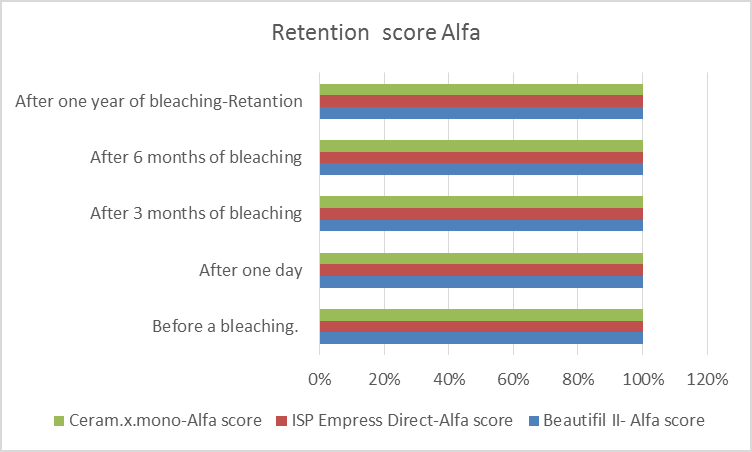
The three restorative groups revealed no statistically significant difference in retention after in-office bleaching at all time periods. The survival rate was 100% with Alfa scoring (Figure 1).
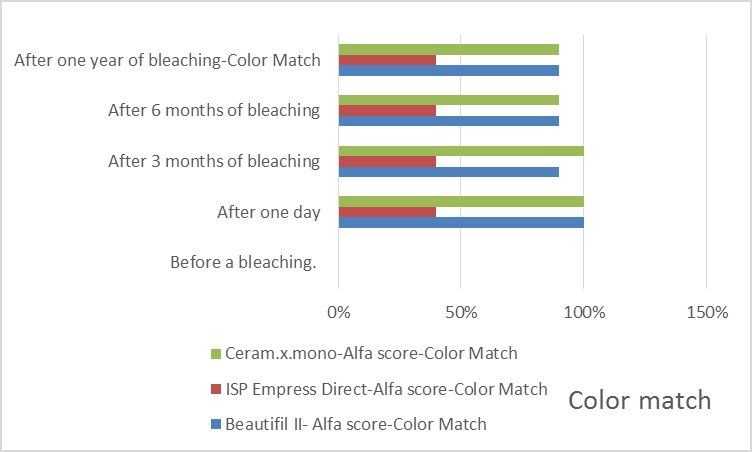
Color match All restorative groups revealed statistically significant difference in color match after bleaching at all tested time periods. Moreover, there was statistically significant difference in color match among the three groups (p˂0.01). Time also had a statistically significant effect on color match (p˂0.01). 90% of G1 (Beautiful II) and G2 (Ceram.x.mono) were able to maintain the matched color with the bleached teeth for three-months after bleaching with A rating. 10% showed B rating at three-months for G1 and six-months for G2after bleaching. However, this mismatch was clinically acceptable and did not require replacement. For G3 (IPS Empress Direct), only 40% showed color match with A rating after bleaching while 60% recorded B rating. At one year after bleaching, 10% had C rating, which is considered clinically unacceptable and needed replacement (Figure 2).
Marginal discoloration
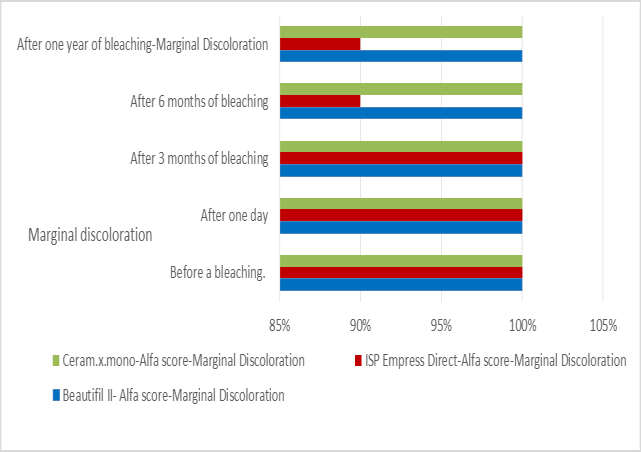
In-office bleaching had no significant effect on marginal discoloration of all restorative groups at all time periods except 10% of G3 that showed clinically unacceptable marginal discoloration (C rating) at the one-year evaluation after bleaching and required replacement (Figure 3).
Discussion
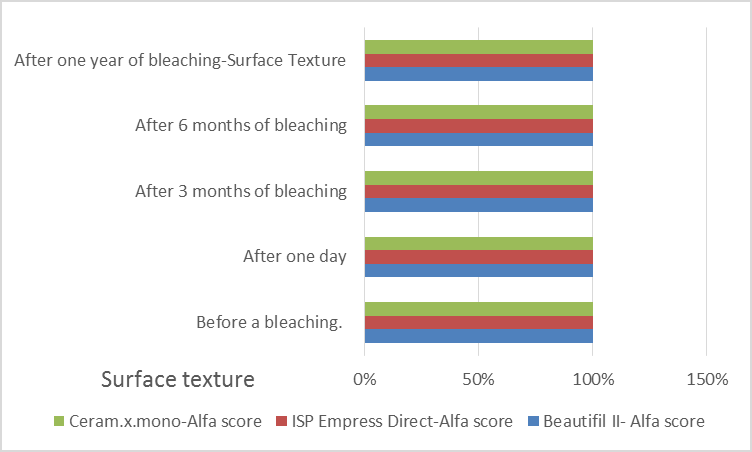
In this clinical trial, all subjects were selected with initial tooth shade (A3) for standardization purposes. Only Class IV was included in the study to facilitate assessment of the bleaching effect on restorations in relation to the tooth. Prior to bleaching, (A1) shades were selected for all composite resin types with the objective of reducing the possibility to have color mismatch after bleaching that may need replacement. Modified Ryge criteria were used for assessment of restoration behaviour because it covers all relevant criteria and is widely used for long-term evaluation of restorations [7]. All subjects revealed significant color change of their teeth after in-office bleaching from A3 to A1 (i.e. 7 units lighter). This could be attributed to the use of the same in- office bleaching technique and time of application sessions. This was in accordance with the study of Auschill, et al. [8] who found that 3.15 cycles of 15 minutes each were necessary in order to achieve the desired six Vita shade-guide tab changes. Color match between the restoration and bleached teeth was clinically acceptable for all restorative materials used at all time periods except 10% of G3at which (A1) translucent enamel and opaque dentin shades were used. The high translucent enamel layer act as a color modifier of underlying opaque dentin. When teeth are bleached, the internal stains are oxidized and teeth appear brighter with increased opacity. Therefore, the color obtained from translucent enamel and opaque dentin shade could not simulate the final bleached shade of the teeth in 60% of the restoration after bleaching, yet it was clinically acceptable and rated as B. At one-year period, 10% of G3 showed color mismatch which was clinically unacceptable (C rating) and required replacement. This mismatch could be attributed to the translucent enamel shade which decreased the value and to color relapse of the teeth. Previous studies reported significant influence of bleaching on the physical properties of composite resin as well as dissolution and leaking of ions such as Barium, Silicon, and Strontium could be referred to the larger the filler particles [9, 10]. Also, the high oxidation and degradation of the resinous matrix in the composite resins and the higher susceptibility to water sorption may cause potential change [11]. In contrast, the results of our study did not show any significant difference among the three materials with respect to surface texture and anatomical form over one-year period. Composite resins used in this study are nano-hybrids with more amounts of nanofillers and less amount of micro-fillers. This could explain the stability of these materials under bleaching conditions. In accordance to our results, Ayad, et al. [12], who conducted a study using an Ormocer (Admira) subjected to different types of bleaching agents for different durations and concluded that this material showed resistance to bleaching. Furthermore, Bryant, et al. [13], indicated that the size and morphology of filler particles influence the mechanical and physical properties while nanoparticles and clusters in the nanofilled materials improved it. The clinical durability of composite restorations depends on successful bonding of the composite resin to the tooth surface. Change in marginal integrity may indicate change in the chemical behaviour of the material as a result of bleaching and/or aging. The present study did not show any significant change among the three restoratives with respect to retention, marginal integrity and secondary caries. This may highlight that in-office bleaching has no harmful effect on bonding or the bonded interface. However, only10% of G3 showed marginal discoloration at 6-months and one-year period. Cavity preparation and the bonding procedures were standardized for all specimens using the same bonding material and technique, which exclude the possibility of bond failure due to bleaching. Therefore, one reasonable explanation could be related to individual patient oral environmental factors as salivary pH or mastication habits.
Conclusion
Within the limitations of this study, the following conclusions may be highlighted: a. Postoperative In-office bleaching had no detrimental effect on the composite resins used in this clinical investigation over one-year period. All restorations were considered clinically acceptable. In-office bleaching may act only on discoloured teeth and not on the dental restoration. b. When bleaching is used in conjunction with direct restoration, postoperative bleaching can be successfully performed by matching the anticipated whitened tooth shade using medium opaque nanohybrid composites. c. High translucent enamel and opaque dentin shade might not be recommended when in-office bleaching is planned. d. When postoperative bleaching is planned, the choice of the restorative material may influence the clinical outcome and long term success.
References
-
Costa JB, McPharlin R, Paravina RD, Ferracane JL (2010) Comparison of at-home and in-office tooth whitening using a novel shade guide. Oper Dent 35(4): 381-388.
-
Dogan A, Ozcelik S, Dogan OM, Hubbezoglu I, Cakmak M, Bolayir M (2008) Effect of bleaching on roughness of dental composite resins. J Adhes 84(11): 897-914.
-
Dutra RA, Branco JR, Alvim HH, Poletto LT, Albuquerque RC (2009) Effect of hydrogen peroxide topical application on the enamel and composite resin surfaces and interface. Indian J Dent Res 20(1): 65-70.
-
D’Amario M, Turco G, Castronovo M (2010) Effect of hydrogen peroxide topical applications on enamel and composite resin surfaces. Dent Mater J 26: e24- e25.
-
Plá Rizzolo BR, Salomone P, Terezinha PR (2013) Effect of bleaching agents on the fluorescence of composite resins. Euro Jof Esth Dent 8(4): 582-591.
-
Xing W, Jiang T, Liang S, Sa Y, Wang Z, et al. (2014) Effect of in-office bleaching agents on the color changes of stained ceromers and direct composite resins. Acta Odonto Scand 72(8): 1032-1038.
-
Konde S, Raj S, Jaiswal D (2012) Clinical evaluation of a new art material: Nanoparticulated resin-modified glass ionomer cement. J Int Soc Prev Community Dent 2(2): 42-47.
-
Auschill TM, Hellwig E, Schmidale S, Sculean A, Arweiler NB (2005) Efficacy, side-effects and patients' acceptance of different bleaching techniques (OTC, in-office, at-home). Oper Dent 30(2): 156-163.
-
Arikawa H, Kanie T, Fujii K, Takahashi H, Ban S (2007) Effect of filler properties in composite resins on light transmittance characteristics and color. Dent Mater J 26(1): 38-44.
-
Ameri H, Chasteen J, Ghavamnasiri M, Torkzadeh M (2010) Effect of a bleaching agent on the color stability of a microhybrid composite resin. J Revista Clínica et Pesquisaem Odontologia 6(3): 215-221.
-
Mourouzis P, Koulaouzidou EA, Helvatjoglu- Antoniades M (2013) Effect of in-office bleaching agents on physical properties of dental composite resins. Quint Inter 44(4): 295-302.
-
Ayad NM, Bedewi AE, Hanafy SA, Saka SE (2009) Effect of bleaching on microleakage, surface hardness, surface roughness, and color change of an ormocer and a conventional hybrid resin composite. Internet J Dent Sci 6(2): 2.
-
Irawan BA, Irawan SN, Masudi SM, Sukminingrum N, Alam MK.3D Surface Profile and Color Stability of Tooth Colored Filling Materials after Bleaching. BioMed Res Int 2015: Article ID 327289.
- Diagnosis and Management of Mental Nerve Paresthesia Secondary to Apical Periodontitis of Mandibular Second Premolar: A CBCT Based Case Report
- A Randomized, Double Blinded Clinical Trial to Compare the Effect of Oral Premedication (Diclofenac Potassium or Dexamethasone) on Post-Operative Pain Following Pulpectomy
- Modified Lip Repositioning Technique for the Management of Excessive Gingival Display
- Integral Role of Non-Dental Providers and Fluoride Dissemination
- Root Canal Treatment Rate in Deciduous Teeth Among 6-Year- Olds in the Era of Discontinuing Water Fluoridation - Historical Cohort Study
- The Impact of the Notch1 on the Migratory Capacity and the Expression of E-Cadherin and CyclinD1 in Ameloblastoma Cells