
Potency of Acid Content in Local and Imported Strawberry Fruit Extract (Fragaria X Ananassa) as Natural Ingredients for Teeth Whitening
Background: Bleaching treatment is a whitening treatment for discolored teeth to restore their aesthetic function. The bleaching agent that is commonly used is 35% carbamide peroxide. Strawberries contain malic acid which can whiten teeth. Purpose: This study aims to find out acid potential on strawberries as a natural ingredient for teeth whitening. Methods: 48 post-extraction permanent single-rooted teeth that had been coated with clear nail polish were soaked in black coffee for 2 days, then 16 teeth were immersed in a local strawberry extract solution, 16 teeth were immersed in an imported strawberry extract solution and the other 16 teeth were immersed in a 35% carbamide peroxide gel solution and then observed and measured the color of the teeth after immersion at 24 hours and 48 hours. Results: There is potential for local and imported strawberry fruit extract in whitening teeth but the whitening potential when compared to carbamide peroxide is not significant (p>0.05). The whitening potential of imported strawberry juice is higher than that of local strawberry juice based on the average value. Conclusion: Based on research results, local and imported strawberry juice extracts have the potential to whiten discolored teeth.
Introduction
Tooth bleaching has become one of the most successful and well-accepted aesthetic dental treatments over the past decades and has become an important part of aesthetic dentistry, representing the most conservative method of treatment of dental discoloration. Special interest enjoyed this type of dental treatment, especially among patients and physicians, has led to numerous market profiles for bleaching products and application techniques [1, 2].
The 2015 survey data states that more than 1 million Americans are interested in carrying out teeth whitening treatment at a cost of up to 600 million dollars per year [3].
Tooth discoloration is caused by stains which may be intrinsic, extrinsic or a combination of both in terms of source [4]. Intrinsic factors such as congenital, systemic, hematologic factors, disorders and exposure to phenolic or iodoformic drugs and conditions caused by extrinsic factors, namely pigments in food, beverages such as tea, coffee, tobacco, red wine, and other substances that often come into contact with the hard tissues of the teeth in the oral cavity. The use of tobacco products is also a risk factor for tooth discoloration [5, 6, 7]. The color of the tooth structure results from the interaction of different light phenomena through hard tissues including dispersion, refraction, transmission and absorption. The final observed color is determined by a combination of the optical properties of the enamel and dentine tissue including translucency and chromaticity [8]. Bleaching involves an oxidation process in which the molecules causing the discoloration are chemically modified [9].
Shade guides is the one commonly used and commercially available is Vitapan Classical with 16 shade guides (Vita Zahnfabrik) arranged from lightest to darkest, namely B1, A1, B2, D2, A2, C1, C2, D4, A3, D3, B3, A3 .5, B4, C3, A4 and C4. Vitapan 3D master with 29 colors including three colors of bleach (Vita Zahnfabrik) which is used as a benchmark for measuring tooth color. Each tab is placed in the inspection box and measured using a spectrophotometer [10, 11].
Color measurement is based on the use of 3 or 4 color discs, each of which has been calibrated using 3 methods, namely chromatic, value and chrome. Chromium is a color intensity that distinguishes strong colors from weak colors which is described as the distance of the circle from the center (Munsell color ball). Value is a color quality associated with lighting and the system’s color measurement for visually matching product colors to Munsell colors using the sense of sight [12].
Indications for bleaching teeth that have undergone discoloration are tooth discoloration caused by pulp chambers, discolored dentin, discolored due to calcification metamorphosis, and discolored due to hypoplasia/ hypomineralization. Hypoplasia and hypomineralization may require additional treatment to completely cover the discoloration [13].
The side effect of using hydrogen peroxide and carbamide peroxide as teeth whitening agents are that they can cause penetration of the pulp chamber, increase sensitivity to temperature making it easier to ache, decrease enamel hardness and changes in enamel layer roughness [14].
The side effects resulting from the use of chemicals as tooth whiteners have made many researchers look for alternative materials to replace chemicals, namely by using natural ingredients that are safer and at affordable prices [14].
Indonesia imports around 150 tons of premium strawberries per year from South Korea, the United States and Australia. Strawberry fruit is a fruit that is widely consumed as fresh or processed food with a distinctive aroma, red color and sweet taste. In 2019 world strawberry production reached 8.9 million tonnes, of which China contributed 35.9%, the United States 11.2% and Mexico 10.11%. Strawberry is a fruit that is valued because of the nutritional content contained in the fruit [15, 16].
Indonesia is one of the fruit-producing countries with diversity and rich in taste when compared to fruit from other countries. Based on data from the Food and Agriculture Organization (FAO). In 2014 Indonesia was ranked in the top 20 as a world-level fruit producing country. Tomatoes and strawberries are types of fruit that are quite popular and are known to have a fairly high water content. Strawberries and tomatoes are considered fruits that are widely consumed in Indonesia, but both have a short shelf life due to their high water content [17].
There are natural ingredients from strawberries as a natural teeth whitener because strawberries (Fragaria x ananassa) contain pectin (natural fiber) which helps clean teeth themselves and strawberries are fruits that are rich in phytochemicals such as ellagic acid (ellagic acid), malic acid (malic acid), anthocyanins, quercetin, catechins and vitamins such as ascorbic acid and folic acid. Ellagic acid has a potential OH group which acts as a strong oxidizer. Stephanie et al noticed that the more ellagic acid, the more OH groups produced and the more effective the bleaching process. OH and H radicals produced from ellagic acid react with organic email molecules, disrupting electron conjugation and changing the absorption of energy in enamel by forming smaller organic molecules with a lighter color [18, 19] (Figure 1).
![Figure 1: Ellagic Acid Structure [20].](/fulltextimages/10807/fig_1.png)
Materials and Methods
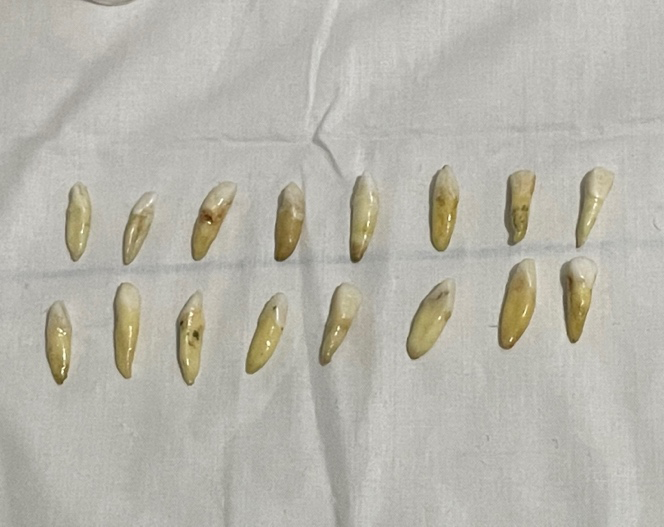
In this study, 48 single-rooted teeth were used which had been coated with clear nail polish on the roots of the teeth Figure 2.
Inclusion Criteria
Caries free teeth, extracted single-rooted teeth, teeth free from calculus. Exclusion criteria: fracture teeth, stained crown.
Carbamide peroxide 35% is the bleaching agent used in this study. A digital spectrophotometer is used to measure the color of the sample, which will take the initial and final colors as a comparison of changes.
The samples used local strawberry juice extract (holibert strawberry, bandung, Indonesia) and imported strawberry fruit juice extract (evergood brand, South Korea). The bleaching potential was compared with 35% carbamide peroxide.
Conducted an analysis test for malic acid content in the strawberries used in this study at the Saraswanti Indo Genetech Bogor laboratory with the result that there was a malic acid content of 0.15% for local strawberries and 0.0885% for imported strawberries.
Making a strawberry fruit extract paste is by preparing 200 grams of strawberries which have been cleaned, diced and mixed with 15 ml of distilled water and blended to get about 100 ml of strawberry concentrate. This concentrate was filtered then transferred into a cooling centrifuge to be processed at 2000 rpm for about 20 minutes at room temperature.4oC. Liquid is collected in a container and stored at 4oC.
Study Design
This type of research is a laboratory experiment with a pre-test-post research design with a control group design, namely in a simple experimental design that is chosen randomly. One group acts as the control group and the other group acts as the experimental group. Sampling was carried out using systematic random sampling technique. Samples taken randomly but systematically.
In this study, immersion was carried out16 tooth samples in coffee solution (pre-test) and then soaked with local strawberry juice (post-test). The second sample group consisted of 16 other tooth samples which were soaked in coffee solution (pre-test) and then soaked with carbamide peroxide. Then there is a third sample group of 16 samples soaked in coffee solution (pre-test) and then soaked with imported strawberry juice (post-test).
After soaking, the light color (L) was measured after being soaked with local strawberry juice which was done 2 times, namely at 24 hours and 48 hours of immersion. The analysis was carried out by carrying out univariate analysis, namely descriptive statistical analysis by calculating the mean of the research data and also carrying out a normality test. Then do the data comparison between the pretest and posttest by using paired t-test and comparison test between treatment groups using the One Way ANOVA test.
Results
Descriptive Statistics
The following is the average value of the research data, namely the average color (L) of the teeth by soaking local strawberry juice, imported strawberry juice and carbamide peroxide gel (Figures 3-5).
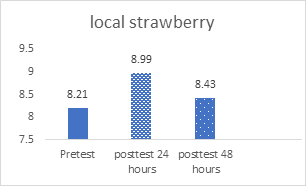
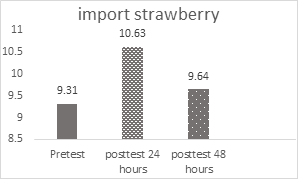
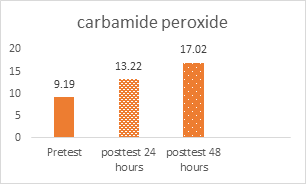
It can be seen from Figures 3-5 that the color (L) of the teeth tends to increase at 24 hours and decrease at 48 hours if soaked with local strawberry juice and imported strawberry juice. On the other hand, the color (L) of the teeth tends to increase if soaked in carbamide peroxide gel solution.
Normality Test
The data normality test is a hypothesis test to find out whether the data obtained is normally distributed or not. This test is carried out to determine whether parametric statistical methods or non-parametric statistics are more suitable to be used in conducting the analysis. The normality test was carried out using the Shapiro-Wilk test method because the data samples totaled less than 50 data. The results of data normality test can be seen in Tables as follows.
It can be seen from the results of the normality test in Table 1 that all data groups produce a p-value for the Shapiro-Wilk test greater than 0,05 which indicates that the data is normally distributed. Because the pair of pre- test and post-test data on immersion with strawberry juice is normally distributed, the Light (L) color comparison test between the pre-test and post-test of local strawberry juice immersion is carried out using the parametric method, namely the dependent t-test or Paired T-test. Likewise with the pre-test and post-test of carbamide peroxide immersion and also imported strawberry juice which can also be carried out using the parametric method namely the dependent t test or Paired T-test.
| Perlakuan | Data Group | P-values |
|---|---|---|
| Local Strawberry Juice | Pre-Test | 0,144 |
| Post-Test 24 Hour | 0,325 | |
| Post-Test 48 Hour | 0,352 | |
| Carbamide Peroxide | Pre-Test | 0,062 |
| Post-Test 24 Hour | 0,702 | |
| Post-Test 48 Hour | 0,646 | |
| Imported Strawberry Juice | Pre-Test | 0,993 |
| Post-Test 24 Hour | 0,166 | |
| Post-Test 48 Hour | 0,459 |
Table 1: Normal Distribution Test Results.
Meanwhile, it can be seen that in the post-test pair of local strawberry juice immersion, post-test data of carbamide peroxide immersion and also post-test data of imported strawberry juice immersion were also normally distributed, so a comparison test between the Light color (L) between the three groups was carried out by parametric method namely One Way ANOVA.
Paired T-test
Paired T-test comparison was conducted to determine whether or not there was an effect of soaking with local strawberry juice, then whether or not there was an effect of soaking with carbamide peroxide and whether or not there was an effect of soaking with imported strawberry juice on the Light (L) color on the teeth. The results of the Paired T-test can be seen in Tables 2-4 as follows.
| P-values | Information | |
|---|---|---|
| 24 Hour Post-Test | 0.408 | Not Significantly Different |
| 48 Hour Post-Test | 0.837 | Not Significantly Different |
Table 2: Results of paired t-test immersion with local strawberry juice.
Based on Table 2, it can be seen that on soaking with local strawberry juice, both after soaking for 24 hours and 48
hours, the resulting p-value is greater than 0.05, this means that there is no significant difference between the Light (L) before and after soaking with local strawberry juice either at 24 hours, 48 hours or 72 hours. So it can be concluded that “local strawberry juice has no significant effect on the color of Light (L) on the teeth either after 24 hours or 48 hours of soaking”.
| P-values | Information | |
|---|---|---|
| 24 Hour Post-Test | 0.196 | Not Significantly Different |
| 48 Hour Post-Test | 0.743 | Not Significantly Different |
Table 3: Test results of paired t-test immersion with imported strawberry juice.
Meanwhile in Table 3 it can be seen that in soaking with local strawberry juice, after soaking for 24 hours and 48 hours, the resulting p-value is greater than 0.05, this means that there is no significant difference between Light (L) before and after soaking with imported strawberry juice at 24 hours and 48 hours. This shows that “imported strawberry juice did not have a significant effect on the color of Light (L) at 24 hours and 48 hours of immersion”.
| P-values | Information | |
|---|---|---|
| 24 Hour Post-Test | 0.014 | Significantly Different |
| 48 Hour Post-Test | 0 | Significantly Different |
Table 4: Test results of paired t-test immersion with carbamide peroxide gel.
Whereas in Table 4 it can be seen that in immersion with carbamide peroxide, both after immersion for 24 hours, 48 hours and 72 hours, the resulting p-value is less than 0.05, this means that there is a significant difference between Light (L) before and after immersion with carbamide peroxide both at 24 hours, 48 hours and 72 hours. So it can be concluded that “carbamide peroxide has a significant effect on the color of Light (L) on the teeth both after soaking for 24 hours, 48 hours and 72 hours”.
ANOVA Test
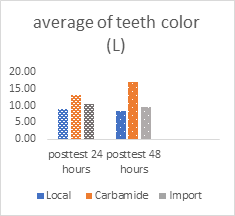
Based on Figure 6 it can be seen that there is a gap or quite a difference in the color of the teeth between after being soaked with local strawberry juice, imported strawberries and carbamide peroxide. To see the significance of these differences, a comparison test was carried out with one way ANOVA.
| Sum of Squares | df | Mean Square | F | P Value | ||
|---|---|---|---|---|---|---|
| Posttest 24jam | Between Groups | 145,666 | 2 | 72,833 | 1,783 | 0,180 |
| Within Groups | 1,837,992 | 45 | 40,844 | |||
| Total | 1,983,658 | 47 | ||||
| Posttest 24jam | Between Groups | 692 | 2 | 345.943 | 15.402 | 0,000 |
| Within Groups | 1,011 | 45 | 22.460 | |||
| Total | 1,703 | 47 |
Table 5: ANOVA test results.
Based on Table 5 it can be seen that the P-value generated for the 24-hour immersion posttest data is greater than 0.05. This means that “the type of treatment given is immersion in juice. Local strawberries, carbamide peroxide and imported strawberry juice did not give a significant difference to the color of the teeth at 24 hours immersion.
Meanwhile, the P-value generated for the 48-hour immersion posttest data is less than 0.05. This means that “the type of treatment given, i.e. immersion with local strawberry juice, carbamide peroxide and imported strawberry juice, produced tooth color that was significantly different from 48-hour immersion”.
Because the results of the ANOVA test show that the type of treatment given, namely immersion with local strawberry juice, carbamide peroxide and imported strawberry juice, produces a significantly different tooth color from the 48- hour immersion, the analysis is continued with a posthoc test to find out more precisely which type of treatment which are significantly different from each other Table 6.
| P-values | ||
|---|---|---|
| Posttest 48 hours | Local vs Carbamide | 0.000* |
| Local vs Import | 0.736 | |
| Carbamide vs Import | 0.001* |
Table 6: 48 hour immersion posthoct test results.
P-values followed by a sign (*) indicates a significant difference. Based on the posthoc test, it was found that the color of the teeth soaked in carbamide peroxide for 48 hours differed significantly from the color of the teeth soaked in local strawberry juice or imported strawberry juice. However, it was also known that there was no significant difference in the color of teeth soaked in local strawberry juice and the color of teeth soaked in imported strawberry juice for 48 hours. That is, the effect of soaking with local strawberry juice and imported strawberry juice for 48 hours on tooth color is the same, but the effect is different from soaking with carbamide peroxide.
Discussion
This study aims to determine the potential of the acid present in local strawberries and imported strawberries. The local strawberries used were Holibert strawberries originating from Garut and Ciwidey Bandung, Indonesia which had been examined for the malic acid content contained in these fruits of 0.15% and the imported strawberries used were strawberries with the Evergood brand originating from South Korea with a malic acid content of 0.0885%. This study used 35% carbamide peroxide bleach.
If you look at the average data in this study for the local strawberry juice group, if you compare the pretest and posttest at 24 hours, there is a difference of 0.78, while at 48 hours there is a difference of 0.22. The imported strawberry juice group when comparing the pretest and posttest at 24 hours there was a difference of 1.32 while at 48 hours of immersion there was difference of 0.33. The 35% carbamide peroxide group when comparing the pretest and posttest at 24 hours there was a difference of 4.03 while at 48 hours of immersion there was a difference of 7.83. If seen from the difference in the average of the data, the immersion group with significant results occurred in the 35% carbamide peroxide group. The group of local strawberries and imported strawberries did not have a significant difference, but when compared through the difference in the average group data, imported strawberries were higher than the local strawberry group.
When compared through data from the average value of these groups, the imported strawberry juice group had a superior effect on teeth whitening results compared to the local strawberry juice group, where the malic acid content in the imported strawberry juice group was lower than the local strawberry juice group with a difference of 0.0615%. This is likely to occur due to the presence of other acids in imported strawberries, thus increasing the potential for teeth whitening, namely the ellagic acid content. Research by Selva Mutkumaran, et al. [20].
In Senthilkumar’s research, et al. in 2021 stated that the average value obtained by using carbamide peroxide was more significant than strawberry extract (p <0.01). In comparison, the carbamide peroxide group was statistically more significant than strawberry extract (p <0.01) [21].
The results of this study are in accordance with the results of research conducted by Senthilkumar, et al. namely “the comparison in the carbamide peroxide group statistically has a significant effect compared to the strawberry fruit extract” but the difference is the soaking time of the samples. Radhakrishnan, et al. namely the use of hydrogen peroxide bleaching agent, while in this study carbamide peroxide was used. Another thing that distinguishes it is the acid content in the strawberries used as research material. It is proven that local strawberries originating from Indonesia, the holibert type, have a malic acid content of 0.15% and imported strawberries originating from South Korea, the evergood brand, have an acid content of 0.15%. 0.0885% while the strawberries used in the study by Radhakrishnan, et al. [21, 22].
Conclusion and Recommendation
Strawberry fruit juice extract with malic acid content in it of 0.15% in local strawberry juice and 0.0885% in imported strawberry fruit juice has the potential to whiten discolored teeth but not significant (p>0.05). Imported strawberries have a higher potential to whiten teeth compared to local strawberries.
Further research is needed to determine the ellagic acid content in local and imported strawberries at the Saraswanti Indo Genetech Laboratory, Bogor, West Java, Indonesia.
Conflicts of Interest
The authors declare that they have no known competing financial interests or personal relationships that could have appeared to influence the work reported in this paper.
References
-
Yu Hao, Zhang Chang-Yuan, Cheng Shao-Long, Cheng Hui (2015) Effects of Bleaching Agents on Dental Restorative Materials: A Review of The Literature and Recommendation to Dental Practitioners and Research. Journal of Dental Sciences 10: 345-351.
-
Iulia SC, Margarita C (2015) Comparative Clinical Study on Professional Bleaching According to Two Age Groups. International Journal of Scientific Research 4(4): 280- 282.
-
Kwon SR, Maherry M, Oyoyo U, Li Y (2015) Efficacy of Do-It-Yourself Whitening as Compared to Conventional Tooth Whitening Modalities: An In Vitro Study. Oper Dent 40(1): 21-27.
-
Li Y (2017) Stain Removal and Whitening by Baking Soda Dentifrice. J Am Dent Assoc 148(11): S20-S26.
-
Sucheta J, Ravjot A, Arundeep S, Dax A (2017) Comparative Evaluation of the Efficacy of In-Office Bleaching (37.5% Hydrogen Peroxide) and At-Home Bleaching (15% Carbamide Peroxide) Using Different Activation Systems. International Journal of Medical Science and Clinical Inventions 4(5): 2929-2940.
-
Prskalo K, Sever EK, Alerić I, Jelić TA, Žaja I (2017) Risk Factors Associated with Black Tooth Stain. Acta Clinica Croatica 56(1): 28-35.
-
Isabele V, Waldemir F, Vieira WF, Pauli MC, Theobaldo JD, et al. (2020) Effect of In-office Bleaching Gels with Calcium or Fluoride on Color, Roughness and Enamel Microhardness. J Clin Exp Dent 12(2): 116-122.
-
de Silva MRP, Leal PD, Faria-e-Silva PC, Luis A (2018) Impact of 35% Hydrogen Peroxide on Color and Translucency Changes in Enamel and Dentin. Brazilian Dental Journal 29(1): 88-92.
-
Rao YM, Srilakshmi V, Vinayagam KK, Narayanan LL (2009) An evaluation of the color stability of tooth- colored restorative materials after bleaching using CIELAB color techniques. Indian J Dent Res 20(1): 60-64.
-
Ishikawa-Nagai S, Wang J, Seliger A, Lin J, da Silva J (2013) Developing a Custom Dental Porcelain Shade System for Computer Color Matching. Journal of Dentistry 41(3): 3-10.
-
de Geus JL, Fernández E, Kossatz S, Loguercio AD, Reis A (2017) Effects of At-home Bleaching in Smokers: 30-month Follow-up. Oper Dent 42(6): 572-580.
-
Kusmawati FN, Kusumaningrum DP (2019) Effect of Red Dragon Fruit Juice on Acrylic Resin Color. SciMedicine Journal 1(3): 143-150.
-
Greenwall-Cohen J, Greenwall LH (2019) The Single Discolored Tooth: Vital and Non-vital Bleaching Techniques. Br Dent J 226(11): 839-849.
-
Simatupang D, Dwisaptarini AP (2021) Effect of Green Kiwifruit Juice (Actinidia Deliciosa) on Discoloration in Teeth Whitening Process (In Vitro). Journal of Integrated Dentistry 3(1): 41-44.
-
Ermi S, Setyadjit (2019) Fresh Handling Techniques for Strawberry to Maintain its Quality. Journal of Agricultural R & D 38(1): 47-54.
-
Porras CL, Leos Maria ZS, Martinez Laura AL, Solis VE, Figueroa YT, et al. (2021) Strawberry Juice Powders: Effect os Spray-Drying Conditions on the Microencapsulation of Bioactive Components and Physicochemical Properties. Molecules 26(5466): 1-14.
-
Maula Rista N, Astuti AP, Maharani Endang TW (2020) Analysis of the Effectiveness of Using Eco-enzymes in Preserving Strawberries and Tomatoes with Comparative Concentrations. Proceedings of the Edusainstech Seminar 20(20): 434-442.
-
Morfeh NEA, EL-Assaly Manal MM, Bashir MH, Abbass Marwa MS (2021) The Bleaching Potential of Curcumin and Strawberries (Home Remedies) Versus Carbamide Peroxide (Conventional Home Bleaching Modality) (An In Vitro Study). Annals of the Romanian Society for Cell Biology 25(5): 1028-1037.
-
Rawan A, Simon S, Matthew G, Waterhouse P (2020) A Review on Dental Whitening. J Dent 100: 103423.
-
Mutkumaran S, Tranchant C, John S, Ye X, Xue SJ (2017) Ellagic Acid in Strawberry (Fragaria spp.): Biological, Technological, Stability, and Human Health Aspects. Food Quality and Safety 1(4): 227-252.
-
Vijayapriyangha S, Ramesh S (2021) Comparative Evaluation of Natural Tooth Whitening Agents-An In vitro Study. International Journal of Dentistry and Oral Science 8(02): 1749-1752.
-
Rajith R, Nesamani R, Sanjeev K, Sekar M (2021) Effect of Bleaching with Strawberry Extract and Hydrogen Peroxide on Color Change, Surface Morphology and Micro-shear Bond Strength of Resin Composite to Enamel Surface. Journal of Clinical and Diagnostic Research 15(3): ZC01-ZC06.
- Diagnosis and Management of Mental Nerve Paresthesia Secondary to Apical Periodontitis of Mandibular Second Premolar: A CBCT Based Case Report
- A Randomized, Double Blinded Clinical Trial to Compare the Effect of Oral Premedication (Diclofenac Potassium or Dexamethasone) on Post-Operative Pain Following Pulpectomy
- Modified Lip Repositioning Technique for the Management of Excessive Gingival Display
- Integral Role of Non-Dental Providers and Fluoride Dissemination
- Root Canal Treatment Rate in Deciduous Teeth Among 6-Year- Olds in the Era of Discontinuing Water Fluoridation - Historical Cohort Study
- The Impact of the Notch1 on the Migratory Capacity and the Expression of E-Cadherin and CyclinD1 in Ameloblastoma Cells