
2% Lemongrass Essential Oil Gel as a Local Drug Delivery Agent Adjunct to Scaling and Root Planning for the Treatment of Chronic Periodontitis
Aims: Evaluation of the efficacy of 2% lemongrass essential oil gel for the treatment of chronic periodontitis, as a local drug delivery agent along with scaling and root planning as compared to the scaling and root planning alone. Methods and Material: Systemically healthy 60 Patients aged 18-55 years with chronic periodontitis having at least 2 interproximal sites with AL ≥4 mm (not on the same tooth), or ≥ 2 interproximal sites with PD≥5 mm (not on the same tooth) were randomly divided into two groups. GROUP 1 (Experimental Group) 2% lemongrass essential oil in gel form was injected along with scaling and root planning. GROUP 2 (Study Group) scaling & root planning (SRP) was done. Statistical analysis used: Paired t Test. Results: Statistically significant reduction in periodontal pocket depth, improvement in gingival status and gain in relative clinical attachment level were noted in the group 1 experimental group as compared to the control group in which scaling and root planning was done alone at 1 and 3 months follow-up. Conclusion: A phytomedicine Lemongrass in gel form can be used as a local drug delivery agent along with scaling and root planning as an alternative to another antimicrobial agent for the treatment of chronic periodontitis patients.
Abbreviations
GI: Gingival Index; PD: Pocket Depth; CAL: Clinical Attachment Level; ANOVA: One-Way Analysis Of Variance.
Key Messages
Scientific Rationale for Study
Periodontal pathogens are in direct contact with the root surface some of these pathogenic microorganisms which cannot be eliminated by hand or power-driven instruments can be reduced or eliminated by using an antimicrobial agent in local drug delivery method. By using the local drug delivery method, High and sustained local drug concentration (many folds more than MIC) can be attained at periodontal pocket sites for a long duration, which eliminates the need for systemic administration of antimicrobial agents, which reduces the risk of systemic toxicity, adverse reactions, resistant strains, and superimposed infections.
Principal Findings
Treatment of isolated deep pockets with local drug delivery reduces gingival inflammation and pocket depth, and improves the clinical attachment level.
Practical Implication
This evidence supports the use of medicinal plants as a local drug delivery agent without any adverse drug reaction for effective management of chronic periodontitis and is also helpful in isolated pockets, or in a patient where flap surgery and systemic antibiotics are contraindicated.
Introduction
Periodontitis is inflammation of the periodontium, comprising the bacterial etiology and an immune response that may cause tissue destruction and teeth loss.
The non-surgical method (Scaling and root planning) is used for plaque removal, and to create a favourable ecology by eliminating deep pockets and controlling the recolonization of subgingival sites by periodontal pathogens for the treatment of chronic periodontitis. But Sometimes SRP is not only effective, due to tooth anatomy and biofilm structure, which may cause the persistence of pathogen even after scaling and root planning, leading to recurrent periodontal tissue destruction. This leads to increased use of systemic antimicrobial drugs along with scaling and root planning. But to reach effective concentration of antimicrobial drug after systemic administration requires high dose with repeated intake for prolonged period of time. This results in various adverse effects like inadequate drug concentration in periodontal pocket, problem related to patient compliance, rapid fall in concentration to sub therapeutic level demanding repeated drug intake, development of bacterial resistance and increased potential for adverse effects like nausea, vomiting, hypersensitivity, gastrointestinal intolerance.
So, using antimicrobial drugs as a local drug delivery agent along with mechanical therapy can give better results in treating periodontal pockets. It Provide high concentrations at the periodontal pockets, no systemic administration, fewer applications, lesser side effects, and high acceptability. It maintains effective concentration of antibacterial agents in periodontal pocket for sufficient periods of time to alter subgingival microorganisms and accelerate the healing of periodontal attachment apparatus.
Continuously developing Phyto sciences has yielded many medicinal plants that can be used as alternative antimicrobial therapy including aloe vera, green tea, Cymbopogon citratus(lemongrass) etc. Cymbopogon citratus is a popular medicinal plant Figure 1 at a concentration of ≤2%, it inhibits the growth of various periodontal pathogens. Actinomyces Naeslundii and Porphyromonas gingivalis, which were resistant to tetracycline hydrochloride are also inhibited by lemongrass.
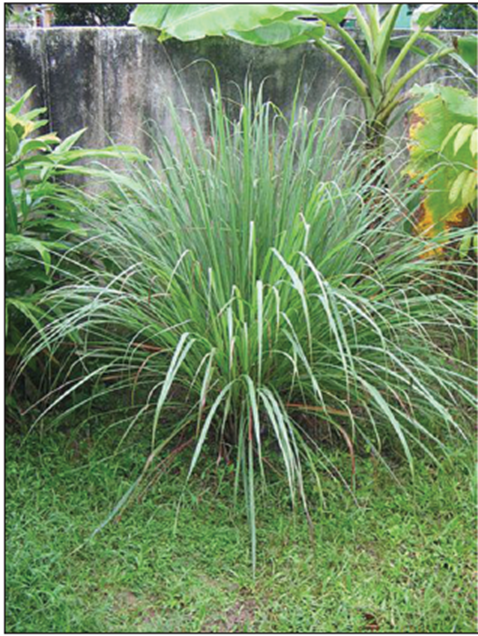
Linking the faith of people for herbal/natural products and potency of lemongrass oil, the present study was conducted to evaluate the efficacy of locally delivered 2% lemongrass essential oil in gel form as an adjunct to SRP, as compared to scaling and root planning alone for the treatment of chronic periodontitis.
Subjects and Methods
Patients coming to the Department of Periodontology of Government Dental College & Hospital, Ahmedabad were recruited for the study.
Inclusion Criteria
A total number of patients- 60 patients Age -20-55 year’s old patients Patients with chronic periodontitis having at least 2 interproximal sites with AL ≥4 mm (not on the same tooth), or ≥ 2 interproximal sites with PD≥5 mm (not on the same tooth).
Exclusion Criteria
- Who had undergone oral prophylaxis in the previous six months.
- Who had taken multivitamins or antioxidant micronutrient supplements in the previous six months
- Who are using mouthwashes regularly.
- Current and former smokers
- Patients who had taken anti-inflammatory or antibiotic drugs within the previous three months
- Patients having any history of drug allergy
- Patients with systemic diseases like diabetes mellitus or with other diseases which compromise the immune system and are known to influence periodontal disease
- Who had undergone any periodontal therapy within 6 months before the study
- Pregnant female and lactating mothers were excluded from study.
All 60 Subjects who fulfil the inclusion criteria were randomly divided into two groups Group 1 and Group 2.
Group 1 was taken as the experimental group and patients who were included in this group were treated with SRP along with that 2% lemongrass essential oil in the gel form injected. While patients from Group 2(the control group) were treated by scaling & root planning only.
All The patients were clinically examined at the first visit and they are informed about the study and risks and benefits of their participation in the study. Informed consent was taken from the patients. After that Gingival status was assessed using Gingival index (GI) (Silness and Loe in 1964) before undergoing oral prophylaxis. After scaling and root planning using ultrasonic device and hand instruments Periodontal pocket depth (PD) and clinical attachment level (CAL) were evaluated at baseline.
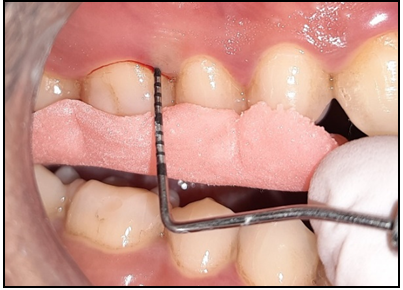
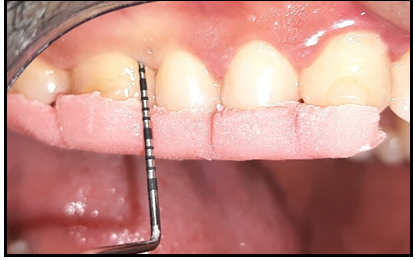
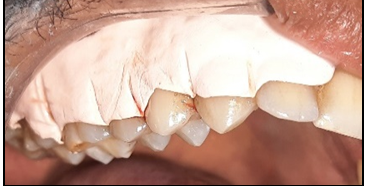
Subjects were again assessed after 1 month & 3 months of intervention for gingival status, probing depth and clinical attachment level. Standardization of the procedure was done with acrylic stent fabrication as depicted in Figures 2&3. Material Lemongrass essential oil was obtained by the distillation process.
2% Lemongrass Essential Gel Preparation
In 5 percent Carbopol 934 in water. Soak for 2 hours and neutralized with triethanolamine to a PH of 7. Previously 2 percent solution of lemon grass oil was made in 5ml of each propylene glycol and ethanol mixture. This blend was transferred to a Carbopol container and was agitated for approximately half an hour and allowed to hydrate and swell for 1-2 hours, after that PH was further checked for the desired value and finally homogeneous gel was obtained.
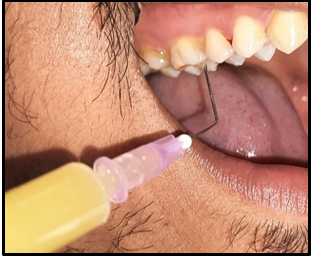
The gel was administered using a syringe with a bent, blunt-end needle as shown in Figure 4 and periodontal pack was applied on site of drug delivery as shown in Figure 5.
Statistical Analysis
Statistical analysis was done using SPSS ver. 26.0 (SPSS, Inc., Chicago, IL, USA). A Mean difference of the GI, PPD and CAL was compared using a paired t-test and intergroup comparison was done using one-way analysis of variance (ANOVA). Level of significance was set at p ≤ 0.05 (95% confidence interval).
Results
All the 60 subjects completed the study without any complication or side effects. Statistically significant reduction in GI and PPD and gain in CAL in both the groups from baseline, and after 3 months were noted. In comparison between both the groups, the experimental group showed more improvement than in the control group.
| Groups | BL | 1 Month | 3 Month | Mean Difference | P Value | |
|---|---|---|---|---|---|---|
| 1 Month | 3 Month | |||||
| Group 1 | 2.06 ±0.31 | 1.76 ±0.37 | 1.22 ± 0.24 | 0.31 ± 0.48 | 0.84 ± 0.41 | <0.05 |
| Group 2 | 1.95 ±0.22 | 1.75 ±0.30 | 1.67 ± 0.40 | 0.28 ± 0.43 | 0.28 ± 0.37 | <0.05 |
Table 1: Comparison of changes in gingival index between experimental group and control group.
| Groups | BL | 1 Month | 3 Month | Mean Difference | P Value | |
|---|---|---|---|---|---|---|
| 1 Month | 3 Month | |||||
| Group 1 | 7.31 ± 114 | 6.86 ± 0.83 | 5.19 ± 0.60 | 0.45 ± 1.44 | 2.12 ± 1.28 | <0.001 |
| Group 2 | 7.87 ±0.96 | 7.05 ± 0.70 | 6.11 ± 1.24 | 0.82 ± 1.39 | 1.76 ± 1.70 | <0.05 |
Table 2: Comparison of changes in pocket depth between experimental group and control group.
| Groups | BL | 1 Month | 3 Month | Mean Difference | P Value | |
|---|---|---|---|---|---|---|
| Groups | BL | 1 Month | 3 Month | 1 Month | P Value | 3 Month |
| Group 1 | 7.31 ± 114 | 6.86 ± 0.83 | 5.19 ± 0.60 | 0.45 ± 1.44 | 2.12 ± 1.28 | <0.001 |
| Group 2 | 7.87 ± 0.96 | 7.05 ± 0.70 | 6.11 ± 1.24 | 0.82 ± 1.39 | 1.76 ± 1.70 | <0.05 |
Table 3: Comparison of changes in clinical attachment level between experimental group and control group.
Discussion
Periodontitis is an inflammatory condition of tissue supporting the tooth structure. Microbial toxins which are released by periodontal pathogens, altered oxidants and antioxidants balance and excessive oxidative stress, altered host immune response are responsible for periodontitis. If left untreated it results in to bleeding gum, loosing of collagen fibers, mobility of teeth, clinical attachment loss and deep periodontal pocket formation.
Non-surgical treatment Scaling and root planning is the most common treatment for periodontitis. But sometimes scaling and root planning cannot eliminate all the periodontal pathogens due to tooth anatomy, inaccessibility to furcation region, or deep periodontal pocket. In such cases local drug delivery with various antimicrobial agents is advantageous.
The Edris AE [1] has published a study in 2007 that lemon grass essential oil can penetrate and rupture the biofilm and inhibit plaque formation hence it can be used as a mouthwash and toothpaste [1]. In the article of drug invention by Kumar MS, et al. [2] concluded that lemongrass can be used for the Management of halitosis (Bad breath), gingivitis and periodontitis and as an antiplaque, anti caries, and antifungal agent [3].
Lemongrass belongs to the family Poaceae and the genus Cymbopogon, also known as barbed wire grass, Tanglad, citronella grass, and Hierba Luisa. It is distributed in India, Tropical Asia and Africa. It has two Active ingredients Citronellol and Geraniol. It has an anti-plaque, antioxidant, Anti-amebic [4], Antidiarrheal [5], Anti filarial [6], Antifungal [3, 7, 8, 9, 10], Anti-inflammatory [11], Antimalarial [12], Antimutagenicity [13, 14, 15] Anti-tumor [16], Free Radical Scavengers and Antioxidant Effects [17]. Its Antibacterial Activity is seen against Bacillus subtilis, Escherichia coli, Staphylococcus aureus [18, 19], Salmonella paratyphi, and Shigella flexneri [20]. These activities are due to α-citral (geranial) and β-citral (neral) active components of the oil.
Research conducted by Saddiq AA, et al. [21] showed that citral epoxide can effectively inhibits methicillin-resistant species of Staphylococcus aureus, which shows it has high activity against the bacteria than fungi [21]. Another Research conducted by Naik I, et al. [22] showed that Lemongrass oil is more effective against Gram-positive bacteria than Gram- negative bacteria even at low concentrations and is effective in treating many species of drug-resistant bacteria except Pseudomonas aeruginosa [23].
In the present study, 2% lemongrass essential oil was used in the gel preparation to achieve both antimicrobial and antioxidant activities [22]. There was a statistically significant reduction in GI in both the groups from baseline, and after 3 months. Although there was a more statistically significant reduction in the experimental group than in the control group (Table 1). In the control group, the mean GI was 1.95 ± 0.22 at baseline, 1.75 ± 0.30 after 1 month, and 1.67 ± 0.40 after 3 months. The mean difference in GI in the control group between baseline and 1-month values was 0.2 ± 0.43 (P<0.01), and at 3 months, it was 0.28 ± 0.37, which was statistically significant. In the experimental group, the mean GI was 2.06 ± 0.31 at baseline and 1.76 ± 0.37 and 1.22 ± 0.24 after 1 and 3 months, respectively. The mean reduction in GI was 0.31 ± 0.48 and 0.84 ±0.41 at 1 and 3 months, respectively. The mean GI reduction was statistically significant after 3 months. This finding was in accordance with a study done by Anand M, et al. [24], who used lemongrass oil mouthwash along with nonsurgical treatment in 0.1%, 0.25%, and 0.5% concentrations and antioxidant level were measured. It resulted in an increased level of Superoxide dismutase with a reduction in gingivitis. So, it can be believed that the lemongrass oil can be used as an adjunct to scaling and root planning for better treatment outcome [2].
The mean PD in group I at baseline was 7.31 ± 1.14 mm, after 1 month was 6.86 ± 0.83 mm, and after 3 months was 5.19 ± 0.60 mm. The mean reduction in PD in group I from baseline to 1 month was 0.45 ± 1.44 mm and at 3 months interval was 2.12 ± 1.28 mm, which was statistically significant. In group II, the mean PD was 7.87 ± 0.96 mm at baseline and 7.05 ± 0.70 mm and 6.11 ± 1.24 mm after 1 and 3 months respectively. Mean PD reduction was 0.82 ± 1.39 mm and 1.76 ± 1.70 mm at 1 and 3 months, respectively, which was statistically significant. There was a more statistically significant PD reduction in group I than in group II at 1 and 3 months (Table 2).
The mean CAL was 8.07 ± 0.90 mm at baseline, 7.54 ± 0.59 mm after 1 month, and 6.06 ± 0.86 mm after 3 months. The mean difference in CAL in group I between baseline and 1-month values was 0.52 ± 0.98 mm and between baseline and 3 months values was 2.01 ± 1.43 mm, which was statistically significant. In group II, the mean CAL was 8.61 ± 0.80 mm at baseline and 7.07 ± 0.73 mm and 6.93 ± 0.85 mm after 1 and 3 months, respectively. Mean CAL gain was 0.91 ± 1.01 and 1.68 ± 1.17 mm at 1 and 3 months, respectively. There was a statistically significant CAL gain in the experimental group than in the control group at 3 months (Table 3).
The present study cannot be compared with the other study as it may be the first study to evaluate the effectiveness of 2% lemongrass essential oil gel on periodontal pocket and clinical attachment level. The anti-biofilm activity of lemongrass oil can be attributed to the presence of various constituents such as citral, limonene, citronellal, β-myrcene, linalool and geraniol [25]. These tarpenes present in lemongrass oil alter cell permeability by penetrating between the fatty acyl chains making up the membrane lipid bilayers, disrupting lipid packing and changing membrane fluidity. These phenomena led to major surface alterations and morphological modifications and reduce the adherence capacity of oral pathogens [26]. Since the adherence represents a major step in biofilm formation, these agents might be used to prevent biofilm-associated infection [27].
In vitro study done by Koba, et al. has shown that 1.3% and 1.6%, lemongrass essential oil has a bright yellow color which is due to its contents citral (neral and geranial) and citronellal contributing to its antioxidant activity. Another in vitro study done by Kukkamalla MA, et al. [28] showed antiplaque efficacy of lemongrass oil mouthwash [28]. Anand M, et al. [24], showed increased the level of thiol anti-oxidants which results in its increased antioxidants properties and decreased the bacterial load which can be used for the prevention and treatment of periodontitis [24]. Its Antioxidant action is responsible for the anticlastogenic effect of citral is also proved by Rabbani, et al.[23].
In the review article given by Rajesvari R, et al. [29] concluded that lemon grass oil has anti-bacterial, anti- fungal, anti-oxidant, anti-proliferative, anti-viral and anti- inflammatory properties, which hints that it can be used to treat various diseases in human [29]. Later, Subha DS, et al. [25] has shown its effect on cardiovascular disease. They have used Lemongrass oil (0.25%) mouthwash as an adjunct to non-surgical periodontal therapy and showed significant changes and reduction in the concentration of total cholesterol, triglyceride, HDL, LDL and C-Reactive Protein levels, which are serum markers of CVDs [25].
So, it can be concluded that by using its anti- inflammatory, anti-microbial and anti-oxidants activity, Microbial recolonization of periodontal pockets can be prevented and can improve the overall gingival health and condition. 0.25% Lemongrass Oil Mouthwash can be used as an alternative to chlorhexidine mouthwash [30, 31].
Lemongrass is native to South India and has various medicinal properties. Isolation and characterization of phytochemical extract from this plant offer a new choice of therapy as an adjunct to scaling and root planning in the treatment of chronic periodontitis with moderate to deep periodontal pockets.
In the present study, the acrylic stent and a UNC -15 periodontal probe was used for the standardization of CAL measurements. But Probing force was not standardized, and the effects of 2% lemongrass essential oil gel on subgingival microbiota and its antioxidant activity were not assessed. So, many more studies with a large sample size, standardization of gel Preparation and comparison of its efficacy with the gold standard therapeutic agents like chlorhexidine should be conducted to evaluate its definitive role in periodontal therapy.
Conclusion
Within the limitations of the present study, it can be concluded that 2% lemongrass essential oil gel as a local drug delivery appears to be an attractive alternating agent that can be used as an effective and safe approach adjunct to nonsurgical periodontal therapy.
Acknowledgment
I would want to convey my heartfelt appreciation and gratitude to my professors as well as my friends for guiding me and supporting me throughout this study. I am grateful to them. I would want to thank my patients, who participated in the study and cooperate thought the study. It was quite useful in terms of expanding my knowledge and abilities.
References
-
Edris AE (2007) Pharmaceutical and Therapeutic Potentials of Essential Oils and their Individual Volatile Constituents: A Review. Phytother Res 21(4): 308-323.
-
Kumar MS, Gurunathan D (2019) Lemongrass in Dental Health. Drug Invention Today 11(3): 780.
-
Taweechaisupapong S, Ngaonee P, Patsuk P, Pitiphat W, Khunkitti W (2012) Antibiofilm Activity and Post Antifungal Effect of Lemongrass Oil on Clinical Candida Dubliniensis Isolate. South African Journal of Botany 78: 37-43.
-
Blasi DV, Debrot S, Menound PA, Gendre L, Schowing J (1990) Amoebicidal Effect of Essential Oils in Vitro. J Toxicol Clin Exp 10: 361-373.
-
Tangpu V, Yadav TA (2006) Some Important Folklore Medicinal Plants Used by Tangkhul Nagas of Ukhrul District, Manipur. Recent Progress in Medicinal Plants.
-
Suresh M, Rai RK (1990) Cardol: The Antifilarial Principle from Anacardium Occidentale. Curr Sci 59(9): 477-479.
-
Wannissorn B, Jarikasem S, Soontorntanasart T (1996) Antifungal Activity of Lemon Grass and Lemon Grass Oil Cream. Phytother Res 10(7): 551-554.
-
Kishore N, Mishra AK, Chansouria JP (1993) Fungitoxicty of Essential Oils against Dermatophyts. Mycoses 36(5- 6): 211-215.
-
Abe S, Sato Y, Inoue S, Ishibashi H, Maruyama N, et al. (2003) Anti-Candida Albicans Activity of Essential Oils Including Lemongrass (Cymbopogon citratus) Oil and its Component, Citral. Nippon Ishinkin Gakkai Zasshi 44(4): 285-291.
-
Misrha AK, Dubey NK (1994) Evaluation of Some Essential Oils for their Toxicity against Fungi Causing Deterioration of Stored Food Commodities. Appl Environ Microbiol 60(4): 1101-1105.
-
Carbajal D, Casaco A, Arruzazabala L, Gonzalez R, Tolon Z (1989) Pharmacological Study of Cymbopogon Citratus leaves. J Ethnopharmacol 25: 103-107.
-
Tchoumbougnang F, Zollo PH, Dagne E, Mekonnen Y (2005) In Vivo Antimalarial Activity of Essential Oils from Cymbopogon citratus and Ocimum gratissimum on Mice Infected with Plasmodium berghei. Planta Medica 71(1): 20-23.
-
Meevatee U, Boontim S, Keereeta O, Vinitketkumnuen U, Ariyakul N (1993) Antimutagenic Activity of Lemon Grass. In: Boot S (Edn.), Man and Environment. Thailand: Chiang Mai University Press.
-
Pimsaeng K (1993) Anti-Micronucleus Formation of Lemon Grass Extract, Master’s Thesis, Faculty of Medicine. Thailand: Chiang Mai University.
-
Vinitketkumnuen U, Puatanachokchai R, Kongtawelert P, Lertprasertsuke N, Matsushima T (1994) Antimutagenicity of Lemon Grass (Cymbopogon Citratus, Stapf) to Various Known Mutagens in Salmonella Mutation Assay. Mutat Res 341(1): 71-75.
-
Crawford M, Hanson SW, Moustapha ES, Koker A (1975) The Structure of Cymbopogon, A Novel Trterpenoid from Lemon Grass. Tetrahedron Letter 16(35): 3099-3128.
-
Cheel J, Theoduloz C, Rodriaguez J, Hirschmann SG (2005) Free Radical Scavengers and Antioxidants from Lemongrass (Cymbopogon citratus Stapf). J Agric Food Chem 53(7): 2511-2517.
-
Onawunmia GO, Yisak WA, Ogunlana EO (1984) Antibacterial Constituents in the Essential Oil of Cymbopogon Citratus Stapf. J Ethnopharmacol 12(3): 279-286.
-
Melo SF, Soares SF, Costa DR, Silva DC, Oliveira DM, et al. (2001) Effect of the Cymbopogon Citratus, Maytenus Ilicifolia and Baccharis Genistelloides Extracts against the Stannous Chloride Oxidative Damage in Escherichia Coli. Mutat Res 496(1-2): 33-38.
-
Syed M, Khalid MR, Chaudhary FM (1990) Essential Oils of Graminae Family having Antibacterial Activity Part 1. (Cymbopogon citrates, C.martinii and C.jawarancusa oils. Pak J Sci Ind Res 33: 529-531.
-
Saddiq AA, Khayyat SA (2010) Chemical and Antimicrobial Studies of Monoterpene; Citral. Pestic Biochem Physiol 98(1): 89-93.
-
Naik I, Fomda BA, Bhat JA (2010) On Antibacterial Activity of Lemongrass (Cymbopogon Citratus) Oil against Some Selected Pathogenic Bacteria. Asian Pac J Trop Med 3(7): 535-538.
-
Susanto SA, Oktavianti TA, Wijaya Y, Wira V, Paramitta VA (2010) Increased Glutathione Level in the Saliva of Moderate Gingivitis Patients after Lemongrass (Cymbopogon Citratus) Essential Oil Gargling. Asia Pac Dent Stud J 1: 45-52.
-
Anand M, Goyal R, Bhat GS, Kamath S, Aggarwal M, et al. (2011) Antioxidant Property of a Novel Lemon Grass Oil Mouthwash: an Experimental Study. Rec Res Sci Technol 3(10): 14-18.
-
Subha DS, Pradeep T (2017) Periodontal Therapy with 0.25% Lemongrass Oil Mouthwash in Reducing Risk of Cardiovascular Diseases: a 3-arm Prospective Parallel Experimental Study. Ethiopian Journal of Health Sciences 27(5): 531-540.
-
Bard M, Albrecht MR, Gupta N, Guynn CJ, Stillwell W (1988) Geraniol Interferes with Membrane Functions in Strains of Candida and Saccharomyces. Lipids 23: 534- 538.
-
Taweechaisupapong S, Ngaonee P, Patsuk P, Pitiphat W, Khunkitti W (2012) Antibiofilm Activity and Post Antifungal Effect of Lemongrass Oil on Clinical Candida Dubliniensis Isolate. South African Journal of Botany 78: 37-43.
-
Kukkamalla MA, Bhat GS, Pentapati KC, Goyal R (2012) Antiplaque Efficacy of Lemongrass Oil Mouthwash an Invitro Study. Global Journal of Medical Research 12(7): 18-23.
-
Rajesvari R, Lakshmi T (2013) Lemon Grass Oil for Improvement of Oral Health. Dent Hypotheses 4(4): 115-117.
-
Rauber S, Guterres SS, Schapoval EE (2005) LC Determination of Citral in Cymbopogoncitratus Volatile Oil. Journal of Pharmaceutical and Biomedical Analysis 37(3): 597-601.
-
Dany SS, Mohanty P, Tangade P, Rajput P, Batra M (2015) Efficacy of 0.25% Lemongrass Oil Mouthwash: A Three Arm Prospective Parallel Clinical Study. Journal of Clinical and Diagnostic Research 9(10): ZC13-ZC17.
- Diagnosis and Management of Mental Nerve Paresthesia Secondary to Apical Periodontitis of Mandibular Second Premolar: A CBCT Based Case Report
- A Randomized, Double Blinded Clinical Trial to Compare the Effect of Oral Premedication (Diclofenac Potassium or Dexamethasone) on Post-Operative Pain Following Pulpectomy
- Modified Lip Repositioning Technique for the Management of Excessive Gingival Display
- Integral Role of Non-Dental Providers and Fluoride Dissemination
- Root Canal Treatment Rate in Deciduous Teeth Among 6-Year- Olds in the Era of Discontinuing Water Fluoridation - Historical Cohort Study
- The Impact of the Notch1 on the Migratory Capacity and the Expression of E-Cadherin and CyclinD1 in Ameloblastoma Cells