
Surgical Aspects of Diabetic Micro-Macroangiopathies
The author proposes a bakterialnya method of surgical treatment of the diabetic foot. This Wednesday from aseptic liquid (2% boric acid), which for a long period of time (up to 10 days) plunge affected tissue of the foot after their dissection and excision. The deep process of sanation affected tissues is achieved through periodic sessions of compression and decompression. This method has been applied at the 56 patients, of whom 81.2 per cent have managed to keep the oporosposobnost limb, which is almost 2 times higher than with other methods of surgical treatment.
The Purpose of Isslevovanijaj
Determine the therapeutic value of a bakterialno Wednesday in maintaining the weight of the lower limb in wet her phlegmon in patients with diabetes (RF patent № 2253427 from 10.06.2005).
Introduction
The term diabetic micro-makroangiopatija proposed h. Burger in the year 1954 [1]. He characterizes himself generalized defeat total arterial blood for diabetes. Affects both small and large vessels [2, 3, 4]. Because insulin deficiency there is a violation of cell humoral immunity, that is accompanied by a blockade of food and reporativnyh protective reactions. The combination of macroangiopathies with obliterating atherosclerosis was called "makroangiopati-ja" [5, 6]. Productive- obliterirujushie Vasculitis in this disease are universal. In the pathological process involved vasa vasorum as arteries and veins, this often is accompanied by formation of focal mezoperiarteriitov than phlebitis. This is accompanied by the development of the fibroskleroza of vascular walls. Typical is the development of hardening of Clinical Note the arteries, i.e. Menkeberga kalcinoza secondary lining of arteries with different diameter, in the absence of hitting inside and outside of their shells [1, 7]. It constantly taped from patients with diabetes over the age of 40 years. Normally, there are two ways: 1 glucose oxidation) glikoliticheskij (the Krebs cycle requires the presence of sufficient amounts of insulin), 2) sorbitolovyj (turns on when there is a shortage of insulin). If there is a surplus of glucose and the lack of insulin in the blood, it is the accumulation in the tissues and blood vessels of sorbitol and fructose, which lead to the development of angiopathy-at the expense of the osmotic equilibrium in the walls of capillaries with thickening of the basal in them membrane [2, 4]. For this reason, in the diet to replace sugar sorbite and fructose is hardly justified. The progressive buildup described pathological process, leads to the development of a situation where drug treatment of diabetes is already becoming ineffective. In tissue necroses occur that require surgical treatment already [2, 8]. If, in the absence of inflammation in the foot run or aorta-femoral reconstructive surgery (they are effective in more than 95% of patients), or perform arterializaciju and reversiju venous blood flow stops (improvement of blood circulation There is on average at 83.8% of patients), if there is resort to genital interventions, about 40-50% of all lower limb amputations have on diabetes [5, 8]. Statistics show that in this disease amputations are performed in 11 times more likely than all other pathological processes, and they are conducted at a younger age. Most often the amputation is carried out at the level of the hips (31.5%) than -43.5 tibias (6.2-8.3%). Oporosposobnost foot to save only 35-47% of the patients. Indications for the amputation of the lower limb at the level of the upper third of the tibia is the spread of Phlegmon on fabric ankle, but without having a purulent flows at the bottom of her third, and while maintaining the patency of popliteal artery, as well as with well developed kollateralnom circulation. If purulent traces already formed, the amputation of limbs of produce at the level of the hips. This is because wet Phlegmon in these patients has a putrid nature with the spread infection far beyond the visible boundaries of the defeat. This spread occurs when the tendon vlagalishham and fascia, causing them to collapse. The skin over the area of necrosis has a healthy appearance, which can lead to an error in choosing the level of amputation of a limb [6, 8]. Thus, the main objective is to preserve the limb weight bearing surgeons, but operational allowance should be not only effective, but also cheap, and available to the public, because the number of patients with diabetic angiopatiej fast increases and costs society on their treatment is growing every year. These circumstances and the purpose and object of the study.
Materials and Methods
Wet flegmone diabetic foot, immediately after the dissection and excision of necrotic tissue, it is placed in a sealed container, posed from the usual thin plastic bag. In this package, pour in up to 0.5 litre 2% boric acid and 0.5 liter of 2% hydrogen peroxide (to stop bleeding from small vessels). Through 1-2 hours krovjanistuju liquid is poured and immediately pour in this package for one day Hay only 2% solution of boric acid. For the strength of this package is inserted into another. The edges of the packages using adhesive plaster tapes are fixed to the skin the middle third of the tibia. Allow the patient to walk using crutches, while periodically based on the injured limb is done with the purpose of compression squeezing pus of mezhfascialnyh spaces, and then sucking them antiseptics (with decompression of tissues). In Figure 1 shows how the foot submerged in an antiseptic solution, which is located in a plastic bag. For the tightness of the edges of the adhesive plaster tapes package are fixed to the skin of the lower leg.
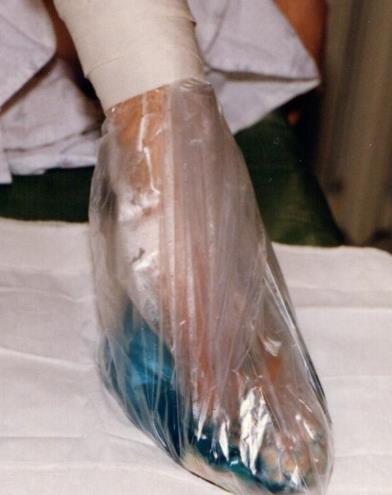
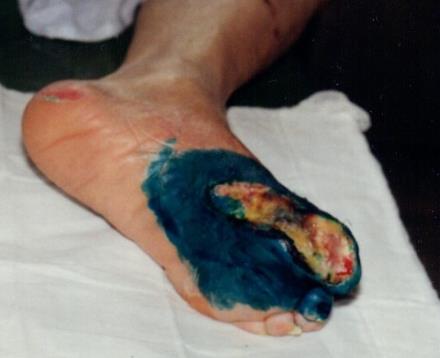
Solution change the next day and so during 8-10 days to cleanse the wound of necrotic tissue and the appearance of granulation in it. Further local treatment is carried out under the bandages at the outset with ointment "Levomekol", and in the stage of epithelialization-metil. On the first day of hospitalization in patients with coetaneous and deep values were determined in blood flow. As an antiseptic 2% boric acid is selected because it is substances has the property as melt necrotic tissue and destroy all microorganisms that cause infection surgery. It is especially effective against Pseudomonas aeruginosa. In addition, it is cheap, it is of particular importance in this group of patients. This method of treatment used in conjunction with angio protektiv nymi drugs. The method used at the 56 patients aged 46 to 74 years, of which 35 were women. In Figure 2 is represented by foot of the patient after treatment in antibacterial Wednesday. Saved oporosposobnost limbs. I removed only the toe of the foot.
The effectiveness of the method was evaluated by clinical data and instrumental examination results, which included a definition of chrezkozhnogo oxygen tension (TsRO2), index, minute blood flow (IMC), the level of microbial obsemenjonnosti wounds and the morphology of the tissue of the stroke. UZD Gsosudov was performed in all patients of lower limbs. In a survey of Plasmids in the grade III ischemia Fonteinu-Pokrovsky, 11.6% have patients, and (IV)-do 88.4%. The average level of TsRO2 on the foot amounted to 24.1 ± 1.3 mm Hg. in the lower third tibia 29.5 ± 1.6 mmHg ISB totaled 1.61 ± 0, 8 mL/min/100 cm 3. Cytology smear woven reflect necrotic or degenerative inflammatory type of pathological process. The average level of microbial contamination amounted to 3, between 5.3x10⁵ and 9.3x10⁶ cfu/g of tissue. Surgical treatment combined with insulinoterapia and medication correction of homeostasis. As endogenous adaptogen, improves oxidative and energy processes in the tissues, with membrane stabilizing and antigipoksicheskimi properties, used a derivative of succinic acid called "sodium succinate.
Results and Discussion
Carried out complex treatment allowed at 45 (81.2%) patients already on 5-7 day to achieve significant improvement in the course of the wound process. This was accompanied by a decrease in microbial contamination of tissues to subporogovyh numbers, and change the type of wound swab on inflammatory- regenerative. With this noted increase in TsRO2 to 27.2 ± 0.9 mmHg at the level of the foot and up to 32.8 ± 1.2 mmHg -on the lower third of the tibia. In the days following the circulation continued to improve and exceed the critical level was 33 mm Hg. Church. After complex treatment took normalization of carbohydrate metabolism, improved blood flow to the limbs, TsRO2 Shin reached 46 mm Hg. Church and in foot-38 mmHg, while IMC respectively amounted to 3.2 and 6.2 mL/min/100 cm 3. The wound closed secondary tension on the 27-32 day. U 11 (18.8%) same patients through 2-3 days appeared fatigue traces above the ankle joint, which can be explained or inferior primary puncturing Phlegmon of the foot, or poor-quality diagnosis of the existing flows. Due to the risk of sepsis all these patients, amputation was performed at that level 9 the upper third of the tibia, and 2 (3.4%)-the middle third of the thigh. Save knee greatly improved process for prosthetic limbs. Within 2 years after discharge from the hospital repeatedly asked the patient 2. This was due to the development of wet gangrene on the other foot. He has held similar treatment.
Conclusion
Diabetic foot is one of the social problems of global health. If in matters of medical treatment made progress, with the development of damp Phlegmon foot situation suddenly worsens. Surgical treatment of this pathology is usually reduced to the amputation of a limb. Man turns into a disabled, despite modern methods of prosthetics. For this reason, weight saving limbs is of paramount importance in the rehabilitation of a patient suffering from diabetes. In this important social issue some assistance has developed a method of treatment with the help of a bakterialno Wednesday, which allows you to reduce the number of amputations of a limb more than in 2 times.
References
-
Abalmasov KG, Busnashvili Yi.I., Morozov KG (2003) Surgical treatment of patients with chronic lower extremity ischemia. Angiology and vascular surgery 3: S1-S3.
-
Ishenin Yu M, Valeev RA, Fahrutdinov RN (2001) Method of surgical treatment of critical limb ischemia. Signal surgery 4(8): S32-S34.
-
Kuleshov EV (1990) Surgical diseases and diabetes. Kiev: health 180.
-
Luher M (2001) Critical limb ischemia in diabetes. VASA 58: 21-27.
-
Malakhov YS, Marchik VV, Averyanov DA, Ivanov AV (2007) Score method of revascularization in patients with necrotic ulcer stage of ischemia of the lower extremities, depending on the State of the distal arterial bed. Herald of the SRC of Cardiovascular Surgery, pp:135.
-
Fokin AA, Baltrushevich OA, Demjanik DV, Grigorieva UF (2003) Methods palliative interventions in patients with diabetic foot syndrome. Angiology and vascular surgery 3: S328-S329.
-
Tran’s atlantics inter-society consensus management of peripheral arterial disease (2000).
-
Rutherford RB (1995) Standards for evaluating results of interventional therapy for peripheral vascular disease. Circulation 83(2): 16-11.
- Shaping Healthy Futures: Pediatric Endocrine Breakthroughs of 2025
- Precision Medicine in Obesity: Customizing Treatment for 2025
- The Thyroid Revolution: How 2025 is Redefining Hormone Health
- Editorial- Targeting Immunometabolism for Generating Innovative Therapies for Cancer
- Current Knowledge of Chickenpox
- Correlation of Preinjection Values of Gonadotropins and Estradiol Level with Clinical and Radiologic Evidence of Sufficient Pubertal Suppression in Girls with Central Precocious Puberty