
Editorial-Incorporating the Altered Shikimate Pathway and Mitochondrial Melatonergic Pathways in Type 1 Diabetes Mellitus (T1D) Etiopathogenesis; Implications for Treatment
Introduction
It had been clear that gut microbiome is correlated with the generation of Type 1 Diabetes Mellitus (T1D) as reviewed by us in the etiopathogenesis of T1D believed to be an autoimmune condition immunotherapy and unsulin independent immunotherapies strategies for the treatment [1, 2, 3, 4, 5, 6]. Nevertheless, the precise explanation had been lacking. Origin of type 1 diabetes mellitus (T1D) takes place from the incapacity of pancreatic βcells to generate enough insulin generally as sequelae of considerable pancreatic βcells damage. T1D gets classified as an immune modulated disease. Nevertheless, the events which guide pancreatic βcells apoptosis still need events to be estimated, causing incapacity of avoidance of continued cellular damage. Changes in the mitochondrial working is definitely the main pathophysiological event reinforcing pancreatic βcells depletion in T1D.Akin to numerous medical disorders ,it has become attractive in T1D,the part of the gut microbiome inclusive of crosstalk of the gut bacteria with the fungal infection Candida albicans. Gut dysbiosis along with gut permeability are intricately correlated with escalated circulating lipopolysaccharide (LPS) and repressed butyrate quantities, which may work in decontrolling immune reactions and systemic mitochondrial working. Here we have reviewed the wider available outcomes of T1D pathophysiology, emphasizing the significance of mitochondrial melatonergic pathways of pancreatic βcells in the guiding of mitochondrial impairment. The repression of mitochondrial melatonin makes pancreatic βcells predisposed to Oxidative stress (OS) and impaired mitophagy; minimally modulated by elimination of melatonin‘s induction of the PTEN induced kinase (PINK1) , thus repressing mitophagy and escalating autoimmune correlated major histocompatibility complex(MHC)-1.The melatonin’s immediate precursor N-acetyl serotonin (NAS), portrays a BDNF simulator through the activation of the BDNF receptor TrkB. Since both full length(TrkB-FL) &truncated( TrkB-T1) possess a substantially robust part in pancreatic βcells working and survival ,NAS, portrays one more perspective of melatonergic pathways germane for pancreatic βcells damage in T1D. Integration of the mitochondrial melatonergic pathways in T1D pathophysiology incorporates broader earlier differing outcomes over pancreatic intercellular events. The repressed Akkermansia muciniphilia, Lactobacillus johnsonii, butyrate, and shikimate pathway, inclusive of bacteriophages aid besidespancreatic βcells apoptosis, however further to the bystander activation of CD8+T cells, that enhances effector function and avoids their thymic deselection. The gut microbiome is a significant estimator of the mitochondrial impairment guiding pancreatic βcells elimination and autoimmune actions obtained from cytotoxicCD8+T cells. This possesses considerable future scientific work and treatment repercussions.
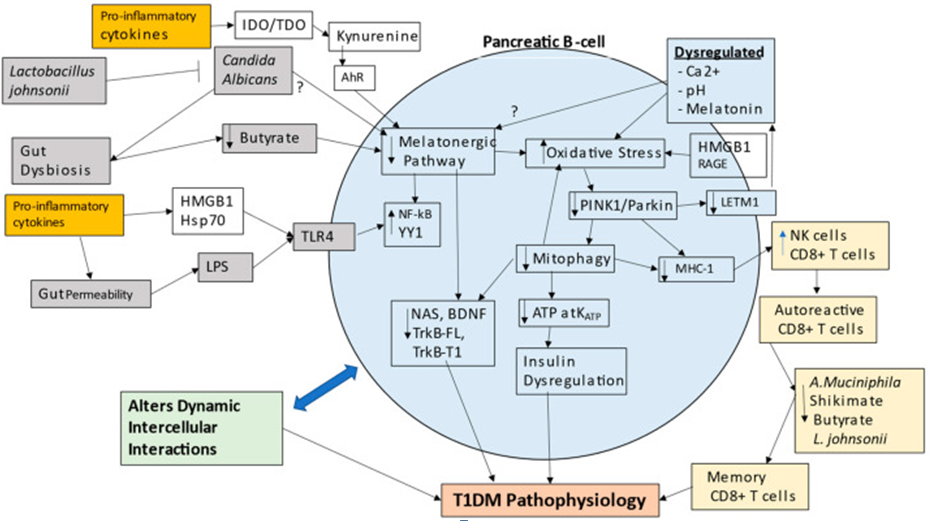
Thus recently George Anderson’s group has tried incorporating the aberrations in the shikimate pathway that takes place in case of microbiota like crosstalk of Akkermansia muciniphilia with the bacteriophages possessing the capacity of controlling Akkermansia muciniphilia quantities [7, 8] pointing bacteriophages significantly influences through Akkermansia muciniphilia along with the shikimate pathway. Normally shikimate pathway is involved in generation of aromatic amino acids, apart from tryptophan for phenylalanine,and tyrosine which is essential in microbiota & other gut microbiome for. In humans this symbiont relation is altered with use of glyphosate based herbicides (GBH), which hampers phosphoenol pyruvate (PEP)-binding to enzyme 5-enolpyruvylshikimate-3-phosphate synthase (EPSPS) thus resulting in death of Akkermansia muciniphilia -see ref 10for details. Furthermore they have integrated this abnormal tryptophan metabolism with repression of mitochondrial melatonergic pathway & shikimate pathway in view of melatonin precursor NAS gets formed from tryptophan (5HT) [9, 10] (Figures 1&2).
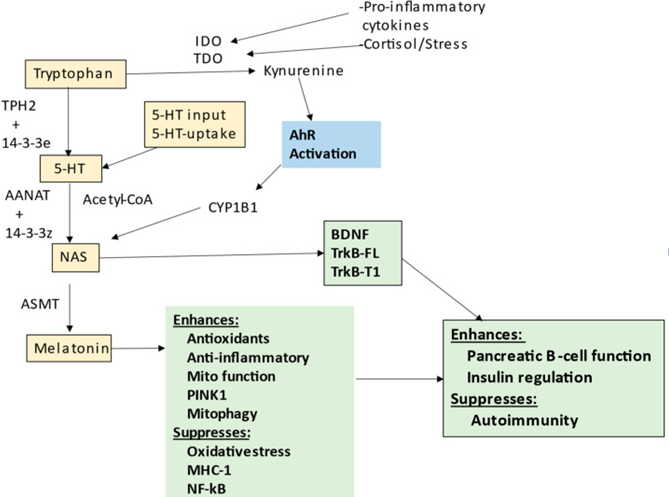
Tryptophan is converted by tryptophan hydroxylase (TPH2 stabilized by 14-3-3e) to serotonin (5-HT), which is the necessary precursor for the melatonergic pathway. 5-HT can also be provided by neuronal inputs and other cellular sources, including platelets. In the presence of acetyl-CoA, 5-HT is converted by 14-3-3 stabilized AANAT to N-acetylserotonin (NAS), which is then converted to melatonin by AANAT. Under inflammatory conditions, as in T1DM, cytokines increase indoleamine 2, 3-dioxygenase (IDO) and TDO, which converts tryptophan to kynurenine, suppressing tryptophan levels. Kynurenine also activates the aryl hydrocarbon receptor (AhR), which can increase the NAS/melatonin ratio, as well as suppress available melatonin. NAS increases BDNF and can activate the TrkB receptors. Melatonin has many protective effects as well as suppressing oxidative stress and MHC-1 linked autoimmunity, including in pancreatic B-cells. Abbreviations: 5-HT: serotonin; AANAT: aralkylamine N-acetyltransferase; AhR: aryl hydrocarbon receptor; ASMT: N-acetylserotonin O-methyltransferase; CYP: cytochrome P450; IDO: indoleamine 2,3-dioxygenase; MHC-1 major histocompatibility complex-class 1; NAS: N-acetylserotonin; NF-κB: nuclear factor kappa-light-chain- enhancer of activated B cells; PINK1: PTEN-induced kinase 1; TDO: tryptophan 2,3-dioxygenase; TrkB-FL: tyrosine receptor kinase B-full length; TrkB-T1: tyrosine receptor kinase B-truncated.
The suppressed capacity to upregulate melatonin prolongs the heightened activation of pro-inflammatory signaling via the transcription factors, NF-κB and YY1, coupled to decreased activation of TrkB-FL and/or TrkB-T1 by NAS and BDNF. A suppressed mitochondrial melatonergic pathway enhances oxidative stress, thereby decreasing PINK1 and its interactions with parkin and LETM1 on the mitochondrial membrane. Decreased PINK1 suppresses mitophagy, coupled to increased MHC-1 that drives ‘autoimmune’ processes via NK cell and CD8+ T cell attraction. The accompanying decrease in OXPHOS-derived ATP prevent KATP induced insulin, whilst decreased PINK1 attenuates LETM1 phosphorylation, leading to Ca2+ and pH dysregulation, likely accompanied by alterations in how LETM1 interacts with 14-3-3 and/or AANAT in the regulation of the mitochondrial melatonergic pathway. As well as activating TLR4, HMGB1 activates RAGE, thereby further contributing to oxidative stress. Changes in pancreatic β-cell mitochondrial function, including by ROS-driven miRNAs, will change patterned gene induction, with consequent changes in fluxes that mediate pancreatic β-cell interactions with other cells in the pancreatic islet microenvironment, thereby changing the dynamic intercellular interactions occurring. The decrease in shikimate pathway, A. muciniphila, L. johnsonii, and butyrate, contributed to by bacteriophages and enteroviruses, provides ‘bystander’ activation of autoreactive CD8+ T cells—possibly in Peyer’s patches—thereby preventing thymic deselection and driving classical ‘autoimmunity’. Abbreviations: AhR: aryl hydrocarbon receptor; BDNF: brain-derived neurotrophic factor; HMGB: high-mobility group box; hsp: heat shock protein; IDO: indoleamine 2,3-dioxygenase; KATP: ATP-activated potassium channel; LETM1: leucine zipper-EF hand-containing transmembrane protein 1; LPS: lipopolysaccharide; MHC-1: major histocompatibility complex-class 1; NAS: N-acetylserotonin; NF-κB: nuclear factor kappa-light-chain-enhancer of activated B cells; RAGE:
receptor for advanced glycation end-products; NK: natural killer; TDO: tryptophan 2,3-dioxygenase; TrkB-FL: tyrosine kinase receptor B-full length; TrkB-T1: tyrosine kinase receptor B-truncated; YY1: yin yang 1.
Additionally, like we earlier reviewed the association of neurodegenerative and neuropsychiatric diseases, Amyotrophic Lateral sclerosis (ALS) pathoetiology with gut microbiome [9, 10, 11]. Moreover George Anderson’s group have reasoned out this same abnormal tryptophan metabolism with repression of mitochondrial melatonergic pathway & shikimate pathway in the etiopathogenesis of neuropsychiatric diseases like , Multiple Sclerosis (MS), depression, ALS and tumours like Glioblastoma and other cancers [12, 13, 14, 15, 16, 17, 18, 19].
References
-
Kaur KK, Allahbadia GN, Singh M (2017) An Update on Etiopathogenesis and Management of Type 1 Diabetes Mellitus. J Endocrinol 1(2): 1-23.
-
Kaur KK, Allahbadia GN, Singh M (2019) Restricting Carbohydrates in the Diet A Possible Method of Meeting the Challenges of Increasing Diabesity in Type1 Diabetes along with Meeting Exercise Performances Requirements A Review. J Endocrinol 3(1).
-
Kaur KK, Allahbadia GN, Singh M (2020) How can we use Empagliflozin as an adjuvant in reducing required need of insulin in type1 diabetes along with lowered HbA1c weight without fear of DKA A Minireview. J Clin Cases Rep 4(2): 30-38.
-
Kaur KK, Allahbadia GN, Singh M (2020) An update on the along with Immunotherapy Strategies for the treatment of Type 1 Diabetes (TID) How far have we reached in reaching insulin independency in TID therapy A Systematic Review. J Endocrinol 4(1).
-
Kaur KK, Allahbadia GN, Singh M (2020) Attempting Getting Insulin Independent Immunotherapies in Type 1 Diabetes Mellitus (T1D) in the Pre Stage 1 (BeforeIslet Autoantibodies). Acta Scientific Paediatrics 3(6): 01-04.
-
Kaur KK, Allahbadia GN, Singh M (2021) Are we any close to unraveling the mechanism of interactions among susceptibility genes towards Type 1 Diabetes Gut Microbiota Along with Environmental factors specifically early diet patterns A Systematic Review. Endocrinology and Surgical Endocrinology 2(1): 1-20.
-
Mesnage R, Antoniou MN (2020) Computational modelling provides insight into the effects of glyphosate on the shikimate pathway in the human gut microbiome. Curr Res Toxicol 1: 25-33.
-
Mesnage R, Teixiera M, Mandrioli D, Falconi L, Ducarmon QR, et al. (2021) Use of shotgun metagenomic and metabolomics to evaluate the impact of glyphosate or Roundup MON52276 on the gut microbiota and serum metabolome of Sprague Dawley rats. Environ Health Perspect 129(1): 17005.
-
Kaur KK, Allahbadia GN, Singh M (2020) The association of dietary fatty acids and gut microbiota alterations in the development of neuropsychiatric diseases A systematic review. Obes Res Open J 7(1): 19-45.
-
Kaur KK, Allahbadia GN, Singh M (2020) Advances in Probiotics use with the utilization of engineering technology for diseases beyond Obesity Non Alcoholic Fatty Liver Disease to treat neurodegenerative diseases metabolic diseases like Type1 diabetes infectious diseases and infections A Systematic Review. J Endocrinol 4(1): 1-12.
-
Kaur KK, Allahbadia GN, Singh M (2023) A Comprehensive Update on the Etiopathogenesis of Amyotrophic Lateral Sclerosis with Specific Emphasis on Gut Microbiota (GM) Enteric Nervous System (ENS) & Associated Crosstalk of Astrocytes GM Muscle With Mitochondrial Melatonergic pathway A Narrative Review. Int J Neurobiol 5(2): 158.
-
Anderson G (2023) Amyotrophic Lateral sclerosis pathoetiology and pathophysiology roles of astrocytes gutmicrobiome and muscle interactions via the mitochondrial melatonergic pathways with disruption by glyphosate based herbicides. Int J Mol Sci 24(1): 587.
-
Anderson G (2018) Linking biological underpinnings of depression role of mitochondrial interactions with melatonin inflammation tryptophan catabolites sirtuins DNArepair and Oxidative and nitrosative stress with consequences for classification and cognition. Prog NeuroPsychopharmacol Biol Psychiatry 80: 255-66.
-
Anderson G, Rodriques M, Reiter R (2019) Multiple Sclerosis: melatonin orexin and ceramide interact with platelet activation coagulation factors and gut microbiome derived butyrate in the circadian dysregulation of mitochondria in glia and immune cells. Int J Mol Sci 20: 5500.
-
Anderson G, Maes M (2017) Interactions of tryptophan and its catabolites with melatonin and the alpha7nicotinergic receptor in central nervous system and Psychiatric disorders role of the aryl hydrocarbon receptor and mitochondrial regulation. Int J Tryptophan Res 10.
-
Anderson G, Reiter R (2019) Glioblastoma Role of mitochondrial N acetyl serotonin melatonin ratio in mediating effects of miR451 and aryl hydrocarbon receptor and in coordinating wider biochemical changes. Int J Tryptophan Res 12.
-
Anderson G (2023) Tumor microenvironment and metabolism: role of the mitochondrial melatonergic pathways in determining intercellular interactions in a new dynamic homeostasis. Int J Mol Sci 23: 311.
-
(2021) Can Targeting Gut Microbiota in Perinatal Events Aid in Prevention of Type 1 Diabetes Development Influence T1D Genes Crosstalk with Environmental Factors. Acta Scientific Microbiology 4(1): 01-04.
-
Anderson G (2023) Type 1 diabetes pathoetiology and pathophysiology roles of gut microbiome pancreatic cellular interactions and the bystander activation of memory CD8+T cells. Int J Mol Sci 24: 3300.
- Shaping Healthy Futures: Pediatric Endocrine Breakthroughs of 2025
- Precision Medicine in Obesity: Customizing Treatment for 2025
- The Thyroid Revolution: How 2025 is Redefining Hormone Health
- Editorial- Targeting Immunometabolism for Generating Innovative Therapies for Cancer
- Current Knowledge of Chickenpox
- Correlation of Preinjection Values of Gonadotropins and Estradiol Level with Clinical and Radiologic Evidence of Sufficient Pubertal Suppression in Girls with Central Precocious Puberty