
First Report of Yellowing Disease of Banana Leaves Caused by Armillaria Tabescens in Cote dIvoire
This disease note is the first occurrence of plantain banana leaves yellowing caused by Armillaria tabscens in Côte d’Ivoire. Serious damages of this disease on plantain plants were found in the central area of the country in December 2017.
Editorial
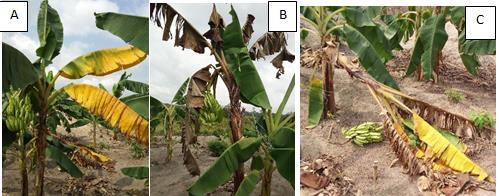
Yellowing disease of banana leaves is commonly attributed to Fusarium oxysporum in Cote d’Ivoire. It’s one of the important diseases of plantain banana. Disease incidence was between 21 and 94% [1]. In 2017, an unknown yellowing disease of banana was observed in the plantain plantation from 1 to 2 years old in the vicinity of Gonate (mid-west Côte d’Ivoire) in a banana regeneration center. Severe yellowing and death of plantain banana were noted (Figure 1).
First Report of Yellowing Disease of Banana Leaves Caused by Armillaria Tabescens in Cote d’Ivoire J Mycol Mycological Sci
Disease symptoms were found on both plantation of Gonate plantain regeneration station. 100 plantain bananas were investigated in the first plantation (A). For the second plantation (B), 310 plantain bananas were assessed. Yellowing of banana leaves was recorded weekly in December using systematic monitoring approach. In the first plantation (A), disease index severity ranged from 8.95 to 24.25% for a period of three weeks. Disease symptoms also progressed from 20.72 to 31.6% for the same period in plantation B. Disease symptoms development has been described in 6 stages. Initially infected leaves slight yellowing (stage 1) and then 40-50% of leaves surface turned yellow (stage 2). The
stage 3 is reached when 85 to 95% of leaves surface turned yellow. The fourth stage is characterized by total yellowing of leaves. As the disease progressed, necrotic areas appear on leaves (stage 5). These necrotic areas enlarged and completely cover leaves (stage 6). These necrotic lesions caused death of plantain plants (Figure 1). On each plant, leaves yellowing progressed from external to internal leaves (Figure 1).
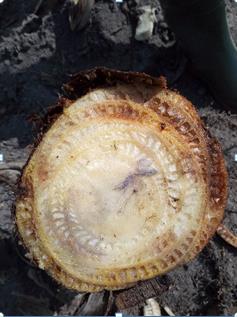
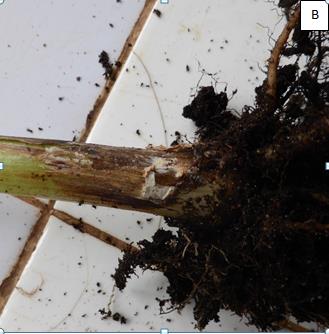
Cross section of pseudostem confirmed this observation by necrotic tissues progression from external to internal areas (Figure 2).
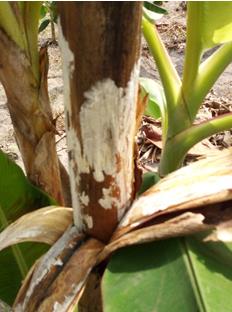
Indeed, white mycelia under bark of pseudostem were also observed on disease plants in both plantations (Figure 3).
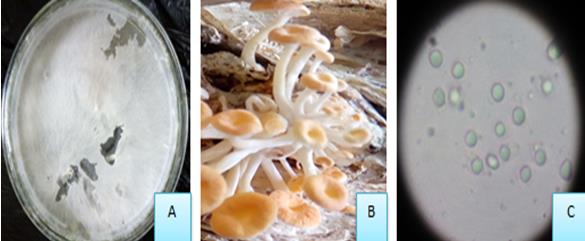
Culture of infected tissues on PDA media showed white mycelia. Culture of mycelia on pseudostem after 7-8 weeks showed basidiocarps of Armillaria sp. On
pseudostem substrate, 30-40 honey color basidiocarps grew. The cap of these basidiocarps was rounded, hollow and funnel-shaped measuring 30-60mm in diameter. Gills were white and deccurent. The stems of these mushrooms were also white powdery aspect, 6-10cm long and 1-2cm wide. Moreover, stems were cylindrical, no hollowed and had no annulus attached just below the gills. Microscopic investigations revealed globose hyaline spores measuring 3.3-6.6x3.3-6.6µm. Morphological and microscopic characteristics described refer to Armillaria tubescens (Figure 4). This description is in line with Tsopelas, et al. [2].
In the inoculation trial, all healthy plantain plants infected with A. tabescens showed yellowing symptoms and presence of white rhizomorphs under bark of pseudostem (Figure 5).
![Figure 5: Pathogenicity Test. (A) Yellowing of plantain seedlings leaves after inoculation of _A. Tabescens_; (B) Rhizomrphs on seedling’s pseudostem_._ _Armillaria_ root disease is a wide report on forest and other plantation trees [3]. However, his implication on banana plantain yellowing disease is rarely cited. Thus,](/fulltextimages/4771/fig_5.jpeg)
this note is the first discovery of banana leaves yellowing caused by A. tabescens in Côte d’Ivoire.
References
-
Kra KD, Diallo HA, Kobenan K, Kone D, Kouadio YJ (2011) Diagnosis of Fusarium wilt on banana (Musa AAA) and horn 1 (Musa AAB) cultivars on the outskirts of Abidjan District (Ivory Coast). International Journal of Biological and Chemical Sciences 5(4): 1501-1514.
-
Tsopelas P, Tjamos EC (1997) Occurrence a pathogenicity of _Armillaria tabescens_ on almond in Greece. OEPP/EPPO Bulletin 27(4): 455-461.
-
Mamle AM, Jolanda R (2015) Diseases of plantation forestry trees in southern Ghana. International Journal of phytopathology 4(1): 5-13.
- Diversity of Candida sp and Antifungal Susceptibility Patterns in Digestive Candidiasis among People Living with HIV in CHU of Libreville, Gabon
- Vulvovaginal candidiasis: Retrospective study (2019- 2021) at the Centre Hospitalier National de Pikine, Suburban Dakar, Senegal
- Identification of Environmental Fungal Species in Clinical Services of University Hospital of Angre, Abidjan (Cote d’Ivoire)
- New Location of some Gasteroid Basidiomycetes in Western Kazakhstan
- Evaluation of Various Extracellular Enzymes of Ectomycorrhizal Mushrooms
- Morphology and Phylogeny of Lactarius Wallichianae sp. nov and Xerula magnispora sp. nov. from India