
The Essential Oil of Thymus Vulgaris L., Biological Study
Essential oils have many therapeutic properties. In herbal medicine, they are used for their antiseptic properties against infectious diseases of fungal origin, against dermatophytes, those of bacterial origin. Humans use plants for thousands of years to treat various ailments, in many developing countries; much of the population relies on traditional doctors and their collections of medicinal plants to cure them. The aim of our study is to determine the antimicrobial and antifungal effect of essential oils of plants Thymus vulgaris on some pathogenic bacteria and fungal. It is a medicinal plant used in traditional therapy. Essential oils have many therapeutic properties. In herbal medicine, they are used for their antiseptic properties against infectious diseases of fungal origin, against dermatophytes, those of bacterial origin. The test adopted, is based on the diffusion method on solid medium (Antibiogram), this method allows to determine the susceptibility or resistance of an organism according to the sample studied. Our study reveals that the essential oil of the plant Thymus vulgaris has a different effect on the resistance of germs.
Introduction
The use of aromatic plants by man is an ancient practice [1]. Nowadays the majority of the inhabitants of the terrestrial world use very many plants, taking into account their aromatic properties, as a source of seasoning or as a cure in traditional medicine. However, this use is not based on any scientific criterion; it simply takes into account observations over the centuries.
The bacteria belonging to the wide range of microorganisms also include viruses, fungi and parasites. Bacterial pathogens for humans are at the origin of many infectious diseases [2].
The antibiotics consider the almost universal solution to serious infections, but drug efficacy is decreases. Bacteria and viruses have gradually adapted to resist medications and their increasingly [3].
The MAP are plants that have grown or have picks in his natural environment for its medicinal and had an infinite variety of jobs, to report the therapeutic area, food, cosmetics, industrial, etc.. Herbs can play an important role in conserving biodiversity. These plants are actually very familiar to rural people who are very sensitive to their scarcity and their disappearance. Indeed, medicinal plants play an important role of health care population and represent a significant source of income for many families in the countryside and cities [4].
The raw extracts of the plants start to have a lot of interest as a source potential of bioactive natural molecules. They are being studied for their eventual use as an alternative for the treatment of infectious diseases and for protection food against oxidation.
They have many therapeutic properties. In herbal medicine, they are used for their antiseptic properties against infectious diseases of fungal origin, against dermatophytes, those of bacterial origin [5]. Humans use plants for thousands of years to treat various conditions in many developing countries; much of the population relies on traditional healers and their collections of medicinal plants to heal them [6]. Indeed, medicinal plants play an important role in the health care population and represent an important source of income for many families in rural and urban areas [7].
Our research aims to study the biological activity of extracts of two medicinal and aromatic plants (Thymus vulgaris L) chosen for therapeutic characteristics in traditional medicine.
The selection of these plants was based on the following criteria: are among the most aromatic plants used all over the world, their frequent use by our populations in the culinary and traditional medicine sectors, apart from the fact that their essential oils are used in the food, pharmaceutical and cosmetic, their effectiveness in the symptomatic treatment of disorders of the digestive system recognized traditionally, they have recently become a research topic interesting scientist. Henceforth, it was believed, they would prescribe exclusively drugs derived from retorts, the plants serving only as reserves of useful chemical molecules [8].
Work Methodology
Plant Material Thymus Vulgaris
The genus Thymus is one of the 220 most diverse genera of the labiate family, with for center of diversity the western part of the Mediterranean basin. As many labies they are known for their essential aromatic oils. The species best known is undoubtedly Thymus vulgaris L. locally known (zaatar). In French and English for example, the name of the genus (thym and thyme respectively) for the species Thymus vulgaris [9]. The name Thymus derives from the Greek word "thymos" which means "to smoke" because of the smell pleasant that the plant releases. The species Thymus vulgaris is an element characteristic of the Mediterranean flora, known mainly for its aromatic qualities; it has also many medicinal properties.
Thymus vulgaris is one of the most popular aromatic plants used in the world whole; these applications are very large and affect the food and medicine fields traditional. In addition, its essential oil is used in industries food, pharmaceuticals and cosmetics.
Biological Materials
Extraction of Essential Oils by Hydrodistillation
The hydrodistillation of Thymus vulgaris (leaves dry) is performed using a Clevenger-type device [10].
The extraction procedure comes down to boil a quantity of 100 g of dry plant for 2 h with water in a 1 liter flask (Figure 1). The distillation was carried out with a recycling cohobage commonly known as described in the Ph.Eur [11].
The essential oil yield was determined from fresh plant material [12], are defined as follows:
HEmass RHEa= Massdryplant material
Study of the Antimicrobial Activity of Essential Oil
Microbial Strains Studied
Five bacteria Escherichia coli ATCC 25922, Enterobacter cloaceai ATCC 13047, Klebsilla pneumonie ATCC 700603, Proteus mirabilis ATCC 49452 and Enterococcus feacalis ATCC 29212 were chosen for their high frequency in human infections. Bacterial strains are lots of ATCC (American Type Culture Collection). They are identified and confirmed in the laboratory of the hospital of Metlili in Ghardaia (Algeria).
We used the Muller Hinton agar. In our tests, we tested both the antimicrobial activity of oiled essentially of Cotula cinerea and Chamomilla recutita L.
Technique in Solid Medium: Method of Aromatogrammes
The aromatogram is based on a technique used in medical bacteriology, called antibiogram [13, 14]. It has the advantage of being very flexible in the choice of products to test and apply to many bacterial species [15].
In this method, we use filter paper discs of 6 mm in diameter, impregnated in different concentrations of essential oil diluted in DMSO at 25%, 50% and 75%. These discs we deposit on the surface of an agar medium inoculated with the surface of a bacterial suspension. The incubation was carried out in an oven at 35°C for 24 h for bacteria and at 25°C for 5 days for yeasts.
The absence of microbial growth resulting in a translucent halo around the disc whose diameter is measured and expressed in millimeters.
Study of the Antifungal Activity of Essential Oil
For the realization of the antifungal activity was adopted method of direct contact. To prepare the different concentrations were taken different concentrations of essential oil of Thymus vulgaris (0.00625,0.0125, 0.025 and 0,05μl) and adjust to 20ml PDA then stirred for 5 minutes to homogenize the medium PDA with essential oil.
Results
We recall that the essential oil was extracted from the aerial part of Thymus vulgaris in the method of steam distillation. We have obtained a yellow essential oil very dark with an aromatic odor. We have not been able to recover a significant amount oily; the yield obtained is around 0.60%.
Biological Activity of The Essential Oil of Cotula Cinerea
The antimicrobial activities of all the plant extracts against the four bacteria strains examined were assessed by the presence or absence of inhibition zones values. The values of inhibition zones of the plant extracts tested for antibacterial activity are given in Figure 1.
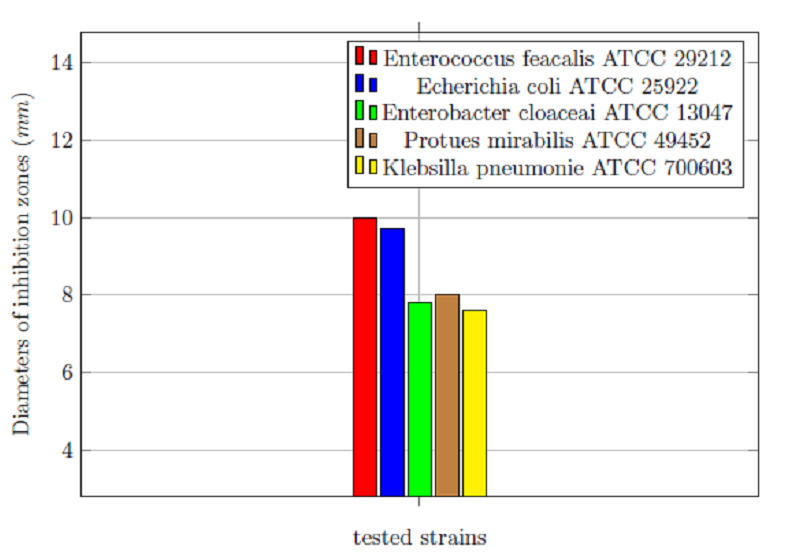
According to Figure 1 we find that the essential oil of Thymus vulgaris has moderate antibacterial activity, the diameters of zones of inhibition does not exceed 10.2mm. studied the different bacterial strains react differently to essential oils tested, even if they are two strains of the same bacterial family to know: Escherichia coli ATCC 25922, Enterobacter cloaceai ATCC 13047, Klebsilla pneumonie ATCC 700603 et Proteus mirabilis ATCC 49452.
The highest antibacterial power of essential oil of Thymus vulgaris was recorded in Enterococcus feacalis ATCC 29212 and Escherichia coli ATCC 25922 which zone diameter of inhibition of 11 and 8.7mm respectively. In addition, cloaceai Enterobacter ATCC 13047, Proteus mirabilis ATCC 49452 and Klebseilla pneumonia ATCC 700603 record a zone of inhibition less than 9mm (7.8, 8 and 8mm, respectively).
Antifungal Activity of the Essential Oil of Thymus Vulgaris on Fusarium Sporotrichioides
Graphs N° 2 shows mycelial growth (mm) of Fusarium sporotrichioides according to incubation time and the concentration of essential oil of Thymus vulgaris.
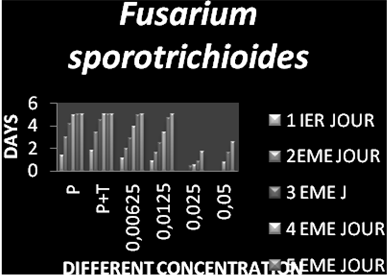
With different concentrations of essential oil extracted from Thymus vulgaris, we observe that mycelial growth of Fusarium sporotrichioides is remarkable after 72hours for the control and different concentrations of essential oil of Thymus vulgaris namely 0.0125, 0.025 and 0,05μl.
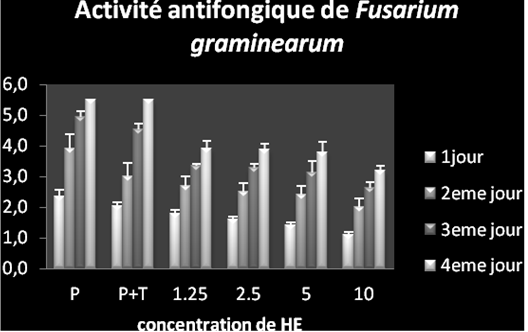
According to the graph No. 3 which represents the antifungal activity of Fusarium graminearum as a function of the incubation time and the concentration of essential oil of Thymus vulgaris, it is noted that there is an increase in the mycelial growth with the time of incubation with the exception of the 50μl/20ml concentration of PDA that it shows no mycelial growth. In addition, a decrease in mycelial growth of Fusarium graminearum with increasing concentration of essential oil of Thymus vulgaris.
Conclusion
Nowadays, the use of medicinal plants in herbal medicine has been of great interest in biomedical research and becomes as important as chemotherapy. This renewal of interest comes from the fact that medicinal plants are an inexhaustible source natural bioactive substances and compounds and, secondly, the need for research better medication with gentler therapy without side effects.
Natural extracts from plants contain a variety of phenolic compounds and essential oils that are believed to inhibit microorganisms and antioxidant capabilities.
This study once again allows the development of the operation of the essential oil in the fields, pharmaceutical and cosmetics and as a preservative in the field of food industry. These preliminary results may be supplemented by other more detailed study (antioxidant is testing, performance testing on other bacterial strains, etc.).
Finally, we are recommending people to a reasonable use of medicinal plants, because improper use of these plants will probably lead to harmful side effects to human health.
References
-
Teixixeira De Saliva (2004) Mining the essential oil of the Anthemideae, African journal of Biotechnology 3(12): 706-720.
-
Verbeke N (2006) L’aromatherapie comme alternative credible A L’antibiotherapie. Preparatrice en pharmacie pp: 1-20.
-
Iserin P (2001) Larousse des plantes medicinales, identification, preparation, soins, Larousse (Edn.), 68: 15-16.
-
Hart T, Shears P (1997) Atlas de Poche de Microbiologie. 1st (Edn.), pp: 310.
-
Aissa B (1999) F. Encyclopedia of useful plants: Flora of Algeria and Maghreb, vegetable substances of East and West Africa; edas, Algeria pp: 8.
-
Couplon F (2007) Reconnaitre facilement les plantes par l’odorat, le gout, le Toucher. (Edn.), Delachaux & Niestle pp: 186.
-
Schauenberg P, Paris F (1977) Guide des plantes medicinales. Librairie Vie et Sante 2: 796.
-
Ould el Hadj MD, Tankari Dan Badjo A, Halouane F, Doumandji S, et al. (2006) Toxicite comparee des extraits de trois plantesacridifuges sur les larves du cinquieme stade et sur les adultes de
-
Beauguesne BL, Pinkas M, Torck M, Trotin F (1990) Plantes medicinales des regionstemperees. 2 emeedition. Maloine pp: 344-365.
-
Clevenger JF (1928) Apparatus for volatile oil determination, Description of New Type. American Perfumer & Essential Oil Review pp: 467-503.
-
Afnor (2000) Recueil de normes: les huiles essentielles. Tome 1. Echantillonnage et methodes d’analyse”, AFNOR, Paris pp: 440.
-
Benjilali BA, Elarki T, Ismaili Alaoui M (1986) Methode d’etude des proprietes antiseptiques des huiles essentielles par contact direct en milieu gelose. Plant Med Phytother 20: 55-167.
-
Satrani B, Fougrach H, Bourkhiss B, Bousta D, Talbi M, et al. (2007) Composition chimique et activite antimicrobienne de l’huile essentielle de Cladanthus mixtus. Bull Soc Pharm Bordeaux 146: 85-96.
-
De Billerbeck VG, Roques C, Vaniere P, Marquier P (2002) Activite antibacterienne et antifongique de produits a base d'huiles essentielles. Health & Co 3: 248-251.
-
Pibiri MC (2005) Assainissement Microbiologique de l'air et des systemes de ventilation au moyen d'huiles Essentielles. Ecole Polytechnique Fedeerale de Lausanne pp: 19-55.
- Diversity of Candida sp and Antifungal Susceptibility Patterns in Digestive Candidiasis among People Living with HIV in CHU of Libreville, Gabon
- Vulvovaginal candidiasis: Retrospective study (2019- 2021) at the Centre Hospitalier National de Pikine, Suburban Dakar, Senegal
- Identification of Environmental Fungal Species in Clinical Services of University Hospital of Angre, Abidjan (Cote d’Ivoire)
- New Location of some Gasteroid Basidiomycetes in Western Kazakhstan
- Evaluation of Various Extracellular Enzymes of Ectomycorrhizal Mushrooms
- Morphology and Phylogeny of Lactarius Wallichianae sp. nov and Xerula magnispora sp. nov. from India