
Participation of Vision in the Perception of Two-Dimensional Objects with a Variative Form
The article deals with the problem of the participation of vision in the perception of objects of variable, soft form. The analysis of the mental process of perception with the help of perceptual influences on an object of variable form is carried out. For the study, experimental equipment in the form of a tablet was developed and a special program was created to record hand movements when applying perceptual influences. The subjects were students in grades 1-4. The idea is substantiated that a person with the help of a tactile and visual analyzer is able to accurately reveal the properties of softness, elasticity, and viscosity of objects. It was revealed that vision is a necessary component in their study. Based on the study of the problem, it has been established that vision "prompts" the hand to the correct trajectory for applying perceptual influence on the studied soft object. The article summarizes the theoretical provisions, supported by practical experience .
Introduction
Perception of objects with variable shape is a complex process of visual perception, in which eye movements are of great importance [1]. The hand affects the variable object, and vision evaluates how the form changes from this. An important step in the analysis of the problem of form perception was made by the representative of the ecological theory of perception, American psychologist James Jerome Gibson (1951). Gibson’s main postulate is that the stimulus has everything necessary for perception. According to the scientist, perception is a function of stimulation, and stimulation is a function of the environment. The nervous system decodes this information and makes an assumption about the outside world. Often, Gibson’s theory is called not a theory of perception, but a theory of stimulation. A stimulus for Gibson is a structural characteristic of physical energy, for vision-a luminous flux [2]. The methodological basis for studying this problem can also be the theory of perceptual actions by Alexander Vladimirovich Zaporozhets (1905- 1981). The main essence of the theory is that perceptual action is assigned a leading role in the formation of an image, a model of the external world. According to the theory, perceptual actions not only reflect the existing situation, but also anticipate those transformations of it that can occur as a result of practical actions. A.V. Zaporozhets revealed the role of practical actions in the genesis of cognitive processes, inclined more towards the theory of assimilation between practical activity and mental reflection [3].
Experimenting
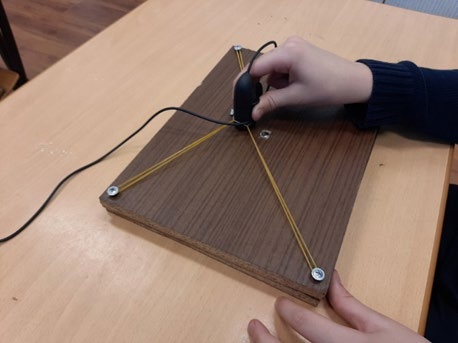
To study the participation of vision in the perception of objects with a variable form, an experiment was developed, experimental equipment was created and a special program for fixing the results. We have designed a homemade laboratory setup for these purposes. It was a tablet and a computer program for it. The tablet was constructed as two wooden panels, placed on top of one another, and fastened in the center with an axis. The latter allowed the upper plate to rotate relative to the lower one. The top panel was fitted with elastic bands running from its four corners to the center, where they were attached to the computer mouse (Figure 1).
As a basis for creating a wooden tablet, we took the tablet which was created at BSUIR. The tablet was designed in the form of two metal plates, placed on top of one another, and fastened in the center by an axis (Figure 2).
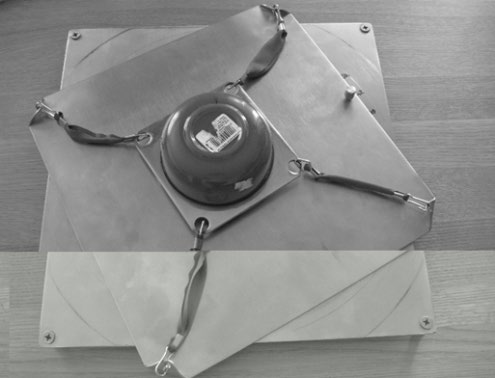
Thus, the computer “mouse” was in the center of the upper panel and was connected to its 4 corners by four rubbers of the same elasticity. The human hand could move the mouse over the surface, feeling the changing elasticity of the rubbers. In addition to this platform, a special program was developed that registers the movement of the “mouse” within the plate field. On the computer display, the program has a special field on which graphically in the “online” mode the movement of the mouse from a person’s hand is displayed. The program stores data on the time and coordinates of the mouse movement on the computer and then makes it possible to review the process of moving the mouse.
This tablet to some extent simulated a virtual reality glove to form perceptual skills in a person on a computer. From the center of the top panel were 4 rubbers in the corners of the tablet. With the help of nanotechnologies, which are actively included in the field of scientific research, it is possible to create rubbers for a given tablet with elasticity varying from signals from a computer. As a result, on such a tablet it will be possible to change the tension of the rubbers at lightning speed from the computer, control the supply of tactile sensations to the human hand, reading the position of the hand while feeling the virtual contour of the soft object.
The platform allowed us to check the following hypothesis. In the absence of vision, the hand in which the mouse is placed will make circular movements in the study of elasticity. Vision cannot see the shape of a variable object; it cannot predict the direction of the degrees of space of a flexible object. Perceptual actions are performed not in a single-coordinate manner, but in a circle. In the second experiment, if you untie the eyes of the subject, then with the help of sight he sees rubber. Thinking puts forward counter hypotheses that each of the four rubbers makes its own independent contribution to the elasticity of mouse movement along the plane. Therefore, the subject begins to perform perceptual movements in a different way. Namely, in the direction of the rubber, in turn to each rubber of the four.
After testing this hypothesis, you can additionally make sure that vision clings to rubbers and their vectors. For an additional experiment, we turned 4 rubbers in front of the subject, in front of his vision, 45 degrees. The experiment was repeated. And we were convinced that, following the rotation of the rubbers by 45 degrees, the directions of the movements of the hand, feeling the rubbers began to be rotated to the same angle. As a result of the analysis of the obtained images of the process of hand movements on the panel, we identified two types of movements:
a) Circular (Figure 3A).
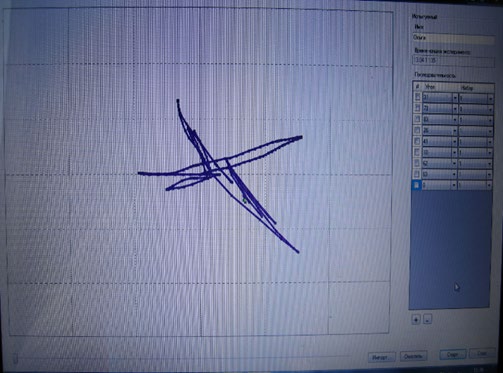
Figure 3A: The trajectory of hand movement while studying the tablet.
b) In the direction back and forth perpendicular to the contour of the virtual object (Figure 3B).
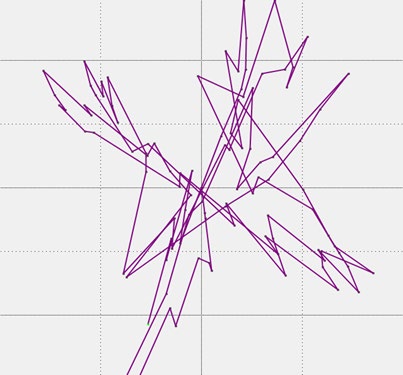
Figure 3B: The trajectory of hand movement while studying the tablet.
In the second type of movements, two types can be distinguished: a) Long movements back and forth correspond to a rough study of the contour of the subject. b) Short movements with the help of which subjects studied each point of the object’s surface in more detail.
The experiments convince us that a person gets acquainted with a new subject with the help of a hand and eye, as it were, in two stages. At the preliminary stage of familiarization with the studied subject, the subjects demonstrated mainly circular and back and forth movements. At the second stage, for most of the subjects, circular movements are practically absent, and movements back and forth become more frequent.
Conclusion
The participation of vision is an important condition in the perception and study of objects of variable form. When perceiving two-dimensional objects, only with the help of hands, information about the object can be distorted, the properties of the object are not fully studied. The experiments carried out indicate that vision helps the hand to study the object and commands the hand what to examine.
References
-
Weinstein LA (2007) Psychology of perception Minsk, Theseus pp: 224.
-
Gibson JJ (1951) What is a form?. Psyhological Review 58: 403-412.
-
Zaporozhets AV (1986) Selected psychological works: In 2 volumes T1 Psychological development of the child. M Pedagogika, pp: 320.
- Screening of Hospital Staff During World Glaucoma Week in a Tertiary Eye Care Centre
- Angioid Streaks with Macular Neovascularization: Clinical Insights from Two Cases
- Giant Kissing Naevus: An Oculoplastic Challenge
- Why Freedom of Vision Should Not Cost the Freedom of Feeling - LASIK in the Climate of Change
- Asymmetric Optic Nerve with Small Disc and Large Cup: A Rare and Challenging Case of Unilateral Optic Nerve Hypoplasia
- Large Angle Exotropia in a Child: A Case Report