
Epidemiological and Clinical Characteristics of Patients Operated for Strabismus at the Yaounde Central Hospital
Purpose: to describe the epidemiological and clinical characteristics of patients operated for strabismus. Methods: records of patients operated for strabismus between 2014 and 2022 at the Yaounde Central Hospital were included in this cross-sectional study. Data collected included: age at onset, age at the time of surgery, sex, type of strabismus, preoperative angle of deviation at distance, number of eyes and muscles operated. Significance level was set at p <0.05. Results: 84 patients were included. There were 57 (67.9%) exotropias and 27 (32.1%) esotropias. Females were predominant, with no significant difference between exotropias and esotropias (70.4% in esotropias and 70.2% in exotropias). Early-onset strabismus was present in 88.9% of esotropias and in 57.9% of exotropias (p=0.0055). The mean age at the time of surgery was respectively 8.6 ± 8.6 years and 18.8±13.9 years for esotropias and exotropias. (p=0.00001). The mean pre-operative angle was 41.1 ± 9.5 prism diopters (PD) in esotropias and 40.2 ± 12.6 PD in exotropias. Surgery was done in both eyes in 82.1% of cases and at least on 2 muscles in 90.5% of cases. Conclusion: surgery for esotropia is carried out in late childhood and that for exotropia in late adolescence. Efforts geared towards sensitizing the public in view of early management of strabismus need to be made.
Introduction
Strabismus does not only pose an esthetical problem due to the deviation but also poses sensory and psychosocial problems. Sensory disorders such as amblyopia may result from a constant deviation. Amblyopia is common in all forms of childhood strabismus [1, 2]. The deviation also causes psycho-social and emotional consequences for both the patient and the family [3, 4, 5]. This can potentially impact daily life activities and social participation. Mental health impairments like anxiety and depression are highly prevalent among children with strabismus [6, 7]. The management of strabismus always begins with the constant wearing of the full cycloplegic correction and treatment for amblyopia. Only after this, can surgery be considered for any persistent deviation. Strabismus is common in our setting with a hospital-based prevalence of 1.3 % [8]. However, it is not well known by the public and non-specialized medical personnel. All these result in late diagnosis and poor compliance to treatment and follow-up. The rate of lost to follow-up is very high; with only 31% of patients returning after at least 3 months of wearing the full cycloplegic correction [9]. Only a few health facilities have the necessary expertise to manage strabismus. With poverty, beliefs, and the absence of health insurance for many, surgery uptake is low. Information on surgeries is important for the planification of health care services. The aim of this study was to describe the epidemiological and clinical characteristics of patients operated for strabismus in our setting.
Material and Methods
A cross-sectional study was carried out at the ophthalmology unit of the Yaounde Central Hospital, in which the medical records of all patients operated for strabismus between January 2014 and December 2022 were included. Our study was reviewed and approved by the Institutional Ethical Clearance Committee of the hospital. Confidentiality was maintained during the review of patient records and data obtained was anonymized. We included complete medical records of patients who underwent surgery for strabismus during the study period. All patients had never undergone extra ocular muscle surgery before. Variables studied included: age at onset, age at the time of surgery, sex, type of strabismus, preoperative angle of deviation at distance, number of eyes and muscles operated. The pre- operative angle of deviation was the angle measured with the full cycloplegic correction following a minimum period of 3 months of constant wear. Data was analyzed using Microsoft Excel. Student’s t-test was used to compare means, Chi2 test and Fischer’s exact test to compare proportions. Significance level was set at p<0.05.
Results
During the study period, 1402 surgeries were carried out, amongst which 84 were cases of strabismus. Strabismus surgery therefore accounted for 6% of surgeries. Females represented 70.2% (n=59) and males 29.8% (n=25). All patients had horizontal strabismus; 67.9% (n=57) were exotropia cases and 32.1% (n=27) were esotropia cases. Females were predominant, with no significant difference between exotropias and esotropias (70.2% in exotropias and 70.4% in esotropias) (Table 1).
| Esotropia | Exotropia | |||
|---|---|---|---|---|
| n | % | n | % | |
| Male | 8 | 29.6 | 17 | 29.8 |
| Female | 19 | 70.4 | 40 | 70.2 |
| Total | 27 | 100 | 57 | 100 |
Table 1: Sex distribution according to type of strabismus.
Early-onset strabismus was common, accounting for 67.9% of cases (n=57). As seen in Table 2, a greater proportion of those with esotropia had early-onset strabismus (88.9% of esotropias vs 57.9% of exotropias). This difference was significant (p=0.0055). Age at the time of surgery, ranged from 3 to 63 years with a mean of 15.7±13.4 years. Patients operated before the age of 8 represented 42.9% (n=36).
Adults aged at least 20 represented 32.1% of cases. The mean age at surgery was significantly different between the two groups; it was 8.6 ± 8.6 years for esotropias and 18.8 ± 13.9 years for exotropias (p= 0,00001). Of all the cases, sensory strabismus and paralytic strabismus represented 8.3% (n=7) and 4.8% (n=4) respectively.
| Esotropia | Exotropia | |||
|---|---|---|---|---|
| n | % | n | % | |
| <1 year | 24 | 88.9 | 33 | 57.9 |
| >1 year | 3 | 11.1 | 24 | 42.1 |
| Total | 27 | 100 | 57 | 100 |
Table 2: Distribution of the age of onset according to type of strabismus.
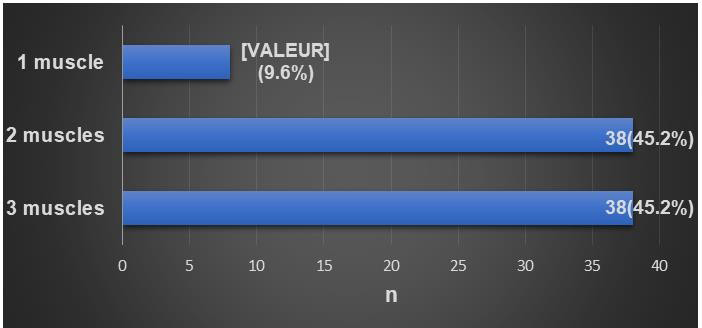
Most cases were large-angle strabismus. The mean pre-operative angle was 41.1 ± 9.5 prism diopters (PD) in esotropias and 40.2 ± 12.6 PD in exotropias. Surgery was done in both eyes in 82.1% of cases and on at least 2 muscles in 90.5% cases (Figure 1).
Discussion
Exotropia was the most common type of strabismus undergoing surgery in this study. Several studies show that exotropia is more common in African and Asian populations, while esotropias are more common in European populations [10, 11]. In this study, 67.9% of cases had exotropia. In similar studies on strabismus surgery in Brasil and in Saudi Arabia; esotropia was more common, representing respectively 74% and 69.3% of strabismus surgeries [12, 13]. Studies from China show that exotropia surgery is the most common, accounting for 44 to 54% of all strabismus surgeries [11, 14]. There is however an increasing trend in exotropia surgery in western populations. A study which analysed the surgical database of 4 494 primary paediatric strabismus procedures from 1990 through 2009 at the Children’s Medical Center of Dallas, noted that surgery for all types of esotropia decreased and that for exotropia increased [15]. This trend has been explained by earlier detection of strabismus and a trend of the full hypermetropic spectacle correction treatment, which would decrease the demand for a procedure to correct esotropia [16]. This hypothesis may not explain the high rate of exotropia in our setting where there are no pre-school or school screening programmes. Genetic factors may play a role. The mean age at the time of surgery in this study was 15 years. This is similar to the 15.9 years mean age reported by Bi et al in a study carried out in a reference hospital in China which included 4640 patients [14].
Although authors still disagree on the optimal age for surgery; it is generally agreed that earlier ocular alignment should be sought, for a better functional outcome. The late surgery in our setting could be due to late presentation and the time lag between the indication for surgery and the surgery. A study in our setting showed that 26.3% of strabismus patients were over 7 years old at the time of the first consultation, despite the fact that the strabismus occurred within the first five years of life [17]. In the absence of health insurance, families must bear the entire cost of surgery and may need time to pull resources together. Social beliefs and taboos can also be a barrier to uptake of surgery. The high mean age could also be explained by the fact that adults were included in this study. However, in a study by Horta-Santini in a pediatric hospital in Puerto Rico on 120 patients, the mean age was 15.1 years [18]. Surgery was done under the age of 8 for 42.9% of our patients, close to the 47.5% reported by Curtis, et al. [13]. The mean age at surgery was lower for esotropias than for exotropias in this study; it was respectively 8.6 and 18.8 years. These tie with past studies with data drawn from another hospital in our setting, which reported a mean age of 8.7 years for esotropia surgery [9] and 18.7 years for exotropia surgery [19]. This difference between the two groups can be explained by the fact that exotropia usually has a gradual onset, with a phoric phase during which fusion occurs and there is no deviation [16]. Exodeviation is noted only upon breaking fusion with a cover test. In due course, these patients often progress to intermittent exotropia, then to constant exotropia (tropic phase).
Jung, et al. in a study to compare and differentiate the clinical characteristics of intermittent exotropia in children and adults; reported a mean age of onset of 4.6 years and 11.6 respectively, with surgery done at a mean of 7.2 years and 26.5 years respectively for both groups [20]. Surgery was done in at least 2 muscles in most cases in this study due to the large angle of deviation and to the fact that most patients cannot pay for multiple surgeries, pushing the team to do the maximum possible surgery in one session. The large angle of deviation is also a great motivation factor for surgery, especially in adult patients and in those with sensory strabismus. The rate of sensory strabismus was 8.3 % in this study, which is much lower than the 20.8% reported by Curtis, et al. [13]. Surgery is usually performed only in the affected eye [21]. The overall goal of surgery in these cases is to improve the patient’s aesthetics and quality of life by treating the maximum angle of deviation. Surgical outcomes are often satisfactory for the patients [22]. At the time of this study, the study site was the only public hospital in the country performing strabismus surgery; therefore, the data should reflect to a great extent, the pattern of strabismus surgery in the general population. Results from this study may help guide future studies and health initiatives.
Conclusion
Patients operated for strabismus in this study generally had large-angle deviations. Exotropia was more frequent than esotropia. Females were predominant, with no difference between the two groups. Overall, surgery was carried out late. There is therefore a need to continuously sensitize the public for earlier presentation and uptake of surgery.
References
-
Mvogo CE, Ellong A, Owona D, Luma H, Bella LA (2005) Amblyopia and strabismus in our environment Bull Soc Belge Ophtalmol 297: 39-44.
-
Zahir KK, Israr M, Khattak MAK, Mudassar S, Shaheen S, et al. (2023) Frequency of amblyopia in strabismus patients presenting to tertiary care hospital. Rom J Ophthalmol 67(1): 46-49.
-
Sim B, Yap GH, Chia A (2014) Functional and psychosocial impact of strabismus on Singaporean children. J AAPOS 18(2): 178-182.
-
Chai Y, Shao Y, Lin S, Xiong KY, Chen WS, et al (2009) Vision-Related quality of life and emotional impact in children with strabismus: a prospective study. J Int Med Res 37(4): 1108-1114.
-
Kothari M (2007) Clinical characteristics of spontaneous late-onset comitant acute nonaccommodative esotropia in children. Indian J Ophthalmol 55(2): 117-120.
-
Schuster AK, Elflein HM, Pokora R, Schlaud M, Baumgarten F, et al. (2019) Health-related quality of life and mental health in children and adolescents with strabismus-results of the representative population- based survey KiGGS. Health Qual Life Outcomes 17(1): 81.
-
Lin S, Congdon N, Yam JCS, Huang Y, Qiu K, et al (2014) Alcohol use and positive screening results for depression and anxiety are highly prevalent among Chinese children with strabismus. Am J Ophthalmol 157(4): 894-900.
-
Ebana C, Ellong A, Omgbwa E, Ebana S, Dohvoma V, et al. (2013) Characteristics of strabismus in the Cameroonian environment. Revue SOAO 1: 38-44.
-
Dohvoma VA, Mvogo SRE, Ndongo JA, Mvilongo CT, Mvogo CE (2020) Outcome of esotropia surgery in 2 tertiary hospitals in Cameroon. Clin Ophthalmol 14: 449-454.
-
Chia A, Roy L, Seenyen L (2007) Comitant horizontal strabismus: an Asian perspective. Br J Ophthalmol 91(10): 1337-1340.
-
Yu X, Ji Z, Yu H, Xu M, Xu J (2016) Exotropia is the main pattern of childhood strabismus surgery in the South of China: a six-year clinical review. J Ophthalmol 2016: 1489537.
-
Rohr JTD, Isaac CR, Santos CCD (2017) Epidemiology of strabismus surgery in a public hospital of the Brazilian Federal District. Rev Bras Oftalmol 76(5): 250-254.
-
Curtis TH, McClatchey M, Wheeler DT (2010) Epidemiology of surgical strabismus in Saudi Arabia. Ophthalmic Epidemiol 17(5): 307-314.
-
Bi Y, Yam JC, Lin S (2022) A retrospective study of strabismus surgery in a tertiary eye hospital in the Chaoshan area in China from 2014 to 2020. BMC Ophthalmol 22(1): 246.
-
Dabes EA, Weakley DR, Birch E (2011) Trends in surgical correction of strabismus: A 20-year experience, 1990- 2009. J AAPOS 15(3): 219-223.
-
Chou MR, Malik ANJ, Suleman M, Gray M, Yeates D, et al. (2013) Time trends over five decades, and recent geographical variation, in rates of childhood squint surgery in England. Br J Ophthalmol 97(6): 746-751.
-
Dohvoma VA, Mvogo SRE, Mvilongo CT, Epee E, Mvogo CE (2020) Strabismus in neglected childhood: epidemiological, clinical and therapeutic aspects. J Fr Ophtalmol 43(8): 774-778.
-
Horta-Santini JM, Vergara C, Colón-Casasnovas JE, Izquierdo NJ (2011) Strabismus surgery at the Puerto Rico Medical Center: a brief report. P R Health Sci J 30(4): 203-205.
-
Mvogo CE, Bella AL, Ellong A, Didier O, Eballe AO, et al. (2007) Surgical management of primary exotropia in Cameroon. Clin Ophthalmol 1(4): 471-474.
-
Jung JW, Lee SY (2010) A comparison of the clinical characteristics of intermittent exotropia in children and adults. Korean J Ophthalmol 24(2): 96-100.
-
Mawatari G, Makino S, Hozawa K, Kondo R, Kanai M, et al (2016) Surgical outcomes of sensory strabismus. Journal of Japan Orthoptist Association 45: 105-108.
-
Lajmi H, Yakhlef AB, Bouazzeoui EOA, Fekih LE (2020) Outcomes of surgery in patients with sensory exotropia. J Fr Ophtalmol 43(2): 128-132.
- Screening of Hospital Staff During World Glaucoma Week in a Tertiary Eye Care Centre
- Angioid Streaks with Macular Neovascularization: Clinical Insights from Two Cases
- Giant Kissing Naevus: An Oculoplastic Challenge
- Why Freedom of Vision Should Not Cost the Freedom of Feeling - LASIK in the Climate of Change
- Asymmetric Optic Nerve with Small Disc and Large Cup: A Rare and Challenging Case of Unilateral Optic Nerve Hypoplasia
- Large Angle Exotropia in a Child: A Case Report