
Bird Electrocution and Collisions with Power Infrastructure in Elgazeira, Kassala and Gadarif States, Sudan
This study was conducted at Elgazeira, kassala and Gadarif states, covered two seasons in exception of Gadarif state studied in the last season only. The first season from 28/6/2015 to 6/7/2015, and another season from 24 December 2015- 6 January 2016, to assess the bird's mortality caused by the power lines. Objectives of this study are: Describe types of killer power lines, and determine numbers of bird species, that are killed by collisions or electrocutions. There were 43 lines traversed in the study area, as follow: 20 lines in the Gaziera state, 9 lines in Gadarif and 14 in kassala. Line transects was adopted to cover the targeted lines. Types of these lines that used were 11 Kilo volte, 33 kilo volte, and 66 kilo volte. Lines were intensive studied by four members under and at the both sides of the line to cover about twenty meters at each side. Dead birds found at an area of 20 meters beneath the line recorded by location using GPS, then classified and documented by digital camera, a photo taken for the poles with its surround habitat. Electrocuted birds distinguished by the signs like burning, injures or the location of the birds from the pole. Dead birds after been registered collected to avoid replication. individuals of 18%. Less proportion was Passeriformes and Charadriiformes. Electrocuted birds were 301 individuals 84.3% higher than collition 56 birds 15.7%. It should be noticed that birds of prey were more affected by power lines mainly at Kassala state, Lesser kestrel 20.7%, Black kite 16.3% Common kestrel 15.1% while Pied crow suffered more in Gaziera state 31 individuals of 8.7%. The total number of birds not reflects the exact real because there are many factors such as Scavengers and carnivores or removing by ploughing or humans. Number of dead birds was 357 individuals classified into 23 species most are member of the order Falconiformes which comprised a total of 257 individuals, about 72% of the whole percentage. The proportion of Ciconiiformes was 64
Introduction
Power lines are one of the major causes of unnatural deaths for birds in a large part of the African-Eurasian Flyways with, for example, an estimated many millions of collision victims each year in Germany alone [1]. The Rift Valley/Red Sea flyway is the second most important flyway for migratory soaring birds (raptors, storks, pelicans and some ibis) in the world, with over 1.5 million birds of 37 species, including 5 globally threatened species, using this corridor between their breeding grounds in Europe and West Asia and wintering areas in Africa each year. Electrocution and collision with power lines are considered to be a major cause of death for some avian species [1, 2, 3, 4]. Electrocution can occur when a bird perches on a cross`-arm and completes an electrical circuit with two or more body parts. Electrocution can also happen when the bird comes between two energized components or an energized and an earthed (also called ‘grounded’) component of the pole structure.
Collisions, on the other hand, happen when birds fly directly into electrical lines, poles and pylons and the bird is typically killed when it collides with such obstructions and the subsequent impact with the ground, or it dies from the resulting injuries [5, 6, 7, 8, 9]. However, birds die either from the impact of hitting the line or from electrocution when they contact two lines simultaneously and complete the electrical circuit [10].
Several studies have shown that electrocution from power lines is a serious conservation problem and is one of the principal causes of mortality among many threatened species of birds [7, 11, 12].
In some areas, it is considered to be the main reason for the decline of endangered species [12, 13, 14]. Collisions may kill anything between hundreds of thousands to 175 Nesradin Y, et al. Bird Electrocution and Collisions with Power Infrastructure in Elgazeira, Kassala and Gadarif States, Sudan. Vet Sci Res 2018, 3(4): 000166.
million birds annually, and power lines electrocute tens to hundreds of thousands more birds annually.
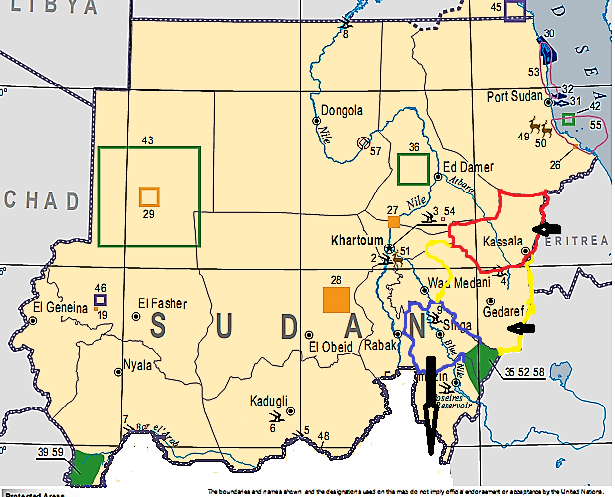
Red color: Kassala stste Yellow color: Gadarif stste Blue color: Sinnar state. Map 1: location of Sinnar, Gdarif and Kassala state.
Methodology
Power lines o the three states were intensively studied in two seasons, from 28/6/2015 to 6/7/2015, and another season from 24 December 2015-6 January 2016.Three compilers walking under and at the both sides of the power line to cover about twenty meters at each side.
Dead birds were counted and recorded by location using GPS, then classified and documented by digital camera, and a photo taken for the poles with it's around habitat.
Copyright© Nesradin Y, et al.
Open Access Journal of Veterinary Science & Research
Several studies have already mentioned the importance of counting bird carcasses by the power lines even if this does not represent the actual number or the actual species affected by the power lines, especially the small species [15]. The majority of lines covered on food because most areas ploughed from last season with remain of dura, cotton, vegetables, or bare land. Less proportion covered by car where the lines goes along roads and open areas where the car find its way slowly and more difficulty.
A questionnaire is used to collect information from the local people in the three states, while a form used for cases of dead birds, collision and Electrocution typical copy of which prepared (Bird life international) by Avian demography in South Africa.
Discussion & Results
The study covered a total of 43 lines, Table 1, distributed as follow: 20, 14 and 9 lines for Gaziera, Kassala and Gadar if respectively, which all reflected the affected lines. The numbers of poles that counted are 3935 poles, Table 2, which they distributed along the lines in states as follow: 1351 poles in the Gaziera are 2127 poles in Gadarif and 457 poles in Kassala. The total number of birds’ species is varied the three states, Table 3 Kassala has high number of species during the two seasons followed by Gadarif, the second season 2016 is higher than the first one 2015. In general, the total number of dead species for the whole study is 23 species Table 4. And it will be mention that this may not the real number of species, since the small species may be burned, eaten, burrowed by soil or even pulled away by wind action.
State First season Second season Total Gaziera 9 11 20 Kassala 7 7 14 Gadarif 0 9 9 Total 16 27 43 Table 1: Number of Power lines studied during the study period at the three states.
| State | Number of poles | |||
|---|---|---|---|---|
| Gaziera | 1351 | |||
| Kassala | 457 | |||
| Gadarif | 2127 | |||
| Total | 3935 |
Table 1: Number of poles in the three states.
| State | First season | Second season | ||||||
|---|---|---|---|---|---|---|---|---|
| Gaziera | 3 | 9 | ||||||
| Kassala | 12 | 13 | ||||||
| Gadarif | 0 | 12 |
Table 2: Total number of dead bird’s species.
| Season | First season 2015 | Second season 2016 | |||||||||||||||||||||||||||||||||
|---|---|---|---|---|---|---|---|---|---|---|---|---|---|---|---|---|---|---|---|---|---|---|---|---|---|---|---|---|---|---|---|---|---|---|---|
| Gaziera | Kassala | Gadarif | Gaziera | Kassala | Gadarif | Total | Percentage | ||||||||||||||||||||||||||||
| No | Species | ||||||||||||||||||||||||||||||||||
| 1 | Pied crow | 8 | 1 | 0 | 15 | 2 | 5 | 31 | 8.7 | ||||||||||||||||||||||||||
| 2 | Brown necked raven | 0 | 1 | 0 | 0 | 0 | 0 | 1 | 0.3 | ||||||||||||||||||||||||||
| 3 | Lesser kestrel | 0 | 26 | 0 | 5 | 19 | 24 | 74 | 20.7 | ||||||||||||||||||||||||||
| 4 | Common kestrel | 0 | 4 | 0 | 0 | 21 | 29 | 54 | 15.1 | ||||||||||||||||||||||||||
| 5 | Sacker falcon | 0 | 0 | 0 | 0 | 8 | 0 | 8 | 2.2 | ||||||||||||||||||||||||||
| 6 | Black kite | 0 | 7 | 0 | 2 | 14 | 35 | 58 | 16.3 | ||||||||||||||||||||||||||
| 7 | Yellow billed kite | 0 | 4 | 0 | 0 | 0 | 0 | 4 | 1.1 | ||||||||||||||||||||||||||
| 8 | Un identified vulture | 0 | 3 | 0 | 0 | 0 | 0 | 3 | 0.8 | ||||||||||||||||||||||||||
| 9 | White backed vulture | 0 | 5 | 0 | 0 | 2 | 0 | 7 | 2 | ||||||||||||||||||||||||||
| 10 | Red necked buzzard | 0 | 0 | 0 | 0 | 4 | 3 | 7 | 2 | ||||||||||||||||||||||||||
| 11 | Levant sparrow hawk | 0 | 0 | 0 | 0 | 0 | 2 | 2 | 0.6 | ||||||||||||||||||||||||||
| 12 | Abdims’ stork | 8 | 17 | 0 | 4 | 8 | 3 | 40 | 11.2 | ||||||||||||||||||||||||||
| 13 | White stork | 0 | 0 | 0 | 1 | 2 | 0 | 3 | 0.7 | ||||||||||||||||||||||||||
| 14 | Black headed heron | 1 | 3 | 0 | 0 | 2 | 1 | 7 | 2 |
Table 3: Occurrence and number of bird’s species.
Nesradin Y, et al. Bird Electrocution and Collisions with Power Infrastructure in Elgazeira, Kassala and Gadarif States, Sudan. Vet Sci Res 2018, 3(4): 000166.
Copyright© Nesradin Y, et al.
Open Access Journal of Veterinary Science & Research
| 15 | Grey heron | 0 | 0 | 0 | 1 | 0 | 2 | 3 | 0.8 |
|---|---|---|---|---|---|---|---|---|---|
| 16 | Cattle egret | 0 | 0 | 0 | 2 | 0 | 6 | 8 | 2.2 |
| 17 | Eagle owl | 0 | 0 | 0 | 1 | 10 | 0 | 11 | 3.1 |
| 18 | Grayish Owl | 0 | 27 | 0 | 0 | 0 | 0 | 27 | 7.6 |
| 19 | Un known owl | 0 | 0 | 0 | 0 | 2 | 0 | 2 | 0.6 |
| 20 | Marabou stork | 0 | 0 | 0 | 1 | 2 | 0 | 3 | 0.8 |
| 21 | Spur winged lapwing | 0 | 1 | 0 | 0 | 0 | 0 | 1 | 0.3 |
| 22 | Abyssinian roller | 0 | 0 | 0 | 0 | 0 | 1 | 1 | 0.3 |
| 23 | African mourning dove | 0 | 0 | 0 | 0 | 0 | 2 | 2 | 0.6 |
| Total | 17 | 99 | 0 | 32 | 96 | 113 | 357 |
Table 4: Occurrence and number of bird’s species.
The total number of dead birds is 357 birds. Although this number probably does not represent the actual bird mortality due to electrocution or collision with the power lines, the occurrence of predators, where tracks of a large of dogs, Common genet (Genetta genetta) African civet (Civettictis civetta) and scavingers in many sites were seen along the power lines, could confirm this fact which stated by Shobrak [16]. The type of effect on birds (Collision and electrocution) is shown in Table 5. It reveals that collided birds were 56 individuals of proportion 15.7% while the Electrocuted birds were the most dominant 301 individuals of 84.3%. The remarkable things that both collision and Electrocution were increased in the second season, which can be big challenge in the future. The effect of collision and Electrocution is varied between the states for the same period, Table 5, Figures 2 & 3. Kassala always has a high mortality of birds either for collision or Electrocution at Awadat lines (begins N: 15 46 384 E36 29 713 and end at N: 15 46 031 E: 366 33 436).
- State
- First season Second season
- Total
- First Season
- Second Season
- Total
- ELEC
- ELEC
- COLL
- COLL
- Gaziera
- 11
- 22
- 37
- 12.3
- 6
- 10
- 16
- 28.6
- Kassala
- 80
- 87
- 167
- 62.1
- 19
- 9
- 28
- 50
- Gadarif
- 0
- 101
- 101
- 33.6
- 0
- 12
- 12
- 21.4
- Total
- 91
- 210
- 301
- 25
- 31
- 56
- Percentage
- 84.3
- 15.7
Table 5: Percentage of collision and electrocutions.
Nesradin Y, et al. Bird Electrocution and Collisions with Power Infrastructure in Elgazeira, Kassala and Gadarif States, Sudan. Vet Sci Res 2018, 3(4): 000166.
Copyright© Nesradin Y, et al.
Open Access Journal of Veterinary Science & Research
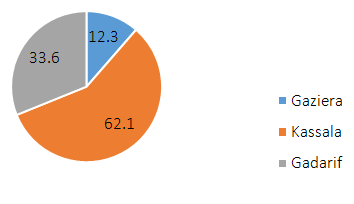
The other line begins at the same point and goes parallel to two kilometers before separate, they consider fatal lines for birds, in spite they are shorter and less number of poles, Table 2, compared to the other states. Gazira state recorded high mortality for collision after kassala while Gadarif came after Kassala in electrocution. The reasons beyond variation in dead number of birds are exactly un known which were determined by the specific factors around the events seasonally (temporary) or annually (permanent) [17, 18] stated that birds from the family Corvidae Passerifоrmes and Storks (Ciconiiformes), most vulenable to electrocution. Raptors and Crows represented 62% of the losses caused by electrocution. Similar results were presented in the research of Demerdzhiev, et al. [18], carried out in four IBAs in Southern Bulgaria, where electrocution of diurnal birds of prey and Crows was suspected for 53% of all detected carcasses. In different parts of Spain these two systematic groups represent 80% to 96% of the suspected electrocutions [19, 20]. Similar results were reported in southeastern France, where raptors and Crows represent 85% of suspected electrocution [7]. The high mortality rates of these species are related to their ecology, as they use electric poles as roosts or perches for hunting [18]. Perching on the poles, the birds sometimes get in contact with parts of the pylons or conductors and die from electrocution [18, 21, 22, 23].
The study agreed with the previous studies above that some species are more valuranable to electrocution in Nesradin Y, et al. Bird Electrocution and Collisions with Power Infrastructure in Elgazeira, Kassala and Gadarif States, Sudan. Vet Sci Res 2018, 3(4): 000166.
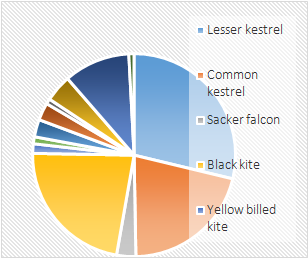
many part of the year. The most threatened bird’s species were a group of birds of prey, Figure 4, these are: Lesser kestrel (Falco naumanni) 20.7%, Black kite 16.3, Common kestrel (Falco tinnuculu), 15.1%, Abdims’ stork (Ciconia abdimii) 11, 2%, Pied crow (Corvus albus) in Gaziera state with percentage of 8.7%. Albania line N: 14 00 794 E: 33 25 233 to Abu amna N: 14 04 73 E: 33 23 426 and Grayish Owl (Bubo cinerascens) of 7.6%. for most birds the conservation status and the globally population trends are least concern (LC) according to the Red list of International Union of Conservation of nature (IUCN) 2018, in exception of lesser kestrel which is internationally threatened. With Grayish owl.
Specific and separated data form for collision and electrocution filled directly in the field at the site of incidence by coordinates indicated that most lines are crossing or passes near agricultural field, the majority are un irrigated.
In most cases the pylons are the higher altitude, animal Caraca s and canals and slouther houses are contribution factors in the vicinity. The type of pole designation used in Sudan (Insulator up) may be important factor never be neglected for increasing bird death (Plates 1-12).
Copyright© Nesradin Y, et al.
Open Access Journal of Veterinary Science & Research
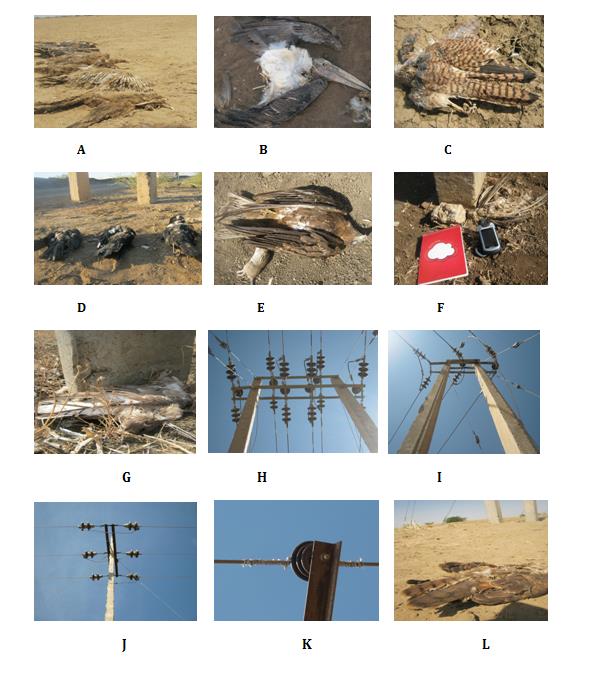
Plates: A: Common kestrel in Kassala; B: Marabou storl in Gaiera state; C: Lessser kestrel in Gaziera state; D: Pied crow in gaziera state; E: Black kite in Gadarif state; F: Lesser kestrel in Gadarif state; G: Red necked buzzard in Gadarif state; H: Type of pole; I: Type of pole; J: Type of pole; K: Insulator; L: Common kestrel in Kassala.
Habitat around the cases mostly were agricultural land, irrigated for dura in Egaziera or unirrigated for sesame and dura in Gadarif, kassala and few cases are fallow land. In one different site is Forest of Acacia Seyal at Abu amna village where pied crow aggregated. Most common shrubs and small trees are Sayal, (Balanites aegyptiaca), (Acacia nilotica), (Ziziphus spina Christi) in Elgaziera and miskeet in kassala.
The most remarkable thing that most electrocution under the double poles sometime reach 11 birds in one double poles in Gadarif state, and the collision varied between under the wire and to about 15 meter may the distance depending on the flying speed, wind action or other factor shifting the Caracas.
The historical information from the personnel of electricity corporation stated that they were suffering more from the birds during the rainy season, they explained that large birds with their high wing span ratio Nesradin Y, et al. Bird Electrocution and Collisions with Power Infrastructure in Elgazeira, Kassala and Gadarif States, Sudan. Vet Sci Res 2018, 3(4): 000166.
like storks, Herons and birds of prey caused electric outage when they are perching on the double poles, in this time of the year correspond with growing season begins in July and harvesting of crops on October, surprisingly this period coincides with migration season of many birds species to Sudan.
Species with less mortality may not indicate the real number of death, dogs and other carnivores around, beside the other contributing factors and the variation in the amount of rain fall which affect availability of food and consequently the number of birds that using habitat.
Obviously the study indicate that birds suffered extremely from power lines and need protection and urgent conservation measures in the three states, especially Kassala, where the greatest threat falls on the birds of prey, especially Lesser kestrel and Abuamna area where the crow killed. The death of birds in these areas can be justified that lines in the Kassala station (Awadat) Copyright© Nesradin Y, et al.
Open Access Journal of Veterinary Science & Research
distributes in a network of parallel lines that consist of large number of poles, especially dabble poles where birds perch and nest. Abomna area there is a forest for trees Acacia seyal where the crow is nesting and feeding from the villages around. It is very difficult to obtain accurate and detailed information to predict the occurrence of electrocutions and collision makes it difficult to know how it happened and the circumstances associated, this situation cause growing concern over time about birds not only in this area, but in many part of Sudan as whole.
Acknowledgment
The authors are grateful to the Sudanese Wildlife Society (SWS) and its head, Professor Ibrahim Mohammed Hashim, for the financial support provided for the field studies. We would like to thank The United Nation Development Program (UNDP), Government environmental Facilities (gef) and Bird Life International for the donation and our thanks to the National Electricity Corporation who helped in the field studies and provided some useful information in the states.
References
-
Prinsen HAM, Boere GC, Píres N, Smallie JJ (2011) Review of the Conflict between Migratory Birds and Electricity Power Grids in the African-Eurasian Region. AEWA, Cms Technical Series No. 20 (Aewa Technical Series No. 20), Bonn.
-
Crivelli AJ, Jerrentrup H, Mitchev T (1988) Electric Power Lines: A Cause of Mortality in Pelecanus Crispus Bruch, a World Endangered Bird Species. Colonial Water birds 11(2): 301-305.
-
Morkill AE, Anderson SA (1991) Effectiveness of Marking Powerlines to Reduce Sandhill Crane Collisions. Wildlife Society Bulletin 19(4): 442-449.
-
Lehman R (2001) Raptor Electrocution on Power Lines: Current Issues and Outlook. Wildlife Society Bulletin 29(4): 804-813.
-
Shaw J, Jenkins AR, Ryan P, Smallie JJ (2010) A Preliminary Survey of Avian Mortality on Power Lines in the Overberg, South Africa. Ostrich 81(2): 109-113.
-
Lehman RN, Kennedy PL, Savidge JA (2007) The State of the Art in Raptor Electrocution Research: A Global Review. Biological Conservation 135(4): 459-474. Nesradin Y, et al. Bird Electrocution and Collisions with Power Infrastructure in Elgazeira, Kassala and Gadarif States, Sudan. Vet Sci Res 2018, 3(4): 000166.
-
Manville AM (2005) Bird Strikes and Electrocutions at Power Lines, Communication Towers, and Wind Turbines: State of the Art and State of the Science next Steps toward Mitigation. Usda Forest Service General Technical Report 19: 442-449.
-
Bevanger K (1994) Bird Interactions with Utility Structures: Collision and Electrocution, Causes and Mitigating Measures. IBIS 136(4): 412-425.
-
Bayle P (1999) Preventing Birds of Prey Problems at Transmission Lines in Western Europe. Journal of Raptor Research 33(1): 43-48.
-
Aplic (2006) Suggested Practices for Avian Protection on Power Lines: The State of the Art in 2006. Edison Electric Institute, Washington, DC.
-
Martin GR (2011) Understanding Bird Collisions with Manmade Objects: A Sensory Ecology Approach. IBIS 153(2): 239-254.
-
Harness R, Gombobaatar S, Yosef R (2008) Mongolian Distribution of Power Lines and Raptor Electrocutions. Rural Electric Power Conference, Charleston, South Caroline.
-
Bevanger K (1998) Biological and Conservation Aspects of Bird Mortality Caused by Electricity Power Lines: A Review. Biological Conservation 86(1): 67- 76.
-
Real J, Grande JM, Mañosa S, Sánchez-Zapata JA (2001) Causes of Death in Different Areas For Bonelli’s Eagle Hieraaetus Fasciatus in Spain. Bird Study 48: 221-228.
-
Ferrer M, De La Riva M, Castroviejo J (1991) Electrocution of Raptors on Power Lines in Southwestern Spain. Journal of Field Ornithology 62(2): 181-190.
-
Bevanger K, Overskaug K (1998) Utility Structures as a Mortality Factor for Raptors and Owls in Norway. In: Chancellor RD, Meyburg BU, Ferrero JJ, (Eds.), Holarctic Birds of Prey, ADENEX-WWGBP, pp: 381- 391.
-
Curry R, Kerlinger P (2002) Desktop Avian Risk Assessment for the Long Island Power Authority Offshore Wind Energy Project. Aws Scientific, Inc. and Long Island Power Authority, Cape May Point. Curry and Kerlinger, LLC, New Jersey. Copyright© Nesradin Y, et al. Open Access Journal of Veterinary Science & Research
-
Mohammed Shobrak (2011) Electrocution and Collision of Birds with Power Lines in Saudi Arabia. Zoology in the Middle East 57(1): 45-52.
-
Georgi P, Gerderzhikov, Dimitara Demerdzhie (2009) Data on Bird Mortality in “Sakar” Iba (Bg021), Caused by Hazardous Power Lines. Ecologia Balkanic 1: 67.
-
Demerdzhiev D, Stoychev S, Petrov T, Angelov I, Nedyalkov N (2009) Impact of Power Lines on Bird Mortality in Southern Bulgaria. Acta Zoologica Bulgarica 61(2): 175-183. Adjacent Habitat in Spain. Bird Conservation International 11(1): 3-12.
-
Manosa S (2001) Strategies to Identify Dangerous Electricity Pylons for Birds. Biodiversity and Conservation 10: 1997-2012.
-
Stoychev S, Demerdzhiev D, Iankov P, Sakar, Kostadinova I, et al. (2007) Important bird areas in Bulgaria and Natura 2000. Bulgarian Society for the Protection of Birds, Conservation Series, Book 11. Sofia, BSPB, pp: 1-87. Nesradin Y, et al. Bird Electrocution and Collisions with Power Infrastructure in Elgazeira, Kassala and Gadarif States, Sudan. Vet Sci Res 2018, 3(4): 000166. Copyright© Nesradin Y, et al.
- The Digital Stethoscope: Harnessing AI in Veterinary Medicine Without Losing Our Healing Touch
- Meningoencephalomyelitis of Unknown Etiology: Short-Term Effect of Two Treatment Protocols on Cerebrospinal Fluid
- Safety and Efficacy of the HomeoPet Cough in Domestic Pets –A Clinical and Correction Analysis Based Upon User Response Survey
- Non Human Animals Responses to Social Loss
- Owner Reported Clinical Outcomes of a Homeopathic Proprietary Preparation for the Treatment of Upper Respiratory and Nasal Disorders in Companion Animals
- Effects and Diagnostic Approach of Ultrasound in Veterinary Practice: A Systematic Review