
Seroprevalence and Associated Risk Factors of Infectious Laryngotracheitis (ILT) from Poultry Farms in Selected Towns of East Shao Zone
Poultry is one of the largest group of livestock species in the world in which chickens largely dominate the flock composition. Although this sector has a potential in elevating poverty in one country it is seriously challenged with various factors, of which poultry disease is the main. Infectious laryngotracheitis (ILT) is a highly contagious and upper respiratory disease of chickens which is caused by a Gallid herpesvirus 1 (GaHV-1) belonging to the genus Iltovirus, and subfamily Alphaherpesvirinae within Herpesviridae family was one of a deadly poultry disease which impose to a loss of production and productivity gained from the sector. Cross-sectional study was conducted from December 2022 to April 2023 in three selected cities of Oromia region (Bishoftu, Adama and Modjo), Ethiopia. In the current study area, of the total 386 serum samples collected using simple random sampling method 14 (3.63%; 95%CI: 2.15-6.04) were found positive for anti-ILTV antibody detection using Indirect Enzyme Linked Immuno Sorbent Assay. Prevalence of the disease at flock level was found 5/17 (29.41%; 95% CI: 11.52%- 57.14%). Different risk factors (sex, age, sampling area, breed, production type, origin, management and supplementation of vitamins) were considered as covariates for this study. Of the different risk factors considered; sampling area, production type, age, origin and management were found statistically significant (p<0.05) whereas the rest factors were not significantly associated with the outcome variable using chi-square analysis. However, using logistic regression model sampling area and management were found significantly associated (p<0.05) with the occurrence of the disease. The result of this study revealed that ILT virus is circulating among commercial chickens in the selected study areas and needs due emphasis to tackle and cease its spread using vaccination, although ILT vaccine is not familiarized now days in Ethiopia. In addition, proper management and biosecurity measures will be highly recommended as the disease is a deadly disease once introduced into the farm.
Introduction
The world has over 23 billion poultry- about three birds per person on the planet and about five times more than 50 years ago [1] and In East Africa, the distribution of indigenous chicken (IC) varied. For example, the poultry population in Rwanda was about 5.3 million birds among which nearly 70% were indigenous chickens (IC) [2]. In Kenya, a report from the Ministry of Agriculture, Livestock, and Fisheries show the presence of 32 million chickens among which over 70% were IC [3]. In 2001, Zambia counted 26 million chickens with 11 million being indigenous varieties [4] and Ethiopia has about 60% of the total chicken population of East Africa, which includes local, exotic, and hybrid chicken breeds. Report on population of Ethiopian chickens estimated to be about 56.53 million [5]. Poultry in Ethiopia are potentially an excellent animal protein supplier serving as an important contributor for food and nutrition security, and they are sources of cash income for a large part of the population [6, 7].
However, Poultry diseases are responsible for a number of adverse economic and social impacts. Their occurrence depends on various factors including geo-climatic condition, population density, management practices, and immunization status [8]. Among the emerging diseases, Infectious laryngotracheitis (ILT) is a highly contagious [9] and the upper respiratory tract disease of chickens caused by infectious laryngotracheitis virus (ILTV, Gallid herpesvirus 1), a member of the Alphaherpesvirinae sub-family (genus Iltovirus) [10] and it was first reported in the 1920s; however, this disease may have existed in chickens much earlier [11]. ILTV infection causes significant economic losses for the poultry sector around the world due to high mortalities and production losses [12].
Field ILTV isolates differ in their pathogenicity, a severe epizootic form and a mild enzootic form. The severe infection manifests in respiratory symptoms such as respiratory depression, gasping, hemorrhagic tracheitis, and bloody mucus sputum, and it has a high rate of mortality. The mild enzootic form is more present in developed poultry industries, and presents with varied clinical expressions, including mucoid tracheitis, sinusitis, conjunctivitis, general un-thriftiness, and a low rate of mortality [13]. Mortality can vary depending on the age of the birds, vaccination history, production type (broilers or layers), individual susceptibility, virulence of the strain, and occurrence of secondary bacterial infections or concurrent immunosuppressive or respiratory diseases [14, 15]. There are no extensive studies on ILT distribution particularly in the current study area and generally in Ethiopia. Hence, this study aimed to determine the sero-prevalence of ILT disease and identify possible associated risk factors which increase the burden of the disease in the study areas.
Materials and Methods
Description of the Study Areas
The study was conducted in Adama, Modjo, and Bishoftu town Oromia regional state, Ethiopia. Adama town is located at about 99 km East of Addis Ababa. It is located at 8.54°N 39.27°E at an altitude of 1,712 m above sea level. It receives an average rainfall of approximately 600– 1,150 mm with annual average minimum and maximum temperatures of 18 and 32°C, respectively. Modjo town is located at 73 km East of Addis Ababa at an altitude of 1,777 m above sea level. It is found on a geographical location of at 8.36°N and 39.7°E. The monthly mean minimum and maximum temperature for Mojo town ranges from 8.5–13.5°C, and 25.6–30.8°C, respectively [16]. Bishoftu town is located about 47 kilometers East of Addis Ababa with latitude of 1850 meters above sea level. The town has the population of about 95,000 people. The soil and climate of the area are similar to those in many highland areas in Ethiopia. The main rainy season of the area ranges from June to September with an average rain fall of 800 millimeters, of which 84% of the rain is expected. There is also a short rainy season from March to May. The annual average temperature ranges from 12.3oc to 27.7oc with an average temperature of 18.7oc. The highest temperature is reached in May [17].
Study Population
The chickens in this study were exotic breeds and cross- breeds with various age categories ranging from 12 weeks to 1 year and 6months. The birds were found under both layer and broiler production types.
Study Design
A cross-sectional study was conducted from; December 2022 to April 2023 to determine the seroprevalence of ILTV in chicken, and identify the potential risk factors which able to contribute for the disease prevalence.
Sample Size Determination and Sampling Method
The sample size was determined using the formula given by Thrusfield M [18]. As there was no previously conducted study in the area, 50% was considered as expected prevalence and desired absolute precision 5% at 95% confidence level. A total number of 384 chickens were required as study units. However, for the current study 386 samples were collected using a simple random sampling method from small, medium and large-scale farms. The following formula was applied to determine the sample size:
( ) $$ n = \frac {1 . 9 6 2 x P \exp (1 - P \exp)}{d ^ {2}} $$
Where: n= of sample size
exp=expected prevalence
d2=desired absolute precision
Method of Sampling and Data Collection
Blood Sample Collection and Serum Preparation
Blood samples of 2–3 ml were collected using 23-gauge needles of 5ml syringe through puncturing the wing vein. The serum part of the blood was separated from other components of the blood, after an overnight standing of the syringe at room temperature. Then, sera samples were poured into a 1.8ml volume cryovials, labeled and transported using an ice box to Animal Health Institute (AHI) and kept at −20°C, until the laboratory analysis was performed. All chickens were sampled according to international animal care and use guide lines.
Data Collection
Appropriate data collection format was prepared and poultry farm owners/attendants were interviewed to assess the potential risk factors for the occurrence of ILTV and seroprevalence, such as, flock size, age, breed, hygienic level of house, housing system, storage and transportation, management practices in the study area and supplements provided.
Laboratory Tests
Serum samples were analyzed using commercial ELISA kits for the presence of antibodies to ILTV (IDVet NDV-Ab ELISA, Veterinary Innovative diagnostic, France), according to the manufacturers’ instructions. Briefly, allow all reagents to come into room temperature (21°C + 5°C) before use. Homogenize all reagents by inversion or vortex. The negative and positive controls are supplied ready-to-use and no need of adding dilution buffer to the control wells (A1, B1, C1 and D1). Samples however, are tested at a final dilution of 1:500 in dilution buffer 14 (1:50 pre-dilution, followed by 1:10 dilution in the micro plate). In a pre-dilution plate, set aside wells A1, B1, C1 and D1 for the controls, and add 5μl of each sample to be tested, 245μl of dilution buffer 14 to all wells except control wells. Then, in the ELISA micro plate, add
100μl of the negative control to wells A1 and B1. 100μL of the positive control to wells C1 and D1. 90μl of dilution buffer 14 to each well except control wells, 10μl of the pre-diluted samples as prepared above. Cover the plate and incubate 60min + 3min at 21°C + 5°C. Prepare the conjugate 1x by diluting the concentrated conjugate 10x to 1:10 in dilution buffer 3. Empty the wells and wash each well 3 times with at least 300μl of the wash solution 1x. Avoid drying of the wells between washings. Add 100μl of the substrate solution to each well and incubate at 21°C + 5°C in the dark for 15min+ 2min. Add 100μl of the stop solution to each well to halt the reaction. The sample and control optical density (OD) values were read using an ELISA reader (ELX800 ELISA Plate reader, BioTek instrument, USA) at 450nm. From OD values, the sample/ positive values (S/P) were calculated using the following formula: S/P = ((ODsample- ODnegative control)/ (ODpositive control- ODnegative control) × 100). So, that S/P values < 0.3 were considered negative and S/P values > 0.3 were positive. Similarly, the antibody titer was calculated using the formula; log10 (titer) =1.00x log10 (S/P) +3.361. The antibody titer result can be interpreted as titer < 611 were considered as negative and titer > 611 were positive. Data Management and Analysis Collected data was inserted and coded using Microsoft excel spreadsheet and were computed using STATA MP/ 13 (Stata Corp., College Station, Texas, USA). Descriptive statistics were computed for all the variables, while the Pearson Chi-square test was used to investigate the association between the sero-prevalence at bird levels in the study areas. Logistic regression model reporting an odd ratio was also manipulated to see the effect of one category over the other. A 95% confidence interval with P- values < 0.05 were considered significant in all attempts of the analysis.
Results
Sero-Prevalence of Infectious Laryngotracheitis Virus
Of the total 386 serum samples tested for anti ILTV antibody detection 14 (3.63%; 95% CI: 2.15-6.04) were found positive at individual bird level. The prevalence of the disease at farm level was 29.41% (95% CI: 11.52-57.14) as shown in Table 1.
| Level of sampling | Total samples | Total positives | Percentage of positivity (95%CI) |
|---|---|---|---|
| Individual bird level | 386 | 14 | 3.63(2.15-6.04) |
| Flock level | 17 | 5 | 29.41(11.52-57.14) |
Table 1: Over all prevalence of the disease in the study areas both for individual and flock level.
Key: CI=Confidence Interval Table 1: Over all prevalence of the disease in the study areas both for individual and flock level.
Relationship of Different Variables among Their Categories
The association between independent (predictor) variable with the outcome variable (ILTV) was assessed in the study area using a chi-square model. Among independent variables area of sampling, age, origin, management and production type were statistically significant (p<0.05) whereas breed, hygiene, sex, and vitamin supplement had not showed significant variation (p >0.005) (Tables 2-4). The prevalence of the disease in Bishoftu (7%) was very much higher than Adama (2.3% and Modjo (0.9%) with a p=0.020. The disease distribution was higher in Lowmans breed (6.1%) compared to Bovans (3.4%), Sasso (0.9%) and Rose 800(0%) although no significant variation occurred in between the breeds. Based on management status of the chickens the prevalence of the disease was more detected from excellent management status (7%) than good management (1.6%). Layer birds (5.1%) were significantly affected (p=0.028) with the disease than broilers (0.8%). Based on age category birds with age of 26-52 weeks (6.2%) were more prone (p=0.026) to the infection with the disease as compared to other categories.
- Variables
- Total samples tested
- Total positive (%)
- X2 p-value
- Area of sampling
- 7.814
- 0.020*
- Bishoftu
- 142
- 10(7%)
- Adama
- 133
- 3(2.3%)
- Modjo
- 111
- 1(0.9%)
- Origin
- Spain
- 142
- 10(7%)
- Ethio-chicken
- 156
- 4(2.6%)
- Elfora
- 23
- 0(0)
- Unknown
- 65
- 0(0)
- Variables
- Total samples tested
- Total positive (%)
- X2 p-value
- Breed
- Lowmans
- 165
- 10(6.1%)
- 5.998
- 0.112
- Bovans
- 88
- 3(3.4%)
- Sasso
- 110
- 1(0.9%)
- Rose 800
- 23
- 0(0)
- Production type
- Broiler
- 133
- 1(0.8%)
- 4.7986
- 0.028*
- Layer
- 253
- 13(5.1%)
- Age
- <=12week
- 91
- 0(0)
- 9.2879
- 0.026*
- 26-Dec
- 42
- 1(2.4%)
- 26-52
- 209
- 13(6.2%)
- >=52
- 44
- 0(0)
- Sex
- Male
- 108
- 1(0.9%)
- 3.1299
- 0.077
- Female
- 278
- 13(4.7%)
Table 2: Relationship of different variables among their categories based on host related factors.
| Unknown | 85 | 0(0) |
Table 3: Relationship of different variables among their categories based on geographical location.
- Variables
- Total samples tested
- Total positive (%)
- X2 p-value
- Management
- Good
- 244
- 4(1.6%)
- 7.4963
- 0.006*
- Excellent
- 142
- 10(7%)
- Vitamin supplement
- 22
- 1(4.5%0
- Vita stress, starter, finisher
- 165
- 10(6.1%)
- Vita stress
- 23
- 0(0)
- Vita-chicken and nebro
- 25
- 0(0)
- Egg stimulant
- 19
- 0(0)
- Vita stress and nebro
- 66
- 2(3%)
- Forty vit
- 22
- 1(4.5%)
- Forty vit and Amino vit
- 23
- 0(0)
- Vita stress and Egg stimulant
- 21
- 0(0)
Table 4: Relationship of variables among their categories based on management related factors.
Strength of Association among Variables Using Univariate Logistic Regression Model
In the current study various variables (sampling area, breed, production type, origin, sex, age, management and vitamin supplement) were considered to assess their association with the occurrence of ILTV (outcome variable). In this model based on sampling area, Modjo was found statistically significant (p=0.045) with (OR=0.12) and Adama (OR=0.3) times less likely occurrence of the disease as compared to Bishoftu. Based on the management of flock of birds, in well managed farms the likelihood of disease distribution was 4.55 times higher than under managed farms with a (p= 0.012). Other risk factors have not showed statistical significance with the occurrence of the disease. However, based on the odds of infection for Bovans and Sasso were 0.55 and 0.14 times less likely compared to Lowmans breed. Regarding to production type the likelihood of infection with the disease for layers were 7.15 times when compared to broilers. Similarly, the odds of infection for females were 5.25 time more likely than males. Based on origin of the bird’s chickens introduced from Ethio-chicken were 0.35 times less likely infected with the disease as compared to chickens introduced from Spain as indicated in Table 5.
| Variables | Category | Total positive (%) | COR (95%CI) | P-Value |
|---|---|---|---|---|
| Sampling area | Bishoftu | 10(7%) | Ref | - |
| Adama | 3(2.3%) | 0.3(0.082- 1.13) | 0.076 | |
| Modjo | 1(0.9%) | 0.12(0.02- 0.95) | 0.045* | |
| Breed | Lowman’s | 10(6.1%) | Ref | - |
| Bovans | 3(3.4%) | 0.55(0.15- 2.04) | 0.369 | |
| Sasso | 1(0.9%) | 0.14(0.02- 1.13) | 0.065 | |
| Rose 800 | 0(0) | 1 | - | |
| Production type | Broiler | 1(0.8%) | Ref | - |
| Layer | 13(5.1%) | 7.15(0.93-55.26) | 0.059 | |
| Age | 26-Dec | 0(0) | Ref | - |
| <=12week | 1(2.4%) | 1 | - | |
| 26-52 | 13(6.2%) | 2.72(0.35-21.37) | 0.342 | |
| >=52 | 0(0) | 1 |
Table 5: Logistic regression analysis to observe the association of each factor on the outcome variable.
| Sex | Male | 1(0.9%) | Ref | - |
|---|---|---|---|---|
| Female | 13(4.7%) | 5.25(0.68- 40.62) | 0.112 | |
| Origin | Spain | 10(7%) | Ref | - |
| Ethio-chicken | 4(2.6%) | 0.35(0.11-1.13) | 0.08 | |
| Elfora | 0(0) | 1 | - | |
| Unknown | 0(0) | 1 | - | |
| Management | Good | 4(1.6%) | Ref | - |
| Excellent | 10(7%) | 4.55(1.4-14.78) | 0.012* | |
| Vitamin supplement | 1(4.5%) | Ref | ||
| Vita stress, starter, finisher | 10(6.1%) | 1.35(.16-11.13) | 0.777 | |
| Vita stress | 0(0) | 1 | - | |
| Vita-chicken and nebro | 0(0) | 1 | - | |
| Egg stimulant | 0(0) | 1 | - | |
| Vita stress and nebro | 2(3%) | 0.32(0.02- 5.39) | 0.431 | |
| Forty vit | 1(4.5%) | 2.1(0.18-25.01) | 0.557 | |
| Forty vit and Amino vit | 0(0) | 1 | - | |
| Vita stress and Egg stimulant | 0(0) | 1 | - |
Table 6: Logistic regression analysis to observe the association of each factor on the outcome variable.
Key: COR=crude odds ratio; Ref=reference Table 5: Logistic regression analysis to observe the association of each factor on the outcome variable.
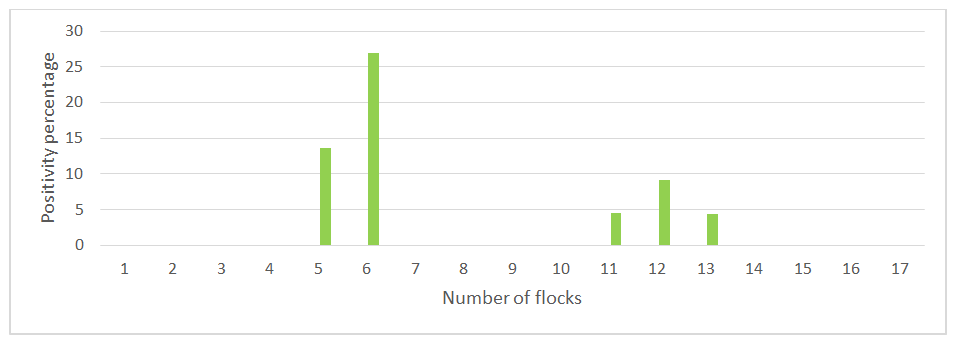
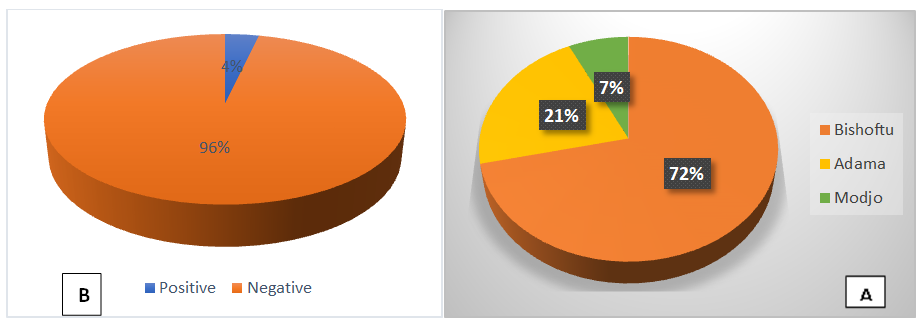
Of the seventeen farms addressed for sampling the disease was detected only on five of them as indicated in Figure 1. From Bishoftu and Adama 2(33.3%) farms for each were found positive for the disease. However, in Modjo only 1(20%) farm was found exposed for ILT disease. Figure
2 illustrate the total prevalence of individual bird in the current study areas, where about 72% of positive birds were from Bishoftu while 21% and 7% positivity were observed in Adama and Modjo towns respectively.
Discussion
Infectious laryngotracheitis (ILT) is a highly contagious and the upper respiratory tract disease of chickens caused by infectious laryngotracheitis virus (ILTV, Gallid herpesvirus 1), a member of the Alphaherpesvirinae sub-family (genus Iltovirus) [10]. A cross-sectional study was conducted to determine the seroprevalence of ILTV and its associated risk factors in East Shewa zone (Bishoftu, Modjo, and Adama).
The result of this study showed an overall sero- prevalence of 3.63 % (95% CI: 2.15-6.04) In contrary to the present finding, higher prevalence rates were reported from different parts of Ethiopia 59.1% in Amhara National Regional State, [19], 19.4% in central and Southern Nations, Nationalities and Peoples’ Region (SNNPR) of Ethiopia [20], 54.7 % in Ada’a district [21], and in other countries such as 50% in Nigeria [22], 67.55% in Trinidad and Tobago [23], 81.47% [24] and 92.28% [25] in Bangladesh. This variation might be emanated related to difference in management and monitoring status prior to flock introduction and chicken health diagnosis practices. Seasonal variation might also affect the distribution of the disease.
In this study, Seroprevalence of ILTV statistically significant (p < 0.05) with the different study sampling area. Among the studied area the highest seroprevalence was recorded (7%) in Bishoftu, followed by (2.3%) Adama and (0.9%) in Modjo. This finding was in line with the reports of Birhan M [19] who reported that seroprevalence of ILTV was statistically significant among study localities. This may be due to similarities in management practices including biosecurity and stock density.
In this study seroprevalence of ILTV had showed a statistical significancy related to age (p=0.026) of chickens.
This finding is in agreement with Baksi S, et al. [26] and Bhuiyan ZA, et al. [27]. In contrast to the current finding Gowthaman V, et al. [28] announced seroprevalence of ILTV was not statistically significant among the age chickens. The study variation among different authors might be due to young chickens have more immunity than older chickens this make older one more susceptible to the disease. In addition, being adult or old age had its own implication to a contact rate so that, chance of contracting a disease might be increased.
Management had shown a statistically significant association with the outcome variable (p=0.006) which was in agreement with the reports of Birhan M [19]. This might be associated with the type of farms and agro-ecology of the locations of study areas.
Based on production type (layer and broiler) a significant variation was observed (P=0.028) which was in line with the finding of Tesfaye A [20] the similarity might be attributed to the sensitivity and specificity of the test method used and sample size taken.
Origin of chickens was one of the determinants which significantly affect the occurrence of ILT disease in the study areas which be due to variation in disease resistance among chickens based on their origin.
Generally, among the risk factors, breed, hygiene, sex, and vitamin supplementation were not statistically significant factors that able to determine for the occurrences of the disease in the current study. Tesfaye, et al. [20] had also reported that breed was not a determinant factor for the occurrence of the disease.
Conclusion and Recommendations
Out of 386 samples tested for anti-ILT antibody detection the current study revealed that 14 (3.64%) were found positive for the disease exposure. This should be an alarm for the concerning bodies to tackle and take measure on the disease prior to its wide spread. Like other herpesviruses, ILTV undergoes latency in trigeminal ganglion and get reactivated whenever the birds undergo stress leading to increased shedding and environmental spread which makes eradication of ILTV difficult. The darkling beetles acts as an important carrier of ILTV in poultry environments. Further, secondary infections increase the severity of the clinical disease and economic losses. Therefore, in light of the above conclusion the following recommendations are forwarded
- Use the best origin of chickens tested negative for major poultry disease like ILTV.
- Use an effective management and biosecurity plan
- Use of effective vaccines to prevent occurrence of the disease should be encouraged
- Extensive research has resulted in increased understanding of herpesvirus transmission, pathogenesis and control. This knowledge helps to reduce the impact of ILTV in poultry industry in near future.
- Further studies on virus circulation and the finding of other possible factors that able to facilitate for the occurrences of the disease might be highly recommended
Acknowledgement
This work was supported by Animal Health Institute and gratefully acknowledged.
References
-
Mottet A, Tempio G (2017) Global poultry production: current state and future outlook and challenges. World’s Poultry Science Journal 73(2): 245-256.
-
Mujyambere V, Adomako K, Olympio SO, Ntawubizi M, Nyinawamwiza L, et al. (2022) Local chickens in East African region: Their production and potential. Poultry Science 101(1): 101547.
-
Chesterman S, Neely C (2015) Evidence and policy implications of climate-smart agriculture in Kenya. CCAFS Working Paper.
-
Bwalya R, Kalinda T (2014) an analysis of the value chain for indigenous chickens in Zambia’s Lusaka and Central Provinces. Journal of Agricultural Studies 2(2): 32-51.
-
Zeleke B (2017) Status and growth trend of draught animals’ population in Ethiopia. JDVSR 6(1): 238-241.
-
Shapiro BI, Gebru G, Desta S, Negassa A, Nigussie K, et al. (2015) Ethiopia livestock master plan. ILRI Project Report. Nairobi, Kenya: International Livestock Research Institute (ILRI).
-
Wubet W, Bitew M, Mamo G, Gelaye E, Tesfaw L, et al. (2019) Evaluation of inactivated vaccine against fowl cholera developed from local isolates of _Pasteurella_ _multocida_ in Ethiopia. African Journal of Microbiology Research 13(27): 500-509.
-
Al Mamun M, Islam KM, Rahman MM (2019) Occurrence of poultry diseases at Kishoregonj district of Bangladesh. MOJ Proteomics & Bioinformatics 8(1): 7-12.
-
Bagust TJ, Jones RC, Guy JS (2000) avian infectious laryngotracheitis. Revue scientifique et technique (International Office of Epizootics) 19(2): 483-492.
-
Davison AJ (2010) Herpesvirus systematics. Vet Microbiol 143(1): 52-69.
-
May HG, Tittsler RP (1925) Tracheo-laryngitis in poultry. J. Am. Vet. Med. Assoc 67: 229-231.
-
Ou SC, Giambrone JJ (2012) Infectious laryngotracheitis virus in chickens. World J Virol 1(5): 142–149.
-
Nair V (2020) Leukosis/Sarcoma Group In: Edited by Swayne DE, et al., Diseases of Poultry. 14th (Edn.).
-
Beltran G, Williams SM, Zavala G, Guy JS, Garcia M (2017) The route of inoculation dictates the replication patterns of the infectious laryngotracheitis virus (ILTV) pathogenic strain and chicken embryo origin (CEO) vaccine. Avian Pathol 46(6): 585-593.
-
Carnaccini S, Palmieri C, Stoute S, Crispo M, Shivaprasad HL (2022) Infectious laryngotracheitis of chickens: Pathologic and immunohistochemistry findings. Vet Pathol 59(1): 112-119.
-
CSA (2012) Ethiopia demographic and health survey 2011. Addis Ababa, Ethiopia and Calverton, Maryland, USA: Central Statistical Agency and ICF International, pp: 1- 430.
-
Hunduma A, Kebede B (2016) Comparative study on the efficacy of amprolium and sulfadimidine in coccidia infected chickens in Debre-Zeit agricultural research center poultry farm, Bishoftu, Ethiopia. SOJ Veterinary Sciences 2(2): 1-5.
-
Thrusfield M (2007) Sampling. In: Veterinary epidemiology. 4th (Edn.), Blackwell Science Ltd, UK, pp: 221-254.
-
Birhan M, Syoum A, Ibrahim SM, Fentahun T, Mohammed A, et al. (2022) Serological Evidence of Infectious Laryngotracheitis Infection and Associated Risk Factors in Chickens in Northwestern Ethiopia. The Scientific World Journal.
-
Tesfaye A, Sahle M, Sori T, Kassa T, Garoma A (2019) Infectious laryngotracheitis virus in commercial and backyard chicken production systems in central and South Ethiopia (first report) ILT in Ethiopian poultry production. Journal of Applied Poultry Research 28(4): 1324-1329.
-
Roba YT, Tadesse D, Assefa Z, Tesfaye A (2020) Seroprevalence of infectious laryngotracheitis disease in backyard chickens in villages of Ada’a district, Oromia, Ethiopia: first report. Trop Anim Health prod 52(6): 3109-3112.
-
Owoade AA, Ducatez MF, Muller CP (2006) Seroprevalence of avian influenza virus, infectious bronchitis virus, reovirus, avian pneumovirus, infectious laryngotracheitis virus, and avian leukosis virus in Nigerian poultry. Avian diseases 50(2): 222-227.
-
Jordan AB, Sookhoo J, Blake L, Crooks P, Mohammed Z, et al. (2018) Serological evidence for eight globally important poultry viruses in Trinidad & Tobago. Preventive veterinary medicine 149: 75-81.
-
Rahman MM, Uddin MK, Hassan MZ, Rahman MM, Ali MZ (2018) Seroprevalence study of infectious laryngotracheitis virus antibody of commercial layer in Gazipur Districts of Bangladesh. AJMBR 4(1): 1-6.
-
Jahan MS, Khan MFR, Nazir KNH, Amin MM, Rahman MB (2012) Sero-Surveillance of infectious laryngotracheitis in layer birds in Bangladesh. Microbes and Health 1(2): 38-40.
-
Baksi S, Savaliya BF, Rao N, Panchal M (2016) Sero- prevalence of infectious laryngotracheitis of poultry in India. Indian Journal of Poultry Science 51(2): 234-236.
-
Bhuiyan ZA, Ali MZ, Moula MM, Bary MA, Arefin N (2019) Seroprevalence of major avian respiratory diseases in broiler and sonali chicken in selected areas of Bangladesh. Journal of Advanced Veterinary and Animal Research 6(4): 561-566.
-
Gowthaman V, Singh SD, Dhama K, Barathidasan R, Mathapati BS (2014) Molecular detection and characterization of infectious laryngotracheitis virus (Gallid herpesvirus-1) from clinical samples of commercial poultry flocks in India. Virus Disease 25(3): 345-349.
- The Digital Stethoscope: Harnessing AI in Veterinary Medicine Without Losing Our Healing Touch
- Meningoencephalomyelitis of Unknown Etiology: Short-Term Effect of Two Treatment Protocols on Cerebrospinal Fluid
- Safety and Efficacy of the HomeoPet Cough in Domestic Pets –A Clinical and Correction Analysis Based Upon User Response Survey
- Non Human Animals Responses to Social Loss
- Owner Reported Clinical Outcomes of a Homeopathic Proprietary Preparation for the Treatment of Upper Respiratory and Nasal Disorders in Companion Animals
- Effects and Diagnostic Approach of Ultrasound in Veterinary Practice: A Systematic Review