
Effectiveness of Homeopathic Medicine in Canine Urinary Incontinence: Outcomes of Owner Response Survey
With advances in data collection via electronic surveys, they have become a popular tool for researchers especially with the changes in normalcy caused by the Coronavirus pandemic. During this pandemic period, previously collected traditional format paper data on Homeopet ™ ‘Leaks No More’ was collated, analysed, written up, reviewed, and published Farrington TJ and Smith . The current study was again an owner response survey like the previous studies but done electronically. In the case of this Homeopet™ 'Leaks No More' survey, the selection criteria used to identify eligible participants who had purchased the product directly from the manufacturer's website helped to ensure that the responses collected were from genuine product users including first time and repeat users. This helped to eliminate potential bias in the responses and ensured that the data collected was of high quality. It ensured elimination of spurious responses and replies from unverified users. The use of gratuities only to those who agreed to provide fully completed surveys containing a true assessment of their pets' responses with an email and other contact details including agreement to be contacted helped to improve the response rate and quality of data collected. In fact the normal verifying of email addresses and names of respondents was turned off for data protection requirements after collection before sending data to analyst and authors removing only from them ability to cross-reference to an original mail shot offering the survey to people who had joined the mailing list on Homeopets own sales site, the researchers were after completion of the paper able to ensure that the data collected was authentic and reliable without exposing any personal data for the participants from the survey collection while still ensuring it was verifiable. Despite striving to write the survey questionnaire in a balanced inclusive way so that it would resonate with a wide range of perspectives and viewpoints across a broad range of views, one can assume that those who filled it out were more likely to have been open to complementary medicine or to have a pet who had failed to respond or responded poorly to conventional therapy. It also meant that emails and names could be verified and if necessary, through the email DNS, and thus could be contacted to complete any missing data needed, which thanks to response numbers was not necessary so the data remained completely confidential. As Homeopet ™ ‘Leaks No More’ is an OTC (Over the Counter) retail product which during the pandemic sold primarily online through various online retailers due to the restricted access to bricks and mortar retailers, shops, and stores there was little or no direct access to or contact with the end users and thus the electronic survey proved highly effective in that environment. Overall, electronic surveys have proven to be a more successful and time-efficient way of collecting data compared to traditional methods as shown in this research paper. The high-quality data collected in this study will be valuable for future research and product development in the field of complementary medicine for pets. Methods and Outcomes: An online questionnaire template was developed using questionnaires from the previous studies and the decision was to use SurveyMonkey® as the mode of delivery to participants. Homeopet™ LLC employed an independent consultant to design and develop the front end for owner response input and the back end for data collection. Ms Jenny Doran Halcyon Days Ltd. worked with Dr Farrington and his team, some external individuals unfamiliar with the project (to ensure the public would understand the questionnaire fully), including staff at Homeopet familiar with the process, to test prototype versions of the SurveyMonkey® and tailor them to the projects requirements till the entire team came to a consensus acceptable to Homeopet™ in the time constraints available. The survey was then made available online with an invitation to participate added to the purchase process on the manufacturer’s website. Other online outlets were considered but were not open to the authors having access to their customer information even for verification purposes. This outlet area is being worked on for future surveys.
Introduction
Urinary Incontinence (UI) in pets continues to be a common challenge socially, and financially [1]. Despite the availability alpha-adrenergic agents, mainly phenylpropanolamine hydrochloride the challenge remains about extremely high costs, risk of disability [2] and limited efficacy in causes other than post neutering, such as ectopic ureters and prostatic cyst, spinal arthritis and following severe spine trauma. Hence, UI is among the common causes of request for Euthanasia [3]. Hence, the concerns of availability of wide-spread therapy, cost and risk of disability still prevail. In UI, the complementary and alternative medicine (CAVM), including homeopathic medicines appear promising in addressing these concerns [4, 5, 6]. CAVM defined as a group of heterogenous medical methods whose principles diverge from the current veterinary practice [4], is a common term used by the group of practitioners who consider this side of medicine as having no acceptable place within conventional medical parameters [5, 6]. However, as observed, many randomized studies reveal the effect of various homeopathic medicines in various conditions of pets (mainly dogs and cats), horse and farming animals [7]. Subset-based evidence of homeopathy improving UI from a large canine and feline study by Mathie, et al. [5], and study by Farrington, et al. [8] represent positive effects of both single and combination homeopathic medicine in UI in a peer sample panel study.
Use of Survey as Research Method
Current practice of evidence generation on veterinary science includes isolated internet-based Prospective animal-owner’s observational surveys. These surveys have clearly traceable activity logs; hence are useful to collect un-biased, voluntary, and realistic responses without psychological effects such as Hawthorne Effect commonly found in randomized studies. In addition to the traceability from internet, the STROBE-Vet is a useful methodology for transparent and effective reporting if the risk of various types of biases that arise from duplicates, selection, dropouts and social desirability are mitigated, especially in cases of social and financial concerns such as UI. This study was a survey- based observation of efficacy of Leak No More combination homeopathic medicine in canine UI.
Materials and Methods
Survey Framework
This study was based upon the internet-based facilitator driven survey. The respondents were remunerated for responding to the survey only where they completed the survey in full knowing that they were free to answer exactly as they felt was true and honest in relation to their pet and in addition consented to being contacted and their details crosschecked as a genuine purchaser of the product and ideally, but not obligatory a repeat user. The Survey was facilitated by Ms Jenny Doran, Managing Director, Digital Marketer, and Social Media Tactician at Halcyon Days Ltd. Marketing working independently through the facilitators in Homeopet LLC. Jenny is a graduate of Trinity College, Dublin, with a degree in Business and Economics, and Dublin City University with a Master’s Degree in Strategic International Marketing. The respondents for the survey were the users of ‘Leak No More’ Homeopathic Combination Medicine, indicated for UI for small pets. All the respondents were asked to provide an informed consent on web before starting the survey. The Name (First Name and Last Name) and email Address fields were originally incorporated in the design of the survey but were disabled from responses sent for analysis thus blinding the data due to privacy regulation requirements, but still retaining full traceability. Each respondent was assigned a unique Respondent ID after signing the consent statement. The IP Address of the computer from which the survey was responded was captured in the background. In combination with the ID of facilitator (Collector ID), the IP address of the computer from where responses were generated and was used for identification of the duplicate respondents and as further confirmation of the data traceability.
The survey was conducted using twelve questions (Table 1) of which six (Question 1 to 6) were related with the demographic characterization, two (Question 8 and 9) were related with posology and four (Question 7, 8, 10 and 11) were related with effect of medicine and user satisfaction. One question (question 12) was added to confirm if the pet was examined by the veterinary physician to check that UI was medically identified.
| Question No. | Question Text |
|---|---|
| i | Respondent ID (Auto generated) |
| ii | Collector ID (Auto generated from the link sharing) |
| iii | Start Date and time (Auto captured) |
| iv | End Date and time (Auto captured) |
| v | IP Address (Auto captured) |
| vi | Email Address (disabled) |
| vii | First Name (disabled) |
| viii | Last Name (disabled) |
| 1. | Pet Type |
| 2. | Pet Breed |
| 3. | Pet Gender |
| 4. | Is your pet neutered? |
| 5. | Pet Age |
| 6. | Pet Weight in lbs |
| 7. | Response time to ‘Leaks No More’: Fast (5) – Slow (1) |
| 8. | How dosed? |
| 9. | How many times dosed daily? |
| 10. | In your opinion did ‘Leaks No More’ work? |
| 11. | Would you recommend ‘Leaks No More’? |
| 12. | Does your pet go to the veterinarian? |
Table 1: The survey framework.
Response to all questions was mandatory, however, intermediate saving after completion of the demographic procedure was enabled to ensure that no data is lost during transit or if the respondents were willing to complete the survey later.
Leak No More – The Investigational Medicine
Leaks No More the investigational product is homeopathic product based on a combination of hyper dilute highly succussed potentised ingredients in an inactive base of ethanol and water. The Investigational product contains no active chemical ingredients thus activity is in conventional terms unexpected, but activity has been demonstrated in a previous paper Canine Urinary Incontinence successfully treated by Homeopathic Medicine: A Real-world Clinical Evidence Panel Study’ Open Access Journal of Veterinary Science & Research ISSN: 2474-9222 MEDWIN PUBLISHERS. This paper uses a different data set collected using a different collection format but retains the same collection questions on the same investigational product.
Calculation of Human Age Equivalent
Urinary Sphincter Mechanism incompetency (USMI), the main pathophysiology in background of UI, has three major aetiologies viz. hormonal (related with aging to neutering), traumatic (post spinal injury) and advanced age. While advancing age is an independent cause of USMI, it also can modify the occurrence and intensity of UI. However, unlike age in humans, age has a wide range in the veterinary world, pertaining to the species and breed within a species. The considering age over 75th percentile of Upper Confidence interval of general life expectancy is a conventional consideration for old age in life science practices. However, for canine and feline medical practice, use of human age equivalent is an effective parameter [9]. Among the Methods of calculation of the human age equivalent, the three most common methods include LeBeau model [10] (Equation 1), Gary et al.’s formula (Equation 2) [11] and the chart published by American Kennel Club [12, 13].
Equation 1 LeBeau’s Regression Model for canine and feline human age equivalent ( ) 4.297 -0.03667 Lebeau HAE Cm = × Where Cm is the Median of the Bin of age of the pets by breed. This model was reconfirmed with reverse analysis in the American Kennel Clubs’s chart (S = 0.886499, R2 = 5.42%, adjusted, R2 = 0%).
Equation 2 Equation for calculation of Human Age equivalent for Canine age ( ) ( ) ( ) ( ) 3 2 0.0013 0.0221 0.0285 0.1071 0.2991 4.9979 3.6437 37.423 HAE X C X C X C X = − + + + + + + − +
Where X is the mean age of the species, C is the age of the individual pet. Apart from the age and the median age of the animal, the American Kennel club considered weight (which is mainly for classification of breed in principle) as one of the parameters for calculation of human age equivalent.
In effect many of the Human Age Equivalent formulas available produced results that were not acceptable in terms of a 15-year-old animal working out at a 150–160-year-old human. Although they can still be effectively used in the analysis of data.
Lebeau’s Original Findings
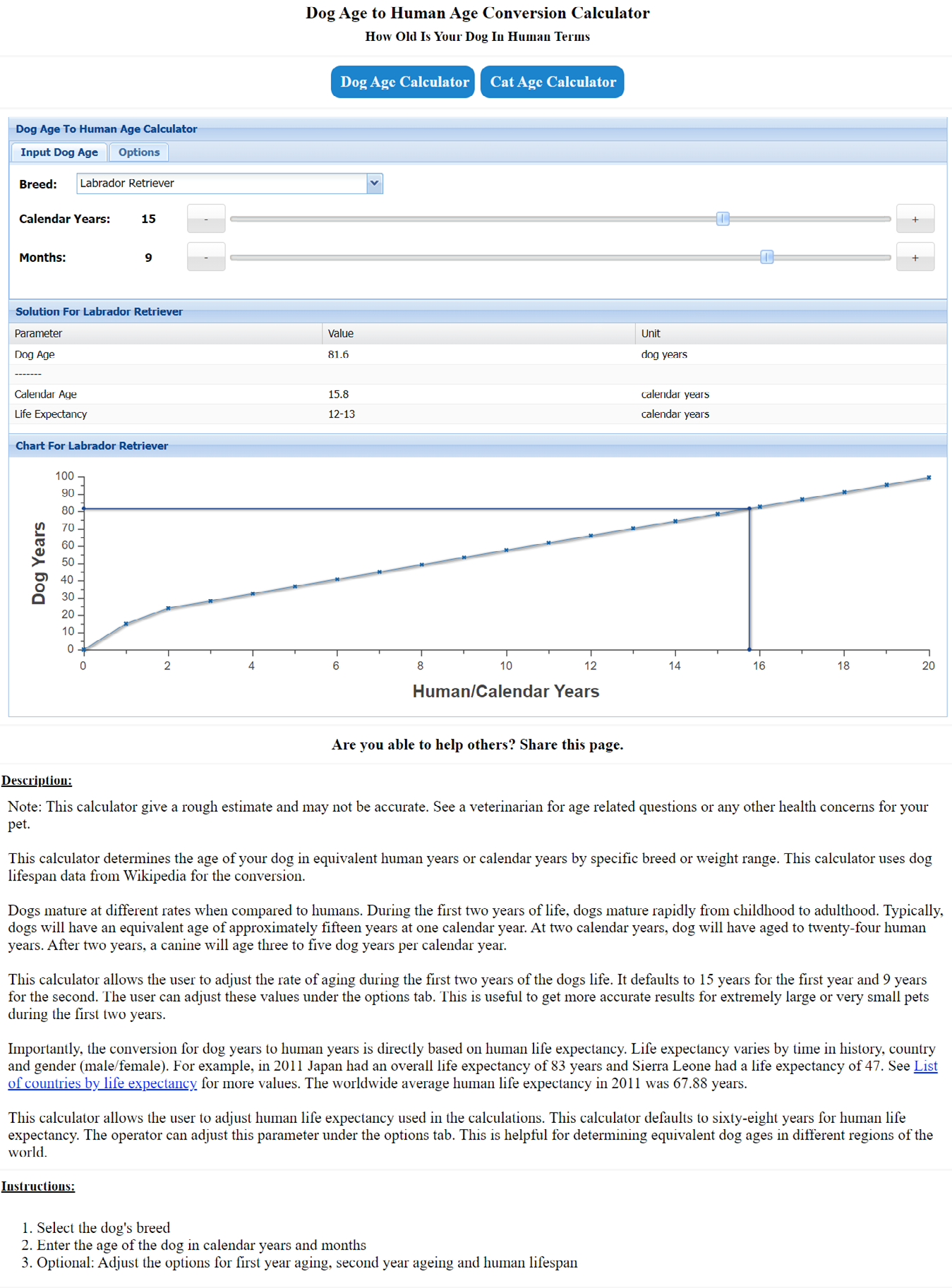
Lebeau’s eventual conclusion: The age of a dog of one year is equivalent to a human being a 15 years; a dog of two years to a human of 24 years; and from the age of two years, each year of a dog’s life is equal to four human years. Subsequent studies sought to disaggregate this data further, by size, weight, and breed. Ref https://priceonomics.com/ the-mythology-of-dog-years/ To show a more realistic human age equivalent a site was used https://www.ajdesigner.com/fl_dog_age/dog_age.php Which worked on the LeBeau model but also integrated modifications for the initial rapid Human Equivalent aging of canines and feline during their first two years of life along with variations between breeds and the difference of specific breeds such as beagles? I am grateful for the permission to replicate his work here from Jimmy Raymond of AJ Design Software [14, 15].
Results
Participant Disposition
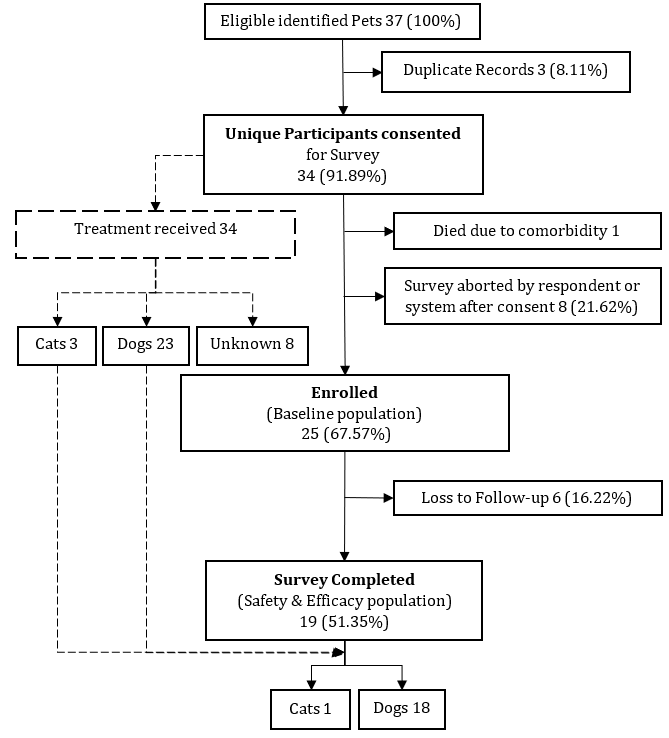
In all 37 participants were sent the survey by the facilitators, of which 3 records were found to be duplicates based on the Ip address and demographic details of the pet. Of the 34 Unique participants, the pet of one owner died due to comorbidity just after the consent and eight surveys were either aborted by the owner or by the system due to extreme delay in completion after consent page signing, leaving 25 (67.57% of the contacted population) at the baseline [16]. In all, 6 owners completed the baseline (demography, Q 1 to 6) in the survey, but they did not complete the rest of the questions. Hence, the baseline analysis included 26 subjects and full analysis was completed for 19 subjects (Figure 1). Under the study, in all 34 pets (3 cats and 31 dogs) were dispensed the Investigational Medicine with intent to treat and monitor. At the completion of the study, with multiphasic disposition, 19 patients (1 cat and 18 dogs) were monitored (Figure 1).
Demographics
At baseline, in all 25 animals enrolled, of which 19 random owners completed the survey (p=0.09). The 25 subjects included 3 (11.54%) cats and 22 (84.62%) dogs of which 1 (5.26%) cat and 18 (94.74%) dogs completed the survey (data normalcy p=0.28 for cats and 0.02 for dogs). In all 6 (23.08%) and 5 (26.32%) animals were males at Baseline and Survey completion respectively (data normalcy p = 0.08). The Female animals counted 19 (73.08%) and 14
(73.68%) at baseline and survey completion respectively (data normalcy p = 0.03). In the set most animals, 23 (88.46% at baseline and 18 (94.74%) at follow-up were neutered (p=0.02). Mean age of the animals was 11.58±4.23 at baseline and 12.34±3.42 at survey completion (p=0.53), Human Age equivalent using LeBeau model, of which was
144.6±105.76 and 155.52±105.78 (using the modified HAE method 63.8±18 and 67.3±14.3 years) respectively (p=0.02). The mean weight of the animals surveyed was 45.32±27.19 Kg and 42.67±27.0 kg at baseline and survey completion respectively (p=0.07); (Table 2).
| Demographics | Baseline | Survey Completion | P | ||
|---|---|---|---|---|---|
| N | 25 | 19 | 0.09 | ||
| Animal | |||||
| Cat | 3 | 11.54 | 1 | 5.26 | 0.28 |
| Dog | 22 | 84.62 | 18 | 94.74 | 0.02 |
| Gender | |||||
| Male | 6 | 23.08 | 5 | 26.32 | 0.08 |
| Female | 19 | 73.08 | 14 | 73.68 | 0.03 |
| Neutered | 23 | 88.46 | 18 | 94.74 | 0.02 |
| Age and Weight | |||||
| Age | 11.58 | 4.23 | 12.34 | 3.42 | 0.53 |
| Human Age equivalent (AJ Calculator) | 63.8 | 18 | 67.3 | 14.3 | 0.02 |
| Weight | 45.32 | 27.19 | 42.67 | 27 | 0.07 |
Table 2: Demographic Characteristics of the study sample The dose was administered with water to 4 (21.05%) animals, through food
| Medicine administration | Count | Percentage |
|---|---|---|
| Mode of Administration | ||
| With Water | 4 | 21.05 |
| Through Food | 5 | 26.32 |
| Direct Inoculation | 9 | 47.37 |
| Dosage per day | ||
| 1 | 5 | 26.32 |
| 2 | 10 | 52.63 |
| 3 | 4 | 21.05 |
| >3 | 0 | 0 |
Table 3: Medicine administration details.
Preliminary Outcomes
Among the 19 animals whose survey was completed, response time rank 1 (Quick), and 3 (Average), was assigned by 8 (42.11%) and 5 (26.322%) patients respectively, while Rank 2 (Fast), 4 (Late) and 5 (Very Late) was assigned by 1 (5.26%) patient each. No noticeable action was observed in
3 (15.79%) animals (chi sq. test against equal proportions p < 0.0001). However, the overall response to whether medicine worked was affirmative (yes) by 17 (89.47%) owners and negative (No) by 2 (10.53%) owners (Chi sq. test for equal proportions, p <0.0001). The user satisfaction was also reconfirmed with a question “Will you recommend to others?” The user satisfaction was observed in 18 (94.74%)
participating owners (chi-sq. for equal proportions, p < 0.0001) (Table 4).
| Effect of Medicine | Count | Percentage |
|---|---|---|
| Response Time Rank for Leak No More | ||
| 1 (Quick) | 8 | 42.11 |
| 2 (Fast) | 1 | 5.26 |
| 3 (Average) | 5 | 26.32 |
| 4 (Late) | 1 | 5.26 |
| 5 (Very Late) | 1 | 5.26 |
| 0 (No noticeable action) | 3 | 15.79 |
| Whether medicine worked (owner response) | ||
| Yes | 17 | 89.47 |
| No | 2 | 10.53 |
| User Satisfaction (Will you recommend to others) | ||
| Yes | 18 | 94.74 |
| No | 1 | 5.26 |
Table 4: Analysis of Medicine effects and owner responses.
Correlation and Failure Analysis
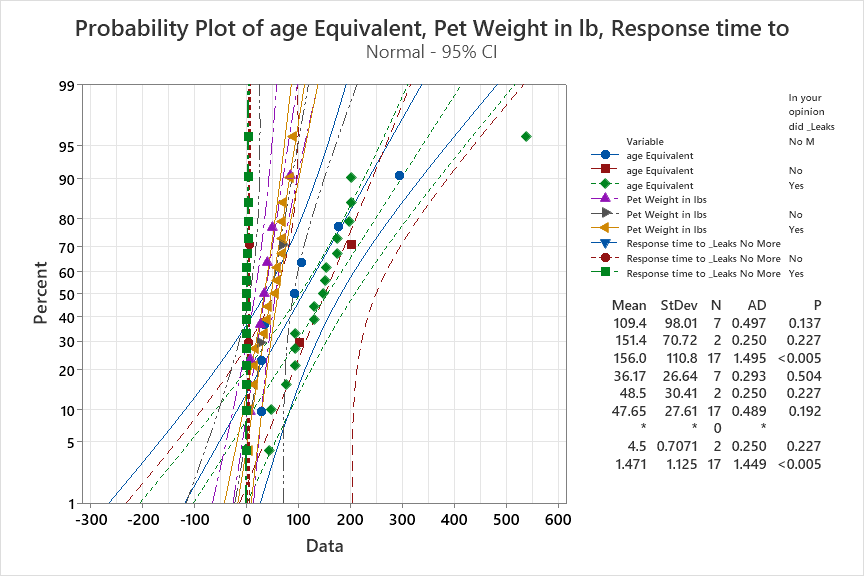
While the flat results were majorly in favour of the investigational medicine, the analysis of failed and succeeded therapy with age of the animals was the one where most correlation analysis was required [17]. However, considering the diversity of age of the animals by breed, comparison was not feasible by age alone. Hence, analysis of correlation was used as the parameter for correlation of success and failure. In addition to ensure that the analysis is correctly benchmarked, pertaining to the small sample, the obvious correlation analysis of probability distribution of correlation between “Response time to ‘Leaks No More’: "Fast (1) – Slow (5)" and “In your opinion did ‘Leaks No More’ work?” was measured. This analysis confirmed that the probability distribution is valid for correlation [18]. The low Response time was directly related with response satisfaction (P<0.005). The age equivalent probability distribution was fairly balanced. There was a direct correlation of the customer satisfaction as indicated by the response “yes” to the question “In your opinion did ‘Leaks No More’ work?” The age equivalent in the group responding “yes” was 156±110.8* (P <0.005) Roughly 66.3±14.5years in Modified HEA) as compared with 151.4±70.72* (66±9.6years in Modified HEA) (p=0.227) in group responding “no” (Figure 2) Authors Note this was using the unmodified LeBeau model on which original analysis was done but to veterinarians a 156 year old dog is just not the norm! Thus, the search for a modified Human Equivalent Age as the Dog Age to Human Age Conversion Calculator by AJ Design Software - By Jimmy Raymond. The same analysis did not reveal any relationship between the user satisfaction and weight of the animal [19].
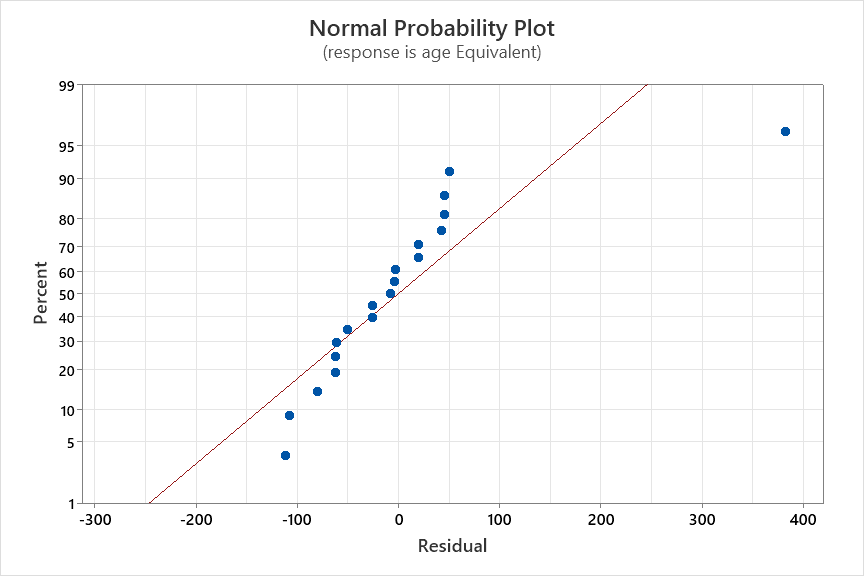
The next level analysis of correlation between age equivalent and owner satisfaction (response “yes”) was performed using ANOVA. This analysis was to identify whether or not the correlation on probability distribution was driven by any major outliers (Figure 3).
| Source | Degree of Freedom | Adjusted Sum Square | Adjusted Mean Squared | F-Value | P-Value |
|---|---|---|---|---|---|
| In your opinion did _Leaks No More worked | 1 | 39 | 38.9 | 0 | 0.955 |
| Error | 17 | 201355 | 11844.4 | ||
| Total | 18 | 201394 | |||
| N | Mean | STDEV | 90% CI | P | |
| In your opinion did _Leaks No More worked | |||||
| Yes | 17 | 156 | 110.8 | (100.3, 211.7) | <0.005 |
| No | 2 | 151.4 | 70.7 | (-11.0, 313.7) | 0.227 |
Table 5: Analysis of Variance (ANOVA) for age Equivalent.
The analysis indicated that there was no effect of outliers on the outcome of probability distribution. The correlation of the age equivalent and user satisfaction is significant statistically (P <0.005). However, the analysis of dissatisfaction of the users with age equivalent or weight could not be established.
Discussion
The methodology used in data collection bears some questionnaire-based similarities to a study which has revealed effectiveness of the CAVM in horses [20] This current study the subject of this paper also showed similar results to the previously published study by Farrington et al. [8] for the same condition with different data sets and from traditional paper collection rather than electronic data collection this further confirmed the action of the homeopathic formulation and also showed that electronic data collection was an effective methodology. It was also observed that the product proved effective across a wide range of routes A) direct inoculation onto a mucous membrane such as the oral cavity (in cattle application via the per-vaginal is also to a mucous membrane). B) When administered in the drinking water also and C) when administered in the food. There is anecdotal evidence of action via the parenteral routes too and this is also the authors experience in practice.
Age and Aging as Risk Factors
Among the common risk factor of UI is old age. However, in veterinary practice, definition of old age is complex due to variety of animal species and breeds. It is practically impossible to generate and use evidence of the effect of medication in each species and breed. In fact, over the actual age of the animal, relative aging with respect to breed’s median lifespan may be a better indicator to understand actual effect of the medicine. Often, just considering age as a demographic parameter may also be misleading as when age is taken as the parameter, it assumes that the lifespan of an animal is constant. However, often, the animals die before completion of study tasks, even including enrolment. Hence, stratification of risk by age stands as a challenge for effective evidence generation. Hence, Human age equivalent is a parameter of more realistic value [21]. In analysis of this survey, age and human age equivalent both are used as demographic factors.
One point of discussion is why a homeopathic product? For veterinarians who are homeopaths it seems a straightforward choice, much as acupuncture and osteopathy are to veterinarians trained in those disciplines, but for non- complementary practitioners with little or no exposure to and in most cases no understanding of homeopathy, it’s principles or action, this can be a major obstacle.
Many wonder how a medication with no chemical action can work and yet the results in this and other papers show they do. This reluctance to consider non-chemical-based therapies is reducing the options to effectively treat patients as in the previous paper by Farrington et al [8]. In that paper one data set comprised only of subjects who were non responders to conventional therapy and yet a positive clinical response was elicited despite the failure of “conventional chemical therapies” for UI. The use of non-chemical imponderable treatments such as radiotherapy, nuclear medicine, MRI, PET Scan, Laser therapy and thermography or attendance at electronic virtual training sessions are all acceptable, yet many CAM’s with papers showing repeated and verified clinical responses are ignored showing not just a bias, but also a disservice to both owners/guardians along with the animals in their care, who could despite a failure to respond to “conventional chemical therapies” may respond to a CAM treatment and as in the case of complex homeopathic formulations such as Homeopet ™ ‘Leaks No More’ are used in much the same way as conventional therapeutics for conditions such as UI there is little excuse for the belief that it requires a who new field of training [22]. To this end there are many publications and articles on homeopathic research showing positive outcomes some of which are noted in the bibliography Hahn RG. Homeopathy: meta-analyses of pooled clinical data25. In addition, there are research papers and articles published by Drs. Farrington & Smith. These cover a range of cases, conditions and trials using a homeopathic approach both alone and in conjunction with homeopathy [23].
The advantages of an approach using homeopathic complex medicines such as Homeopet™ ‘Leaks No More’ are many fold.
- Lack of chemical interactions so common with conventional medical approaches.
- Lack of toxicity. (Homeopet has recorded as required by the FDA for drugs adverse reactions both in a large range of trials and reported ADR’s (Adverse Drug Reactions) Over a twenty-five-year period and over millions of doses the levels are (In the year to October 2020 to 2021 Out of 35,000 bottles (14 million doses) there were zero ADR's Reported and this is repeated in other years) The ADR Rate against doses sold from 2017 to 2023 was 0.000005 especially when compared to chemical therapies.
- No additional metabolic burden which means no medicine induced nutrient deficiencies that are so common with conventional medications
- No metabolic component breakdown in the body which is particularly important in patient(‘s) with compromised organ(s), systems or multiple system failure which often cannot bear the additional burden of another medication even the more modern biologicals such as immunological therapies such as monoclonal antibodies, mRNA therapies, and the like. These are often given in lieu of conventional molecular drug medications. An example being an older pet with incontinence partially contributed to by arthritis, but as often in an older patient with co-morbidities such as compromised heart, lung, liver and kidney issues. These cases can suffer catastrophic complications even with a mild but common allergic reaction to even these modern therapies. Yet homeopathic medicines because of their very nature and as yet not fully understood mode of action do not adversely impact these patients and can improve their quality and extent of life by the very fact, they do not cause any of the issues outlined above. Dr. Farrington one of the authors regularly has feedback from exactly such patients that are alive and well long beyond the MST (Median Survival Time) for their condition due specifically to this lack of adverse therapeutic action and metabolic burden, a point that is so often overlooked when one has a purely limited viewpoint only considering conventional medical options, when there are viable and safer alternatives with an evidence base such as presented in this and related articles. This is particularly so with conditions such as urinary incontinence where the age and health profile often predisposes to these adverse outcomes with conventional therapeutics something which can be avoided using homeopathic therapeutic approaches integrated into the normal conventional non CAM approach especially when they are used as the first line of approach, as one of very wise professor of veterinary medicine once said “First do no harm” unknowingly echoing the words of the modern founder of Homeopathy Samuel Hahnemann.
Conclusion
The results from the online data collection confirmed and aligned with results obtained by traditional paper questionnaire data collection carried out by university-based veterinarians and regulatory authority supervised owner response paper questionnaires. This allowed us to conclude that Online Electronic Data Collection in the format used was a valid method for this and future product safety and efficacy data collection. The correlation between all three sets of data, two from the previous paper ‘Canine Urinary Incontinence successfully treated by Homeopathic Medicine: A Real- world Clinical Evidence Panel Study’ Open Access Journal of Veterinary Science & Research ISSN: 2474-9222 MEDWIN PUBLISHERS and this current data set further confirm known predisposing factors for Urinary Incontinence UI and Urethral Sphincter Mechanism Incompetence (USMI). The results, particularly when taken as a group, show that a homeopathic product can be a valid option for the treatment of UI. Finally, that the product Homeopet ™ ‘Leaks No More’ is both safe and effective in treating UI.
References
-
Freeman PM, Holmes MA, Jeffery ND, Granger N (2013) Time requirement and effect on owners of home-based management of dogs with severe chronic spinal cord injury, Journal of Veterinary Behaviour 8(6): 439-443.
-
White RA, Pomeroy CJ (1989) Phenylpropanolamine: an alpha-adrenergic agent for the management of urinary incontinence in the bitch associated with urethral sphincter mechanism incompetence. Vet Rec 125(19): 478-480.
-
Davidson AP, Westropp JL (2014) Diagnosis and management of urinary ectopia. Vet Clin North Am Small Anim Pract 44(2): 343-353.
-
Stilwell C, Tappin S (2016) Approach to canine urinary incontinence, Companion Animal 21 (12): 692-699.
-
Mallwitz MT, Maydannik V, Keller T, Klement P (2015) a Homeopathic Combination Preparation in the Treatment of Feverish Upper Respiratory Tract Infections: An International Randomized Controlled Trial. Forsch Komplementmed 22 (3): 163-170.
-
Vickers A, Zollman C (1999) ABC of complementary medicine, Homoeopathy. BMJ, pp: 1115-1118.
-
Reilly D, Taylor MA, Beattie NG, Campbell JH, McSharry C, et al. (1994) Is evidence for homoeopathy reproducible. Lancet 344(8937): 1601-1606.
-
Farrington TJ, Smith I (2022) Canine Urinary Incontinence successfully treated by Homeopathic Medicine: A Real-world Clinical Evidence Panel Study. J Vet Sci Res 7(1): 000223.
-
Smith CA (2001) Alternative and Complementary Therapies Task Force. AVMA guidelines for complementary and alternative medicine. J Am Vet Med Assoc 218 (11): 1729-1730.
-
Arlt S, Heuwieser W (2010) Evidence-based complementary and alternative veterinary medicine-A contradiction in terms? Berl Munch Tierarztl Wochenschr 123(10): 377-384.
-
Ramey WD, Rollin BE (2003) Complementary and Alternative Veterinary Medicine Considered. Iowa State University Press, USA.
-
Mathie RT, Clausen J (2014) Veterinary homeopathy: Systematic review of medical conditions studied by randomised placebo-controlled trials. Vet Rec 175(15): 373-381.
-
Mathie RT, Baitson ES, Hansen L, Elliott MF, Hoare J, et al. (2010) Homeopathic prescribing for chronic conditions in feline and canine veterinary practice. Homeopathy 99(4): 243-248.
-
Treese JS, Nolte I, Bach JP (2021) [Patient owner surveys in small animal medicine - importance, benefits and pitfalls in planning, execution and analysis]. Tierarztl Prax Ausg K Kleintiere Heimtiere 49(1): 14-21.
-
McCambridge J, Witton J, Elbourne DR (2014) Systematic review of the Hawthorne effect: new concepts are needed to study research participation effects. J Clin Epidemiol 67(3): 267-277.
-
Sargeant JM, Connor AM, Dohoo IM, Erb HN, Cevallos M, et al. (2016) Methods and processes of developing the strengthening the reporting of observational studies in epidemiology-veterinary (STROBE-Vet) statement, Preventive Veterinary Medicine (134): 188-196.
-
Caswell JL, Bassel LL, Rothenburger JL, Grone A, Sargeant JM, et al. (2018) Observational Study Design in Veterinary Pathology, Part 1: Study Design. Veterinary Pathology 55(5): 607-621.
-
Patronek GJ, Waters DJ, Glickman LT (1997) Comparative Longevity of Pet Dogs and Humans: Implications for Gerontology Research. J Gerontol A Biol Sci Med Sci 52(3): BI71-BI78.
-
Albert L (1953) the age of the dog and that of the man Statistical essay on canine mortality. Bulletin of the French Veterinary Academy.
-
AKC Staff (2019) How to Calculate Dog Years to Human Years, American Kennel Club.
-
Blog post: Senior Pet by American Veterinary Medical Association available from: https://www.avma.org/ resources-tools/pet-owners/petcare/senior-pets
-
Gilberg K, Bergh A, Lewerin S (2021) A Questionnaire Study on the Use of Complementary and Alternative Veterinary Medicine for Horses in Sweden. Animals 11(11): 3113.
-
Schneider R (1970) Comparison of age, sex, and incidence rates in human and canine breast cancer. Cancer 26(2): 419-426.
- The Digital Stethoscope: Harnessing AI in Veterinary Medicine Without Losing Our Healing Touch
- Meningoencephalomyelitis of Unknown Etiology: Short-Term Effect of Two Treatment Protocols on Cerebrospinal Fluid
- Safety and Efficacy of the HomeoPet Cough in Domestic Pets –A Clinical and Correction Analysis Based Upon User Response Survey
- Non Human Animals Responses to Social Loss
- Owner Reported Clinical Outcomes of a Homeopathic Proprietary Preparation for the Treatment of Upper Respiratory and Nasal Disorders in Companion Animals
- Effects and Diagnostic Approach of Ultrasound in Veterinary Practice: A Systematic Review