
Are Bovine Calves Ideal Bio-Indicators for Endemic Fluorosis?
Fluoride occurs naturally in water, rocks, and soils or from modern industrial processes, such as such as coal burning power generation stations, and manufacture of steel iron, aluminium, zinc, phosphorus, chemical fertilizers, bricks, glass, plastics, cement, hydrofluoric acid, etc. Long-term regular exposure to fluoride through fluoride-contaminated drinking water and airborne fluoride can cause serious and disabling health effects in both humans and animals. However, in mammalian species, the skeleton in particular is relatively more sensitive or susceptible; growth on the bones and fusion of the joints cause lameness and lack of mobility at an early age. Teeth can become severely worn and damaged, often losing their enamel. Fluorosis has been well studied at different fluoride concentrations in drinking waters in different species of domestic animals, such as cattle (Bos Taurus), water buffalo (Bubals bubalis), sheep (Ovis Aries), goat (Capra hircus), camel (Camelus dromedaries), horse (Equus caballus), donkey (E. asinus), etc. Recent studies indicate that among these animals, bovines (cattle and buffalo) are found to be relatively less tolerant to fluoride toxicity and suffer from more severe fluorosis than other animal species. Their calves are also found to be relatively more sensitive to fluoride toxicity than immature animals or juveniles of other species. Cattle and buffalo calves were found to suffer from dental fluorosis even at fluoride concentrations less than 1.5 ppm in drinking water and a relatively high prevalence of 58.42% and 62.82%, respectively was observed. Therefore, bovine calves can be considered an ideal bio-indicator for endemic fluorosis as they show the earliest pathognomonic sign of chronic fluoride intoxication in the form of dental fluorosis compared to other animal species. Whether fluorosis is endemic in any geographical province or region can be interpreted from the evidence of dental fluorosis in bovine calves, which is highlighted and focused in the present editorial.
Introduction
In animals, three major sources of fluoride exposures are possible, fluoridated drinking water, industrial fluoride emission, and fluoride-rich feed phosphate supplements. However, the commonest source of fluoride exposure for animals is the fluoridated drinking water which is natural or geogenic in origin. Remaining two sources are anthropogenic and restricted to a specific area or region and are also potential sources for developing of fluorosis in man and animals [1, 2, 3, 4, 5, 6, 7]. In the rural areas, several coal- burning and industrial activities like electric generating processes and aluminium, iron, steel, zinc, chemical fertilizers, bricks and hydrofluoric acid production factories emit or release fluoride into surrounding environments [1]. This emitted fluoride contaminates diverse food chains, agriculture soil, Fresh water sources, air, vegetation, agriculture crops, and biotic communities around fluoride emitting industries, on which animals are generally dependant for foods and drinking water. Long-term fluoride exposure through any fluoride source causes diverse serious health hazards, including a serious disease called fluorosis, not only in humans [8, 9, 10, 11, 12, 13, 14, 15, 16, 17, 18, 19, 20, 21, 22, 23, 24] but also in various mammalian species of wild [25, 26, 27, 28, 29, 30, 31, 32] and domestic [33, 34, 35, 36, 37, 38, 39, 40, 41, 42, 43, 44, 45, 46, 47, 48, 49, 50, 51, 52, 53] animals. Thousands of animals around the world suffer from chronic fluoride intoxication or endemic fluorosis due to drinking of fluoridated water and inhalation of air-borne fluoride. Is it possible to predict the endemicity of fluorosis in any area without fluoride testing of water, air, and biological and environmental samples? Yes, this could be possible with bovine calves as these are ideal bio-indicators for endemic fluorosis. Factual information about how this may be possible is described and focused on in this editorial.
Fluorosis
Regardless of the source of fluoride exposure, once fluoride enters the body, it is absorbed by the digestive and/or respiratory tract. Through these it reaches various organs or tissues of the body through blood. More than 50% of the absorbed fluoride is excreted from the body through excretory products, faeces and urine, and sweat, while the rest is retained in the body where it gradually accumulates in various organs. But its maximum bioaccumulation is found in calcified tissues, such as bones and teeth. Nevertheless, the bioaccumulation of fluoride in growing calves and juvenile animals is relatively higher than in adult animals [32, 54, 55]. Therefore, an early sign of chronic fluoride toxicity commonly appears in the form of dental fluorosis in calves and juveniles. This accumulation of fluoride causes toxic changes and interference in physiological and biochemical or metabolic processes that ultimately trigger the generation of adverse reversible and non-reversible toxic health effects in humans and animals. These fluoride-induced toxic or health changes are collectively known as fluorosis [1, 5, 6]. Various fluoride- induced anomalies or deformities in the teeth (dental fluorosis) and bones (skeletal fluorosis) are permanent, irreversible, not curable and are detected visually. If fluorosis develops from exposure to fluoride through fluoridated water and industrial fluoride pollution it is known as hydro fluorosis and industrial fluorosis, respectively [1, 3, 5].
Dental Fluorosis
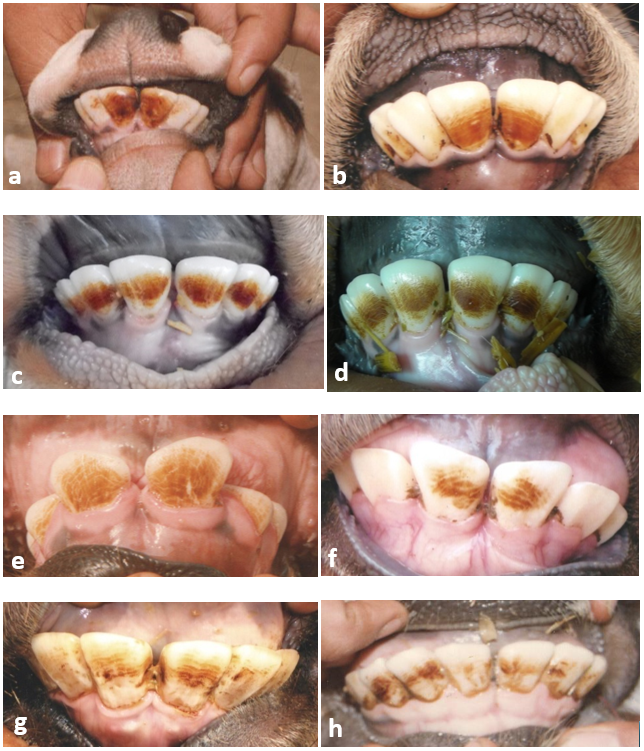
The first and most recognizable sign of chronic fluoride toxicity is lesions or spots on the teeth (dental fluorosis) that can be seen with necked eyes. Dental fluorosis is typically characterized by small brown spots, blotches, and dots on the tooth enamel and/or light to dark brown with bilateral, and horizontal striated stripes [1, 35, 56]. These pigmented or stained stripes appear more contrasting, regular, denser, and more intensely on the anterior teeth (incisors) in calves of bovine animals (Figure 1). In most calves, the pattern and appearance of dental fluorosis is approximately the same. But as they age, the patterns of dental fluorosis may change. The worst aspect of dental fluorosis is that it reduces the life span or longevity of animals. Its severe form causes severe problems in grazing and chewing food which can lead to death from hunger and weakness in animals [1, 57].
Skeletal Fluorosis
Excessive accumulation of fluoride in the various bones of the skeleton and the attached muscles and ligaments causes mild to severe deformities that are dangerous and painful. These pathologies are collectively called skeletal or osteoporosis which ultimately restrict mobility due to various morphological changes in the bones, such as periosteal exostosis, osteosclerosis, osteoporosis, and osteophytosis [58, 59, 60]. Clinically, these changes manifest as vague aches and pains in the body and joints associated with stiffness, lameness, reduced body growth and detectable bone lesions in animals. These bone changes are progressive and irreversible and become severe as animals age and the duration of fluoride exposure increases. Intermittent lameness, enlarged joints, debility, invalidity, hoof deformities, wasting of body muscles, and bone lesions in the jaw, ribs, metacarpus, and metatarsus regions are well recognized in animals with severe fluorosis [37, 56].
Non-Skeletal Fluorosis
This form of fluorosis is the result of various fluoride- induced histological, biochemical and physiological changes in the soft organs of animals [56] and is the initial stage of chronic fluoride toxicity in animals. In fact, many health complaints in animals such as gastrointestinal discomforts (intermittent diarrhea or constipation, abdominal pain, flatulence, etc.), urticaria, tendency to frequent urination (polyuria), excessive thirst (polydipsia), lethargy, muscle weakness, irregular reproductive cycles, reduce the reproductive performance, miscarriage, stillbirth, etc. [26] are the consequences of chronic fluoride toxicosis. These adverse health effects are temporary and may be reversed within a few days after removing the source of fluoride exposure. It is not necessary that all of these fluoride-induced health outcomes occur at the same time in the animal. Nevertheless, the severity of fluorosis is relatively high depending on the density and rate of bio-accumulation of fluoride [1, 56] or the fluoride concentration and its duration and frequency of exposure. Apart from these factors the severity or magnitude of fluoride toxicity is also controlled by species, sex, nutrition, food nutrients, chemicals in drinking water, environmental factors, individual biological response and genetics, etc [61, 62, 63, 64, 65, 66, 67, 68, 69, 70, 71].
Are Bovine Calves’ Ideal Bio-Indicators for Endemic Fluorosis?
It is well known that fluoride occurs naturally in water and soil or through modern industrial processes. If animals are exposed to fluoride over a long period of time through any of these potential sources, it can cause fluorosis or serious and disabling effects on the health of humans and animals. In vertebrate species, the skeleton is particularly relatively more sensitive; growths on the bones and fusion of the joints lead to lameness and lack of mobility. Teeth can become severely worn and damaged, often with their enamel destroyed. Whatever the case, the primary manifestations of excess fluoride exposure in herbivorous mammals are known as dental and skeletal fluorosis. In fluoride endemic India [47, 72], fluorosis has been well studied in diverse species of domestic animals, such as cattle (B. taurus), water buffaloes (B. bubalis), sheep (O. aries), goats (C. hircus), camels (C. dromedarius), horses (E. caballus), donkeys (E. asinus), etc. [47]. Thousands of domestic animals of these species are found suffering from fluorosis in many countries due to exposure to fluoride through various fluoride sources.
In general, herbivorous mammals are more susceptible to fluorosis than birds, amphibians, reptiles, and fish. Among various species of domestic animals, bovine species (cattle and buffalo) are found to be relatively more susceptible to fluorosis. However, buffaloes are comparatively more sensitive to fluoride toxicity [69, 71]. Nevertheless, in general, growing animals (calves/juveniles) are relatively more sensitive and susceptible to fluoride toxicity than adult or mature animals [32, 53, 54, 73]. This statement is supported by recent studies conducted on mature and immature bovines, equines, camels, goats, and sheep animals living in two different provinces whose drinking water sources had fluoride concentrations <1.5 ppm and >1.5 ppm [74, 75]. Below 1.5 ppm fluoride concentration, the prevalence of fluorosis in cattle and buffalo calves was found to be 58.42% and 6282%, respectively [74]. But the prevalence of fluorosis in immature donkeys and horses was found to be low, 16.66% and 14.28%, respectively. Interestingly, immature camels, goats, and sheep did not show evidence of chronic fluoride toxicity at < 1.5 ppm fluoride concentration (Table 1). Among mature animals of these animal species, the highest prevalence of fluorosis was also observed in the bovine species [75]. It is clearly evident that bovine animals are less tolerant or highly sensitive and susceptible to fluoride toxicity (Table 2).
| Animals (spp) | No. of animals (age) | No. of animals showed | Total | |
|---|---|---|---|---|
| Investigated | DF | SF | ||
| Buffaloes (B. bubalis) | 78 (< 3 years) | 41 (52.56) | 8 (10.25) | 49 (62.82) |
| Cattle (B. taurus ) | 89 (< 3 years) | 44 (49.43) | 8 (8.98) | 52 (58.42) |
| Donkey (E. asinus) | 30 (< 3 years) | 5 (16.66) | 0 | 5 (16.66) |
| Horses (E. caballus) | 21 (< 3 years) | 3 (14.28) | 0 | 3 (14.28) |
| Camels (C. dromrdarius) | 23 (< 6 years) | 0 | 0 | 0 |
| Sheep (O. aries) | 92 (< 1 year) | 0 | 0 | 0 |
| Goats (C. hircus) | 96 (< 1 year) | 0 | 0 | 0 |
Table 1: Prevalence (%) of dental fluorosis (DF) and skeletal fluorosis (SF) in domestic animals living in areas with high fluori
| Animal (species) | Immature animals | Mature animals | Lameness | ||
|---|---|---|---|---|---|
| DF | SF | DF | SF | ||
| Buffaloes | 62/64 (96.8) | 22/64 (34.3) | 209/312 (66.9) | 188/312 (60.2) | +++ |
| Cattle | 63/78 (80.7) | 21/78 (26.9) | 328/518 (63.3) | 267/518 (51.5) | +++ |
| Donkeys | 16/33 (48.4) | 6/33 (18.1) | 39/106 (36.7) | 28/106 (26.4) | ++ |
| Horses | 7/16 (43.7) | 3/16 (18.7) | 23/70 (32.8) | 17/70 (24.2) | ++ |
| Camels | 4/18 (22.2) | 2/18 (11.1) | 13/67 (19.4) | 12/67 (17.9) | + |
| Sheep | 12/126 (9.5) | –/126 (0.0) | 112/544 (20.5) | 54/544 (9.9) | + |
| Goats | 8/108 (7.4) | –/108 (0.0) | 102/538 (18.9) | 47/538 (8.7) | + |
+, mild; ++, moderate; +++, severe Bio-indicators are those who are potential to reveal the presence of pollutants or contaminants by the occurrence of unique or typical symptoms or measurable responses. These are may be an organism (animals, humans, plants, microbes, etc.) or biological responses which deliver information on alteration in the environment by changing in one the ways: physiologically, chemically or behaviourally. Hence, these are generally used in assessing of environmental health and bio- geographical changes [76, 77, 78].
It is evidently clear that calves of bovine animals comparatively have the greatest sensitivity and susceptibility to fluoride and fluorosis. In other words, bovine calves have the lowest tolerance for fluoride toxicity. Therefore, bovine calves can be considered bio-indicators [79, 80] for fluoride and fluorosis endemicity because they have the ability to reveal the presence of fluoride contaminants in the environment by the occurrence of unique or specific symptoms of dental fluorosis that are the earliest pathognomonic sign of chronic fluoride intoxication [1, 56]. Bovine calves are available almost everywhere to be examined for evidence of dental fluorosis and can be easily handled without any fear. If dental fluorosis is present in calves, further studies such as analysis of fluoride in biological (urine, blood serum, hair, etc.) and environmental (urine, blood serum, hair, etc.) samples are not needed to confirm fluorosis endemic areas. No doublet, bovine calves are ideal bio-indicators for chronic fluoride toxicity or endemicity of fluorosis.
Conclusion
Fluorosis in animals is the result of chronic fluoride exposure through fluoridated drinking water and air-borne fluoride (industrial fluoride pollution) and manifests as dental and bone lesions. Thousands of animals in the world are suffering from this serious disease. Whether the disease is endemic in geographical provinces can be predicted by its bio-indicators without the analysis of fluoride in biological and environmental samples. Based on several studies, it can be assumed that bovine calves are ideal bio-indicators for endemic fluorosis because even at low fluoride levels these are the first to be affected by chronic fluoride toxicity or revealed dental fluorosis compared to other animal species. It is also well known that dental fluorosis is the first and most recognizable pathognomonic sign and biomarker of chronic fluoride intoxication or endemic fluorosis. However, genetic- based studies have also been suggested to further confirm this and are useful as well as relatively more reliable.
Acknowledgements
The author thanks to Prof. Darshana Choubisa, Department Prosthodontics and Crown & Bridge, Geetanjali Dental and Research Institute, Udaipur, Rajasthan 313002, India for their cooperation.
References
-
Adler P, Armstrong WD, Bell ME, Bhussry BR, Buttner W, et al. (1970) Fluorides and human health. World Health Organization Monograph Series No. 59. Geneva: World Health Organization.
-
Choubisa SL (2023) is drinking groundwater in India safe for human health in terms of fluoride. J Biomed Res 4(1): 64-71.
-
Choubisa SL, Choubisa D, Choubisa A (2023) Can people get fluorosis from drinking water from surface water sources? Fluoride test of water mandatory before its supply. SciBase Epidemiol Public Health 1(2): 1006.
-
Choubisa SL (2023) Industrial fluoride emissions are dangerous to animal health, but most ranchers are unaware of it. Austin Environ Sci 8(1): 1089.
-
Choubisa SL (2023) a brief review of industrial fluorosis in domesticated bovines in India: focus on its socio- economic impacts on livestock farmers. J Biomed Res 4(1): 8-15.
-
Choubisa SL (2023) is drinking groundwater in India safe for domestic animals with respect to fluoride. Arch Animal Husb & Dairy Sci 2(4): 1-7.
-
Choubisa SL (2023) is it safe for domesticated animals to drink fresh water in the context of fluoride poisoning. Clin Res Anim Sci 3(2): 1-5.
-
Choubisa SL, Sompura K, Bhatt SK, Choubisa DK, Pandya H, et al. (1996) Prevalence of fluorosis in some villages of Dungarpur district of Rajasthan. Indian J Environ Health 38(2): 119-126.
-
Choubisa SL, Verma R (1996) skeletal fluorosis in bone injury case. J Environ Biol 17(1): 17-20.
-
Choubisa SL, Sompura K (1996) Dental fluorosis in tribal villages of Dungarpur district (Rajasthan). Poll Res 15(1): 45-47.
-
Choubisa SL, Choubisa DK, Joshi SC, Choubisa L (1997) Fluorosis in some tribal villages of Dungarpur district of Rajasthan, India. Fluoride 30(4): 223-228.
-
Choubisa SL (1997) Fluoride distribution and fluorosis in some villages of Banswara district of Rajasthan. Indian J Environ Health 39(4): 281-288.
-
Choubisa SL (1998) Fluorosis in some tribal villages of Udaipur district (Rajasthan). J Environ Biol 19(4): 341- 352.
-
Choubisa SL (1999) chronic fluoride intoxication (fluorosis) in tribes and their domestic animals. Intl J Environ Stud 56(5): 703-716.
-
Choubisa SL (2001) Endemic fluorosis in southern Rajasthan (India). Fluoride 34(1): 61-70.
-
Choubisa SL, Choubisa L, Choubisa DK (2001) Endemic fluorosis in Rajasthan. Indian J Environ Health 43(4): 177-189.
-
Choubisa SL (2012) Fluoride in drinking water and its toxicosis in tribals, Rajasthan, India. Proc Natl Acad Sci, India Sect B: Biol Sci 82(2): 325-330.
-
Choubisa SL, Choubisa D (2015) Neighbourhood fluorosis in people residing in the vicinity of superphosphate fertilizer plants near Udaipur city of Rajasthan (India). Environ Monit Assess 187(8): 497.
-
Choubisa SL, Choubisa D (2016) Status of industrial fluoride pollution and its diverse adverse health effects in man and domestic animals in India. Environ Sci Pollut Res 23(8): 7244-7254.
-
Choubisa SL (2018) A brief and critical review of endemic hydrofluorosis in Rajasthan, India. Fluoride 51(1): 13-33.
-
Choubisa SL, Choubisa D (2019) Genu-valgum (knock- knee) syndrome in fluorosis- endemic Rajasthan and its current status in India. Fluoride 52(2): 161-168.
-
Choubisa SL (2022) the diagnosis and prevention of fluorosis in humans (editorial). J Biomed Res Environ Sci 3(3): 264-267.
-
Choubisa SL (2022) Status of chronic fluoride exposure and its adverse health consequences in the tribal people of the scheduled area of Rajasthan, India. Fluoride 55(1): 8-30.
-
Choubisa SL, Choubisa D, Choubisa A (2023) Fluoride contamination of groundwater and its threat to health of villagers and their domestic animals and agriculture crops in rural Rajasthan, India. Environ Geochem Health. 45: 607-628.
-
Shupe JL, Olson AE, Sharma R.P (1972) Effects of fluoride in domestic and wild animals. Clinic Toxicol 5(2): 195- 213.
-
Shupe JL, Olson AE (1982) Clinical and pathological aspects of fluoride toxicosis in animals. In ‘Fluorides: effects on vegetation, animals and humans.’ Paragon Press: Utah State University, Logan, Utah, USA.
-
Shupe JL, Olson AE, Peterson HB, Low JB (1984) Fluoride toxicosis in wild ungulates. J Ame Vet Med Assoc 185(11): 1295-1300.
-
Suttie JW, Hamilton RJ, Clay AC, Tobin ML, Moore WG (1985) Effects of fluoride ingestion on white-tailed deer (_Odocoileus virginianus_). J Wildl Dis 21(3): 283-288.
-
Van PM, Dierick N, Janssens G, Fievez V, Smet S (2010) Selected trace and ultratrace elements: Biological role, content in feed and requirements in animal nutrition – Elements for risk assessment. EFSA Support Public 7(7): 1-71.
-
Kierdorf U, Death C, Hufschmid J, Witzel C, Kierdorf H (2016) Developmental and post-eruptive defects in molar enamel of free-ranging eastern grey kangaroos (_Macropus giganteus_) exposed to high environmental levels of fluoride. PLoS One 11(2): e0147427.
-
Kierdorf U, Kierdorf H, Sedlacek F, Fejerskov O (1996) Structural changes in fluorosed dental enamel of red deer (_Cervus elaphus_ L.) from a region with severe environmental pollution by fluorides. J Anat 188(1): 183-195.
-
Choubisa SL (2024) Can fluoride exposure be dangerous to the health of wildlife? If so, how can they be protected from it? J Vet Med Animal Sci 7(1): 1-6.
-
Choubisa SL, Pandya H, Choubisa DK, Sharma OP, Bhatt SK, et al. (1996) Osteo-dental fluorosis in bovines of tribal region in Dungarpur (Rajasthan). J Environ Biol 17(2): 85-92.
-
Choubisa SL (1996) an epidemiological study on endemic fluorosis in tribal areas of southern Rajasthan. A technical report. The Ministry of Environment and Forests, Government of India, New Delhi, pp: 1-84.
-
Choubisa SL (1999) some observations on endemic fluorosis in domestic animals of southern Rajasthan (India). Vet Res Commun 23(7): 457-465.
-
Choubisa SL (2000) Fluoride toxicity in domestic animals in Southern Rajasthan. Pashudhan 15(4): 5.
-
Swarup D, Dwivedi SK (2002) Environmental pollution and effect of lead and fluoride on animal health. New Delhi: Indian Council of Agricultural Research.
-
Choubisa SL (2007) Fluoridated ground water and its toxic effects on domesticated animals residing in rural tribal areas of Rajasthan (India). Intl J Environ Stud 64(2): 151-159.
-
Choubisa SL (2008) Dental fluorosis in domestic animals. Curr Sci 95(12): 1674-1675.
-
Choubisa SL (2010) Osteo-dental fluorosis in horses and donkeys of Rajasthan, India. Fluoride 43(1): 5-10.
-
Choubisa SL (2010) Fluorosis in dromedary camels of Rajasthan, India. Fluoride 43(3): 194-199.
-
Choubisa SL, Mishra GV, Sheikh Z, Bhardwaj B, Mali P, et al. (2011) Toxic effects of fluoride in domestic animals. Adv Pharmacol Toxicol 12(2): 29-37.
-
Choubisa SL (2012) Status of fluorosis in animals. Proc Natl Acad Sci, India Sect B: Biol Sci 82(3): 331-339.
-
Choubisa SL, Modasiya V, Bahura CK, Sheikh Z (2012) Toxicity of fluoride in cattle of the Indian Thar Desert, Rajasthan, India. Fluoride 45(4): 371-376.
-
Choubisa SL, Mishra GV (2013) Fluoride toxicosis in bovines and flocks of desert environment. Intl J Pharmacol Biol Sci 7(3): 35-40. _46. Choubisa SL_ (2015) Industrial fluorosis in domestic goats (Capra hircus), Rajasthan, India. Fluoride 48(2): 105-115.
-
Choubisa SL (2018) A brief and critical review on hydrofluorosis in diverse species of domestic animals in India. Environ Geochem Health 40(1): 99-114.
-
Choubisa SL (2022) A brief and critical review of chronic fluoride poisoning (fluorosis) in domesticated water buffaloes (Bubalus bubalis) in India: focus on its impact on rural economy. J Biomed Res Environ Sci 3(1): 96-104.
-
Choubisa SL (2022) a brief review of chronic fluoride toxicosis in the small ruminants, sheep and goats in India: focus on its adverse economic consequences. Fluoride 55(4): 296-310.
-
Choubisa SL (2023) Endemic hydrofluorosis in cattle (Bos Taurus) in India: an epitomised review. Int J Vet Sci Techno 8(1): 001-007.
-
Choubisa SL (2023) chronic fluoride poisoning in domestic equines, horses (Equus caballus) and donkeys (Equus asinus). J Biomed Res 4(1): 29-32.
-
Choubisa SL (2023) a brief review of endemic fluorosis in dromedary camels (Camelus dromedarius) and focus on their fluoride susceptibility. Austin J Vet Sci & Anim Husb 10(1): 1-6.
-
Choubisa SL (2023) a brief and critical review of endemic fluorosis in domestic animals of scheduled area of Rajasthan, India: focus on its impact on tribal economy. Clin Res Anim Sci 3(1): 1-11.
-
Weinstein LH, Davison AW (2004) Fluoride in the environment. CABI Publishing: Oxon, UK.
-
Whitford GM (1996) the metabolism and toxicity of fluoride. Monographs in oral science (16).
-
Choubisa SL (2022) how can fluorosis in animals be diagnosed and prevented?. Austin J Vet Sci & Anim Husb 9(3): 1-5.
-
Wang JD, Zhan CW, Chen YF, Li J, Hong JP, et al. (1992) A study of damage to hard tissue of goats due to industrial fluoride pollution. Fluoride 25(3): 123-128.
-
Choubisa SL (1996) Radiological skeletal changes due to chronic fluoride intoxication in Udaipur district (Rajasthan). Poll Res 15(3): 227-229.
-
Choubisa SL (2012) Toxic effects of fluoride on bones. Adv Pharmacol Toxicol 13(1): 9-13.
-
Choubisa SL (2022) Radiological findings more important and reliable in the diagnosis of skeletal fluorosis. Austin Med Sci 7(2): 1-4.
-
Choubisa SL, Choubisa L, Sompura K, Choubisa D (2007) Fluorosis in subjects belonging to different ethnic groups of Rajasthan. J Commun Dis 39(3): 171-177.
-
Choubisa SL, Choubisa L, Choubisa D (2009) Osteo- dental fluorosis in relation to nutritional status, living habits and occupation in rural areas of Rajasthan, India. Fluoride 42(3): 210-215.
-
Choubisa SL, Choubisa L, Choubisa D (2010) Osteo-dental fluorosis in relation to age and sex in tribal districts of Rajasthan, India. J Environ Sci Engg 52(3): 199-204.
-
Choubisa SL (2010) Natural amelioration of fluoride toxicity (fluorosis) in goats and sheep. Curr Sci 99(10): 1331-1332.
-
Choubisa SL, Choubisa L, Choubisa D (2011) Reversibility of natural dental fluorosis. Intl J Pharmacol Biol Sci 5(2): 89-93.
-
Choubisa SL, Mishra GV, Sheikh Z, Bhardwaj B, Mali P, et al. (2011) Food, fluoride, and fluorosis in domestic ruminants in the Dungarpur district of Rajasthan, India. Fluoride 44(2): 70-76.
-
Choubisa SL (2012) Osteo-dental fluorosis in relation to chemical constituents of drinking waters. J Environ Sci Eng 54(1): 153-158.
-
Choubisa SL (2013) why desert camels are least afflicted with osteo-dental fluorosis? Curr Sci 105(12): 1671- 1672.
-
Choubisa SL, Choubisa D, Choubisa P (2023) Are tribal people in India relatively more susceptible to fluorosis? More research is needed on this. Poll Commun Health Effect 1(2): 1-10.
-
Choubisa SL (2024) Are sheep and goat animals relatively more tolerant to fluorosis? J Vet Med Res 11(1): 1-5.
-
Choubisa SL (2024) is the water buffalo species (Bubalus bubalis) relatively more sensitive to fluorosis than other species of domestic animals? Still, there is a need for more in-depth research on this. J Vet Med Animal Sci 7(1): 1-6.
-
Choubisa SL (2018) Fluoride distribution in drinking groundwater in Rajasthan, India. Curr Sci 114(9): 1851- 1857.
-
Choubisa SL (2021) chronic fluoride exposure and its diverse adverse health effects in bovine calves in India: an epitomised review. Glob J Biol Agric Health Sci 10(3): 1-6.
-
Choubisa SL (2013) Fluoride toxicosis in immature herbivorous domestic animals living in low fluoride water endemic areas of Rajasthan, India: an observational survey. Fluoride 46(1): 19-24.
-
Choubisa SL (2013) Fluorotoxicosis in diverse species of domestic animals inhabiting areas with high fluoride in drinking waters of Rajasthan, India. Proc Natl Acad Sci, India Sect B: Biol Sci 83(3): 317-321.
-
Choubisa SL (1992) Mollusc as bio-indicators for the trophic stages of lakes and lotic environments. Bull Pure Appl Sci 11A (1-2): 35-40.
-
Choubisa SL (2010) Snails as bio-indicators for dreaded trematodiasis diseases. J Commun Dis 42(3): 223-226.
-
Parmar TK, Rawtani D, Agrawal YK (2016) Bioindicators: the natural indicator of environmental pollution. Front life Sci 9(2): 110-118.
-
Choubisa SL (2014) Bovine calves as ideal bio-indicators for fluoridated drinking water and endemic osteo-dental fluorosis. Environ Monit Assess 186 (7): 4493-4498.
-
Choubisa SL, Choubisa A (2021) a brief review of ideal bio-indicators, bio-markers and determinants of endemic of fluoride and fluorosis. J Biomed Res Environ Sci 2(10): 920-925.
- The Digital Stethoscope: Harnessing AI in Veterinary Medicine Without Losing Our Healing Touch
- Meningoencephalomyelitis of Unknown Etiology: Short-Term Effect of Two Treatment Protocols on Cerebrospinal Fluid
- Safety and Efficacy of the HomeoPet Cough in Domestic Pets –A Clinical and Correction Analysis Based Upon User Response Survey
- Non Human Animals Responses to Social Loss
- Owner Reported Clinical Outcomes of a Homeopathic Proprietary Preparation for the Treatment of Upper Respiratory and Nasal Disorders in Companion Animals
- Effects and Diagnostic Approach of Ultrasound in Veterinary Practice: A Systematic Review