
Sero-Conversion Status of Different Breeds of Chickens Vaccinated With Newcastle Disease I2 Vaccine Type around Hawassa, Ethiopia
Chickens are vaccinated with live attenuated and inactivated vaccines in order to control Newcastle disease (ND). The vaccine can be administered by eye drop, aerosol or drinking water. Humoral antibodies usually appear within 6 to 10 days after vaccination in the serum and also locally in the upper respiratory tract and in the intestine. The efficacy of vaccinations can be estimated best with challenge experiments but they are expensive and time consuming. For the current study, a cross sectional study was conducted to determine the sero-conversion status of ND I-2 vaccine type provided to chicken reared in intensive, semi-intensive and extensive farms in Sidama region, Ethiopia. Of the total 401 samples collected from 29 various flock sizes 363(90.5%) were protective at individual bird level; whereas at flock level 86.2% (25/29) were met above 80% protection. Of 29 flocks 12 (42.4%) flocks were found 100% protective from the disease. The CV% varied between 21.2% and 122.3 percent among the flocks. The uniformity of average antibody titer for Bovans breed (CV%: 56.7) was comparatively better followed by Sasso (CV%: 69.2), Local breed (CV%: 73.1) and mixed breeds (CV%: 83). The overall average minimum, maximum and mean antibody titer for this study was 1179.8, 13840.1 and 5945, respectively. However, the minimum and maximum antibody titer for this study was 37.4 for Sasso breed with the age of 8 months and 20465.8 for mixed type of breed with the age of 12 months respectively. Significant antibody titer variation was observed among Breeds (p=0.018) and Ages (p=0.001) of the birds in this study. In general, the vaccination scheme for the current study revealed ND I-2 vaccine type was effective in protecting the chickens from the disease in respective of the age of birds at vaccination although the pattern of uniformity for antibody production is variably interrupted among the flocks.
Introduction
Majority (95 %) of Ethiopian chickens were kept in village scavenging systems [1]. Chickens in scavenging production systems in rural settings exist with little human input and are constrained by feed, management and disease problems [2]. Newcastle disease (ND) is a devastating disease of both commercial farms and village chickens [3]. Newcastle
disease (ND) is a highly contagious viral infection of avian species especially poultry caused by Newcastle disease virus (NDV), a Paramyxovirus called avian Paramyxovirus type 1 (APMV-1). It is a single-stranded non-segmented RNA virus with an approximately 15 kb genome of negative sense that codes for six proteins. Among these proteins, only hemagglutinin-neuraminidase (HN), fusion (F), and matrix (M) proteins interact with the viral envelope and contribute to the expression of the key antigenic and pathogenic properties of the virus [4]. Meanwhile, HN glycoprotein performs several functions during the infectious process of the virus, such as hemagglutination (HA), neuraminidase, as well as facilitating virus attachment, and is known as the main antigen of paramyxoviruses [4].
Although other host species are usually susceptible, the disease has a significant economic impact on poultry production [5]. There are about nine strains of NDV which are distinguished on the basis of pathogenicity test [6]. Based on the variation in strains of NDV, the rate of morbidity and mortality due to the disease in a flock varies from 90- 100% [7, 8]. The transmission of NDV occurs through newly introduced birds, selling of sick birds and exposure to fecal and other excretion from infected birds and contact with contaminated feed, water, equipment and clothing [9]. The disease is characterized by nervous, respiratory gastrointestinal and reproductive impairments [10, 11]. Vaccines are used for preventing the establishment of the disease. Currently many inactivated and live ND vaccines available around the world [12, 13].
The propagation of the virus in embryonated chicken eggs (ECEs) is the core element of developing licensed inactivated Newcastle vaccines [14]. Similar to other viruses, the life cycle of the NDV depends on the host cellular machinery [15]. In addition, it is of vital importance to investigate data on the growth of vaccine strains in host cells (HCs) [16].
Heat stable, non-pathogenic ND strains (I2 and V4) have been identified as an innovative alternative to traditional vaccines [17]. Heat stable vaccines, such as NDI2, are cheaper to produce, do not rely on a cold-chain and can easily be administered with feed grain or water without catching individual bird, and are thought to be suitable and fit for village chickens [9]. The reports from other countries indicated that ND-I2 vaccine retains potency in the absence of a cold chain, for eight weeks when stored in a cool, dark condition, or at 28 °C in a freeze-dried form [18]. Hence, the current study aims to observe the sero-conversion status of chickens with different breeds vaccinated with NDI2 vaccine and effect of various factors on immunological response of the vaccine.
Materials and Methods
Study Area
Aleta Chuko is one of the Woredas /district in the Sidama Region of Ethiopia, located within 6460’- 6720’ N and 3820’- 3856’E Longitude and Latitude respectively. This woreda has twenty-seven rural kebeles and two town kebeles totaling twenty-nine kebeles. It is bordered on the south by Dara, on the southwest by the Oromia Region, on the west by Lake Abaya, on the north by Dale, and on the east by Aleta Wendo. The administrative center called Chuko was separated from Aleta Wendo woreda. The main source for economic contribution of the woreda was coffee, inset (kochoo), peanaple, chat and livestock.
Study Population
The study populations were scavenging chickens at backyard management system and vaccinated with a thermo- stable inactivated I2 Newcastle disease vaccine campaign.
Study Design
A purposive type of study was conducted to observe the sero-conversion status of chickens exposed to thermo-stable inactivated I2 vaccine and to assess an associated risk factors that contribute for the failure of sero-conversion in randomly selected flocks in the study area. Several factors determine the degree and duration of immunity induced by the vaccine. These factors include the age of vaccinated chickens, breed, management, production stage and flock size of the birds.
Sampling Technique
After disinfecting the sampling body part (wing vein), about 2ml of blood was collected from the Brachial vein of chickens using a 3ml syringe and a 23gauge needle. Then, the collected blood was labeled and allowed to clot overnight under room temperature. Clear serum was harvested in a labeled 1.8ml cryovial. The samples were transported to Animal Health Institute using a cold chain facility where it was stored at −20 °C until the laboratory test conducted [19].
Laboratory Procedures
Serum samples were analyzed using commercial ELISA kits for the presence of antibodies to NDV (IDVet NDV-Ab ELISA, Veterinary Innovative diagnostic, France), according to the manufacturers’ instructions. Briefly, samples were tested at a final dilution of 1:100 in dilution buffer except control wells. Add 100µl of the negative and positive controls in to A1, B1; and C1, D1 wells respectively. The plate was covered and incubated at 21°C for 30min. Conjugate 1x was prepared using dilution buffer 3 and 100 µl 1x conjugate after each well was washed 3 times with at least 300 µl of the wash solution 1x. Then, incubated for further 30min at 21°C and similar wash steps as the above was continued. 100 µl of the substrate solution was added to each well and incubated at 21°C for 15min in the dark. 100 µl of the stop solution was added to each well to halt the reaction. The sample and control optical density (OD) values were read using an ELISA reader (ELX800 ELISA Plate reader, Biotech instrument, USA) at 450 nm. From OD values, the sample/positive values (S/P) were calculated using the following formula: S/P = [(OD sample- OD negative control)/ (OD positive control-OD negative control) × 100]. S/P values < 0.3 were considered negative and S/P values > 0.3 were positive. Similarly, the antibody titer was calculated using the formula; log10 (titer) =1.00x log10 (S/P) +3.520. The antibody titer result was interpreted as negative when the titer was less than or equal to 993, and positive when the titer was greater than 993.
Statistical Analysis
The data generated from the study was arranged, coded, and entered into an Excel spreadsheet. Stata MP statistical software version 13 was used for descriptive analysis. Pearson’s chi-squared test was also used to determine the association between the sero-conversion status and associated risk factors. P- Value less than 0.05 was considered statistically significant.
Results
Mean Titer Value and Percentage of Birds with Protective Titer
The minimum standard protective level of ND vaccine based on the manufacturer recommendation was 994 antibody titers. Interestingly, in the current test result the total percentage of vaccine protectiveness at individual birds was 90.5% (363/401), suggesting good protective immunity in chickens. At flock level, it was 86.2% (25/29), which is above the required minimum flock immunity (> 80%), and 12 (42.4%) were found 100% protective from NDV. In contrary, 13.8% (4/29) of monitored flocks showed immunity lower than the minimum protective level required.
Based on age categories, chickens with age of 3month induced an average antibody titer of 3459. However, better level of immunity was induced in birds aged between 4-6 months (titer = 6843.3) followed by birds of age 7-9 months (titer =6082.9), but chickens with the age of 10-12 months showed lower antibody titer (5855.5) which may suggest the decline of antibody production at older age. In the current sero-monitoring investigation, the CV varied between 21.2%-122.3% among the flocks. Three- point four percent (1/29) of the flocks showed CV lower than 30, and 13.8% (4/29) showed below 50%. The uniformity of average antibody titer for Bovans breed (CV%: 56.7) was comparatively better followed by Sasso (CV%: 69.2), Local breed (CV%: 73.1) and mixed breeds (CV%: 83).
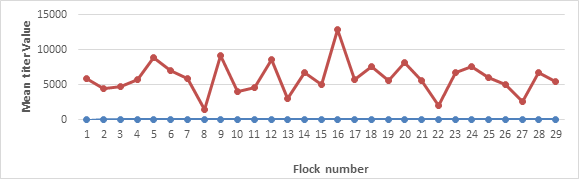
The overall average minimum, maximum and mean antibody titer for this study was 1179.8, 13840.1 and 5945, respectively. Of the 29 flocks addressed for this study, the minimum antibody titer value for 13 (44.8%) flocks was above the cut-off value (993). This means all birds from 13/29 flocks were protective against the disease. The minimum and maximum antibody titer for this study was 37.4 for Sasso breed with the age of 8 months and 20465.8 for mixed type of breed with the age of 12 months, respectively (Table 1). Similarly, the highest antibody titer recorded in flock 16 (12900.1), while the lowest was observed in flock 8 (1365.8) (Figure 1).
| Flock number | Number of samples | Breed | Age (month) | Period since last vaccination | Min. titer | Max. titer | Mean | SD | CV% | Percentage of animals per flock with protective titer |
|---|---|---|---|---|---|---|---|---|---|---|
| 1 | 23 | Bovans | 5 | 2month | 78.9 | 13181.3 | 5924 | 3202.4 | 54.1 | 21/23 (91.3) |
| 2 | 8 | Local | 3 | 2month | 176.7 | 14955.4 | 4426.7 | 5411.6 | 122.3 | 7/8(87.5) |
| 3 | 22 | Bovans | 6 | 2month | 1176.4 | 12331.9 | 4743 | 3169.7 | 66.8 | 21/22(95.5) |
| 4 | 23 | Bovans | 8 | 2month | 214.2 | 13294.1 | 5784.5 | 3327.9 | 57.5 | 22/23(95.7) |
| 5 | 21 | Sasso | 6 | 2month | 319. 5 | 15158.4 | 8865.1 | 4036.2 | 45.5 | 20/21(95.2) |
| 6 | 9 | Local | 7 | 2month | 2772.8 | 18163.8 | 7009.2 | 4639.6 | 66.2 | 9/9(100) |
| 7 | 4 | Local | 8 | 2month | 1409.5 | 10632.4 | 5814.8 | 3803.3 | 65.4 | 4/4(100) |
| 8 | 10 | Local | 8 | 2month | 37.9 | 3605.8 | 1365.8 | 1186.4 | 86.9 | 6/10(60) |
| 9 | 12 | Sasso | 8 | 2month | 1342.2 | 16489.2 | 9206.7 | 3899.5 | 42.4 | 12/12(100) |
| 10 | 8 | Local | 3 | 2month | 1729.3 | 5516 | 3950.9 | 1233.8 | 31.2 | 8/8(100) |
| 11 | 9 | Sasso | 8 | 2month | 63.1 | 11423.4 | 4531.5 | 4023.7 | 88.8 | 7/9(77.8) |
| 12 | 9 | Sasso | 12 | 2month | 2570.8 | 16682.8 | 8579.1 | 4379.6 | 51 | 9/9(100) |
| 13 | 20 | Mixed | 5 | 2month | 105.2 | 8755.8 | 2949.9 | 2806.2 | 95.1 | 15/20(75) |
| 14 | 22 | Local | 7 | 2month | 1990.2 | 18828.3 | 6733.3 | 4499.6 | 66.8 | 22/22(100) |
| 15 | 22 | Sasso | 5 | 2month | 500.5 | 13951.1 | 5041.6 | 4614 | 91.5 | 21/22(95.5) |
| 16 | 12 | Sasso | 5 | 2month | 8868.7 | 17151.2 | 12900.1 | 2733.9 | 21.2 | 12/12(100) |
| 17 | 9 | Sasso | 8 | 2month | 1664.2 | 11238.8 | 5739.9 | 3264.2 | 56.9 | 9/9(100) |
| 18 | 12 | Sasso | 5 | 2month | 2032.1 | 18280.7 | 7623 | 5046 | 66.2 | 12/12(100) |
| 19 | 13 | Sasso | 7 | 2month | 457.8 | 12950.1 | 5512.6 | 3700.6 | 67.1 | 12/13(92.3) |
| 20 | 5 | Bovans | 8 | 2month | 2169 | 11957.5 | 8129.4 | 3943.2 | 48.5 | 5/5(100) |
| 21 | 20 | Mixed | 8 | 2month | 342.3 | 20342.7 | 5531.6 | 5761.2 | 104.2 | 16/20(80) |
| 22 | 12 | Sasso | 3 | 2month | 61.9 | 6841.2 | 1999.3 | 2297.6 | 114.9 | 6/12(50) |
| 23 | 14 | Sasso | 9 | 2month | 169.1 | 21472 | 6701 | 6289.2 | 93.9 | 13/14(92.9) |
| 24 | 11 | Sasso | 10 | 2month | 317.5 | 18758.6 | 7572.9 | 6244.9 | 82.5 | 10/11(90.9) |
| 25 | 10 | Mixed | 12 | 2month | 1241.2 | 20465.8 | 6074.2 | 5552.4 | 91.4 | 10/10(100) |
| 26 | 19 | Mixed | 10 | 2month | 1142.3 | 12969 | 4933.4 | 3415.7 | 69.2 | 19/19(100) |
| 27 | 5 | Mixed | 10 | 2month | 952.6 | 4490.7 | 2552.6 | 1527.1 | 59.8 | 4/5(80) |
| 28 | 19 | Sasso | 8 | 2month | 37.4 | 15825.3 | 6789 | 5303.4 | 78.1 | 16/19(84.2) |
| 29 | 18 | Mixed | 12 | 2month | 270.1 | 15650.8 | 5420.5 | 4229.5 | 78 | 15/18(83.3) |
Table 1: Mean titer value of each flock using ELISA test and percentage of animals with protective titer per flocks vaccinated wi
Association of Risk Factors to the Outcome Variable
The configuration of the outcome variable having various ranges of antibody titer was compared with a presumed risk factors as indicated in table 2. Based on age category, birds with the age of 10-12 months (97.2%) showed better protection followed by birds with age group of 4-6 months (96.2%), 3month groups (89.3%) and 7-9month age category (83.4%) with a statistical significance of (p=0.001) at individual birds.
Regarding production stage of the birds, sero-conversion status of the vaccine was also assessed and showed that broilers (97%) were found more protected which was followed by pullets (90.4%) and layers (89.5%) but with no significant variation (p>0.05).
Based on breed difference, mixed chickens (97.8%) were found to be more protected compared to Sasso (90.9%), Bovans (90.4%) and local breeds (45.9%) with a statistical significance of (p=0.018).
Sero-conversion status of birds challenged with the vaccine having small flock size (<= 20) and (21-100) were found more protective (91.7%) and (91.4%), respectively as compared to chickens with a flock size of (>= 100) which was 73.9% protection level. However, no statistical difference was observed (p=0.085).
The protective level for intensively reared birds (98.2%) were comparatively higher than semi-intensive (91.7%) and extensively managed chickens (91%) but the difference was not statistically significant (p=0.366).
| Variables | Total samples | Anti-body titer ranges (%) | No. of protected individual birds (%) | Chi- square | P-value | |||||||
|---|---|---|---|---|---|---|---|---|---|---|---|---|
| <=993 | 994- 1999 | 2000- 3999 | 4000- 5999 | 6000- 8999 | 9000- 11999 | 12000- 14999 | >=15000 | |||||
| Sample size | 31.6608 | 0.004 | ||||||||||
| <=10samples | 86 | 8(9.3) | 14(16.3) | 16(18.6) | 22(25.6) | 9(10.5) | 13(15.1) | 1(1.2) | 3(3.5) | 72(83.7) | ||
| 11-17samples | 86 | 9(10.5) | 9(10.5) | 8(9.3) | 15(17.4) | 17(19.8) | 10(11.6) | 8(9.3) | 10(11.6) | 71(82.6) | ||
| >=18samples | 229 | 21(9.2) | 31(13.5) | 48(21) | 33(14.4) | 47(20.5) | 24(10.5) | 19(8.3) | 6(2.6) | 208(90.8) | ||
| Flock Size | 21.684 | 0.085 | ||||||||||
| <=20 | 216 | 18(8.3) | 30(13.9) | 39(18.1) | 36(16.7) | 31(14.4) | 35(16.2) | 16(7.4) | 11(5.1) | 198(91.7) | ||
| 21-100 | 162 | 14(8.6) | 22(13.6) | 29(17.9) | 29(17.9) | 38(23.5) | 11(6.8) | 11(6.8) | 8(4.9) | 148(91.4) | ||
| >=100 | 23 | 6(26.1) | 2(8.7) | 4(17.4) | 5(21.5) | 4(17.4) | 1(4.3) | 1(4.3) | 0(0) | 17(73.9) | ||
| Breed type | 36.6477 | 0.018 | ||||||||||
| Bovans | 73 | 7(9.6) | 9(12.3) | 17(23.3) | 14(19.2) | 13(17.8) | 3(4.1) | 7(9.6) | 3(4.1) | 66(90.4) | ||
| Local | 61 | 33(54.1) | 11(18) | 5(8.2) | 10(16.4) | 8(13.1) | 6(9.8) | 3(4.9) | 5(8.2) | 28(45.9) | ||
| Sasso | 175 | 16(9.1) | 24(13.7) | 30(17.1) | 28(16) | 39(22.3) | 24(13.7) | 9(5.1) | 5(2.9) | 159(90.9) | ||
| Mixed | 92 | 2(2.2) | 10(10.9) | 20(21.3) | 18(19.6) | 13(14.1) | 14(15.2) | 9(9.8) | 6(6.5) | 90(97.8) | ||
| Production stage | 23.8297 | 0.301 | ||||||||||
| Broiler | 33 | 1(3) | 3(9.1) | 7(21.2) | 5(15.1) | 5(15.1) | 6(18.2) | 5(15.1) | 1(3) | 32(97) | ||
| Layer | 105 | 11(10.5) | 19(18.1) | 21(20) | 18(17.1) | 17(16.2) | 10(9.5) | 4(3.8) | 5(4.8) | 94(89.5) | ||
| Pullet | 157 | 15(9.6) | 17(10.8) | 30(19.1) | 28(17.8) | 36(22.9) | 12(7.6) | 13(8.3) | 6(3.8) | 142(90.4) | ||
| Mixed | 106 | 11(10.4) | 15(14.1) | 14(13.2) | 19(17.9) | 15(14.1) | 19(17.9) | 6(5.7) | 7(6.6) | 95(89.6) | ||
| Age | 46.4965 | 0.001 | ||||||||||
| <=3month | 28 | 3(10.7) | 3(10.7) | 2(7.1) | 5(17.9) | 4(14.3) | 6(21.4) | 2(7.1) | 3(10.7) | 25(89.3) | ||
| 4-6month | 132 | 5(3.8) | 12(9.1) | 30(22.7) | 24(18.2) | 32(24.2) | 13(9.8) | 12(9.1) | 4(3) | 128(96.2) | ||
| 7-9month | 169 | 28(16.6) | 33(19.5) | 26(15.4) | 24(14.2) | 26(15.4) | 17(10.1) | 9(5.3) | 6(3.6) | 141(83.4) | ||
| 10-12month | 72 | 2(2.8) | 6(8.3) | 14(19.4) | 17(23.6) | 11(15.3) | 11(15.3) | 5(6.9) | 6(8.3) | 70(97.2) | ||
| Management | 15.1735 | 0.366 | ||||||||||
| Extensive | 279 | 25(9) | 36(12.9) | 48(17.2) | 52(18.6) | 46(16.5) | 36(12.9) | 19(6.8) | 17(6.1) | 254(91) | ||
| Semi- intensive | 12 | 1(8.3) | 4(33.3) | 3(25) | 0(0) | 1(8.3) | 2(16.7) | 1(8.3) | 0(0) | 11(91.7) | ||
| Intensive | 110 | 2(1.8) | 14(12.7) | 21(19.1) | 18(16.4) | 26(23.6) | 9(8.2) | 8(7.3) | 2(1.8) | 108(98.2) |
Table 2: Association of variables with antibody titer ranges
Discussion
Much of the samples 279/401 (69.6%) for these studies were collected from the scavenging chickens reared extensively constituting small number of birds per flock. Although the number of samples collected from each flock should be 18-22 to determine the level of sero-conversion due to vaccination, the flock size of chickens in the area were very few and subjected for the variation of sample sizes. Insufficient antibody titers can be caused by underlying immunosuppressive disorders such as Gumboro disease, Marek’s disease, or Chicken Anemia Virus [20]. The reason for insufficient sero-conversion in some flocks remains unclear and requires further investigation.
For the current study the individual bird level protection was 90.5% against the disease which was an acceptable level due to herd immunity status was expected to be above 80%. This result was in agreement with the findings of Kapczynski and King, [21] and Susta et al. [22] who reported ND vaccines offer substantial protection against clinical disease, although it fails to completely prevent infection. In this study, most of the chickens in the vaccinated flock generated the optimum amount of protective antibody titer (5945) compared to the minimum expected threshold value (993). Although, the highest antibody titer production does not mean the birds are contained from the disease where the study result is in agreement with the study done by Capua et al. [23]. Virulent ND virus was isolated from embryonated eggs from clinically normal breeder hens with high antibody titers to ND and clinically sick chickens produced from eggs. The sero- conversion status at flock level for this study was 86.2%, which was lower than the findings of Numan et al. [24] who obtained 98.07% of serum samples were positive for specific immunity against NDV in Pakistan. The difference might be attributed to vaccine strains used, route of administration, breed of chickens, type of production and management practices followed.
The uniformity of antibody titer was significantly varied from 21.2%-122.3% CV values where in most of the flocks (82.8%) of the CV% was beyond 50% which was considered as poor outcome.
This outcome might be emanated from various factors like age variability at the time of vaccination, difference among vaccinators, infection with other diseases, difference in management practice and breed variation.
Significant antibody titer variation was observed among Breeds (p=0.018) and Ages (0.001) of the birds in this study. Mixed type of breeds was more protective (97.8%) while local breed’s sero-conversion status was comparatively low (45.9%). Similarly, chickens with higher age categories were more protective than the rest which was in line with the reports of Okwor and Eze [25] that antibody titers against ND can vary in different breed’s and ages, because of differences of the speed of metabolism as well as the stress induced by the onset of lying. In addition, some chickens might be vulnerable to parasitism, inability in feeding competitively with others, vaccinator faults at the time of ocular droppings of the vaccine (dosage issues).
Based on number of samples collected, statistical significance (p=0.004) among the sample sizes of each flock was observed which might be due to the flock size for scavenging birds/ chickens reared extensively were by far fewer than commercially managed chickens, so that contributes for the collection of variable sample sizes. This also elevates the coverage of vaccination spots and vaccine delivery personnel numbers which might contribute to loosen antibody titer uniformity among the birds. Inadequate vaccination practices might result incidence of ND in vaccinated flocks as described by Dortmans et al. [26] in Algeria. De Wit and Cook [27] and Oberländer et al., [28], reported a vaccination’s success is determined by a variety of factors of which route of vaccination, vaccine storage, the hygiene of the administering vessel, and the number of vaccine doses per bird is all important aspects to be considered. All of these and other factors result in a reduction in vaccine dose per chicken or even the injection of entirely damaged virus, rendering immunization ineffective [29].
In general, the test result clearly showed that the type of vaccine used for the flocks was an excellent inducer of immunity and able to protect birds from the infection. However, factors that caused for the occurrence of a wide coefficient of variation should be well managed because the main cause of vaccination failure arises from the vaccine management itself.
Conclusion and Recommendations
Newcastle disease is a costly poultry disease that affects commercial farmers and poultry production sectors around the world. Although there is vaccination failure, the major strategy for controlling virulent NDV is to use vaccines which provide immunological protection against the disease. The vaccination campaign for the current study revealed ND I-2 vaccine type was effective in protecting the chickens from the disease in respective of the age of birds at vaccination although uniformity of antibody production is variably interrupted among the flocks. Therefore, the following recommendations were forwarded:
- The protective efficacy of the vaccine varies between flocks, so those flocks developing low antibody titers should need to be further assessed for poor sero- conversion and management conditions.
- The temperature, storage condition, way of administration, dose and transportation of the vaccine should be checked particularly in those flocks that induce low antibody titer.
- Finally, the vaccines should be administered by professionals, who have a good knowledge and skill about vaccination and poultry disease.
Acknowledgement
This research was supported by Animal Health Institute and Kyeema foundation and gratefully acknowledged.
References
-
Wilson RT (2010) Poultry production and performance in the Federal Democratic Republic of Ethiopia. World Poultry Sci J 66: 441-54.
-
Duguma R (2009) Understanding the role of indigenous chicken during the long walk to food security in Ethiopia. LRRD 21(8): 116.
-
OIE (2004) Newcastle disease. In: OIE manual for diagnostic tests and vaccines for terrestrial animals 1: 270-283.
-
Kai Y, Hu Z, Xu H, Hu S, Zhu J, et al. (2015) The M, F and HN genes of genotype VIId Newcastle disease virus are associated with the severe pathological changes in the spleen of chickens. Virol J 12:133.
-
Alexander D (1992) Paramyxoviridae, infection and immunity. In Encyclopedia of Immunology 37: 63-99.
-
Alexander DJ (2000) Newcastle disease and other avian paramyxoviruses. Rev Sci Tech 19(2): 443-462.
-
Choi KS, Lee EK, Jeon WJ, Kwon JH (2010) Antigenic and Immunogenic investigation of the virulence motif of the Newcastle virus fusion protein. J Vet Sci 11(3): 205-211.
-
Haque MH, Hossain MT, Islam MT, Zinnah MA, Khan MSR, et al. (2010) Isolation and detection of NCDV from field outbreaks in broiler and layer chickens by reverse transcription-polymerase chain reaction. Bangladesh J Vet Med 8(2): 87-92.
-
Tu TD, Phuc KV, Dinh NTK, Quoc DN, Spradbrow PB (1998) Vietnamese trials with a thermo-stable Newcastle disease vaccine (Strain I2) in experimental and village chickens. Prev Vet Med 34(2-3): 205-214.
-
Nanthakumar T, Kataria RS, Tiwari AK, Buchaiah G, Kataria JM (2000) Pathotyping of Newcastle disease virus by RT-PCR and restriction enzyme analysis. Vet Res Commun 24(4): 275-286.
-
Tiwari AK, Kataria RS, Nanthakumar T, Dash BB, Desai G (2004) Differential detection of NDV strains by degenerate primers-based RT-PCR. Comp Immunol Microbiol Infect Dis 27(3): 163-169.
-
Shim JB, So HH, Won HK, Mo IP (2011) Characterization of avian paramyxovirus 1 from migratory wild birds and chickens. J Avian Pathol 40(6): 565-572.
-
Xiao S, Paldurai A, Nayak B, Mirande A, Cllins PL, et al. (2013) Complete genome sequence of a highly virulent Newcastle disease virus currently circulating in Mexico Genome Announc 1(1): e00177-12.
-
Jansen T, Hofmans MP, Theelen MJ, Schijns VE (2005) Structure-activity relations of water-in-oil vaccine formulations and induced antigen-specific antibody responses. Vaccine 23(8): 1053-1060.
-
Miller P, Koch G (2013) Newcastle disease. In: Swayne D, et al. (Ed’s). Diseases of poultry. 13th (Edn) Wiley- Blackwell, pp: 89-107.
-
Alders RG (2014) Making Newcastle disease vaccines available at village level. Vet Rec 174(20): 502-503.
-
Spradbrow PB, Ibrahim AC, Mustaffa-Bajee A, Kim SJ (1977) Use of an avirulent Australia of Newcastle Disease Virus (NDV) as a vaccine. Avian Dis 22(2): 329-335.
-
Spradbrow PB (1993) Disease in village chickens. Poultry Science Review. 5: 57-96.
-
OIE (2012) Manual of diagnostic tests and vaccines for terrestrial animals. Office international des epizooties, pp: 1092-1106.
-
Swayne David E, Martine Boulianne, Catherine M, Logue Larry R, McDougald, et al. (2020) Diseases of poultry 14(Edn.). Avian Pathology 49(5): 526.
-
Kapczynski DR, King DJ (2005) Protection of chickens against overt clinical disease and determination of viral shedding following vaccination with commercially available Newcastle disease virus vaccines upon challenge with highly virulent virus from the California 2002 exotic Newcastle disease outbreak. Vaccine 23(26): 3424-3433.
-
Susta L, Jones MEB, Cattoli G, Cardenas-Garcia S, Miller PJ, et al. (2015) Pathologic characterization of genotypes XIV and XVII Newcastle disease viruses and efficacy of classical vaccination on specific pathogen-free birds. Vet pathol 52(1): 120-131.
-
Capua MI, Scacchia T, Toscani V, Caporale (1993) Unexpected Isolation of Virulent Newcastle Disease Virus from Commercial Embryonated Fowls’ Eggs. Zentralbl Veterinarmed B 40(10): 609-612.
-
Numan M, Zahoor MA, Khan HA, Siddique M (2005) Serologic status of Newcastle disease in broilers and layers in Faisalabad and surrounding districts. Pakistan Vet J 25(2): 55-58.
-
Okwor EC and Eze DC (2013) Newcastle disease in layers: Preliminary studies on the stress associated with onset of lay and initiation of clinical disease. African Journal of Microbiology Research 7(11): 960-965.
-
Dortmans JC, Peeters BP, Koch G (2012) Newcastle disease virus outbreaks: vaccine mismatch or inadequate application? Vet Microbiol 160(1-2): 17-22.
-
De Wit JJ, Cook JK (2014) Factors influencing the outcome of infectious bronchitis vaccination and challenge experiments. Avian Pathol 43(6): 485-497.
-
Oberländer B, Failing K, Jüngst CM, Neuhaus N, Lierz M, et al. (2020) Evaluation of Newcastle Disease antibody titers in backyard poultry in Germany with a vaccination interval of twelve weeks. Plos one 15(8): e0238068.
-
Gary DB, Richard DM (2022) Vaccine Failure in Poultry: Factors to Consider. University of Florida.
- The Digital Stethoscope: Harnessing AI in Veterinary Medicine Without Losing Our Healing Touch
- Meningoencephalomyelitis of Unknown Etiology: Short-Term Effect of Two Treatment Protocols on Cerebrospinal Fluid
- Safety and Efficacy of the HomeoPet Cough in Domestic Pets –A Clinical and Correction Analysis Based Upon User Response Survey
- Non Human Animals Responses to Social Loss
- Owner Reported Clinical Outcomes of a Homeopathic Proprietary Preparation for the Treatment of Upper Respiratory and Nasal Disorders in Companion Animals
- Effects and Diagnostic Approach of Ultrasound in Veterinary Practice: A Systematic Review