
Hydrogen Peroxide Scavenging by Methanolic Extracts of Coriander: An In Vitro Antioxidant Study
Most of the nutraceutical plants, plants associated products and foods are known for their promising antioxidant properties due to the presence of several metabolites like polyphenolic compounds, flavonoids, terpenoids, vitamin C and many other. These molecules have strong tendency to scavenge the free radicals (reactive oxygen species) generated inside our body system due to the various reasons. Out of several methods for the antioxidant activity determination; hydrogen peroxide scavenging activity is an important method. This method has been used to determine the percentage scavenging activity of coriander seeds methanolic extract and coriander leaves methanolic extract for four different concentrations i.e. 100, 200, 300, and 400 μg/mL. Coriander seeds methanolic extracts showed the good level of percentage hydrogen peroxide scavenging activities in the range of 33.67-60.2% while scavenging activities for methanolic extract of coriander leaves were in the range of 47.95-70.61%. Range of scavenging activity for standard ascorbic acid was 65.12-81.35%. Although, extracts showed lower scavenging activity than standard ascorbic acid but result was promising indicating the good antioxidant activities of these extracts. Study demonstrates that methanolic extract of coriander leaves showed higher antioxidant activity (H2O2 scavenging activity) than coriander seeds and thus, coriander leaves are better antioxidant plant source.
Introduction
Edible plants, plant’s originated materials and foods play significant role in the human life due to their nutritious benefits in enhancing the human health [1, 2, 3, 4]. One of the most advantageous properties of plants or herbs based edible food products are the antioxidant properties and their tendency to scavenge reactive oxygen species like hydroxyl radical (OH)˙, superoxide (O2˙ˉ), hydroperoxide etc. These are very reactive oxygen species and very harmful for the human health and cause the oxidation of lipid and protein [5]. Usually, these free radicals can be scavenged by the antioxidant system of our body and thus, balance between oxidation and anti- oxidation processes is maintained [5]. But, due to the various environmental or other adverse human activities, generation of free radicals in our body may be increased. In these situations, exogenous antioxidants’ uses may ameliorate the damages (caused by oxidative stress) by checking the chains of oxidative reactions, performing as scavenger of free radicals, singlet oxygen and reducing agents’ quenchers [6].
Phytochemicals of plant origin have a significant place among the compounds with promising antioxidant activities [7]. Phenolic components are the responsible factor for these antioxidant activities while it is less linked with vitamins [8, 9, 10] but vitamin C, E, or A are known for their strong antioxidant properties [7, 11]. Broad antioxidant defense system is possessed in the plants in the form of enzymes and metabolites which have tendency to prevent the oxidative damage done by the reactive oxygen species or free radicals [12]. Major metabolites (water soluble antioxidants) with strong antioxidant properties are ascorbate (Vitamin C) and glutathione but polyphenols, flavonoids and terpenoids like secondary metabolites are also strongly involved in the destruction of reactive oxygen species under various stresses [13, 14, 15, 16, 17]. Thus, out of several reactive oxygen species scavengers; coriander (Coriandrum sativum L.) seeds and leaves are also renowned for their strong antioxidant potential. The principle aim of this work was to obtain the coriander (Coriandrum sativum L.) seeds and leaves from Muzaffarpur (Bihar, India), dry them properly, convert into powdered form, extract with methanol using Soxhlet apparatus and use the concentrated extracts (oleoresin i.e. mixture of resin and essential oil) for hydrogen peroxide scavenging activities determination to know the potential of these extracts in the scavenging of hydrogen peroxide and its generated hydroxyl free radicals.
Experimental
Materials
pH 7.4 phosphate buffer (50 mM concentration), H2O2, deionized water, pH meter (digital), electronic balance (K-Roy), NaH2PO4.H2O and Na2HPO4 for buffer preparation, ascorbic acid as standard, coriander seeds (dried) obtained from Muzaffarpur (Bihar) and coriander green leaves also obtained from Muzaffarpur (Bihar) and dried for extraction, methanol, Soxhlet apparatus, heating mantle (temperature controlled) double bean UV-Visible spectrophotometer (Systronics).
Methods
Extraction
Methanolic extraction of coriander seeds and leaves was done by using the Soxhlet apparatus. Extraction was done for three rounds in each case. After extraction, extracts were concentrated keeping it in beaker at 30-35℃ using heating mantle up to approximately 5 mL. Stock solution of concentration 10 mg/mL was prepared from this concentrated methanolic extract was prepared for both extracts separately. In vitro Percentage H2O2 Scavenging Activity Determination Hydrogen peroxide scavenging activity determination is based on the literature study [18, 19, 20, 21, 22]. The 40 mM H2O2 was prepared in phosphate buffer (50 mM) with 7.4 pH. Plant extracts (100, 200, 300 and 400 μg/mL concentrations) were taken in the solution of phosphate buffer of 7.4 pH having H2O2. After 10 minute of the addition of plant sample extract, absorbance was taken at 230 nm in UV-Visible double bean spectrophotometer for each concentration (i.e. 100-400 μg/ mL) and for each extracts in separate studies. Same study was also performed for standard solution of ascorbic acid with same concentrations i.e. 100-400 μg/mL. Percentage H2O2 scavenging activity was calculated using following formula [18, 19, 20, 21, 22] for each concentration i.e. 100-400 μg/mL.
Percentage H2O2 scavenging activity = [(AControl - ASample)/AControl] x 100
A is the absorbance.
Results and Discussion
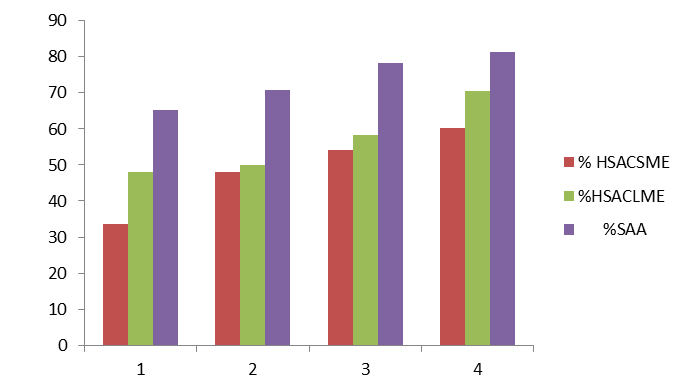
Hydrogen peroxide scavenging activity of coriander seeds and leaves extract also shows the antioxidant potential of these extracts. Ascorbic acid was used as a standard for the comparison of antioxidant potential of these plant extracts. Methanolic extract solution of each type was subjected to in vitro percentage H2O2 scavenging activity determination for four different concentrations of coriander seeds and leaves extracts (100, 200, 300 and 400 μg/mL) in order to get the percentage values for these concentrations. Each concentration shows the concentration of each of the extracts (coriander seeds and leaves extracts separately) in the 50 mM phosphate buffer with 40 mM H2O2 solution. Coriander seeds’ methanolic extract for 100, 200, 300 and 400 μg/mL showed the good level of percentage H2O2 scavenging activity (H2O2 scavenging activity of coriander seed methanolic extract is presented as HSACSME) which was observed as 33.67, 47.99, 54.08, and 60.2%, respectively. On the other hand, percentage H2O2 scavenging activities of the coriander leaves methanolic extract (HSACLME) for the same range of concentrations as 100, 200, 300 and 400 μg/mL were also determined which were observed as 47.95, 50, 58.16, and 70.61%, respectively. These values were compared for the same concentrations of the standard solution of ascorbic acid. H2O2 scavenging activity of ascorbic acid (SAA) for the concentrations 100, 200, 300 and 400 μg/mL were observed as 65.12, 70.62,
78.28, and 81.35%, respectively.
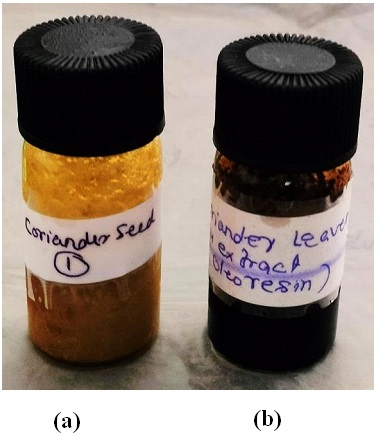
Study suggests that coriander seeds and coriander leaves both show the good level of scavenging activities at 200, 300, and 400 μg/mL concentrations but the maximum scavenging activities was observed at 400 μg/mL for the coriander seeds as well as coriander leaves methanolic extracts. It was also observed that coriander leaves methanolic extract (70.61%,) showed better percentage scavenging activity than coriander seeds methanolic extract (60.2%). Figure 1 shows the concentrated methanolic extracts (oleoresin i.e. resin+ essential oil) of coriander seeds and leaves (oleoresins). Figure 2 shows the hydrogen peroxide scavenging activities of seeds, leaves and standard ascorbic acid.
There are number of methods for the determination of antioxidant activities of any plant materials like DPPH method (2,2-diphenyl-1-picrylhydrazy), ABTS methods (2,2′-azinobis (3-ethylbenzothiazoline-6-sulfonic acid)) and many other [23, 24]. Percentage H2O2 scavenging activity is also a effective type of method for the determination of antioxidant potential of any compounds or plants sources in term of hydrogen peroxide scavenging activity [18, 19, 20, 21, 22, 24, 25]. In our study, coriander leaves showed some greater hydrogen peroxide scavenging activity than coriander seeds.
Study of Wangensteen, et al. [26] also presents that coriander leaves have better antioxidant properties than coriander seeds. H2O2 does not show very high reactivity itself but it may be toxic for the cells due to the generation of hydroxyl radical inside the cells [27]. Due to the generation of hydroxyl radical by hydrogen peroxide, its elimination is very necessary for the antioxidant defense in food system or cells [19]. There are also several works on the different varieties of coriander’s antioxidant activities using different methods [26, 28, 29, 30, 31].
Conclusion
Study suggests that coriander leaves have good level of antioxidant properties than coriander seeds in term of hydrogen peroxide scavenging activity. Methanolic extract of seeds showed the scavenging activities in the range of 33.67-60.2% while scavenging activities for methanolic extract of coriander leaves were in the range of 47.95- 70.61%. Maximum percentage scavenging activities for the tested concentration range of 100-400 μg/mL were obtained for 400 μg/mL i.e. 60.2% for the methanolic extract of coriander seeds while 70.61% for the methanolic extract of coriander leaves. These percentage scavenging activities were lower than the standard molecule used for the study i.e. ascorbic acid for which maximum activity was 81.35%. Although, the tested plant extracts have lower percentage scavenging activities than standard molecule but they are in the promising range of a good antioxidant material.
Acknowledgment
Dr. Pankaj Kumar Chaurasia, Mithu Yadav, Sunita Kumari, Nagraj, and Nagendra Sharma are thankful to the L.S. College, Muzaffarpur for providing chemicals and other facilities for the work. Dr. P.K. Chaurasia is also thankful to the other authors Dr. S.L. Bharati, and Dr. S. Singh for their effective involvements in writing, editing and revising the paper.
Conflict of Interest
Not applicable
References
-
Chaurasia PK, Bharati SL, Singh S (2024) The Chemistry Inside Spices and Herbs: Research and Developments, Bentham Science Publisher, UAE, 3, ISBN : 978-981- 5196-83-2
-
Chaurasia PK, Bharati SL, Singh S (2024) Garlic against Heart-related Ailments: Chemistry, Pharmacology, and Future Perspective. Mini-Rev in Med. Chem 24(5):521- 530.
-
Chaurasia PK, Bharati SL (2025) Coriander: A holistic outlook on its chemistry and pharmacology. Food Chemistry, 469:142444.
-
Singh S, Chaurasia PK, Bharati SL (2023) Pharmacological aspects of Essential Oils: Current and Future Trends, CRC Press/Taylor & Francis.
-
Xu DP, Li Y, Meng X, Zhou T, Zhou Y, et al. (2017) Natural Antioxidants in Foods and Medicinal Plants: Extraction, Assessment and Resources. Int J Mol Sci 18(1): 96.
-
Baiano A, Nobile MAD (2015) Antioxidant compounds from vegetable matrices: Biosynthesis, occurrence, and extraction systems. Crit Rev Food Sci Nutr 56: 2053- 2068.
-
Bryshten I, Paprotny Ł, Olszowy-Tomczyk M, Wianowska D (2024) Antioxidant Properties of Green Plants with Different Vitamin K Contents. Molecules 29: 3655.
-
Kaźmierczak-Barańska J, Karwowski BT (2022) Vitamin K contribution to DNA damage-Advantage or disadvantage? A human health response. Nutrients 14: 4219.
-
Axita PV, Parth RM, Prachi KP, Payal KG, Zalak RR, et al. (2022) Analysis of antioxidants and its properties of vitamins as a key source for human health. Act Sci Nutr Health 6: 104-114.
-
Wianowska D, Bryshten I (2024) New insights into vitamin K-From its natural sources through biological properties and chemical methods of quantitative determination. Crit Rev Anal Chem 54(6): 1502-1524.
-
Asensi-Fabado MA, Munne’-Bosch S (2010) Vitamins in plants: Occurrence, biosynthesis and antioxidant function. Trends Plant Sci 15: 582-592.
-
Maury GL, Rodríguez DM, Hendrix S (2020) Antioxidants in Plants: A Valorization Potential Emphasizing the Need for the Conservation of Plant Biodiversity in Cuba. Antioxidants 9: 1048.
-
Nadarajah KK (2020) ROS homeostasis in abiotic stress tolerance in plants. Int J Mol Sci 21: 5208.
-
Du B, Kreuzwieser J, Winkler JB, Ghirardo A, Schnitzler JP, et al. (2018) Physiological responses of date palm (Phoenix dactylifera) seedlings to acute ozone exposure at high temperature. Environ Pollut 242: 905-913.
-
Berni R, Luyckx M, Xu X, Legay S, Sergeant K, et al. (2019) Reactive oxygen species and heavy metal stress in plants: Impact on the cell wall and secondary metabolism. Environ Exp Bot 161: 98-106.
-
Sharma A, Shahzad B, Rehman A, Bhardwaj R, Landi M, et al. (2019) Response of phenylpropanoid pathway and the role of polyphenols in plants under abiotic stress. Molecules 24: 2452.
-
Hashim AM, Alharbi BM, Abdulmajeed AM, Elkelish A, Hozzein WN, et al. (2020) Oxidative stress responses of some endemic plants to high altitudes by intensifying antioxidants and secondary metabolites content. Plants 9: 869.
-
Ruch RJ, Cheng SJ, Klaunig JE (1989) Prevention of cytotoxicity and inhibition of intercellular communication by antioxidant catechins isolated from Chinese green tea. Carcinogen 10: 1003-1008.
-
Keser S, Celik S, Turkoglu S, Yilmaz Ö, Turkoglu I (2012) Hydrogen Peroxide Radical Scavenging and Total Antioxidant Activity of Hawthorn. Chemistry Journal 02(1): 9-12.
-
Bhatti MZ, Ali A, Ahmad A, Saeed A, Malik SA (2015) Antioxidant and phytochemical analysis of Ranunculus arvensis L. extracts. BMC Res Notes 8: 279.
-
Agrawal MY, Agrawal YP, Arora SK, Lahange P, Kshirsagar N (2021) Phytochemical Screening and Evaluation of Antioxidant Activity of hydroalcoholic extract of Justicia procumbans leaf. J Ayu Herb Med 7(1): 41-45.
-
Al-Amiery AA, Al-Majedy YK, Kadhum AAH, Mohamad AB (2015) Hydrogen Peroxide Scavenging Activity of Novel Coumarins Synthesized using different approaches. PLos One 10(7): e0132175.
-
Moon JK, Shibamoto T (2009) Antioxidant assays for plant and food components. J Agric Food Chem 57(5): 1655-1666.
-
Ghenima AI, Idir M, Nadjet MG, Samia MA, Mihoub ZM, et al. (2015) In vitro evaluation of biological activities of Pistacia lentiscus aqueous extract. Int J Pharm Pharm Sci 7(11): 133-139.
-
Sroka Z, Cisowski W (2003) Hydrogen peroxide scavenging, antioxidant and anti-radical activity of some phenolic acids. Food Chem Toxicol 41(6): 753-758.
-
Wangensteen H, Samuelsen AB, Malterud KE (2004) Antioxidant activity in extracts from coriander. Food Chem 88(2): 293-297.
-
Halliwell B (1991) Reactive oxygen species in living systems: Source, biochemistry, and role in human disease. Am J Med 91: 14-22.
-
Msaada K, Jemia MB, Salem N, Bachrouch O, Sriti J, et al. (2017) Antioxidant activity of methanolic extracts from three coriander (Coriandrum sativum L.) fruit varieties. Arabian J Chem 10(2): S3176-S3183.
-
Lin HH, Lin KH, Yang MJ, Nguyen HC, Wang HJ, et al. (2022) Physiological responses and antioxidant properties of coriander plants (Coriandrum sativum L.) under different light intensities of red and blue lights. Sci Rep 12: 21139.
-
Kačániová M, Galovičová L, Ivanišová E, Vukovic NL, Štefániková J, et al. (2020) Antioxidant, Antimicrobial and Antibiofilm Activity of Coriander (Coriandrum sativum L.) Essential Oil for Its Application in Foods. Foods 9(3): 282.
-
Pratama IH, Girsang E, Suyono T (2022) Coriander Seed Extract (Coriandum Sativum L) as an antioxidant. Int J Health Pharmaceut (IJHP) 2(1): 65-69.
- Aromatherapy in Palliative Care: A Fragrant Quest for Relief
- Empowering Women, Securing Futures: Contraception’s Role in Socioeconomic Progress in India
- Effect of Crospovidone, Croscaramellose Sodium in Combination on the Drug Release of Anti diabetic Medication in Tablet Form
- Knowledge, Attitudes, Anxiety, and Preventive Behaviors Regarding Covid-19 Affliction among Healthcare Workers in Pakistan
- “Competitive Landscape and Brand Equivalents: Implications for ANDA (Abbreviated New Drug Application) Approval”
- Novel Advancements in Mouth Dissolving Film Technology