
Biodiesel Production from Waste Cooking Oil Using Different Heterogeneous Catalysts Support on Alumina
This paper explores the using of waste cooking oil (WCO) as an attractive option to reduce the raw material cost for the biodiesel production. This can be achieved by using two different heterogeneous catalysts Ceria-Magnesium support on Alumina and Ceria-Cobalt support on Alumina. Full characterization have been carried out of the produced catalyst using XRD, SEM and Surface area. The optimum conditions for ceria cobalt are 0.3% catalyst (weight % of oil), and methanol/oil molar ratio 6:1, with temperature 60°C for 1.5 hrs with yield 97% while the same conditions applied for ceria magnesium as methanol/oil molar ratio 6:1, with temperature 60°C for 2 hrs using 0.5% catalyst (weight % of oil), the yield is 90%.
Introduction
Human energy needs to spend all the requirements of life such as houses must be heated, energy is required for industry and agriculture. All processes that provide us with the luxuries of every day live we can no longer live without require energy generation. Fossil fuels are the main stream of energy from ancient time. But unfortunately, these fossil fuel reservoirs are dwindling very fast due to rapid growth in the global population and industrialization [1]. Biodiesel, a clean renewable and an alternative fuel derived from vegetable oils, animal fats and used frying oils. It consists of long-chain fatty acid methyl esters (FAME), which is chemically produced through the transesterification reaction of a triglyceride with an alcohol (methanol is common) in the presence of an alkaline or acidic catalyst. It has recently been considered as the best candidate for a diesel fuel substitution because it`s advantages such as biodegradability, nontoxicity, and sulfurandaromatic-free in comparison with petroleum-based fuels. A good catalytic activity for biodiesel production shows in traditional homogeneous catalysts (base or acid). However, the separation of these catalysts from biodiesel requires washing with water which in turn results in loss of fatty acid alkyl esters (FAAE), energy consumption, and generates large amounts of waste water [2, 3]. For this problem, heterogeneous catalysts are recommended in the biodiesel production process; where they can be reused repeatedly without any major loss in their catalytic activity, making the process more economical [4, 5].
The most commonly used heterogeneous catalysts are carbonates, alkali and alkaline earth oxides and zeolites, since high reaction yields (>94%) are achieved and these are comparable to those reached with homogeneous catalysts [6, 7, 8, 9]. Also, K2O/NaX and Na2O/NaX have demonstrated an excellent catalytic activity and high yields (98%) in the production of biodiesel from vegetable oils under moderated reaction temperatures and methanol-oil ratios [10, 11]. Among these catalysts CaO, ZnO, Al2O3, MgO, TiO2, zeolites [23], and inorganic heterogeneous catalysts have been used [12, 13, 14, 15, 16, 17, 18, 19, 20, 21, 22, 23, 24]. Unfortunately, there are three phases in heterogeneous catalyzed transesterification process caused a lower reaction rate due to diffusion limitation so it leads to achieve a very low catalytic efficiency and needs to be improved [25]. Transesterification involves the displacement of alcohol from an ester where the preferred alcohol is methanol due to cheaper cost and polar nature. Transesterification tends be to more complex as it contains two immiscible phases such as oil and methanol. The metal oxide heterogeneous catalyst consists of positive metal ions which act as electron acceptors and negative oxygen ions which act as proton acceptors. Recently, much interest has been taken in the application of structure promoters or catalyst supports which can provide more specific surface area and pores for active species, in which the O–H groups potentially break into hydrogencations and methoxide anions, and then methoxide anions strongly react with large triglyceride molecules [26]. The present work was focused on synthesis of novel heterogeneous catalyst for transesterification process using Ceria-Magnesium support on Alumina (Ce- Mg/Al2O3) with percentage 2.5 and Ceria-Cobalt over Alumina (Ce-Co/Al2O3) with percentage 3.3 for efficient production of biodiesel from waste cooking oil. The produced catalyst was characterized using Scanning Electron Microscopy (SEM), X-Ray Diffraction (XRD), Fourier Transform Infra-Red spectroscopy (FTIR) and Brunauer-Emmett-Teller (BET-surface area). Various process parameters were also studied and optimized. The purity of produced biodiesel was characterized using gas chromatography.
Methods
Materials
Chemicals used for the synthesis of catalyst and production of biodiesel were purchased from Cerium Sulphate (Ce(SO4)2.4H2O)-Merck), Magnesium Nitrate(Mg(NO3)2.H2O-J.T.Bauer), Alumina(Norton chemicals), Cobalt nitrate (Co(NO2)2.6H2O) and iso- propanol (VWR chemicals) of analytical grade and used without further purification. The waste cooking oil used for biodiesel production was obtained from commercial cooking unit in Alexandria-Egypt. The collected oil was subjected to pre-treatment to remove suspended solid materials.
Catalysts Preparation
Ceria-Magnesium Support on Alumina: The (Ce- Mg/Al2O3) with percentage 2.5 was synthesized by Sol-Gel method. Solution I was prepared by dissolving 2.85 gm of ceria sulphate with 15.15gm of magnesium nitrate in 100 ml of iso-propranol with high mixing rate for 15 minutes. Then add 14 gm of alumina under continuous stirring for 2 hrs. Put the sample in the oven over night at 110 0C then calcination has been held at 400 0C for 1hr. Ceria-Cobalt Support on Alumina: The Ceria-Cobalt over Alumina (Ce-Co/Al2O3) with percentage 3.3 was synthesized by Sol-Gel method. Solution I was prepared by dissolving 2.85 gm of ceria sulphate with 15.15gm of Cobalt nitrate in 100 ml of iso-propranol with high mixing rate for 15 minutes. Then add 14 gm of alumina under continuous stirring for 2 hrs. Put the sample in the oven over night at 110°C then calcination has been held at 400°C for 2hrs. Catalysts Characterization: Surface structure and the morphology of the catalysts were analyzed using different magnifications of scanning electron microscopy (SEM, JEOL JSM 6360LA). The Brunauer–Emmett–Teller (Autosorb-1 Model No. ASIMP.VP4, USA), BET surface of the catalysts was determined by N2 adsorption– desorption at – 196°C or 77 K to identify the surface area and pore volume of the catalysts. Also X-Rays Diffraction (XRD) is carried out for catalysts to estimate Structure properties to determine the crystalline phase in a material. Feed Stock Preparation: Before using the waste cooking oil in transesterification process, acid esterification should be taken place to decrease the acid value of oil that make the separation easier due to less glycerol formation. Sulphuric acid 2% by wt. of oil was used. Transesterfication process takes place in a one liter 3- neck round bottom flask, 100 ml of waste cooking oil was heated and stirred in a water bath equipped with magnetic stirrer (Wisdstir, temperature range up to 400°C and stirring range up to 1700 rpm) to the required temperature at 1000 rpm. Catalyst in the ratio (0.3-1 % by weight of oil) was added to alcohol (4:1-10:1 molar ratio to oil) then mixture was added to the heated oil. The product was left in a separating funnel for 12 hours and then the ester layer was collected after complete separation by washing with hot water for 5-6 times and using anhydrous Na2SO4 for drying. The yield was determined by measuring the volume of ester layer (biodiesel) and the conversion was determined using gas chromatography and quadruple Mass Spectrometers [GC-MS].
Results and Discussions
Catalysts Characterization
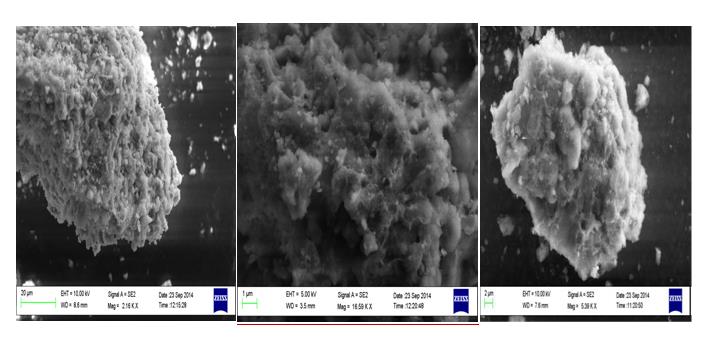
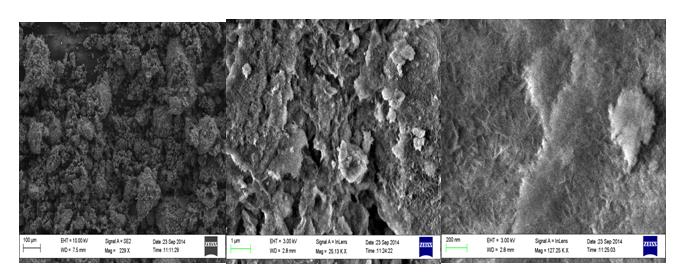
SEM Analysis: In order to know the structure sight of the two catalysts prepared, Scanning Electron Microscopy (SEM) was employed to visualize sample morphology. In the present work, the samples prepared were analyzed by using SEM "JEOL JSM 6360L. The surface morphology of the (Ce-Mg/Al2O3) with percentage 2.5 and (Ce-Co/Al2O3) with percentage 3.3 are presented in Figures 1 & 2 Respectively.
BET Analysis: The Brunauer–Emmett–Teller (BET) device is used in surface area measurements, pore size and volume of powder catalysts as shown in the following Table 1.
| Type | Surface area | Volume | Pore Size | ||||||||
|---|---|---|---|---|---|---|---|---|---|---|---|
| Ce-Mg/Al2O3, 2.5% | 217.8 m²/g | 0.603 cm³/g | 110.63ºA | ||||||||
| Ce-Co/Al2O3, 3.3% | 236.9 m²/g | 0.702 cm³/g | 118.43ºA |
Table 1: The Brunauer–Emmett–Teller (BET) device is used in surface area measurements, pore size and volume of powder catalysts.
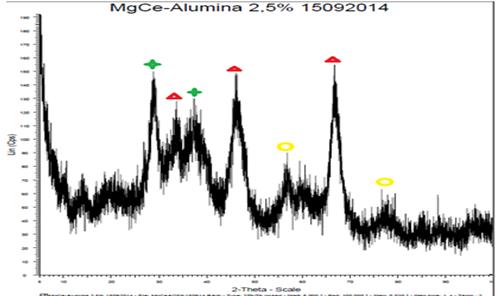
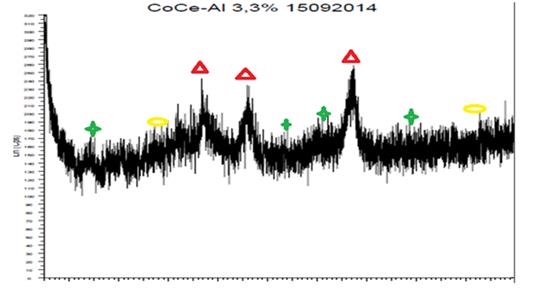
Table 1: The Brunauer–Emmett–Teller (BET) device is used in surface area measurements, pore size and volume of powder catalysts. As shown in the comparing table the surface area of ceria cobalt is bigger than ceria magnesium, and as the surface area increase the conversion yield increase. So theoretically ceria cobalt is supposed to be the best one. X-Ray Diffract Meter (XRD): X-ray powder diffraction (XRD) is a rapid analytical technique primarily used for phase identification of a crystalline material and can provide information on unit cell dimensions. The analyzed material is finely ground, homogenized, and average bulk composition is determined as shown in Figure 3 & 4. The XRD of Ce-Mg/Al2O3, 2.5% shows in Figure 3 that the major peaks for Alumina which appeared at 2θ value ranging ,the diffraction peak at 2θ with 33°,45° and 67°, because alumina is the largest element which have oxides. While the other peaks are approximately equals for Ceria & Magnesium oxide. Figure 4 shows the XRD of Ce- Co/Al2O3, 3.3% that the major peaks for Alumina because alumina is the largest element which has oxides. While the other peaks Ceria is more than cobalt oxide that is because the source of the x-ray is copper and in the periodic table Cobalt and copper are very near to each other.
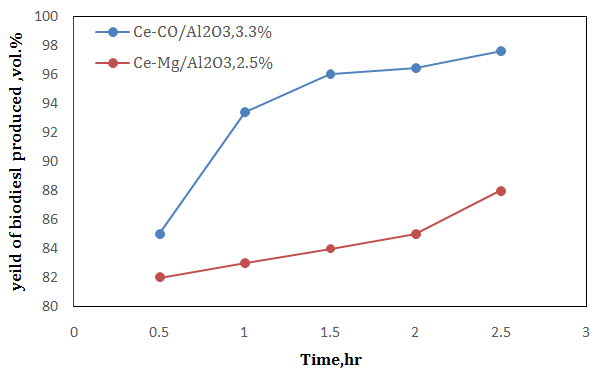
The effect of reaction time on the process of transesterification is shown in Figure 5. The conversion increases with the time of reaction being a key parameter for obtaining a good industrial production. The
Effect of Molar Ratio of Alcohol to Oil
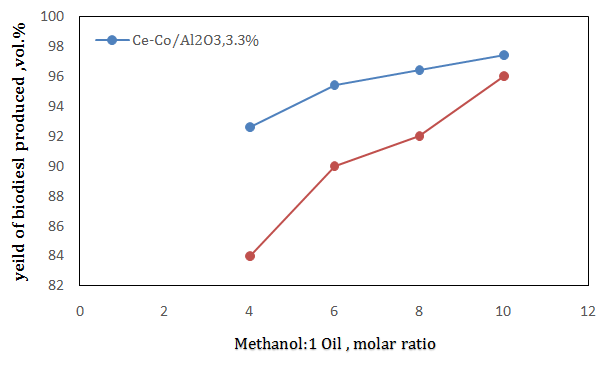
One of the most important variables affecting the yield of methyl esters is the molar ratio of alcohol to oil. Transesterification requires 3 mol of alcohol for each mole of triglyceride to produce 1 mol of glycerol and 3 moles of methyl esters. Industrial processes use 6 mol of methanol for each mole of triglyceride in order to have a maximum conversion. The alcohol/triglyceride molar ratio has to be essentially large. The excess of alcohol is used in order to shift the reaction equilibrium, to avoid the reverse reactions and to accelerate the process. The effect of molar ratio of methanol/oil on the process of transesterification is shown in Figure 6. As the molar ratio of methanol/oil increases from 4:1 to 10:1 the yield of biodiesel increases from 92.6% to 97.4% using 0.3% catalyst amount for 1.5hrs at 60°C using Ce-Co/Al2O3, 3.3% while from 84% to 96% using 0.5% catalyst amount for 2 hrs at 60°C using Ce-Mg/Al2O3, 2.5%.
Effect of Catalyst Amount
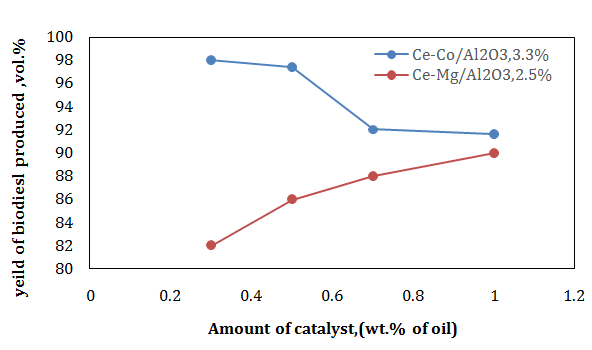
An insufficient amount of catalyst results in an incomplete conversion of the triglycerides into the fatty acid esters. Figures 7 show the effect of catalyst amount by wt. % of oil on the yield of biodiesel produced. In the process, the catalyst should be added into the alcohol first and then in the oils in order to prevent the hydrolysis reaction due to the small amount of water formed during the mixing between the alcohol and the catalyst. In this way the effect of the alcohol-catalyst mixing are not influences the product yield. As shown in Figure 7, the catalyst amount increases from 0.3 to 1 (wt. % of oil), the yeild of biodiesel produced increses from 82% to 90% using 6:1 methanol/oil molar ratio for 2hrs.at 60° C using Ce-Mg/Al2O3, 2.5% but by using Ce-Co/Al2O3, 3.3 %, the yeild of biodiesel produced decrease from 98% to 91.6% using 6:1 methanol/oil molar ratio for 1.5 hrs. at 60° C.
Effect of Temperature
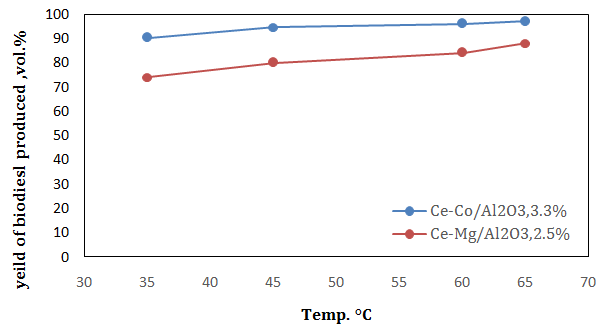
The effect of temperature on the % yield of biodiesel with varied range of temperature as (35, 45, 60 & 65 °C) is shown in Figure 8. Transesterfication reaction can take place at different temperatures depending on the properties of reactants. In Figure 8, the behaviour of the two catalysts has the same trend, as temperture increases from 35°C to65°C, the yeild of biodiesel increases from 74% to 88% using 6:1 methanol/oil molar ratio, 0.5 % catalyst (%by wt.) for 2hrs using Ce-Mg/Al2O3, 2.5% but by using Ce-Co/Al2O3,3.3%, the yeild of biodiesel produced increase from 90.2% to 97% using 6:1 methanol/oil molar ratio , 0.3 % catalyst (%by wt.) for 1.5 hrs.
Conclusions
The production of fuel quality biodiesel from low-cost high FFA waste cooking oil was investigated. A two-step transesterification process was used to convert the high free fatty acid oil to its ester. Trans-esterification of waste cooking oil using heterogeneous catalyst was investigated for optimum reaction conditions. The preliminary experimental study per- formed in this work has demonstrated that: Ceria cobalt has higher surface area and pore volume than ceria magnesium. Ceria cobalt used less amount of catalyst than ceria magnesium to obtain more yield of conversion. Ceria cobalt is faster than ceria magnesium to achieve more yield of biodiesel. The optimum conditions for ceria cobalt are 0.3% catalyst (weight % of oil), and methanol/oil molar ratio 6:1, with temperature 60°C for 1.5 hrs. The optimum conditions for ceria magnesium are 0.5% catalyst (weight % of oil), and methanol/oil molar ratio 10:1, with temperature 60°C for 2 hrs.
Acknowledgement
I wish to thank everyone who helped me to complete this dissertation. Without their continued efforts and support, I would have not been able to bring my work to a successful completion. Eng. Nesma Ahmed, Eng. Adham Hassan and Eng. Kareem Theraa.
References
-
Takase M, Zhang M, Feng W, Chen Y, Zhao T, et al. (2014) Application of zirconia modified with KOH as heterogeneous solid base catalyst to new non-edible oil for biodiesel. Energy Convers Manag 80: 117-125.
-
Lam MK, Lee KT, Mohamed AR (2010) Homogeneous, heterogeneous and enzymatic catalysis for transesterification of high free fatty acid oil (waste cooking oil) to biodiesel: a review. Biotechnol Adv 28(4): 500-518.
-
Raita M, Laothanachareon T, Champreda V, Laosiripojana N (2011) Biocatalytic esterification of palm oil fatty acids for biodiesel production using glycine-based cross-linked protein coated microcrystalline lipase. J Mol Catal B Enzym 73(1-4): 74-79.
-
Tang S, Zhao H, Song Z, Olubajo O (2013) Glymes as benign co-solvents for CaO catalyzed transesterification of soybean oil to biodiesel. Bioresour Technol 139: 107-112.
-
Suryaputra W, Winata I, Indraswati N, Suryadi Ismadji S (2013) Waste capiz (_Amusium cristatum_) shell as a new heterogeneous catalyst for biodiesel production. Renew Energy 50: 795-799.
-
Romero MD, Ovejero G, Rodríguez A, Gómez JM (2005) Enhancement of the basic properties in FAU zeolites by impregnation with cesium hydroxide. Microporous Mesoporous Materials 81(1-3): 313- 320.
-
Refaat AA (2011) Biodiesel production using solid metal oxide, catalysts. International Journal of Environmental Science and Technology 8(1): 203- 221.
-
Semwal S, Arora AK, Badoni RP, Tuli DK (2011) Biodiesel production using heterogeneous catalysts. Bioresour Technol 102(3): 2151-2161.
-
Xie W, Fan M (2014) Biodiesel production by transesterification using tetraalkylammonium hydroxides immobilized onto SBA-15 as a solid catalyst. Chem Eng J 239: 60-67.
-
Pe˜na R, Romero R, Martínez SL, Natividad R, Ramírez A (2013) Characterization of KNO 3/NaX catalyst for sunflower oil transesterification. Fuel 110: 63-69.
-
Muciño GG, Romero R, Ramírez A, Martínez SL (2014) Biodiesel production from used cooking oil and sea sand as heterogeneous catalyst. Fuel 138: 143-148.
-
Tan YH, Abdullah MO, Nolasco-Hipolito C (2015) The potential of waste cooking oil-based biodiesel using heterogeneous catalyst derived from various calcined eggshells coupled with an emulsification technique: a review on the emission reduction and engine performance. Renew Sustain Energy Rev 47: 589-603.
-
Farooq M, Ramli A, Naeem A (2015) Biodiesel production from low FFA waste cooking oil using heterogeneous catalyst derived from chicken bones. Renew Energy 76: 362-368.
-
Ho WWS, Ng HK, Gan S, Tan SH (2014) Evaluation of palm oil mill fly ash supported calcium oxide as a heterogeneous base catalyst in biodiesel synthesis from crude palm oil. Energy Convers Manage 88: 1167-1178.
-
Mahesh SE, Ramanathan A, Begum KMMS, Narayanan A (2015) Biodiesel production from waste cooking oil using KBr impregnated CaO as catalyst. Energy Convers Manage 91: 442-450.
-
Chen G, Shan R, Li S, Shi JA (2015) biomimetic silicification approach to synthesize CaO–SiO2 catalyst for the transesterification of palm oil into biodiesel. Fuel 153: 48-55.
-
Lu Y, Zhang Z, Xu Y, Liu Q, Qian G (2015) CaFeAl mixed oxide derived heterogeneous catalysts for transesterification of soybean oil to biodiesel. Bioresour Technol 190: 438-441.
-
Gurunathan B, Ravi A (2015) Biodiesel production from waste cooking oil using copper doped zinc oxide nanocomposite as heterogeneous catalyst. Bioresour Technol 188: 124-127.
-
Gao L, Wang S, Xu W, Xiao G (2015) Biodiesel production from palm oil over monolithic KF/c Al2O3/honeycomb ceramic catalyst. Appl Energy 146: 196-201.
-
Mahdavi V, Monajemi A (2014) Optimization of operational conditions for biodiesel production from cottonseed oil on CaO–MgO/Al2O3 solid base catalysts. J Taiwan Inst Chem Eng 45(5): 2286-2292.
-
Mutreja V, Singh S, Ali A (2011) Biodiesel from mutton fat using KOH impregnated MgO as heterogeneous catalysts. Renew Energy 36(8): 2253– 2258.
-
Feyzi M, Shahbazi E (2015) Catalytic performance and characterization of Cs–Ca/SiO2–TiO2 nanocatalysts for biodiesel production. J Mol Catal A: Chem 404–405: 131-138.
-
Sun K, Lu J, Ma L, Han Y, Fu Z, et al. (2015) A comparative study on the catalytic performance of different types of zeolites for biodiesel production. Fuel 158: 848-854.
-
Endalew AK, Kiros Y, Zanzi R (2011) Inorganic heterogeneous catalysts for biodiesel production from vegetable oils. Biomass and Bioenergy 35(9): 3787-3809.
-
Xie WL, Peng H, Chen LG (2006) Transesterification of soybean oil catalyzed by potassium loaded on alumina as a solid-base catalyst. Appl Catal A Gen 300(1): 67-74.
-
Zabeti M, Daud WMAW, Aroua MK (2009) Optimization of the activity of CaO/Al2O3 catalyst for biodiesel production using response surface methodology. Appl Catal A Gen 366(1): 154-159.
- Nigeria’s Vulnerability in the Face of Global Energy Policy
- A Simulation Study of Investigation of Optimum Oil Production Performance by Applying Various Gas Injection Methods in Oil Reservoir
- Characterization of Permo-Triassic Reservoirs through Thermal Maturity Assessment of Westphalian Source Rocks in the Cheshire Basin
- Influence of Microwax on the Rheological and Thermal Behaviour of a Wax Crude Oil
- Real-Time Monitoring and Performance Optimization of Steam Injection in Heavy Oil Reservoirs Using Fiber Optic Sensing and Integrated Predictive Simulation Models
- Rapid On-Site Determination of the Total Petroleum Hydrocarbon Content of Soils by Handheld Fourier Transform Near-Infrared Spectroscopy: Development of a Global, Site- and Scanner- Independent Calibration Model